hood open CHEVROLET CAMARO 1967 1.G Chassis User Guide
[x] Cancel search | Manufacturer: CHEVROLET, Model Year: 1967, Model line: CAMARO, Model: CHEVROLET CAMARO 1967 1.GPages: 659, PDF Size: 114.24 MB
Page 114 of 659

CORVETTE BODY
1B-7
HEAT
CONTROL
€P-
CABLE
VIEW A
HOOD RELEASE
Fig.
11—Cowl Ventilator
and
Controls
and reveal moldings; upper garnish molding; lower
garnish molding; side garnish molding; header latch
plates on 19467 Models and rear view mirror.
11.
Clean
up
excess sealer
and
cement with rag damp-
ened with oleum spirits, prep-sol
or
kerosene;
in-
stall wiper arm assemblies.
DOORS
ADJUSTMENTS
Door Lock Striker
Door lock strikers incorporate
an
inter-lock feature
consisting
of a
notch
in the
striker into which the lock
bolt housing extension engages. With
the
inter-lock
feature
it is
very important that
the
lock extension en-
gages properly
in the
striker notch
and
that, where
necessary,
the
correct striker emergency spacers
are
used to obtain proper engagement.
1.
To
adjust striker
up,
down,
in, or
out loosen striker
plate screws and shift striker and adjusting plates
as
required, then tighten screws.
2.
To determine
if
door lock striker emergency spacers
are required, apply modeling clay
or
body caulking
compound
in the
door lock striker notch where
the
lock extension engages,
and
then close
the
door
to
form
a
measurable impression in the clay
or
caulk-
ing compound,
as
shown
in
Figure
24.
Remove
all
clay
or
compound when adjustment
is
completed.
When dimension
"A"
from inside face
of
striker teeth
to center
of
lock extension
is
less than 3/16", install
emergency spacers
and
proper length striker attaching
screws.
NOTE:
Dimension
"B"
from center
of
lock
extension
to
inside face
of
striker notch should
.
never be less than 1/8".
If check indicates need
for
emergency spacers,
pro-
ceed
as
follows:
1.
With pencil, scribe position
of
striker on body pillar.
2.
Remove three door lock striker attaching screws and
remove striker
and
adjusting plates from pillar.
3.
To
install, place striker, shims and adjusting plates
within scribe marks
on
pillar
and
tighten screws.
IMPORTANT: Whenever
a
door
has
been
re-
moved
and
installed,
or
realigned,
the
door
SHOULD NOT be closed completely until
a
visual
check
is
made to determine
if
the lock extension/
will engage
in the
striker notch. Where
re-
quired, door lock striker emergency spacers
should
be
installed
so
that door
can be
closed
and
an
accurate check made to determine emer-
gency spacer requirements.
Door Window and Vent Adjustment
To move
the top of the
window
in or
out, the bottom
ends
of
both
run
channels
are
adjustable.
The
rear
channel
is
adjusted
by
loosening
the
lower
of
the two
screws
on the
rear face
of
door, "C" Figure 25, and
moving channel
as
necessary.
The
front channel
is ad-
justed
by
removing
the
trim pad and moving the Channel
in
or out by a
stud
and nut
adjustment, "B" Figure 25.
The
top end of the
rear channel
is
not adjustable in
or
out.
On 19467 models
an
adjustment
may be
made
to the
closed-door relationship
of the
vent assembly
to the
windshield frame. This adjustment
is
controlled
by the
stud-nut assembly "B" Figure
25.
The closed position
of the
window
is
controlled
by
bumper assemblies located
at
each end
of
window frame
as shown
in
Figure
26.
^
Access
to
bumper retaining
screw
may be
gained through holes
"D" and
"E"
in
Figure
25.
Door Hinges
The position
of the
door assembly in the body opening
is adjusted
by the
striker plate position covered
pre-
viously
and the
position
of the
door
on
the hinge rear
CHEVROLET
a
SERVICE
Page 160 of 659
CORVETTE BODY 1B-53
13.
Drill 1/2" hole at pilot hole locations.
14..
Insert ferrules furnished for holes drilled in top
compartment lid. Crimp ferrule tabs.
15.
With aid of an assistant, place the hardtop onto the
vehicle and install attaching parts at all four loca-
tions.
Lock latches at windshield header.
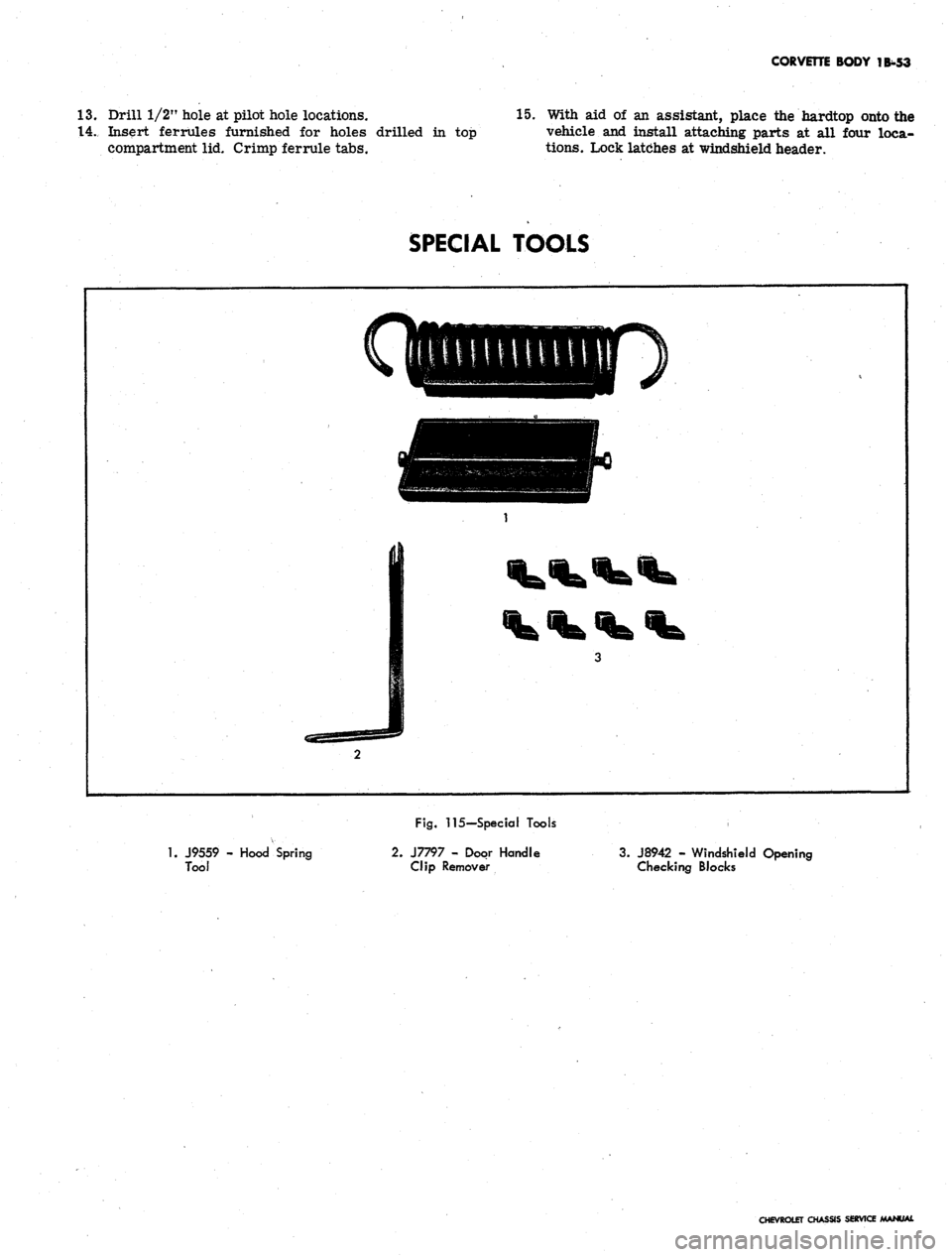
SPECIAL TOOLS
1.
J9559 - Hood Spring
Tool
Fig.
115-Special Tools
2.
J7797 - Door Handle
Clip Remover
3. J8942 - Windshield Opening
Checking Blocks
CHEVROLET CHASSIS SERVICE MANUAL
Page 290 of 659
ENGINE 6-25
refer to Section 6 of the Chassis Overhaul Manual.
Because of the interchangeability and similarity of
many engines, engine sub-assemblies and engine parts,
regardless of which passenger vehicle they are used in,
typical illustrations and procedures are used except
where specific illustrations or procedures are necessary
to clarify the operation. Although illustrations showing
bench operations are used, most single operations, when
not part of a general overhaul, should be performed (if
practical) with the engine in the vehicle.
COMPONENT REPLACEMENT AND ADJUSTMENT
ENGINE ASSEMBLY
Removal
• .1. Drain cooling system and engine oil.
2.
Remove air cleaner and disconnect battery cables at
battery.
3.
Remove hood as outlined in Section 11.
4.
Remove radiator and shroud as outlined in Sec-
tion 13.
5. Remove fan blade and pulley as outlined in Sec-
tion 6K.
6. Disconnect wires at:
• Starter solenoid
• Delcotron
• Temperature switch
• Oil pressure switch
• Coil
7. Disconnect:
• Accelerator linkage at pedal lever.
• Exhaust pipes at manifold flanges.
• Vacuum line to power brake unit at manifold (if
so equipped),
• Power steering pump lines at pump end (if so
equipped).
• Fuel line (from tank) at fuel pump.
• Engine cooler lines (if so equipped).
• Oil pressure gauge line (if so equipped).
8. Raise vehicle and place on jack stands.
9. Remove propeller shaft.
NOTE:
If plug for propeller shaft opening
in transmission is not available, drain
transmission.
10.
Disconnect:
• Shift linkage at transmission.
• Speedometer cable at transmission.
• Transmission cooler lines (if so equipped).
11.
On synchromesh equipped vehicles, disconnect clutch
linkage at cross-shaft then remove cross-shaft en-
gine bracket.
12.
Remove rocker arm covers as outlined, then attach
engine lifting adapter at the proper cylinder head bolt
locations.
13.
Remove front mount bolts.
14.
Attach lifting device and raise engine to take weight
off front mounts, then remove rear mount bolts.
15.
Raise engine to take weight off rear mount, then re-
move crossmember.
NOTE:
On Chevrolets it will be necessary to
remove mount from transmission before cross-
member can be removed.
16.
Remove engine-transmission assembly from vehicle
as a unit.
17.
Remove transmission (and clutch):
Synchromesh Transmission
a. Remove clutch housing cover plate screws.
b.
Remove bolts attaching the clutch housing to en-
gine block then remove transmission and clutch
housing as a unit.
NOTE:
Support the transmission as the last
mounting bolt is removed, and as it is being
pulled away from the engine (to prevent damage
to clutch disc).
c. Remove starter and clutch housing rear cover
plate.
d. Loosen clutch mounting bolts a turn at a time (to
prevent distortion of clutch cover) until the spring
pressure is released. Remove all bolts, clutch
disc and pressure plate assembly.
Automatic
Transmission
a. Lower engine, secured by the hoist, and support
engine on blocks.
b.
Remove starter and converter housing underpan.
c. Remove flywheel-to-converter attaching bolts.
d. Support transmission on blocks.
e. Remove transmission-to-engine mounting bolts.
f. With the hoist attached, remove blocks from the
engine only and slowly guide the engine from the
transmission.
18.
Mount engine in stand.
Installation
1.
Attach lifting device to engine and remove engine
from engine stand.
2.
Install transmission (and clutch):
Synchromesh Transmission
a. Install the clutch on flywheel as outlined in Sec-
tion 7.
b.
Install clutch housing rear cover and starter.
c. Install transmission and clutch housing as out-
lined in Section 7.
d. Install clutch housing cover screws and tighten
securely.
Automatic
Transmissions
a. Position engine adjacent to the transmission and
align the converter with the flywheel.
b.
Bolt transmission to engine, then raise engine and
transmission assembly and install flywheel to
converter attaching bolts.
c. Install converter housing underpan and starter.
3.
Tilt and lower engine and transmission assembly into
the chassis as a unit, guiding engine to align front
mounts with frame supports.
4.
Install front mount bolts and torque to specifications.
5. Raise engine enough to install rear crossmember,
then install crossmember, install rear mount, lower
engine and torque rear mount to specifications.
CHEVROLET CHASSIS SERVICE MANUAL
Page 354 of 659
ENGINE-ELECTRICAL 6Y-29
each capacitor (not illustrated). The capacitor is
shorted if both readings are zero.
6. Resistor Rl: The resistor is open if both readings
are infinite.
7. Resistor R2: Use an ohmmeter scale on which the
1800 ohm value is within, or nearly within, the
middle third of the scale. If both readings are infi-
nite, the resistor is open.
8. Resistor R3: Use an ohmmeter scale on which the
680 Ohm value is within, or nearly within, the middle
third of the scale. If both readings are infinite, the
resistor is open.
9. Resistor R4: Select an ohmmeter scale on which the
15000 ohm value is within, or nearly .within, the
middle third of the scale. If either reading is infi-
nite, the resistor is open. ~
10.
Resistor R5: Use the lowest range ohmmeter scale.
The resistor is open if either reading is infinite.
NOTE:
This resistor on some applications may
be located in the vehicle wiring harness, and not
on the panel board.
11.
Resistor R6: An ohmmeter scale on which the 150
ohm value is within or nearly within, the middle
third of the scale should be used. If both readings
are infinite, the resistor is open.
REASSEMBLY
During assembly, coat with silicone grease both sides
of the flat insulators used between the transistors and
heat sink, and also the heat sink on the side on which the
transistors are mounted. The silicone grease, which is
available commercially, conducts heat and thereby pro-
vides better cooling.'
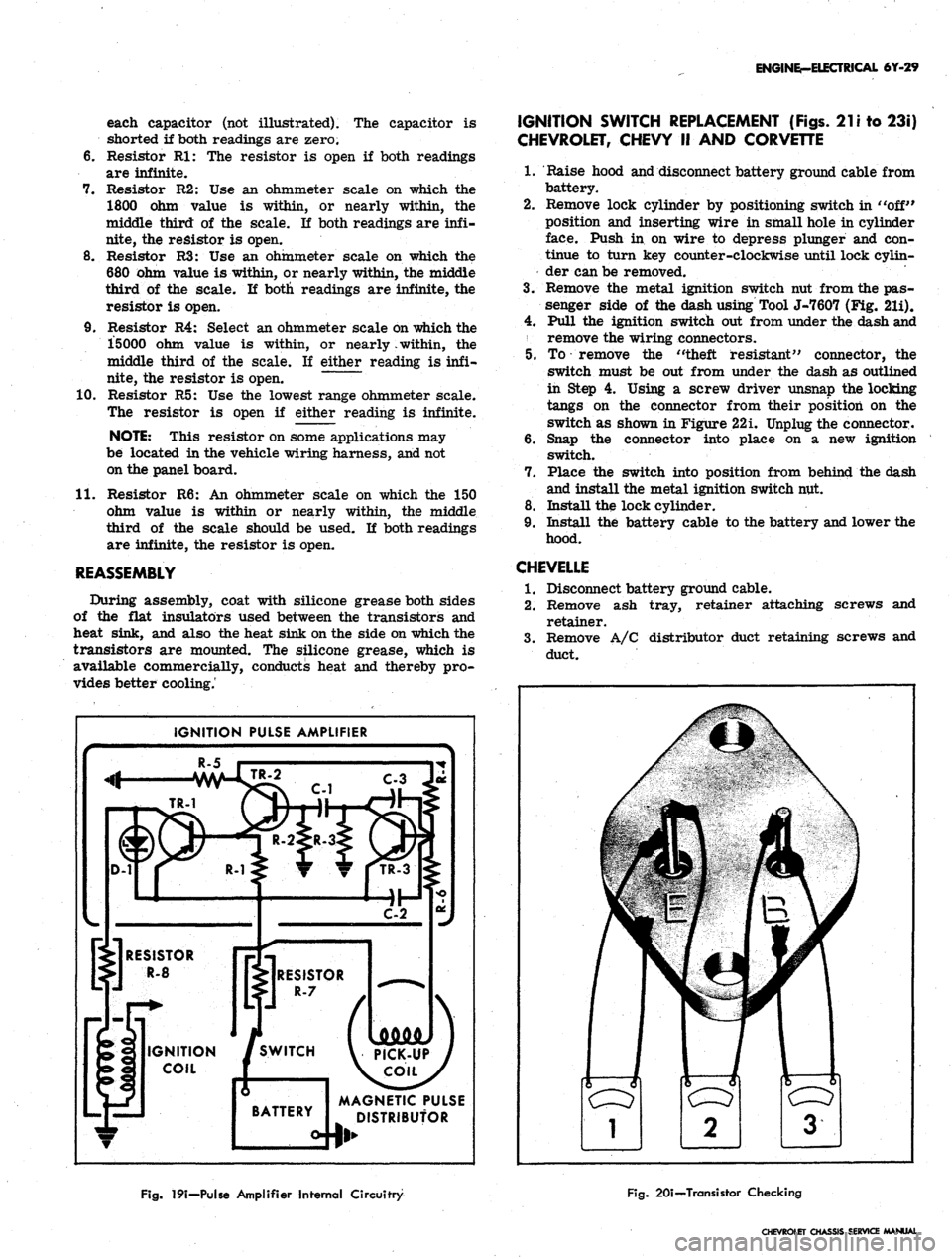
IGNITION PULSE AMPLIFIER
R-5
C-3 Ju
MAGNETIC PULSE
DISTRIBUTOR
IGNITION SWITCH REPLACEMENT (Figs.
21
i to 23i)
CHEVROLET, CHEVY II AND CORVETTE
1.
Raise hood and disconnect battery ground cable from
battery.
2.
Remove lock cylinder by positioning switch in "off"
position and inserting wire in small hole in cylinder
face. Push in on wire to depress plunger and con-
tinue to turn key counter-clockwise until lock cylin-
der can be removed.
3.
Remove the metal ignition switch nut from the pas-
senger side of the dash using Tool J-7607 (Fig. 21i).
4.
Pull the ignition switch out from under the dash and
remove the wiring connectors.
5. To remove the "theft resistant" connector, the
switch must be out from under the dash as outlined
in Step 4. Using a screw driver unsnap the locking
tangs on the connector from their position on the
switch as shown in Figure 22i. Unplug the connector.
6. Snap the connector into place on a new ignition
switch.
7. Place the switch into position from behind the dash
and install the metal ignition switch nut.
8. Install the lock cylinder.
9. Install the battery cable to the battery and lower the
hood.
CHEVELLE
1.
Disconnect battery ground cable.
2.
Remove ash tray, retainer attaching screws and
retainer.
3.
Remove A/C distributor duct retaining screws and
duct.
Fig.
19i—Pulse Amplifier Internal Circuitry
Fig.
20i—Transistor Checking
CHEVROLET Oi
Page 492 of 659
CHASSIS SHEET METAL 11-5
GRILLE TO BE FLUSH
TO +.06 TO W/SHIELD
MOLDING
±.06 GRILLE TO FENDER
.06 -.05 FENDER TO
W/SHIELD MOLDING
GRILLE"
& FENDER; ~ ~
FLUSH ± .06
FENDER FLUSH TO .06 INBOARD
OF DOOR SURFACE. FULL LENGTH
OF VERTICAL OPENING.
12±.O6 HOOD
TO GRILLE
.12 -.04
TO FENDER
FLUSH ± .06
HOOD TO GRILLE
FLUSH ± .06
HOOD TO FENDER
.12/.17 (REF.)
AT RAD. SUPPORT
.18 ± .06 FENDER
TO DOOR
FLUSH ± .06
HOOD TO FENDER
09 zfc .06 FENDER
TO ROCKER
.75 (REF.) AT
TOP FLANGE
1.08 EXC. WAG
URFACE
TYPICAL ON SURFACE
FLUSH CONDITION
DESIRED
.75 REF.
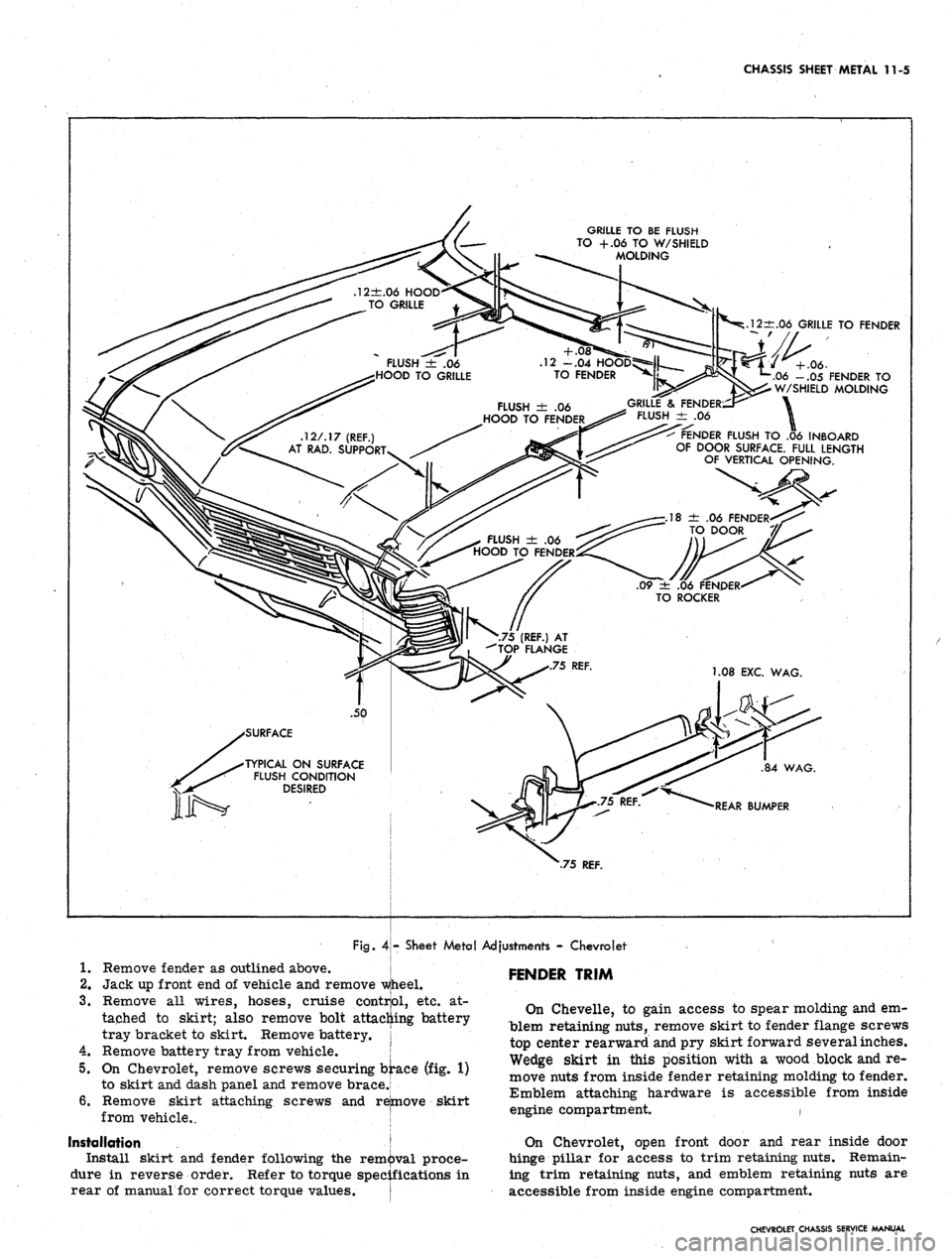
Fig.
4
- Sheet Metal Adjustments - Chevrolet
1.
Remove fender as outlined above.
2.
Jack up front end of vehicle and remove wjheel.
3.
Remove all wires, hoses, cruise control, etc. at-
tached to skirt; also remove bolt attaching battery
tray bracket to skirt. Remove battery, j
Remove battery tray from vehicle. \
5.
On Chevrolet, remove screws securing bj:ace (fig. 1)
to skirt and dash panel and remove brace.;
Remove skirt attaching screws and remove skirt
from vehicle.. !
4.
6.
Installation
j
Install skirt and fender following the removal proce-
dure in reverse order. Refer to torque specifications in
rear of manual for correct torque values. !
FENDER TRIM
On Chevelle, to gain access to spear molding and em-
blem retaining nuts, remove skirt to fender flange screws
top center rearward and pry skirt forward several inches.
Wedge skirt in this position with a wood block and re-
move nuts from inside fender retaining molding to fender.
Emblem attaching hardware is accessible from inside
engine compartment. t
On Chevrolet, open front door and rear inside door
hinge pillar for access to trim retaining nuts. Remain-
ing trim retaining nuts, and emblem retaining nuts are
accessible from inside engine compartment.
CHEVROLET CHASSIS SERVICE MANUAL
Page 493 of 659
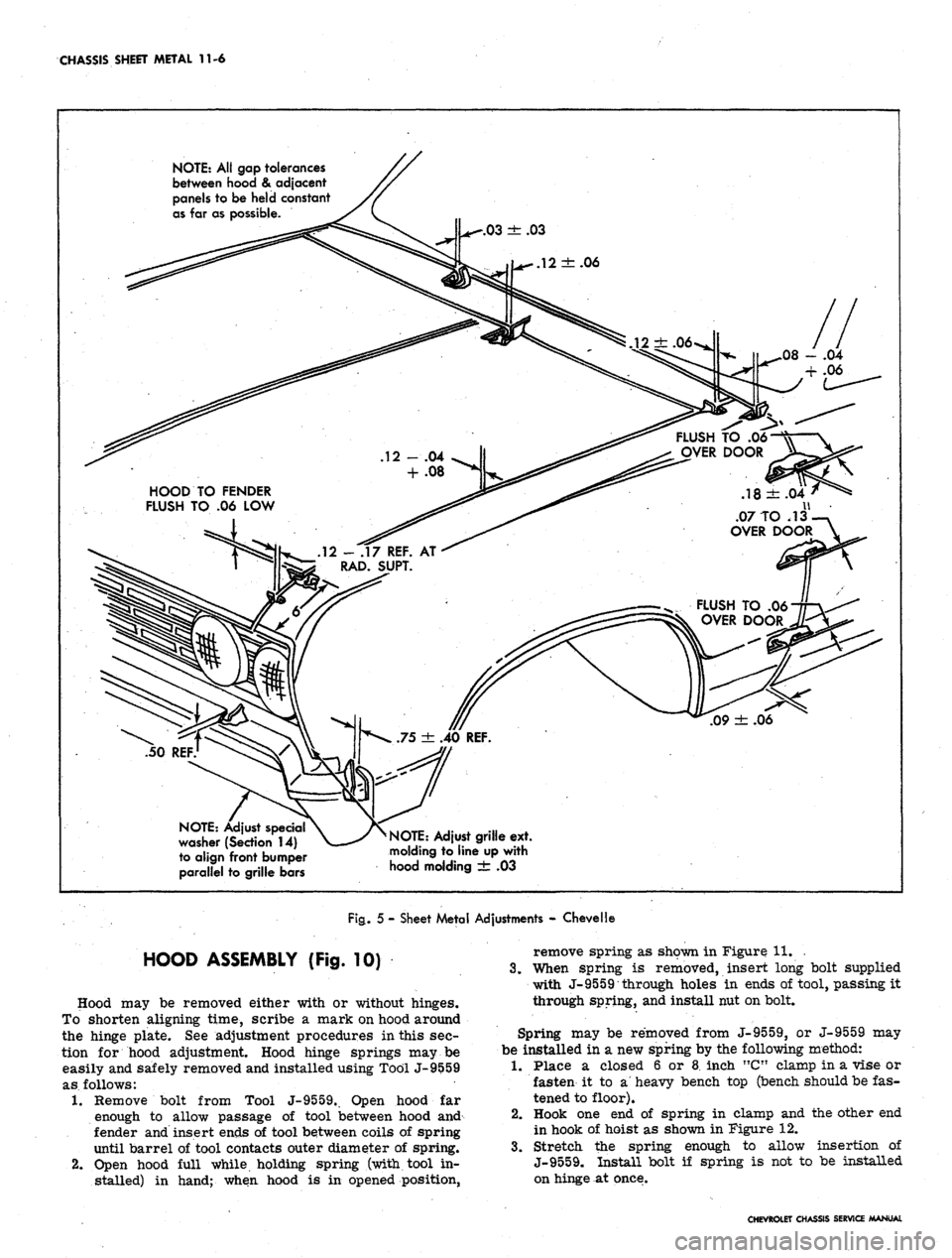
CHASSIS SHEET METAL 11-6
NOTE:
All gap tolerances
between hood & adjacent
panels to be held constant
as far as possible.
FLUSH
TO .06
OVER
DOOR
HOOD
TO
FENDER
FLUSH
TO .06 LOW
12 - .17 REF. AT
RAD.
SUPT.
.18 it .04
.07 TO J3l.
OVER
DOOR
FLUSH
TO .06
OVER
DOOR
X
.09 ± .06
.75
± .40 REF.
NOTE:
washer (Section 14)
to align front bumper
parallel to grille bars
NOTE:
Adjust grille ext.
molding to line up with
hood molding ± .03
Fig.
5 - Sheet Metal Adjustments - Chevelle
HOOD ASSEMBLY (Fig. 10)
Hood may be removed either with or without hinges.
To shorten aligning time, scribe a mark on hood around
the hinge plate. See adjustment procedures in this sec-
tion for hood adjustment. Hood hinge springs may be
easily and safely removed and installed using Tool J-9559
as follows:
1.
Remove bolt from Tool J-9559.. Open hood far
enough to allow passage of tool between hood and
fender and insert encls of tool between coils of spring
until barrel of tool contacts outer diameter of spring.
2.
Open hood full while holding spring (with tool in-
stalled) in hand; when hood is in opened position,
remove spring as shown in Figure 11. .
3.
When spring is removed, insert long bolt supplied
with J-9559 through holes in ends of tool, passing it
through spring, and install nut on bolt.
Spring may be removed from J-9559, or J-9559 may
be installed in a new spring by the following method:
1.
Place a closed 6. or 8. inch "CTt clamp in a vise or
fasten it to a' heavy bench top (bench should be fas-
tened to floor).
2.
Hook one end of spring in clamp and the other end
in hook of hoist as shown in Figure 12.
3.
Stretch the spring enough to allow insertion of
J-9559. Install bolt if spring is not to be installed
on hinge at once.
CHEVROLET CHASSIS SERVICE MANUAL
Page 494 of 659
CHASSIS SHEET METAL 11-7
Fig.
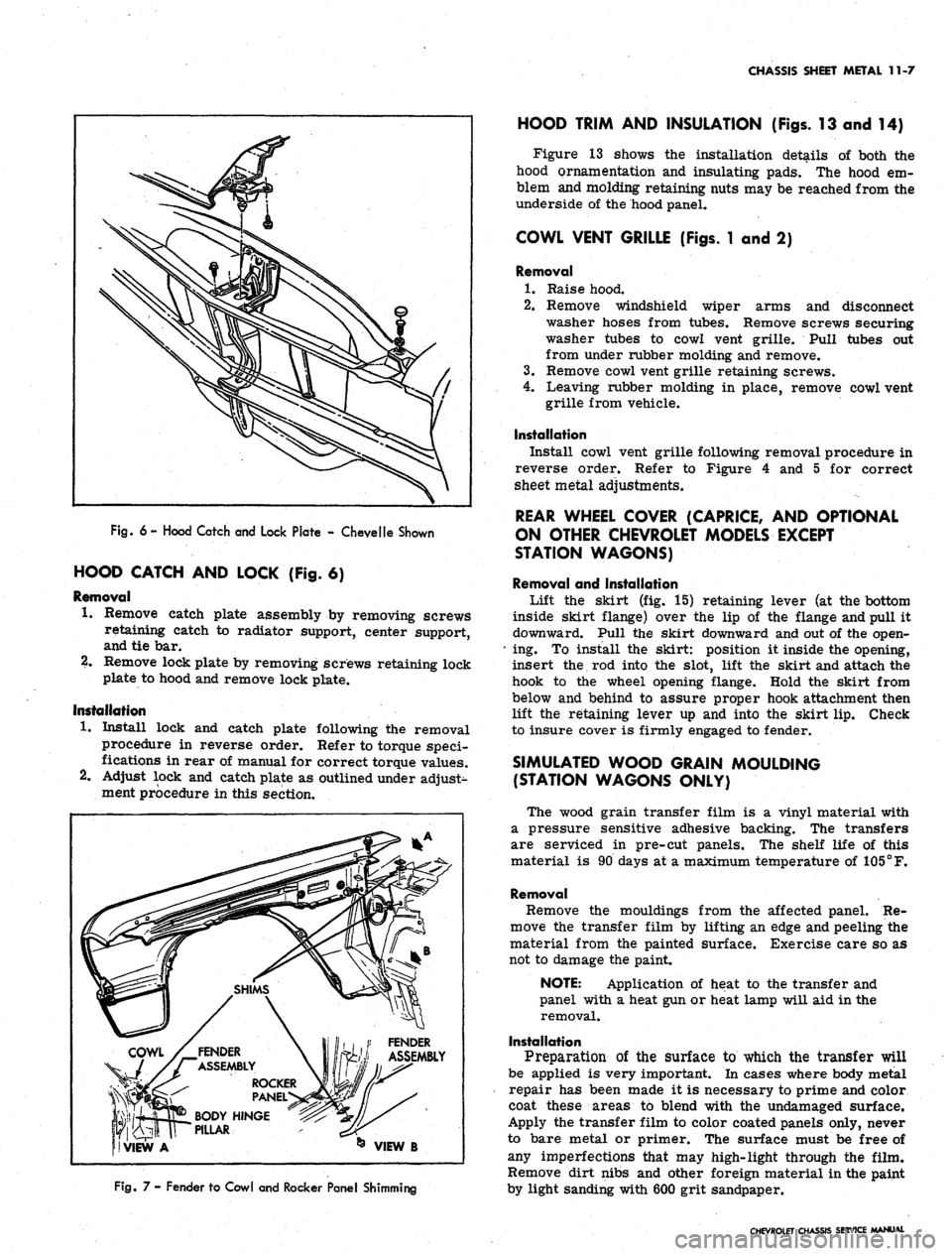
6 - Hood Catch and Lock Plate - Chevelle Shown
HOOD CATCH AND LOCK {Fig. 6)
Removal
1.
Remove catch plate assembly by removing screws
retaining catch to radiator support, center support,
and tie bar.
2.
Remove lock plate by removing screws retaining lock
plate to hood and remove lock plate.
Installation
1.
Install lock and catch plate following the removal
procedure in reverse order. Refer to torque speci-
fications in rear of manual for correct torque values.
2.
Adjust lock and catch plate as outlined under adjust^
ment procedure in this section.
FENDER
ASSEMBLY
ROCKER
PANEL
BODY HINGE
PILLAR
VIEW B
Fig.
7 - Fender to Cowl and Rocker Panel Shimming
HOOD TRIM AND INSULATION (Figs. 13 and 14)
Figure 13 shows the installation details of both the
hood ornamentation and insulating pads. The hood em-
blem and molding retaining nuts may be reached from the
underside of the hood panel.
COWL VENT GRILLE (Figs. 1 and 2)
Removal
1.
Raise hood.
2.
Remove windshield wiper arms and disconnect
washer hoses from tubes. Remove screws securing
washer tubes to cowl vent grille. Pull tubes out
from under rubber molding and remove.
3.
Remove cowl vent grille retaining screws.
4.
Leaving rubber molding in place, remove cowl vent
grille from vehicle.
Installation
Install cowl vent grille following removal procedure in
reverse order. Refer to Figure 4 and 5 for correct
sheet metal adjustments.
REAR WHEEL COVER (CAPRICE, AND OPTIONAL
ON OTHER CHEVROLET MODELS EXCEPT
STATION WAGONS)
Removal and Installation
Lift the skirt (fig. 15) retaining lever (at the bottom
inside skirt flange) over the lip of the flange and pull it
downward. Pull the skirt downward and out of the open-
*
ing. To install the skirt: position it inside the opening,
insert the rod into the slot, lift the skirt and attach the
hook to the wheel opening flange. Hold the skirt from
below and behind to assure proper hook attachment then
lift the retaining lever up and into the skirt lip. Check
to insure cover is firmly engaged to fender.
SIMULATED WOOD GRAIN MOULDING
(STATION WAGONS ONLY)
The wood grain transfer film is a vinyl material with
a pressure sensitive adhesive backing. The transfers
are serviced in pre-cut panels. The shelf life of this
material is 90 days at a maximum temperature of
105°
F.
Removal
Remove the mouldings from the affected panel. Re-
move the transfer film by lifting an edge and peeling the
material from the painted surface. Exercise care so as
not to damage the paint.
NOTE: Application of heat to the transfer and
panel with a heat gun or heat lamp will aid in the
removal.
Installation
Preparation of the surface to which the transfer will
be applied is very important. In cases where body metal
repair has been made it is necessary to prime and color
coat these areas to blend with the undamaged surface.
Apply the transfer film to color coated panels only, never
to bare metal or primer. The surface must be free of
any imperfections that may high-light through the film.
Remove dirt nibs and other foreign material in the paint
by light sanding with 600 grit sandpaper.
CHEVROLET CHASSIS SERVICE MANUAL
Page 499 of 659
CHASSIS SHEET METAL 11-12
GENERAL DESCRIPTION
The sturdy front end structure is formed by three
welded assemblies, the left and right hand fender skirts
and the radiator support panel. These units are bolted
together and to the dash panel (fig.
16).
Fender skirts, containing spring towers and support
brackets for control arms, are welded to the reinforced
"closed hat section" side rails. The skirts and rails
are fastened at top and bottom to reinforced areas of the
dash panel. Each skirt and rail assembly is securely
mated ta the body with three bolts at the top, and at the
stub fr|.me butt plates with a four bolt series. Heavy
gauge, formed, reinforcing plates receive the top of the
fender skirt and provide a shimming surface for precise
alignment of front end and body when assembled.
The one-piece radiator support panel completes a box
section when welded to the front crossmember. The
panel is formed to add structural strength and rigidity.
This strong combination is bolted along the full length of
each forward vertical edge of the fender skirts and at
the stub frame ends. Additional strength is obtained from
rigid diagonal corner braces. These open hat section
braces, bolted to side rails and front crossmember,
provide mountings for the suspension tension struts.
Conventional front fenders, grille, bumper and brack-
ets all bolt on to the unit front end structure. The hood
is connected to the front end with hinges that are attached
to the fender skirts.
MAINTENANCE AND ADJUSTMENTS
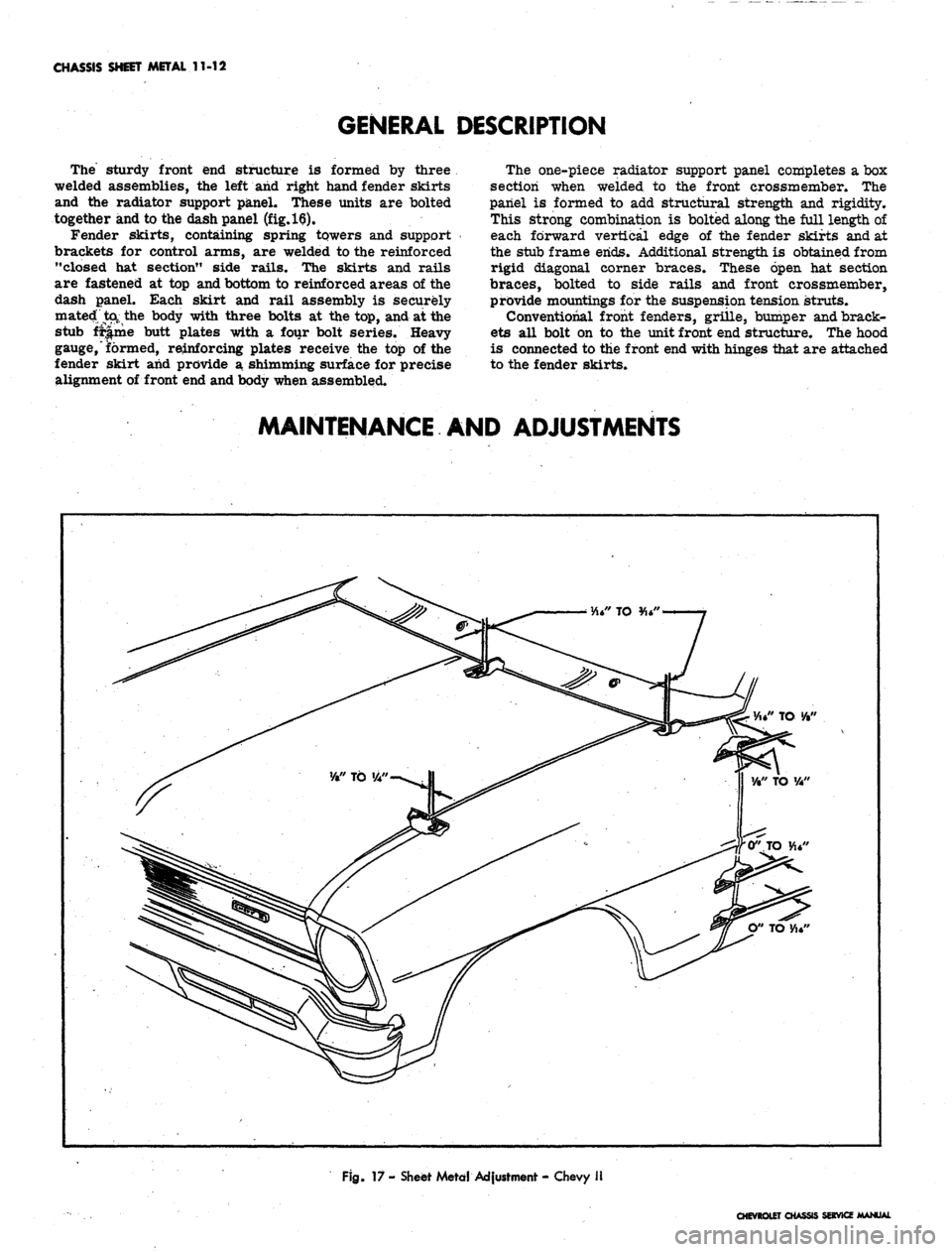
" TO •/•"
Fig.
17 - Sheet Metd Adjustment - Chevy II
CHEVROLET CHASSIS SERVICE MANUAL
Page 500 of 659
CHASSIS SHEET METAL 11-13
HOOD ADJUSTMENT
The alignment of the hood in relation
to*
other sheet
metal parts is controlled by the position of the hood
hinges and the height of the two bumpers, located one at
each end of the radiator support. The adjustments at
the hood latch must be made after the hinges and bumpers
are positioned to yield the dimensions shown in Figure
17.
Latch adjustments are made so that effort required
to open and close the hood is reasonable, and hood align-
ment obtained by hinge and bumper adjustment is main-
tained when the hood is closed. Note that the hood latch
is not designed or intended to correct basic hood align-
ment faults.
To align the hood and lock, proceed as follows:
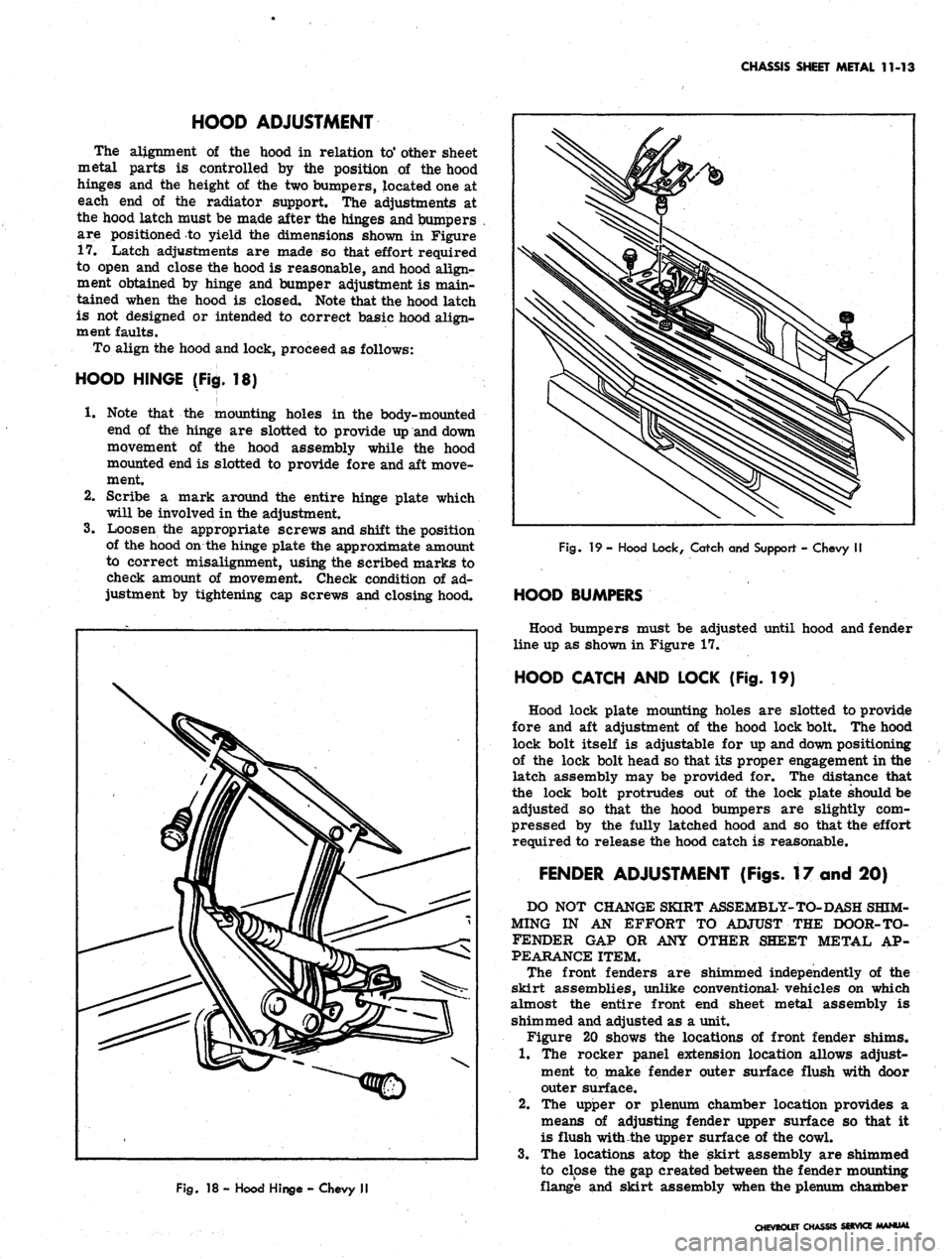
HOOD HINGE (Fig. 18)
1.
Note that the mounting holes in the body-mounted
end of the hinge are slotted to provide up and down
movement of the hood assembly while the hood
mounted end is slotted to provide fore and aft move-
ment.
2.
Scribe a mark around the entire hinge plate which
will be involved in the adjustment.
3.
Loosen the appropriate screws and shift the position
of the hood on the hinge plate the approximate amount
to correct misalignment, using the scribed marks to
check amount of movement. Check condition of ad-
justment by tightening cap screws and closing hood.
Fig.
18 - Hood Hinge - Chevy II
Fig.
19 - Hood Lock, Catch and Support - Chevy II
HOOD BUMPERS
Hood bumpers must be adjusted until hood and fender
line up as shown in Figure 17.
HOOD CATCH AND LOCK (Fig. 19)
Hood lock plate mounting holes are slotted to provide
fore and aft adjustment of the hood lock bolt. The hood
lock bolt itself is adjustable for up and down positioning
of the lock bolt head so that its proper engagement in the
latch assembly may be provided for. The distance that
the lock bolt protrudes out of the lock plate should be
adjusted so that the hood bumpers are slightly com-
pressed by the fully latched hood and so that the effort
required to release the hood catch is reasonable.
FENDER ADJUSTMENT (Figs. 17 and 20)
DO NOT CHANGE SKIRT ASSEMBLY-TO-DASH SHIM-
MING IN AN EFFORT TO ADJUST THE DOOR-TO-
FENDER GAP OR ANY OTHER SHEET METAL AP-
PEARANCE ITEM.
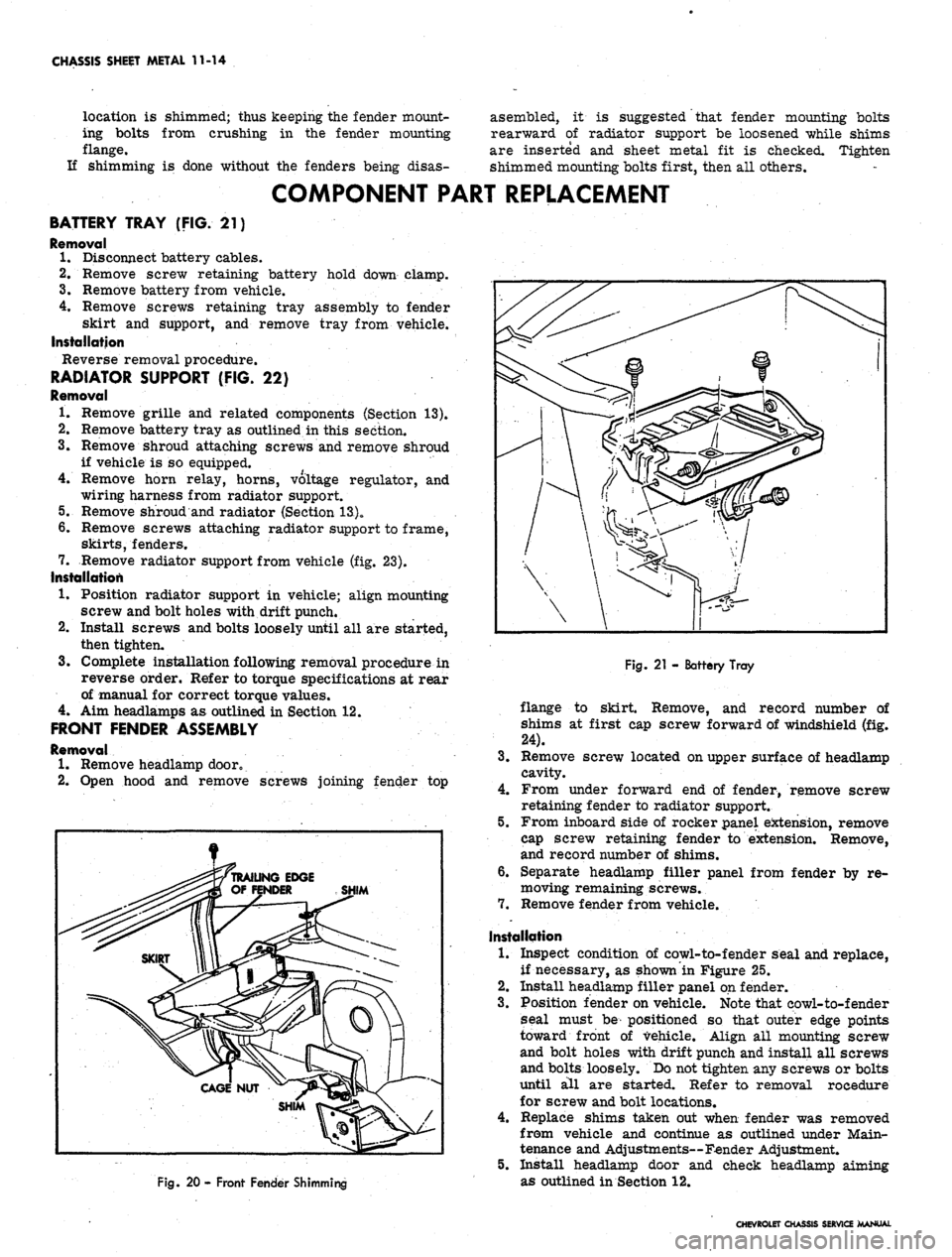
The front fenders are shimmed independently of the
skirt assemblies, unlike conventional- vehicles on which
almost the entire front end sheet metal assembly is
shimmed and adjusted as a unit.
Figure 20 shows the locations of front fender shims.
1.
The rocker panel extension location allows adjust-
ment to make fender outer surface flush with door
outer surface.
2.
The upper or plenum chamber location provides a
means of adjusting fender upper surface so that it
is flush with the upper surface of the cowl.
3.
The locations atop the skirt assembly are shimmed
to close the gap created between the fender mounting
flange and skirt assembly when the plenum chamber
CHEVROLET CHASSIS SWVICE MANUAL
Page 501 of 659
CHASSIS SHEET METAL 11-14
location is shimmed; thus keeping the fender mount-
ing bolts from crushing in the fender mounting
flange.
If shimming is done without the fenders being disas-
asembled, it is suggested that fender mounting bolts
rearward of radiator support be loosened while shims
are inserted and sheet metal fit is checked. Tighten
shimmed mounting bolts first, then all others.
COMPONENT PART REPLACEMENT
BATTERY TRAY (FIG. 21)
Removal
1.
Disconnect battery cables.
2.
Remove screw retaining battery hold down clamp.
3.
Remove battery from vehicle.
4.
Remove screws retaining tray assembly to fender
skirt and support, and remove tray from vehicle.
Installation
Reverse removal procedure.
RADIATOR SUPPORT (FIG. 22)
Removal
1.
Remove grille and related components (Section 13).
Remove battery tray as outlined in this section.
Remove shroud attaching screws and remove shroud
if vehicle is so equipped.
Remove horn relay, horns, voltage regulator, and
wiring harness from radiator support.
Remove shroud and radiator (Section 13)o
Remove screws attaching radiator support to frame,
skirts,
fenders.
Remove radiator support from vehicle (fig. 23).
Installation
1.
Position radiator support in vehicle; align mounting
screw and bolt holes with drift punch.
Install screws and bolts loosely until all are started,
then tighten.
3.
Complete installation following removal procedure in
reverse order. Refer to torque specifications at rear
of manual for correct torque values.
4.
Aim headlamps as outlined in Section 12.
FRONT FENDER ASSEMBLY
Removal
1*
Remove headlamp dooro
2.
Open hood and remove screws joining fender top
2.
Fig. 20 - Front Fender Shimming
Fig.
21 - Battery Tray
flange to skirt. Remove, and record number of
shims at first cap screw forward of windshield (fig.
24).
3.
Remove screw located on upper surface of headlamp
cavity.
4.
From under forward end of fender, remove screw
retaining fender to radiator support.
5.
From inboard side of rocker panel extension, remove
cap screw retaining fender to extension. Remove,
and record number of shims.
6. Separate headlamp filler panel from fender by re-
moving remaining screws.
7.
Remove fender from vehicle.
Installation
1.
Inspect condition of cowl-to-fender seal and replace,
if necessary, as shown in Figure 25.
2.
Install headlamp filler panel on fender.
3.
Position fender on vehicle. Note that eowl-to-fender
seal must be positioned so that outer edge points
toward front of vehicle. Align all mounting screw
and bolt holes with drift punch and install all screws
and bolts loosely. Do not tighten any screws or bolts
until all are started. Refer to removal rocedure
for screw and bolt locations.
4.
Replace shims taken out when fender was removed
from vehicle and continue as outlined under Main-
tenance and Adjustments—Fender Adjustment.
5.
Install headlamp door and cheek headlamp aiming
as outlined in Section 12.
CHEVROLET CHASSIS SERVICE MANUAL