oil type CHEVROLET CAMARO 1967 1.G Chassis User Guide
[x] Cancel search | Manufacturer: CHEVROLET, Model Year: 1967, Model line: CAMARO, Model: CHEVROLET CAMARO 1967 1.GPages: 659, PDF Size: 114.24 MB
Page 52 of 659
HEATER AND AIR CONDITIONING 1A-29
time as possible will be required to perform the
operation. Don't leave the system open any longer
than is necessary.
• Finally, after the operation has been completed and
the system sealed again, air and moisture should be
evacuated from the system before recharging.
GAUGE SET
The gauge set (fig. 41) is used when purging, evacua-
ting, charging or diagnosing trouble in the system. The
gauge at the left is known as the low pressure gauge.
The face is graduated into pounds of pressure and, in
the opposite direction, in inches of vacuum. This is the
gauge that should always be used in checking pressures
on the low pressure side of the system. When all parts of
the system are functioning properly the refrigerant
pressure on the low pressure side never fails below 0
pounds pressure. However, several abnormal conditions
can occur that will cause the low pressure to fall into a
partial vacuum. Therefore, a low pressure gauge is
required.
The high pressure gauge is used for checking pres-
sures on the high pressure side of the system.
The connection at the left is for attaching the low
pressure gauge line and the one at the right the high
pressure gauge line. The center connector is common to
both and is for the purpose of attaching a line for adding
refrigerant, discharging refrigerant, evacuating the sys-
tem and other uses. When not required, this line or
connection should be capped.
NOTE:
Gauge fitting connections should be in-
stalled hand tight only and the connections leak
tested before proceeding.
The hand shutoff valves on the gauge manifold do not
control the opening or closing off of pressure to the
gauges. They merely close each opening to the center
connector and to each other. During most diagnosing
and service operation, the valves must be closed. The
only occasion for opening both at the same time would be
to bypass refrigerant vapor from the high pressure to
the low pressure side of the system, or in evacuating
both sides of the system.
CHARGING STATION
The J-8393 Charging Station is a portable assembly of
a vacuum pump, refrigerant supply, gauges, valves, and
most important, a five (5) pound metering refrigerant
charging cylinder. The use of a charging ey'inder elim-
inates the need for scales, hot water pails, etc.
The chief advantage of this unit is savings. A very
definite savings in refrigerant and time can be obtained
by using this unit. Since the refrigerant is metered into
the system by volume, the correct amount may be added
to.
the system and charged to the customer. This, coupled
with the fact that the unit remains "plumbed" at all times
and thus eliminates loss of refrigerant in purging of
lines and hooking-up, combines to enable the operator to
get full use of all refrigerant purchased by the
dealership.
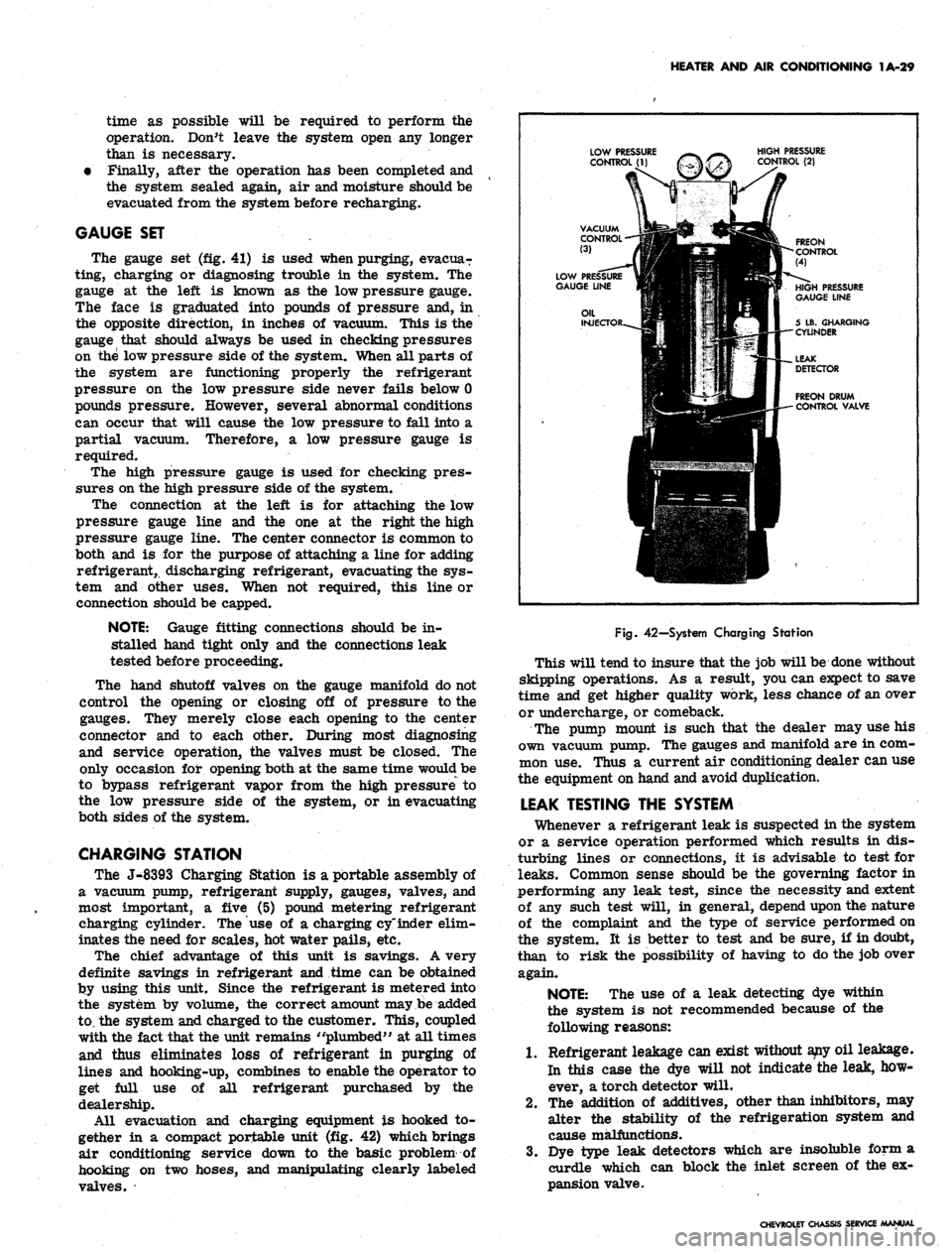
All evacuation and charging equipment is hooked to-
gether in a compact portable unit (fig. 42) which brings
air conditioning service down to the basic problem of
hooking on two hoses, and manipulating clearly labeled
valves.
Fig.
42—System Charging Station
This will tend to insure that the job will be done without
skipping operations. As a result, you can expect to save
time and get higher quality work, less chance of an over
or undercharge, or comeback.
The pump mount is such that the dealer may use his
own vacuum pump. The gauges and manifold are in com-
mon use. Thus a current air conditioning dealer can use
the equipment on hand and avoid duplication.
LEAK TESTING THE SYSTEM
Whenever a refrigerant leak is suspected in the system
or a service operation performed which results in dis-
turbing lines or connections, it is advisable to test for
leaks.
Common sense should be the governing factor in
performing any leak test, since the necessity and extent
of any such test will, in general, depend upon the nature
of the complaint and the type of service performed on
the system. It is better to test and be sure, if in doubt,
than to risk the possibility of having to do the job over
again.
NOTE:
The use of a leak detecting dye within
the system is not recommended because of the
following reasons:
1.
Refrigerant leakage can exist without any oil leakage.
In this case the dye will not indicate the leak, how-
ever, a torch detector will.
2.
The addition of additives, other than inhibitors, may
alter the stability of the refrigeration system and
cause malfunctions.
3.
Dye type leak detectors which are insoluble form a
curdle which can block the inlet screen of the ex-
pansion valve.
CHEVROLET CHASSIS SERVICE MANUAL
Page 53 of 659
HEATER AND AIR CONDITIONING 1A-30
Leak Detector
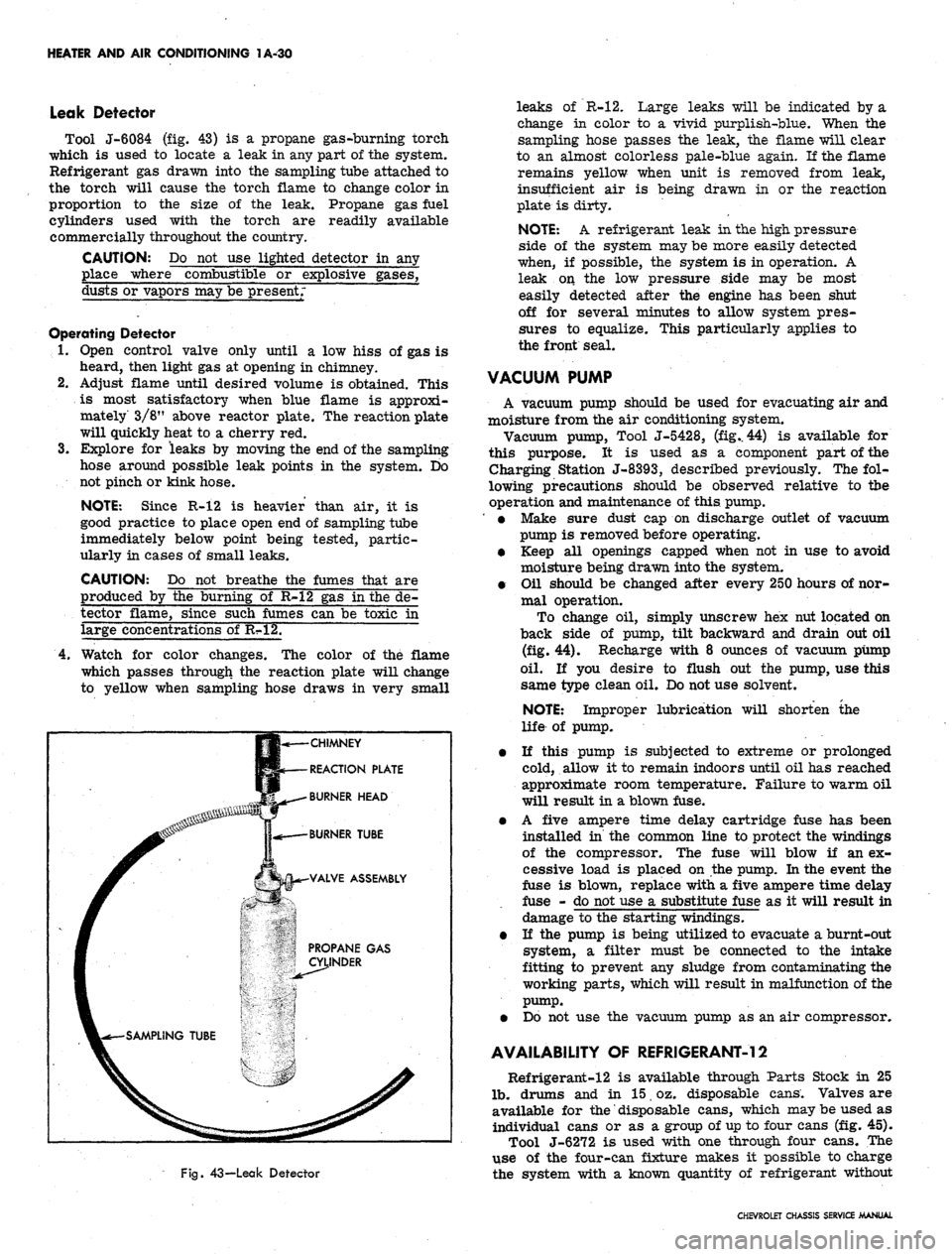
Tool J-6084 (fig. 43) is a propane gas-burning torch
which is used to locate a leak in any part of the system.
Refrigerant gas drawn into the sampling tube attached to
the torch will cause the torch flame to change color in
proportion to the size of the leak. Propane gas fuel
cylinders used with the torch are readily available
commercially throughout the country.
CAUTION: Do not use lighted detector in any
place where combustible or explosive gases,
dusts or vapors may be present;
Operating Detector
1.
Open control valve only until a low hiss of gas is
heard, then light gas at opening in chimney.
2.
Adjust flame until desired volume is obtained. This
is most satisfactory when blue flame is approxi-
mately 3/8" above reactor plate. The reaction plate
will quickly heat to a cherry red.
3.
Explore for leaks by moving the end of the sampling
hose around possible leak points in the system. Do
not pinch or kink hose.
NOTE: Since R-12 is heavier than air, it is
good practice to place open end of sampling tube
immediately below point being tested, partic-
ularly in cases of small leaks.
CAUTION: Do not breathe the fumes that are
produced by the burning of R-12 gas in the de-
tector flame, since such fumes can be toxic in
large concentrations of R?»12.
4.
Watch for color changes. The color of the flame
which passes through the reaction plate will change
to yellow when sampling hose draws in very small
CHIMNEY
REACTION PLATE
BURNER HEAD
Fig.
43—Leak Detector
leaks of R-12. Large leaks will be indicated by a
change in color to a vivid purplish-blue. When the
sampling hose passes the leak, the flame will clear
to an almost colorless pale-blue again. If the flame
remains yellow when unit is removed from leak,
insufficient air is being drawn in or the reaction
plate is dirty.
NOTE: A refrigerant leak in the high pressure
side of the system may be more easily detected
when, if possible, the system is in operation. A
leak on the low pressure side may be most
easily detected after the engine has been shut
off for several minutes to allow system pres-
sures to equalize. This particularly applies to
the front seal.
VACUUM PUMP
A vacuum pump should be used for evacuating air and
moisture from the air conditioning system.
Vacuum pump, Tool J-5428, (fig.. 44) is available for
this purpose. It is used as a component part of the
Charging Station J-8393, described previously. The fol-
lowing precautions should be observed relative to tbe
operation and maintenance of this pump.
' • Make sure dust cap on discharge outlet of vacuum
pump is removed before operating.
• Keep all openings capped when not in use to avoid
moisture being drawn into the system.
• Oil should be changed after every 250 hours of nor-
mal operation.
To change oil, simply unscrew hex nut located on
back side of pump, tilt backward and drain out oil
(fig. 44). Recharge with 8 ounces of vacuum pump
oil.
If you desire to flush out the pump, use this
same type clean oil. Do not use solvent.
NOTE: Improper lubrication will shorten the
life of pump.
• If this pump is subjected to extreme or prolonged
cold, allow it to remain indoors until oil has reached
approximate room temperature. Failure to warm oil
will result in a blown fuse.
• A five ampere time delay cartridge fuse has been
installed in the common line to protect the windings
of the compressor. The fuse will blow if an ex-
cessive load is placed on the pump. In the event the
fuse is blown, replace with a five ampere time delay
fuse - do not use a substitute fuse as it will result in
damage to the starting windings.
• If the pump is being utilized to evacuate a burnt-out
system, a filter must be connected to the intake
fitting to prevent any sludge from contaminating the
working parts, which will result in malfunction of the
pump.
• Do not use the vacuum pump as an air compressor.
AVAILABILITY OF REFRIGERANT-12
Refrigerant-12 is available through Parts Stock in 25
lb.
drums and in 15 oz. disposable cans. Valves are
available for
the"
disposable cans, which may be used as
individual cans or as a group of up to four cans (fig. 45).
Tool J-6272 is used with one through four cans. The
use of the four-can fixture makes it possible to charge
the system with a known quantity of refrigerant without
CHEVROLET CHASSIS SERVICE MANUAL
Page 60 of 659
HEATER AND AIR CONDITIONING 1A-37
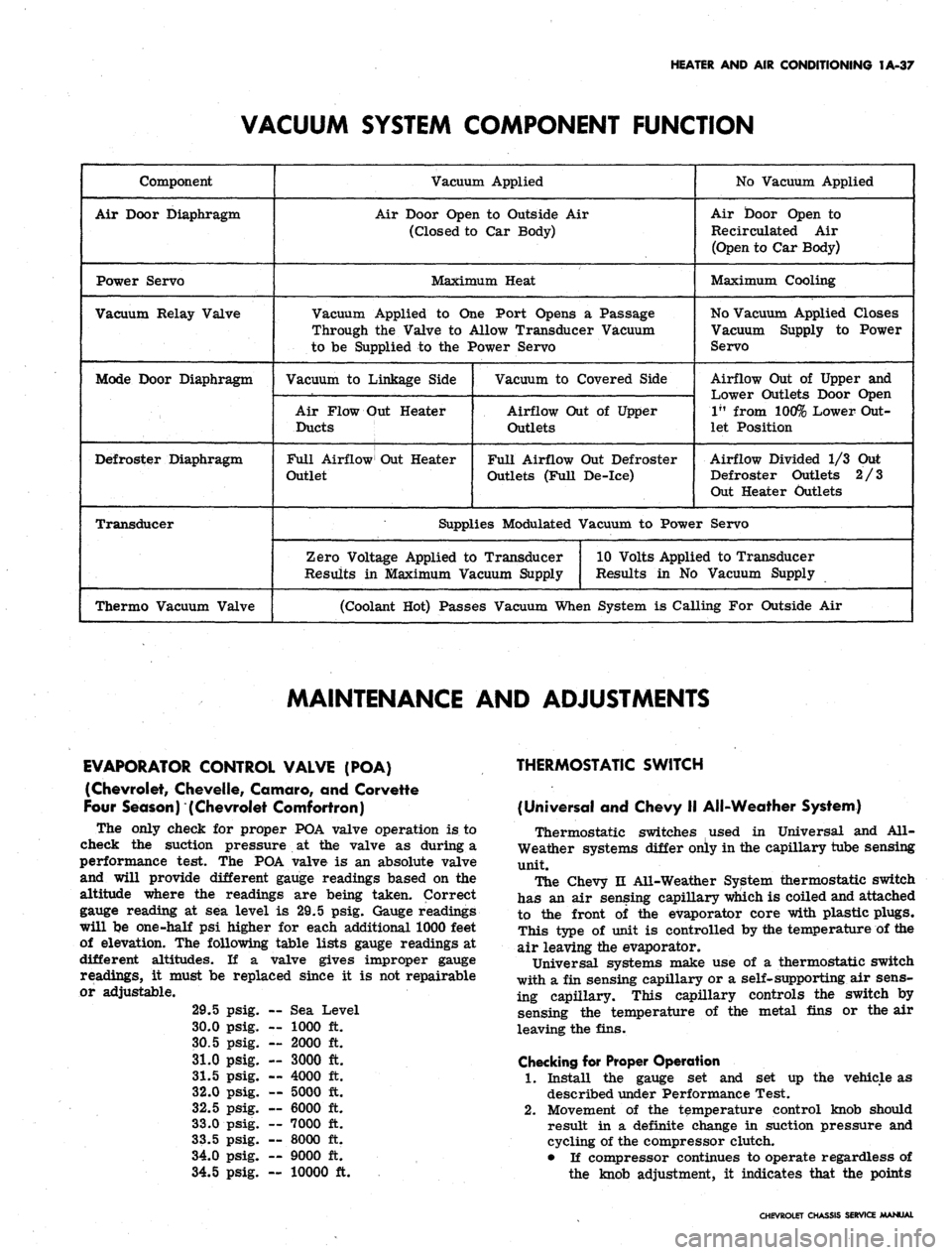
VACUUM SYSTEM COMPONENT FUNCTION
Component
Air Door Diaphragm
Power Servo
Vacuum Relay Valve
Mode Door Diaphragm
Defroster Diaphragm
Transducer
Thermo Vacuum Valve
Vacuum Applied
Air Door Open to Outside Air
(Closed to Car Body)
Maximum Heat
Vacuum Applied to One Port Opens a Passage
Through the Valve to Allow Transducer Vacuum
to be Supplied to the Power Servo
Vacuum to Linkage Side
Air Flow Out Heater
Ducts
Full Airflow Out Heater
Outlet
Vacuum to Covered Side
Airflow Out of Upper
Outlets
Full Airflow Out Defroster
Outlets (Full De-ice)
No Vacuum Applied
Air Door Open to
Re circulated Air
(Open to Car Body)
Maximum Cooling
No Vacuum Applied Closes
Vacuum Supply to Power
Servo
Airflow Out of Upper and
Lower Outlets Door Open
1"
from 100% Lower Out-
let Position
Airflow Divided 1/3 Out
Defroster Outlets 2/3
Out Heater Outlets
Supplies Modulated Vacuum to Power Servo
Zero Voltage Applied to Transducer
Results in Maximum Vacuum Supply
10 Volts Applied to Transducer
Results in No Vacuum Supply
(Coolant Hot) Passes Vacuum When System is Calling For Outside Air
MAINTENANCE AND ADJUSTMENTS
EVAPORATOR CONTROL VALVE (POA)
(Chevrolet, Chevelle, Comoro, and Corvette
Four Season) (Chevrolet Comfortron)
The only check for proper POA valve operation is to
check the suction pressure at the valve as during a
performance test. The POA valve is an absolute valve
and will provide different gauge readings based on the
altitude where the readings are being taken. Correct
gauge reading at sea level is 29.5 psig. Gauge readings
will be one-half psi higher for each additional 1000 feet
of elevation. The following table lists gauge readings at
different altitudes. If a valve gives improper gauge
readings, it must be replaced since it is not repairable
or adjustable.
29.5
30.0
30.5
31.0
31.5
32.0
32.5
33.0
33.5
34.0
34.5
psig.
psig.
psig.
psig.
psig.
psig.
psig.
psig.
psig.
psig.
psig.
— Sea 1
— 1000
— 2000
— 3000
— 4000
— 5000
— 6000
— 7000
— 8000
— 9000
Level
ft.
ft.
ft.
ft.
ft.
ft.
ft.
ft.
ft.
— 10000 ft.
THERMOSTATIC SWITCH
(Universal and Chevy II All-Weather System)
Thermostatic switches used in Universal and All-
Weather systems differ only in the capillary tube sensing
unit.
The Chevy n All-Weather System thermostatic switch
has an air sensing capillary which is coiled and attached
to the front of the evaporator core with plastic plugs.
This type of unit is controlled by the temperature of the
air leaving the evaporator.
Universal systems make use of a thermostatic switch
with a fin sensing capillary or a self-supporting air sens-
ing capillary. This capillary controls the switch by
sensing the temperature of the metal fins or the air
leaving the fins.
Checking for Proper Operation
1.
Install the gauge set and set up the vehicle as
described under Performance Test.
2.
Movement of the temperature control knob should
result in a definite change in suction pressure and
cycling of the compressor clutch.
• If compressor continues to operate regardless of
the knob adjustment, it indicates that the points
CHEVROLET CHASSIS SERVICE MANUAL
Page 128 of 659

CORVETTE BODY 1B-21
Fig.
45—
Locking Regulator Arm in Place
REAR WINDOW-ADHESIVE CAULKED-
19437 MODEL
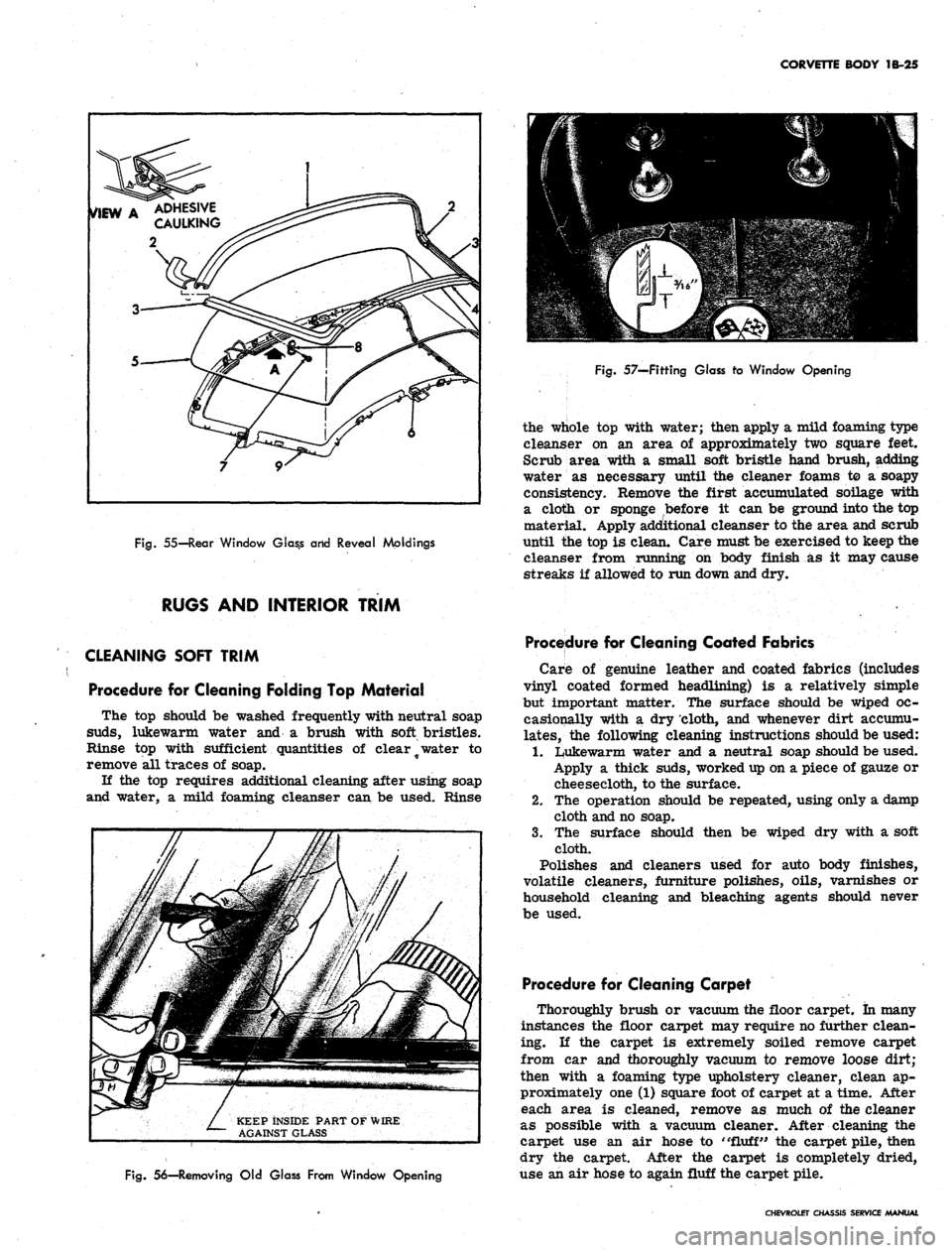
For parts identification refer to Figure 55.
1.
Remove the 2 rear window garnish moldings by re-
moving the 14 attaching screws.
2.
Pry molding caps from reveal moldings.
3.
Carefully remove lower, side, and top reveal mold-
ings after marking their position on body with tape.
4.
Secure one end of steel music wire to piece of wood
for handle. Insert other end through caulking mater-
ial at lower corner of rear window; then secure end
of wire to another piece of wood (fig. 56).
5. With the aid of helper, carefully cut through caulking
material (using a sawing motion) with the steel wire;
up side of window, across top, down opposite side,
and across bottom of window.
6. Remove old glass from window opening.
7. Using a sharp scraper or wood chisel, remove ad-
hesive caulking material from body pinchweld flange.
NOTE:
It is not necessary to clean off all the
old caulking material completely from body
opening; however, there should not be any loose
pieces of caulking material left in the opening.
8. Check all reveal molding retaining clips for damage
(24 required). Replace those that are bent or dis-
torted with clips provided in kit.
9. Using weatherstrip adhesive, cement rubber spacers
at bottom, sides, and top of window opening. The
step-type spacers are used at bottom and sides, the
flat type are used at the top, sides, and bottom of
window opening as shown on Figure 55.
10.
Using suction cup holders, position replacement
glass in body opening. Carefully check relationship
of glass to body pinchweld completely around open-
ing. The overlap of glass to body pinchweld and re-
taining flanges should be equal with a minimum over-
lap of 3/16M. Where necessary, position shims under
the lower spacers to obtain required overlap of glass
to body upper and lower flanges.
11.
After proper glass to pinchweld relationship has
been attained, mark position with grease pencil on
glass and body as shown in Figure 57.
12.
Remove glass from body opening and place on pro-
tected surface.
13.
Clean inside edge surface of glass so that glass is
free of any foreign material (oil, grease, etc.).
Using 3/4" masking tape, place tape approximately
1/2 inch from edge of inside surface of glass com-
pletely around glass. Then apply a film of silane
primer to inside edge surface completely around
glass,
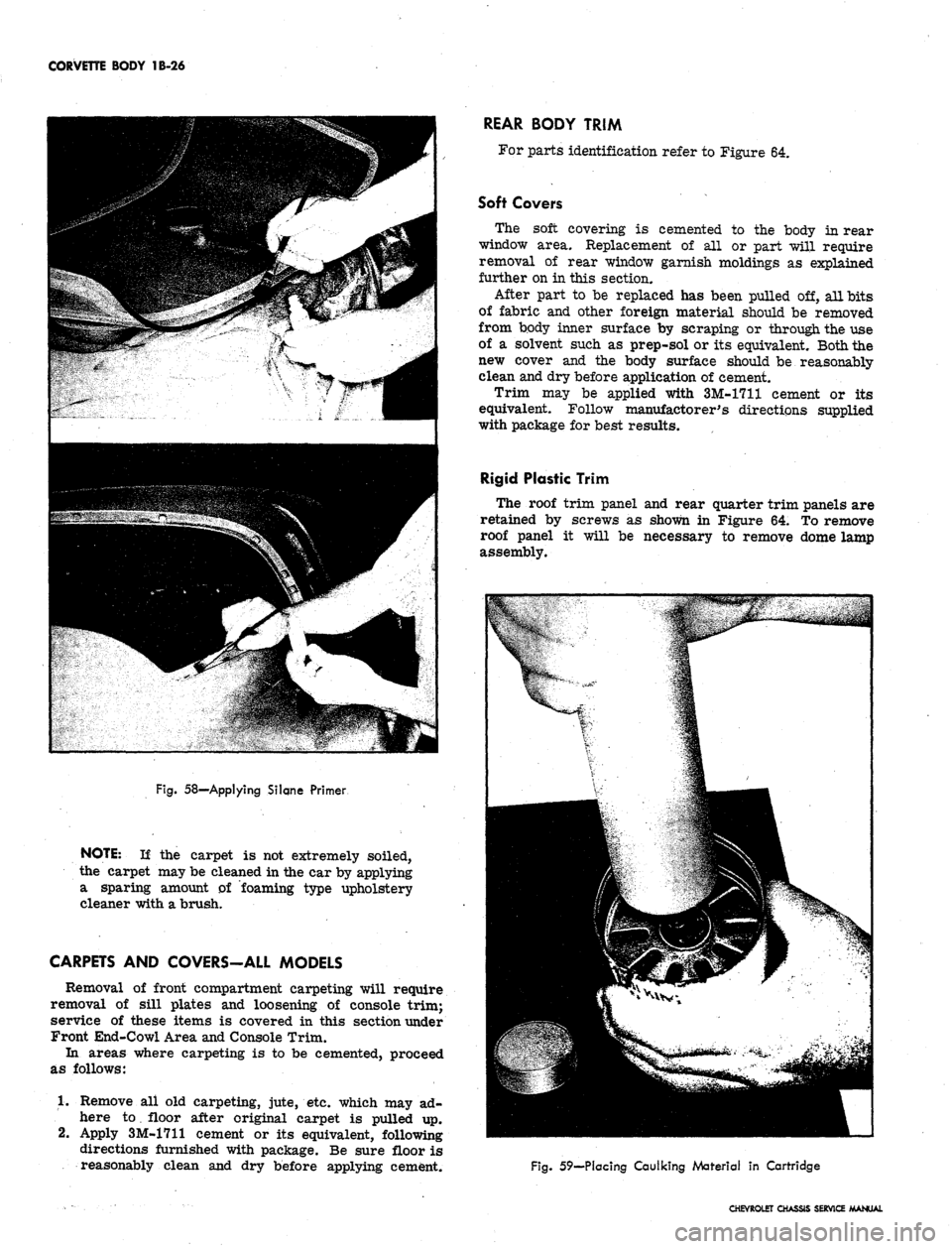
also apply silane primer to sealing surface
of pinchweld as shown in Figure 58.
Fig.
46—Door Lock and Remote Controls
1.
Door Lock Remote Control
Assembly
2.
Door Lock Remote Control Knob
3. Door Lock Remote Control Rod
4.
Remote Control Locking Rod
5. Remote Locking Control
Assembly
6. Lock Assembly
CHEVROLET CHASSIS SERVICE MANUAL
Page 132 of 659
CORVETTE BODY 1B-25
Fig.
55—Rear Window G!as.s arid Reveal Moldings
RUGS AND INTERIOR TRIM
Fig.
57—Fitting Glass to Window Opening
the whole top with water; then apply a mild foaming type
cleanser on an area of approximately two square feet.
Scrub area with a small soft bristle hand brush, adding
water as necessary until the cleaner foams to a soapy
consistency. Remove the first accumulated soilage with
a cloth or sponge before it can be ground into the top
material. Apply additional cleanser to the area and scrub
until the top is clean. Care must be exercised to keep the
cleanser from running on body finish as it may cause
streaks if allowed to run down and dry.
CLEANING SOFT TRIM
Procedure for Cleaning Folding Top Material
The top should be washed frequently with neutral soap
suds,
lukewarm water and a brush with soft bristles.
Rinse top with sufficient quantities of clear # water to
remove all traces of soap.
If the top requires additional cleaning after using soap
and water, a mild foaming cleanser can be used. Rinse
KEEP INSIDE PART OF WIRE
AGAINST GLASS
Fig.
56—Removing Old Glass From Window Opening
Procedure for Cleaning Coated Fabrics
Care of genuine leather and coated fabrics (includes
vinyl coated formed headlining) is a relatively simple
but important matter. The surface should be wiped oc-
casionally with a dry cloth, and whenever dirt accumu-
lates,
the following cleaning instructions should be used:
1.
Lukewarm water and a neutral soap should be used.
Apply a thick suds, worked up on a piece of gauze or
cheesecloth, to the surface.
2.
The operation should be repeated, using only a damp
cloth and no soap.
3.
The surface should then be wiped dry with a soft
cloth.
Polishes and cleaners used for auto body finishes,
volatile cleaners, furniture polishes, oils, varnishes or
household cleaning and bleaching agents should never
be used.
Procedure for Cleaning Carpet
Thoroughly brush or vacuum the floor carpet, in many
instances the floor carpet may require no further clean-
ing. If the carpet is extremely soiled remove carpet
from car and thoroughly vacuum to remove loose dirt;
then with a foaming type upholstery cleaner, clean ap-
proximately one (1) square foot of carpet at a time. After
each area is cleaned, remove as much of the cleaner
as possible with a vacuum cleaner. After cleaning the
carpet use an air hose to
"fluff"
the carpet pile, then
dry the carpet. After the carpet is completely dried,
use an air hose to again fluff the carpet pile.
CHEVROLET CHASSIS SERVICE MANUAL
Page 133 of 659
CORVETTE BODY 1B-26
Fig.
58—-Applying Silqne Primer
NOTE: If the carpet is not extremely soiled,
the carpet may be cleaned in the car by applying
a sparing amount of foaming type upholstery
cleaner with a brush.
CARPETS AND COVERS-ALL MODELS
Removal of front compartment carpeting will require
removal of sill plates and loosening of console trim;
service of these items is covered in this section under
Front End-Cowl Area and Console Trim.
In areas where carpeting is to be cemented, proceed
as follows:
1.
Remove all old carpeting, jute, etc. which may ad-
here to floor after original carpet is pulled up.
2.
Apply 3M-1711 cement or its equivalent, following
directions furnished with package. Be sure floor is
reasonably clean and dry before applying cement.
REAR BODY TRIM
For parts identification refer to Figure 64.
Soft Covers
The soft covering is cemented to the body in rear
window area. Replacement of all or part will require
removal of rear window garnish moldings as explained
further on in this section.
After part to be replaced has been pulled off, all bits
of fabric and other foreign material should be removed
from body inner surface by scraping or through the use
of a solvent such as prep-sol or its equivalent. Both the
new cover and the body surface should be reasonably-
clean and dry before application of cement.
Trim may be applied with 3M-1711 cement or its
equivalent. Follow manufactorer's directions supplied
with package for best results.
Rigid Plastic Trim
The roof trim panel and rear quarter trim panels are
retained by screws as shown in Figure 64. To remove
roof panel it will be necessary to remove dome lamp
assembly.
Fig.
59—Placing Caulking Material In Cartridge
CHEVROLET CHASSIS SERVICE MANUAL
Page 165 of 659
SECTION
3
FRONT SUSPENSION
INDEX
Page
General Description
. . . . 3-1
Maintenance and Adjustments
3-3
Front Wheel Bearing Adjustment
3-3
Front End Alignment
3-5 .
Alignment Preliminary Steps ............
3-5
Caster
and
Camber Adjustments
. . 3-5
Chevelle, Caxnaro
and
Corvette
3-5
Chevrolet and Chevy
II 3-6
Steering Axis Inclination
3-6
Toe-in Adjustment
3-6
Cornering Wheel Relationship
3-6
Riding Heigit
and
Coil Spring Sag
3-7
Repair Procedures
3-8
Front Brake Drum (Chevrolet, Camaro, Chevelle,
Chevy E)
. . 3-8
Removal
3-8
Installation
3-8
Front Wheel Hub
3-8
Replacement
. . . . . 3-8
Replacement
of
Hub Wheel Bolts
3-8
Front Wheel Bearings
. . 3-8
Removal
3-8
Inspection
3-9
Repairs
. . 3-9
Replacement
of
Bearing Cups
3-9
Installation
3-9
Steering Knuckle
. . . 3-9
Removal
3-9
Installation
3-9
Shock Absorber
3-10
Chevrolet, Chevelle, Camaro
and
Corvette
3-10
Removal
, . 3-10
Installation
3-10
Chevy
It 3-11
Removal
3-11
Installation
3-11
Stabilizer
Bar 3-11
Removal
3-11
Installation
3-11
Strut Rod
3-11
Chevrolet and Chevy
II 3-11
Removal
3-11
Installation
3-12
Front Coil Springs
3-12
Chevrolet
3-12
Removal
3-12
Installation
3-13
Chevelle
and
Camaro
3-13
Removal
3-13
Installation
3-14
Chevy H
3-14
Removal
3-14
Spring Seat Disassembly and Assembly
3-15
Installation
3-15
Corvette
3-15
Lower Control Arm Spherical Joint
.' 3-16
Chevrolet, Chevelle, Camaro and
Corvette
3-16
Inspection
. 3-16
Chevrolet and Corvette
3-16
Removal
3-16
Installation
3-16
Page
Chevelle
and
Camaro
3-17
Removal
3-17
Installation
. . . . 3-17
Chevy
II 3-17
Inspection
. 3-17
Removal
3-17
Installation
3-17
Lube Fittings
3-18
Lower Control Arm
. . . . 3-18
Chevrolet
. 3-18
Removal
3-18
Installation
3-18
Chevelle and Camaro
3-18
Removal
3-18
Installation
3-18
Chevy H
3-18
Removal
3-18
Installation
3-19
Corvette
3-19
Removal
3-19
mstallation
3-19
Lower Control Arm Bushings
3-20
Chevrolet
3-20
Removal
3-20
Installation
3-20
Chevelle and Camaro
. 3-20
Removal
3-20
Installation
3-20
Chevy H
3-21
Removal
* 3-21
InstaEation
3-21
Cross Shaft and/or Bushings
. 3-21
Corvette
3-21
Removal
3-21
Installation
3-21
Upper Control Arm Spherical Joint
3-21
Chevrolet, Chevelle, Camaro and Corvette
..... 3-21
Inspection.
3-21
Replacement
3-21
Chevy
II 3-21
Inspection
3-21
Replacement
3-21
Lube Fittings
3-22
Upper Control Arm
3-22
Chevrolet, Chevelle, Camaro
and
Corvette
3-22
Removal
3-22
Installation
3-22
Chevy H
3-22
Removal
3-22
Installation
3-23
Upper Control Arm Cross Shaft
and/or Bushings
3-23
Chevrolet, Camaro and Chevelle
3-23
Removal
. 3-23
Installation
3-23
Chevy H
3-24
Removal
3-24
Installation
. . . 3-25
Corvette
3-25
Removal
3-25
Installation
3-25
Special Tools
3-26
Specifications
...'..'
At rear of Book
GENERAL DESCRIPTION
The 1967 Chevrolet, Chevelle, Camaro, Chevy n and
Corvette front suspension systems are basically similar,
being of the
S.L.A.
(short-long arm) type with independent
coil springs. In the Chevrolet, Chevelle, Camaro and
Corvette the springs ride on the lower control arms; in
the Chevy II the springs ride on the upper control arms.
Spherical joints connect the upper and lower arms to the
steering knuckle. Tapered roller wheel bearings are
used.
Camber angle is adjusted, on the Chevrolet and Chevy n
CHEVROLET CHASSIS SERVICE MANIM
Page 182 of 659
FRONT SUSPENSION 3-18
CHEVROLET
CHEVELLE
CAMARO (TYPICAL)
CHEVY U
LOWER CONTROL ARM
CORVETTE
Fig.
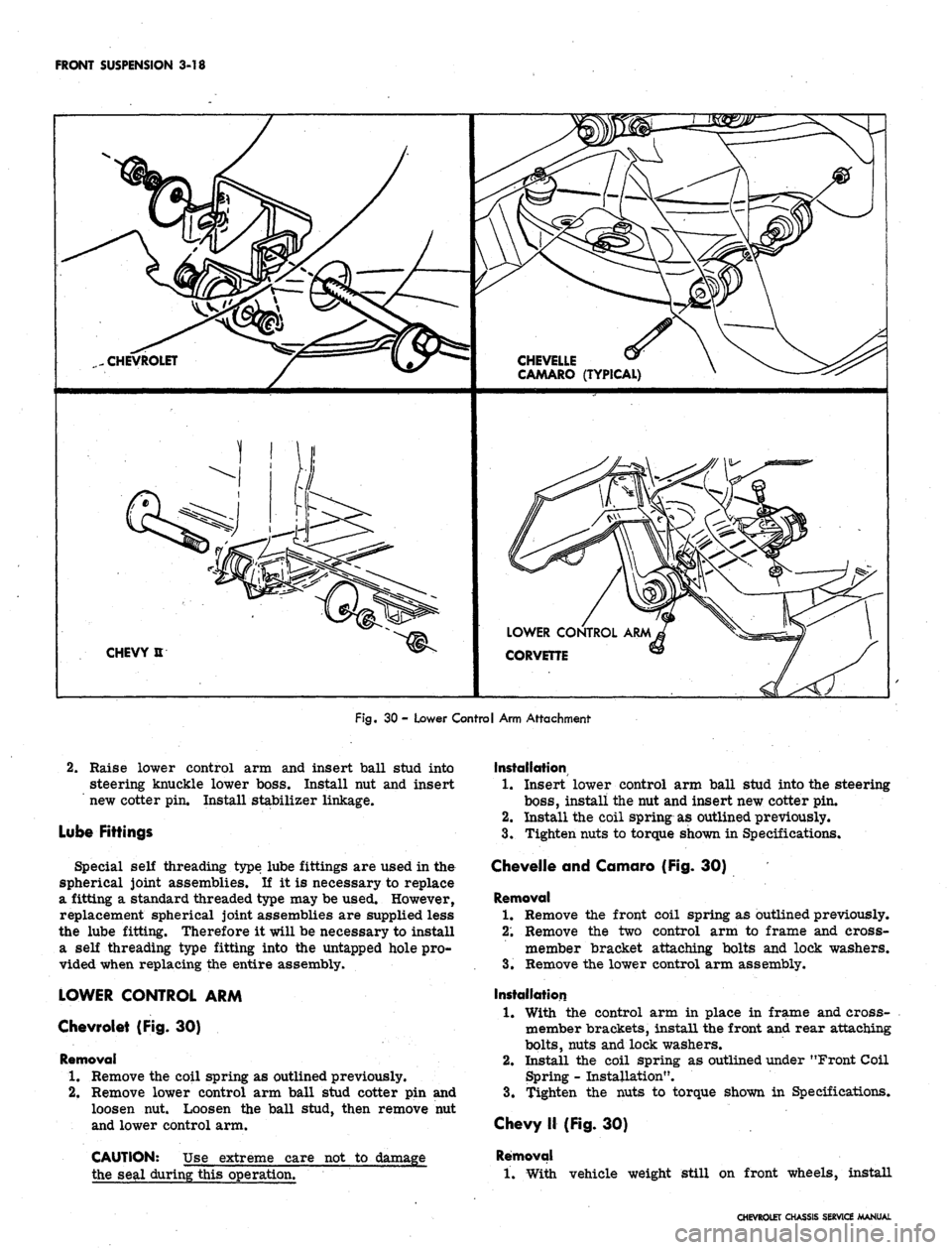
30 - Lower Control Arm Attachment
2.
Raise lower control arm and insert ball stud into
steering knuckle lower boss. Install nut and insert
new cotter pin. Install stabilizer linkage.
Lube Fittings
Special self threading type lube fittings are used in the
spherical joint assemblies. If it is necessary to replace
a fitting a standard threaded type may be used. However,
replacement spherical joint assemblies are supplied less
the lube fitting. Therefore it will be necessary to install
a self threading type fitting into the untapped hole pro-
vided when replacing the entire assembly.
LOWER CONTROL ARM
Chevrolet (Fig. 30)
Removal
1.
Remove the coil spring as outlined previously.
2.
Remove lower control arm ball stud cotter pin and
loosen nut. Loosen the ball stud, then remove nut
and lower control arm.
CAUTION: Use extreme care not to damage
the seal during this operation.
Installation
1.
Insert lower control arm ball stud into the steering
boss,
install the nut and insert new cotter pin.
2.
Install the coil spring as outlined previously.
3.
Tighten nuts to torque shown in Specifications.
Chevelle and Camaro (Fig. 30)
Removal
1.
Remove the front coil spring as outlined previously.
2;
Remove the two control arm to frame and cross-
member bracket attaching bolts and lock washers.
3.
Remove the lower control arm assembly.
Installation
1.
With the control arm in place in frame and cross-
member brackets, install the front and rear attaching
bolts,
nuts and lock washers.
2.
Install the coil spring as outlined under "Front Coil
Spring - Installation".
3.
Tighten the nuts to torque shown in Specifications.
Chevy II (Fig. 30)
Removal
1.
With vehicle weight still on front wheels, install
CHEVROLET CHASSIS SERVICE MANUAL
Page 191 of 659
SECTION
4
REAR SUSPENSION
AND
DRIVE LINE
CONTENTS
OF
THIS SECTION
Page
Rear Suspension
4-1
Drive Line.
. 4-26
Rear Axle ......
4-26
Propeller Shaft
and
Universal Joints
Special Tools
4-37
4-43
REAR SUSPENSION
INDEX
General Description
4-1
Chevrolet
4-1
Chevelle
4-1
Chevy
n and
Camaro
. . . . . 4-2
Corvette
. . . . . . 4-3
Maintenance
and
Adjustments ...............
4-4
Riding Height Check (Chevrolet, Camaro,
Chevelle
and
Chevy
II) 4-5
Wheel Alignment (Corvette)
4-5
Wheel Bearing Adjustment (Corvette)
4-6
Component Parts Replacement (Chevrolet, Camaro,
Chevelle
and
Chevy
JJ) 4-7
Coil Spring
4-7
Chevrolet
4-7
Removal
4-7
Installation
4-7
Chevelle
4-8
Removal
4-8
4-8
Installation
.
Leaf Spring, Spring Seat Pads, Spring
Eye
Bushings
4-9
Chevy
H 4-9
Removal
4-9
Installation
4-9
Camaro
4-10
Removal
4-10
Installation
4-11
Shock Absorber
4-11
Chevrolet
and
Chevelle
. 4-11
Removal
4-11
Installation
. . 4-12
Chevy
II 4-12
Removal
4-12
Installation
4-rl2
Camaro
4-12
Removal
. 4-12
Installation
4-12
Control
Arm . . 4-12
Chevrolet Upper
4-12
Removal
. 4-12
Page
Bushing Replacement
. 4-13
Installation
4-14
Chevrolet Lower
4-14
Removal
4-14
Bushing Replacement
4-14
Installation
. 4-15
Chevelle Upper
and
Lower.
. 4-15
Removal
4-15
Bushing Replacement
4-15
Installation
4-17
Rear Suspension
Tie Rod
(Chevrolet)
. . .
......
. . . 4-17
Removal
4-17
Bushing Replacement
4-17
Installation
4-17
Component Parts Replacement (Corvette)
. . 4-17
Wheel Spindle
and
Support
4-17
Removal
4-17
Repairs
', . 4-17
Installation
4-18
Differential Carrier Support Bracket Replacement.
. 4-20
Shock Absorber
4-20
Removal
4-20
Installation
* .... 4-20
Strut
Rod and
Bracket
4-20
Removal
4-20
Repairs
4-21
Installation
4-21
Spring
4-21
Removal
4-21
Repairs
4-22
Installation
4-22
Torque Control
Arm 4-23
Removal
4-23
Repairs
. 4-23
Installation
4-24
Suspension Crossmember
4-24
Removal
4-24
Repairs—Isolation Mount
4-25
Installation
4-25
Stabilizer Shaft Replacement
4-25
GENERAL DESCRIPTION
CHEVROLET
The link type rear suspension (fig. 1) has two lower
control arms which maintain proper axle to frame re-
lationship and also take the acceleration, drive and
braking forces. A single upper control arm on light-
duty models (or two upper control arms on heavy-duty
models and all station wagons) limits axle rotation when
drive, acceleration or braking forces are applied. Lateral
movement of the axle is restricted by the axle-to-frame
tie rod. Two full coil springs and two direct, double
acting shock absorbers are provided for additional ride
control.
CHEVELLE
The rear suspension (fig. 2) is of the four-link design
utilizing axle mounted, full coil springs and direct,
double-acting shock absorbers.
Two rubber-bushed lower control arms, stretching
slightly outboard from axle-mounted brackets to frame
side member mounted brackets, maintain fore and aft
CHEVROLET CHASSIS SERVICE MANUAL
Page 216 of 659
REAR SUSPENSION
AND
DRIVE LINE
4-26
DRIVE LINE
REAR AXIE
INDEX
Page
General
Description
4-26
Chevrolet,
Camaro,
Chevelle
and
Chevy
II 4-26
Corvette
4-26
Maintenance
and
Adjustments
4-27
Lubricant
4.37
Lubricant'
Leaks
4_27
Axle Bolts
and
Wheel
Nuts
4-27
Rear Axle Noise
Diagnosis
4-29
Gear Noise
4_29
Bearing
Noise
4-29
Failure
Analysis
4^9
Hypoid
Gears
4..3Q
Differential Gears. 4_30
Bearings
....'.
4.30
Component Parts Replacement
(Chevrolet, Chevelle, Camaro and Chevy n ..... 4.30
Axle Assembly ,. . 4_30
Removal 4 30
Installation * ' 4 3Q
Axle Shaft . . . 4-31
Removal 4-31
Wheel Bolt Replacement 4-31
Oil Seal and/or Bearing Replacement. 4-31
Brake Flange Plate Replacement 4-31
Installation 4-32
Pinion Flange, Dust Deflector and/or
Oil Seal Replacement 4-32
Component Parts Replacement (Corvette) 4-34
Axle Driveshaft .- 4-34
Removal 4-34
Repairs 4-34
Installation. . 4-34
Pinion Flange, Dust Deflector and/or Oil Seal. .... 4-35
Removal 4-35
Inspection . 4-35
Installation .- 4-35
Differential Carrier 4-36
Removal 4-36
Installation 4-36
Positraction Differential Unit-On the Vehicle Check . . 4-37
\
GENERAL DESCRIPTION
CHEVROLET, CHEVELLE, CHEVY
I! AND
CAMARO
The rear axle
(fig. 72) is a
semifloating, fabricated
construction type consisting
of a
cast carrier with large
bosses
on
each
end
into which
two
welded steel tubes
are fitted.
The
carrier contains
an
overhung hypoid
pinion
and
ring gear.
The
differential
is a
two pinion
arrangement.
The axle housing
is
made up
of
two steel welded tubes
pressed into
the
crossbore
of the
cast carrier
-
each
tube
is
puddle welded
at
three places
to the
carrier.
Welded-on brackets provide attachment points
for
Chevelle springs,; shock absorbers,
and
lower control
arms.
Chevrolet models have welded-on brackets
for
control arms,
tie
rod, and shock absorbers. The housing
on Chevy II and Camaro has welded brackets
for
mounting
lower spring
pad
and shock absorber.
A
welded flange
is
provided
for
brake flange plate attachment.
The overhung hypoid drive pinion
is
supported
by
two
preloaded tapered roller bearings.
The
pinion shaft
is
sealed
by
means
of a
molded, spring loaded, rubber seal.
The seal
is
mounted
on the
pinion shaft flange which
is
splined and bolted
to
the hypoid pinion shaft.
The hypoid ring gear
is
bolted
to a
one-piece differen-
tial case which
is
supported
by two
preloaded tapered
roller bearings.
CORVETTE
The Corvette rear axle
is of the
type where
the dif-
ferential carrier housing enclosing
the
differential
and
hypoid gears
is
supported
on a
crossmember mounted
to
the chassis frame.
The
differential
is
connected through
universal joints
to the
drive shafts
and
wheels
(fig. 73).
The internal components
of the
carrier
are of
conven-
tional design, incorporating
a
hypoid gear
set
with
an
overhung pinion supported
on two
pre-loaded, tapered
roller bearing assemblies,
and a
two-pinion differential
assembly supported
on
tapered roller bearings. Pinion
mounting distance adjustments
are
made through the
use
of shims,
as are the
differential bearing pre-load
and
backlash adjustments.
The
differential side gears drive
two splined yokes which
are
retained laterally
by
snap
rings located on the yoke splined end. The yokes
are
sup-
ported on caged needle bearings pressed into
the
carrier,
adjacent
to the
differential bearings.
A
lip seal, pressed
in outboard
of
the bearings, prevents
oil
leakage and dirt
entry.
The
carrier cover
is
bolted
to the
carrier and
provides accessibility
to the
internal parts.
The
cover
incorporates two integral, reinforced mounting pads which
serve
as the
carrier attaching point
to the
suspension
crossmember,
and an
attaching point
for the
spring
center section. The filler plug
is
located on the right side
of the cover near the bolting flange.
All service operations allow carrier removal without
removing
the
carrier cover. Cover removal
is
not nec-
essary
in any of the
service procedures except
in
the
case
of
complete carrier housing replacement,
as the
carrier and cover
are
serviced
as
an assembly.
CHEVROLET CHASSIS SERVICE MANUAL