belt CHEVROLET CAMARO 1971 2.G User Guide
[x] Cancel search | Manufacturer: CHEVROLET, Model Year: 1971, Model line: CAMARO, Model: CHEVROLET CAMARO 1971 2.GPages: 88, PDF Size: 34.8 MB
Page 57 of 88
Downloaded from www.Manualslib.com manuals search engine Recommended Viscosity
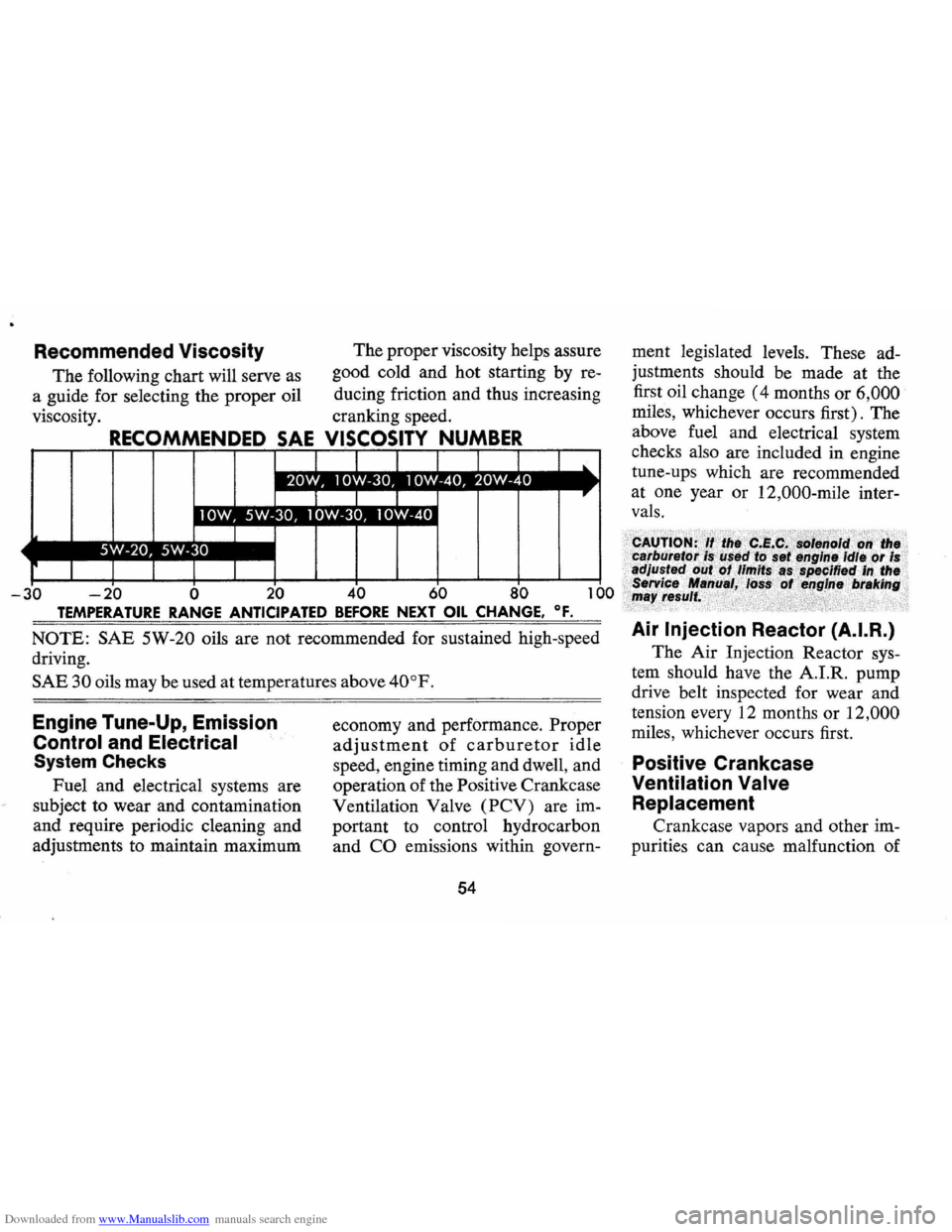
The following chart will serve as
a guide for selecting the proper oil
viscosity. The
proper viscosity helps assure
good cold and hot starting by re
ducing friction and thus increasing
cranking speed.
OSITY NUMBER
-20 0 20 60 0
TEMPERATURE RANGE ANTICIPATED BEFORE NEXT OIL CHANGE. OF.
NOTE: SAE 5W-20 oils are not recommended for sustained high-speed
driving.
SAE 30 oils may be used at temperatures above 40°F.
Engine Tune-Up, Emission
Control and Electrical
System Checks
Fuel and electrical systems are
subject to wear and contamination
and require periodic cleaning and
adjustments to maintain maximum economy
and performance. Proper
adjustment of carburetor idle
speed, engine timing and dwell, and
operation of the Positive Crankcase
Ventilation Valve
(PCV) are im
portant to control hydrocarbon
and
CO emissions within govern-
54
ment legislated levels. These ad
justments should be made at the
first oil change
(4 months or 6,000
miles, whichever occurs first). The
above fuel and electrical system
checks also are included in engine
tune-ups which are recommended
at one year or 12,000-mile inter
vals.
Air Injection Reactor (A.I.R.)
The Air Injection Reactor sys
tem should have the A.I.R. pump
drive belt inspected for wear and
tension every 12 months or
12,000
miles, whichever occurs first.
Positive Crankcase
Ventilation
Valve
Replacement
Crankcase vapors and other im
purities can cause malfunction of
Page 58 of 88
Downloaded from www.Manualslib.com manuals search engine the crankcase ventilation valve.
Regular replacement of the PCV
Valve
is recommended at 24-month
or
24,000-mile intervals.
G.M. Evaporation
Control SYltem
The Evaporation Control System
requires only periodic canister filter
servicing.
Every 12 months
or 12,000
miles, whichever occurs first, (more
often under dusty conditions) the
filter in the base of the canister
must be replaced and the canister
inspected.
Drive Beltl
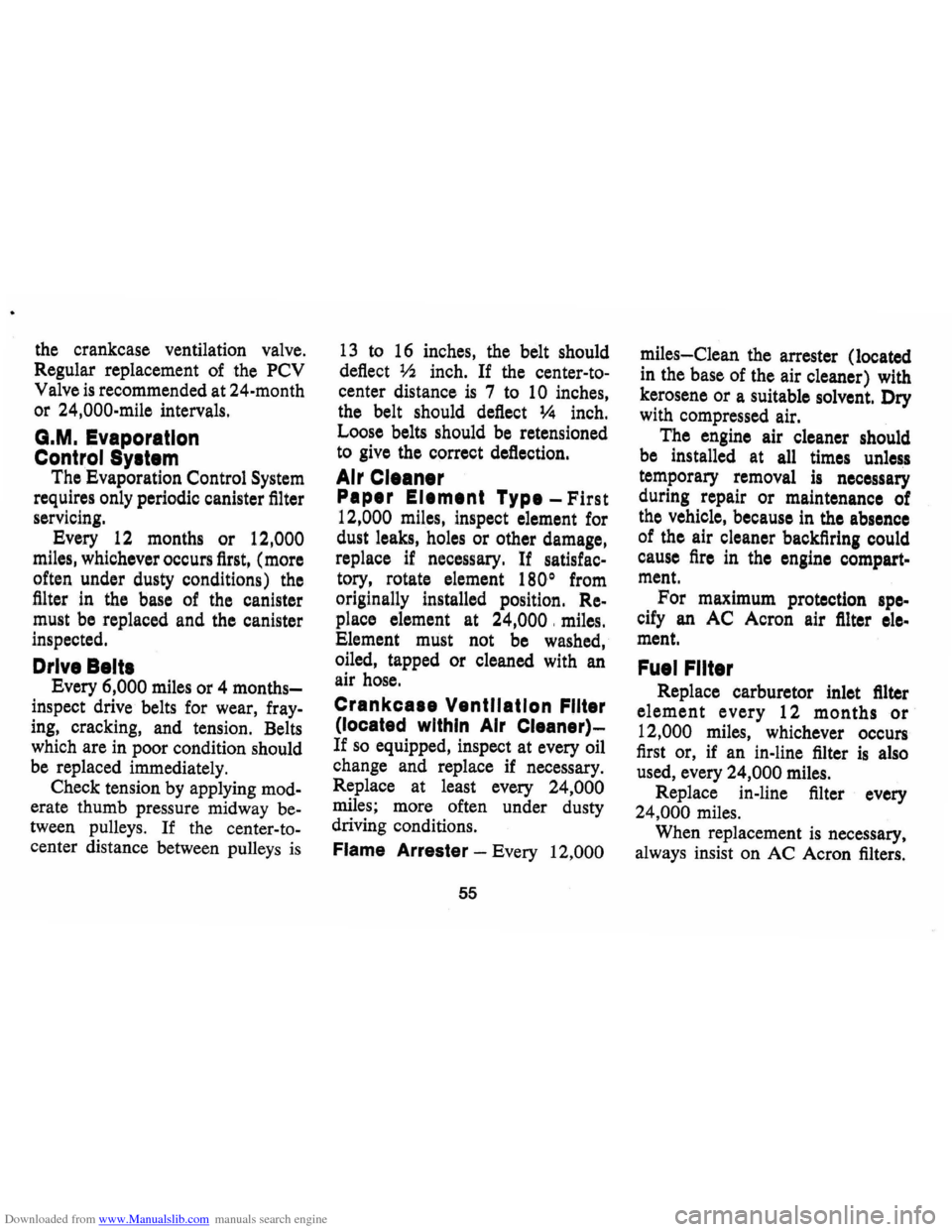
Every 6,000 miles or 4 months
inspect drive belts for wear, fray
ing, cracking, and tension. Belts
which are in poor condition should
be replaced immediately.
Check tension by applying
mod
erate thumb pressure midway be
tween pUlleys. If the center-to
center distance between pulleys
is
13 to 16 inches, the belt should
deflect
lh inch. If the center-to
center distance
is 7 to 10 inches,
the belt should deflect
1;4 inch.
Loose belts should be retensioned
to give the correct deflection.
Air Cleaner
Paper Ellment Type -First
12,000 miles, inspect element for
dust leaks, holes
or other damage,
replace
if necessary. If satisfac
tory, rotate element
1800 from
originally installed position.
Re
place element at 24,000, miles.
Element must not be washed,
oiled, tapped or cleaned with an
air hose.
Crankca.e Ventilation Filter
(located within Air Cleaner)
If so equipped, inspect at every oil
change and replace if necessary.
Replace at least every
24,000
miles; more often under dusty
driving conditions.
Flame Arrester -Every 12,000
55
miles-Clean the arrester (located
in the base of the air cleaner) with
kerosene
or a suitable solvent. Dry
with compressed air.
The engine air cleaner should
be installed at all times unless
temporary removal
is necessary
during repair or maintenance of
the vehicle, because in the absence
of the air cleaner backfiring could
cause
fire in the engine compart
ment.
For maximum protection spe
cify an AC Acron air filter ele
ment.
Fuel Filter
Replace carburetor inlet filter
element every 12 months or
12,000 miles, whichever occurs
first or, if an in-line filter
is also
used, every
24,000 miles.
Replace in-line filter every
24,000 miles.
When replacement
is necessary,
always insist on AC Acron filters.
Page 65 of 88
Downloaded from www.Manualslib.com manuals search engine When driving on wet or slushy
roads, it
is possible for a wedge of
water to build up between the tire
and road surface. This phenome
non, known as hydroplaning, may
cause partial or complete loss of
traction, which adversely affects
vehicle control and stopping abil
ity.
To reduce the possibility of
traction loss, the following pre
cautions should be observed:
1. Slow down during rainstorms or
when roads are slushy.
ENGINE AND BODY
2. Slow down if road has standing
water or puddles.
3. Replace tires when tread wear
indicators are visible. (See
Safety Checks section.)
4. Keep tires properly inflated.
For temporary assistance when
traction
is lost on ice or snow, the
use of
AC Liquid Tire Chain is
recommended.
Optional Tires
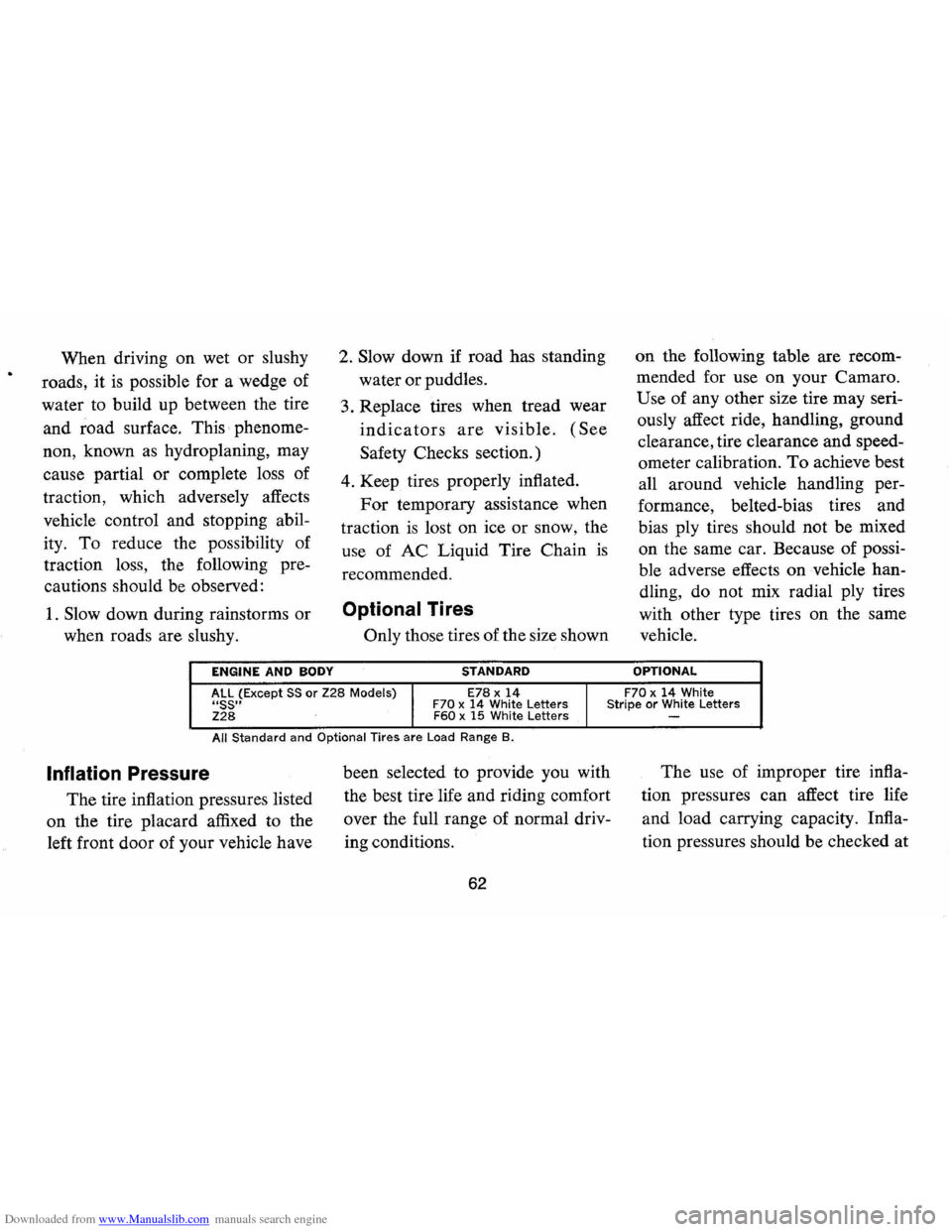
Only those tires of the size shown
STANDARD
on the following table are recom
mended for use on your Camaro.
Use of any other size tire may seri
ously affect ride, handling, ground
clearance, tire clearance and speed
ometer calibration.
To achieve best
all around vehicle handling per
formance, belted-bias tires and
bias ply tires should not be mixed
on the same car. Because of possi
ble adverse effects
on vehicle han
dling, do not mix radial ply tires
with other type tires on the same
vehicle.
OPTIONAL
ALL (Except SS or Z28 Models) I "ss" Z28
E78 x 14 F70 x 14 White Letters F60 x 15 White Letters Stripe or White Letters
I
F70 x 14 White
All
Standard and Optional Tires are Load Range B.
Inflation Pressure
The tire inflation pressures listed
on the tire placard affixed to the
left front door of your vehicle have been
selected to provide you with
the best tire life and riding comfort
over the full range of normal driv
ing conditions.
62
The use of improper tire infla
tion pressures can affect tire life
and load carrying capacity. Infla
tion pressures should be checked at
Page 69 of 88
Downloaded from www.Manualslib.com manuals search engine MAINTENANCE SCHEDULE
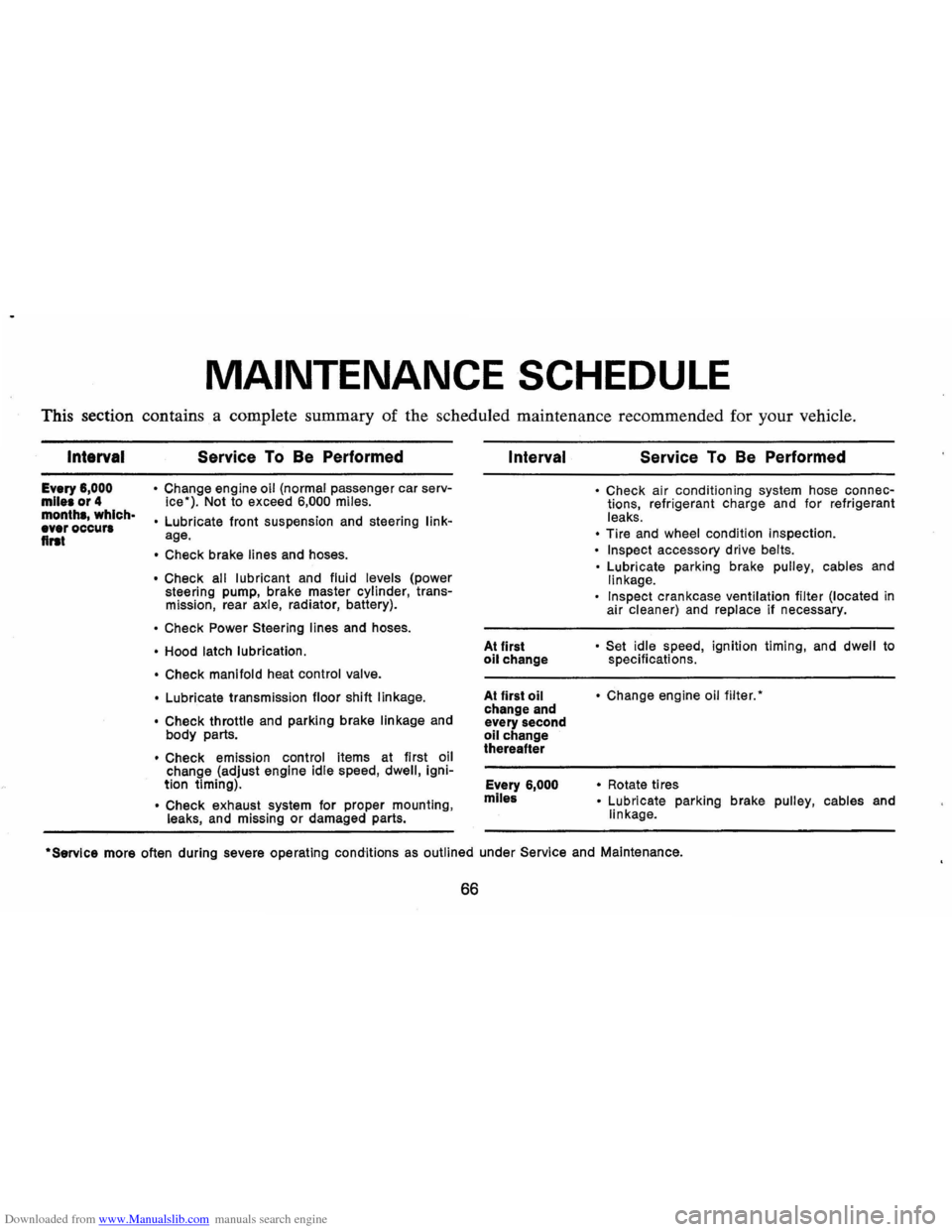
This section contains a complete summary of the scheduled maintenance recommended for your vehicle.
Intarval
Every 6,000 mile. or 4 month., which· ever occur. flrat
Service To Be Performed
• Change engine oil (normal passenger car serv
ice"). Not to exceed 6,000 miles.
•
Lubricate front suspension and steering linkage.
• Check brake lines and hoses.
• Check all lubricant and fluid levels (power
steering pump, brake master cylinder, transmission, rear axle, radiator, battery).
• Check Power Steering lines and hoses.
• Hood latch lubrication.
• Check manifold
heat control valve.
•
Lubricate transmission floor shift linkage.
• Check
throttle and parking brake linkage and
body parts.
• Check emission control items at first oil
change (adjust engine idle speed, dwell, ignition timing) .
• Check exhaust system for proper mounting , leaks, and missing or damaged parts.
Interval
At first oil change
At first
oil change and
every second
oil change
thereafter
Every
6,000
mlle&
Service To Be Performed
• Check air conditioning system hose connections, refrigerant charge and for refrigerant
leaks.
• Tire and wheel condition inspection.
• Inspect accessory drive belts.
•
Lubricate parking brake pulley, cables and linkage.
Inspect crankcase ventilation filter (located in
air cleaner) and replace if necessary.
• Set idle speed , ignition timing, and dwell to
specifications.
• Change engine oil filter."
•
Rotate ti res • Lubricate parking brake pulley, cables and
linkage .
·Servlce more often during severe operating conditions as outlined under Service and Maintenance.
66
Page 70 of 88
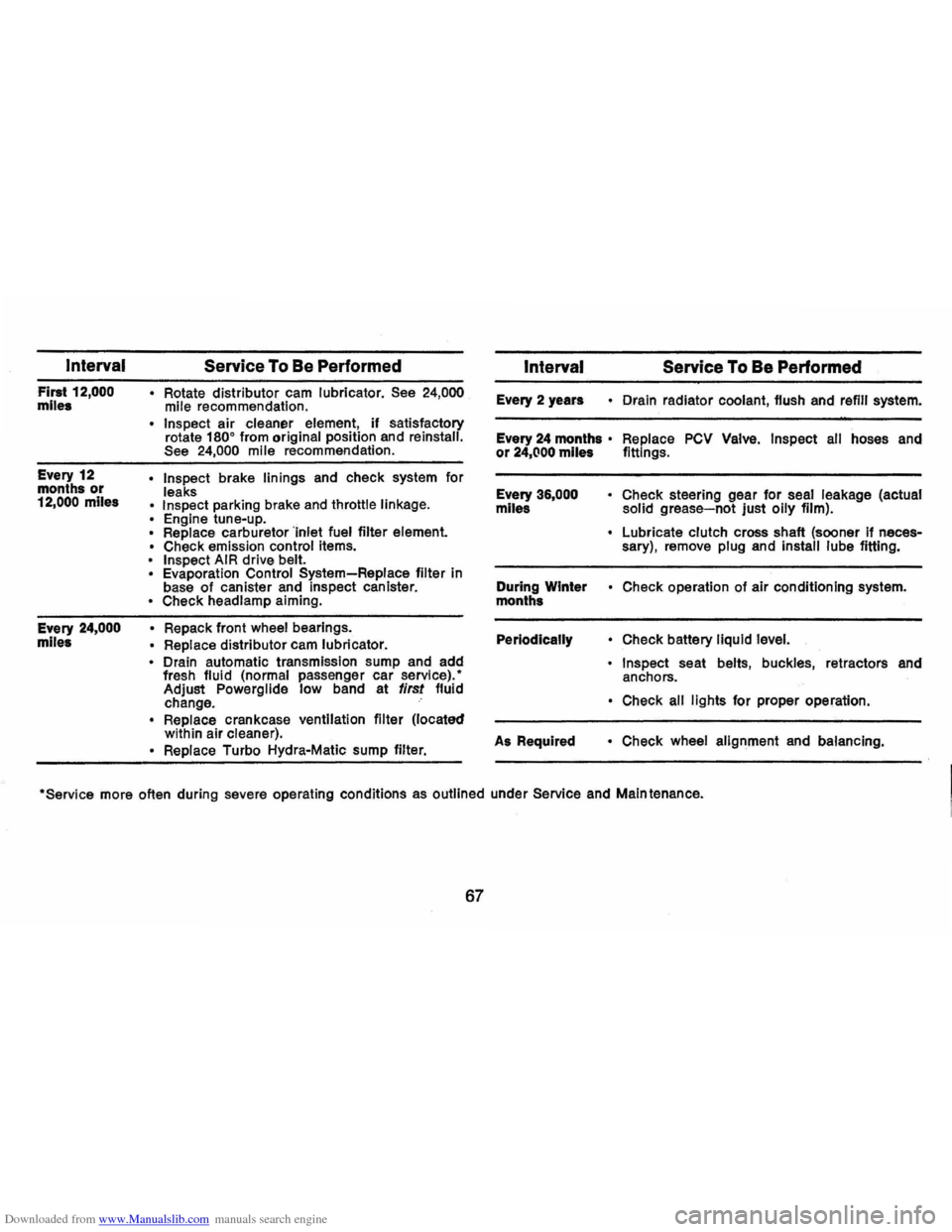
Downloaded from www.Manualslib.com manuals search engine Interval
First 12,000 miles Every 12
months
or 12,000 miles
Every
24,000 miles
Service To Be Performed
• Rotate distributor cam lubricator. See 24,000 mile recommendation.
• Insp .ect air cleaner element, if satisfactory
rotate 1800 from original position and reinstall. See 24,000 mile recommendation.
• Inspect brake linings and check system for
leaks
• Inspect parking brake and throttle linkage. • Engine tune-up.
Replace carburetor 'Inlet fuel filter element. • Check emission control items. • Inspect AIR drive belt.
Evaporation Control System-Replace filter in
base of canister and inspect canister. • Check headlamp aiming.
• Repack front wheel bearings.
• Replace distributor cam lubricator. • Drain automatic transmission sump and add
fresh fluid (normal passenger car service).' Adjust Powerglide low band at first fluid
change.
• Replace crankcase ventilation filter (located
within air cleaner).
• Replace Turbo Hydra-Matic sump filter.
Interval Service To Be Performed
Every 2 years • Drain radiator coolant, flush and refill system.
Every
24 months· Replace PCV Valve. Inspect all hoses and or 24,(100 miles fittings.
Every
36,000 • Check steering gear for seal leakage (actual
miles solid grease-not just oily film).
• Lubricate clutch cross shaft (sooner if necessary), remove plug and install lube fittIng.
During Winter
• Check operation of air conditioning system.
months
Periodically • Check battery liquid leve/.
• Inspect seat belts, buckles, retractors and
anchors.
• Check all lights for proper operation.
As Required
• Check wheel alignment and balancing.
'Service more often during severe operating conditions as outlined under Service and Maintenance.
67
Page 74 of 88
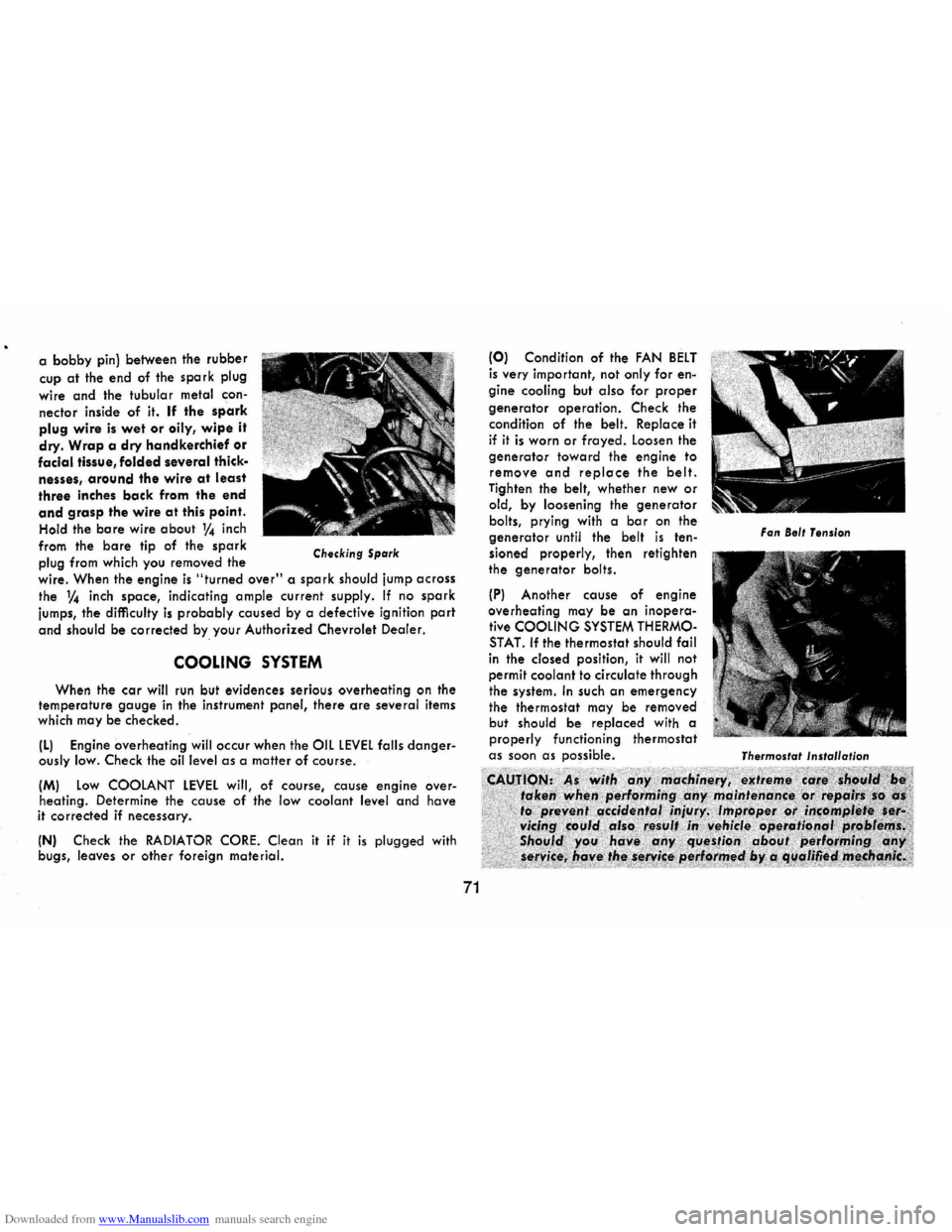
Downloaded from www.Manualslib.com manuals search engine a bobby pin) between the rubber
cup at the end of the spark plug
wire
and the tubular metal con
nector inside of it. If the spark plug wire is wet or oily, wipe it
dry. Wrap a dry handkerchief or facial tissue, folded several thick·
nesses, around the wire at least
three inches back from the end
and grasp the wire at this point.
Hold the bare wire about 1f4 inch
from the
bare tip of the spark
plug from which you removed the Checking Spark
wire. When the engine is "turned over" a spark should jump across
the 1f4 inch space, indicating ample current supply. If no spark
jumps, the difficulty is probably caused by a defective ignition part
and should be corrected by. your Authorized Chevrolet Dealer.
COOLING SYSTEM
When the car will run but evidences serious overheating on the temperature gauge in the instrument panel, there are several items
which may be checked.
(L) Engine overheating will occur when the OIL LEVEL falls dangerously low. Check the oil level as a matter of course.
(M) Low COOLANT LEVEL will, of course, cause engine over
heating. Determine the cause of the low coolant level and have
it corrected if necessary.
(N) Check the RADIATOR CORE. Clean it if it is plugged with
bugs, leaves or other foreign material.
71
(0) Condition of the FAN BELT is very important, not only for engine cooling but also for proper
generator operation. Check the
condition of the belt. Replace it if it is worn or frayed. Loosen the generator toward the engine to remove and replace the belt. Tighten the belt, whether new or old, by loosening the generator bolts, prying with a bar on the generator until the belt is ten
sioned properly, then retighten
the
generator bolts.
(P) Another cause of engine overheating may be an inoperative COOLING SYSTEM THERMOSTAT. If the thermostat should fail in the closed position, it will not
permit coolant to circulate through
the system.
In such an emergency the thermostat may be removed
but should be replaced with a properly functioning thermostat as soon as possible.
Fan Belt Tension
Thermostat
Installation
Page 87 of 88
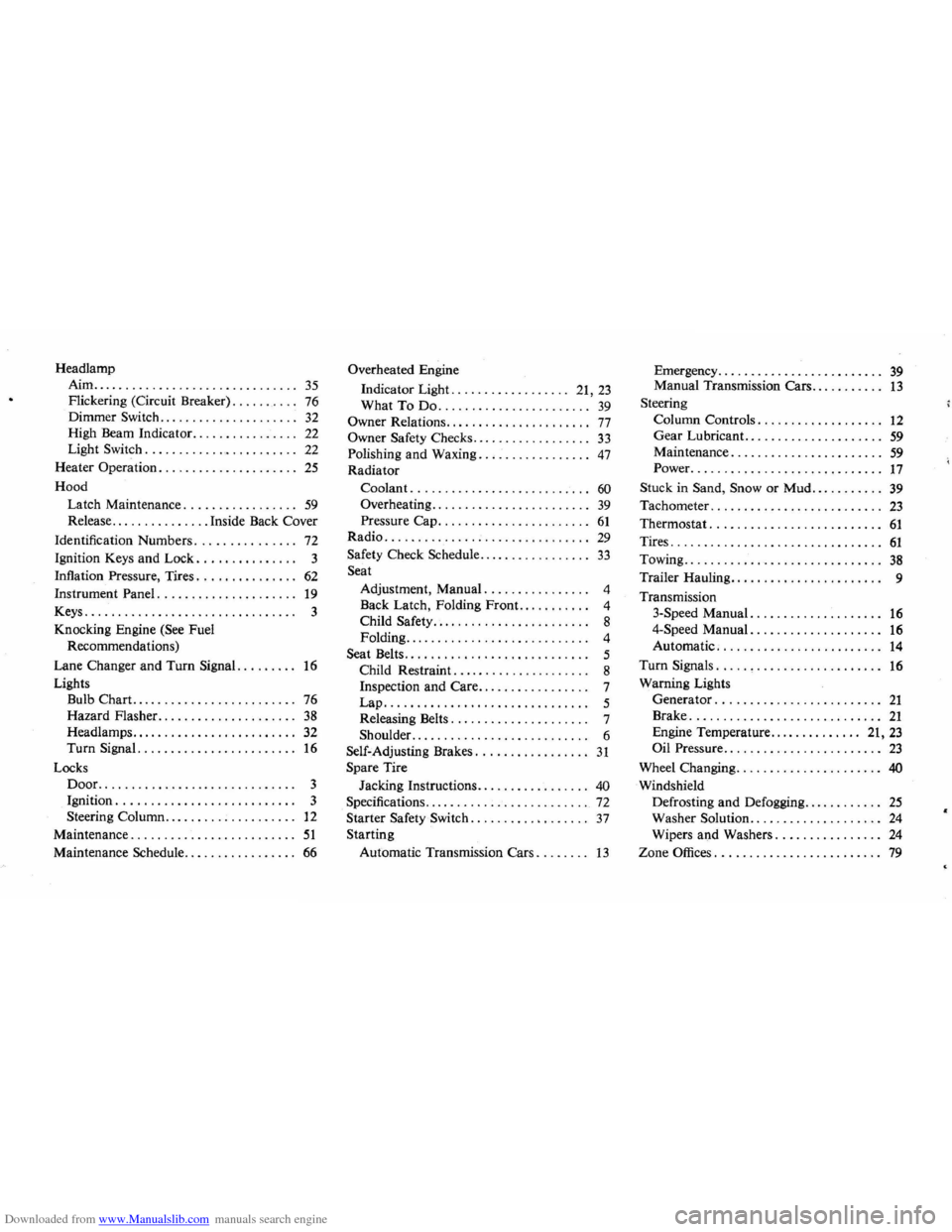
Downloaded from www.Manualslib.com manuals search engine Headlamp Aim
............................... 35 Flickering (Circuit Breaker). . . . . . . . . . 76
Dimmer Switch ..................... 32 High Beam Indicator ................ 22
Light Switch. . . . . . . . . . . .. . . . . . . . . .. 22
Heater Operation ..................... 25
Hood
Latch Maintenance. . . . . . . . . . . . . . .
.. 59
Release ............... Inside Back Cover
Identification Numbers. . . . . . . . . . . . .
.. 72
Ignition Keys and Lock. . . . . . . . . . . . . . . 3
Inflation Pressure, Tires. . . . . . . . . . . . . .. 62
Instrument Panel. . . . . . . . . . . . . . . . . . .
.. 19
Keys................................ 3
Knocking Engine
(See Fuel
Recommendations)
Lane Changer and Turn
Signal. . . . . . . . . 16
Lights
Bulb Chart. . . . . . . . . . . . . . . . . . . . . . .
.. 76
Hazard Flasher. .. . .. . .. . . .. . . .. . ... 38
Headlamps. . . . . . . . . . . . . . . . . . . . . . . .. 32
Turn Signal. . . . .. .. . .. . .. . . .. . . . ... 16
Locks Door............. ................. 3
Ignition. . . . . . . . . . . . . . . . . . . . . . . . . . . 3
Steering Column .................... 12
Maintenance. . . . . . . . . . . . . . . . . . . . . . . .. 51
Maintenance Schedule. . . . . . . . . . . . . . . .. 66
Overheated Engine
Indicator Light. .
.. .. .. .. .. .. .. .. 21, 23
What To Do. . . . . . . . . . . . . . . . . . . . . .. 39 Owner Relations ...................... 77
Owner Safety Checks .................. 33
Polishing and Waxing. . . . . . . . . . . . . . . .. 47 Radiator
Coolant
................... .. ...... 60
Overheating. . . . . . . . . . . . . . . . . . . . . . .. 39
Pressure Cap. . . . . . . . . . . . . . . . . . . . . .. 61
Radio ......... .. .................... 29
Safety Check Schedule.. .. . . . . . . . . . . . .. 33
Seat
Adjustment, Manual. . . . . . . . . . . . . .
.. 4
Back Latch, Folding Front. ......... , 4
Child
Safety. . . . . . . . . . . . . . . . . . . . . . .. 8
Folding............................ 4
Sea t Belts. . . . . . . . . . . . . . . . . . . . . . . . . . .. 5
Child Restraint. ..
.. .. . . . . . . . . . . . . .. 8
Inspection and Care. . . . . . . . . . . . . . .
.. 7
Lap............................... 5
Releasing Belts. .. . . . . . . . . . . . . . . . . .. 7
Shoulder...
.. . . .. . ... . .... . . . . . . . .. 6
Self~Adjusting Brakes .............. ... 31 Spare Tire
Jacking Instructions
................ , 40
Specifications ......................... 72
Starter Safety Switch. . . . . . . . . . . . . . . . .. 37
Starting
Automatic Transmission Cars. . . . . . .. 13
Emergency . . . . . . . . . . . . . . . . . . . . . . . .. 39 Manual Transmission Cars ........... 13
Steering
Column Controls. . . . . . . . . . . . . . . . . .. 12
Gear Lubricant. . . . . . . . . . . . . . . . . . . .. 59
Maintenance . . . . . . . . . . . . . . . . . . . . . .. 59
Power. ............................ 17
Stuck in Sand, Snow or Mud ........... 39
Tachometer. . . . . . . . . . . . . . . . . . . . . . . . .. 23
Thermostat. . . . . . . . . . . . . . . . . . . . . . . . .. 61
Tires ................................ 61
Towing .......... ........... ......... 38
Trailer Hauling. . . . . . . . . . . . . . . . . . . . . . . 9
Transmission
3-Speed Manual. ........... ~ . . . . . .. 16
4-Speed Manual.. . .. . . .. . . . .. . . .... 16
Automatic. . . . . . . . . . . . . . . . . . . . . . . .. 14
Turn Signals. . . . . • . . . . . . . . . . . . . . . . . .. 16
Warning Lights
Generator. . . . . . . . . . . . . . . . . . . . . . .
.. 21 Brake ............................. 21
Engine Temperature .............. 21, 23
Oil Pressure ........................ 23
Wheel Changing .................... .. 40
Windshield
Defrosting and Defogging.. . . . . . . . . ..
25
Washer Solution .................... 24
Wipers and Washers ................ 24
Zone Offices. . . . . . . . . . . . . . . . . . . . . . . .. 79