light CHEVROLET CAMARO 1973 2.G User Guide
[x] Cancel search | Manufacturer: CHEVROLET, Model Year: 1973, Model line: CAMARO, Model: CHEVROLET CAMARO 1973 2.GPages: 84, PDF Size: 32.64 MB
Page 27 of 84

Downloaded from www.Manualslib.com manuals search engine Generator Indicator Light
The red light will go on when
the ignition key
is in the "on" posi
tion, but before the engine
is
started. After the engine starts, the
light should go out and remain out.
If the light remains on when engine
is running, have your Authorized
Chevrolet Dealer locate and correct
the trouble as soon
as possible.
Engine Temperature
Indicator Light
This indicator light is provided
in the instrument cluster to quickly
warn of an overheated engine. With
,the ignition switch in the START
position, the red
TEMP indicator
will light to let you know that it
is
operating properly.
When the engine
is started, the
red light will go out immediately.
It will light up at no other time
unless for some reason the engine reaches
a dangerously high oper
ating temperature.
If the red light
should come on, the engine must be
stopped until the cause of the over
heating
is corrected. Glance at in
strument cluster frequently
as you
drive to see if this light
is on.
Brake System Warning
Light
The service brake system is de
signed
so that half of the brake sys
tem will provide some braking ac
tion in the event of a hydraulic leak
in the other half of the system.
If
the warning light located at lower
left of instrument cluster (speed
ometer face), glows continuously
when the ignition
is on and after
the brakes have been firmly applied
it may indicate that there
is a mal
function in one half of the brake
hydraulic system.
On cars equipped
with front drum brakes, the light
24
will go out when foot is removed
from brake pedal.
• As a check on bulb condition
the light should glow with the
parking brake applied and the
ignition on. (Light
is also a re
minder to release parking brake.)
• Have system repaired if light
does not come
on during check.
• This warning light is. not a' sub
stitute for the visual check of
brake fluid level required
as part
of normal maintenance.
If the light glows red:
• The parking brake control is not
fully released or,
• The service brake system is par
tially inoperative.
What to do:
1. Check that the parking brake is
released. If it is ...
2. Pull off the road and stop, care
fully-remembering that:
Page 28 of 84

Downloaded from www.Manualslib.com manuals search engine • Stopping distances may be
greater.
• Greater pedal effort may be re
quired .
• Pedal travel may be greater.
3.
Tryout brake operation by
starting and stopping on road
shoulder-then:
• If you judge such operation to
be safe, proceed cautiously at a
safe speed to nearest dealer for
repair.
• Or have car towed to dealer for
repair.
Continued operation of the car
in this condition
is dangerous.
Headlight Beam Indicator
Light
The headlights of your car have
high and low
beams to provide you with
proper night-time visibility
for most driving conditions. The
"low" beams are used during most
city driving. The
"high" beams are
especially useful when driving on
dark roads since
they' provide ex
cellent long range illumination.
The headlight beam indicator will
be on whenever the high beams
or
"brights" are in use. The Headlight
Beam Switch controls the headlight
beams (see Page
21).
Light Switch
The three position light switch
controls the headlights, taillights,
parking lights, side marker lights,
instrument lights and dome lights
as shown. The headlamp circuit is
protected by a circuit breaker in the
light switch.
An overload on the
breaker will cause the lamps to
"flicker" on and off. If this condi
tion develops, have your headlamp
wiring checked immediately.
PARKING LAMPS MARKER LAMPS TAIL AND INSTRUMENT LIGHTS
TURN KN08 TO VARY INSTRUMENT LIGHTS FUll Y COUNTER CLOCKWISE FOR DOME LIGHTS
25
HEADLIGHTS
PARKING LAMPS MARKER LAMPS
Page 29 of 84
Downloaded from www.Manualslib.com manuals search engine k)
2530 35404550
15 55
10 60
5 65 RPM/tOO 70 Illm
Optional Instruments and Gauges
Tachometer and Oil Pressure Indicator Light
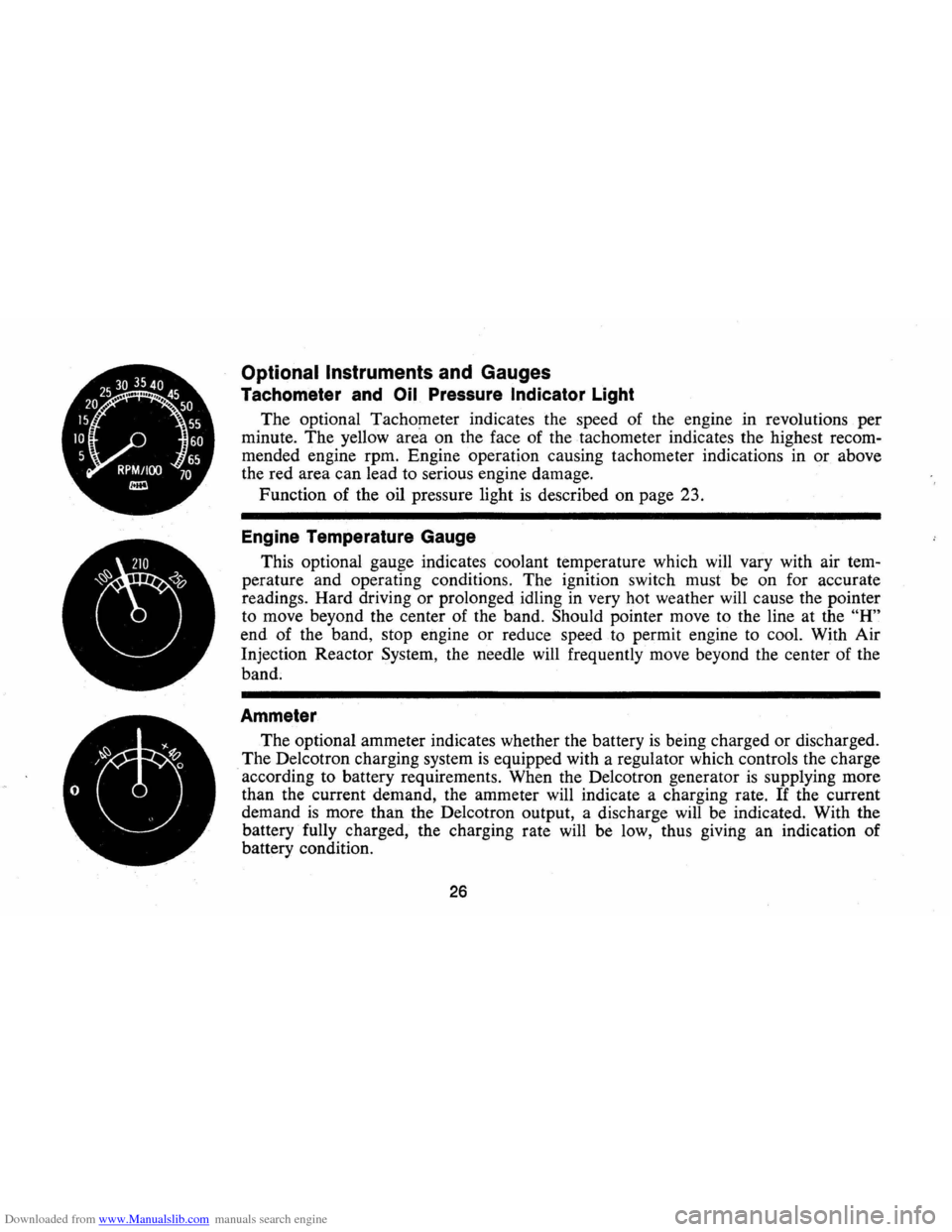
The optional Tachometer indicates the speed of the engine in revolutions per
minute . The yellow are'a on the face of the tachometer indicates the highest recom
mended engine rpm. Engine operation causing tachometer indications in
or above
the red area can lead to serious engine damage.
Function of the oil pressure light
is described on page 23.
Engine Temperature Gauge
This optional gauge indicates coolant temperature which will vary with air tem
perature and operating conditions. The ignition switch must be on for accurate
readings. Hard driving or prolonged idling in very hot weather will cause the pointer
to move beyond the center of the band. Should pointer move to the line at the
"H"
end of the band, stop engine or reduce speed to permit engine to cool. With Air
Injection Reactor System, the needle will frequently move beyond the center of the
band.
Ammeter
The optional ammeter indicates whether the battery is being charged or discharged.
The Delcotron charging system
is equipped with a regulator which controls the charge
according to battery requirements. When the Delcotron generator
is supplying more
than the current demand, the ammeter will indicate a charging rate.
If the current
demand
is more than the Delcotron output, a discharge will be indicated. With the
battery fully charged, the charging rate will be low, thus giving an indication of
battery condition.
26
Page 30 of 84
Downloaded from www.Manualslib.com manuals search engine Clock Reset the clock, if your car is so
equipped, by pulling out the knob
and turning the hands clockwise if
slow, counterclockwise if fast. This
will, if the clock error
is five min
utes or more, automatically com
pensate for time gain
or lag. Sev
eral resettings, several days apart,
may be needed to properly adjust
the clock mechanism. Have your
clock cleaned and oiled by a com
petent clock serviceman at least
every two years.
Cigarette Lighter
The accessory cigarette lighter is
located on the instrument panel
face.
To operate, push it in. When
it becomes heated, it automatically
pops out ready for use.
Windshield Wiper
and Washer
The windshield wiping system
operates at two speeds and
is de
signed to wipe clear designated areas
of the windshield under most
inclement weather conditions. The
windshield wipers work electrically
and are not affected by engine op
eration. Push the control lever to the
right to start the electric windshield
wiper. The two-speed electric wiper
has both a
"low" and a "high" speed
position. Pressing the control will send a
measured amount of water or other
cleaning agent onto the windshield
and will also cause the wiper lever
to move, thus starting the wiper
motor. The wiper will then con
tinue to operate until manually
turned off at the wiper lever.
Fill the washer jar only
% full
during the winter to allow for ex
pansion if the temperature should
fall low enough to freeze the so
lution.
• Check washer fluid level regu
larly-do it frequently when the
weather is bad.
27
• Use fluid such as GM
OPTIKLEEN to prevent freez
ing damage, and to provide bet
ter cleaning.
• Do not use radiator anti-freeze in
windshield washer; it could
cause paint damage.
• In cold weather, warm the wind
shield with defrosters before us
ing
washer-to help prevent ic
fig that may seriously obscure
vision.
Ventilation System
Your Camaro incorporates a
ventilation system that provides
improved ventilation comfort,
made possible by the addition of
air vent provisions in the rear body
lock pillar. Another feature of the
system
is continuous low-speed
operation of the air conditioner
blower, resulting
in an uninter
rupted supply of outside air
flow
Page 36 of 84
Downloaded from www.Manualslib.com manuals search engine Chevrolet II All Transistor" Radios
To operate the radios, the igni
tion switch must be in
"ON" or
"ACC" position.
Push Button AM Radio
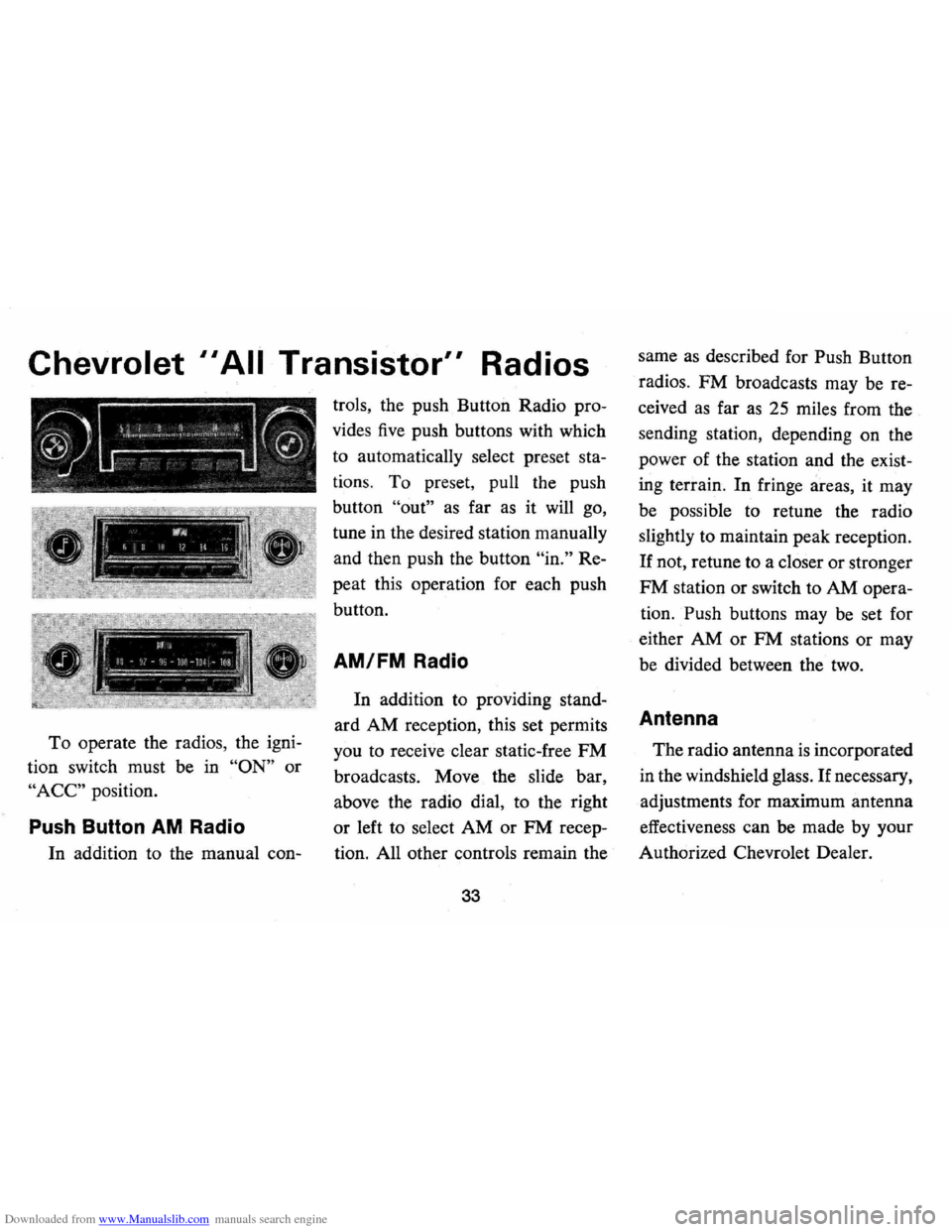
In addition to the manual con-troIs,
the push Button Radio pro
vides
five push buttons with which
to automatically select preset sta
tions. To preset, pull the push
button
"out" as far as it will go,
tune in the desired station manually
and then push the button
"in." Re
peat this operation for each push
button.
AM/FM Radio
In addition to providing stand
ard AM reception, this set permits
you to receive clear static-free
FM
broadcasts. Move the slide bar,
above the radio dial, to the right
or left to select AM or PM recep
tion. All other controls remain the
33
same as described for Push Button
radios.
FM broadcasts may be re
ceived
as far as 25 miles from the
sending station, depending on the
power of the station and the exist
ing terrain. In fringe areas, it may
be possible to retune the radio
slightly to maintain peak reception.
If not, retune to a closer or stronger
FM station or switch to AM opera
tion.Push buttons may be set for
either AM
or PM stations or may
be divided between the two.
Antenna
The radio antenna is incorporated
in the windshield glass.
If necessary,
adjustments for maximum antenna
effectiveness can be made by your
Authorized Chevrolet Dealer.
Page 39 of 84
Downloaded from www.Manualslib.com manuals search engine .1 n Case of Emergency
Four Way Hazard
Warning Flasher
• Use the warning flasher to warn
other drivers any time your
ve·
hicle becomes a traffic hazard,
day or night.
• Avoid stopping on the roadway
if possible.
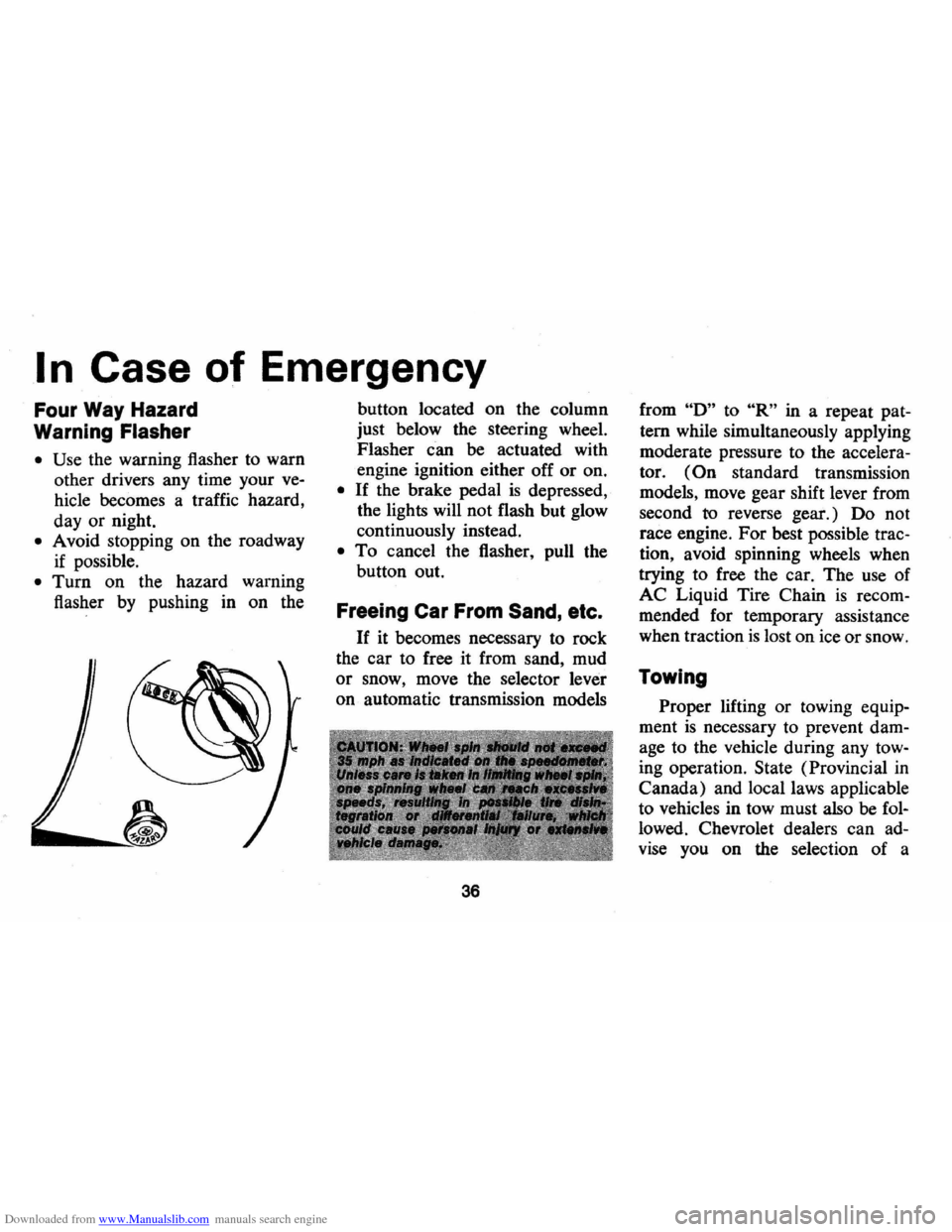
• Turn on the hazard warning
flasher
by pushing in on the
.---~
button located on the column
just below the steering wheel.
Flasher can be actuated with
engine ignition either off or on.
• If the brake pedal is depressed,
the lights will not flash but glow
continuously instead.
• To cancel the flasher, pull the
button out.
Freeing Car From Sand, etc.
If it becomes necessary to rock
the car to free it from sand, mud
or snow, move the selector lever
on automatic transmission models
36
from "0" to "R" in a repeat pat·
tern while simultaneously applying
moderate pressure to the
accelera
tor. (On standard transmission
models, move gear shift lever from
second
to reverse gear.) 00 not
race engine.
For best possible trac
tion, avoid spinning wheels when
trying to free the car. The use of
AC Liquid Tire Chain is recom
mended for temporary assistance
when traction
is lost on ice or snow.
Towing
Proper lifting or towing equip
ment is necessary to prevent dam
age to the vehicle during any tow
ing operation. State (Provincial in
Canada) and local laws applicable
to vehicles in tow must also be
fol
lowed . Chevrolet dealers can ad
vise you on the selection of a
Page 40 of 84
Downloaded from www.Manualslib.com manuals search engine knowledgeable towing concern.
Your Camaro may be towed on
all four wheels, at speeds of
less
than 35 mph, for distances up to
50 miles, provided driveline, axle
and transmission are otherwise
normally operable. For such tow
ing, parking brake must be re
leased, transmission must be in
neutral
and ignition lock turned to
OFF position. Attachments must
be to main structural members of
the car, not to bumpers or brac
keting. Separate safety chains
or
cables should be used. Remember
that power brake and steering
as
sists will not be available when
engine
is inoperative.
Emergency Starting
• Never tow the car to start be
cause the surge forward when
the engine starts could cause a
collision with the tow vehicle.
• Engines in vehicles with auto
matic transmissions cannot be
started by (towing
or) pushing
the car.
• To start the car when the Ener
gizer (battery)
is discharged,
use a single auxiliary battery or
Energizer of the same nominal
voltage
(12 volts) as the dis
charged battery, with suitable
jumper cables.
• Make connections as set forth
below under
"Jump Starting
with Auxiliary (Booster) Bat
tery" to lessen the chance of
personal injury
or property
damage.
Jump Starting with
Auxiliary (Booster) Battery
Both booster and discharged
battery should be treated carefully
when using jumper cables. Follow
37
exactly the procedure outlined be
low, being careful not to cause
sparks:
1. Set parking brake and place
automatic transmission in
"PARK" (neutral for manual
transmission). Turn
off lights,
heater and other electrical loads.
2. Remove vent caps from both
the booster and the discharged
batteries. Lay a cloth over the
open vent wells of each battery.
These two actions help reduce
the explosion hazard always
Page 43 of 84

Downloaded from www.Manualslib.com manuals search engine • Activate hazard warning flasher.
• Block both the front and back
of the wheel diagonally opposite
the jack position.
Remove
hubcap or wheel cover
with flat end of wheel
nut wrench
and loosen wheel nuts slightly.
Set
lever on jack to UP position.
Properly position load rest which
engages bumper by moving base of
NOTE: Base of jack column
should be slightly angled in toward
car since it will straighteri
as car is
raised.
jack slightly under car and engage
tang of
bracket in bumper notch,
then bring jack base back toward
upright position. Check that
l~ad
rest is positioned before operatmg
jack.
40
Jack Operation
After jack is positioned as noted
above use
wheel nut wrench as . ,
jack handle and raise car until tire
clears ground. Remove wheel nuts
and wheel, install spare and tighten
wheel nuts. Move jack lever to
DOWN and install hub cap or
wheel cover.
Page 45 of 84
Downloaded from www.Manualslib.com manuals search engine Cleaning Fabrics with
Cleaning
Fluid
This type of cleaner should be
used for cleaning stains containing
grease, oil or fats. Exces s stain
should be gently scraped off with
a clean dull knife
or scraper. Use
very little cleaner, light pressure,
and clean cloths (preferably cheese
cloths) . Cleaning action with cloth
should be from outside of stain to
wards center and constantly chang
ing to a clean section of cloth.
When stain
is cleaned from fabric,
immediately wipe
area briskly with
a clean absorbent towel or cheese
cloth to help dry area and prevent
a cleaning ring.
If ring forms, im
mediately clean entire area or panel
section of the trim assembly.
NOTE: Sometimes a difficult spot
may require a second application
of cleaning fluid followed immedi- ately
by a soft brush to completely
remove the spot.
Cleaning Fabrics with
Detergent Foam Cleaners
This type of cleaner is excellent
for cleaning general soilage from
fabrics and for cleaning a panel sec
tion where a minor cleaning ring
may be left from spot cleaning.
Vacuum area to remove excess
loose dirt. Always clean at least a
full trim panel or section of trim.
Mask adjacent trim along stitch or
weld lines. Mix detergent type foam
cleaners in strict accordance with
directions on label of container.
Use
foam only on a clean sponge or
soft bristle brush -Do not wet
fabric excessively or rub harshly
with brush. Wipe clean with a
slightly damp absorbent towel
or
cloth. Imm~diately after cleaning
fabric, dry fabric with a dry towel
42
or hair dryer. Rewipe fabric with
dry absorbent towel
or cloth to re
store the luster of the trim and to
eliminate any dried residue.
Seat Belt Care
• Clean only with mild soap solu
tion and lukewarm water.
• Do not bleach or dye belts since
this may severely weaken belts.
Removal of Specific Stains
Candy -Chocolate, use cloth
soaked in lukewarm water; other
than chocolate, use very hot water.
Dry.
If necessary, clean lightly with
fabric cleaning fluid.
Chewing Gum-Harden gum with
ice cube and scrape off with dull
knife. Moisten with fabric cleaning
fluid and scrape again.
Page 46 of 84
Downloaded from www.Manualslib.com manuals search engine Fruit Stains, Coffee, Soft Drinks,
Ice Cream and Milk-Wipe with
cloth soaked in cold water.
If nec
essary clean lightly with fabric
cleaning fluid.
Soap and water is
not recommended as it might set
the stain.
Catsup-Wipe with cloth soaked in
cool water.
If further cleaning is
necessary, use a detergent foam
cleaner.
Grease, Oil, Butter, Margarine
and Crayon -
Scrape off excess
with dull knife.
Use fabric cleaning
fluid.
Paste or Wax Type Shoe Polish
-Light applications of fabric clean
ing fluid.
Exterior Appearance
Your car is finished with General
Motors "Magic-Mirror" acrylic
lacquer. This is a finish of maxi
mum beauty which, in depth of
color, gloss retention and durability
Tar -Remove excess with dull
knife, moisten with fabric cleaning
fluid, scrape again, rub lightly with
additional cleaner.
Blood -Wipe with clean cloth
moistened with cold water. Use no
soap.
Urine -Sponge stain with luke
warm soap suds from mild neutral
soap on clean cloth, rinse with cloth
soaked in cold water, saturate cloth
with one
part household ammonia
and 5 parts water, apply for 1 min
ute, rinse with clean, wet cloth.
Vomitus-Sponge with clean cloth
dipped
in clean, cold water. Wash
lightly with lukewarm water
and
is superior to conventional lacquer
finishes.
Washing Your Car
The best way to preserve the
finish and maintain original beauty
43
mild neutral soap. If odor persists,
treat area with a water-baking soda
solution (1 teaspoon
baking soda
to one cup of tepid water).
Rub
again with cloth and cold water.
Finally , if necessary , clean lightly
with fabric cleaning fluid.
Interior Glass Surface
The interior glass surface should
be cleaned on a periodic basis for
continued good visibility. A com
mercial household glass cleaning
agent containing ammonia will re
move normal tobacco smoke and
dust films sometimes caused by in
gredients used in vinyls, plastics
or
other interior trim materials.
of appearance
is to keep it clean .
Wash the car
in lukewarm or cold
water. Never use strong so ap
or
chemical detergents. Cleaning
agents should be quickly flushed
from the surfaces.