light CHEVROLET CAMARO 1974 2.G User Guide
[x] Cancel search | Manufacturer: CHEVROLET, Model Year: 1974, Model line: CAMARO, Model: CHEVROLET CAMARO 1974 2.GPages: 85, PDF Size: 32.84 MB
Page 27 of 85
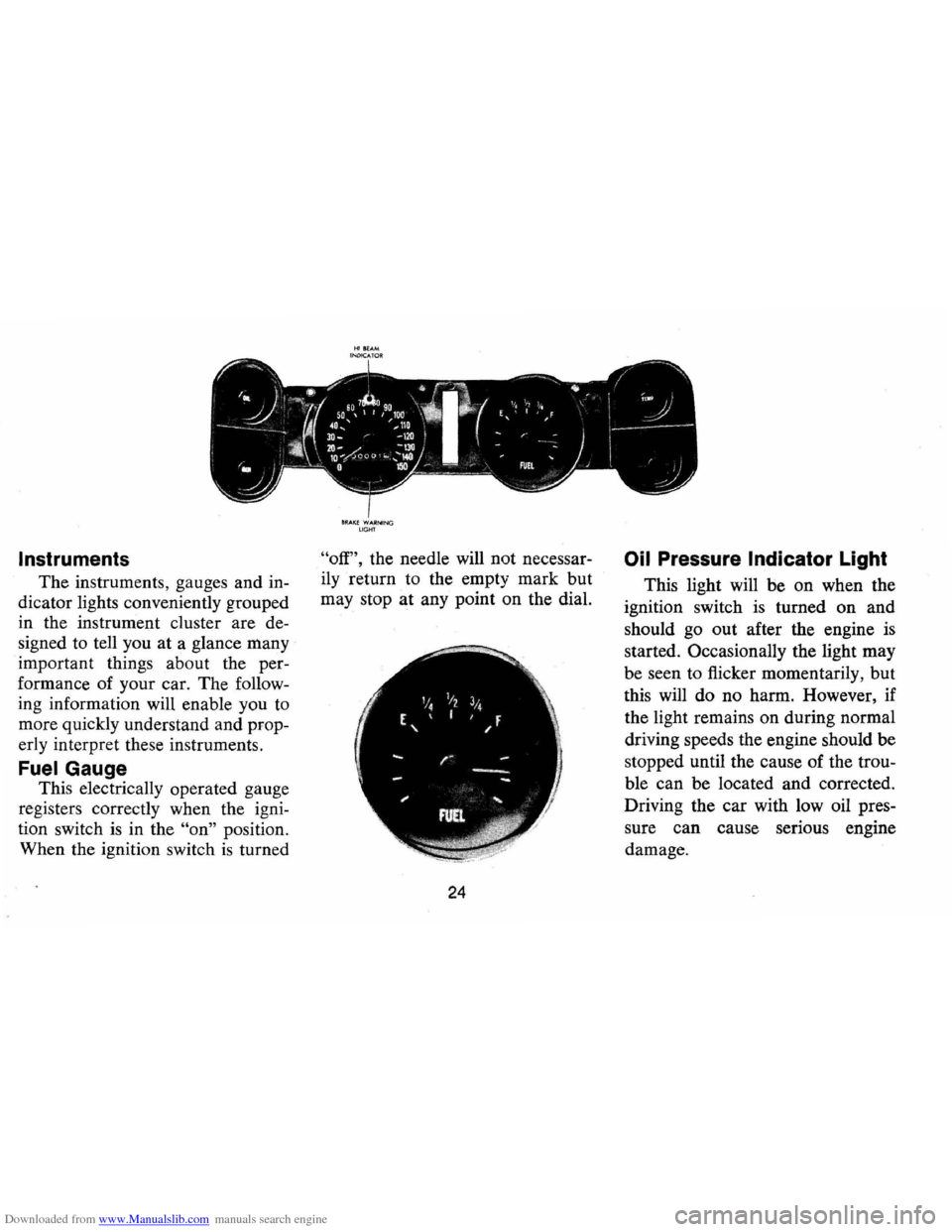
Downloaded from www.Manualslib.com manuals search engine Instruments
The instruments, gauges and in
dicator lights conveniently grouped
in the instrument cluster are de
signed to tell you
at a glance many
important things about the per
formance of your car. The follow
ing information will enable you to
more quickly understand and prop
erly interpret these instruments.
FuelGauge
This electrically operated gauge
registers correctly when the igni
tion switch
is in the "on" position.
When the ignition switch
is turned
8RAI(E WARNIN G LIGHT
"off", the needle will not necessar
ily return to the empty mark but
may stop at any point on the dial.
24
Oil Pressure Indicator Light
This light will be on when the
ignition switch
is turned on and
should go out after the engine
is
started. Occasionally the light may
be seen to flicker momentarily, but
this will do no harm. However , if
the light remains on during normal
driving speeds the engine should be
stopped until the cause of the trou
ble can be located and corrected .
Driving the car with low oil pres
sure can cause serious engine
damage.
Page 28 of 85
Downloaded from www.Manualslib.com manuals search engine Generator Indicator Light
The red light will go on when
the ignition key
is in the "on" posi
tion, but before the engine
is
started. After the engine starts, the
light should
go out and remain out.
If the light remains on when engine
is running, have your Authorized
Chevrolet Dealer locate and correct
the trouble
as soon as possible.
Engine Temperature
Indicator Light
This indicator light is provided
in the instrument cluster to quickly
warn of an overheated engine. With
the ignition switch in the START
position, the red
TEMP indicator
will light to let you know that it
is
operating properly.
When the engine
is started, the
red light will go out immediately.
It will light up at no other time
unless for some reason the engine
reaches a dangerously high oper
ating temperature.
If the light comes on
during extreme driving condi
tions, such as an extended idle, turn
off the air conditioner (if used) and
run the engine slightly faster than
idle speed with the transmission in
neutral gear.
If the light does not
go off within a short period of time
(1-2 minutes), then turn the engine
off until the cause of the overheat
ing
is corrected. Glance at the in
strument cluster frequently
as you
drive to see
if this light is on.
Brake System Warning
Light
The service brake system is de
signed so that half of the brake
system will provide some braking
action in the event of a hydraulic
leak in the other half of the sys
tem .
If the warning light labeled
"BRAKE, " located at lower left of
instrument cluster (speedometer
face), glows continuously when the
ignition
is on and after the brakes
have been firmly applied it may in-
25
dicate that there is a malfunction
in one half of the brake hydraulic
system .
On cars equipped with
front drum brakes, the light will
go out when foot is removed from
brake pedal.
• As a check on bulb condition
the light should glow with the
parking brake applied and the
ignition on. (Light
is also a
reminder to release parking
brake).
• The light should glow during
engine starting to verify that the
bulb
is operating properly.
• Have system repaired if light
does not come on during check.
• This warning light is not a sub
stitute for the visual check of
brake fluid level required as part
of normal maintenance.
If the light glows red:
• The parking brake control is not
fully released or,
• The service brake system is par
tially inoperative.
Page 29 of 85
Downloaded from www.Manualslib.com manuals search engine What to do:
1. Check that the parking brake is
released. If it is ...
2. Pull off the road and stop, care
fully-remembering that:
• Stopping distances may be
greater.
• Greater pedal effort may be re
quired.
• Pedal travel may be greater.
3.
Tryout brake operation by
starting and stopping on road
shoulder-then:
• If you judge such operation to
be safe, proceed cautiously at a
safe speed to nearest dealer for
repair.
• Or have car towed to dealer for
repair.
Continued operation of the car
in this condition
is dangerous .
. Headlight Beam Indicator
Light
The headlights of your car have
high and low beams to provide you with
proper night-time visibility
for most driving conditions. The
"low" beams are used during most
city driving. The
"high" beams are
especially useful when driving on
dark roads since they provide ex
cellent long range illumination.
The headlight beam indicator will
be on whenever the high beams or
"brights" are in use. The Headlight
Beam
Switch controls the headlight
beams (see Page 22) .
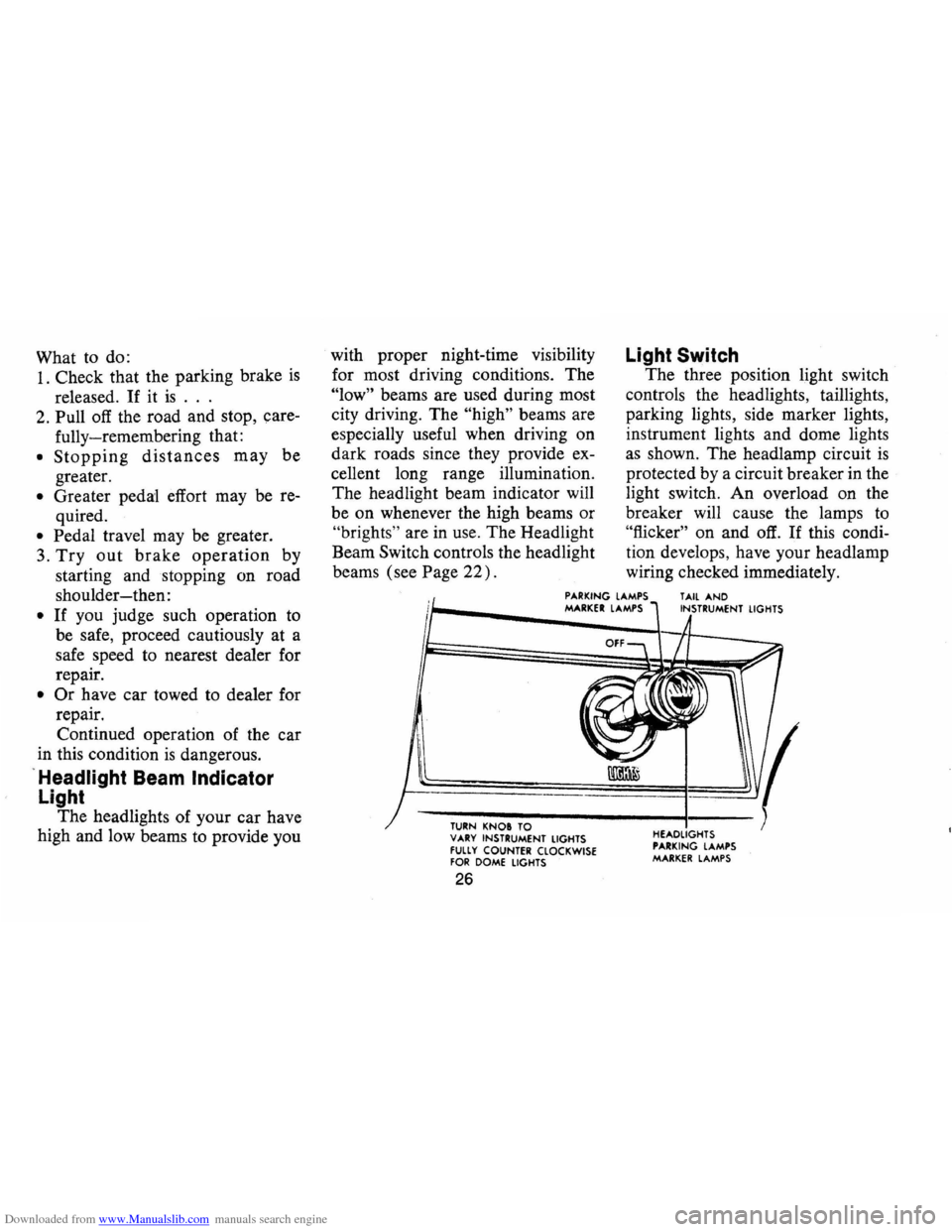
Light Switch
The three position light switch
controls the headlights, taillights,
parking lights, side marker lights,
instrument lights and dome lights
as shown. The headlamp circuit is
protected by a circuit breaker in the
light switch. An overload on the
breaker will cause the lamps
to
"flicker" on and off. If this condi
tion develops, have your headlamp
wiring checked immediately.
PARKING LAMPS
MARKER LAMPS
TURN KNOB TO
VARY INSTRUMENT LIGHTS
FULL Y COUNTER CLOCKWISE FOR DOME LIGHTS
26
HEADLIGHTS PARKING LAMI'S
MARKER LAMPS
Page 30 of 85
Downloaded from www.Manualslib.com manuals search engine Optional Instruments and Gauges
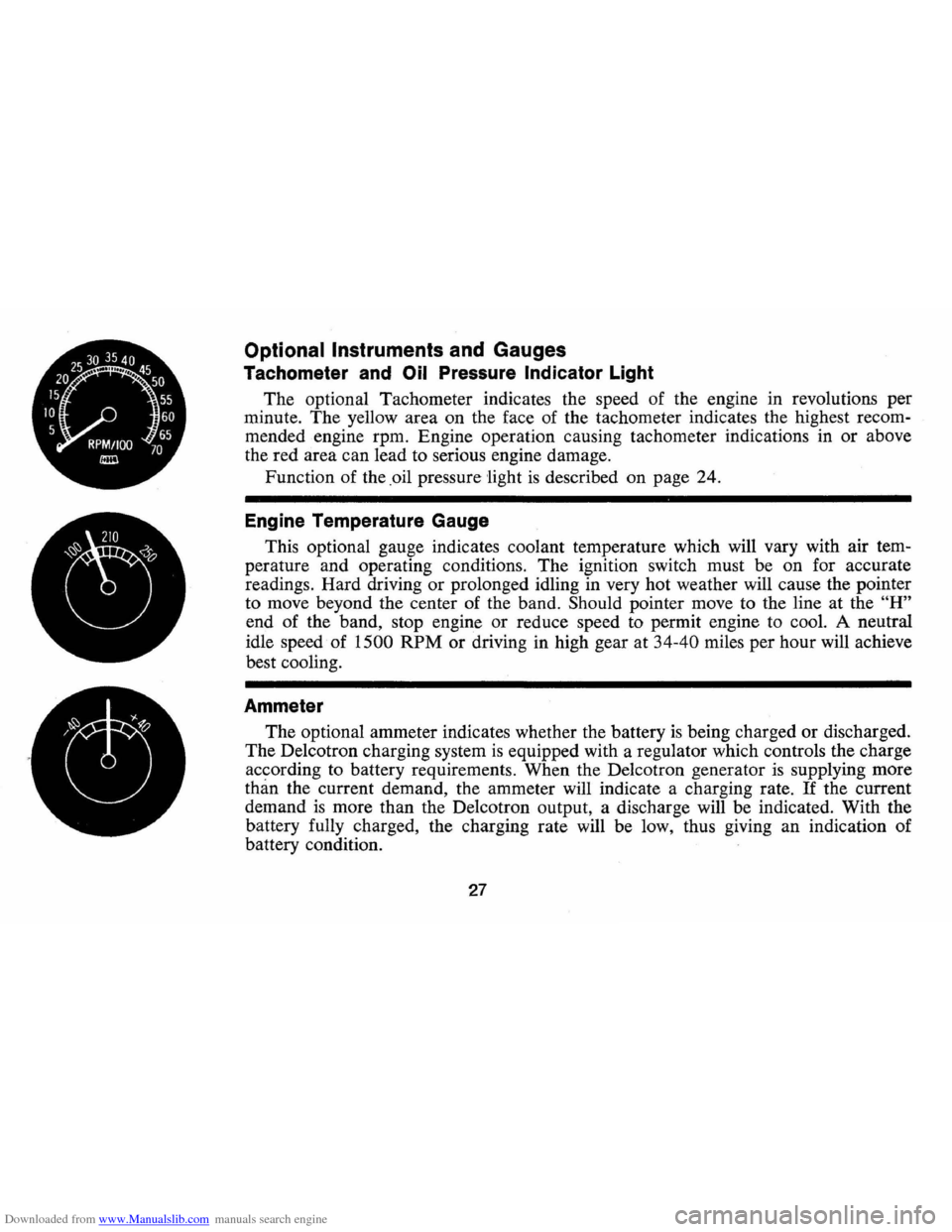
Tachometer and Oil Pressure Indicator Light
The optional Tachometer indicates the speed of the engine in revolutions per
minute. The yellow area on the face of the tachometer indicates the highest recom
mended engine rpm. Engine operation causing tachometer indications in or above
the red area can lead to serious engine damage.
Function of the .oil pressure
'light is described on page 24.
Engine Temperature Gauge
This optional gauge indicates coolant temperature which will vary with air tem
perature and operating conditions. The ignition switch must be on for accurate
readings. Hard driving
or prolonged idling in very hot weather will cause the pointer
to move beyond the center of the band.
Should pointer move to the line at the "H"
end of the band, stop engine or reduce speed to permit engine to cool. A neutral
idle speed of
1500 RPM or driving in high gear at 34-40 miles per hour will achieve
best cooling.
Ammeter
The optional ammeter indicates whether the battery is being charged or discharged.
The De1cotron charging system
is equipped with a regulator which controls the charge
according to battery requirements. When the De1cotron generator
is supplying more
than the current demand, the ammeter will indicate a charging rate. If the current
demand
is more than the De1cotron output, a discharge will be indicated. With the
battery fully charged, the charging rate will be low, thus giving an indication of
battery condition.
27
Page 31 of 85
Downloaded from www.Manualslib.com manuals search engine Clock
Reset the clock, if your car is so
equipped, by pulling
out the knob
and turning
the hands clockwise if
slow, counterclockwise if fast. This
will,
if the clock error is five min
utes
or more, automatically com
pensate for time gain
or lag. Sev
eral resettings, several days apart,
may be needed to properly adjust
the clock mechanism. Have your
clock cleaned
and oiled by a com
petent clock serviceman at least
every two years.
Cigarette Lighter
The accessory cigarette lighter is
located on the instrument panel
face.
To operate, push it in. When
it becomes heated,
it automatically
pops
out ready for use.
Windshield Wiper
and Washer
The windshield wiping system
operates
at two speeds and is de
signed to wipe clear designated areas
of the
windshield under most
inclement weather conditions.
The
windshield wipers work electrically
and are not affected by engine op
eration.
Push the control lever to the
right to
start the electric windshield
wiper .
The two-speed electric wiper
has both a
"low" and a "high" speed
po sition.
Pressing the control will send a
measured amount of water
or other
cleaning agent onto the windshield
and will also cause the wiper lever
to move, thus starting the wiper .
motor. The wiper will then con
tinue to operate until manually
turned off at the wiper lever.-
Fill the washer
jar only % full
during the winter to allow for ex
pansion if the temperature should
fall low enough to freeze the so
lution.
• Check washer fluid level regu
larly-do it frequently when the
weather is bad.
28
• Use fluid such as GM
OPTIKLEEN to preventfreez
ingdamage, and to provide bet
ter cleaning.
• Do not use radiator anti-freeze in
windshield washer; it could
cause paint damage.
• In cold weather, warm the wind
shield with defrosters before us
ing
washer-to help prevent ic
ing that may seriously obscure
vision.
Ventilation System
Your Camaro incorporates a
ventilation system
that provides
ventilation comfort, made possible
by the addition of air vent provi
sions in the rear body lock pillar.
Another feature of the system
is
continuous low-speed operation of
the air conditioner blower, result
ing in an uninterrupted supply
of
outside air flow into the car when-
Page 37 of 85
Downloaded from www.Manualslib.com manuals search engine Chevrolet II All Transistor" Radios
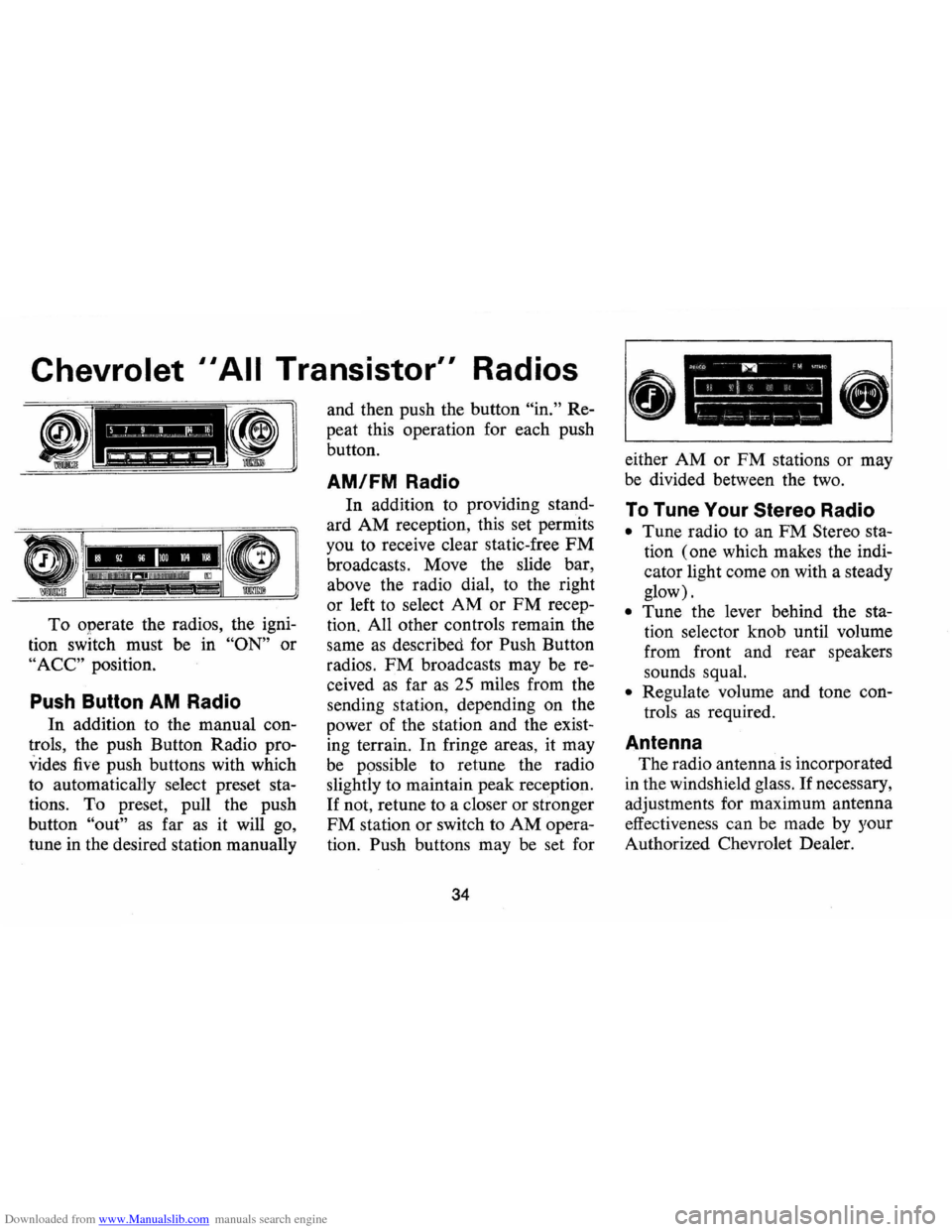
To operate the radios, the igni
tion switch must be in
"ON" or
"ACC" position.
Push Button AM Radio
In addition to the manual con
trols, the push Button Radio pro
vides five push buttons with which
to automatically select preset sta
tions. To preset, pull the push
button
"out" as far as it will go,
tune in the desired station manually and
then push the button
"in." Re
peat this operation for each push
button.
AM/FM Radio
In addition to providing stand
ard
AM reception, this set permits
you to receive clear static-free
FM
broadcasts. Move the slide bar,
above the radio dial, to the right
or left to select AM or
FM recep
tion. All other controls remain the
same
as described for Push Button
radios.
FM broadcasts may be re
ceived
as far as 25 miles from the
sending station, depending on the
power of the station and the exist
ing terrain.
In fringe areas, it may
be possible to retune the radio
slightly to maintain peak reception.
If not, retune to a closer or stronger
FM station or switch to AM opera
tion. Push buttons may be set for
34
"""-:0 - "-!IJ ,_,
~ r------l 1----__ ~r--~
either AM or FM stations or may
be divided between the two.
To Tune Your Stereo Radio
• Tune radio to an FM Stereo sta
tion (one which makes the indi
cator light come on with a steady
glow).
• Tune the lever behind the sta
tion selector knob until volume
from front and rear speakers
sounds squal.
• Regulate volume and tone con
trols
as required.
Antenna
The radio antenna is incorporated
in the windshield glass. If necessary,
adjustments for maximum antenna
effectiveness can be made by your
Authorized Chevrolet Dealer.
Page 39 of 85
Downloaded from www.Manualslib.com manuals search engine I n Case of Emergency
Four-Way Hazard
Warning
Flasher
• Use the warning flasher to warn
other drivers any time your
vehicle becomes a traffic hazard,
day
or night.
• Avoid stopping on the roadway
if possible.
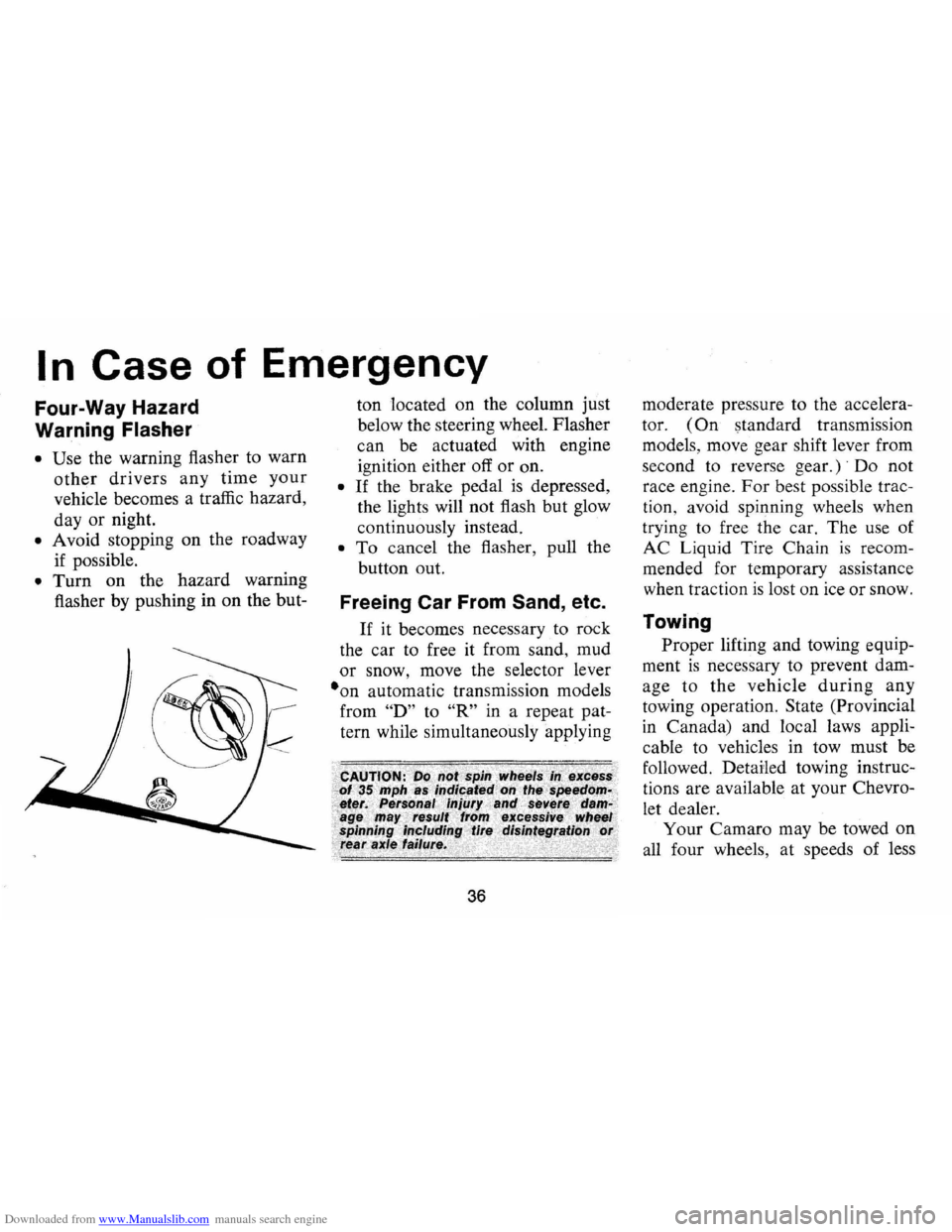
• Turn on the hazard warning
flasher by pushing in on the but- ton
located on the column just
below the steering wheel. Flasher
can be actuated with engine
ignition either off
or on.
• If the brake pedal is depressed,
the lights will not flash but glow
continuously instead.
• To cancel the flasher, pull the
button out.
Freeing Car From Sand, etc.
If it becomes necessary to rock
the car to free it from sand, mud
or snow, move the selector lever
·on automatic transmission models
from
"D" to "R" in a repeat pat
tern while simultaneously applying
36
moderate pressure to the accelera
tor.
(On standard transmission
models, move gear shift lever from
second to reverse
gear.)' Do not
race engine.
For best possible trac
tion, avoid spinning wheels when
trying to free the car. The use of
AC Liquid Tire Chain
is recom
mended for temporary assistance
when traction
is lost on ice or snow.
Towing
Proper lifting and towing equip
ment
is necessary to prevent dam
age to
the vehicle during any
towing operation. State (Provincial
in Canada) and local laws appli
cable to vehicles in tow must be
followed. Detailed towing instruc
tions are available at your Chevro
let dealer.
Your Camaro may be towed on
all four wheels, at speeds of less
Page 40 of 85
Downloaded from www.Manualslib.com manuals search engine than 35 mph, for distances up to
50 miles, provided the drive-line,
axle, transmission, and steering
system are otherwise normally op
erable.
Use only towing equipment
specifically designed for this pur
pose following the instructions of
the towing equipment manufac
turer. A separate safety chain sys
tem must be used.
For such towing
the steering must be unlocked,
transmission in neutral and the
parking brake released. Attach
ments must be made to main struc
tural members of the car. Do not
attach to bumpers
or associated
brackets. Remember that power
brake and power steering assists
will not be available when engine
is inoperative.
Emergency Starting
• Engines in vehicles with auto
matic transmissions cannot be started
by pushing
or towing the
car.
• Never tow a manual transmis
sion-equipped
car to start be
cause the surge forward when
the engine starts could cause a
collision with the tow vehicle.
• A car with a discharged battery
may be started by transferring
electrical power from a battery
in another car -called
"jump
starting."
Jump Starting
37
• The battery in the other vehicle
must be of the
same nominal
voltage
(12 volts), and must be
negatively grounded. (All Gen
eral Motors cars, light trucks
(10,000 GVWR and under),
and motor homes use 12-volt,
negatively grounded electrical
systems and
can be used to jump
start one another.) The nominal
voltage and grounding of the
other vehicle's battery may be
determined by checking the spec
ifications
in its owner's manual.
Use of a booster battery of a
higher nominal voltage,
or which
is positively grounded may re
sult
in serious personal injury or
property damage.
• The battery in your car must be a
Delco battery (the original,
or a
replacement) which
is equipped
with flame arrestor type filler/
vent caps
on all filler openings, or
a sealed-type battery which does
Page 41 of 85
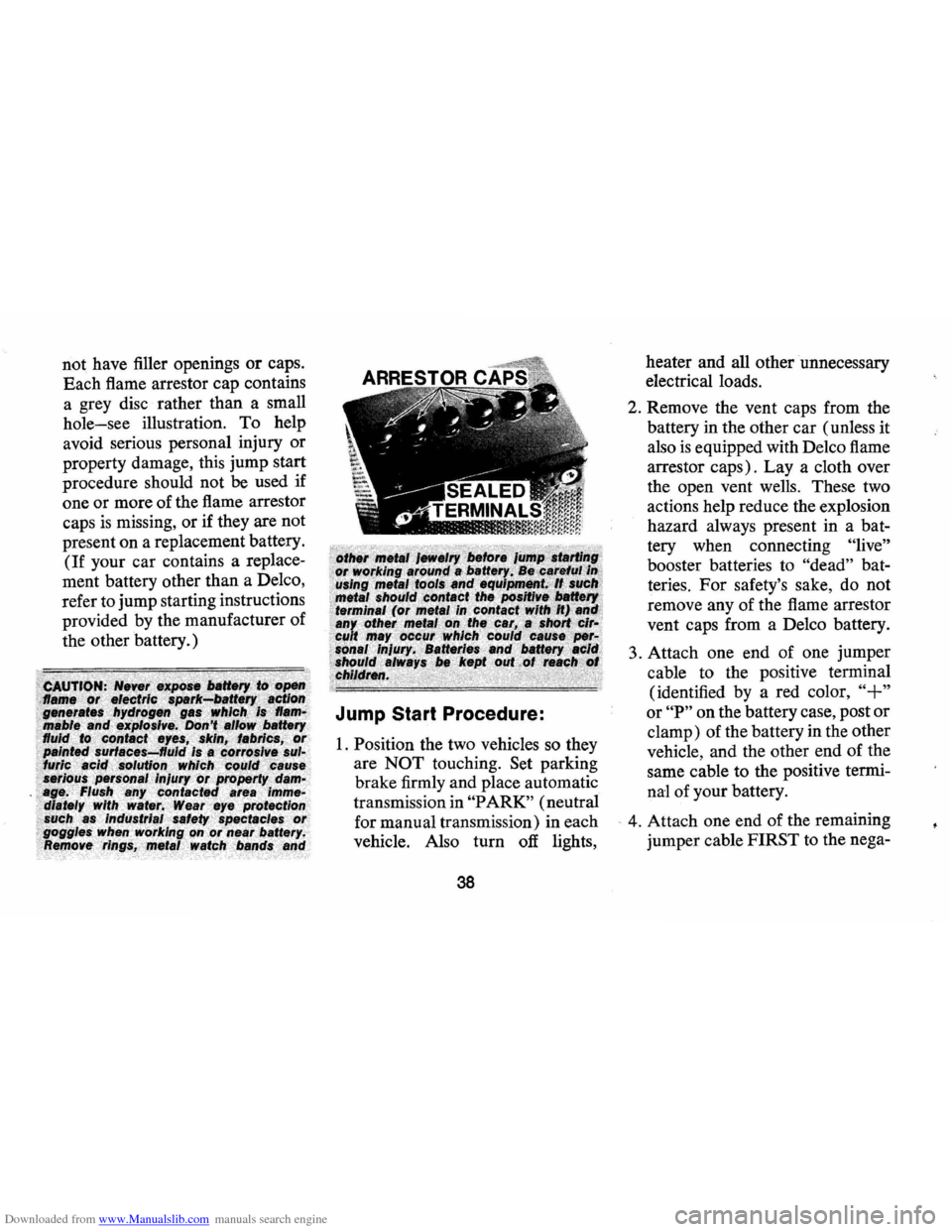
Downloaded from www.Manualslib.com manuals search engine not have filler openings or caps.
Each flame arrestor cap contains
a grey disc rather than a small
hole-see illustration. To help
avoid serious personal injury or
property damage, this jump start
procedure should not
be used if
one or more of the flame arrestor
caps
is missing, or if they are not
present on a replacement battery.
(If your car contains a replace
ment battery other than a Delco,
refer to jump starting instructions
provided by the manufacturer of
the other battery.)
Jump Start Procedure:
1. Position the two vehicles so they
are
NOT touching. Set parking
brake firmly and place automatic
transmission in
"PARK" (neutral
for manual transmission) in each
vehicle. Also turn
off lights,
38
heater and all other unnecessary
electrical loads.
2. Remove the vent caps from the
battery in the other car (unless it
also
is equipped with Delco flame
arrestor caps). Lay a cloth over
the open vent wells. These two
actions help reduce the explosion
hazard always present in a bat
tery when connecting
"live"
booster batteries to "dead" bat
teries.
For safety's sake, do not
remove any of the flame arrestor
vent caps from a Delco battery.
3. Attach one end of one jumper
cable to the positive terminal
(identified by a red color,
"+"
or "P" on the battery case, post or
clamp) of the battery in the other
vehicle, and the other end of the
same cable to the positive termi
nal of your battery.
- 4. Attach one end of the remaining
jumper cable FIRST to the nega-
Page 43 of 85
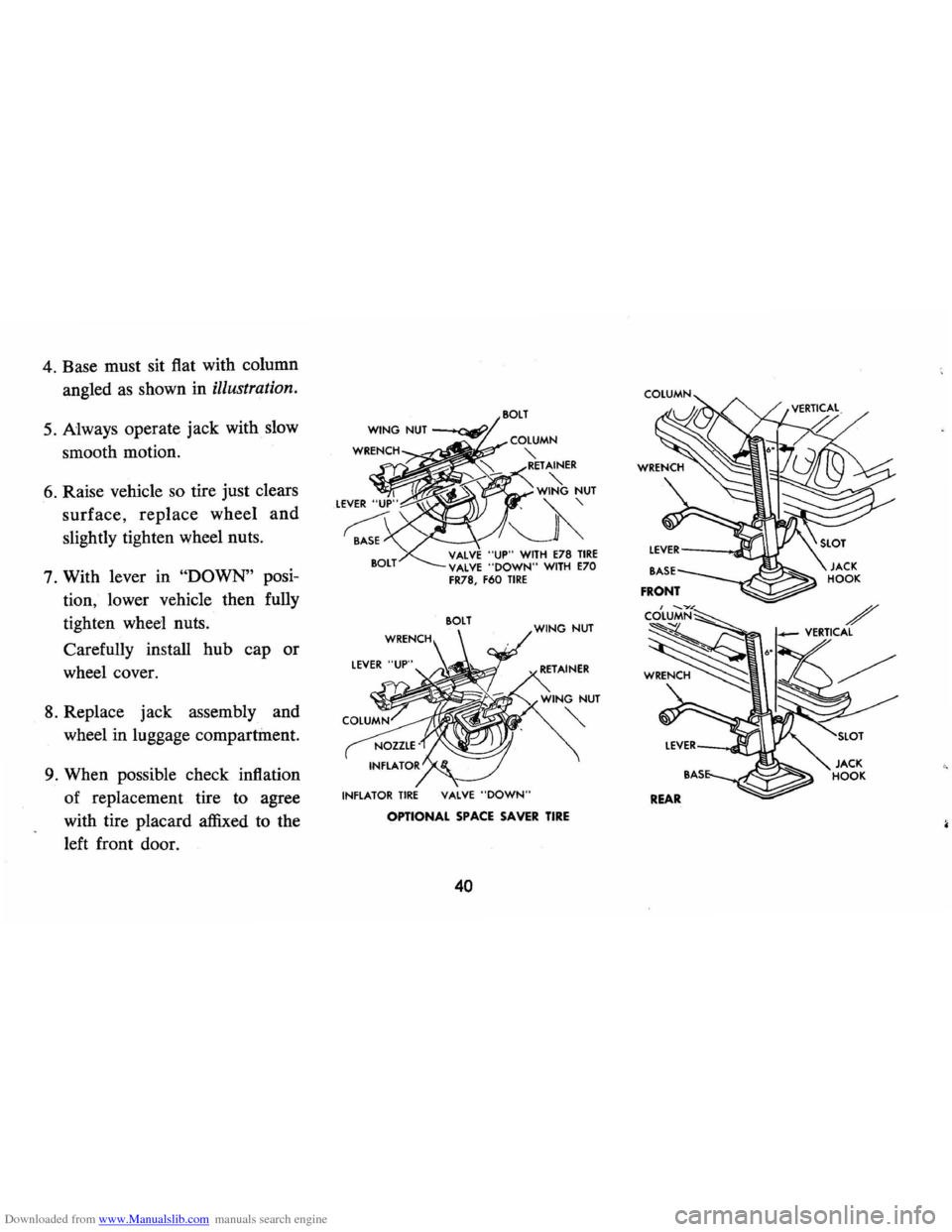
Downloaded from www.Manualslib.com manuals search engine 4. Base must sit flat with column
angled
as shown in illustration.
5. Always operate jack with slow
smooth motion.
6. Raise vehicle so tire just clears
surface,
replace wheel and
slightly tighten wheel nuts.
7. With lever in
"DOWN" posi
tion, lower vehicle then fully
tighten
wheel nuts.
Carefully install hub cap or
wheel cover.
8. Replace jack assembly and
wheel in luggage compartment.
9. When possible check inflation
of replacement tire to agree
with tire placard affixed to the
left front door.
COlUMN
;:>;;;Om~r?' ';;ErAINER
"'-WING NUT
~~
VALVE "UP" WITH E78 TIRE VALVE "DOWN" WITH E70 FR78, F60 TIRE
SOLT
INFLAT07
INFLATOR TIRE VALVE "DOWN"
OPTIONAL SPACE SAVER TIRE
40
COLUMN
JACK
HOOK