towing CHEVROLET CAMARO 1974 2.G Owners Manual
[x] Cancel search | Manufacturer: CHEVROLET, Model Year: 1974, Model line: CAMARO, Model: CHEVROLET CAMARO 1974 2.GPages: 85, PDF Size: 32.84 MB
Page 14 of 85
Downloaded from www.Manualslib.com manuals search engine erly when riding. However, if
unusual conditions prohibit use
of restraints
and require that a
Trailer Hauling
Since passenger cars are designed
and intended to be used primarily
as passenger conveyances, towing
a trailer will affect handling,
dura
bility and economy. Maximum
safety and satisfaction depends
upon proper use of correct
equip
ment and avoiding overloads and
other abusive operation.
The maximum loaded trailer
weight which you
can pull with your
Camaro depends on what special
equipment has been installed on
your car. Chevrolet does not
rec
ommend towing any trailer unless
the
car is properly equipped. Infor
mation on trailer hauling capabili
ties, special equipment required,
and optional equipment offered by child
must stand,
he should
stand
on the floor directly be
hind the front seat. This will
Chevrolet
is available from your
Chevrolet Dealer
or by writing:
Chevrolet
Motor Division, Detroit,
Michigan
48202 (or in Canada
by writing to General Motors of
Canada Limited, Owner Relations
Department,
Oshawa, Ontario).
To assist in attaining good han
dling of the car-trailer combina
tion, it is important that the trailer
tongue load be maintained
at ap
proximately 10% of the loaded
trailer weight. Tongue loads
can be
adjusted by proper distribution of
the load in the trailer,
and can be
checked by weighing separately the
loaded trailer and then the tongue.
When towing trailers, tires should
be inflated to the highest
infla
tion pressures shown on the placard
affixed to the left front door. The
11
help minimize the possibility of
injury from frontal impacts in
the event of an accident.
allowable passenger
and cargo
load, also shown
on the same plac
ard, is reduced by an amount equal
to the trailer tongue load on the
trailer hitch.
Maintenance
More frequent vehicle mainte
nance is required when using your
car to pull a trailer. Change the:
• Automatic transmission fluid
each
12,000 miles,
• Rear axle fluid each 12,000
miles,
• Engine oil each 60 days or 3,000
miles, whichever occurs first,
• Positive crankcase ventilation
valve each 12 months
or 12,000
miles, whichever occurs first.
• See index for important informa
tion on belts, cooling system care
and automatic brake adjustment.
Page 15 of 85
Downloaded from www.Manualslib.com manuals search engine Break-in Schedule
In addition to the new car
break-in instructions in this man
ual, it
is recommended that your
new Camaro be operated for
500
miles before trailer towing. If it is
necessary to tow during this period,
avoid speeds over
50 MPH and full throttle
starts. The same precau
tions should be observed whenever
a new engine, transmission
or axle
is installed in your car.
Operation in Foreign Countries
Your Camaro is designed to op
erate on fuel of approximately
91
research octane number or higher,
sold in the United States and Can
ada.
If you plan to operate your
Camaro outside the continental
limits of the United States
or Can
ada, there
is a possibility that the
best fuels available in some coun
tries are so low in anti-knock
quality that excessive knocking
and serious engine damage may
. result from their use. To obtain
information on the quality of fuels available
in the countries in which
you plan to travel , write to Chevro
let Motor Division, Service Depart
ment, Detroit, Michigan
48202,
(or in Canada write to General
Motors of Canada Limited,
Owner
Relations Department , Oshawa,
Ontario),
giving:
• The vehicle identification num
ber ( on plate on instrument
panel ahead of the steering
wheel and visible through the
windshield , or from registration
slip or title).
• The country or countries in
12
which you plan to travel.
It
is recommended that you not
operate your Camaro in any coun
try not having fuels meeting the
requirements of
your Camaro
engine. Engine modifications are
not available to compensate for
low anti-knock quality fuels. Op
eration of your car under condi
tions of continuous
or excessive
knocking constitutes misuse of the
engine and may cause engine dam
age for which the Chevrolet Divi
sion
is not responsible under the
terms
of the Chevrolet New
Vehicle Warranty.
Page 39 of 85
Downloaded from www.Manualslib.com manuals search engine I n Case of Emergency
Four-Way Hazard
Warning
Flasher
• Use the warning flasher to warn
other drivers any time your
vehicle becomes a traffic hazard,
day
or night.
• Avoid stopping on the roadway
if possible.
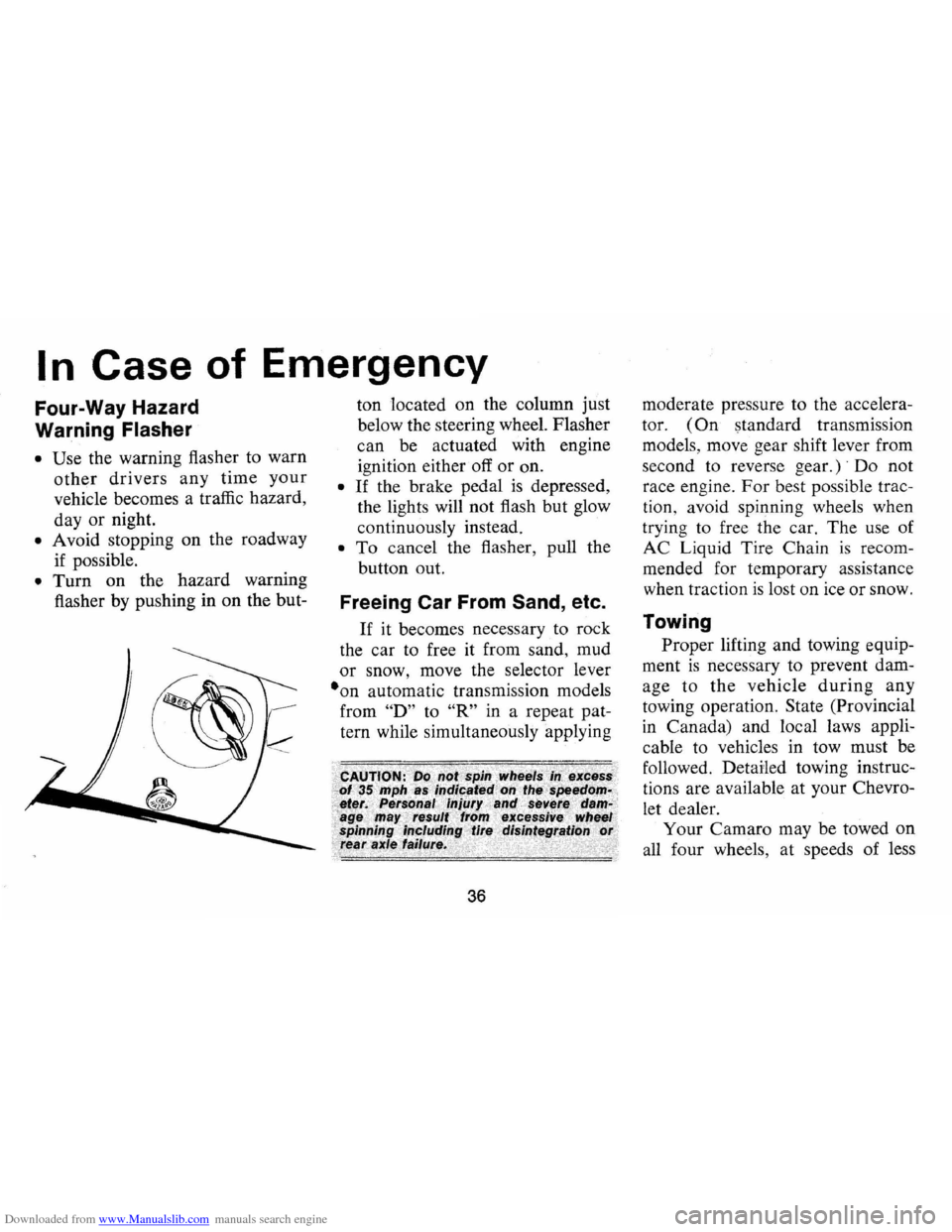
• Turn on the hazard warning
flasher by pushing in on the but- ton
located on the column just
below the steering wheel. Flasher
can be actuated with engine
ignition either off
or on.
• If the brake pedal is depressed,
the lights will not flash but glow
continuously instead.
• To cancel the flasher, pull the
button out.
Freeing Car From Sand, etc.
If it becomes necessary to rock
the car to free it from sand, mud
or snow, move the selector lever
·on automatic transmission models
from
"D" to "R" in a repeat pat
tern while simultaneously applying
36
moderate pressure to the accelera
tor.
(On standard transmission
models, move gear shift lever from
second to reverse
gear.)' Do not
race engine.
For best possible trac
tion, avoid spinning wheels when
trying to free the car. The use of
AC Liquid Tire Chain
is recom
mended for temporary assistance
when traction
is lost on ice or snow.
Towing
Proper lifting and towing equip
ment
is necessary to prevent dam
age to
the vehicle during any
towing operation. State (Provincial
in Canada) and local laws appli
cable to vehicles in tow must be
followed. Detailed towing instruc
tions are available at your Chevro
let dealer.
Your Camaro may be towed on
all four wheels, at speeds of less
Page 40 of 85
Downloaded from www.Manualslib.com manuals search engine than 35 mph, for distances up to
50 miles, provided the drive-line,
axle, transmission, and steering
system are otherwise normally op
erable.
Use only towing equipment
specifically designed for this pur
pose following the instructions of
the towing equipment manufac
turer. A separate safety chain sys
tem must be used.
For such towing
the steering must be unlocked,
transmission in neutral and the
parking brake released. Attach
ments must be made to main struc
tural members of the car. Do not
attach to bumpers
or associated
brackets. Remember that power
brake and power steering assists
will not be available when engine
is inoperative.
Emergency Starting
• Engines in vehicles with auto
matic transmissions cannot be started
by pushing
or towing the
car.
• Never tow a manual transmis
sion-equipped
car to start be
cause the surge forward when
the engine starts could cause a
collision with the tow vehicle.
• A car with a discharged battery
may be started by transferring
electrical power from a battery
in another car -called
"jump
starting."
Jump Starting
37
• The battery in the other vehicle
must be of the
same nominal
voltage
(12 volts), and must be
negatively grounded. (All Gen
eral Motors cars, light trucks
(10,000 GVWR and under),
and motor homes use 12-volt,
negatively grounded electrical
systems and
can be used to jump
start one another.) The nominal
voltage and grounding of the
other vehicle's battery may be
determined by checking the spec
ifications
in its owner's manual.
Use of a booster battery of a
higher nominal voltage,
or which
is positively grounded may re
sult
in serious personal injury or
property damage.
• The battery in your car must be a
Delco battery (the original,
or a
replacement) which
is equipped
with flame arrestor type filler/
vent caps
on all filler openings, or
a sealed-type battery which does
Page 85 of 85
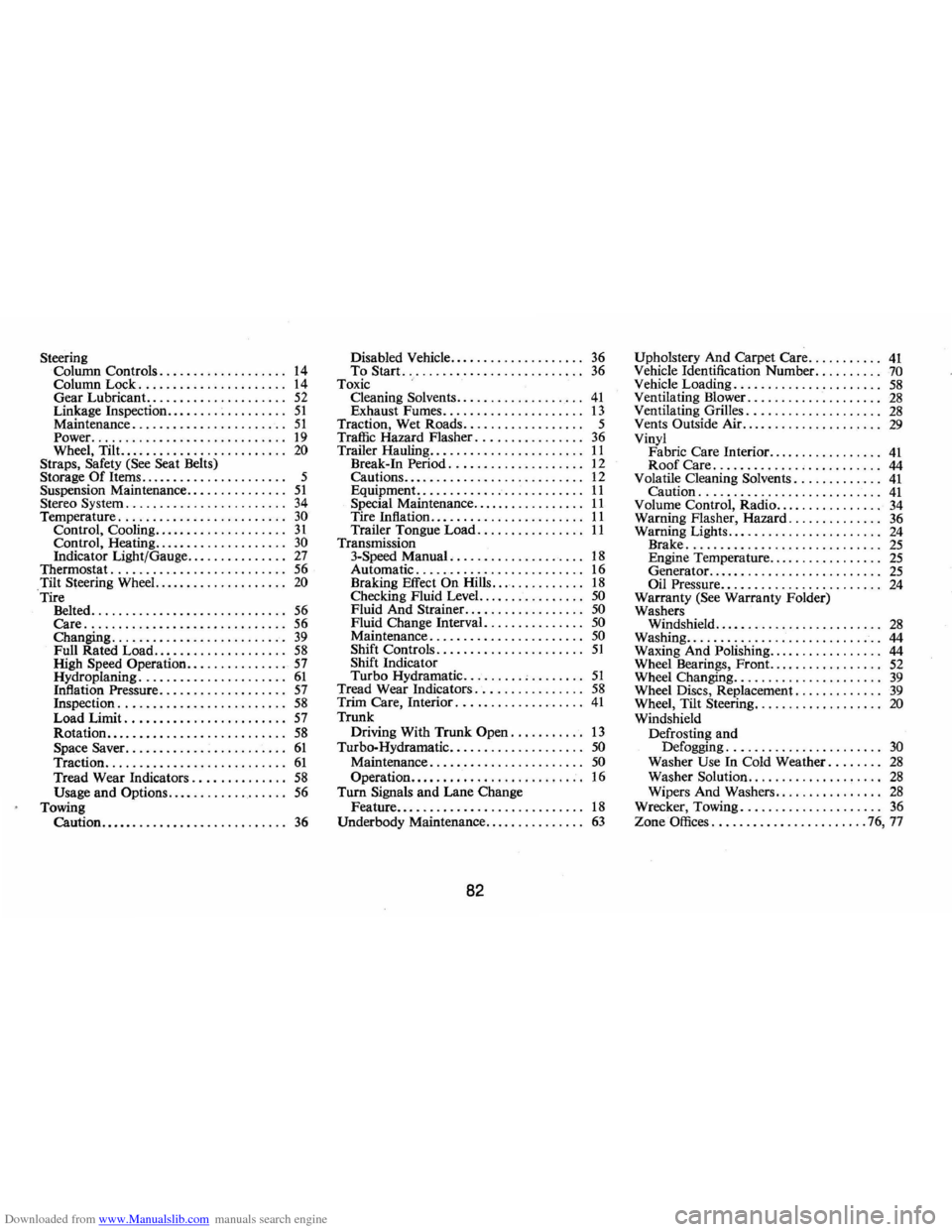
Downloaded from www.Manualslib.com manuals search engine Steering Disabled Vehicle .................... 36 Upholstery And Carpet Care ........ ... 41 Column Controls ................... 14 To Start. .......................... 36 Vehicle Identification Number .... ...... 70 Column Lock ...................... 14 Toxic Vehicle Loading ...................... 58 Gear Lubricant. .................... 52 Cleaning Solvents ......... .. ........ 41 Ventilating Blower ................. ... 28 Linkage Inspection .................. 51 Exhaust Fumes ............. ........ 13 Ventilating Grilles .................... 28 Maintenance ....................... 51 Traction, Wet Roads .................. 5 Vents Outside Air .................. '" 29
Power ... ............... ........... 19 Traffic Hazard Flasher. ............... 36 Vinyl Wheel, Tilt. ........................ 20 Trailer Hauling ....................... 11 Fabric Care Interior ................. 41 Straps, Safety (See Seat Belts) Break-In Period .................... 12 Roof Care ......................... 44 Storage Of Items ............ .......... 5 Cautions ........................... 12 Volatile Cleaning Solvents ............. 41 Suspen sion Maintenance ............... 51 Equipment ......... ................. 11 Caution ........................... 41 Stereo System ........................ 34 Special Maintenance ................. 11 Volume Control, Radio ......... ... .... 34 Temperature ................. ........ 30 Tire Inflation ....................... 11 Warning Flasher, Hazard .............. 36 Control , Cooling .................... 31 Trailer Tongue Load .... .......... .. 11 Warning Lights ....................... 24 Control , Heating .................... 30 Transmission
Brake ....................... ...... 25 Indicator Light/Gauge ... ............ 27 3-Speed Manual .................... 18 Engine Temperature ............... .. 25 Thermostat ...... .. .................. 56 Automatic ....................... .. 16 Generator .......................... 25 Tilt Steering Wheel.. .................. 20 Braking Effect On Hills .............. 18 Oil Pressure ........................ 24 Tire Checking
Fluid Level. ............... 50 Warranty (See Warranty Folder)
Belted ......... .................. .. 56 Fluid And Strainer ................ .. 50 Washers
Care ........... .................. . 56 Fluid Change Interval. .............. 50 Windshield ............. ......... ... 28 Changing .. .............. .......... 39 Maintenance .............. ....... .. 50 Washing .......... ................... 44 Full Rated Load .................... 58 Shift Controls ...................... 51 Waxing And Polishing ................. 44 High Speed Operation ............... 57 Shift Indicato r
Wheel Bearings, Front. ................ 52 Hydroplaning ...................... 61 Turbo Hydramatic ......... ; ........ 51 Wheel Changing ...................... 39 Infla tion Pressure . . . . . . . . . . . . . . . . . . . 57 Tread Wear Indicators ................ 58 Wheel Discs, Replacement ............. 39 Inspection ....... .................. 58 Trim Care, Interior ................... 41 Wheel, Tilt Steering ................... 20 Load Limit ........................ 57 Trunk
Windshield
Rotation ........ ................... 58 Driving With Trunk Open ........... 13 Defrosting and Space Saver .. .......... : . .......... 61 Turbo-Hydramatic .............. ...... 50 Defogging ................. ...... 30 Traction ............. .............. 61 Maintenance .... .... ...... ......... 50 Washer Use In Cold Weather ........ 28 Tread Wear Indicators .............. 58 Operation .......................... 16 Washer Solution .................... 28 Usage and Options .................. 56 Turn Signals and
Lane Change Wipers And Washers ................ 28 Towing Feature ..................
.......... 18 Wrecker , Towing ....... .............. 36 Caution .................. .... ...... 36 Underbody Maintenance ......... ...... 63 Zone Offices ................. ...... 76, 77
82