lock CHEVROLET CAMARO 1974 2.G User Guide
[x] Cancel search | Manufacturer: CHEVROLET, Model Year: 1974, Model line: CAMARO, Model: CHEVROLET CAMARO 1974 2.GPages: 85, PDF Size: 32.84 MB
Page 26 of 85
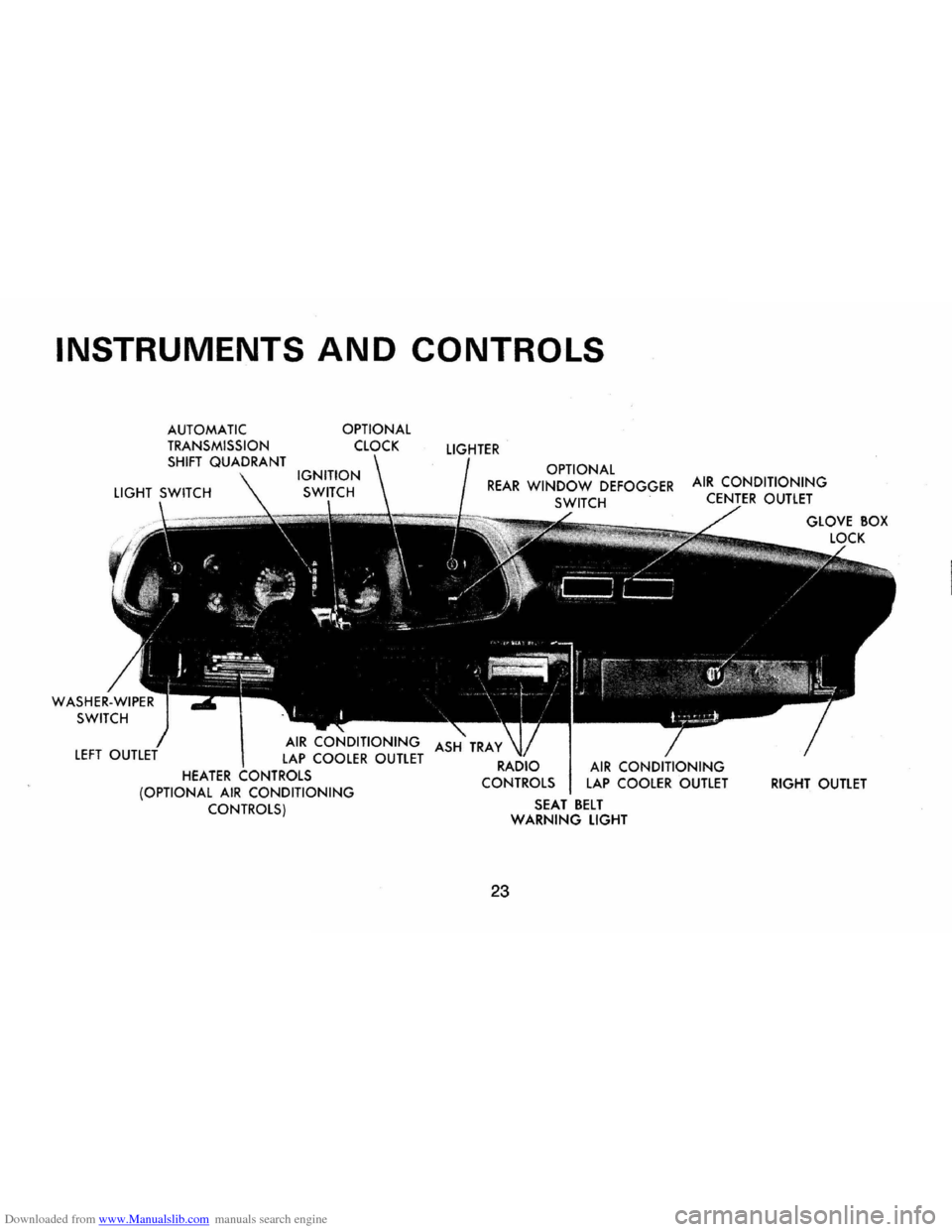
Downloaded from www.Manualslib.com manuals search engine INSTRUMENTS AND CONTROLS
AUTOMATIC TRANSMISSION
SHIFT QUADRANT
HEATER ,-,.., ... ,T,,,,",'
OPTIONAL
CLOCK
(OPTIONAL
AIR CONDITIONING CONTROLS)
LIGHTER
OPTIONAL REAR WINDOW DEFOGGER AIR CONDITIONING SWITCH CENTER OUTLET
ASH TRAY
RADIO
CONTROLS
23
SEAT BELT WARNING LIGHT
GLOVE BOX
RIGHT
OUTLET
Page 29 of 85
Downloaded from www.Manualslib.com manuals search engine What to do:
1. Check that the parking brake is
released. If it is ...
2. Pull off the road and stop, care
fully-remembering that:
• Stopping distances may be
greater.
• Greater pedal effort may be re
quired.
• Pedal travel may be greater.
3.
Tryout brake operation by
starting and stopping on road
shoulder-then:
• If you judge such operation to
be safe, proceed cautiously at a
safe speed to nearest dealer for
repair.
• Or have car towed to dealer for
repair.
Continued operation of the car
in this condition
is dangerous .
. Headlight Beam Indicator
Light
The headlights of your car have
high and low beams to provide you with
proper night-time visibility
for most driving conditions. The
"low" beams are used during most
city driving. The
"high" beams are
especially useful when driving on
dark roads since they provide ex
cellent long range illumination.
The headlight beam indicator will
be on whenever the high beams or
"brights" are in use. The Headlight
Beam
Switch controls the headlight
beams (see Page 22) .
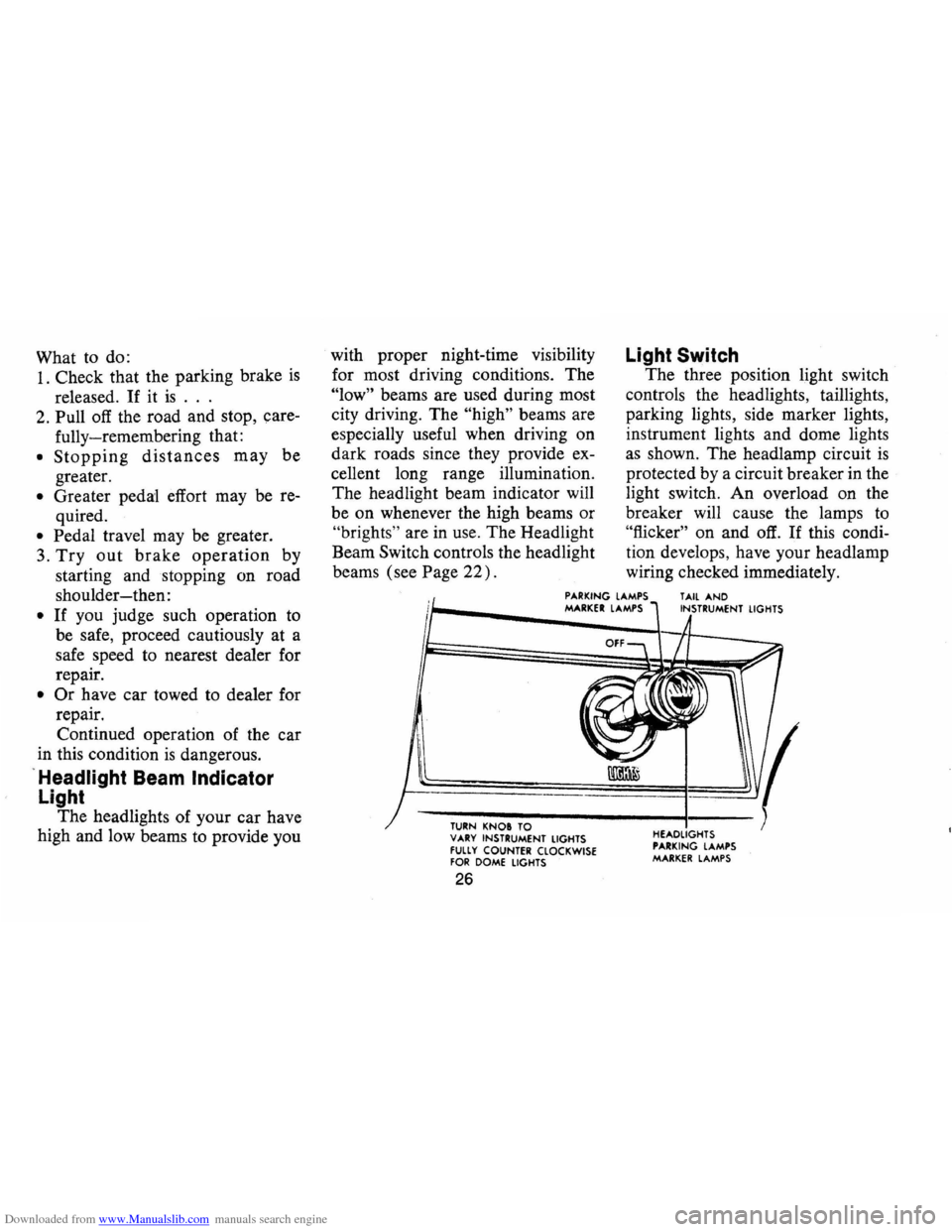
Light Switch
The three position light switch
controls the headlights, taillights,
parking lights, side marker lights,
instrument lights and dome lights
as shown. The headlamp circuit is
protected by a circuit breaker in the
light switch. An overload on the
breaker will cause the lamps
to
"flicker" on and off. If this condi
tion develops, have your headlamp
wiring checked immediately.
PARKING LAMPS
MARKER LAMPS
TURN KNOB TO
VARY INSTRUMENT LIGHTS
FULL Y COUNTER CLOCKWISE FOR DOME LIGHTS
26
HEADLIGHTS PARKING LAMI'S
MARKER LAMPS
Page 31 of 85
Downloaded from www.Manualslib.com manuals search engine Clock
Reset the clock, if your car is so
equipped, by pulling
out the knob
and turning
the hands clockwise if
slow, counterclockwise if fast. This
will,
if the clock error is five min
utes
or more, automatically com
pensate for time gain
or lag. Sev
eral resettings, several days apart,
may be needed to properly adjust
the clock mechanism. Have your
clock cleaned
and oiled by a com
petent clock serviceman at least
every two years.
Cigarette Lighter
The accessory cigarette lighter is
located on the instrument panel
face.
To operate, push it in. When
it becomes heated,
it automatically
pops
out ready for use.
Windshield Wiper
and Washer
The windshield wiping system
operates
at two speeds and is de
signed to wipe clear designated areas
of the
windshield under most
inclement weather conditions.
The
windshield wipers work electrically
and are not affected by engine op
eration.
Push the control lever to the
right to
start the electric windshield
wiper .
The two-speed electric wiper
has both a
"low" and a "high" speed
po sition.
Pressing the control will send a
measured amount of water
or other
cleaning agent onto the windshield
and will also cause the wiper lever
to move, thus starting the wiper .
motor. The wiper will then con
tinue to operate until manually
turned off at the wiper lever.-
Fill the washer
jar only % full
during the winter to allow for ex
pansion if the temperature should
fall low enough to freeze the so
lution.
• Check washer fluid level regu
larly-do it frequently when the
weather is bad.
28
• Use fluid such as GM
OPTIKLEEN to preventfreez
ingdamage, and to provide bet
ter cleaning.
• Do not use radiator anti-freeze in
windshield washer; it could
cause paint damage.
• In cold weather, warm the wind
shield with defrosters before us
ing
washer-to help prevent ic
ing that may seriously obscure
vision.
Ventilation System
Your Camaro incorporates a
ventilation system
that provides
ventilation comfort, made possible
by the addition of air vent provi
sions in the rear body lock pillar.
Another feature of the system
is
continuous low-speed operation of
the air conditioner blower, result
ing in an uninterrupted supply
of
outside air flow into the car when-
Page 34 of 85
Downloaded from www.Manualslib.com manuals search engine • Keep all windows and vents
closed to reduce dust, road and
wind noise and uncomfortable
drafts .
• For most satisfactory heater op
eration and air circulation, oper
ate fan on low or medium speeds
for normal operation and high
speed for quick warm-up and
during extremely low tempera
tures.
• For adequate rear seat heating,
the area beneath the front seat
must not be blocked by carpet
ing, rags, paper
or other mate
rial and fan should operate on
.high blower.
• For additional summer ventila
tion move the
AIR lever to mid
position and the
DEFROSTER
lever to DEE If greater air
flow is desired, move the FAN
lever down to operate the three
speed blower.
Rear Window Defroster
To insure clear vision through
the rear window during
incH:ment
weather, the Rear Window De
froster has become established
as a
popular accessory . This unit draws in
air from the passenger compart
ment and direct s it against the back
window to remove frost or mois
ture. Its blower has a two-speed
control switch on the instrument
panel.
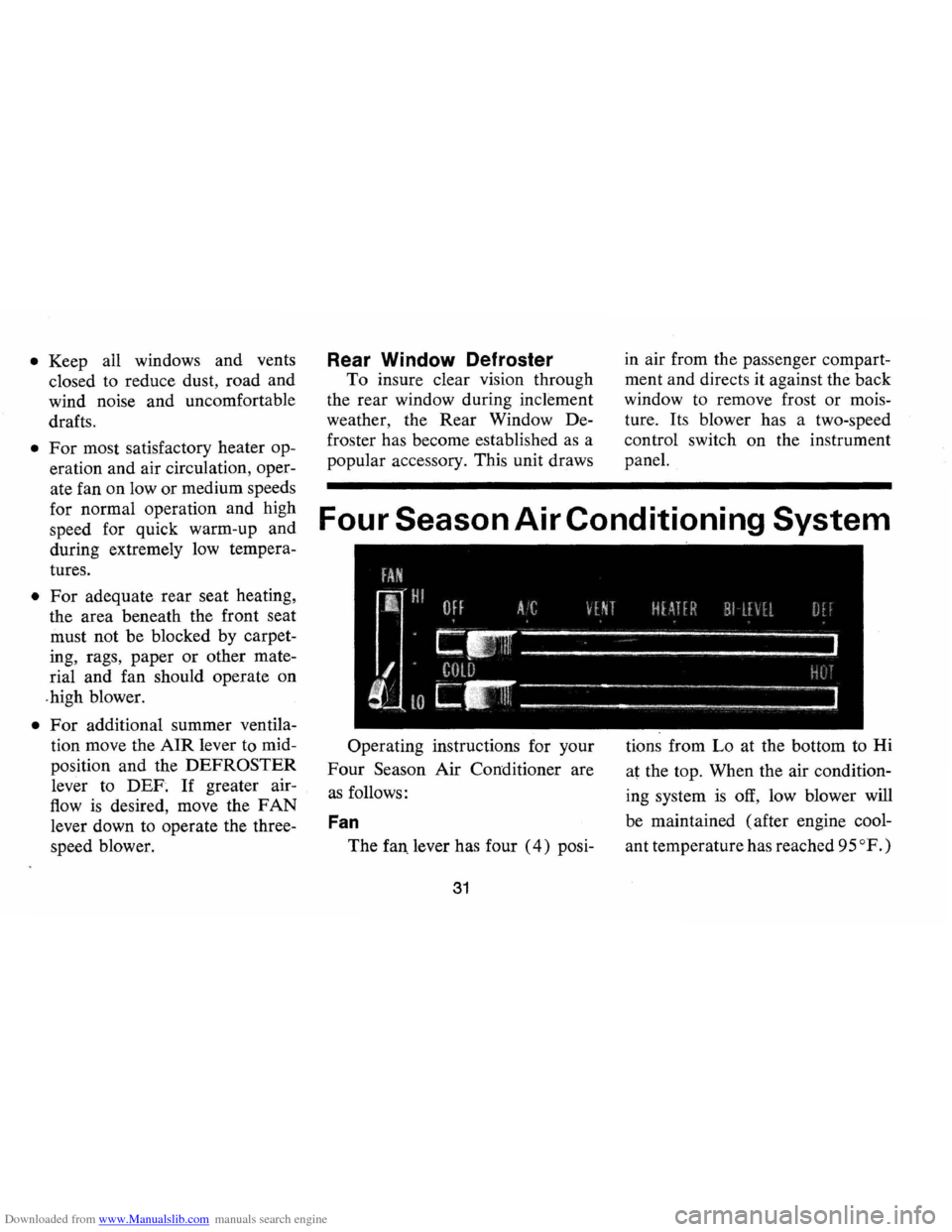
Four Season Air Conditioning System
Operating instructions for your
Four Season Air Conditioner are
as follows:
Fan
The fan. lever has four (4) posi-
31
tions from Lo at the bottom to Hi
at the top. When the air condition
ing system
is off, low blower will
be maintained (after engine cool
ant temperature has reached
95 of.)
Page 38 of 85
Downloaded from www.Manualslib.com manuals search engine OTHER CONTROLS AND FEATURES
Positraction Rear Axle
The optional Positraction pro
vides additional traction on snow ,
ice , mud, sand, and gravel, par
ticularly when one rear wheel
is on
a surface providing poor traction.
During normal driving and cor
nering, the Positraction unit
func~
tions as a standard differential.
When one wheel encounters a slip
pery surface, however , the Positrac
tion directs driving force to the rear
wheel having the better traction.
Power Windows
Power windows have an ignition
interlock so the windows cannot be
operated unless the ignition switch
is in the "on" position.
REMINDER: Remove the ignition
key when the vehicle
is not at
tended by a responsible person.
A master control for both win
dows
is provided at the driver's
position. Also, an individual switch
is provided under right window for
passenger use.
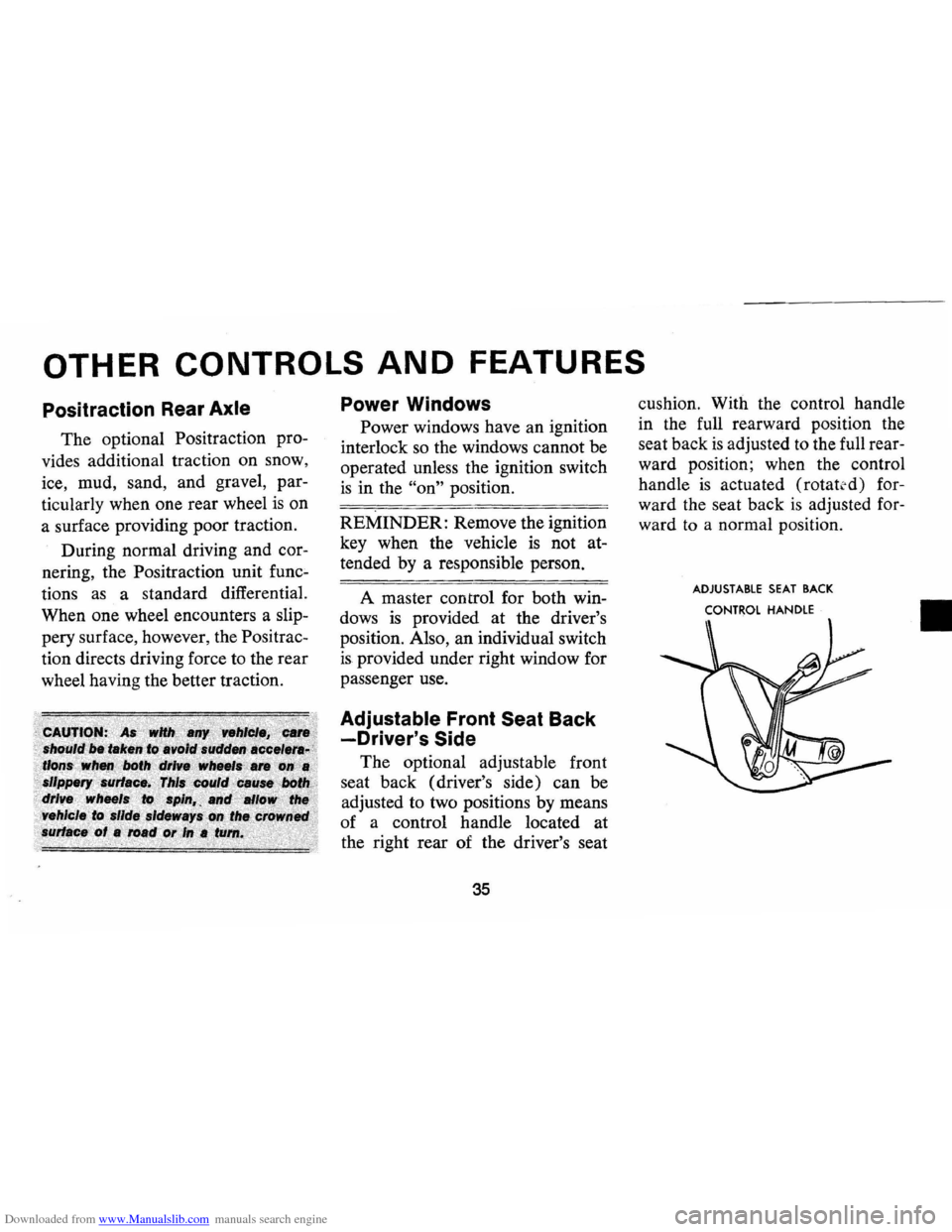
Adjustable Front Seat Back
-Driver's Side
The optional adjustable front
seat back (driver's side) can be
adjusted to two positions by means
of a control handle located at
the right rear of the driver's seat
35
cushion. With the control handle
in the full rearward position the
seat back
is adjusted to the full rear
ward position; when the control
handle
is actuated (rotat td) for
ward the seat back
is adjusted for
ward
to a normal position .
ADJUSTABLE SEAT BACK
CONTROL
HANDLE
II
Page 40 of 85
Downloaded from www.Manualslib.com manuals search engine than 35 mph, for distances up to
50 miles, provided the drive-line,
axle, transmission, and steering
system are otherwise normally op
erable.
Use only towing equipment
specifically designed for this pur
pose following the instructions of
the towing equipment manufac
turer. A separate safety chain sys
tem must be used.
For such towing
the steering must be unlocked,
transmission in neutral and the
parking brake released. Attach
ments must be made to main struc
tural members of the car. Do not
attach to bumpers
or associated
brackets. Remember that power
brake and power steering assists
will not be available when engine
is inoperative.
Emergency Starting
• Engines in vehicles with auto
matic transmissions cannot be started
by pushing
or towing the
car.
• Never tow a manual transmis
sion-equipped
car to start be
cause the surge forward when
the engine starts could cause a
collision with the tow vehicle.
• A car with a discharged battery
may be started by transferring
electrical power from a battery
in another car -called
"jump
starting."
Jump Starting
37
• The battery in the other vehicle
must be of the
same nominal
voltage
(12 volts), and must be
negatively grounded. (All Gen
eral Motors cars, light trucks
(10,000 GVWR and under),
and motor homes use 12-volt,
negatively grounded electrical
systems and
can be used to jump
start one another.) The nominal
voltage and grounding of the
other vehicle's battery may be
determined by checking the spec
ifications
in its owner's manual.
Use of a booster battery of a
higher nominal voltage,
or which
is positively grounded may re
sult
in serious personal injury or
property damage.
• The battery in your car must be a
Delco battery (the original,
or a
replacement) which
is equipped
with flame arrestor type filler/
vent caps
on all filler openings, or
a sealed-type battery which does
Page 42 of 85
Downloaded from www.Manualslib.com manuals search engine tive terminal (black color, "-" Engine Coolant
or "N") of the battery in the other
vehicle, and
THEN the other
end of the same cable to the nega
tive terminal of your battery in
this car. Take care that clamps
from one cable do not inadver
tently touch the clamps on the
other cable. Do not lean over the
battery when making this con
nection.
5. Start the engine in the vehicle
that
is providing the jump start
(if it
was not running). Let run
a
few minutes, then start the en-
gine in the car with the dis-
Jacking Instructions
charged battery.
6. Reverse the above sequence ex
actly when removing the jumper
cables. Reinstall vent caps and
dispose in a safe manner of any
cloths used to cover vent wells,
as
the cloths may have corrosive
acid on them.
39
Preparation
• Park on level surface and set
parking brake firmly.
• Set automatic transmission in
park. (Manual transmission in
reverse).
• Activate hazard warning flasher.
Instructions
1. After removing spare wheel
and tire, jack, jack
base,and
jack handle (wheel nut wrench),
proceed with changing the
wheel
as follows:
2. Remove hub cap
or wheel
cover with flat end of wheel
nut wrench and loosen, but do
not remove nuts, by turning
counterclockwise.
3. With column assembly seated
in base and lever in
"UP" posi
tion,
insert jack hook in
bumper slot.
Page 50 of 85
Downloaded from www.Manualslib.com manuals search engine below, preferably use unleaded or
low-lead gas with a symbol number
of
2. Regular fuel (symbol num
ber
3) should be used only when
needed to eliminate knock. Ask
your gasoline dealer for informa
tion on the fuel you are using both
as to
lead content and octane
rating.
Gas Cap-The fuel tank filler cap has
a new two-step removal and
installation procedure plus a pres
sure-vacuum safety relief valve. It
is equipped with a double set of
locking tangs. To remove:
• Rotate cap one-half turn coun
terclockwise to clear the first set
of tangs from the slots inside the
filler neck. This will allow any
residual pressure to escape.
• Pull the cap outward and rotate
one-quarter turn counterclock
wise to clear second set of tangs
and remove the cap.
• To install, reverse this procedure.
NOTE: If this cap requires a re
placement, only a cap with these
same features should be used. Fail
ure to use the correct cap can re
sult in a serious malfunction of the
system. Correct replacement caps
may be obtained from your Au
thorized Chevrolet Dealer.
47
Engine Oil and Filter
Recommendations
• Use only SE engine oil.
• Change oil each 4 months or
6,000 miles. If more than 6,000
miles are driven in a 4-month
period, change oil each
6,000
miles.
• Change oil each 2 months or
3,000 miles, whichever occurs
first, under the following con
ditions: - driving in dusty conditions,
-trailer pulling,
- extensive idling,
- short-trip operation at freez-
ing temperatures (engine not
II
thoroughly warmed-up).
• Operation in dust storms may
require an immediate oil change.
• Replace the oil filter at the first
oil change, and every second oil
change thereafter. AC oil filters
Page 56 of 85
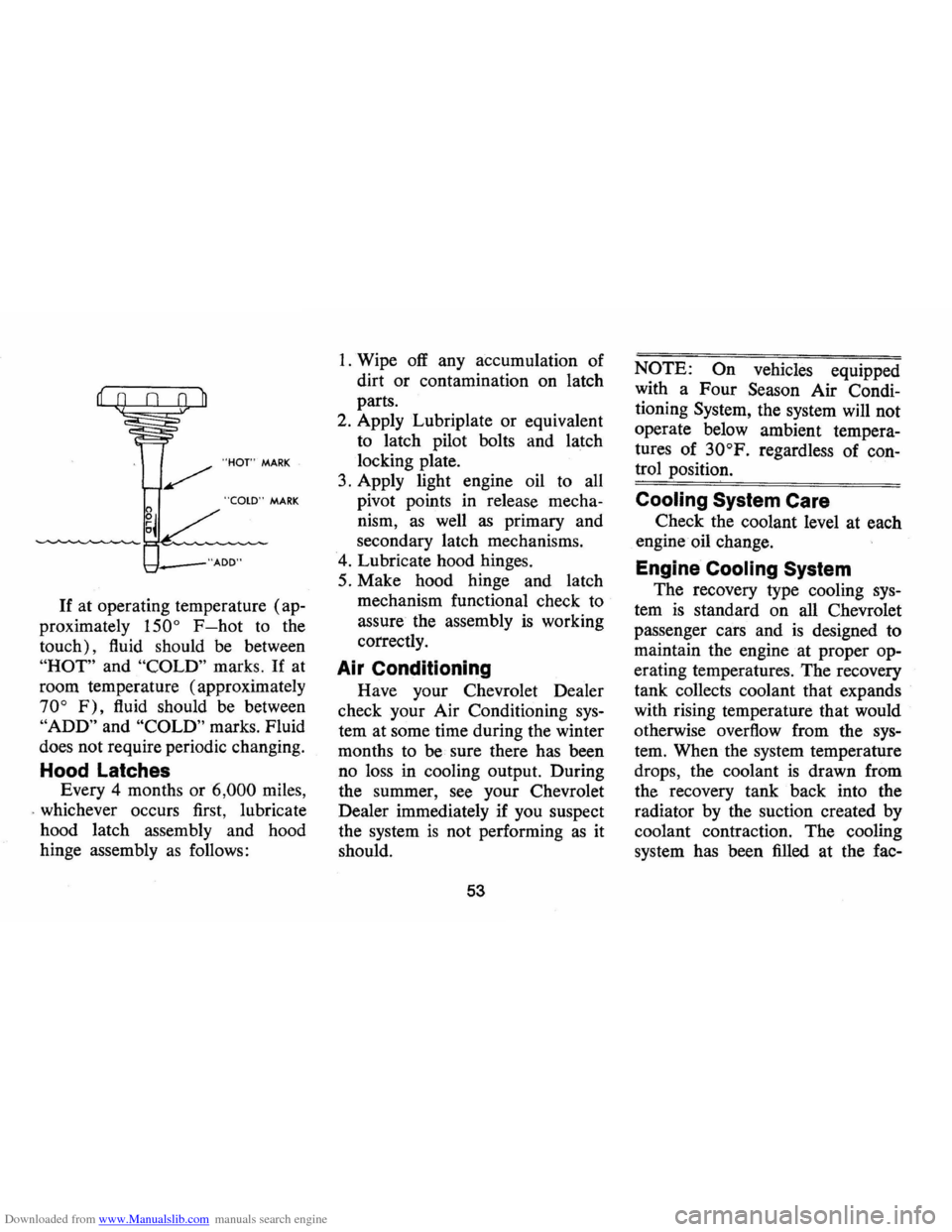
Downloaded from www.Manualslib.com manuals search engine "HOT" MARK
"COLD" MARK
>-f.. __ "AOO"
If at operating temperature (ap
proximately
150° F-hot to the
touch), fluid should be between
"HOT" and "COLD" marks. If at
room temperature (approximately
70° F), fluid should be between
"ADD" and "COLD" marks. Fluid
does not require periodic changing.
Hood Latches
Every 4 months or 6,000 miles,
. whichever occurs first, lubricate
hood latch assembly and hood
hinge assembly
as follows:
1. Wipe off any accumulation of
dirt or contamination on latch
parts.
2. Apply Lubriplate or equivalent
to latch pilot bolts and latch
locking plate.
3. Apply light engine oil to all
pivot points in release mecha
nism,
as well as primary and
secondary latch mechanisms.
4. Lubricate hood hinges.
5. Make hood hinge and latch
mechanism functional check to
assure the assembly
is working
correctly.
Air Conditioning
Have your Chevrolet Dealer
check your Air Conditioning
sys
tem at some time during the winter
months to
be sure there has been
no loss in cooling output. During
the summer,
see your Chevrolet
Dealer immediately if you suspect
the system
is not performing as it
should.
53
NOTE: On vehicles equipped
with a Four Season Air Condi
tioning System, the system will not
operate below ambient tempera
tures of
30°F. regardless of con
trol position.
Cooling System Care
Check the coolant level at each
engine · oil change.
Engine Cooling System
The recovery type cooling sys
tem is standard on all Chevrolet
passenger cars and
is designed to
maintain the engine at proper op
erating temperatures.
The recovery
tank collects coolant that expands
with rising temperature that would
otherwise overflow from the
sys
tem. When · the system temperature
drops, the coolant
is drawn from
the recovery tank back into the
radiator by the suction created by
coolant contraction. The cooling
system has been filled at the fac-
Page 58 of 85
Downloaded from www.Manualslib.com manuals search engine clockwise to detent (do not
press down while rotating).
• Wait until any residual pres
sure (indicated by a hissing
sound)
is relieved.
• After all hissing ceases, press
down on cap while continuing
to rotate counterclockwise.
CAUTION: To ,a~()/d' thedange, .• olbfling "l)~ned;tlo n(Jtl'entoveradiator «aP while
, engipe and radiator are ,stlll hot because $ca/ding ' flU./d·antlsteam' will be blown .
(1utunder pressure.
2. If necessary, run engine, with
radiator cap removed, until nor
mal operating temperature
is
reached and upper radiator hose
is hot (indicates thermostat
is
open).
3. Stop engine and open radiator
drain valve to drain coolant. (To
speed this operation, the drain
plugs in the block can also be
removed.) 4.
Close valve (install block drain
plugs, if removed) and add suf
ficient water to
fill system .
5. Run engine, drain and refill the
system, as described in steps
1,
2, 3, and 4, a sufficient number
of times until the drained liquid
is nearly colorless.
6. Allow system to drain com
pletely and then close radiator
drain valve tightly. (Install
block drain plugs, if removed.)
7. Remove recovery cap leaving
hoses in place. Remove coolant
recovery tank and empty of
fluid. Flush tank with clean
water , drain and reinstall.
8. Add sufficient ethylene glycol
coolant , meeting GM specifica
tion 1899-M, to provide the re
quired freezing and corrosion
protection-at least a 44 percent
solution
(-20°F). Fill radiator
to the base of the radiator filler
55
neck and add sufficient coolant
to the recovery tank to raise level
to the
"FULL HOT" mark. Re
install recovery tank cap.
9. Run engine , with radiator cap
removed, until normal operat
ing
temperature is reached.
(Radiator upper hose becomes
hot.)
10. With engine idling, add cool
ant until level reaches bottom
of filler neck and install radia
tor cap making certain arrows
line up with overflow tube.
It is the owner's responsibility
to keep the freeze protection at a
level commensurate with the tem
peratures which may occur in the
area of vehicle operation .
• Maintain cooling system freeze
protection at
-20 °F or below
to ensure protection against cor
rosion and loss of coolant from
boiling even though freezing