cooling CHEVROLET CAMARO 1974 2.G Owners Manual
[x] Cancel search | Manufacturer: CHEVROLET, Model Year: 1974, Model line: CAMARO, Model: CHEVROLET CAMARO 1974 2.GPages: 85, PDF Size: 32.84 MB
Page 14 of 85
Downloaded from www.Manualslib.com manuals search engine erly when riding. However, if
unusual conditions prohibit use
of restraints
and require that a
Trailer Hauling
Since passenger cars are designed
and intended to be used primarily
as passenger conveyances, towing
a trailer will affect handling,
dura
bility and economy. Maximum
safety and satisfaction depends
upon proper use of correct
equip
ment and avoiding overloads and
other abusive operation.
The maximum loaded trailer
weight which you
can pull with your
Camaro depends on what special
equipment has been installed on
your car. Chevrolet does not
rec
ommend towing any trailer unless
the
car is properly equipped. Infor
mation on trailer hauling capabili
ties, special equipment required,
and optional equipment offered by child
must stand,
he should
stand
on the floor directly be
hind the front seat. This will
Chevrolet
is available from your
Chevrolet Dealer
or by writing:
Chevrolet
Motor Division, Detroit,
Michigan
48202 (or in Canada
by writing to General Motors of
Canada Limited, Owner Relations
Department,
Oshawa, Ontario).
To assist in attaining good han
dling of the car-trailer combina
tion, it is important that the trailer
tongue load be maintained
at ap
proximately 10% of the loaded
trailer weight. Tongue loads
can be
adjusted by proper distribution of
the load in the trailer,
and can be
checked by weighing separately the
loaded trailer and then the tongue.
When towing trailers, tires should
be inflated to the highest
infla
tion pressures shown on the placard
affixed to the left front door. The
11
help minimize the possibility of
injury from frontal impacts in
the event of an accident.
allowable passenger
and cargo
load, also shown
on the same plac
ard, is reduced by an amount equal
to the trailer tongue load on the
trailer hitch.
Maintenance
More frequent vehicle mainte
nance is required when using your
car to pull a trailer. Change the:
• Automatic transmission fluid
each
12,000 miles,
• Rear axle fluid each 12,000
miles,
• Engine oil each 60 days or 3,000
miles, whichever occurs first,
• Positive crankcase ventilation
valve each 12 months
or 12,000
miles, whichever occurs first.
• See index for important informa
tion on belts, cooling system care
and automatic brake adjustment.
Page 16 of 85
Downloaded from www.Manualslib.com manuals search engine STARTING AND OPERATING
Engine Exhaust Gas Caution (Carbon Monoxide)
AvoId Inhaling exhaust gases because
they contain carbon monoxide, which by
itself is colorless and odorless. Carbon
monoxide is
a dangerous gas that can
cause unconsciousness and is potentially
lethal.
" at any time you suspect that exhaust fumes are entering the passenger com
partment, have the cause determined and
corrected as soon as
possible. If you
must drive under these conditions, drive
only with aU windows fully open.
The best protection against carbon
monoxIde entry Into the car body Is a
properly maintained engine exhaust sys
tem, car body and body ventilation system.
It is recommended that the exhaust sys
tem and body Is Inspected by a competent
mechanic:
• Each time the vehicle Is raised for 011
change.
• Whenever a change is noticed in the
sound
of the exhaust system.
• Whenever the exhaust system, under
body or rear of the vehicle Is damaged.
See your Maintenance Schedule folder
for inspection
procedure.
To aI/ow proper operation of the car's
ventilation system, keep front ventilation
inlet
grille clear of snow, leaves or other
obstruction at al/ tImes.
SITTING IN A PARKED CAR WITH
ENGINE RUNNING
FOR AN EXTENDED
PERIOD IS NOT RECOMMENDED.
Do not run engIne In confined areas such as garages any more than needed
to
move vehicle in or out of area. When
vehicle is stopped in
an UNCONFINED
area with the engine running for any more
than
a short period, adjust heating or
cooling system to force outside air into
car as follows:
13
1. On cars not equipped with air condi
tioning, set fan to medium or high
speed and upper control lever to any
position
except OFF.
2. On cars equipped with air condition-• ing, set fan to medium or high speed
and upper control lever to any position
except OFF or MAX •
The trunk lid should be closed while
driving to help prevent inadvertently
drawing
exhaust gases into the car. It is
unwise
to drive at high speeds for long
durations with the trunk
lid open. However, if for some reason the trunk must
remain open for
a perIod while moving,
or electrical wiring or other cable con
nections to a trailer must pass through
the seal between
trunk lid and body, the
following precautions should
be observed:
• Close all windows.
• Adjust heating or COOling system to
force outside air into car as described
in items 1 and 2 above but with fan set
at high speed.
• On cars equipped with outside air vents
in or under instrument panel, open
vents fully.
Page 30 of 85
Downloaded from www.Manualslib.com manuals search engine Optional Instruments and Gauges
Tachometer and Oil Pressure Indicator Light
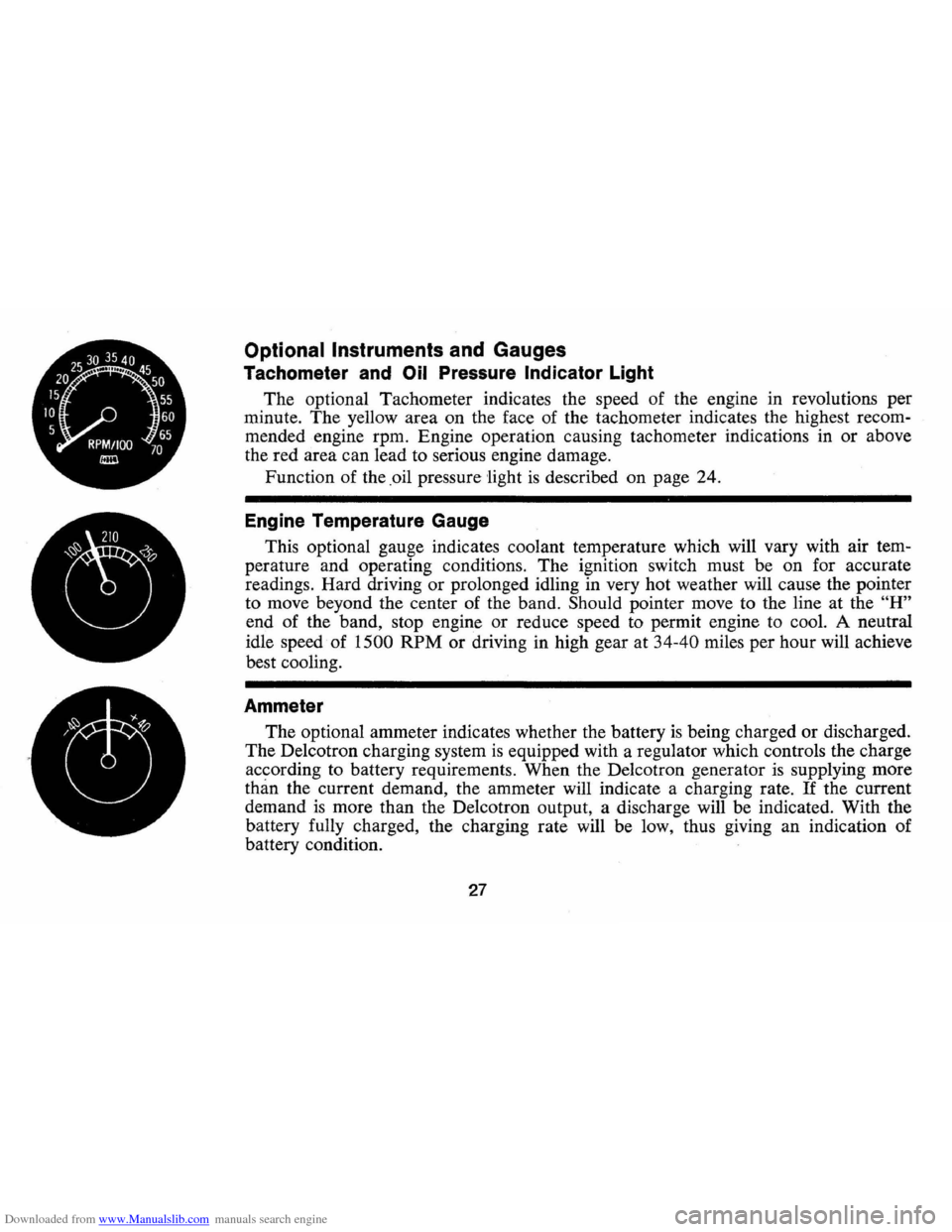
The optional Tachometer indicates the speed of the engine in revolutions per
minute. The yellow area on the face of the tachometer indicates the highest recom
mended engine rpm. Engine operation causing tachometer indications in or above
the red area can lead to serious engine damage.
Function of the .oil pressure
'light is described on page 24.
Engine Temperature Gauge
This optional gauge indicates coolant temperature which will vary with air tem
perature and operating conditions. The ignition switch must be on for accurate
readings. Hard driving
or prolonged idling in very hot weather will cause the pointer
to move beyond the center of the band.
Should pointer move to the line at the "H"
end of the band, stop engine or reduce speed to permit engine to cool. A neutral
idle speed of
1500 RPM or driving in high gear at 34-40 miles per hour will achieve
best cooling.
Ammeter
The optional ammeter indicates whether the battery is being charged or discharged.
The De1cotron charging system
is equipped with a regulator which controls the charge
according to battery requirements. When the De1cotron generator
is supplying more
than the current demand, the ammeter will indicate a charging rate. If the current
demand
is more than the De1cotron output, a discharge will be indicated. With the
battery fully charged, the charging rate will be low, thus giving an indication of
battery condition.
27
Page 32 of 85
Downloaded from www.Manualslib.com manuals search engine ever the ignition switch is on.
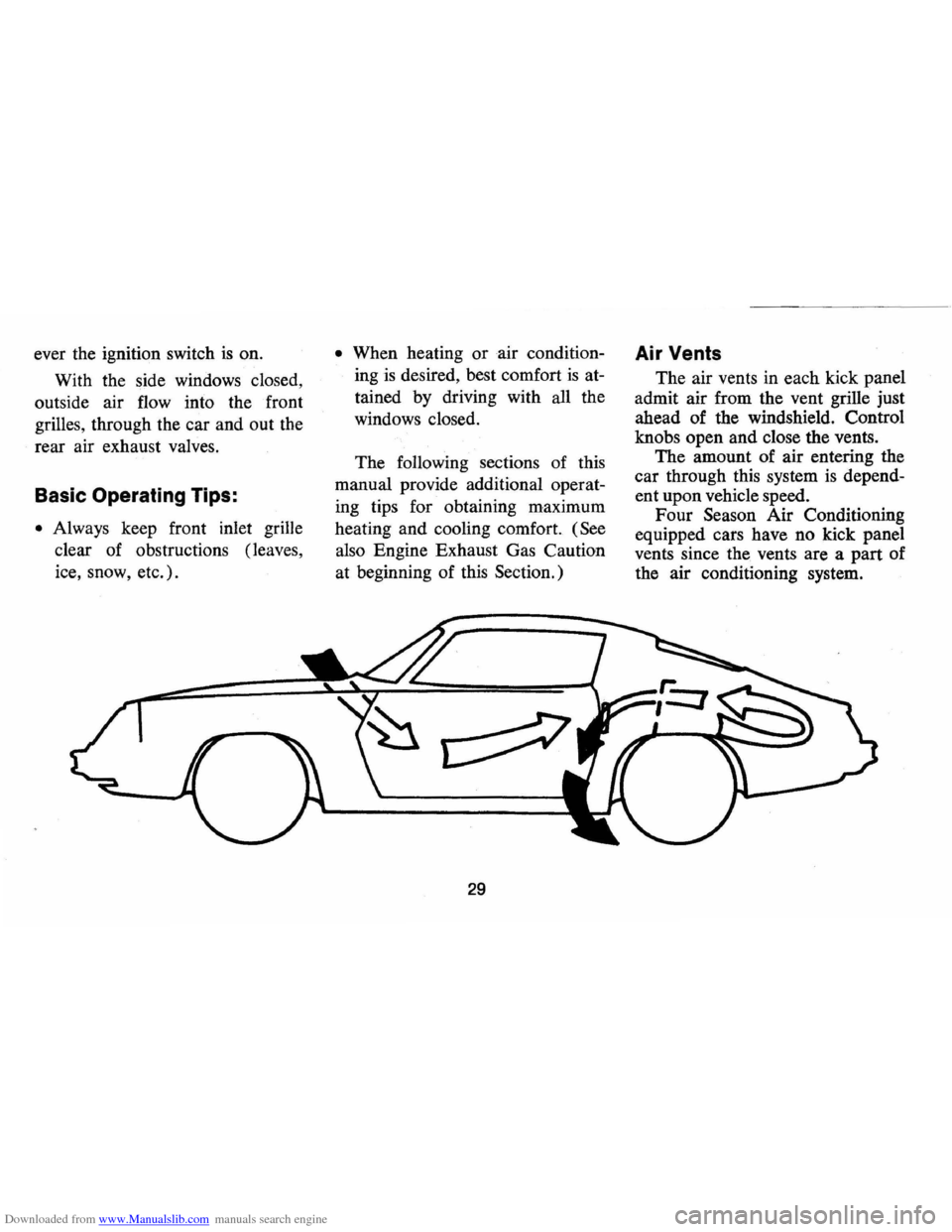
With the side windows closed,
outside air flow into the front
grilles, through the car and out the
rear air exhaust valves.
Basic Operating Tips:
• Always keep front inlet grille
clear of obstructions (leaves,
ice, snow, etc.).
• When heating or air condition
ing
is desired, best comfort is at
tained by driving with all the
windows closed.
The following sections of this
manual provide additional operat
ing tips for obtaining maximum
heating and cooling comfort.
(See
also Engine Exhaust Gas Caution
at beginning of this Section.)
29
Air Vents
The air vents in each kick panel
admit air from the vent grille just
ahead of the windshield. Control
knobs open and close the vents.
The amount of air entering the
car through this system
is depend
ent upon vehicle speed.
Four Season Air Conditioning
equipped cars have no kick panel
vents since the vents are a part of
the air conditioning system.
Page 35 of 85
Downloaded from www.Manualslib.com manuals search engine no matter which position the fan
switch
is in.
Temperature (Lower Level)
The temperature lever allows a
selection of air temperature from
Cold at the far left to Hot at the
far right. When the temperature
lever
is in the COLD position the
system will provide the coldest air
possible. When the temperature
lever
is moved to the right (toward
HOT), the system will operate on
outside air.
Selector (Upper Lever)
This lever provides a selection of
systems available to handle various
heating and cooling requirements
throughout the year . The
"Air Con
ditioning" and "Heating" groups have
several
posItIons which im
prove the effectiveness of the
sys
tem for various demands.
OFF-The system operates on low
blower regardless of fan switch
position with air discharged into
vehicle through heater outlet.
A/C-Air from the passenger com
partment
is recirculated through
the system with some outside air
and discharged from the upper
outlets when the temperature lever
is in Full COLD or extreme left. If
the Temperature lever is moved
right to the first stop or further,
the system will automatically go
on outside air. The
AIC position,
with Temp. lever in Full
COLD ,
is used when maximum cooling is
required under conditions of high
temperature and humidity. High
32
fan speed is automatically attained
in this position.
AI C (with Temp lever right to first
stop)-Outside air
is passed through
the system and discharged through
the upper outlets. This position
is
recommended for most air condi
tioning situations because of re
duced blower noise and reduction
of cigarette smoke within the
vehicle.
Fan speed may be varied
as required.
VENT -Outside air is passed
through the system and discharged
from the defroster, upper, and
lower outlets. This position
is pro
vided for cool
to moderate weather
when refrigeration
is not required.
HEATER-Outside air is delivered
through the heater outlet and with
Page 56 of 85
Downloaded from www.Manualslib.com manuals search engine "HOT" MARK
"COLD" MARK
>-f.. __ "AOO"
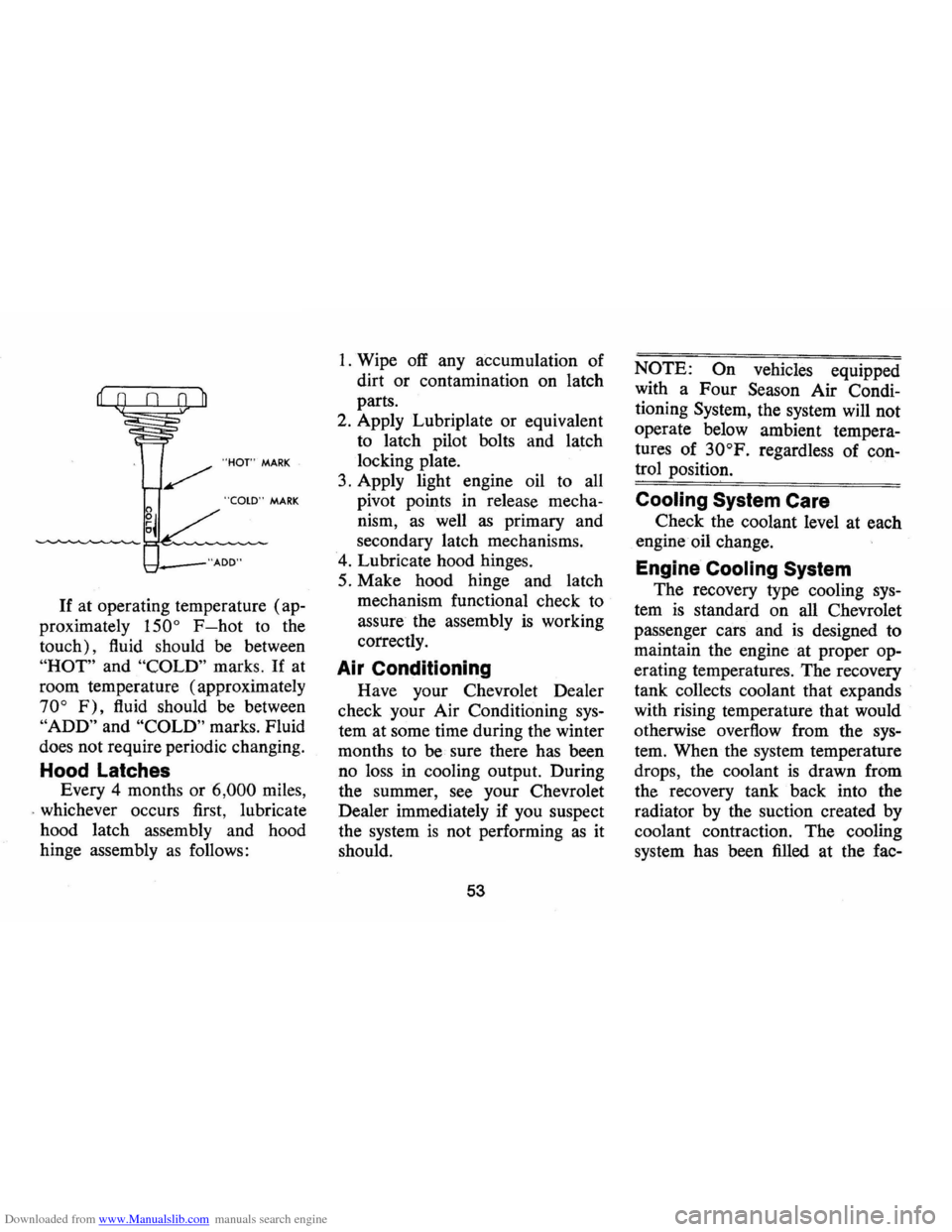
If at operating temperature (ap
proximately
150° F-hot to the
touch), fluid should be between
"HOT" and "COLD" marks. If at
room temperature (approximately
70° F), fluid should be between
"ADD" and "COLD" marks. Fluid
does not require periodic changing.
Hood Latches
Every 4 months or 6,000 miles,
. whichever occurs first, lubricate
hood latch assembly and hood
hinge assembly
as follows:
1. Wipe off any accumulation of
dirt or contamination on latch
parts.
2. Apply Lubriplate or equivalent
to latch pilot bolts and latch
locking plate.
3. Apply light engine oil to all
pivot points in release mecha
nism,
as well as primary and
secondary latch mechanisms.
4. Lubricate hood hinges.
5. Make hood hinge and latch
mechanism functional check to
assure the assembly
is working
correctly.
Air Conditioning
Have your Chevrolet Dealer
check your Air Conditioning
sys
tem at some time during the winter
months to
be sure there has been
no loss in cooling output. During
the summer,
see your Chevrolet
Dealer immediately if you suspect
the system
is not performing as it
should.
53
NOTE: On vehicles equipped
with a Four Season Air Condi
tioning System, the system will not
operate below ambient tempera
tures of
30°F. regardless of con
trol position.
Cooling System Care
Check the coolant level at each
engine · oil change.
Engine Cooling System
The recovery type cooling sys
tem is standard on all Chevrolet
passenger cars and
is designed to
maintain the engine at proper op
erating temperatures.
The recovery
tank collects coolant that expands
with rising temperature that would
otherwise overflow from the
sys
tem. When · the system temperature
drops, the coolant
is drawn from
the recovery tank back into the
radiator by the suction created by
coolant contraction. The cooling
system has been filled at the fac-
Page 57 of 85
Downloaded from www.Manualslib.com manuals search engine tory with a high-quality, inhibited,
year-around coolant that meets the
standards of General Motors
Spe
cification 1899-M. This coolant
solution provides freezing protec
tion to
-20oP (-35°P in Can
ada), and it has been formulated to
be used for two full calendar years
or
24,000 miles, whichever first
occurs, of normal operation with
out replacement, provided the
proper concentration of coolant is
maintained.
Cooling System Care
The radiator cap should not be
removed to check coolant level.
Check the coolant level visually in
the 'see thru' coolant recovery tank
at least
as frequently as engine oil
changes. Level should be at the
"full cold" mark on the recovery
tank when the system
is cold. At
normal operating temperature the
coolant should be at the
"full hot"
mark on the recovery tank. Add sufficient
coolant to the recovery
tank.
Use a 50/50 mixture of high
quality ethylene glycol antifreeze
and water for coolant additions.
If
regular additions are required, see
your dealer for a cooling system
check.
NOTE: If recommended quality
antifreeze
is used, supplemental in
hibitors or additives claiming to
provide increased capability are
not necessary. They may be detri
mental to the efficient operation of
the system, and represent an un
necessary operating expense.
Every year, the cooling system
should be serviced
as follows:
1. Wash
radiator cap and filler
neck with clean water.
2. Check coolant for proper level
and freeze protection.
3. Pressure test system and radia-
54
tor cap for proper pressure hold
ing capacity (15 psi) .
If re
placement of cap
is required, use
the special AC cap designed for
coolant recovery systems, speci
fied for your model.
4. Tighten hose clamps and inspect
all hoses. Replace hoses when
ever swollen, checked or other
wise deteriorated.
5. Clean frontal area of radiator
core and air conditioning con
denser.
Replace hoses every 24 months
or 24,000 miles or earlier if
checked, swollen or otherwise de
teriorated. Every two years
or 24,-
000 miles, whichever first occurs,
the cooling system should be
flushed and refilled using the fol
lowing recommended procedure:
1. Remove radiator cap when
engine is cool by:
• Slowly rotating cap counter-
Page 58 of 85
Downloaded from www.Manualslib.com manuals search engine clockwise to detent (do not
press down while rotating).
• Wait until any residual pres
sure (indicated by a hissing
sound)
is relieved.
• After all hissing ceases, press
down on cap while continuing
to rotate counterclockwise.
CAUTION: To ,a~()/d' thedange, .• olbfling "l)~ned;tlo n(Jtl'entoveradiator «aP while
, engipe and radiator are ,stlll hot because $ca/ding ' flU./d·antlsteam' will be blown .
(1utunder pressure.
2. If necessary, run engine, with
radiator cap removed, until nor
mal operating temperature
is
reached and upper radiator hose
is hot (indicates thermostat
is
open).
3. Stop engine and open radiator
drain valve to drain coolant. (To
speed this operation, the drain
plugs in the block can also be
removed.) 4.
Close valve (install block drain
plugs, if removed) and add suf
ficient water to
fill system .
5. Run engine, drain and refill the
system, as described in steps
1,
2, 3, and 4, a sufficient number
of times until the drained liquid
is nearly colorless.
6. Allow system to drain com
pletely and then close radiator
drain valve tightly. (Install
block drain plugs, if removed.)
7. Remove recovery cap leaving
hoses in place. Remove coolant
recovery tank and empty of
fluid. Flush tank with clean
water , drain and reinstall.
8. Add sufficient ethylene glycol
coolant , meeting GM specifica
tion 1899-M, to provide the re
quired freezing and corrosion
protection-at least a 44 percent
solution
(-20°F). Fill radiator
to the base of the radiator filler
55
neck and add sufficient coolant
to the recovery tank to raise level
to the
"FULL HOT" mark. Re
install recovery tank cap.
9. Run engine , with radiator cap
removed, until normal operat
ing
temperature is reached.
(Radiator upper hose becomes
hot.)
10. With engine idling, add cool
ant until level reaches bottom
of filler neck and install radia
tor cap making certain arrows
line up with overflow tube.
It is the owner's responsibility
to keep the freeze protection at a
level commensurate with the tem
peratures which may occur in the
area of vehicle operation .
• Maintain cooling system freeze
protection at
-20 °F or below
to ensure protection against cor
rosion and loss of coolant from
boiling even though freezing
Page 59 of 85
Downloaded from www.Manualslib.com manuals search engine temperatures are not expected.
• Add ethylene glycol base coolant
that meets GM Specification
1899-M when coolant additions
are required because of coolant
loss or to provide additional pro
tection against freezing at tem
peratures lower than
-20°F
(-35°F in Canada).
NOTE: Alcohol or methanol base
coolants or plain water are not
recommended for your Camaro at
any time.
Radi~tor Pressure Cap
The radiator cap, a 15 lb. pres
sure type, must be installed tightly,
9therwise coolant may be lost and
damage to engine may result from
overheating.
Radiator pressure
caps should be checked periodi
cally for proper operation.
If re
placement
is required specify AC.
Thermostat
The cooling system is protected
and controlled by a thermostat in
stalled in the engine coolant outlet
to maintain a satisfactory operat
ing temperature of the engine. This
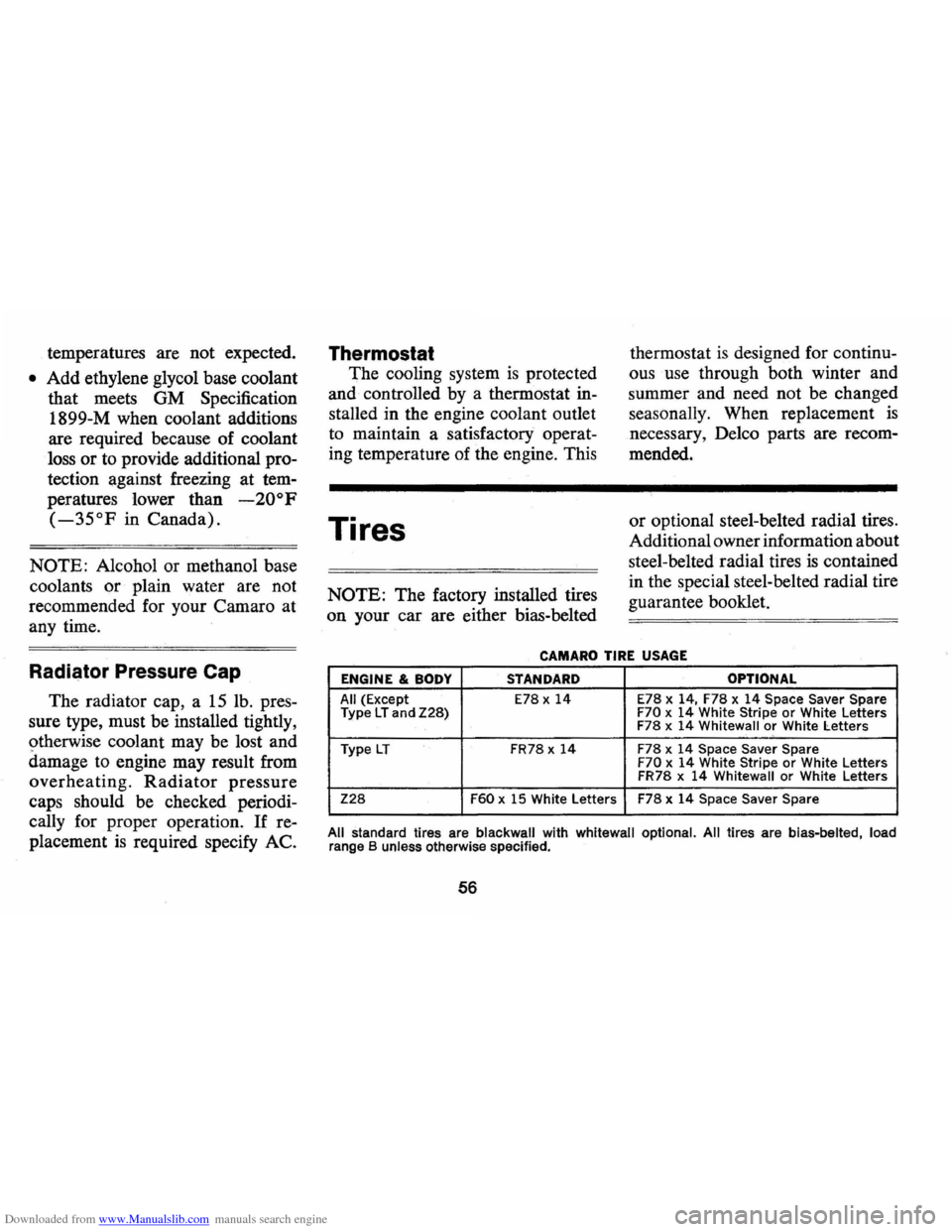
Tires
NOTE: The factory installed tires
on your car are either bias-belted thermostat
is designed
for continu
ous
. use through both winter and
summer and need not be changed
seasonally. When replacement
is
necessary, Delco parts are recom
mended.
or optional steel-belted radial tires.
Additional owner information about
steel-belted radial tires
is contained
in the special steel-belted radial tire
guarantee booklet.
CAMARO TIRE USAGE
ENGINE & BODY STANDARD OPTIONAL
All (Except E78 x 14 E78 x 14, F78 x 14 Space Saver Spare
Type LTand Z28) F70 x 14 White Stripe or White Letters
F78 x 14 Whitewall or White Letters
Type
LT FR78 x 14 F78 x 14 Space Saver Spare F70 x 14 White Stripe or White Letters
FR78 x 14 Whitewall or White Letters
Z28 F60 x 15 White Letters F78 x 14 Space Saver Spare
All standard tires are blackwall with whitewall optional. All tires are bias-belted load range B unless otherwise specified. '
56
Page 69 of 85
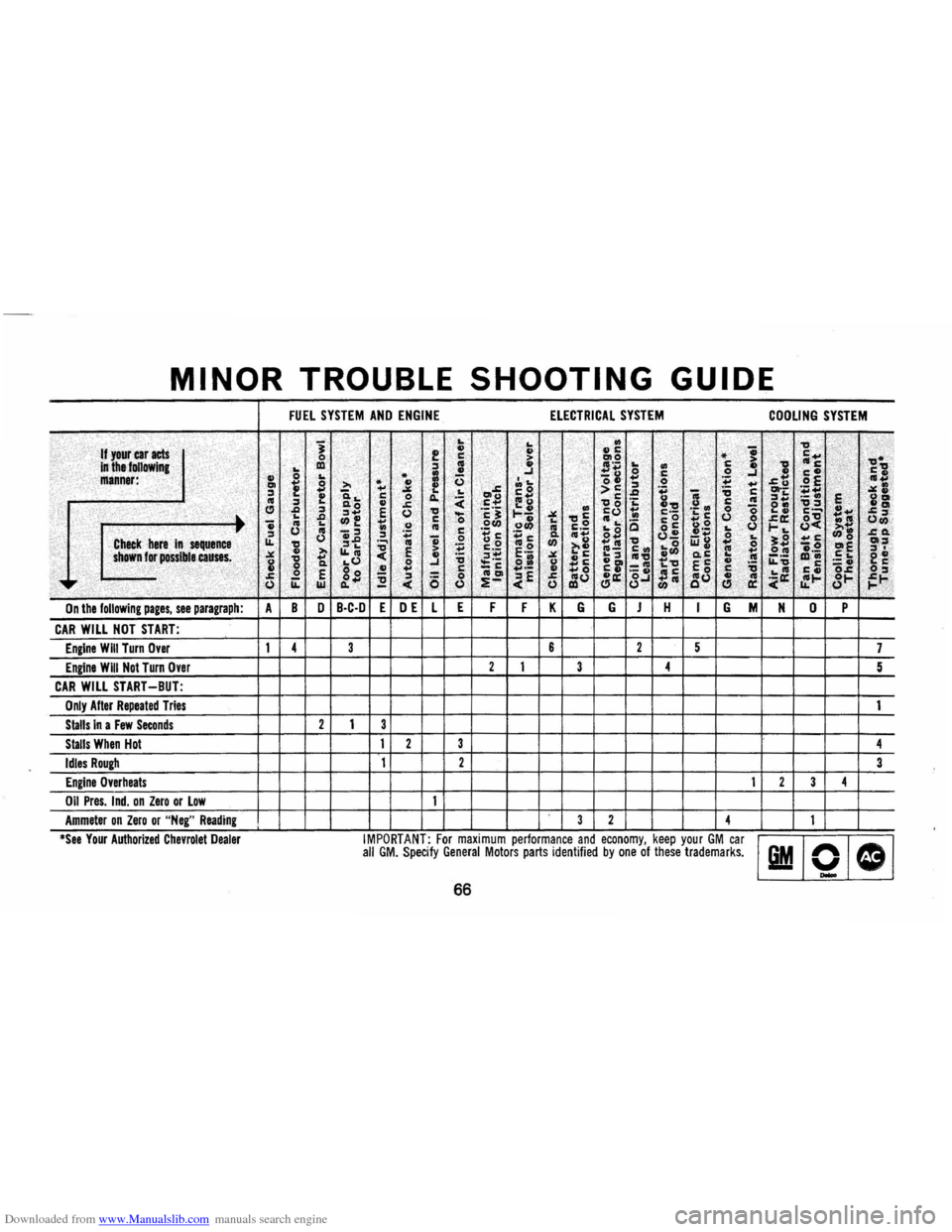
Downloaded from www.Manualslib.com manuals search engine MINOR TROUBLE SHOOTING GUIDE
FUEL SYSTEM AND ENGINE ELECTRICAL SYSTEM COOLING SYSTEM
IMPORTANT: For maximum performance and economy, keep your GM car I I I I all GM. Specify General Motors parts identified by one of these trademarks. liM Q ~
66