steering CHEVROLET CAMARO 1974 2.G Owners Manual
[x] Cancel search | Manufacturer: CHEVROLET, Model Year: 1974, Model line: CAMARO, Model: CHEVROLET CAMARO 1974 2.GPages: 85, PDF Size: 32.84 MB
Page 4 of 85
Downloaded from www.Manualslib.com manuals search engine 1974 CAMARO
OWNER'S
MANUAL
This manual should be considered a permanent part of the vehicle,
and must remain with the vehicle
at time of resale.
CHEVROLET MOTOR
DIVISION
GENERAL MOTORS CORPORATION DETROIT. MICHIGAN 48202
All information. illustrations and specifications contained in this manual are based on the latest product information available at the time of publication. The right is reserved to make changes at any time without notice.
For vehicles
sold in Canada, substitute the name
General Motors of Canada Limited, wherever the name
Chevrolet Motor Division appears in this manual.
ST 309-74
©GENERAL MOTORS CORPORATION 1974
Table of Contents
Section
Reprinted with Permission of
General Motors Corporation
1 Before Driving Your Camaro ................................ .
Page
3
2 Starting and Operating. . . . . . . . . . . . . . . .. . . . . . . . . . . . . . . . . . . . . .. 13
Steering Column Controls. . . . . . . . . . . . . . . . . . . . . . . . . . . . . . . .. 14
Starting Engine. . . . . . . . . . . . . . . . . . . . . . . . . . . . . . . . . . . . . . . . .. 15
Floor Controls.. . . . . . . . . . . . . . . . . . . . . . . . . . . . . . . . . . . . . . . . . .. 21
Instrument Panel ......................................... , 23
Other Controls and Features. . . . . . . . . . . . . . . . . . . . . . . . . . . . . . .. 35
3 I n Case of Emergency.. . . . . . . . . . . . . . . . . . . . . . . . . . . . . . . . . . . . . .. 36
4 Appearance Care ............................................. 41
5 Service and Maintenance. . . . . . . . . . . . . . . . . . . . . . . . . . . . . . . . . . .. 46
6 Minor Trouble Shooting. . .. . . . . . . . . .. .. . . .. . . . . . . .. . . . . .. .. .. 66
7 Specifications. Owner Assistance. Service Manuals. Index. Gas
Station Information. . . . . . . . . . . . . . . . . . . . . . . . . . . . . . . . . . . . . . . . .. 70
Applicable to CALIFORNIA Sales Only This vehicle as delivered by GM Chevrolet Division is equipped with a bumper energy
absorption system meeting California S.B.42 (1971) as set forth in Sec. 34715 Vehicle Code.
1
Page 15 of 85
Downloaded from www.Manualslib.com manuals search engine Break-in Schedule
In addition to the new car
break-in instructions in this man
ual, it
is recommended that your
new Camaro be operated for
500
miles before trailer towing. If it is
necessary to tow during this period,
avoid speeds over
50 MPH and full throttle
starts. The same precau
tions should be observed whenever
a new engine, transmission
or axle
is installed in your car.
Operation in Foreign Countries
Your Camaro is designed to op
erate on fuel of approximately
91
research octane number or higher,
sold in the United States and Can
ada.
If you plan to operate your
Camaro outside the continental
limits of the United States
or Can
ada, there
is a possibility that the
best fuels available in some coun
tries are so low in anti-knock
quality that excessive knocking
and serious engine damage may
. result from their use. To obtain
information on the quality of fuels available
in the countries in which
you plan to travel , write to Chevro
let Motor Division, Service Depart
ment, Detroit, Michigan
48202,
(or in Canada write to General
Motors of Canada Limited,
Owner
Relations Department , Oshawa,
Ontario),
giving:
• The vehicle identification num
ber ( on plate on instrument
panel ahead of the steering
wheel and visible through the
windshield , or from registration
slip or title).
• The country or countries in
12
which you plan to travel.
It
is recommended that you not
operate your Camaro in any coun
try not having fuels meeting the
requirements of
your Camaro
engine. Engine modifications are
not available to compensate for
low anti-knock quality fuels. Op
eration of your car under condi
tions of continuous
or excessive
knocking constitutes misuse of the
engine and may cause engine dam
age for which the Chevrolet Divi
sion
is not responsible under the
terms
of the Chevrolet New
Vehicle Warranty.
Page 17 of 85
Downloaded from www.Manualslib.com manuals search engine STEERING COLUMN CONTROLS
Anti-Theft Steering
Column Lock
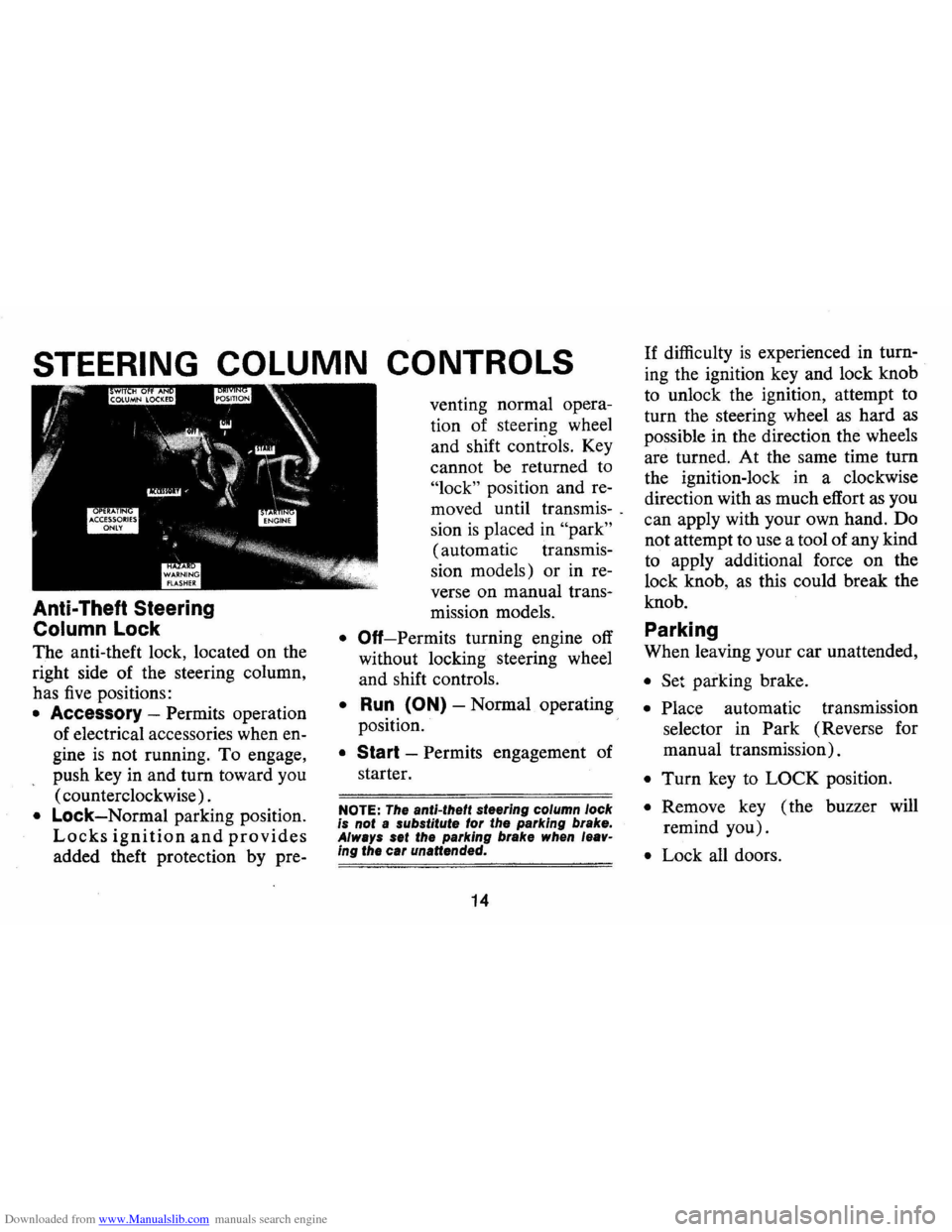
The anti-theft lock, located on the
right side of the steering column,
has
five positions:
• Accessory -Permits operation
of electrical accessories when en
gine
is not running. To engage,
push key in and turn toward you
( counterclockwise) .
• Lock-Normal parking position.
Locks ignition and provides
added theft protection by pre- venting
normal opera
tion of steering wheel
and shift controls. Key
cannot be returned to
"lock" position and re
moved until transmis-.
sion
is placed in "park"
(automatic transmis
sion models) or in re
verse on manual trans-
mission models.
• Off-Permits turning engine off
without locking steering wheel
and shift controls.
• Run (ON) -Normal operating
position.
• Start -Permits engagement of
starter.
NOTE: The anti-theft steering column lock
is not a substitute for the parking brake.
Always set the parking brake when leav
ing the car unattended.
14
If difficulty is experienced in turn
ing the ignition key and lock knob
to unlock the ignition, attempt to
turn the steering wheel
as hard as
possible in the direction the wheels
are turned. At the same time turn
the ignition-lock in a clockwise
direction with
as much effort as you
can apply with your own hand. Do
not attempt to use a tool of any kind
to apply additional force on the
lock knob,
as this could break the
knob.
Parking
When leaving your car unattended,
• Set parking brake.
• Place automatic transmission
selector in Park (Reverse for
manual transmission).
• Turn key to LOCK position.
• Remove key ( the buzzer will
remind you).
• Lock all doors.
Page 21 of 85
Downloaded from www.Manualslib.com manuals search engine Driving with Manual Transmissions
The 3-and 4-speed transmission
shift levers, extending from the
fioor, have their special shift pat
tern diagram located on the knob.
Depress the clutch pedal fully be
fore attempting to shift
toa differ
ent gear, then release the pedal to
move in that gear.
For normal
accelerations shift into second gear
at
20 mph; into third gear at 30
mph; and on 4-speed models into
fourth gear at
40 mph.
Both transmissions, being fully
synchronized, may be downshifted
into 1 st gear at any speed below
20
m. p.h. Shift into Reverse gear only
after the car has stopped. Always
depress and release the clutch pedal
fully when shifting.
Also, shift into
"Reverse" before
shutting
off engine. This will permit the
ignition key to be turned to the
"Lock" position.
Good Driving Practice: On cars
equipped with manual transmis
sions , use second gear at slow
speeds (less than
30 m.p.h.) when
driving in stop-and-go traffic; for
improved vehicle performance dur
ing acceleration; and when de
scending steep hills.
18
Turn Signals and Lane
Change Feature
The tum signal lever is located
on the left side of the steering col
umn immediately under the steer
ing wheel. The lever
is moved up
,ward to signal a right
tum and
downward to signal a left
tum.
Lamps on the front and rear of the
car transmit this signal to other
motorists and pedestrians. The
ig
nition switch must be in the "ON"
position in order for the tum sig
nals to be operational. This feature
prevents battery drain if the lever .
is left in an "ON" position when
your car
is not in use.
Page 22 of 85
Downloaded from www.Manualslib.com manuals search engine In a normal turning situation
such
as turning a corner, the turn
signal
is cancelled automatically
after the turn
is completed. How
ever, in some driving maneuvers
such
as changing lanes on an ex
pressway, the steering wheel
is not
turned back sufficiently after com
pleting the turn to automatically
cancel the turn signal. For con
venience in such maneuvers, the
driver can flash the turn signals by
moving the turn signal lever part
way (to the first stop) and holding
it there. The lever returns to the
neutral or cancelled position when
the driver releases his hold on the
lever.
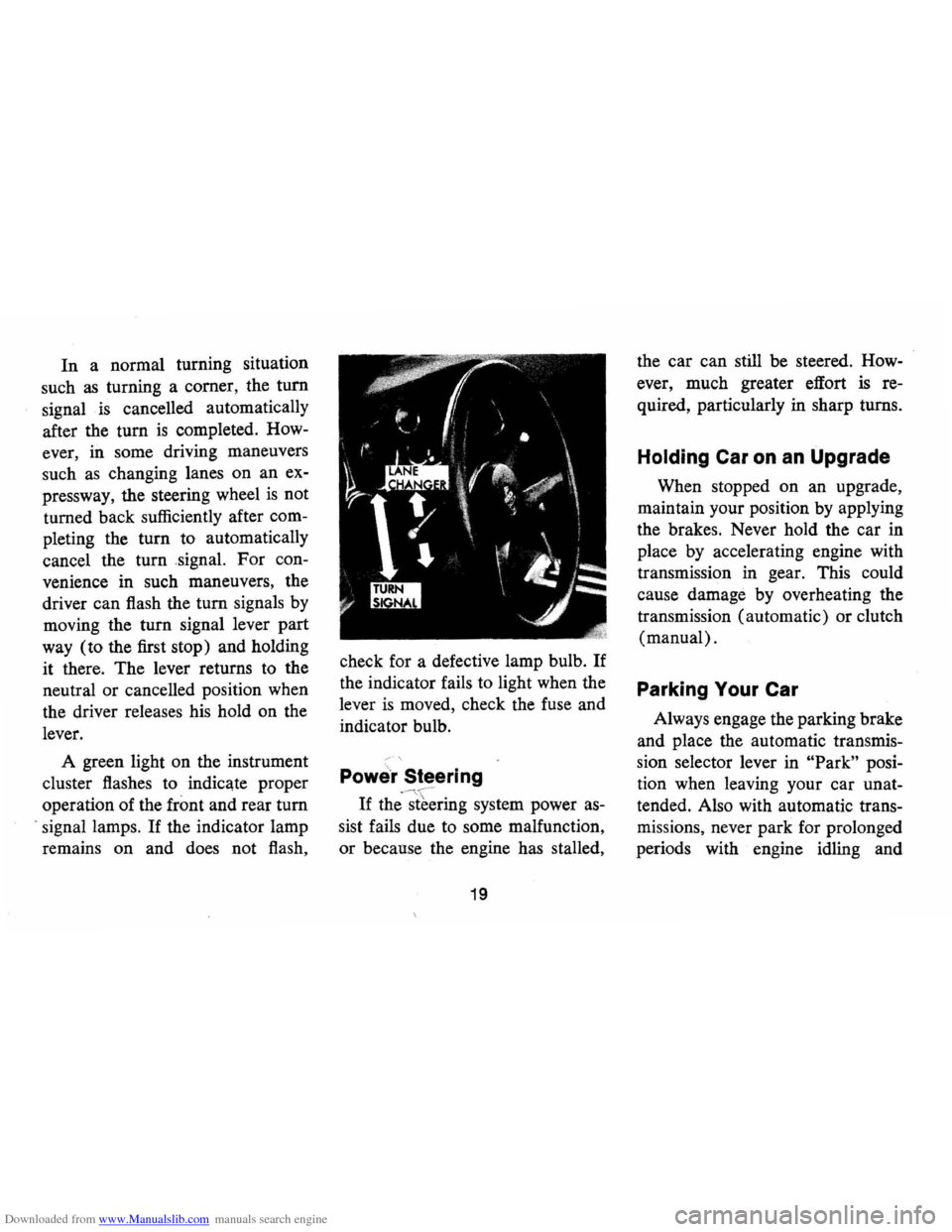
A green light on the instrument
cluster flashes to indicate proper
operation of the
front and rear tum
> signal lamps. If the indicator lamp
remains on and does not flash, check
for a defective lamp bulb.
If
the indicator fails to light when the
lever
is moved, check the fuse and
indicator bulb.
Powe'r Steering
If
the'-~[~~ring system power as
sist fails due to some malfunction,
or because the engine has stalled,
19
the car can still be steered. How
ever, much greater effort
is re
quired, particularly in sharp turns.
Holding Car on an Upgrade
When stopped on an upgrade,
maintain your position by applying
the brakes. Never hold the car in
place by accelerating engine with
transmission in gear. This could
cause damage by overheating the
transmission (automatic) or clutch
(manual).
Parking Your Car
Always engage the parking brake
and place the automatic transmis
sion selector lever in
"Park" posi
tion when leaving your car unat
tended. Also with automatic trans
missions, never park for prolonged
periods with engine idling and
Page 23 of 85
Downloaded from www.Manualslib.com manuals search engine transmiSSIOn in gear, especially if
your car
is equipped with air con
ditioning. This practice
is detri
mental to the transmission, due to
overheating.
Tilt Steering Wheel
The optional tilt steering wheel
can be tilted up above normal posi
tion to provide additional room for
entrance and exit
as well as selected
driving positions below normal
Horn
The horn on your Camara is
actuated by firmly pressing on the
horn button in the center of the
steering wheel. height.
This permits individual
se
lection of the most natural position
for all driving conditions.
On long
trips
the steering wheel position can
be changed to minimi ze tension and
fatigue.
The
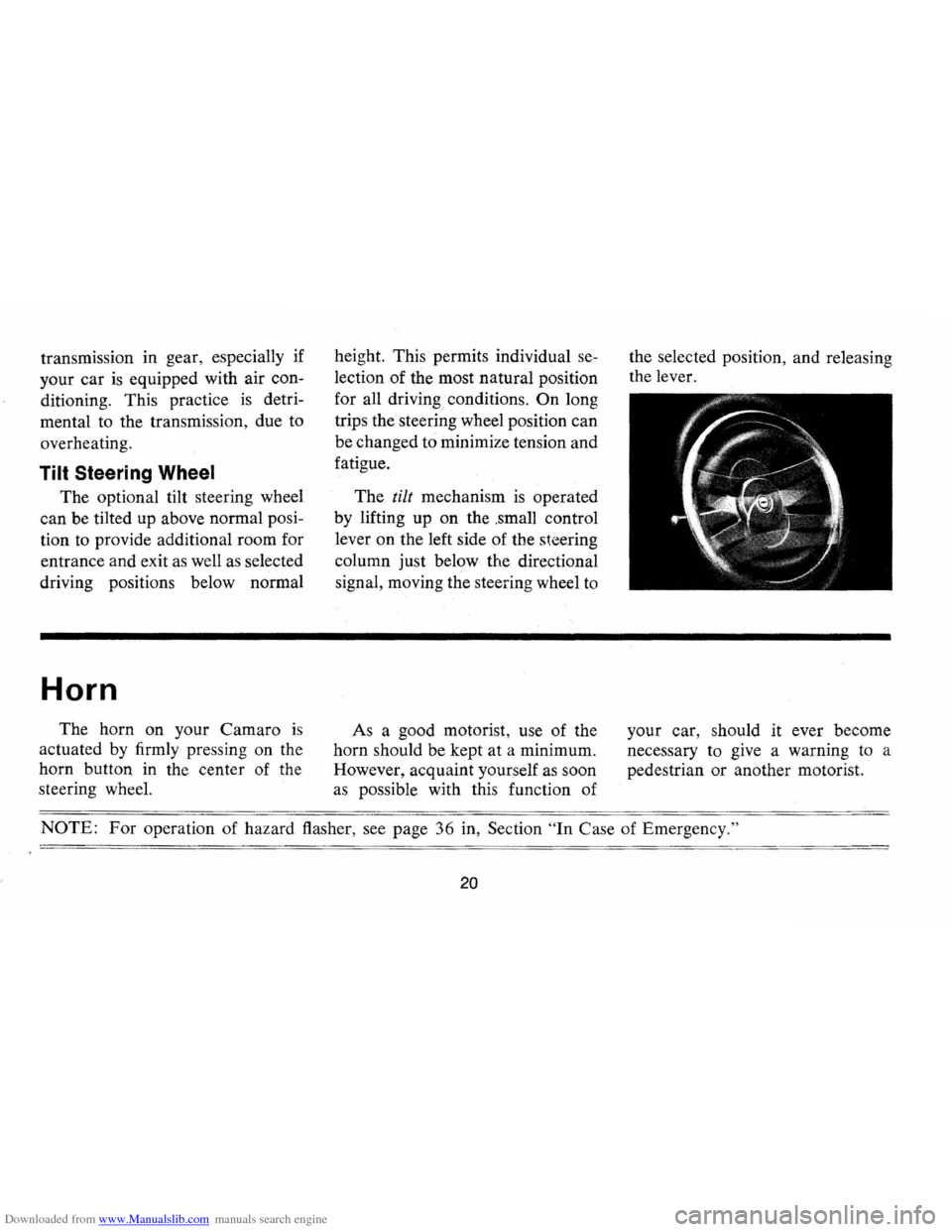
tilt mechanism is operated
by lifting up on the .small control
lever on the left side of the
steering
column just below the directional
signal, moving the steering wheel to
As a good motorist , use of the
horn should be kept at a minimum.
However , acquaint yourself
as soon
as possible with this function of the
selected position, and releasing
the lever.
your car, should it ever become
necessary to give a warning
to a
pedestrian or another motorist.
NOTE: For operation of hazard flasher, see page 36 in, Section "In Case of Emergency. "
20
Page 36 of 85
Downloaded from www.Manualslib.com manuals search engine some air through defroster outlets.
Temperature may be adjusted
as
required. This position is recom
mended for most winter driving.
BI-LEVEL-Outside air is delivered
from the heater lower outlet and
the defroster duct and upper out
lets to provide comfort and keep
the windshield and side glass clear
under low fogging conditions.
DEF -Outside air is delivered
mainly through the defroster out
lets. Temperature and blower
speeds may be adjusted as required.
This position
is recommended for
conditions of severe fogging and
icing only.
Operating tip: When driving in
,snow , if defrost or defog is not re
quired to keep the windshield from
fogging, it
is recommended that the
"Heater" position be used. This keeps
the windshield cold so that
snow will not stick and melt and
will provide a cleaner view.
Four Season System
Air Outlets
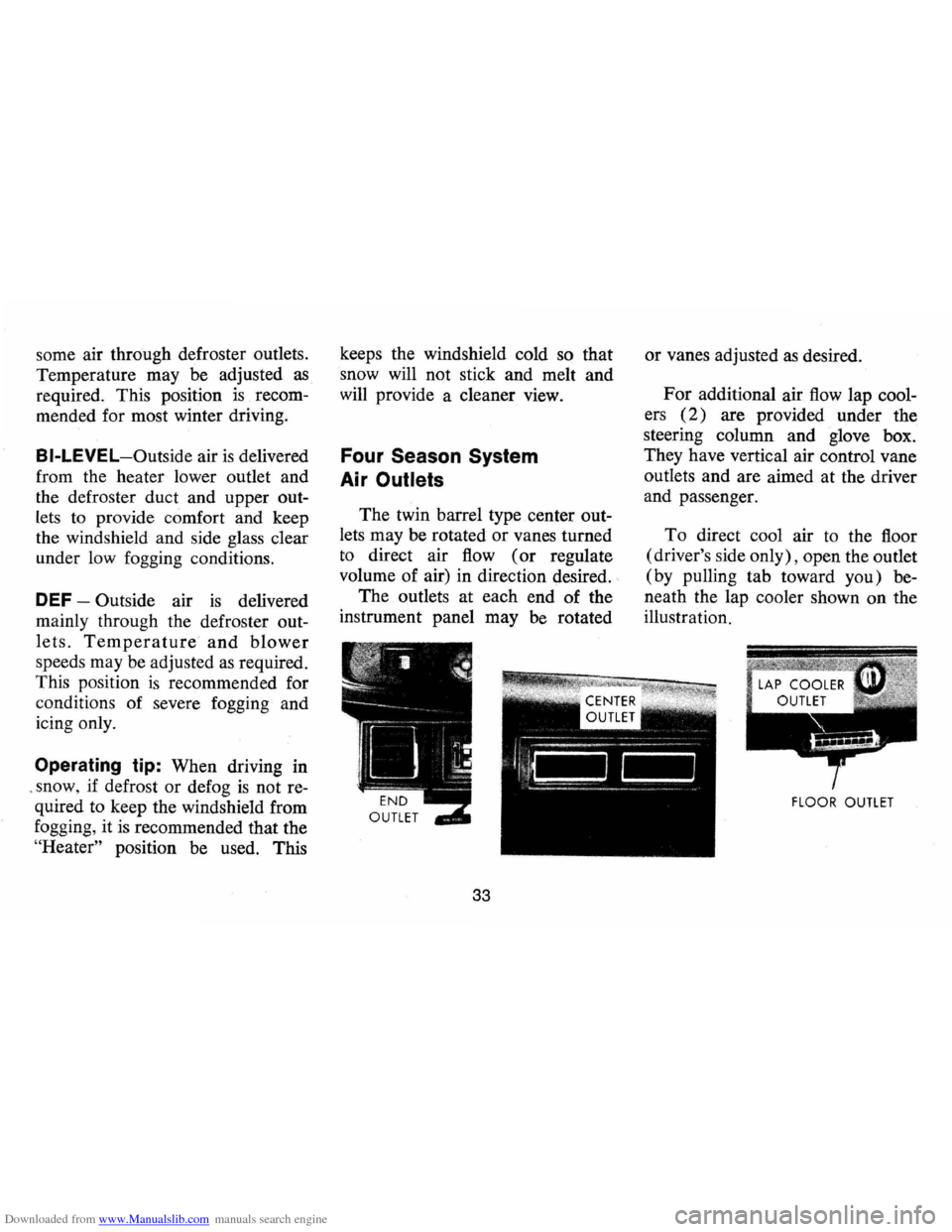
The twin barrel type center out
lets may be rotated or vanes turned
to direct air flow ( or regulate
volume of air) in direction desired.
The outlets at each end of the
instrument panel may be rotated
33
or vanes adjusted as desired.
For additional air flow lap cool
ers
(2) are provided under the
steering column and glove box.
They have vertical air control vane
outlets and are aimed at the driver
and passenger.
To direct cool air to the floor
(driver's side only), open the outlet
(by pulling tab toward you) be
neath the lap cooler shown on the
illustration.
FLOOR OUTLET
Page 39 of 85
Downloaded from www.Manualslib.com manuals search engine I n Case of Emergency
Four-Way Hazard
Warning
Flasher
• Use the warning flasher to warn
other drivers any time your
vehicle becomes a traffic hazard,
day
or night.
• Avoid stopping on the roadway
if possible.
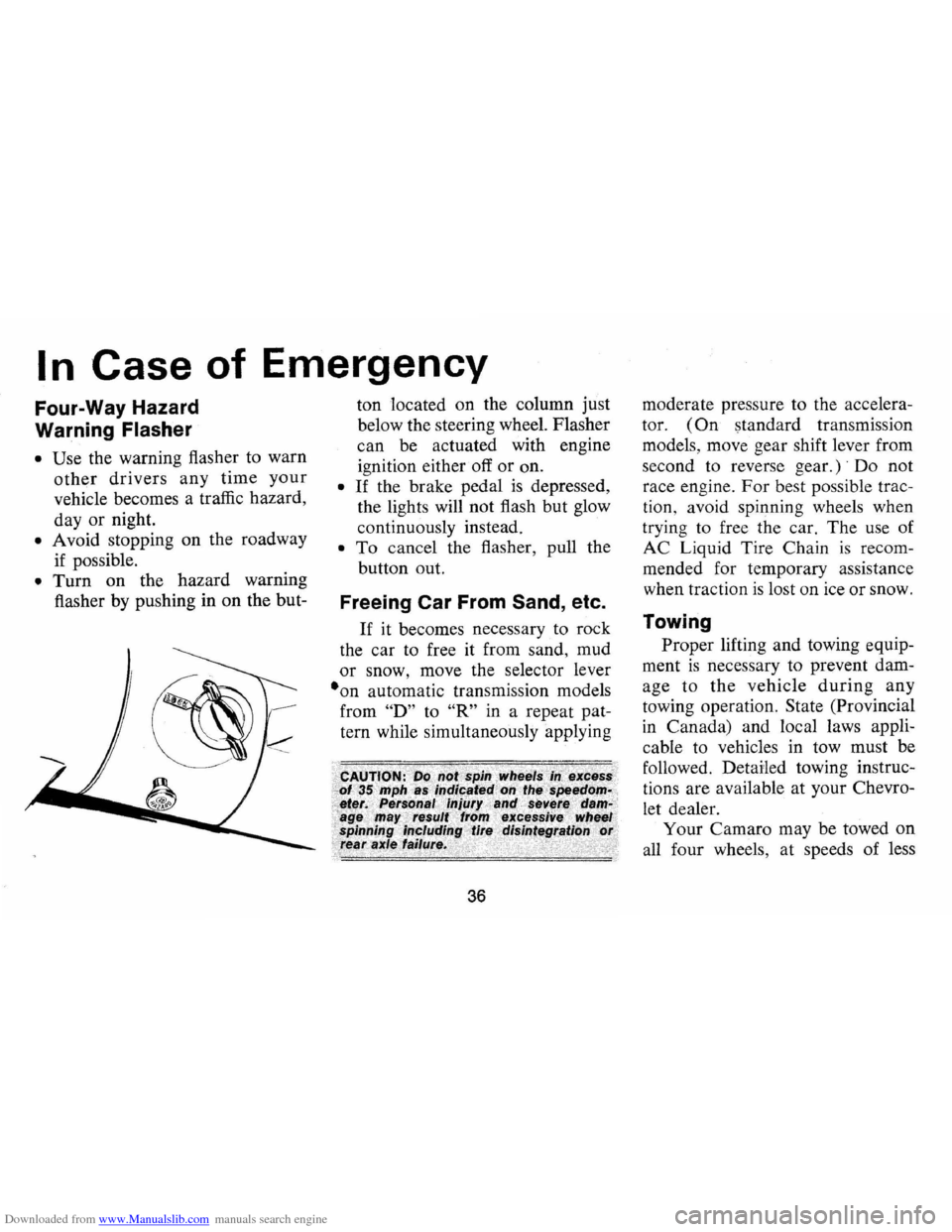
• Turn on the hazard warning
flasher by pushing in on the but- ton
located on the column just
below the steering wheel. Flasher
can be actuated with engine
ignition either off
or on.
• If the brake pedal is depressed,
the lights will not flash but glow
continuously instead.
• To cancel the flasher, pull the
button out.
Freeing Car From Sand, etc.
If it becomes necessary to rock
the car to free it from sand, mud
or snow, move the selector lever
·on automatic transmission models
from
"D" to "R" in a repeat pat
tern while simultaneously applying
36
moderate pressure to the accelera
tor.
(On standard transmission
models, move gear shift lever from
second to reverse
gear.)' Do not
race engine.
For best possible trac
tion, avoid spinning wheels when
trying to free the car. The use of
AC Liquid Tire Chain
is recom
mended for temporary assistance
when traction
is lost on ice or snow.
Towing
Proper lifting and towing equip
ment
is necessary to prevent dam
age to
the vehicle during any
towing operation. State (Provincial
in Canada) and local laws appli
cable to vehicles in tow must be
followed. Detailed towing instruc
tions are available at your Chevro
let dealer.
Your Camaro may be towed on
all four wheels, at speeds of less
Page 40 of 85
Downloaded from www.Manualslib.com manuals search engine than 35 mph, for distances up to
50 miles, provided the drive-line,
axle, transmission, and steering
system are otherwise normally op
erable.
Use only towing equipment
specifically designed for this pur
pose following the instructions of
the towing equipment manufac
turer. A separate safety chain sys
tem must be used.
For such towing
the steering must be unlocked,
transmission in neutral and the
parking brake released. Attach
ments must be made to main struc
tural members of the car. Do not
attach to bumpers
or associated
brackets. Remember that power
brake and power steering assists
will not be available when engine
is inoperative.
Emergency Starting
• Engines in vehicles with auto
matic transmissions cannot be started
by pushing
or towing the
car.
• Never tow a manual transmis
sion-equipped
car to start be
cause the surge forward when
the engine starts could cause a
collision with the tow vehicle.
• A car with a discharged battery
may be started by transferring
electrical power from a battery
in another car -called
"jump
starting."
Jump Starting
37
• The battery in the other vehicle
must be of the
same nominal
voltage
(12 volts), and must be
negatively grounded. (All Gen
eral Motors cars, light trucks
(10,000 GVWR and under),
and motor homes use 12-volt,
negatively grounded electrical
systems and
can be used to jump
start one another.) The nominal
voltage and grounding of the
other vehicle's battery may be
determined by checking the spec
ifications
in its owner's manual.
Use of a booster battery of a
higher nominal voltage,
or which
is positively grounded may re
sult
in serious personal injury or
property damage.
• The battery in your car must be a
Delco battery (the original,
or a
replacement) which
is equipped
with flame arrestor type filler/
vent caps
on all filler openings, or
a sealed-type battery which does
Page 54 of 85
Downloaded from www.Manualslib.com manuals search engine (such as taxicab, limousine or pa
trol car service) where the engine
idles for long periods, should
change fluid every
12,000 miles.
Changing Fluid-For Turbo Hy
dra-Matic
350, remove fluid from
the transmission sump and add ap
proximately 2.5 quarts
U.S. Mea
sure
(2.0 quarts Imperial Mea
sure). Operate transmission
through all shift ranges and re
check fluid level as described
above.
Turbo Hydra-Matic 400-Lubri
cation of your Turbo Hydra-matic
400 will, except for fluid capacity
and filter change listed below, fol
low previously stated automatic
transmission recommendations.
After checking transmission fluid
level it
is important that the dip
stick be pushed all the way into
the filler tube.
Every 24,000 miles -After re- moving
fluid from the transmission
sump, approximately
7V2 pints
U.S. measure (6 pints Imperial
measure) of fresh fluid will be re
quired to return level to proper
mark on the dipstick.
Every 24,000 miles the transmis
sion sump filter should be re
placed.
Transmission Shift and Back
drive Linkage (Manual and
Automatic) -
Every 6,000 miles
or 4 months lubricate shift link
age and on manual transmission
floor controls lever contacting
faces with water resistant
EP chas
sis lubricant which meets GM
Specification 6031M.
Transmission Shift Linkage
(Manual and Automatic)
Every 6,000 miles or 4 months
lubriCate shift linkage and on man
ual transmission floor controls
lever contacting faces with water
51
resistant EP chassis lubricant
which meets GM Specification
6031M.
Chassis
Front Suspension
Every 6,000 miles or 4 months
-Lubricate 4 fittings with water
resistant
EP Chassis Lubricant
which meets GM Specification
6031M.
Ball jOints should not be lu
bricated unless their tempera
ture
is 10°F. or higher. During
colder weather, they should be
allowed to warm up as neces
sary before
lubricaJion.
Steering Linkage
Every 6,000 miles or 4 months
-Lubricate 7 fittings, one at each
end of each tie rod, one at each
end of relay rod, and one at idler
lever with water resistant
EP Chas
sis Lubricant which meets GM
Specification
6031 M.