fuel CHEVROLET CAMARO 1982 Repair Guide
[x] Cancel search | Manufacturer: CHEVROLET, Model Year: 1982, Model line: CAMARO, Model: CHEVROLET CAMARO 1982Pages: 875, PDF Size: 88.64 MB
Page 723 of 875

GM – CAMARO 1982-1992 – Repair Guide (Checked by WxMax) 723
Fig. 2: Fuel pressure regulator assembly
THROTTLE POSITION SENSOR (TPS)
REMOVAL & INSTALLATION 1. Remove the air cleaner.
2. Disconnect the electrical connector.
3. Remove the TPS attaching screws and lockwashers.
4. Remove the TPS.
To install: 5. Install the throttle position sensor. On 2.5L engines, make sure the TPS pickup lever is located above the tang on the throttle actuator lever. On
5.0L engines, line up the TPS lever with the TPS drive lever on the
throttle body.
6. Install the TPS attaching screws.
7. Adjust the TPS volt age, if applicable.
8. Reconnect the electrical connector.
9. Install the air cleaner.
IDLE AIR CONTROL (IAC) VALVE
REMOVAL & INSTALLATION 1. Unplug the electrical connector from idle air control valve.
2. Remove the idle air control valve.
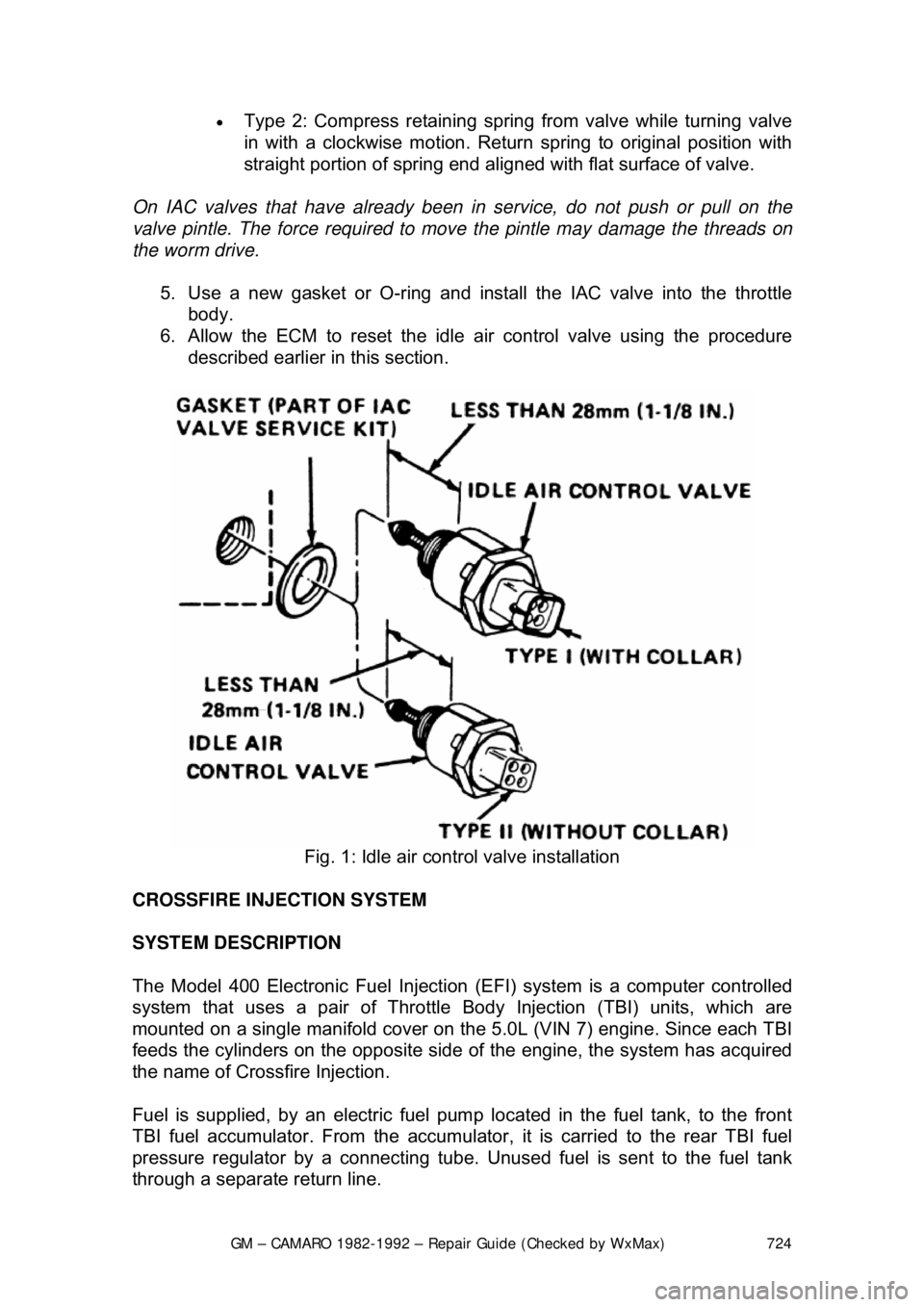
To install: 3. Before installing the idle air contro l valve, measure the distance that the
valve is extended. Measurement s hould be made from the motor housing
to the end of the cone. It should not exceed 28.5mm (1
1/8 in.), or damage
to the valve may occur when installed.
4. Identify the replacement IAC valve as being either Type 1 (with collar at
electric terminal end) or Type 2 (without collar). If measuring distance is
greater than specified abov e, proceed as follows:
• Type 1: Use finger pressure to slowly retract the pintle.
Page 724 of 875
GM – CAMARO 1982-1992 – Repair Guide (Checked by WxMax) 724
•
Type 2: Compress retaining spring from valve while turning valve
in with a clockwise motion. Return spring to original position with
straight portion of spring end aligned with flat surface of valve.
On IAC valves that have already been in service, do not push or pull on the
valve pintle. The force required to move the pintle may damage the threads on
the worm drive.
5. Use a new gasket or O-ring and install the IAC valve into the throttle body.
6. Allow the ECM to reset the idle air control valve using the procedure
described earlier in this section.
Fig. 1: Idle air control valve installation
CROSSFIRE INJECTION SYSTEM
SYSTEM DESCRIPTION
The Model 400 Electronic Fuel Injection (EFI) system is a computer controlled
system that uses a pair of Throttle Body Injection (TBI) units, which are
mounted on a single manifold cover on t he 5.0L (VIN 7) engine. Since each TBI
feeds the cylinders on the opposite side of the engine, the system has acquired
the name of Crossf ire Injection.
Fuel is supplied, by an electric fuel pum p located in the fuel tank, to the front
TBI fuel accumulator. From the accumulator, it is carried to the rear TBI fuel
pressure regulator by a c onnecting tube. Unused fuel is sent to the fuel tank
through a separate return line.
Page 725 of 875
GM – CAMARO 1982-1992 – Repair Guide (Checked by WxMax) 725
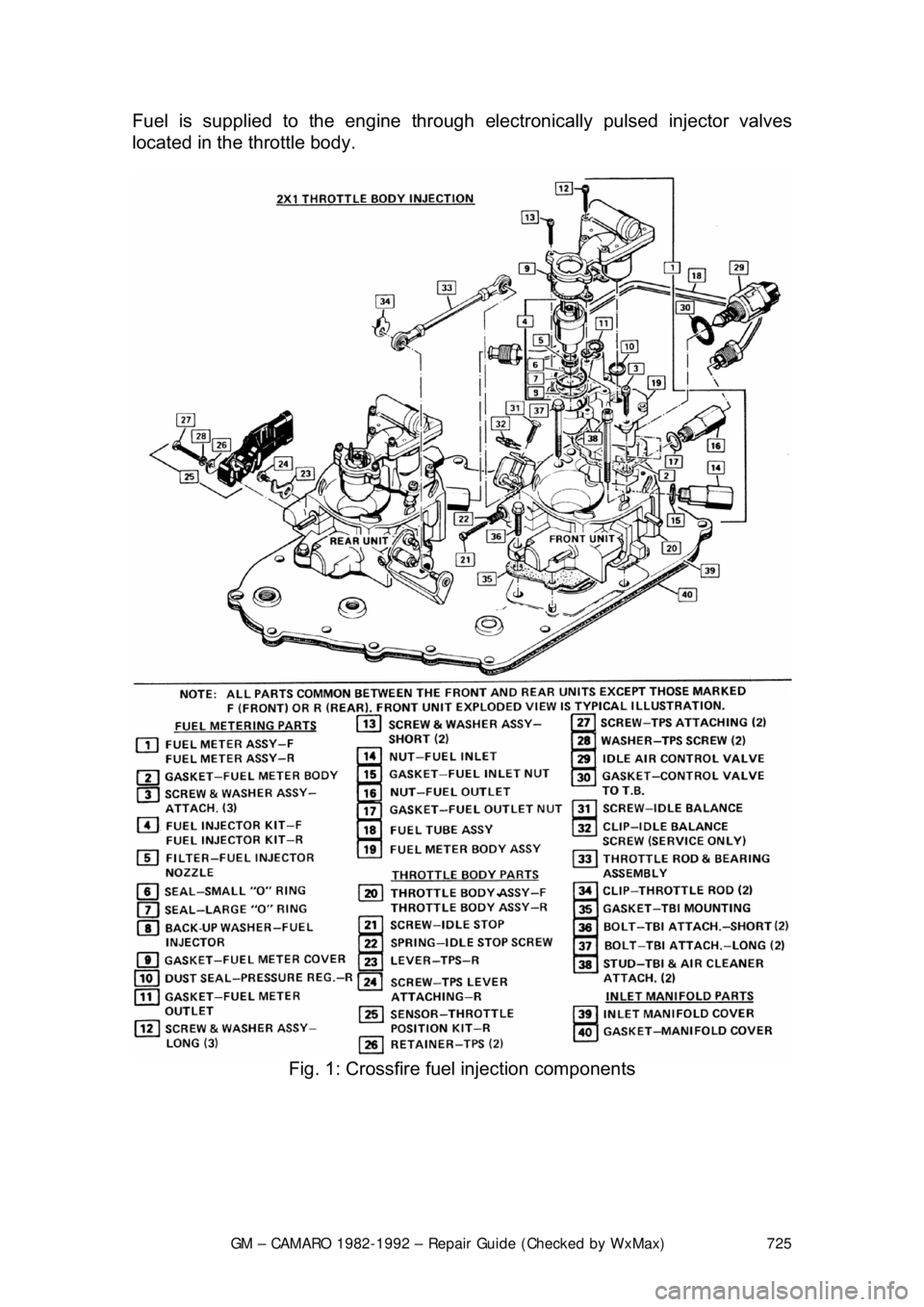
Fuel is supplied to the engine through
electronically pulsed injector valves
located in the throttle body.
Fig. 1: Crossfire fuel injection components
Page 726 of 875

GM – CAMARO 1982-1992 – Repair Guide (Checked by WxMax) 726
RELIEVING FUEL SYSTEM PRESSURE
1. Remove the fuse marked "Fuel Pu mp" from the fuse block in the
passenger compartment.
2. Crank the engine. Th e engine will start and run until the fuel supply
remaining in the lines is exhauste d. When the engines stops, engage the
starter again for three seconds to a ssure dissipation of any remaining
pressure.
3. With the ignition OFF, disconnect the negative battery cable to prevent
fuel discharge if the key is accidentally turned to the ON position.
Replace the fuse with the ignition OFF.
When disconnecting fuel lines, there ma y still be a small amount of fuel
released. Cover the fuel line connection wi th a shop cloth to collect the fuel,
then place the cloth in an approved container.
ELECTRIC FUEL PUMP
REMOVAL & INSTALLATION
The removal and installation procedures fo r the Crossfire injection system fuel
pump is identical to the Throttle Body In jection (TBI) system. Please refer to the
TBI fuel pump procedures earlier in this repair guide.
TESTING
The testing procedures for the Crossfire in jection system fuel pump is identical
to the Throttle Body Injection (TBI) syst em. Please refer to the TBI fuel pump
procedures earlier in this repair guide.
THROTTLE BODY
REMOVAL & INSTALLATION
FRONT UNIT
1. Relieve the fuel system pressure.
2. Remove the air cleaner assembly, noting the connection points of the
vacuum lines.
3. Detach the electrical connectors at the injector and the idle air control
motor.
4. Disconnect the vacuum lines from the TBI unit, noting the connection
points. During installation, refer to the underhood emission control
information decal for vacuum line routing information.
5. Disconnect the transmission det ent cable from the TBI unit.
6. Disconnect the fuel inlet (feed) and fuel balance line connections at the
front TBI unit.
7. Remove and discard the throttle cont rol rod retaining clip from the front
TBI throttle lever stud. A new clip must be used during reassembly.
8. Unbolt and remove the TBI unit.
Page 727 of 875

GM – CAMARO 1982-1992 – Repair Guide (Checked by WxMax) 727
To install:
9. Replacement of the manifold cover or either throttle body requires throttle
valve synchronizing and checking of the throttle rod alignment (see
"Preliminary Adjustments"). Before installing the replacement throttle
body unit(s) on the engine, perform the following steps:
a. If the tamper resistant plugs co vering the throttle stop screws are
in place, remove the plugs.
b. If the front TBI unit throttle syn chronizing screw has a welded
retaining collar, grind off the weld.
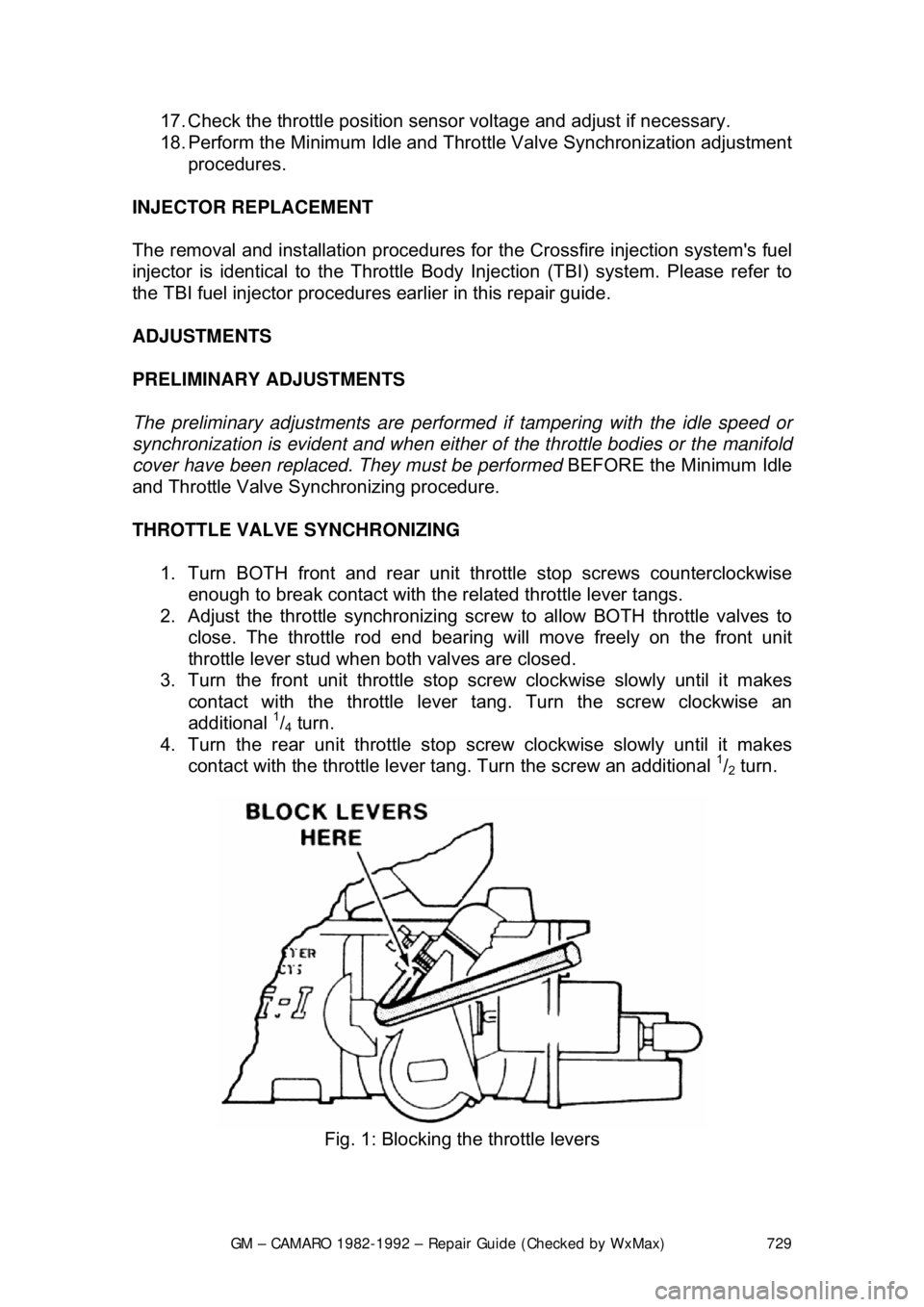
c. Block possible movement of the throttle lever, relieving the force
of the heavy spring against the throttle synchronizing screw. This
prevents the levers from coming into contact.
If the lever is not blocked before the thro ttle synchronizing screw is removed,
the screw may be damaged, and reinstallation will be accomplished only with
great difficulty.
d. Remove the synchronizing screw and collar. Discard the collar and reinstall the screw. The blocking from the throttle lever (installed in the
previous step) can now be removed.
CAUTION - The collar must be removed to prevent possible interference with
the air cleaner. Failure to do so c ould result in personal injury
10. Use new gaskets and tighten the TB I bolts to 120-168 inch lbs. (13-19
Nm) during installation.
11. Perform the preliminary adjustm ents. These procedures must be
followed before further assembly.
12. Reconnect the fuel lines to the TBI units. Use a backup wrench to
prevent the nuts from tu rning in the TBI unit.
13. Reconnect the throttle cable and detent cable.
14. Reconnect all related vacuum lines.
15. Reconnect the electrical connectors.
16. With the engine OFF, depress the accelerator pedal to the floor and
release. Check for free return of the pedal.
17. Check the throttle position sensor voltage and adjust if necessary.
18. Perform the Minimum Idle and Thro ttle Valve Synchronization adjustment
procedures.
Rear Unit 1. Relieve the fuel system pressure.
2. Remove the air cleaner assembly, noting the connection points of the
vacuum lines.
3. Disconnect the electrical connectors at the injector, idle air control motor,
and throttle position sensor.
4. Disconnect the vacuum lines from the TBI unit, noting the connection
points. During installation, refer to the underhood emission control
information decal for vacuum line routing information.
Page 728 of 875

GM – CAMARO 1982-1992 – Repair Guide (Checked by WxMax) 728
5. Disconnect the throttle and cruise c
ontrol (if so equipped) cables at the
TBI unit.
6. Disconnect the fuel return and bal ance line connections from the rear TBI
unit.
7. Remove and discard the throttle cont rol rod retaining clip from the front
TBI unit throttle lever stud. A new clip must be used during reassembly.\
One throttle rod end bearing is permanently attached to the throttle lever stud of
the rear TBI unit, and must not be remov ed from it. If the throttle rod and
bearing assembly needs replacement, Th e entire rear throttle body must be
replaced.
8. Unbolt and remove the TBI unit.
To install: 9. Replacement of the manifold cover or either throttle body requires throttle
valve synchronizing and checking of the throttle rod alignment (see
"Preliminary Adjustments"). Before installing the replacement throttle
body unit(s) on the engine, perform the following steps:
a. If the tamper resistant plugs co vering the throttle stop screws are
in place, remove the plugs.
b. If the front TBI unit throttle syn chronizing screw has a welded
retaining collar, grind off the weld.
c. Block possible movement of the throttle lever, relieving the force
of the heavy spring against the throttle synchronizing screw. This
prevents the levers from coming into contact.
If the lever is not blocked before the thro ttle synchronizing screw is removed,
the screw may be damaged, and reinstallation will be accomplished only with
great difficulty.
d. Remove the synchronizing screw and collar. Discard the collar and reinstall the screw. The blocking from the throttle lever (installed in the
previous step) can now be removed.
CAUTION - The collar must be removed to prevent possible interference with
the air cleaner. Failure to do so c ould result in personal injury.
10. Use new gaskets and tighten the TB I bolts to 120-168 inch lbs. (13-19
Nm) during installation.
11. Perform the preliminary adjustm ents. These procedures must be
followed before further assembly.
12. Reconnect the fuel lines to the TBI units. Use a backup wrench to
prevent the nuts from tu rning in the TBI unit.
13. Reconnect the throttle cable and the cruise control cable.
14. Reconnect all related vacuum lines.
15. Reconnect the electrical connectors.
16. With the engine OFF, depress t he accelerator pedal to the floor and
release. Check for free return of the pedal.
Page 729 of 875
GM – CAMARO 1982-1992 – Repair Guide (Checked by WxMax) 729
17. Check the throttle position sensor voltage and adjust if necessary.
18. Perform the Minimum Idle and Thro
ttle Valve Synchronization adjustment
procedures.
INJECTOR REPLACEMENT
The removal and installation procedures fo r the Crossfire injection system's fuel
injector is identical to the Throttle Bo dy Injection (TBI) system. Please refer to
the TBI fuel injector procedures earlier in this repair guide.
ADJUSTMENTS
PRELIMINARY ADJUSTMENTS
The preliminary adjustments are performed if tampering with the idle speed or
synchronization is evident and when either of the throttle bodies or the manifold
cover have been replaced. They must be performed BEFORE the Minimum Idle
and Throttle Valve Synchronizing procedure.
THROTTLE VALVE SYNCHRONIZING
1. Turn BOTH front and rear unit throttle stop screws counterclockwise enough to break contact with the related throttle lever tangs.
2. Adjust the throttle synchronizing scr ew to allow BOTH throttle valves to
close. The throttle rod end bearing w ill move freely on the front unit
throttle lever stud when both valves are closed.
3. Turn the front unit th rottle stop screw clockwise slowly until it makes
contact with the throttle lever tang. Turn the screw clockwise an
additional
1/4 turn.
4. Turn the rear unit throttle stop screw clockwise slowly until it makes
contact with the throttle lever t ang. Turn the screw an additional
1/2 turn.
Fig. 1: Blocking the throttle levers
Page 733 of 875
GM – CAMARO 1982-1992 – Repair Guide (Checked by WxMax) 733
THROTTLE POSITION SENSOR (TPS)
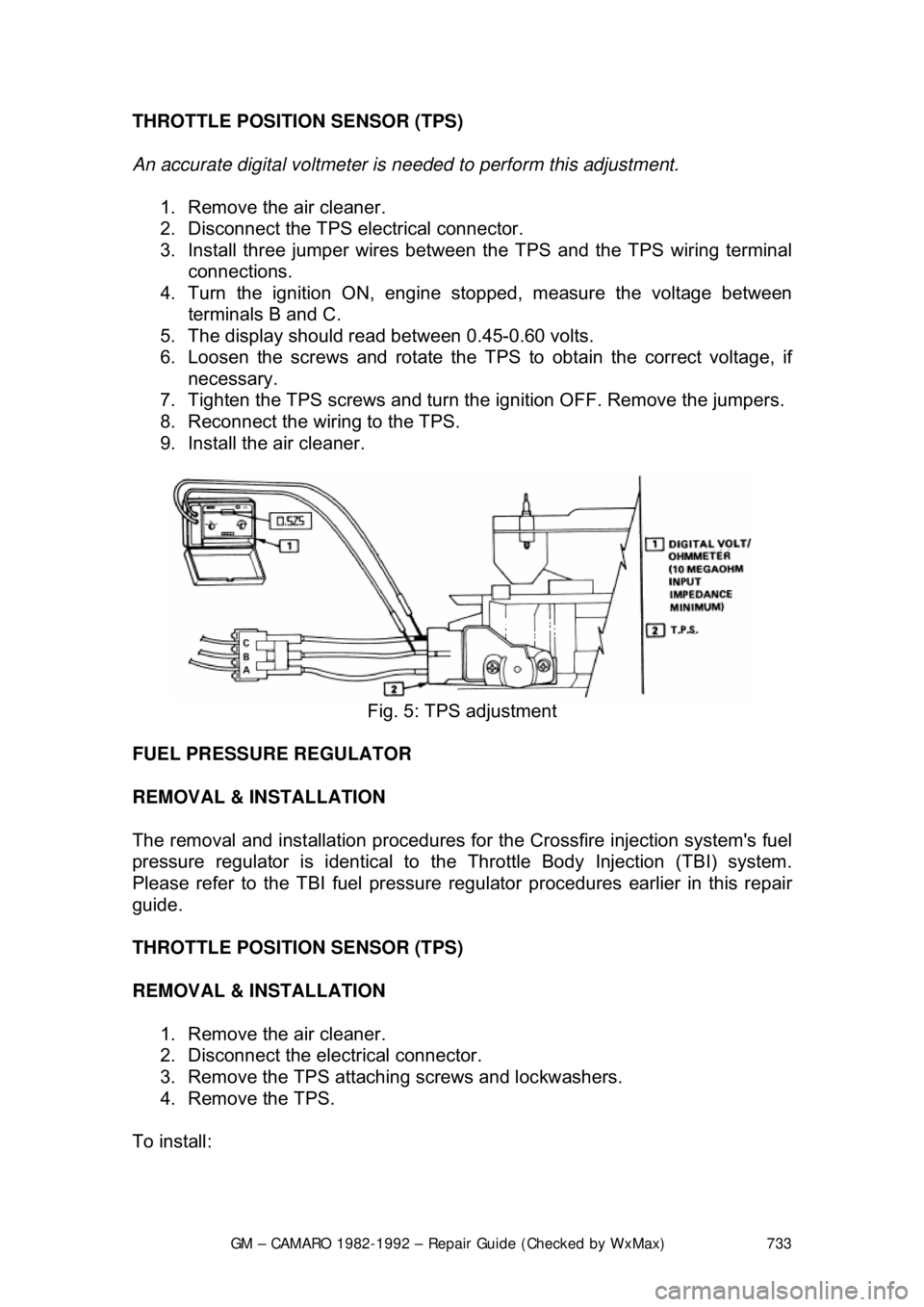
An accurate digital voltmeter is
needed to perform this adjustment.
1. Remove the air cleaner.
2. Disconnect the TPS electrical connector.
3. Install three jumper wires betwe en the TPS and the TPS wiring terminal
connections.
4. Turn the ignition ON, engine stopped, measure the voltage between
terminals B and C.
5. The display should read between 0.45-0.60 volts.
6. Loosen the screws and rotate the TPS to obtain the correct voltage, if necessary.
7. Tighten the TPS screws and turn the i gnition OFF. Remove the jumpers.
8. Reconnect the wir ing to the TPS.
9. Install the air cleaner.
Fig. 5: TPS adjustment
FUEL PRESSURE REGULATOR
REMOVAL & INSTALLATION
The removal and installation procedures fo r the Crossfire injection system's fuel
pressure regulator is identical to t he Throttle Body Injection (TBI) system.
Please refer to the TBI fuel pressure r egulator procedures earlier in this repair
guide.
THROTTLE POSITION SENSOR (TPS)
REMOVAL & INSTALLATION
1. Remove the air cleaner.
2. Disconnect the electrical connector.
3. Remove the TPS attaching screws and lockwashers.
4. Remove the TPS.
To install:
Page 735 of 875
GM – CAMARO 1982-1992 – Repair Guide (Checked by WxMax) 735
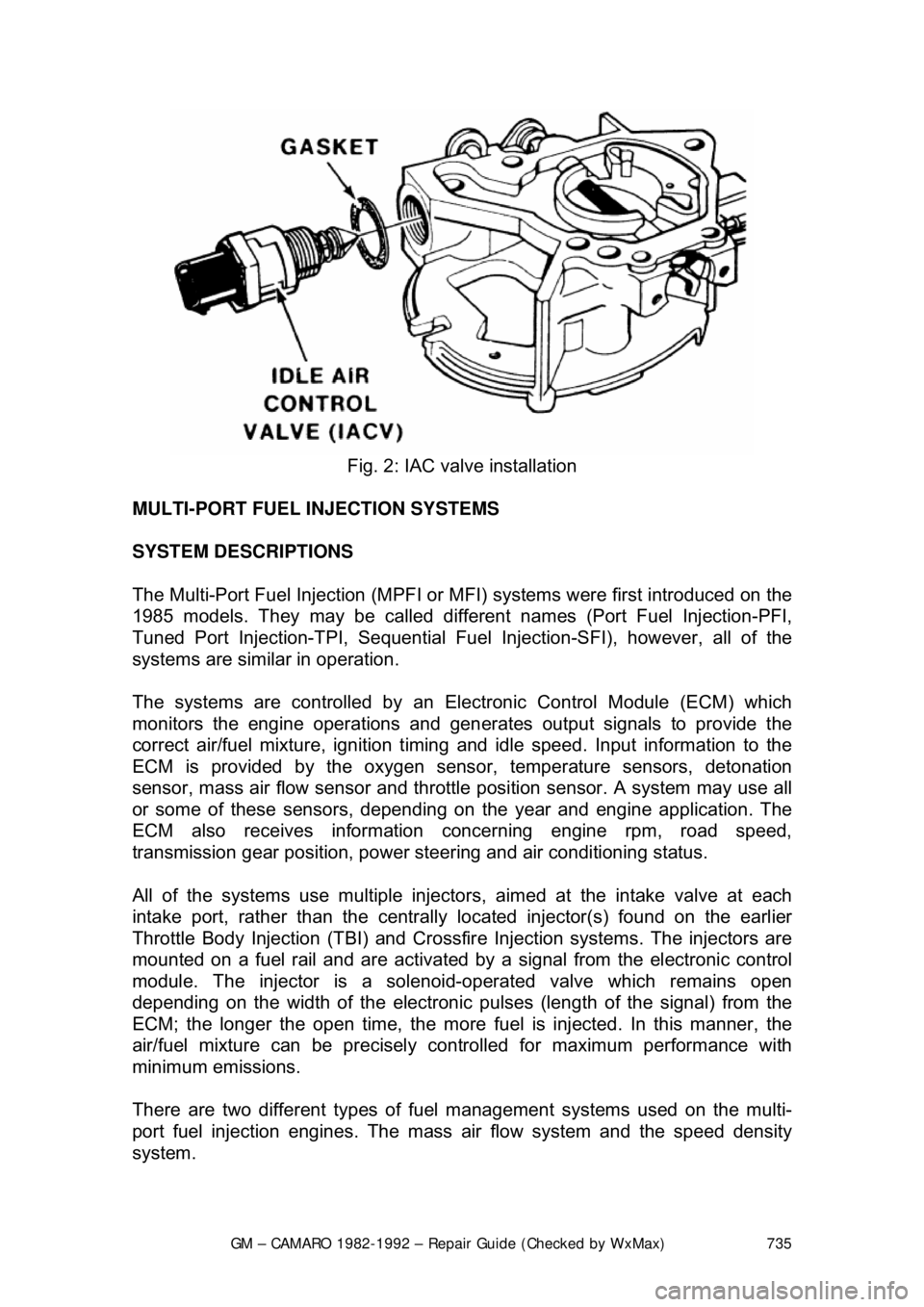
Fig. 2: IAC valve installation
MULTI-PORT FUEL INJECTION SYSTEMS
SYSTEM DESCRIPTIONS
The Multi-Port Fuel Injection (MPFI or MFI) systems were first introduced on the
1985 models. They may be called different names (Port Fuel Injection-PFI,
Tuned Port Injection-TPI, Sequential Fuel Injection-SFI), however, all of the
systems are similar in operation.
The systems are controlled by an Elec tronic Control Module (ECM) which
monitors the engine operations and gen erates output signals to provide the
correct air/fuel mixture, ignition timing and idle speed. Input information to the
ECM is provided by the oxygen sens or, temperature sensors, detonation
sensor, mass air flow sensor and throttle position sensor. A system may use all
or some of these sensors, depending on the year and engine application. The
ECM also receives information concerning engine rpm, road speed,
transmission gear position, power steer ing and air conditioning status.
All of the systems use multiple injector s, aimed at the intake valve at each
intake port, rather than the centrally lo cated injector(s) found on the earlier
Throttle Body Injection (TBI) and Crossfir e Injection systems. The injectors are
mounted on a fuel rail and ar e activated by a signal from the electronic control
module. The injector is a solenoi d-operated valve which remains open
depending on the width of t he electronic pulses (length of the signal) from the
ECM; the longer the open time, the more f uel is injected. In this manner, the
air/fuel mixture can be precisely c ontrolled for maximum performance with
minimum emissions.
There are two different types of f uel management systems used on the multi-
port fuel injection engines. The mass air flow system and the speed density
system.
Page 736 of 875

GM – CAMARO 1982-1992 – Repair Guide (Checked by WxMax) 736
The mass air flow systems measure the
mass of air that is drawn into the
engine cylinders, rather than just the vo lume. The sensor contains a hot-wire
sensing unit, which is made up of an electronic balanced bridge network.
Whenever current is suppli ed to the sensor, the bridge is energized and the
sensing hot-wire is heated. As the air enter s the mass air flow sensor, it passes
over and cools the hot wire. When the hot wire is cooled, it's resistance changes
and additional current is needed to k eep the bridge network balanced. This
increase in current is sent to the computer as a voltage signal and is used to
calculate the mass of the incoming air. The ECM uses this information to\
determine the duration of fuel injection pulse, ignition timing and EGR operation.
The speed density systems calculate the volume of air moving through the
intake. The ECM establishes the speed fact or through a signal from the ignition
module. The Manifold or Intake Air Temperature (MAT/IAT) and the Engine
Coolant Temperature (ECT) sensors work together to assure that proper
temperature information gets to the ECM wh ile the Manifold Absolute Pressure
(MAP) sensor monitors the changes in m anifold pressure which results from
changes in engine loading. These three se nsors contribute to the density factor.
Together, these inputs (engine speed, coolant temperature sensor, etc ...) are
the major determinants of the air/fuel mixture delivered by the fuel injection
system.
The following engines and fuel managem ent systems are covered in this
section:
• 1985-1989 2.8L MPFI - Mass Air Flow
• 1990-1992 3.1L MPFI - Speed Density
• 1985-1989 5.0L and 5.7L TPI - Mass Air Flow
• 1990-1992 5.0L and 5.7L TPI - Speed Density
Relieving Fuel System Pressure
1. Disconnect the negative battery cable to prevent fuel discharge if the key
is accidentally turned to the RUN position.
2. Loosen the fuel filler cap to reliev e the tank pressure and do not tighten
until service has been completed.
3. Connect J-34730-1 fuel pressure gauge or equivalent, to the fuel
pressure test valve. Wrap a shop towel around the fitting while
connecting the gauge to prevent spillage.
4. Place the end of the bleed hose into a suitable container and open the
valve to relieve the fuel system pressure.
ELECTRIC FUEL PUMP
REMOVAL & INSTALLATION
The fuel pump is part of t he fuel sender assembly located inside the fuel tank.