brake CHEVROLET CAMARO 1982 Repair Guide
[x] Cancel search | Manufacturer: CHEVROLET, Model Year: 1982, Model line: CAMARO, Model: CHEVROLET CAMARO 1982Pages: 875, PDF Size: 88.64 MB
Page 818 of 875
GM – CAMARO 1982-1992 – Repair Guide (Checked by WxMax) 818
•
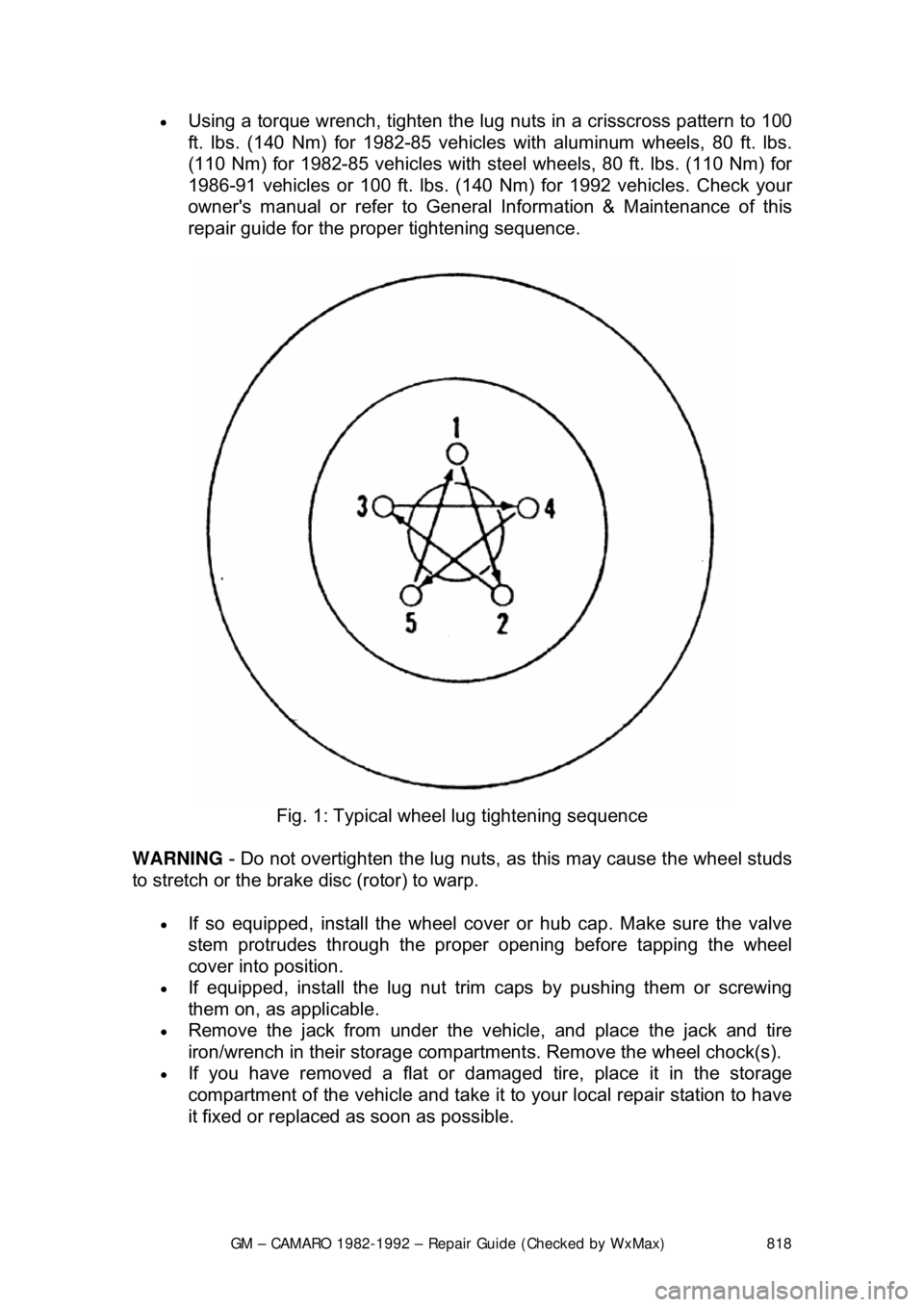
Using a torque wrench, tighten the lug nuts in a crisscross pattern to 100
ft. lbs. (140 Nm) for 1982-85 vehicles with aluminum wheels, 80 ft. lbs.
(110 Nm) for 1982-85 vehicles with st eel wheels, 80 ft. lbs. (110 Nm) for
1986-91 vehicles or 100 ft. lbs. (140 Nm) for 1992 vehicles. Check your
owner's manual or refer to General Information & Maintenance of this
repair guide for the proper tightening sequence.
Fig. 1: Typical wheel lug tightening sequence
WARNING - Do not overtighten the lug nuts, as this may cause the wheel studs
to stretch or the brake disc (rotor) to warp.
• If so equipped, install the wheel cover or hub cap. Make sure the valve
stem protrudes throu gh the proper opening bef ore tapping the wheel
cover into position.
• If equipped, install the lug nut trim caps by pushing them or screwing
them on, as applicable.
• Remove the jack from under the v ehicle, and place the jack and tire
iron/wrench in their storage compartment s. Remove the wheel chock(s).
• If you have removed a flat or damaged tire, place it in the storage
compartment of the vehicle and take it to your local repair station to have
it fixed or replaced as soon as possible.
Page 819 of 875
GM – CAMARO 1982-1992 – Repair Guide (Checked by WxMax) 819
INSPECTION
Inspect the tires for lacerations, puncture
marks, nails and other sharp objects.
Repair or replace as necessary. Also check the tires for treadwear and air
pressure as outlined in General Information & Maintenance of this repair guide.
Check the wheel assemblies for dents, crac ks, rust and metal fatigue. Repair or
replace as necessary.
WHEEL LUG STUDS
REMOVAL & INSTALLATION
WITH DISC BRAKES
1. Raise and support the appropriate end of the vehicle safely using
jackstands, then remove the wheel.
2. Remove the brake pads and caliper. Support the caliper aside using wire
or a coat hanger. For details, please re fer to Brakes of this repair guide.
3. Remove the outer w heel bearing and lift off the rotor. For details on
wheel bearing removal, installation and adjustment, please refer to
General Information & Maintenan ce of this repair guide.
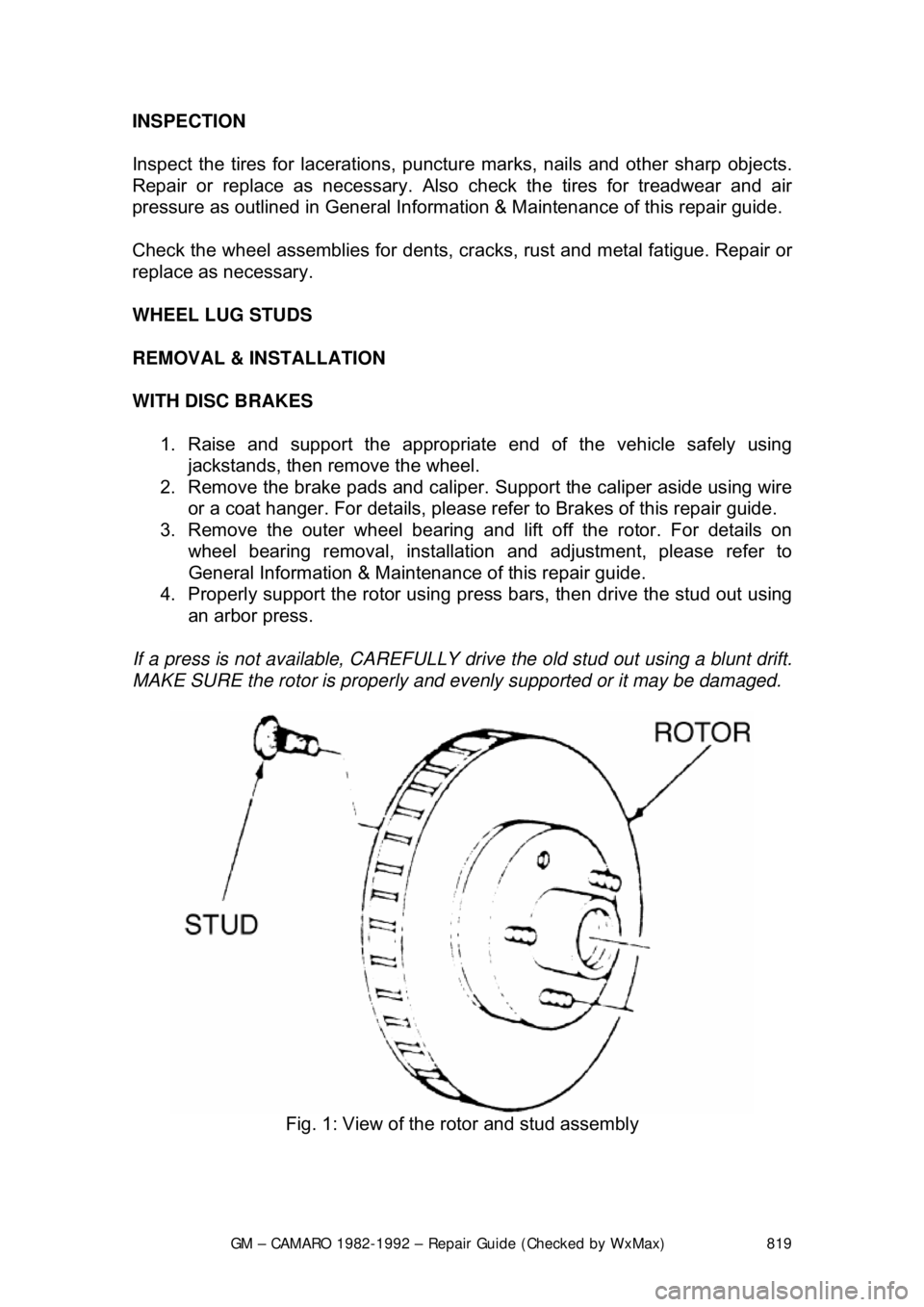
4. Properly support the rotor using pre ss bars, then drive the stud out using
an arbor press.
If a press is not available, CAREFULLY drive the old stud out using a blunt drift.
MAKE SURE the rotor is properly and ev enly supported or it may be damaged.
Fig. 1: View of the rotor and stud assembly
Page 821 of 875
GM – CAMARO 1982-1992 – Repair Guide (Checked by WxMax) 821
If a press is not availabl
e, start the lug stud through the bore in the hub, then
position about 4 flat washers over t he stud and thread the lug nut. Hold the
hub/rotor while tightening the lug nut, and the stud should be drawn into
position. MAKE SURE THE STUD IS FU LLY SEATED, then remove the lug nut
and washers.
7. Install the rotor and adjust the wheel bearings.
8. Install the brake caliper and pads.
9. Install the wheel, then remove the jackstands and carefully lower the
vehicle.
10. Tighten the lug nuts to the proper torque.
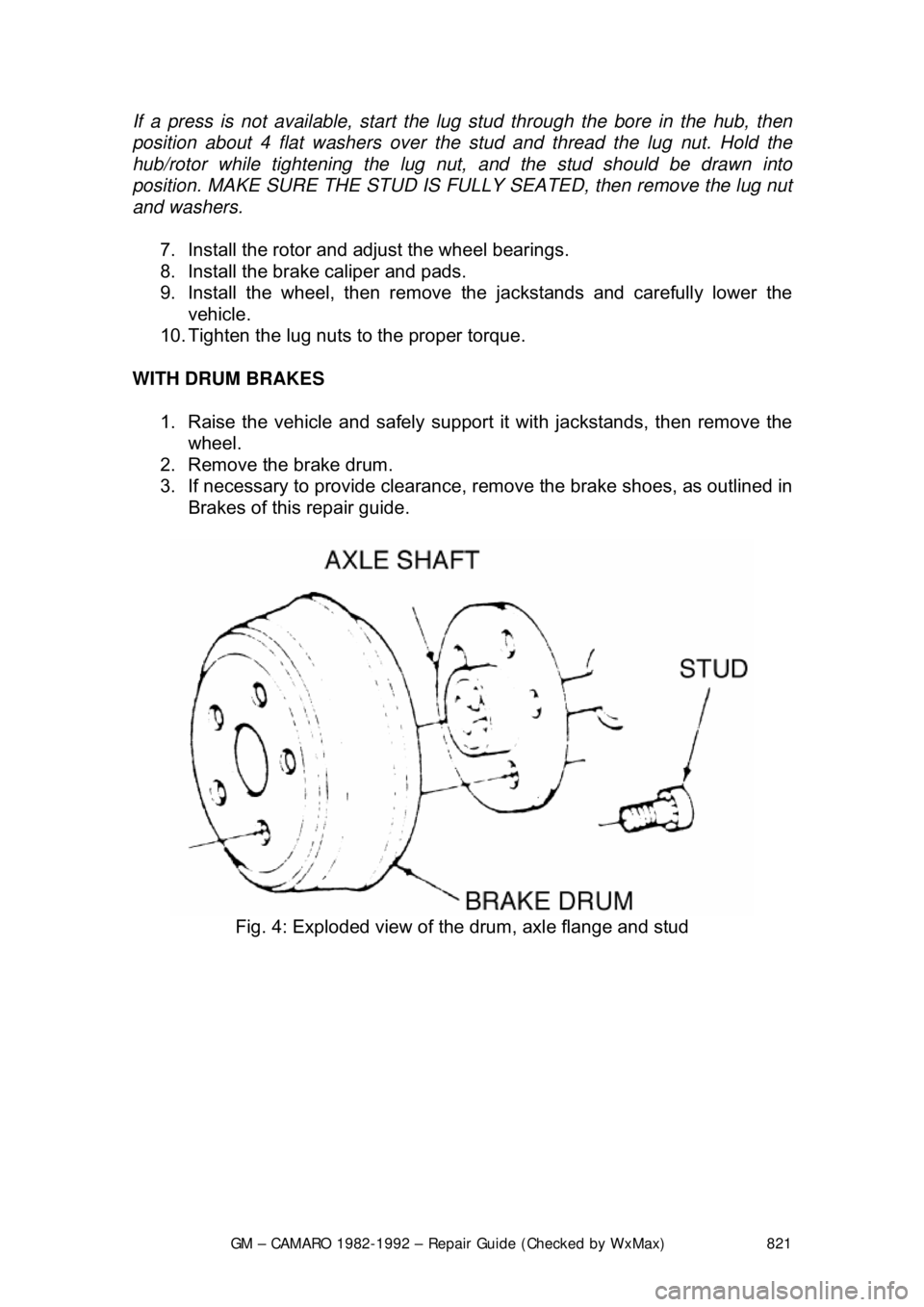
WITH DRUM BRAKES 1. Raise the vehicle and safely su pport it with jackstands, then remove the
wheel.
2. Remove the brake drum.
3. If necessary to provide clearance, re move the brake shoes, as outlined in
Brakes of this repair guide.
Fig. 4: Exploded view of t he drum, axle flange and stud
Page 822 of 875
GM – CAMARO 1982-1992 – Repair Guide (Checked by WxMax) 822
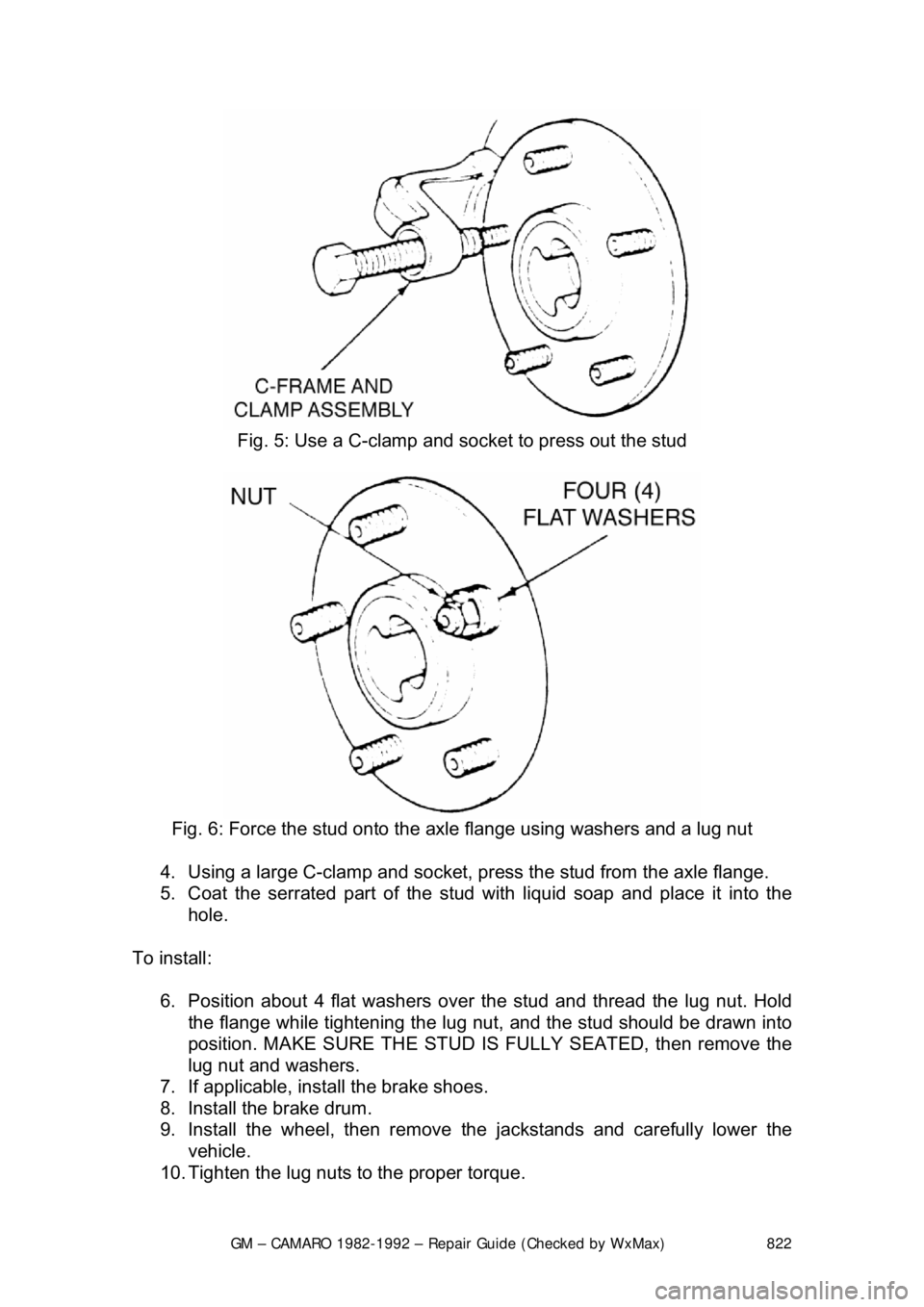
Fig. 5: Use a C-clamp and socket to press out the stud
Fig. 6: Force the stud onto the axle flange using washers and a lug nut
4. Using a large C-clamp and socket, pre ss the stud from the axle flange.
5. Coat the serrated part of the stud with liquid soap and place it into the
hole.
To install: 6. Position about 4 flat washers over the stud and thread the lug nut. Hold
the flange while tightening the lug nut, and the stud should be drawn into
position. MAKE SURE THE STUD IS FULLY SEATED, then remove the
lug nut and washers.
7. If applicable, install the brake shoes.
8. Install the brake drum.
9. Install the wheel, then remove the jackstands and carefully lower the
vehicle.
10. Tighten the lug nuts to the proper torque.
Page 828 of 875
GM – CAMARO 1982-1992 – Repair Guide (Checked by WxMax) 828
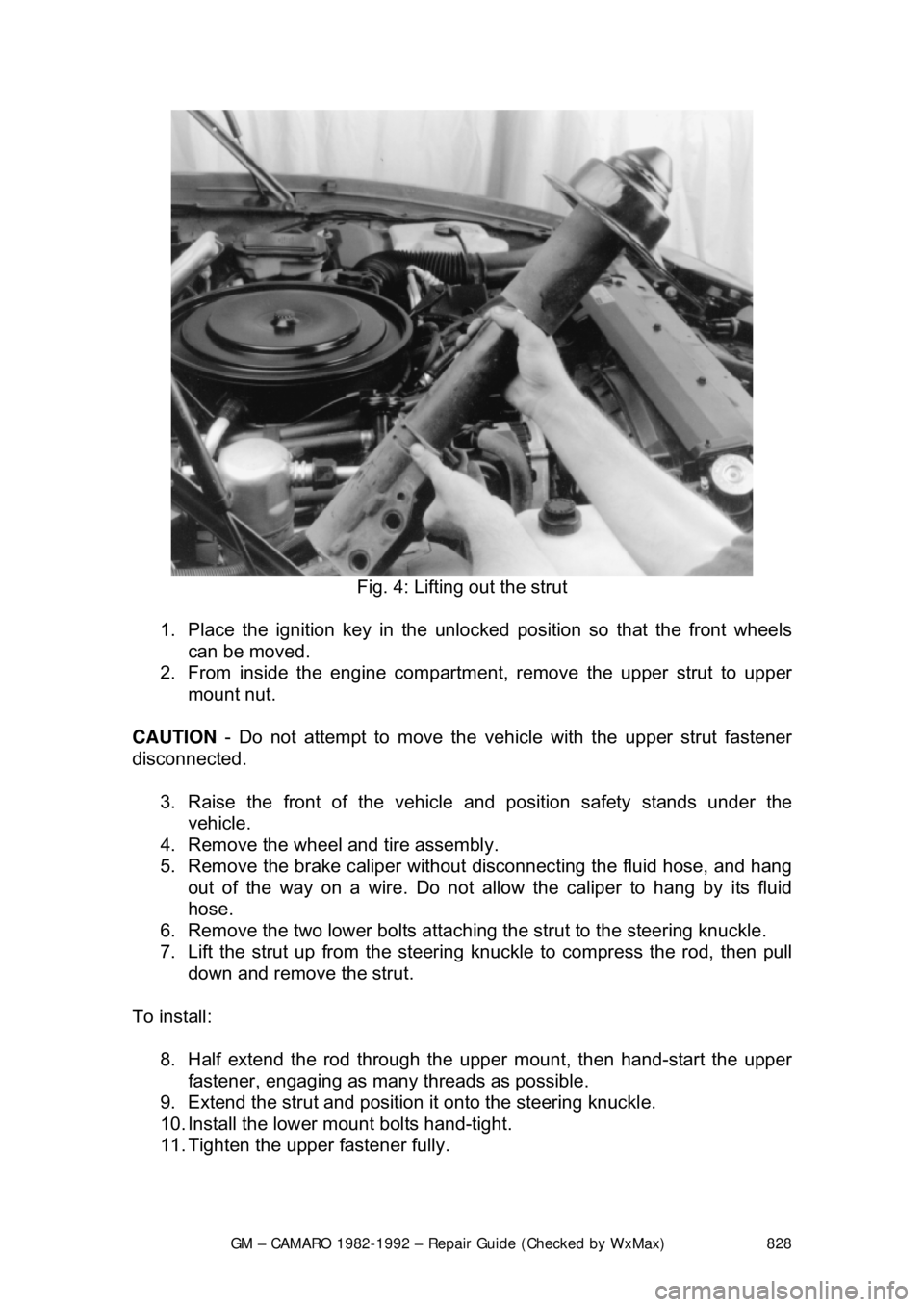
Fig. 4: Lifting out the strut
1. Place the ignition key in the unlock ed position so that the front wheels
can be moved.
2. From inside the engine compartm ent, remove the upper strut to upper
mount nut.
CAUTION - Do not attempt to move the ve hicle with the upper strut fastener
disconnected.
3. Raise the front of the vehicl e and position safety stands under the
vehicle.
4. Remove the wheel and tire assembly.
5. Remove the brake caliper without disconnecting the fluid hose, and hang
out of the way on a wire. Do not allo w the caliper to hang by its fluid
hose.
6. Remove the two lower bolts attachi ng the strut to the steering knuckle.
7. Lift the strut up from the steering k nuckle to compress the rod, then pull
down and remove the strut.
To install: 8. Half extend the rod through th e upper mount, then hand-start the upper
fastener, engaging as many threads as possible.
9. Extend the strut and position it onto the steering knuckle.
10. Install the lower mount bolts hand-tight.
11. Tighten the upper fastener fully.
Page 829 of 875
GM – CAMARO 1982-1992 – Repair Guide (Checked by WxMax) 829
12. Fully tighten the lower bolts onl
y when the front suspension is on the
ground. Torque the steering knuckle-to-strut nuts to 125 ft. lbs. (170 Nm)
followed by a 120 degree turn. Do not exceed a final torque of 148 Ft.
lbs. (200 Nm).
13. Install the brake caliper
14. Install the wheel and tire assembly.
15. Lower the front of the vehicle.
16. From inside the engine compartm ent, tighten the upper strut to upper
mount nut to 44 ft. lbs. (60 Nm).
17. Have the front end aligned.
OVERHAUL
The OEM domestic struts are serviced by replacement of the entire unit. There
is no strut cartridge to replace.
LOWER BALL JOINT
INSPECTION
Before performing this inspection, make sure the wheel bearings are adjusted
correctly and that the control arm bushings are in good condition.
1. Jack the car up under the front lower control arm at the spring seat.
2. Raise the car until t here is 1-2 in. (25-51mm) of clearance under the
wheel.
3. Insert a bar under the wheel and pr y upward. If the wheel raises more
than
1/8 in. (3mm), the ball joints are worn. Determine if the lower ball
joint is worn by visual inspec tion while prying on the wheel.
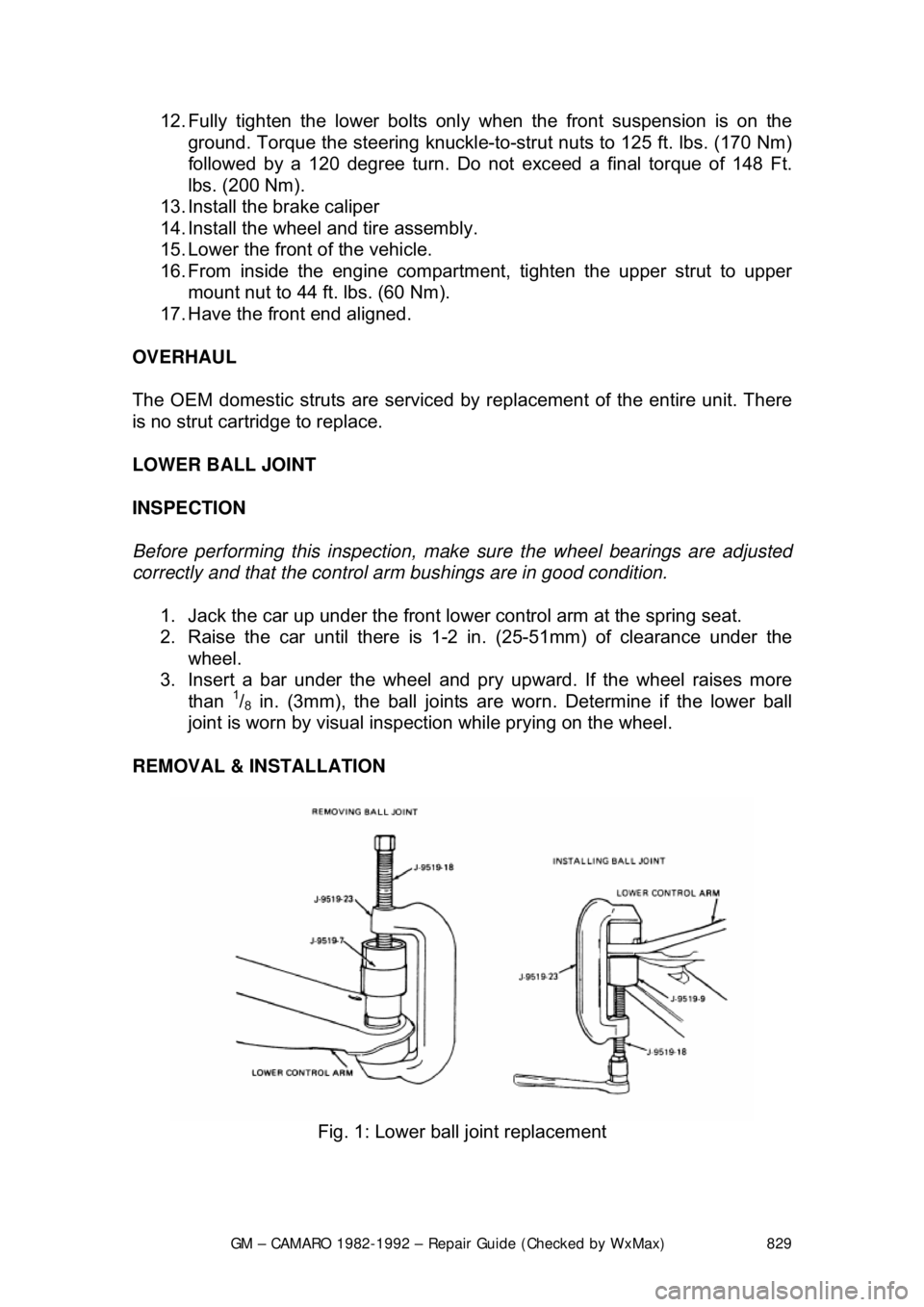
REMOVAL & INSTALLATION
Fig. 1: Lower ball joint replacement
Page 833 of 875
GM – CAMARO 1982-1992 – Repair Guide (Checked by WxMax) 833
1. Siphon some brake fluid from the ma
ster cylinder. Raise and support the
vehicle.
2. Remove the wheel and tire. Remo ve the brake hose from the strut.
3. Remove the caliper and support on a wire. Refer to Brakes for
procedures, then remove the hub-and-disc.
4. Remove the splash shield. Disc onnect the tie rod from the steering
knuckle.
5. Support the lower control arm and disconnect the ball joint from the
steering knuckle using tool J-24292A.
6. Remove the 2 bolts securing the stru t to the steering knuckle and remove
the steering knuckle.
To install: 7. Place the steering knu ckle into position and install the 2 bolts securing
the strut to the st eering knuckle.
8. Support the lower control arm and c onnect the ball joint to the steering
knuckle.
9. Connect the tie rod to the steering knuckle. Install the splash shield.
10. Install the caliper.
11. Install the brake hose from the strut. Install the wheel and tire.
12. Lower the vehicle and refill the master cylinder with brake fluid.
FRONT WHEEL BEARINGS
ADJUSTMENT
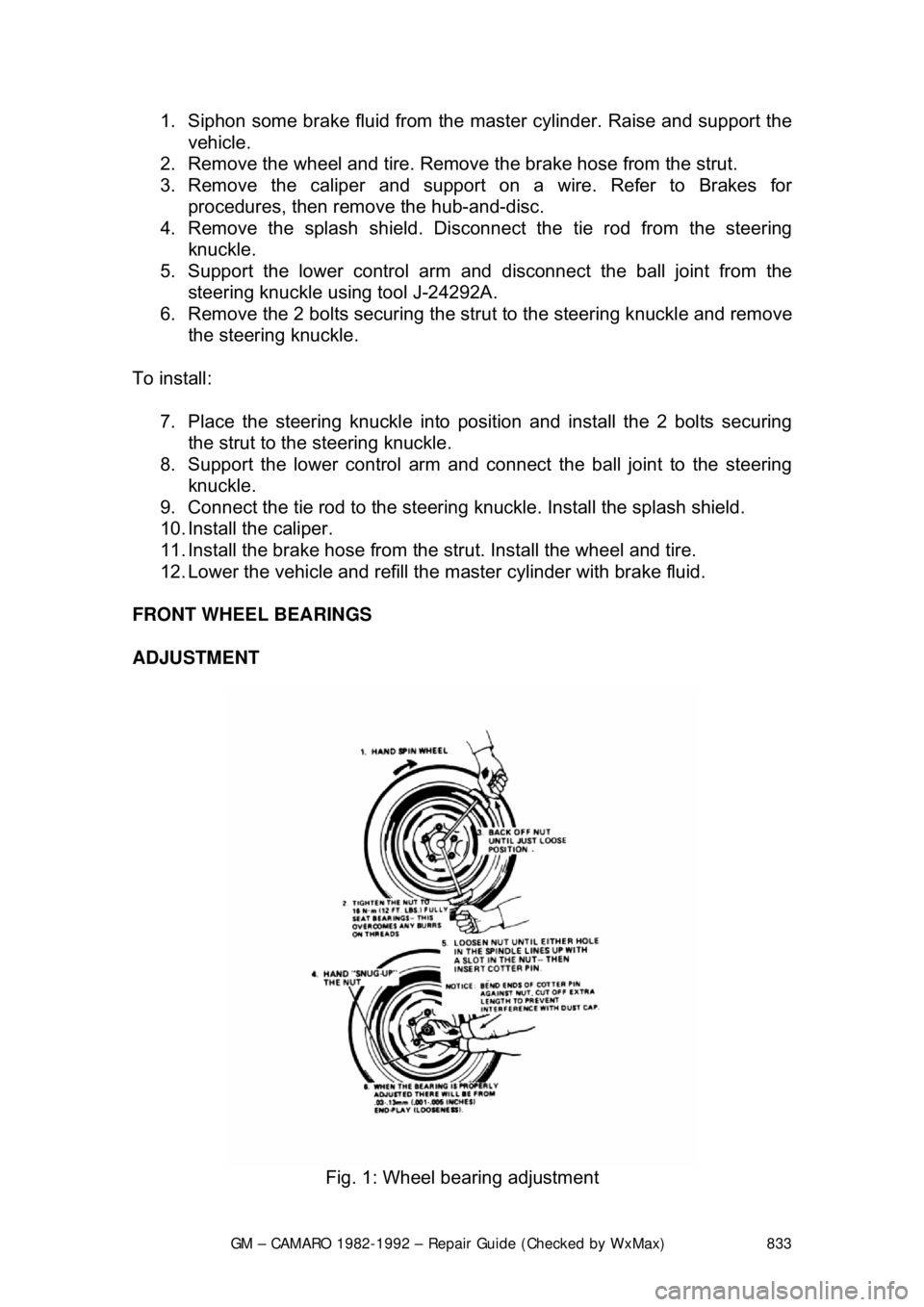
Fig. 1: Wheel bearing adjustment
Page 834 of 875

GM – CAMARO 1982-1992 – Repair Guide (Checked by WxMax) 834
1. Raise the car and support it at the lower arm.
2. Remove the hub dust cover and spindle cotter pin. Loosen the nut.
3. While spinning the wheel
, snug the nut down to seat the bearings. Do not
exert over 12 ft. lbs. (16 Nm) of force on the nut.
4. Back the nut off
1/4 turn or until it is just loos e. Line up the cotter pin hole
in the spindle with the hole in the nut.
5. Insert a new cotter pin. E ndplay should be between 0.001-0.005 in.
(0.03-0.13mm). If play exceeds this to lerance, the wheel bearings should
be replaced.
REMOVAL & INSTALLATION 1. Raise the car and support it at t he lower arm. Remove the wheel.
Remove the brake caliper and support it on a wire.
2. Remove the dust cap, cotter pin, ca stle nut, thrust washer and outside
wheel bearing. Pull the disc/hub assemb ly from the steering knuckle.
3. Pry out the inner seal and remove the inner bearing. If necessary to
remove the inner bearing races, use a hammer and a brass drift to drive
the bearing races from the hub.
4. Clean all parts in kerosene or e quivalent, DO NOT use gasoline. After
cleaning, check parts for excessive wear and replace damaged parts.
5. Smear grease inside of hub. Install the bearing races into hub, using a
hammer and a brass drift. Drive the ra ces in until they seat against the
shoulder of the hub.
6. Pack the bearings with grease and install the inner bearing in the hub.
Install a new grease seal, be careful not to damage the seal.
7. Install the disc/hub assembly onto t he steering knuckle. Install the outer
bearing, thrust washer and castle nut. Tighten the nut until the wheel
does not turn freely.
8. Back off the nut until the wheel tu rns freely and install the cotter pin.
Install the dust cap, caliper and wheel. Lower the car.
PACKING
Clean the wheel bearings thoroughly with solvent and check their condition
before installation.
CAUTION - Do not blow the beari ng dry with compressed ai r as this could allow
the bearing to turn without lubrication.
Apply a sizable amount of lubricant to the palm of one hand. Using your other
hand, work the bearing into the lubricant so that the grease is pushed through
the rollers and out the other side. Keep ro tating the bearing while continuing to
push the lubricant through it.
Page 839 of 875

GM – CAMARO 1982-1992 – Repair Guide (Checked by WxMax) 839
COIL SPRINGS
REMOVAL & INSTALLATION
1. Raise the car by the frame so that the rear axle can be independently
raised and lowered.
2. Support the rear axle with a floor jack.
3. If equipped with brake hose attaching brackets, disconnect the brackets
allowing the hoses to hang free. Do not disconnect the hoses. Perform
this step only if the hoses woul d otherwise be stretched and damaged
when the axle is lowered.
4. Disconnect the track bar from the axle.
5. Remove the lower shock absorber bol ts and lower the axle. Make sure
the axle is supported securely on t he floor jack and that there is no
chance of the axle slipping after the shock absorbers are disconnected.
On vehicles equipped with a 4-cylinder engine, remove the driveshaft.
6. Lower the axle and remove the coil spring. Do not lower the axle past th\
e limits of the brake lines or the lines will be damaged.
To install: 7. Position spring with the axle lowered.
8. On vehicles equipped with 4-cylinder engines, install the driveshaft.
9. Raise the axle and install the lower shock absorber bolts.
10. Connect the track bar to the axle.
11. Connect the brake hose attaching brackets, if removed.
12. Remove the support from the rear axle.
13. Lower the vehicle.
Page 843 of 875

GM – CAMARO 1982-1992 – Repair Guide (Checked by WxMax) 843
TRACK BAR BRACE
REMOVAL & INSTALLATION
1. Raise the rear of the vehicle, pl ace jackstands under the rear axle, then
lower the jack so that the stands are supporting all of the weight.
2. Remove the heat shield screw s from the track bar brace.
3. Remove the three track bar brace-to-body brace screws.
4. Remove the track bar-to-body bra cket fasteners and remove the track
bar brace.
To install: 5. Place the track bar brace into position.
6. Install the track bar-to-body bracket fasteners.
7. Install the three track bar brace-to-body brace screws.
8. Install the heat shield scre ws to the track bar brace.
9. Lower the vehicle.
CONTROL ARM
REMOVAL & INSTALLATION
Remove/reinstall only one lower control ar m at a time. If both arms are removed
at the same time, the axle could roll or slip sideways, making reinstallation of
the arms very difficult.
1. Raise the rear of the vehicle, pl ace jackstands under the rear axle, then
lower the jack so that the stands are supporting all of the weight.
2. Remove the control arm attachi ng fasteners, then remove the control
arm.
3. Installation is a simple matter of bol ting the arm into place. Torque the 3
bolts at the body brace bracket to 35 ft. lbs. (47 Nm) and the nut at the
body bracket to 61 ft. lbs. (83 Nm).
TORQUE ARM
REMOVAL & INSTALLATION
The coil springs must be removed BEFORE the torque arm. If the torque arm is
removed first, vehicle damage will result. In order to proceed, the vehicle must
be supported in a manner whic h will allow the rear axle height to be adjusted
independently of the body height.
1. Remove the track bar mounting bolt at the axle assembly, then loosen
the track bar bolt at the body brace.
2. Disconnect the rear brake hose clip at the axle assembly, which will allow
additional drop of the axle.
3. Remove the lower attaching nuts from both rear shock absorbers.
4. Disconnect the shock absorbers from their lower attaching points.