wiring CHEVROLET CAMARO 1982 Repair Guide
[x] Cancel search | Manufacturer: CHEVROLET, Model Year: 1982, Model line: CAMARO, Model: CHEVROLET CAMARO 1982Pages: 875, PDF Size: 88.64 MB
Page 580 of 875

GM – CAMARO 1982-1992 – Repair Guide (Checked by WxMax) 580
4. Spray a commercial solvent onto the sensor threads and allow it to soak
in for at least five minutes.
5. Carefully remove the sensor wit h a special oxygen sensor socket.
To install: 6. First coat the new sensor's th reads with GM anti-seize compound No.
5613695 or the equivalent. This is not a conventional anti-seize paste.
The use of a regular compound may el ectrically insulate the sensor,
rendering it inoperative. Y ou must coat the threads with an electrically
conductive anti-seize compound. Installati on torque is 30 ft. lbs. (41 Nm).
Do not overtighten.
7. Reconnect the electric al wiring. Be careful not to damage the electrical
pigtail. Check the sensor boot fo r proper fit and installation.
8. Reconnect the negative battery cable.
COOLANT TEMPERATURE SENSOR
OPERATION
Most engine functions are affected by the coolant temperature. Determining
whether the engine is hot or cold is largely dependent on the temperature of the
coolant. An accurate temperature signal to the ECM is supplied by the coolant
temperature sensor. The coolant temperatur e sensor is a thermistor mounted in
the engine coolant stream. A thermistor is an electrical device that varies its
resistance in relation to changes in temperature. Low coolant temperature
produces a high resistance and high coolant temperature produces low
resistance. The ECM supplies a signal of 5 volts to the coolant temperature
sensor through a resistor in the ECM and measures the voltage. The voltage
will be high when the engine is cold and low when the engine is hot.
REMOVAL & INSTALLATION
1. Disconnect the negative battery cable.
2. Drain the cooling system to an appropr iate and clean container for reuse.
3. Disconnect the electrical wiring fr om the coolant temperature sensor.
4. Remove the coolant temperature sensor.
To install: 5. Install the coolant temperature sensor.
6. Connect the electrical wiring.
7. Fill the cooling system.
8. Connect the negative battery cable.
9. Start the engine and check for leaks.
Page 582 of 875

GM – CAMARO 1982-1992 – Repair Guide (Checked by WxMax) 582
REMOVAL & INSTALLATION
On some models it may be necessary
to remove the air inlet assembly.
1. Disconnect the negative battery cable. Disconnect the IAC valve
electrical wiring.
2. Remove the IAC valve by performing the following: a. On thread-mounted units, use a 1
1/4 inch (32mm) wrench.
b. On flange-mounted units, remove the mounting screw assemblies.
3. Remove the IAC valve ga sket or O-ring and discard.
To install: 4. Clean the mounting surfaces by performing the following:
a. If servicing a thread-mounted valve, remove the old gasket material from the surf ace of the throttle body to ensure proper
sealing of the new gasket.
b. If servicing a flange-mounted valve, clean the IAC valve surfaces on the throttle body to assure pr oper seal of the new O-ring and
contact of the IAC valve flange.
5. If installing a new IAC valve, meas ure the distance between the tip of the
IAC valve pintle and the mounting flange. If the distance is greater than
1.102 inch (28mm), use finger pressure to slowly retract the pintle. The
force required to retract the pintle of a new valve will not cause damage
to the valve. If reinstalling the origin al IAC valve, do not attempt to adjust
the pintle in this manner.
6. Install the IAC valve into the thro ttle body by performing the following:
a. With thread-mounted valves, in stall with a new gasket. Using a
1
1/4 inch (32mm) wrench, tighten to 13 ft. lbs. (18 Nm).
b. With flange-mounted valves, lubricate a new O-ring with
transmission fluid and install on the IAC valve. Install the IAC
valve to the throttle body. Inst all the mounting screws using a
suitable thread locking compound. Tight en to 28 inch lbs. (3 Nm).
7. Connect the IAC valve electrical wiring.
8. Connect the negative battery cable.
9. No physical adjustment of the IAC valve assembly is required after installation. Reset the IAC valve pintle position by performing the
following:
a. Depress the accelerator pedal slightly.
b. Start the engine and run for 5 seconds.
c. Turn the ignition switch to the OFF position for 10 seconds.
d. Restart the engine and check for proper idle operation.
Page 585 of 875
GM – CAMARO 1982-1992 – Repair Guide (Checked by WxMax) 585
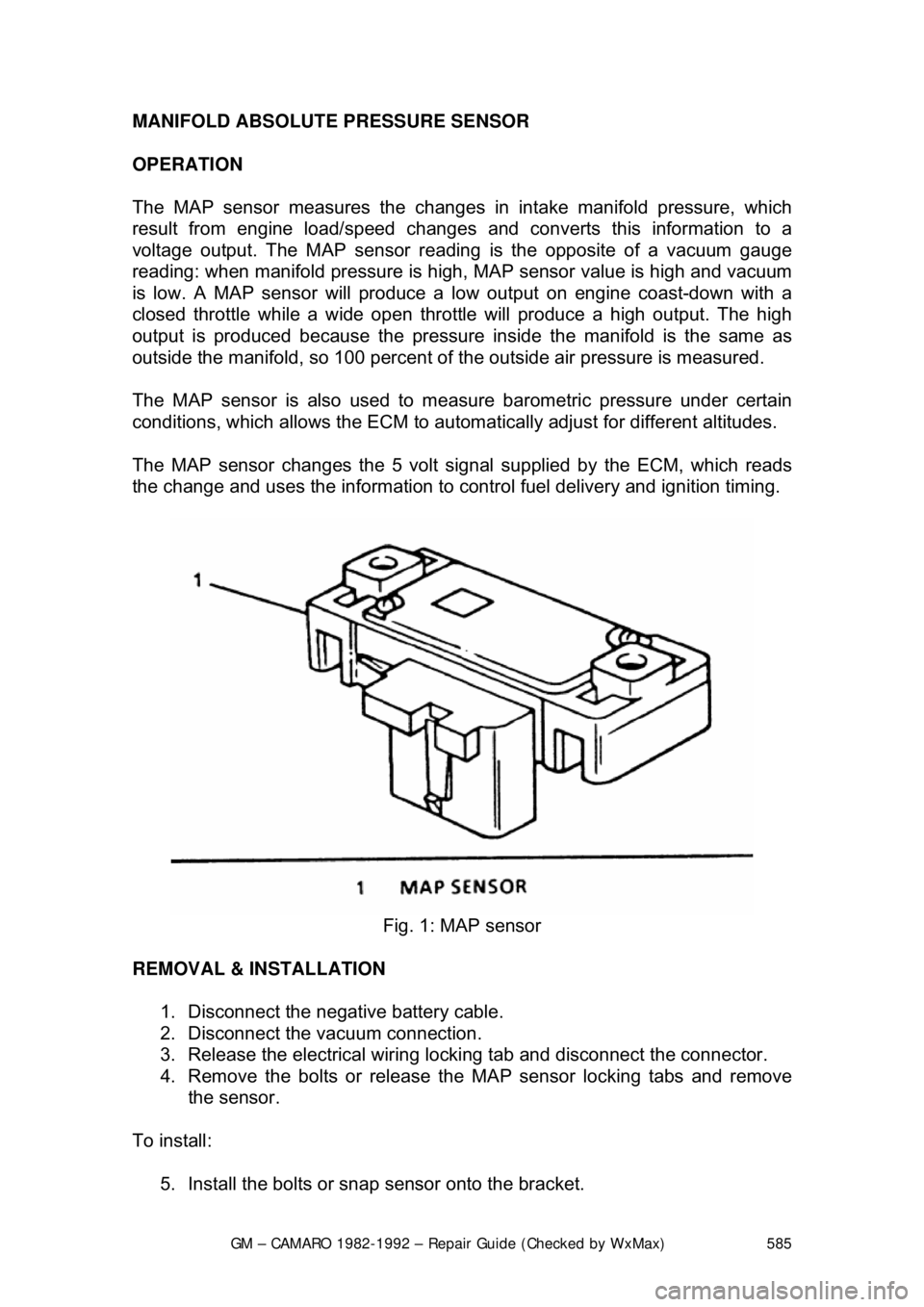
MANIFOLD ABSOLUTE PRESSURE SENSOR
OPERATION
The MAP sensor measures the changes in
intake manifold pressure, which
result from engine load/ speed changes and converts this information to a
voltage output. The MAP sensor reading is the opposite of a vacuum gauge
reading: when manifold pressu re is high, MAP sensor value is high and vacuum
is low. A MAP sensor will produce a low output on engine coast-down with a
closed throttle while a wide open throttle will produce a high output. The high
output is produced because the pressure inside the manifold is the same as
outside the manifold, so 100 percent of t he outside air pressure is measured.
The MAP sensor is also used to meas ure barometric pressure under certain
conditions, which allows the ECM to autom atically adjust for different altitudes.
The MAP sensor changes the 5 volt signal supplied by the ECM, which reads
the change and uses the information to cont rol fuel delivery and ignition timing.
Fig. 1: MAP sensor
REMOVAL & INSTALLATION 1. Disconnect the negative battery cable.
2. Disconnect the vacuum connection.
3. Release the electrical wiring lo cking tab and disconnect the connector.
4. Remove the bolts or release the MAP sensor locking tabs and remove
the sensor.
To install: 5. Install the bolts or snap sensor onto the bracket.
Page 586 of 875
GM – CAMARO 1982-1992 – Repair Guide (Checked by WxMax) 586
6. Connect the MAP sensor
electrical wiring.
7. Connect the MAP sensor vacuum harness connector.
8. Connect the negative battery cable.
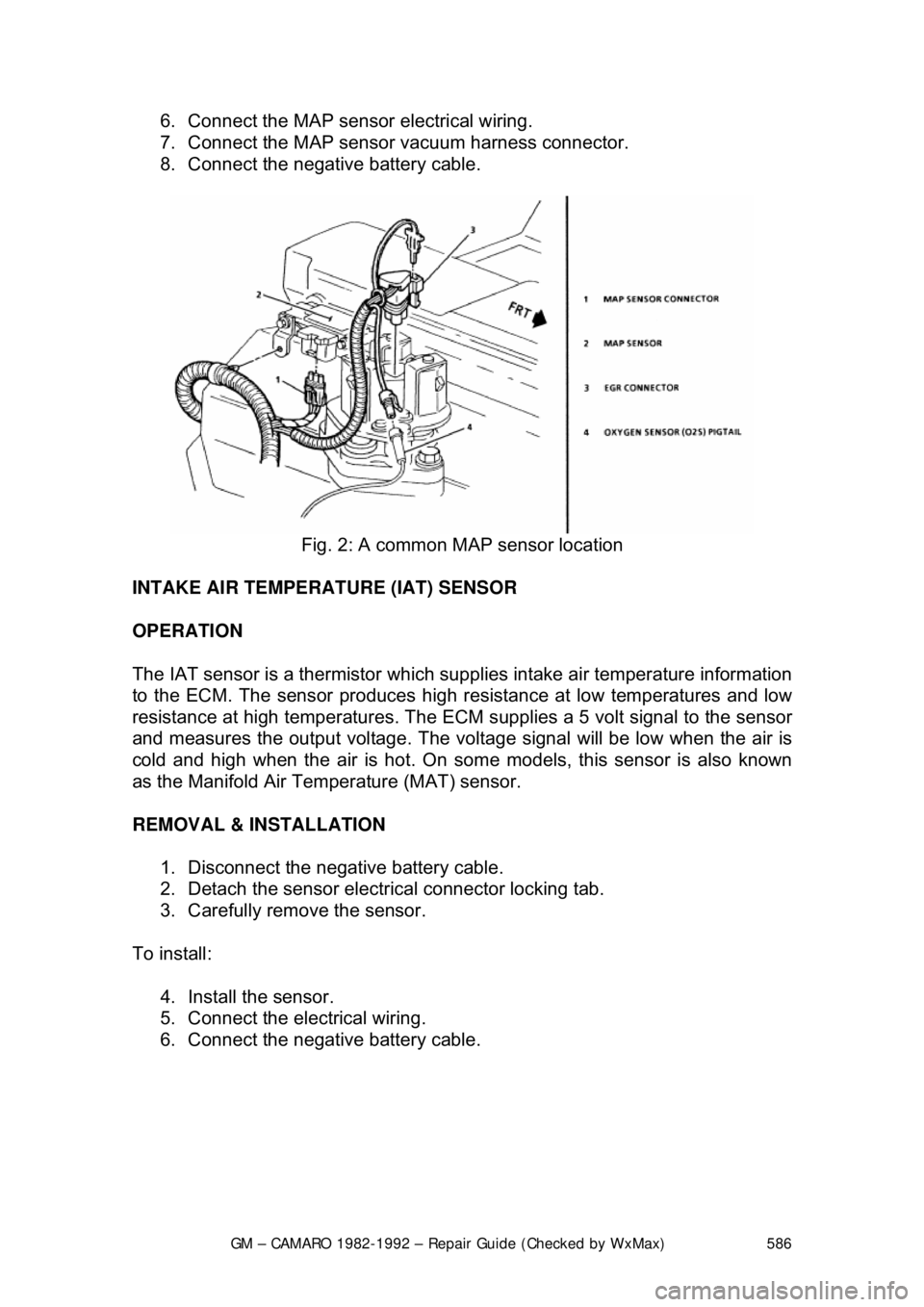
Fig. 2: A common MAP sensor location
INTAKE AIR TEMPERATURE (IAT) SENSOR
OPERATION
The IAT sensor is a thermistor which su pplies intake air temperature information
to the ECM. The sensor produces high re sistance at low temperatures and low
resistance at high temperatures. The ECM supplies a 5 volt signal to the sensor
and measures the output voltage. The vo ltage signal will be low when the air is
cold and high when the air is hot. On so me models, this sensor is also known
as the Manifold Air Tem perature (MAT) sensor.
REMOVAL & INSTALLATION 1. Disconnect the negative battery cable.
2. Detach the sensor electr ical connector locking tab.
3. Carefully remove the sensor.
To install: 4. Install the sensor.
5. Connect the electrical wiring.
6. Connect the negative battery cable.
Page 590 of 875
GM – CAMARO 1982-1992 – Repair Guide (Checked by WxMax) 590
REMOVAL & INSTALLATION
1. Disconnect the negative battery cable.
2. Disconnect the TPS electrical wiring.
3. Remove the mounting screws.
4. Remove the TPS and, if equipped, s ensor seal from the throttle body.
To install: 5. Place the TPS in positi on. Align the TPS lever with the sensor drive lever
on the throttle body.
6. Install the TPS mounting screws.
7. Connect the electrical wiring.
8. Connect the negative battery cable.
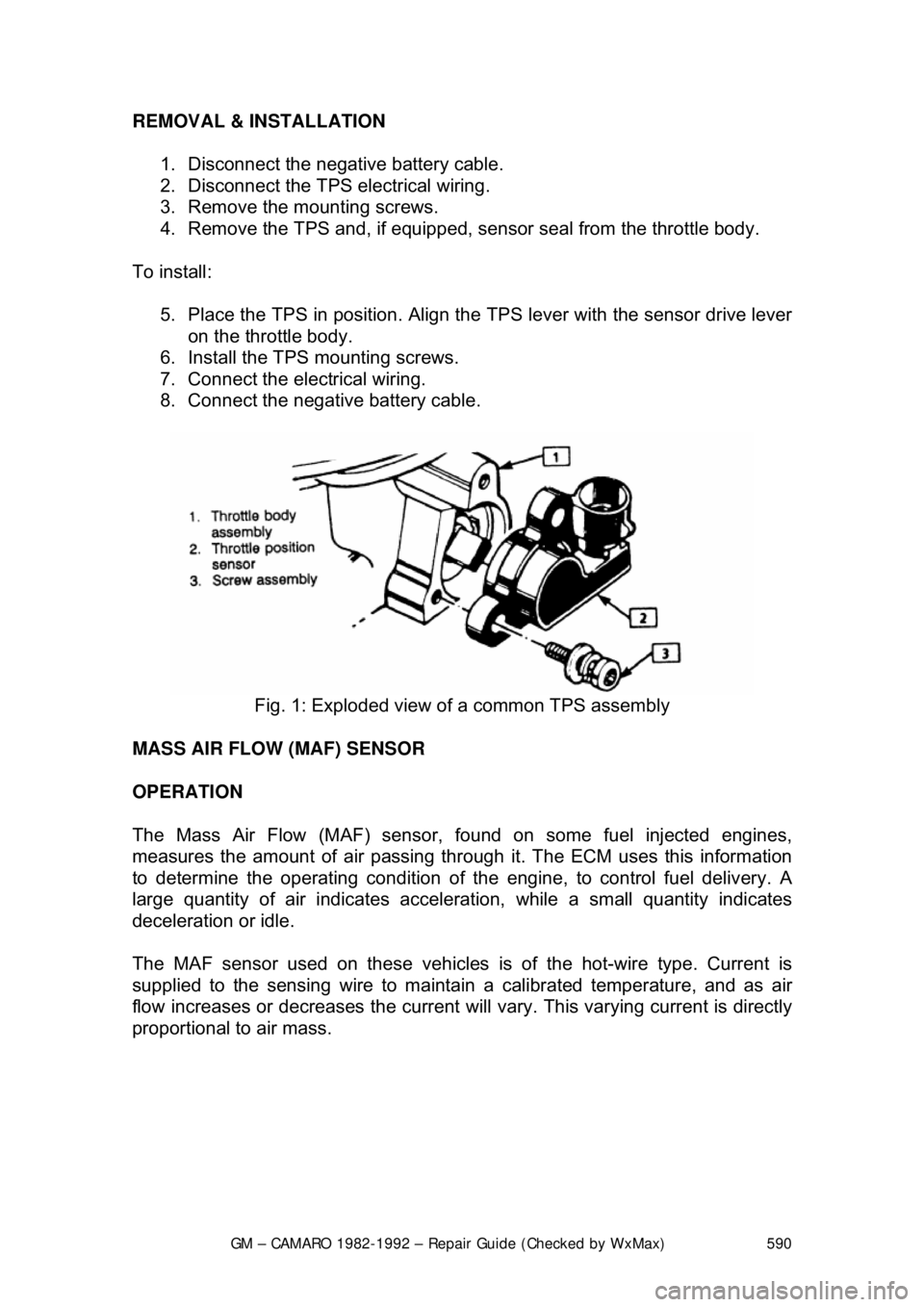
Fig. 1: Exploded view of a common TPS assembly
MASS AIR FLOW (MAF) SENSOR
OPERATION
The Mass Air Flow (MAF) sensor, found on some fuel injected engines,
measures the amount of air passing through it. The ECM uses this information
to determine the operating cond ition of the engine, to control fuel delivery. A
large quantity of air indicates acceleration, while a small quantity indicates
deceleration or idle.
The MAF sensor used on these vehicles is of the hot-wire type. Current is
supplied to the sensing wire to maintain a calibrated temperature, and as air
flow increases or decreases the current will vary. This varying current is directly
proportional to air mass.
Page 593 of 875
GM – CAMARO 1982-1992 – Repair Guide (Checked by WxMax) 593
REMOVAL & INSTALLATION
1. Disconnect the negative battery cable.
2. Drain the engine coolant.
3. Raise and properly support the vehicle.
4. Disconnect the knock sensor wiring harness.
5. Remove the knock sensor from the engine block.
CAUTION - The knock sensor is mounted in the engine block cooling passage.
Engine coolant in the block will dr ain when the sensor is removed.
6. Installation is the reverse of remova l. Tighten the sensor to 14 ft. lbs (19
Nm).
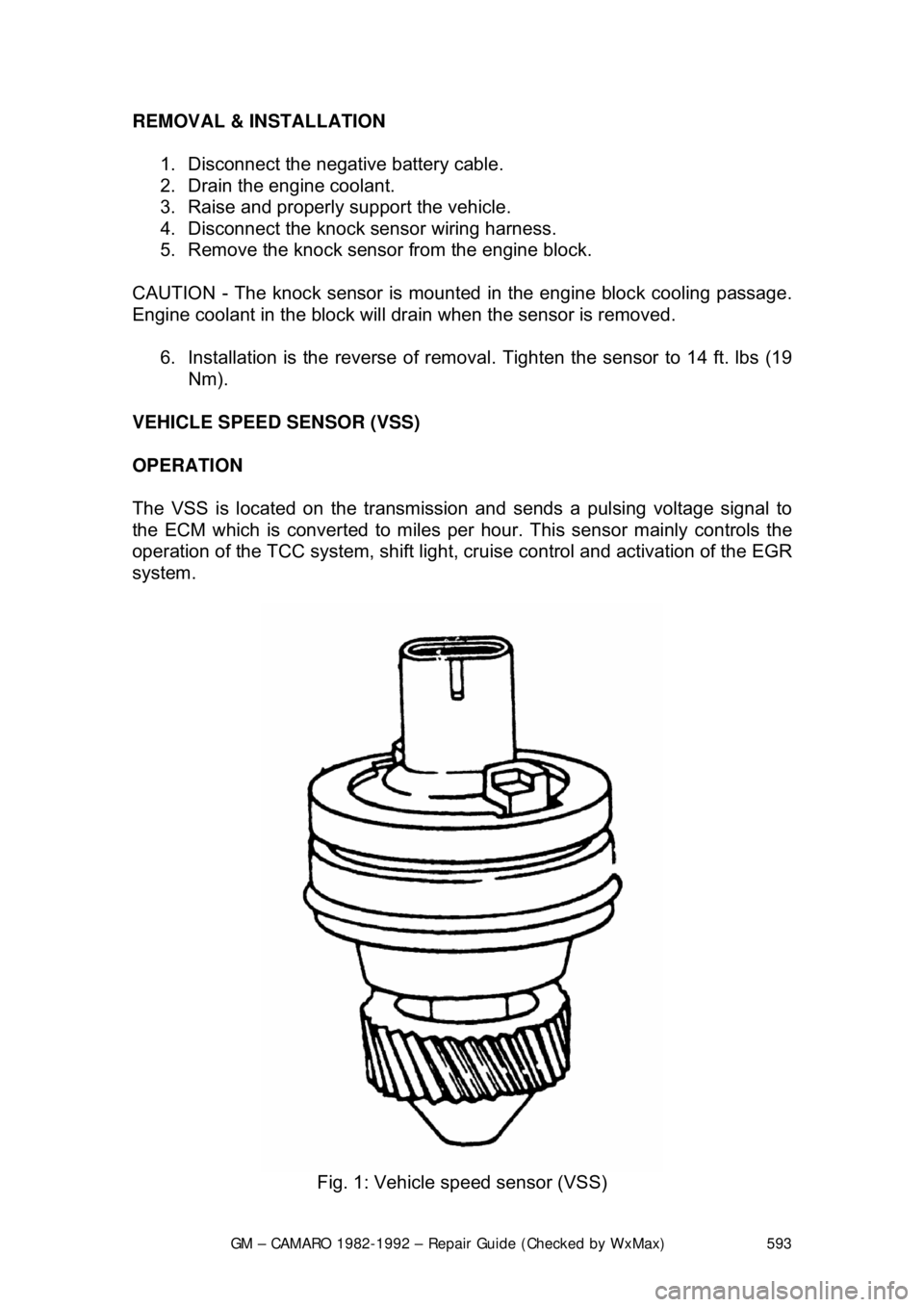
VEHICLE SPEED SENSOR (VSS)
OPERATION
The VSS is located on the transmission and sends a pulsing voltage signal to
the ECM which is converted to miles per hour. This sensor mainly controls the
operation of the TCC system, shift light, cr uise control and activation of the EGR
system.
Fig. 1: Vehicle speed sensor (VSS)
Page 594 of 875

GM – CAMARO 1982-1992 – Repair Guide (Checked by WxMax) 594
REMOVAL & INSTALLATION
1. Disconnect the negative battery cable.
2. Raise and safely support the vehicle.
3. Disconnect the VSS electrical wiring.
4. Remove the retaining bolt.
5. Have a clean container to catch the transmission fluid and remove the
VSS.
6. Remove and discard the O-ring.
To install: 7. Lubricate a new O-ring with a thin f ilm of transmission fluid. Install the O-
ring and VSS.
8. Install the retaining bolt.
9. Connect the electrical wiring.
10. Lower the vehicle.
11. Connect the negative battery cable.
12. Refill transmission to proper level.
TROUBLE CODES
SELF DIAGNOSTICS
READING CODES
The following procedure applies to mode ls with the 12 pin diagnostic connector
only.
1. Turn the ignition switch OFF. Locate the Assembly Line Diagnostic Link
(ALDL), usually under the instrument panel. It may be within a plastic
cover or housing labeled DIAGNOSTIC CONNECTOR. This link is used
to communicate with the ECM.
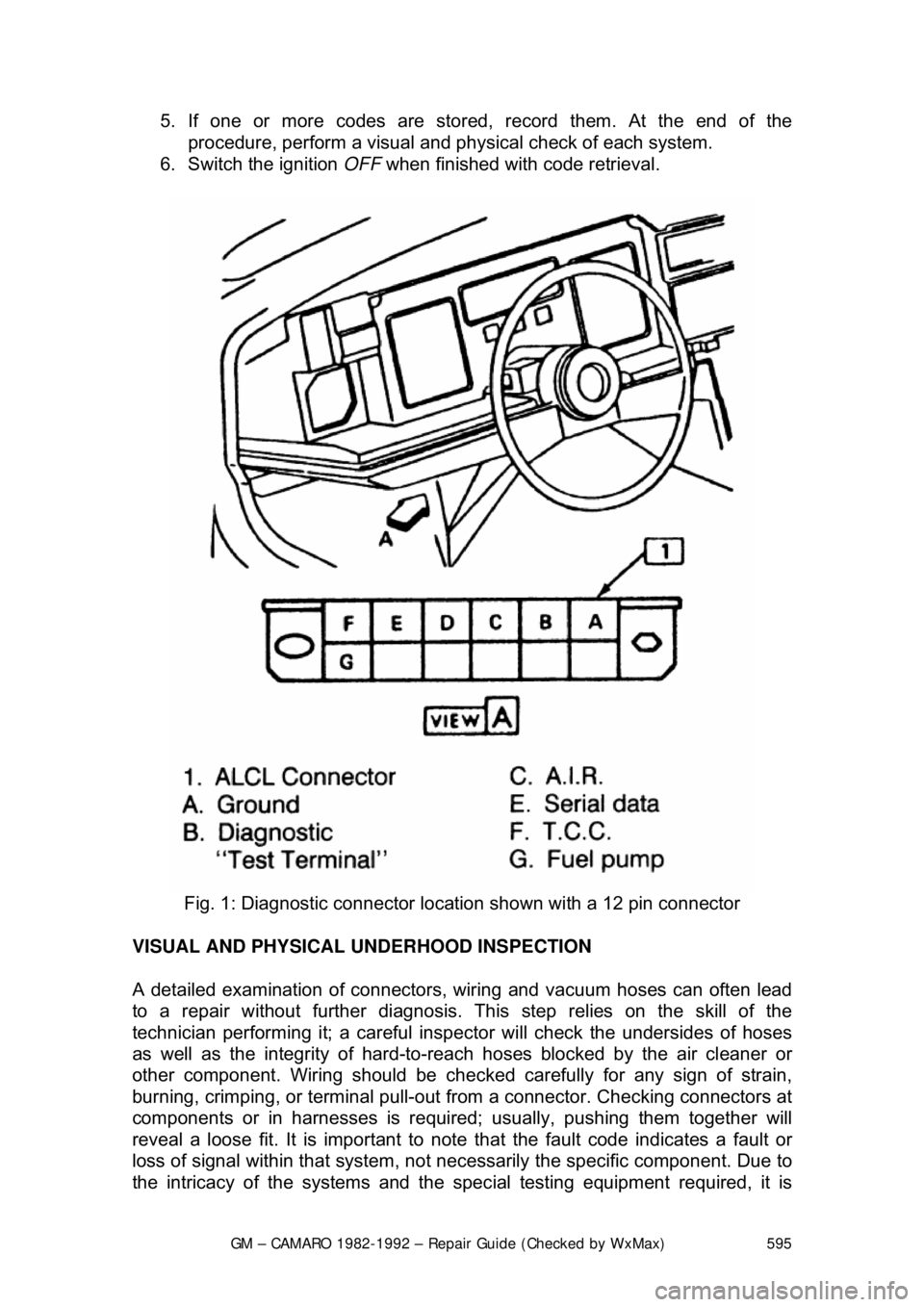
2. Use a small jumper wire to connect Terminal B of the ALDL to Terminal
A. As the ALDL connector is viewed from the front, Terminal A is on the
extreme right of the upper row; Terminal B is second from the right on
the upper row.
3. After the terminals are connected, turn the ignition switch to the ON
position but do not start the engine. T he dash warning lamp should begin
to flash Code 12. The code will disp lay as one flash, a pause and two
flashes. Code 12 is not a fault code. It is used as a system
acknowledgment or handshake code; its presence indicates that the
ECM can communicate as requested. Code 12 is used to begin every
diagnostic sequence.
4. After Code 12 has been transmitted 3 times, the fault codes, if any, will
each be flashed in the same manner th ree times. The codes are stored
and transmitted in numeric order from lowest to highest.
The order of codes in the memory does not indicate the order of occurrence.
Page 595 of 875
GM – CAMARO 1982-1992 – Repair Guide (Checked by WxMax) 595
5. If one or more codes are stored,
record them. At the end of the
procedure, perform a visual and physical check of each system.
6. Switch the ignition OFF when finished with code retrieval.
Fig. 1: Diagnostic connector lo cation shown with a 12 pin connector
VISUAL AND PHYSICAL UNDERHOOD INSPECTION
A detailed examinatio n of connectors, wiring and va cuum hoses can often lead
to a repair without further diagnosis. This step relies on the skill of the
technician performing it; a careful inspec tor will check the undersides of hoses
as well as the integrity of hard-to-reac h hoses blocked by the air cleaner or
other component. Wiring should be check ed carefully for any sign of strain,
burning, crimping, or terminal pull-out from a connector. Checking connectors at
components or in harnesses is required; usually, pushing them together will
reveal a loose fit. It is important to note that the fault code indicates a fault or
loss of signal within that system, not necessarily the specific component. Due to
the intricacy of the systems and the spec ial testing equipment required, it is
Page 633 of 875
GM – CAMARO 1982-1992 – Repair Guide (Checked by WxMax) 633
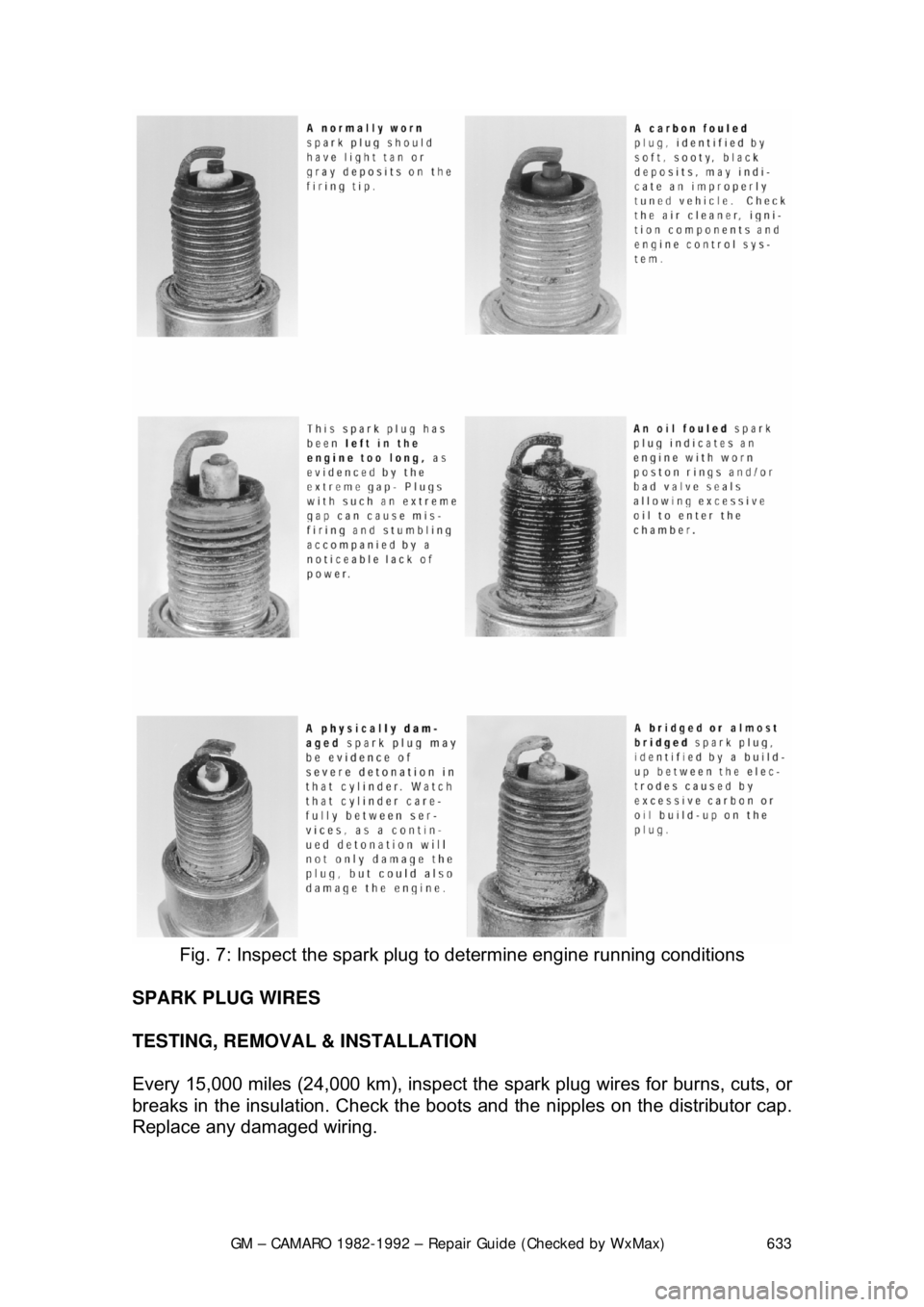
Fig. 7: Inspect the spark plug to determine engine running conditions
SPARK PLUG WIRES
TESTING, REMOVAL & INSTALLATION
Every 15,000 miles (24,000 km), inspect the spark plug wires for burns, cuts, or
breaks in the insulation. Check the boots and the nipples on the distributor cap.
Replace any damaged wiring.
Page 635 of 875
GM – CAMARO 1982-1992 – Repair Guide (Checked by WxMax) 635
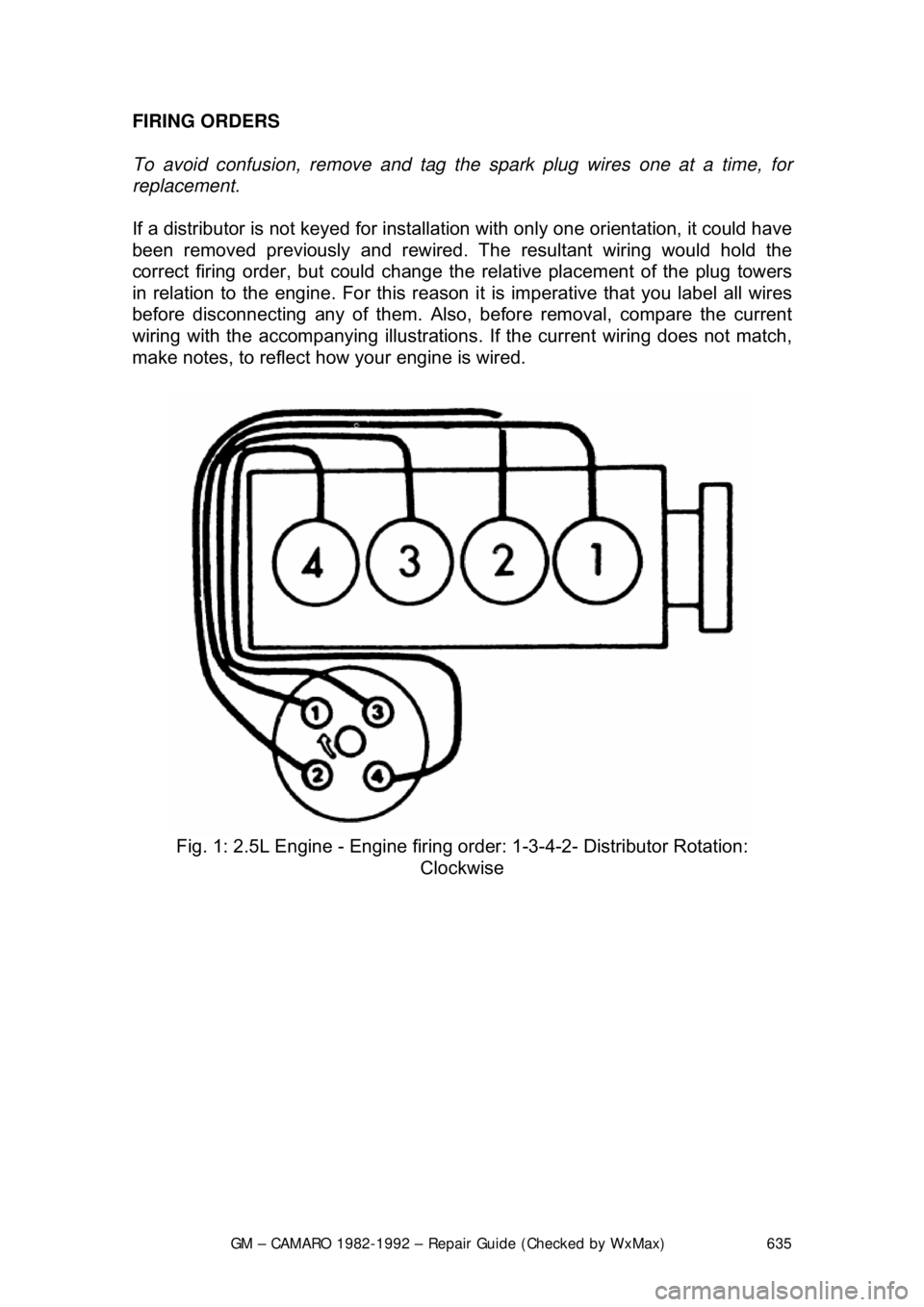
FIRING ORDERS
To avoid confusion, remove and tag th
e spark plug wires one at a time, for
replacement.
If a distributor is not keyed for installati on with only one orientation, it could have
been removed previously and rewired. Th e resultant wiring would hold the
correct firing order, but could change the relative placement of the plug towers
in relation to the engine. Fo r this reason it is imperative that you label all wires
before disconnecting any of them. Also, before removal, compare the current
wiring with the accompanying i llustrations. If the current wiring does not match,
make notes, to reflect how your engine is wired.
Fig. 1: 2.5L Engine - Engine firing or der: 1-3-4-2- Distributor Rotation:
Clockwise