alternator CHEVROLET CAMARO 1982 Repair Guide
[x] Cancel search | Manufacturer: CHEVROLET, Model Year: 1982, Model line: CAMARO, Model: CHEVROLET CAMARO 1982Pages: 875, PDF Size: 88.64 MB
Page 354 of 875
GM – CAMARO 1982-1992 – Repair Guide (Checked by WxMax) 354
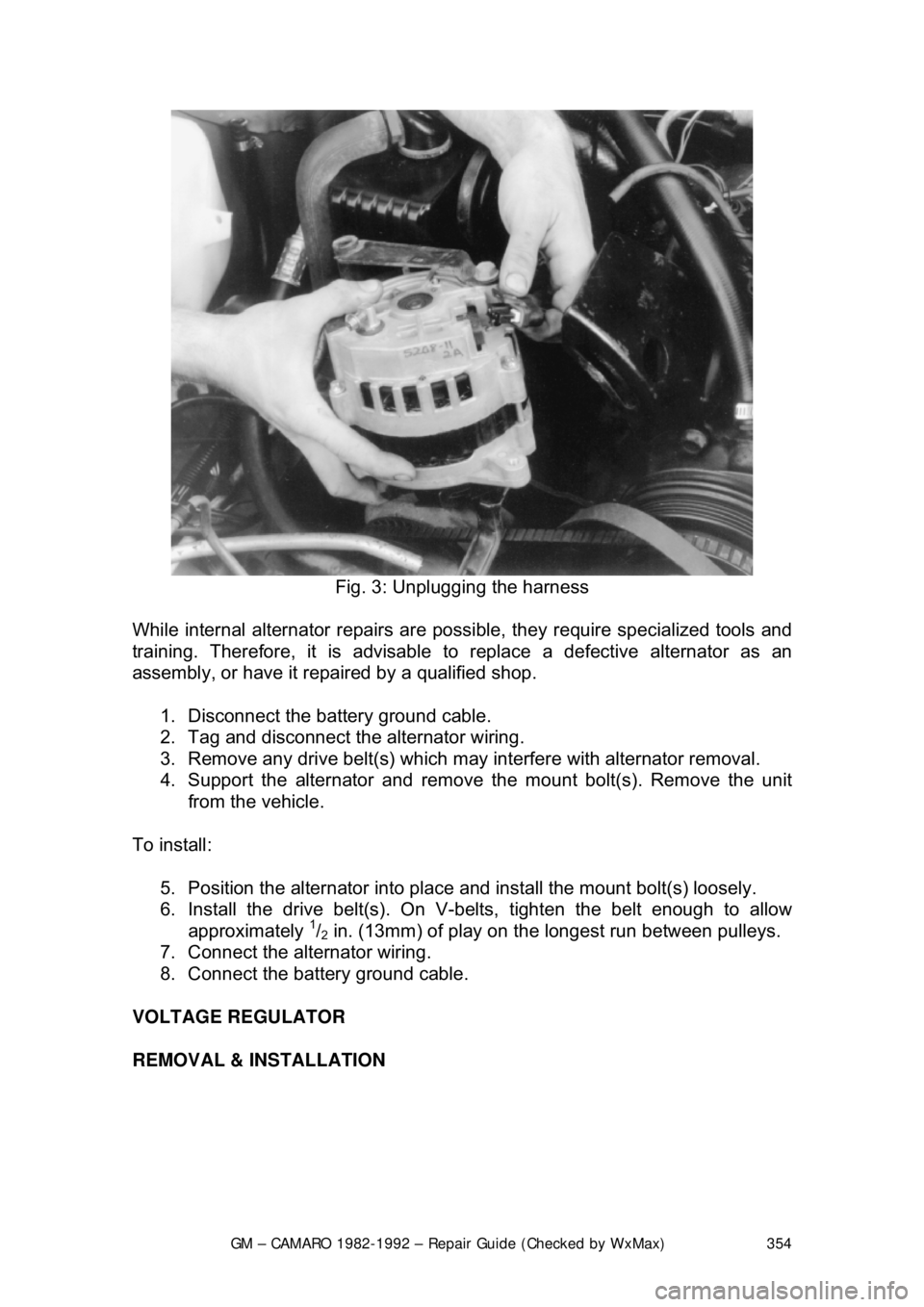
Fig. 3: Unplugging the harness
While internal alternator repairs are possi ble, they require specialized tools and
training. Therefore, it is advisable to replace a defective alternator as an
assembly, or have it repai red by a qualified shop.
1. Disconnect the battery ground cable.
2. Tag and disconnect the alternator wiring.
3. Remove any drive belt(s) which may interfere with alternator removal.
4. Support the alternator and remove the mount bolt(s). Remove the unit
from the vehicle.
To install: 5. Position the alternator into place and install the mount bolt(s) loosely.
6. Install the drive belt(s). On V- belts, tighten the belt enough to allow
approximately
1/2 in. (13mm) of play on the longest run between pulleys.
7. Connect the alternator wiring.
8. Connect the battery ground cable.
VOLTAGE REGULATOR
REMOVAL & INSTALLATION
Page 355 of 875
GM – CAMARO 1982-1992 – Repair Guide (Checked by WxMax) 355
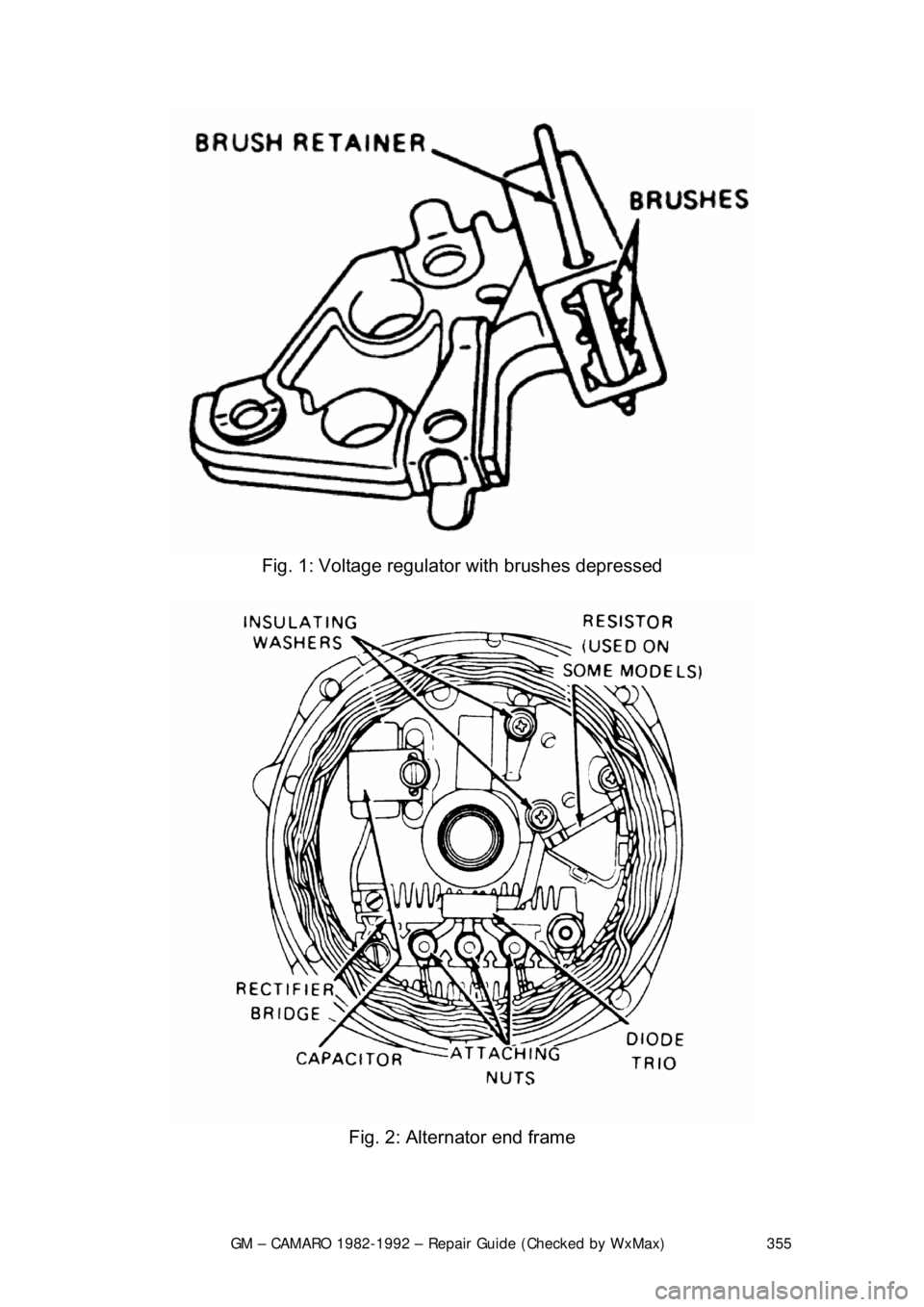
Fig. 1: Voltage regulator with brushes depressed
Fig. 2: Alternator end frame
Page 356 of 875
GM – CAMARO 1982-1992 – Repair Guide (Checked by WxMax) 356
This procedure is to be performed with t
he alternator removed from the vehicle.
The new style CS alternators on 1987-92 vehicles are non-serviceable and
must be replaced as an assembly.
1. Make scribe marks on the end fram es to make reassembly easier.
2. Remove the 4 through-bolts and s eparate the drive end frame assembly
from the rectifier end frame assembly.
3. Remove the 3 diode trio attachi ng nuts and the 3 regulator attaching
screws.
4. Remove the diode trio and the regulator from the end frame.
To install: 5. Push the brushes into the brush hol der and install a brush retainer or a
tooth pick to hold the brushes in place.
6. Install the regulator into the alternator.
7. Install the diode trio.
8. Install the halves of the alternat or and secure the halves with the 4
through-bolts. After the alternator is assembled, remove the brush
retainer.
STARTER
REMOVAL & INSTALLATION
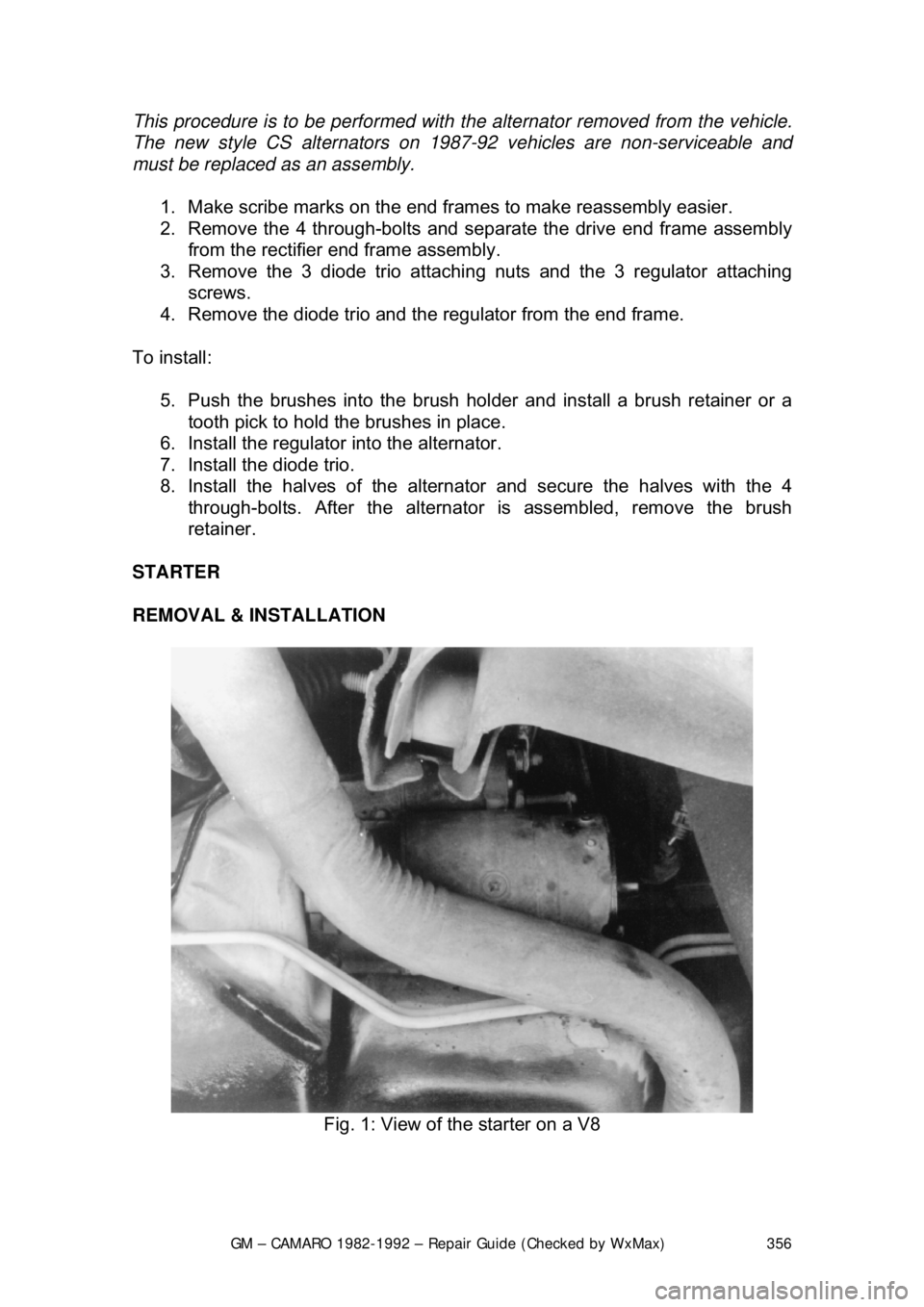
Fig. 1: View of the starter on a V8
Page 373 of 875
GM – CAMARO 1982-1992 – Repair Guide (Checked by WxMax) 373
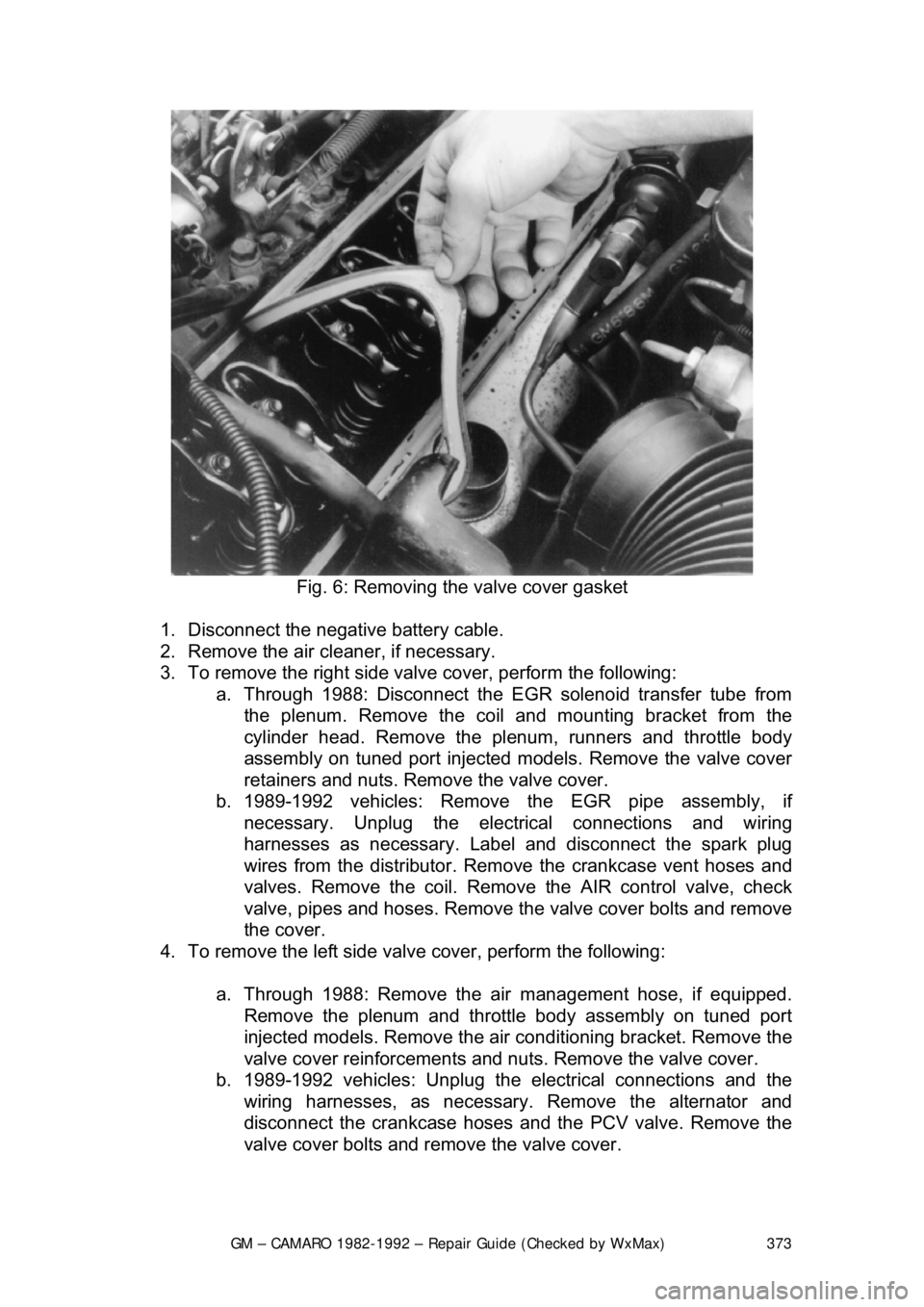
Fig. 6: Removing the valve cover gasket
1. Disconnect the negative battery cable.
2. Remove the air cleaner, if necessary.
3. To remove the right side valv e cover, perform the following:
a. Through 1988: Disconnect the EG R solenoid transfer tube from
the plenum. Remove the coil and mounting bracket from the
cylinder head. Remove the plenum, runners and throttle body
assembly on tuned port injected models. Remove the valve cover
retainers and nuts. Remove the valve cover.
b. 1989-1992 vehicles: Remove the EGR pipe assembly, if
necessary. Unplug the electrical connections and wiring
harnesses as necessary. Label and disconnect the spark plug
wires from the distributor. Remo ve the crankcase vent hoses and
valves. Remove the coil. Remove the AIR control valve, check
valve, pipes and hoses. Remove t he valve cover bolts and remove
the cover.
4. To remove the left side valve cover, perform the following:
a. Through 1988: Remove the air management hose, if equipped.
Remove the plenum and throttle body assembly on tuned port
injected models. Remove the air conditioning bracket. Remove the
valve cover reinforcements and nuts. Remove the valve cover.
b. 1989-1992 vehicles: Unplug the electrical connections and the
wiring harnesses, as necessary . Remove the alternator and
disconnect the crankcase hoses and the PCV valve. Remove the
valve cover bolts and remove the valve cover.
Page 386 of 875

GM – CAMARO 1982-1992 – Repair Guide (Checked by WxMax) 386
FUEL INJECTION
1. Remove the air cleaner.
2. Drain the radiator.
3. Disconnect: a. Battery cables at the battery.
b. Upper radiator and heater hoses at the manifold.
c. Crankcase ventilation hoses as required.
d. Fuel line at the carburetor.
e. Accelerator linkage.
f. Vacuum hose at the distributor, if equipped.
g. Power brake hose at the car buretor base or manifold, if
applicable.
h. Temperature sending switch wires.
4. Remove the distributor cap and scribe the rotor position relative to the
distributor body, and engine.
5. Remove the distributor.
6. If applicable, remove the alternator upper bracket. As required, remove
the air cleaner bracket, and accelerator bellcrank.
7. Remove the manifold-to-head attachi ng bolts, then remove the manifold
and carburetor as an assembly.
8. Mark and disconnect all emission re lated items (e.g.: wiring, vacuum
hoses, etc.) which are connected to manifold mounted items.
9. If the manifold is to be replaced , transfer the carburetor (and mounting
studs), water outlet and thermostat (use a new gasket) heater hose
adapter, EGR valve (use new gasket) and, if applicable, TVS switch(s)
and the choke coil.
To install: 10. Before installing the manifold, thoroughly clean the gasket and sealing
surfaces of the cylinder heads and manifold.
11. Install the manifold end seals, folding the tabs if applicable, and the
manifold/head gaskets, using a s ealing compound around the water
passages.
Make sure that the new manifold gaskets match the old ones EXACTLY.
12. When installing the manifold, care should be taken not to dislocate the
end seals. It is helpful to use a pilo t in the distributor opening. Tighten the
manifold bolts to 30 ft. lbs. (40 Nm) for 5.0L or 20-25 ft. lbs. (27-34 Nm)
for 2.8L in the sequence illustrated.
13. Install the distributor with the rotor in its original location as indicated by
the scribe line. If the engi ne has been disturbed, refer to the previous
Distributor Removal and Installation procedure.
14. If applicable, install the alter nator upper bracket and adjust the belt
tension.
15. Connect all disconnected components at their original locations.
16. Fill the cooling system, start the engine, check for leaks and adjust the
ignition timing and carburetor idle speed and mixture.
Page 410 of 875
GM – CAMARO 1982-1992 – Repair Guide (Checked by WxMax) 410
11. Disconnect all electrical connecti
ons from the intake manifold and
cylinder head.
12. If the vehicle has air conditioning, remove the compressor and position it
out of the way. Do not disc onnect the refrigerant lines.
13. Remove the alternator and lay the unit aside. If necessary, remove the
alternator brackets.
14. Remove any other brackets or components mounted on the cylinder
head.
15. Remove the upper radiator hose.
16. Remove the rocker arm cover and back off the rocker arm nuts/bolts and
pivot the rocker arms out of the way so that the pushrods can be
removed. Identify the pushrods so that they can be reinstalled in their
original locations.
17. Remove the cylinder head bolts and cylinder head. Remove the intake
and exhaust manifolds, as required.
To install: 18. Thoroughly clean all mating surfaces of oil, grease and old gasket material. Clean the head bo lts and cylinder block threads, otherwise an
accurate torque specificat ion will not be attained.
19. Install a new gasket on the block mating surface. Position the cylinder
head on the block.
Clean the bolt threads, apply sealing comp ound and install the bolts finger-tight.
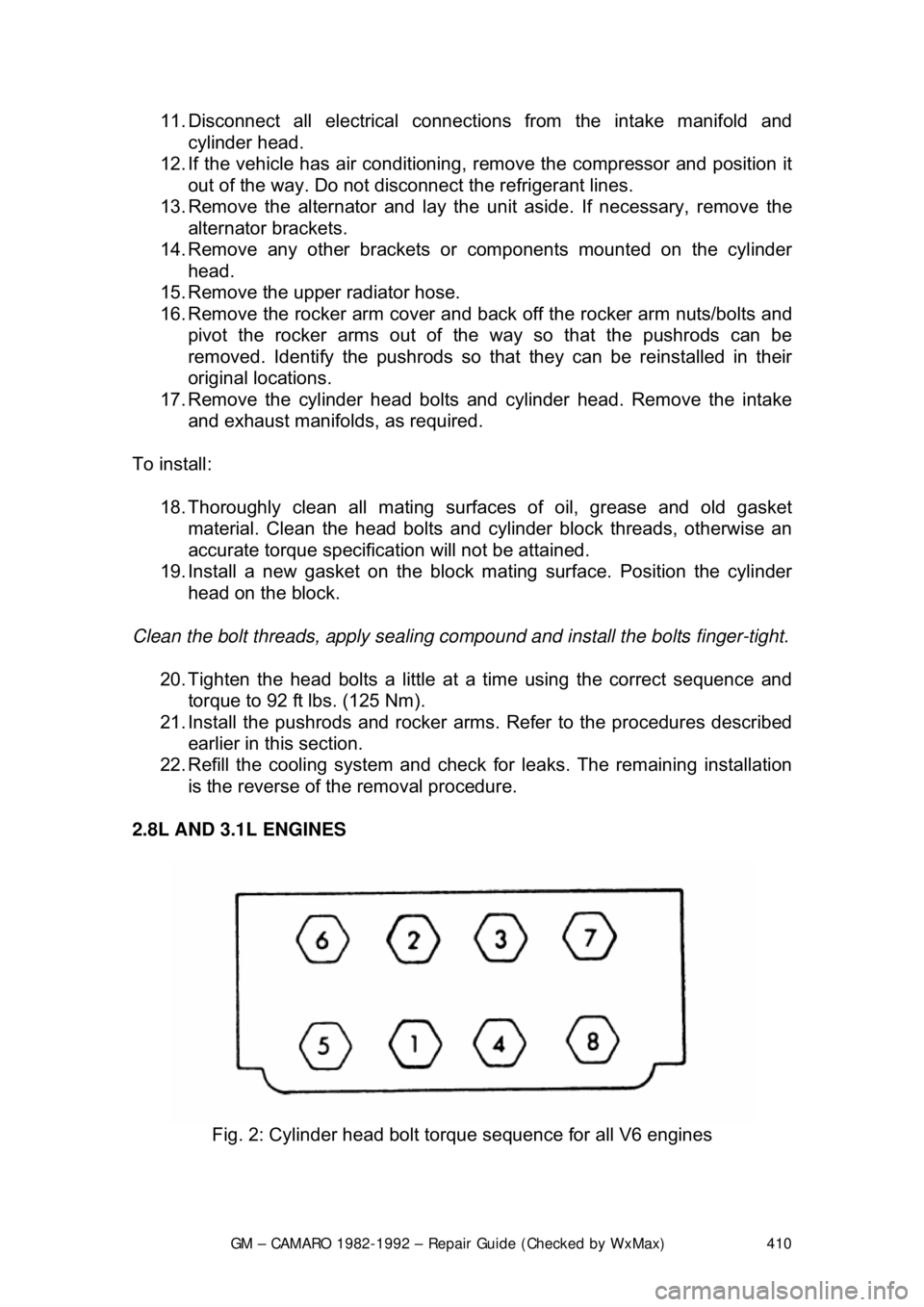
20. Tighten the head bolts a little at a time using the correct sequence and
torque to 92 ft lbs. (125 Nm).
21. Install the pushrods and rocker arms . Refer to the procedures described
earlier in this section.
22. Refill the cooling system and check for leaks. The remaining installation
is the reverse of the removal procedure.
2.8L AND 3.1L ENGINES
Fig. 2: Cylinder head bolt torque sequence for all V6 engines
Page 411 of 875

GM – CAMARO 1982-1992 – Repair Guide (Checked by WxMax) 411
1. Disconnect the negative battery cable.
2. Relieve the fuel system pressure
and drain the engine coolant from the
radiator into a suitable container.
3. Remove the intake manifold and the spark plugs.
4. Remove the dipstick tube and bra cket. Raise and support the vehicle
safely. Drain the oil and remove the oil filter. Lower the vehicle.
5. Remove the exhaust manifolds.
6. Remove the drive belt(s).
7. Remove the air conditioning compresso r and bracket, reposition it aside.
Do not disconnect the lines.
8. Remove the power steering pump and bracket, reposition it aside.
9. Remove the alternator and br acket, reposition it aside.
10. Remove the ground cable from the rear of the cylinder head and remove
the engine lift bracket.
11. Remove the rocker arm covers.
12. Loosen the rocker arms until the pushrods can be removed.
13. Remove the cylinder head bolts and remove the cylinder heads.
To install: 14. Clean the gasket mating surfaces of all components. Be careful not to
nick or scratch any surfaces as this will allow leak paths. Clean the bolt
threads in the cylinder bl ock and on the head bolts. Dirt will affect bolt
torque.
15. Place the head gaskets in pos ition over the dowel pins.
16. Install the cylinder heads.
17. Coat the cylinder head bolts th reads with GM sealer 1052080 or
equivalent, and install the bolts. Tight en the bolts in the proper sequence
to:
• 1982-1987 engines: 70 ft lbs. (90 Nm)
• 1988-1992 engines: 1st step: 40 ft lbs. (55 Nm); 2nd step: tighten
an additional 1/4 (90 degree) turn
18. Install the pushrods a nd loosely retain them wit h the rocker arms. Make
sure the lower ends of the pushrods ar e in the lifter seats. Refer to the
rocker arm procedures outlined ea rlier in this section.
19. Install the power steering pump br acket and pump. Do the same for the
air conditioning compressor bracket and compressor.
20. Install the ground cable to t he rear of the cylinder head.
21. Install the exhaust manifolds.
22. Install the dipstick tube and bracket.
23. Install the intake manifold.
24. Install the alternator bracket and alternator.
25. Install the drive belt(s).
26. Install the spark plugs.
27. Fill the cooling system with the proper type and quantity of coolant. Install
a new oil filter and fill the crankca se with the proper type and quantity of
oil.
28. Connect the negative battery cable, star t the vehicle and check for leaks.
Page 416 of 875
GM – CAMARO 1982-1992 – Repair Guide (Checked by WxMax) 416
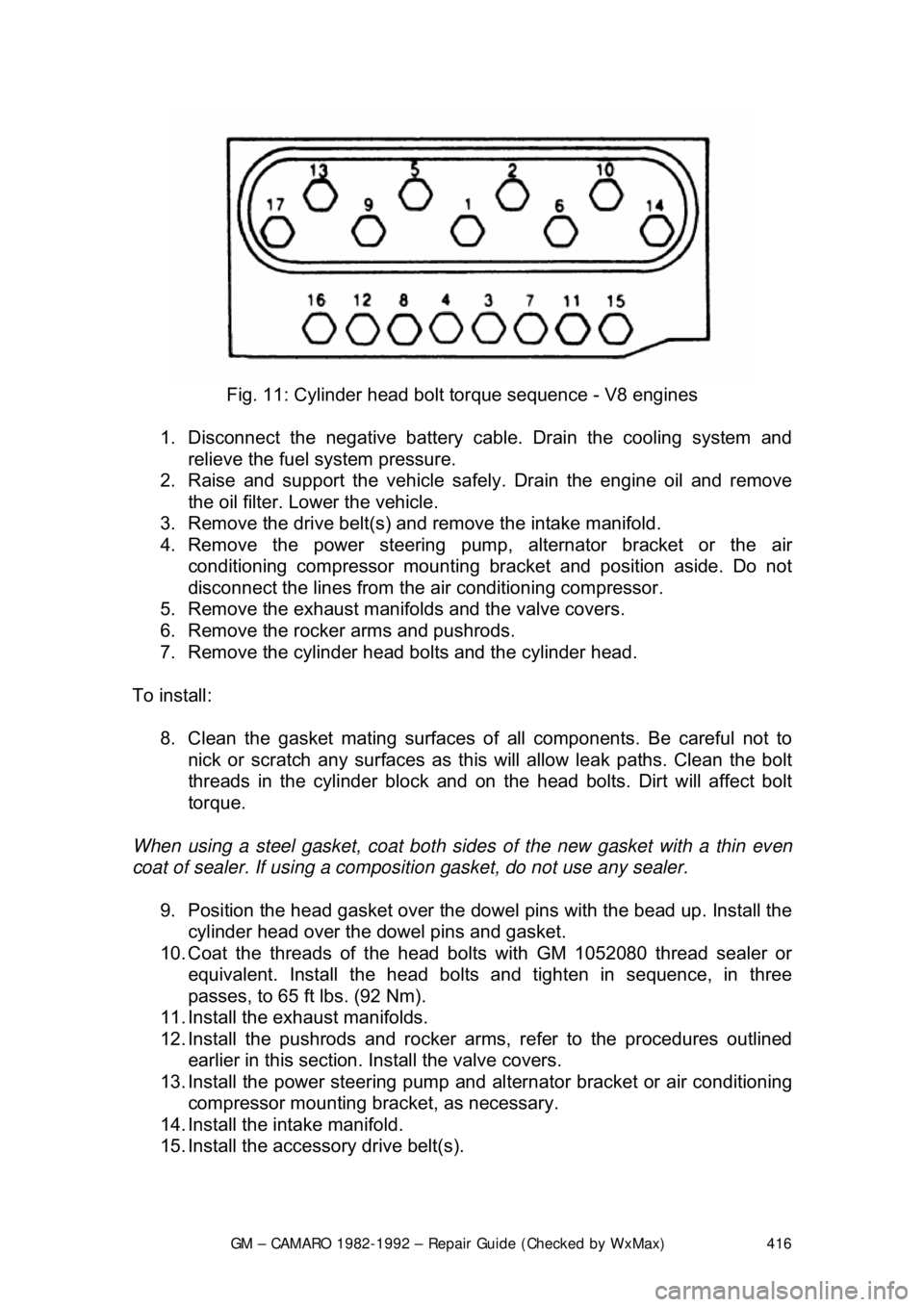
Fig. 11: Cylinder head bolt torque sequence - V8 engines
1. Disconnect the negative battery c able. Drain the cooling system and
relieve the fuel system pressure.
2. Raise and support the vehicle safe ly. Drain the engine oil and remove
the oil filter. Lower the vehicle.
3. Remove the drive belt(s) and remove the intake manifold.
4. Remove the power steering pump, alternator bracket or the air
conditioning compressor mounting br acket and position aside. Do not
disconnect the lines from the air conditioning compressor.
5. Remove the exhaust manifolds and the valve covers.
6. Remove the rocker arms and pushrods.
7. Remove the cylinder head bolts and the cylinder head.
To install: 8. Clean the gasket mating surfaces of all components. Be careful not to
nick or scratch any surfaces as this will allow leak paths. Clean the bolt
threads in the cylinder bl ock and on the head bolts. Dirt will affect bolt
torque.
When using a steel gasket, coat both sides of the new gasket with a thin even
coat of sealer. If using a compos ition gasket, do not use any sealer.
9. Position the head gasket over the dow el pins with the bead up. Install the
cylinder head over the dowel pins and gasket.
10. Coat the threads of the head bo lts with GM 1052080 thread sealer or
equivalent. Install the head bolts and tighten in sequence, in three
passes, to 65 ft lbs. (92 Nm).
11. Install the exhaust manifolds.
12. Install the pushrods and rocker arms, refer to the procedures outlined earlier in this section. Install the valve covers.
13. Install the power steering pump and al ternator bracket or air conditioning
compressor mounting bra cket, as necessary.
14. Install the intake manifold.
15. Install the accessory drive belt(s).
Page 428 of 875

GM – CAMARO 1982-1992 – Repair Guide (Checked by WxMax) 428
1. Disconnect the battery ground c
able. Drain the cooling system.
2. Remove the fan shroud or the upper radiator support and drive belts.
Remove the fan and pulley from the water pump.
3. Remove the alternator upper and lower brackets, air brace with brackets,
and power steering lower bra cket (move it aside).
4. Remove the radiator lower hose and the heater hose from the water
pump. Remove the water pump bolts and the water pump.
5. If A/C equipped, remove the comp ressor and move aside. Remove the
compressor mounting bracket.
6. Remove the damper pulley retain ing bolt and the damper pulley.
7. Remove the timing gear cover bolts and the timing gear cover.
With the timing gear cover removed, use a large screwdriver to pry the oil seal
from the cover. To install the new oil se al, lubricate it with engine oil and drive it
into place.
To install: 8. Prepare the mating surfaces for reinst allation of the timing gear cover.
Coat the new gasket with RTV sealer.
9. Install the timing gear cover and timing gear cover bolts. Torque the
cover bolts to specifications:
• V6 engines (M8 x 1.25 bolts): 13-22 ft. lbs. (18-30 Nm)
• V6 engines (M10 x 1.5 bolts): 20-35 ft. lbs. (27-48 Nm)
• V8 engines (all bolts): 69-130 inch lbs. (8-14 Nm)
10. Install the damper pulley by pulli ng the damper onto the crankshaft. Use
tool J-23523 or equivalent. Install t he damper pulley retaining bolt and
torque bolts to 67-85 ft lbs. (90-110 Nm).
11. If A/C equipped, install the compressor mounting bracket and
compressor.
12. Install the water pump and the water pump bolts.
13. Install the radiator lower hose and the heater hose to the water pump.
14. Install the alternator upper and lower brackets, air brace with brackets
and the power steering lower bracket.
15. Install the fan and pull ey to the water pump. Inst all the fan shroud or the
upper radiator support and drive belts and adjust.
16. Connect the battery ground cable.
17. Fill the cooling syst em, start the engine and check for leaks.
Page 476 of 875

GM – CAMARO 1982-1992 – Repair Guide (Checked by WxMax) 476
Before attempting to repair a threaded
hole, remove any snapped, broken or
damaged bolts or studs. Penetrating oil ca n be used to free frozen threads. The
offending item can usually be removed with locking pliers or using a screw/stud
extractor. After the hole is clear, the thread can be repaired, as shown in the
series of accompanying illustrations and in the kit manufacturer's instructions.
ENGINE PREPARATION
To properly rebuild an engine, you must fi rst remove it from the vehicle, then
disassemble and diagnose it. Ideally you should place your engine on an engine
stand. This affords you the best access to the engine components. Follow the
manufacturer's directions for using the stand with your particular engine.
Remove the flywheel or fl explate before installing the engine to the stand.
Now that you have the engine on a stand, and assuming that you have drained
the oil and coolant from the engine, it's ti me to strip it of all but the necessary
components. Before you start disassembli ng the engine, you may want to take
a moment to draw some pictures, or fabr icate some labels or containers to mark
the locations of various components and the bolts and/or studs which fasten
them. Modern day engines use a lot of littl e brackets and clips which hold wiring
harnesses and such, and these holders are often mounted on studs and/or bolts
that can be easily mixed up. The manufacturer spent a lot of time and money
designing your vehicle, and they wouldn't have wasted any of it by haphazardly
placing brackets, clips or fasteners on t he vehicle. If it's present when you
disassemble it, put it back when you asse mble, you will regret not remembering
that little bracket which holds a wire har ness out of the path of a rotating part.
You should begin by unbolting any accessories still attached to the engine, such
as the water pump, power steering pump, alternator, etc. Then, unfasten any
manifolds (intake or exhaust) which were not removed during the engine
removal procedure. Finally, remove any covers remaining on the engine such
as the rocker arm, front or timing cove r and oil pan. Some front covers may
require the vibration dam per and/or crank pulley to be removed beforehand.
The idea is to reduce the engine to the bar e necessities (cylinder head(s), valve
train, engine block, crankshaft, pistons and connecting rods), plus any other 'in
block' components such as oil pumps, balance shafts and auxiliary shafts.
Finally, remove the cylinder head(s) from the engine block and carefully place
on a bench. Disassembly instructions fo r each component follow later in this
section.
CYLINDER HEAD
There are two basic types of cylinder heads used on today’s automobiles:
the Overhead Valve (OHV) and the Over head Camshaft (OHC). The latter can
also be broken down into two subgr oups: the Single Overhead Camshaft
(SOHC) and the Dual Overhead Camshaft (DO HC). Generally, if there is only a
single camshaft on a head, it is just referred to as an OHC head. Also, an
engine with a OHV cylinder head is also known as a pushrod engine.