brake light CHEVROLET CAMARO 1982 Repair Guide
[x] Cancel search | Manufacturer: CHEVROLET, Model Year: 1982, Model line: CAMARO, Model: CHEVROLET CAMARO 1982Pages: 875, PDF Size: 88.64 MB
Page 118 of 875

GM – CAMARO 1982-1992 – Repair Guide (Checked by WxMax) 118
9. Remove the caliper lever pivot pin s
eal, sprag clip, spring and lever. Discard
the clip.
10. Inspect the caliper lever for worn spots, replace as necessary.
11. Remove the 2 guide pins from the mounting bracket.
12. Clean all parts not included in the r ebuild kit in denatured alcohol. Use only
dry filtered compressed air to dry parts . Replace the caliper housing if badly
scored or corroded.
To install:
13. Lubricate the new piston s eal with clean brake fluid. Place the seal into the
caliper groove, making sure t he seal is not twisted.
14. Install the piston. Lubricate seal s and piston with brake fluid prior to
reinstallation.
15. Assemble the pushrod, 2 new boots and new retainers to the actuating
collar.
16. Lightly coat the actuat ing collar with the lubricant provided in the rebuild kit.
Do not use any other type of lubricant.
17. Install the clamp retainers firmly agains t the actuating collar. Bend the tabs
on the retainer to hold the assembly together.
18. Install the preload spring into the boot retainers.
19. Install the clamp rod to the actuati ng collar and boot. Lubricate the clamp rod
with the lubricant supplied in the kit.
20. Slide the clamp rod th rough the holes in the boot and actuating collar. The
boot must be against the reacti on plate on the clamp rod.
21. Lubricate and install t he new compliance bushing with the lubricant supplied
in the kit.
22. Install the clamp rod with assembled parts into the connecting hole in the
caliper piston.
23. Install a new bleeder valve.
24. Install the pivot pin and new nut into the housing, if removed.
25. Install the caliper pivot pin seal, parking brake lever, new sprag clip and
spring, in that order. The teeth of the sprag clip mu st face away from the
lever.
26. Install the 2 collar return springs to the retainer. The retainer must enter the
return springs at the end of the second coil.
27. Install the adjuster screw into the cali per housing until the actuating collar is
parallel to the piston bore face of the caliper housing.
28. Lubricate and then install the guide pi ns and boots. Install the pads and
caliper assembly.
29. Bleed the brake system.
BRAKE DISC (ROTOR)
REMOVAL & INSTALLATION
CAUTION - Brake pads contain asbestos, which has been determined to be a
cancer causing agent. Never clean the brake surfaces with compressed air!
Avoid inhaling any dust from any brake surface! When cleaning brake surfaces,
use a commercially available brake cleaning fluid.
Page 122 of 875
GM – CAMARO 1982-1992 – Repair Guide (Checked by WxMax) 122
REAR DISC BRAKES
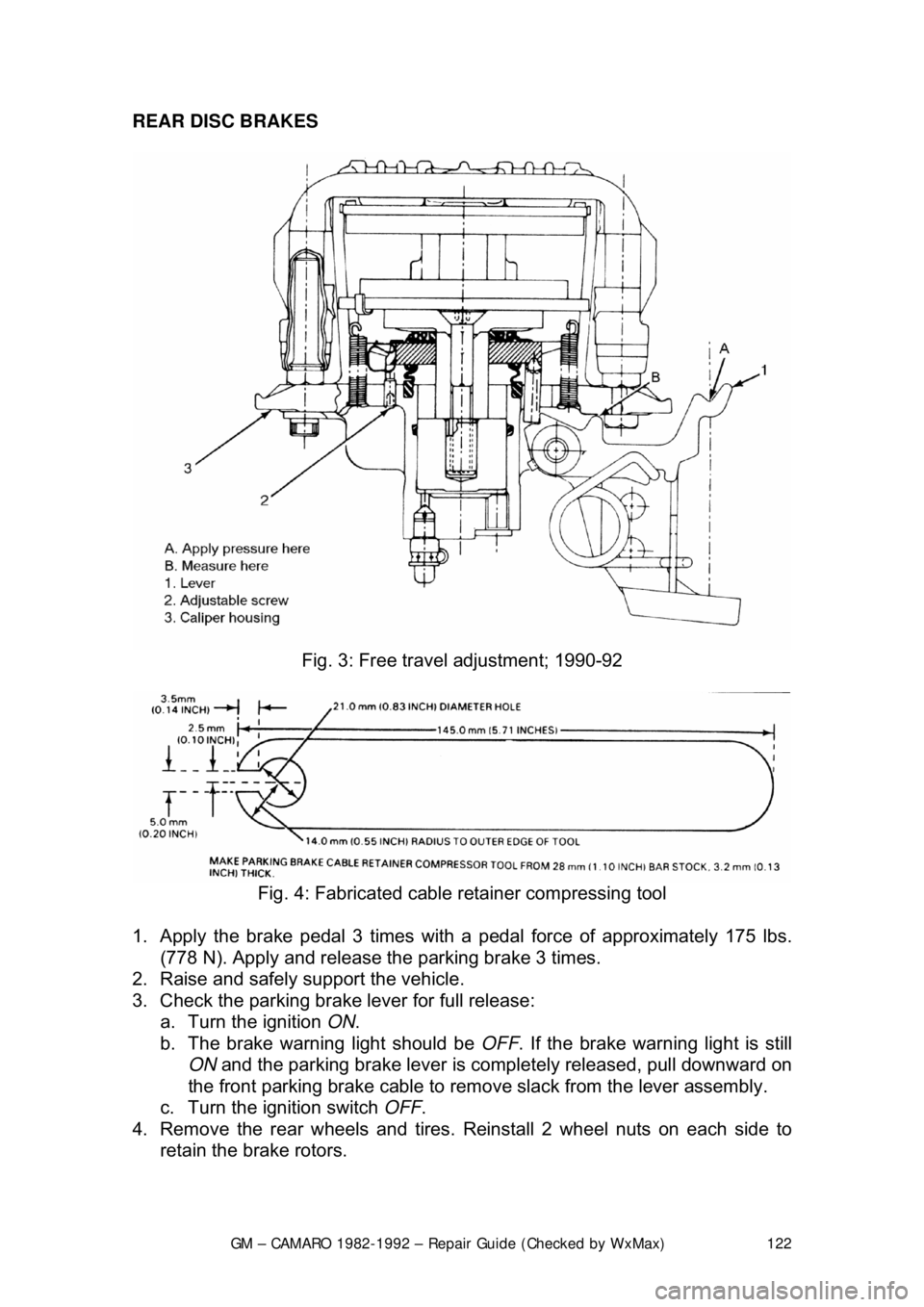
Fig. 3: Free trav el adjustment; 1990-92
Fig. 4: Fabricated cable retainer compressing tool
1. Apply the brake pedal 3 times with a pedal force of approximately 175 lbs.
(778 N). Apply and release t he parking brake 3 times.
2. Raise and safely support the vehicle.
3. Check the parking brake lever for full release: a. Turn the ignition ON.
b. The brake warning light should be OFF. If the brake warning light is still
ON and the parking brake lever is comple tely released, pull downward on
the front parking brake cable to remove slack from the lever assembly.
c. Turn the ignition switch OFF.
4. Remove the rear wheels and tires. Reinstall 2 wheel nuts on each side to
retain the brake rotors.
Page 123 of 875

GM – CAMARO 1982-1992 – Repair Guide (Checked by WxMax) 123
5. Pull the parking lever 4 clicks. T
he parking brake levers on both calipers
should be against the lever stops on the caliper housings. If the levers are
not against the stops, check for binding in the rear cables and/or loosen the
cables at the equalizer nut until both left and right levers are against their
stops.
6. Adjust the equalizer adjusting nut unt il the parking brake levers on both
calipers just begin to mo ve off their stops.
7. Back off the adjuster nut until the le vers move back, barely touching their
stops.
8. Operate the parking brak e lever several times to check adjustment. After
cable adjustment, the parking brake le ver should travel no more than 14
ratchet clicks. The rear wheels shoul d not turn forward when the parking
brake lever is applied 8-16 ratchet clicks.
9. Release the parking brake lever. Both rear whee ls must turn freely in both
directions. The parking brake levers on both calipers should be resting on
their stops.
10. Remove the wheel nuts retaining t he rotors. Install the wheel and tire
assemblies.
11. Lower the vehicle.
PARKING BRAKE FREE-TRAVEL
ADJUSTMENT
1989-92 MODELS
REAR DISC BRAKES
Disc brake pads must be new or parallel to within 0.006 in. (0.15mm). Parking
brake adjustment is not valid wit h heavily tapered pads and may cause
caliper/parking brake binding. Replace tapered brak e pads. Parking brake free-
travel should only be made if the caliper has been taken apart. This adjustment
will not correct a condition where the caliper levers will not return to their stops.
1. Have an assistant apply a light brake pedal load, enough to stop the rotor
from turning by hand. This takes up all clearances and ensures that
components are correctly aligned.
2. Apply light pressure to the caliper lever.
3. Measure the free-travel between t he caliper lever and the caliper housing.
The free-travel must be 0.0024-0.028 in. (0.6-0.7mm).
4. If the free-travel is incorrect, do the following: a. Remove the adjuster screw.
b. Clean the thread adhesive re sidue from the threads.
c. Coat the threads with adhesive.
d. Screw in the adjuster screw far enough to obtain 0.024-0.028 in. (0.6-
0.7mm) free-travel between the caliper lever and the caliper housing.
5. Have an assistant release the brak e pedal, then apply the brake pedal firmly
3 times. Recheck the free-travel and adjust as necessary.
Page 200 of 875

GM – CAMARO 1982-1992 – Repair Guide (Checked by WxMax) 200
9. Lubricate the speedometer cable
with an appropriate lubricant, being
sure to cover the lower thirds of the cable.
10. Insert the cable into the casi ng, then connect the cable and casing
assembly to the speedometer.
11. Install the instrument cluster, then install the cluster attaching screws.
12. Install the instrument cluster trim plate.
13. On models without cruise control, connect the speedometer cable strap
at the power brake booste r. On models with cruise control, connect the
speedometer cable at the cr uise control transducer.
14. Connect the negative battery cable at the battery.
WIPER SWITCH
REMOVAL & INSTALLATION
The wiper switch is part of the multi-function lever, located on the steering
wheel column.
1. Disconnect the electrical connector of the multi-function lever, located
under the instrument panel.
2. Remove the protective cover from the wire.
3. Grasp the lever firmly, twist and pull (the tang on the lever must align
with the socket) the lever straight out.
4. Pull the wire through the steering column.
To install: 5. Slide a music wire tool through the steering column and connect the
lever wire to the tool wire; pull t he wire through the steering column.
6. Push the control lever into the sp ring loaded socket (be sure to align the
tang).
7. Install the protective cover to the wire.
8. Connect the electrical connector of the multi-function lever.
HEADLIGHT SWITCH
REMOVAL & INSTALLATION 1. Disconnect the negative batte ry cable at the battery.
2. Remove the four screws from insi de the defroster duct (instrument panel
pad securing screws).
3. Remove the screws which are under the lip of the instrument panel pad.
4. Remove the instrument panel pad.
5. On models equipped with air condition ing, remove the instrument panel
cluster bezel and the cluster.
6. Remove the radio speaker bracket.
7. Pull the headlamp switch knob to the ON position, depress the locking
button for the knob and shaft (locat ed on the switch), and remove the
knob and shaft.
8. Remove the switch bezel (retainer).
Page 211 of 875
GM – CAMARO 1982-1992 – Repair Guide (Checked by WxMax) 211
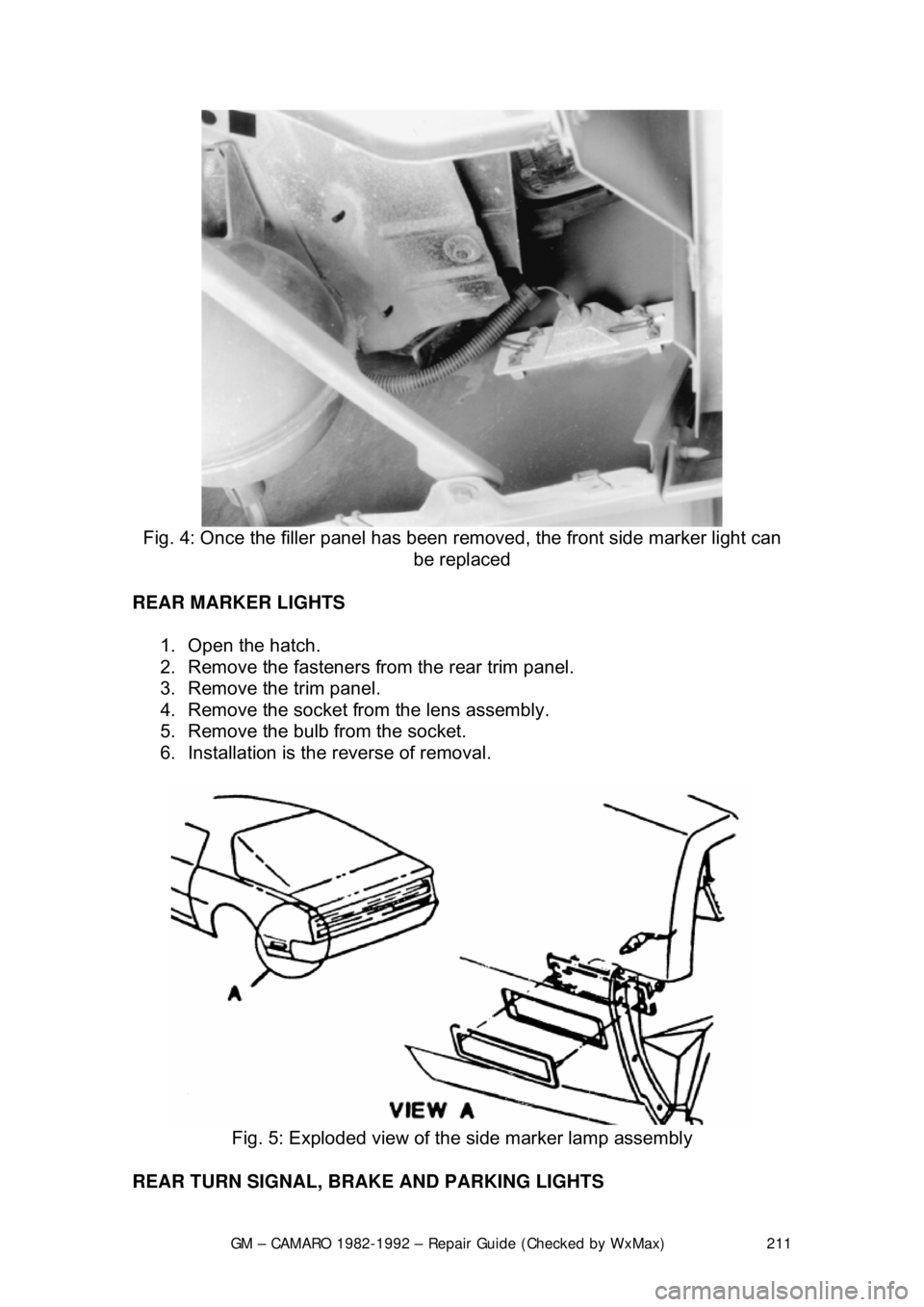
Fig. 4: Once the filler panel has been remo ved, the front side marker light can
be replaced
REAR MARKER LIGHTS 1. Open the hatch.
2. Remove the fasteners from the rear trim panel.
3. Remove the trim panel.
4. Remove the socket from the lens assembly.
5. Remove the bulb from the socket.
6. Installation is the reverse of removal.
Fig. 5: Exploded view of the side marker lamp assembly
REAR TURN SIGNAL, BRAKE AND PARKING LIGHTS
Page 213 of 875
GM – CAMARO 1982-1992 – Repair Guide (Checked by WxMax) 213
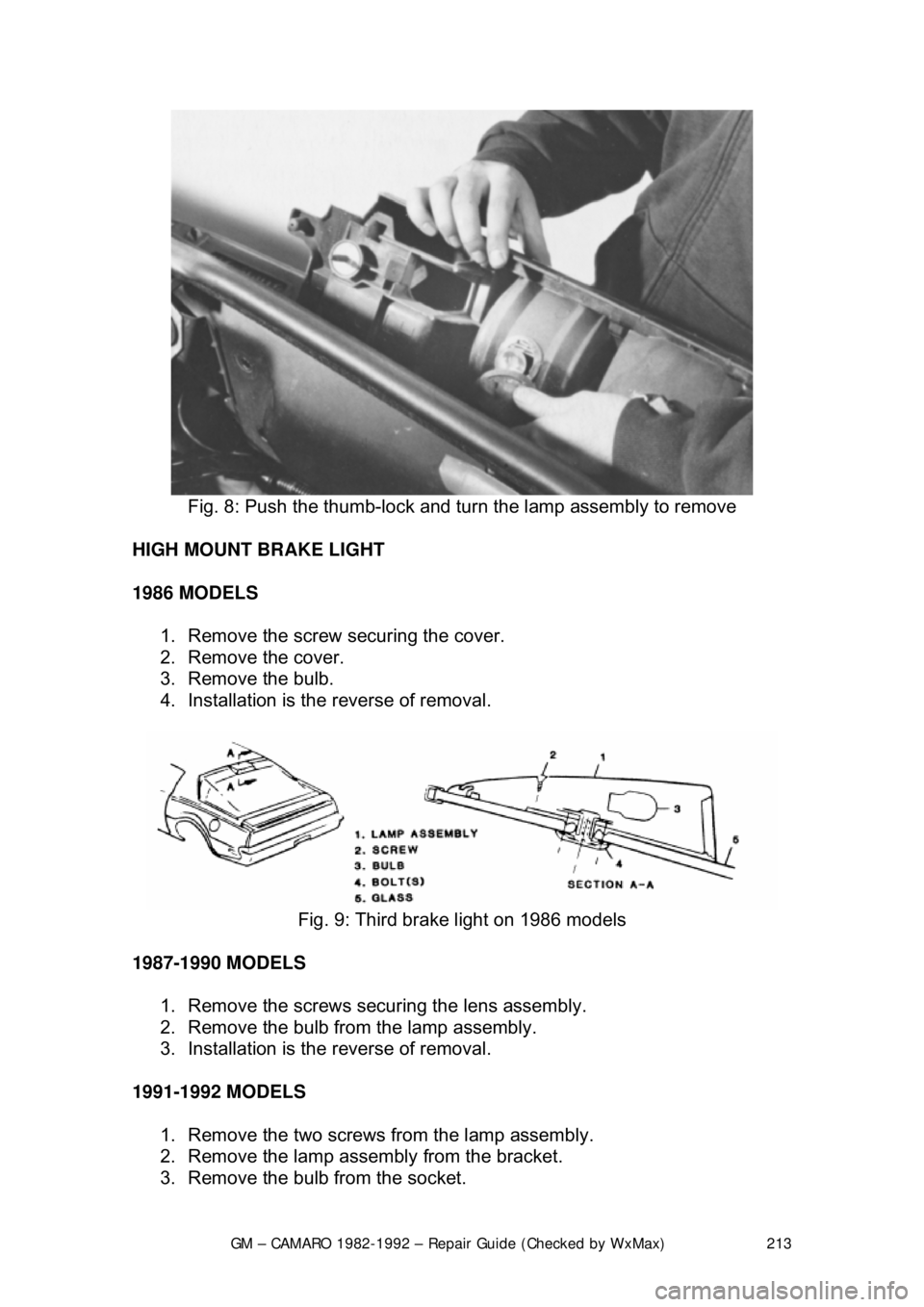
Fig. 8: Push the thumb-lock and turn the lamp assembly to remove
HIGH MOUNT BRAKE LIGHT
1986 MODELS 1. Remove the screw securing the cover.
2. Remove the cover.
3. Remove the bulb.
4. Installation is the reverse of removal.
Fig. 9: Third brake light on 1986 models
1987-1990 MODELS 1. Remove the screws securing the lens assembly.
2. Remove the bulb from the lamp assembly.
3. Installation is the reverse of removal.
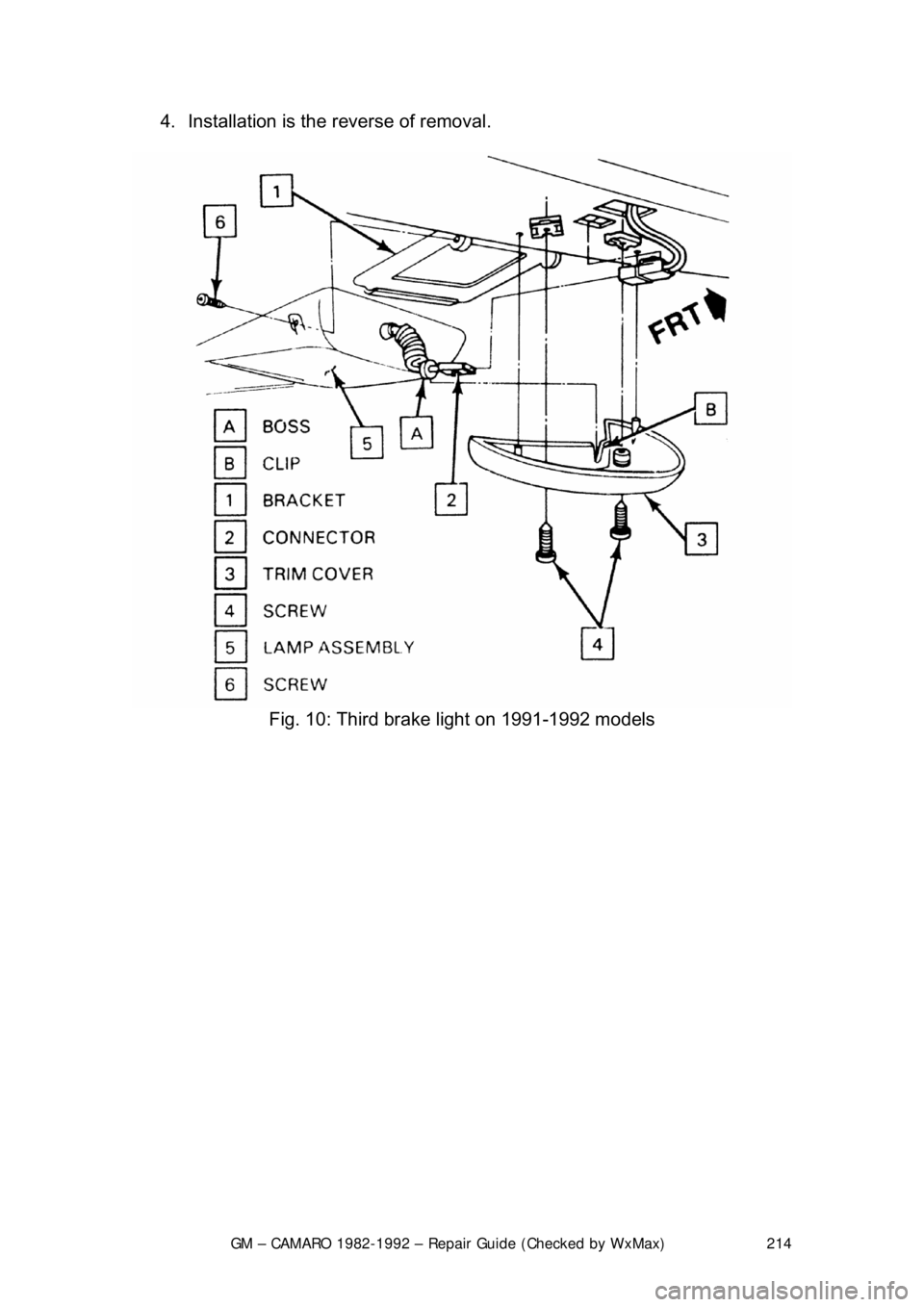
1991-1992 MODELS 1. Remove the two screws fr om the lamp assembly.
2. Remove the lamp assembly from the bracket.
3. Remove the bulb from the socket.
Page 214 of 875
GM – CAMARO 1982-1992 – Repair Guide (Checked by WxMax) 214
4. Installation is the reverse of removal.
Fig. 10: Third brake light on 1991-1992 models
Page 295 of 875

GM – CAMARO 1982-1992 – Repair Guide (Checked by WxMax) 295
of the spring bow outward, pushing the pre
ssure plate into closer contact with
the clutch disc. As the disc and plate mo ve closer together, friction between the
two increases and slippage is reduced until, when full spring pressure is applied
(by fully releasing the pedal) the speed of the disc and plate are the same. This
stops all slipping, creating a direct connection between the plate and disc which
results in the transfer of power from t he engine to the transmission. The clutch
disc is now rotating with the pressure plate at engine speed and, because it is
splined to the transmission shaft, the shaft now turns at the same engine speed.
The clutch is operating properly if: 1. It will stall the engine when released with the vehicle held stationary.
2. The shift lever can be moved freel y between 1st and reverse gears when
the vehicle is stationary and the clutch disengaged.
APPLICATION
All 1982-83 vehicles use a mechanical (non-hydraulic) clutch; 1984-92 models
use a hydraulic clutch. With the hydraulic clutch, no adjustment of the clutch
pedal or the linkage is required. On t he mechanical type, the only required
adjustment is to maintain the proper clutch pedal freeplay. The freeplay\
adjustment is very important, for it determines the engaging and disengaging
characteristics of the clutch assembly.
The clutch assembly consists of: a flywheel, a pressure plate, a throwout
bearing and fork, a clutch pedal, and an actuating lever (non-hydraulic) or a
master cylinder/slave cylinder (hydraulic).
The hydraulic system utilizes a remote re servoir which is mounted to the power
brake booster, a master cy linder mounted to the cowl p anel and a slave cylinder
that is mounted to the bell housing. Th e system is operated directly by the
clutch pedal. When adding fl uid to the reservoir, always use a type which meets
DOT 3 specifications.
CAUTION - The clutch driven disc contains asbestos, which has been
determined to be a cancer causing agen t. Never clean clutch surfaces with
compressed air! Avoid inhaling any dus t from any clutch surface! When
cleaning clutch surfaces, use a commercia lly available brake cleaning fluid.
FREE-PLAY ADJUSTMENT
MECHANICAL LINKAGE 1. Disconnect the return sp ring at the clutch fork.
2. Hold the pedal against the rubber bumper on the dash brace.
3. Push the clutch fork so that th e throwout bearing lightly contacts the
pressure plate fingers.
Page 659 of 875

GM – CAMARO 1982-1992 – Repair Guide (Checked by WxMax) 659
VALVE LASH
All models utilize a hydraulic valve lifter system to obtain zero lash. No periodic
adjustment is necessary. An initial adjustm
ent is required anytime that the lifters
are removed or the valve tr ain is disturbed. This procedure is covered in Engine
& Engine Overhaul .
IDLE SPEED AND MIXTURE ADJUSTMENTS
Mixture adjustments are factory set and sealed; no adjustment attempt should
be made, except by an aut horized GM dealer or reputable shop equipped with
the necessary equipment.
IDLE SPEED
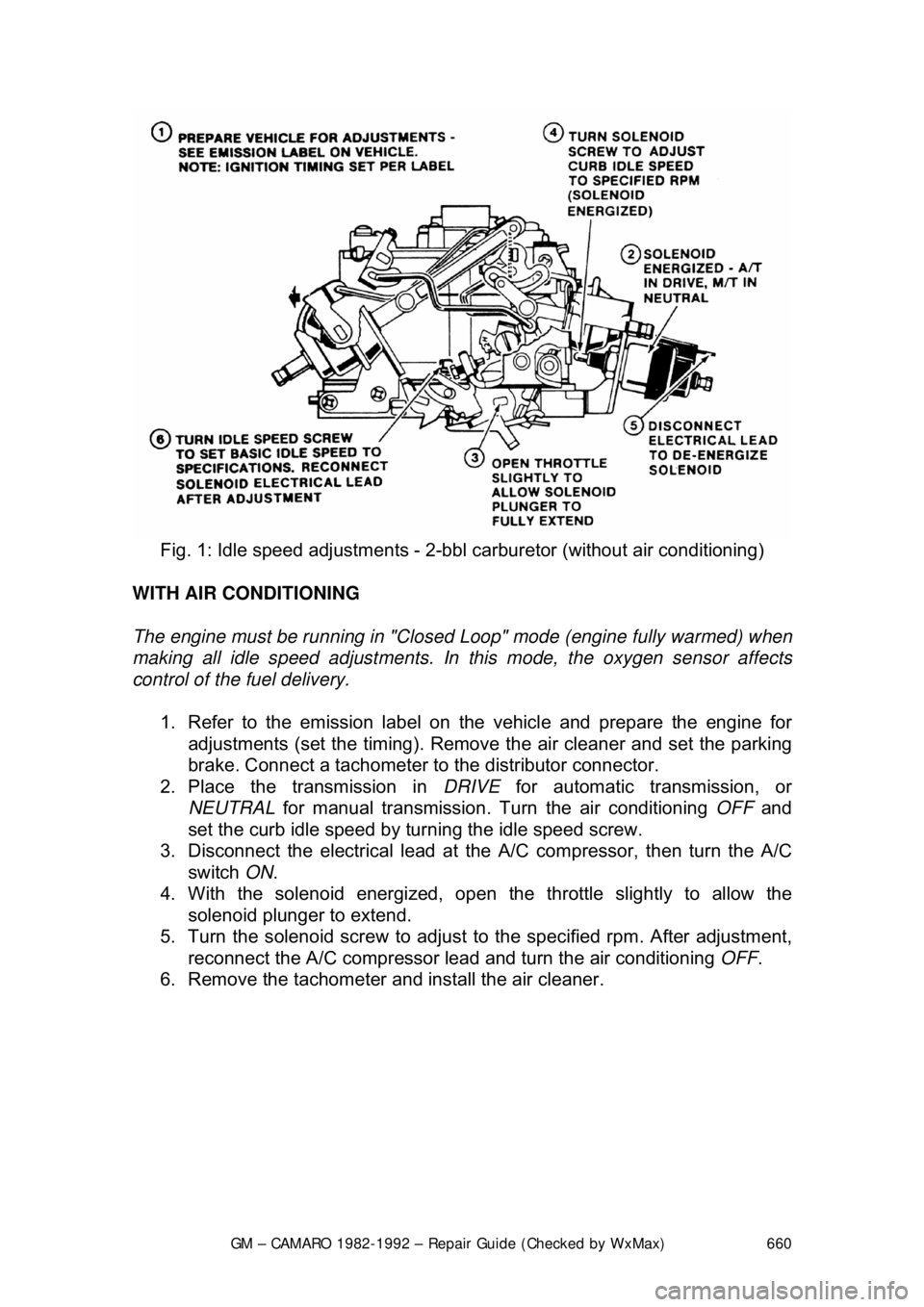
2-BBL CARBURETOR
WITHOUT AIR CONDITIONING
The engine must be running in "Closed Loop" mode (engine fully warmed) when
making all idle speed adjustments. In this mode, the oxygen sensor affects
control of the fuel delivery.
1. Refer to the emission label on the vehicle and prepare the engine for
adjustments (set the timing). Remove the air cleaner and set the parking
brake. Connect a tachometer to the distributor connector.
2. Place the transmission in DRIVE for automatic transmission, or
NEUTRAL for manual transmission; make sure that the solenoid is
energized.
3. Open the throttle slightly to allow the solenoid plunger to extend. Adjust
the curb idle speed to the specified rpm by turning the solenoid screw.
4. De-energize the solenoid by disconnecting the electrical lead.
5. Set the basic idle speed rpm by turning the idle speed screw. After
adjustment, reconnect the solenoid electrical lead.
6. Remove the tachometer and install the air cleaner.
Page 660 of 875
GM – CAMARO 1982-1992 – Repair Guide (Checked by WxMax) 660
Fig. 1: Idle speed adjustm ents - 2-bbl carburetor (without air conditioning)
WITH AIR CONDITIONING
The engine must be running in "Closed Loop" mode (engine fully warmed) when
making all idle speed adjustments. In this mode, the oxygen sensor affects
control of the fuel delivery.
1. Refer to the emission label on the vehicle and prepare the engine for
adjustments (set the timing). Remove the air cleaner and set the parking
brake. Connect a tachometer to the distributor connector.
2. Place the transmission in DRIVE for automatic transmission, or
NEUTRAL for manual transmission. Tu rn the air conditioning OFF and
set the curb idle speed by turning the idle speed screw.
3. Disconnect the electrical lead at the A/C compressor, then turn the A/C
switch ON.
4. With the solenoid e nergized, open the throttle slightly to allow the
solenoid plunger to extend.
5. Turn the solenoid screw to adjust to the specified rpm. After adjustment,
reconnect the A/C compressor lead and turn the air conditioning OFF.
6. Remove the tachometer and install the air cleaner.