cruise control CHEVROLET CAMARO 1982 Repair Guide
[x] Cancel search | Manufacturer: CHEVROLET, Model Year: 1982, Model line: CAMARO, Model: CHEVROLET CAMARO 1982Pages: 875, PDF Size: 88.64 MB
Page 381 of 875

GM – CAMARO 1982-1992 – Repair Guide (Checked by WxMax) 381
It is not necessary to remove the radi
ator hose from the thermostat housing.
4. Remove the two retaining bolts from the thermostat housing and remove
the thermostat.
To install: 5. Using a new gasket, install the thermostat and housing.
6. Tighten the bolts to 21 ft lbs. (28 Nm).
7. Fill and bleed t he cooling system.
INTAKE MANIFOLD
REMOVAL & INSTALLATION
When servicing all vehicles, be absolutel y sure to mark vacuum hoses and
wiring so that these items may be properly reconnected during installation. Also,
when disconnecting fitting lines (fuel lines, power brake vacuum lines,
transmission and engine cooler lines, etc.), always use two flare nut (or line)
wrenches. Hold the wrench on the large fitti ng with pressure on the wrench as if
you were tightening the fitting (clockw ise), THEN loosen and disconnect the
smaller fitting from the larger fitting. If this is not done, damage to the line will
result. Always relieve fuel system pressure before disconnecting lines.
CAUTION - When draining the coolant, keep in mind that cats and dogs are
attracted by the ethylene gl ycol antifreeze, and are quite likely to drink any that
is left in an uncovered container or in puddles on the ground. This will prove
fatal in sufficient quantity. Always drai n the coolant into a sealable container.
Coolant should be reused unless it is contaminated or several years old.
2.5L ENGINE
Fig. 1: Intake manifold bol t torque sequence for 2.5L engine
1. Disconnect the negative batte ry cable at the battery.
2. Remove the air cleaner assembly.
3. Remove the PCV valve and hose.
4. Drain the cooling system.
5. Disconnect the fuel lines from the Throttle Body Injection (TBI) unit.
6. Mark and disconnect the vacuum li nes and the electrical connections
from the TBI unit.
7. Disconnect the linkage from the TBI unit (throttle, downshift, and/or
cruise control, as applicable).
8. Disconnect the coolant inlet and outlet hoses from the intake manifold.
9. Remove the air conditioning co mpressor support brackets and the
compressor. DO NOT disconnect the refrigerant lines from the
compressor. Lay the compressor aside.
10. Remove the manifold attachi ng bolts and remove the manifold.
To install:
Page 382 of 875
GM – CAMARO 1982-1992 – Repair Guide (Checked by WxMax) 382
11. Position the manifold into place and install manifold attaching bolts.
Torque manifold bolts to specificat ion (see illustration for tightening
sequence and torque specifications).
12. Install the air conditioning comp ressor and compressor support brackets,
if so equipped.
13. Connect the coolant inlet and outlet hoses to the intake manifold.
14. Connect the linkage to the TBI unit (throttle, downshift, and/or cruise
control, as applicable).
15. Connect the vacuum lines and the elec trical connections to the TBI unit.
16. Connect the fuel lines to the Th rottle Body Injection (TBI) unit.
17. Install the PCV valve and hose.
18. Install the air cleaner assembly.
19. Connect the negative battery cable at the battery.
20. Fill the cooling system.
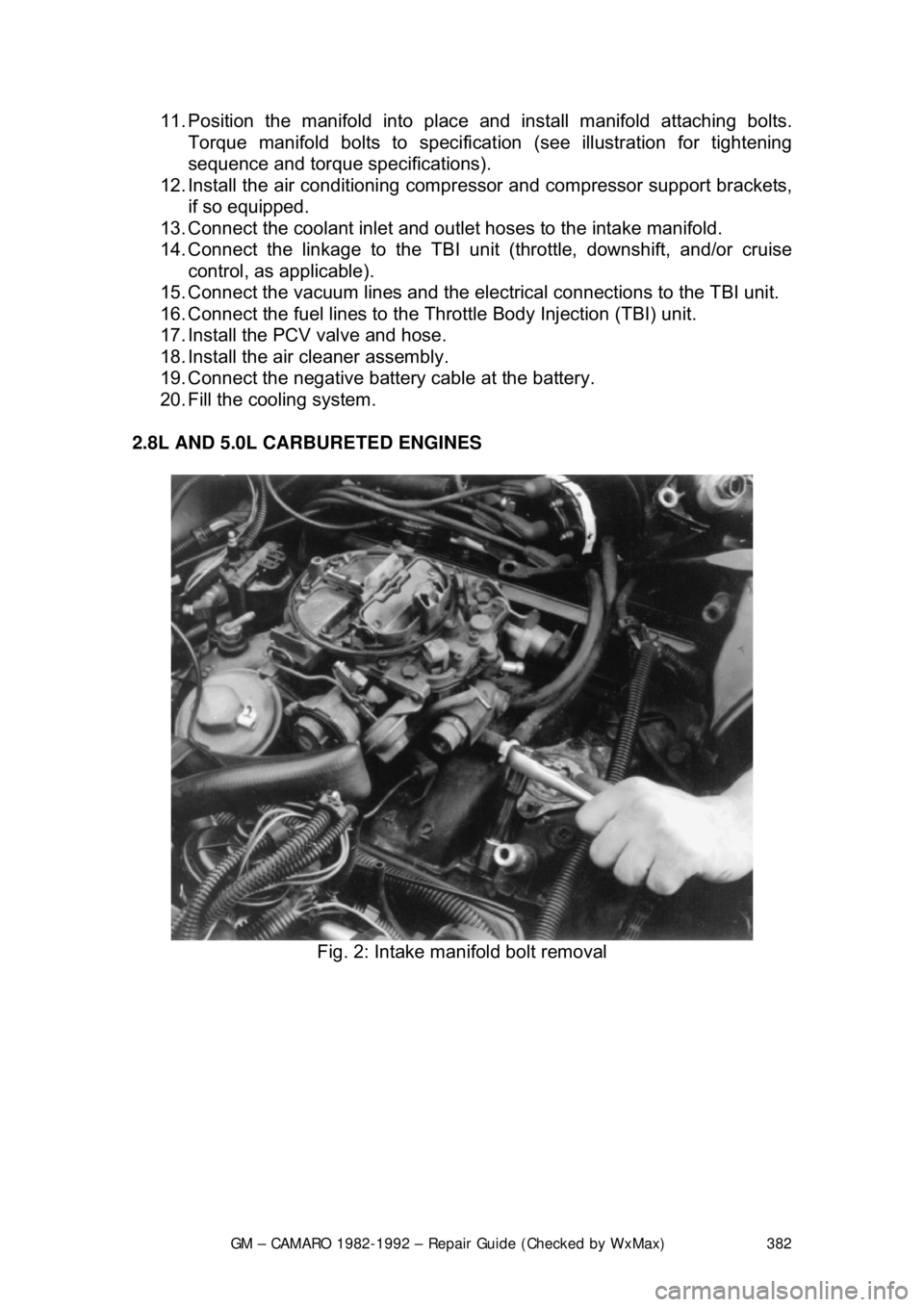
2.8L AND 5.0L CARBURETED ENGINES
Fig. 2: Intake manifold bolt removal
Page 388 of 875
GM – CAMARO 1982-1992 – Repair Guide (Checked by WxMax) 388
To install:
18. Clean the sealing surfaces.
19. Install the gaskets and apply a
3/16 in. (5mm) bead of RTV sealant on the
front and rear ridge of the cylinder case.
20. Hold the gaskets in place by ex tending the RTV bead up onto the gasket
ends. Use sealer at the water passages.
21. Position the intake manifold as sembly onto the engine and install the
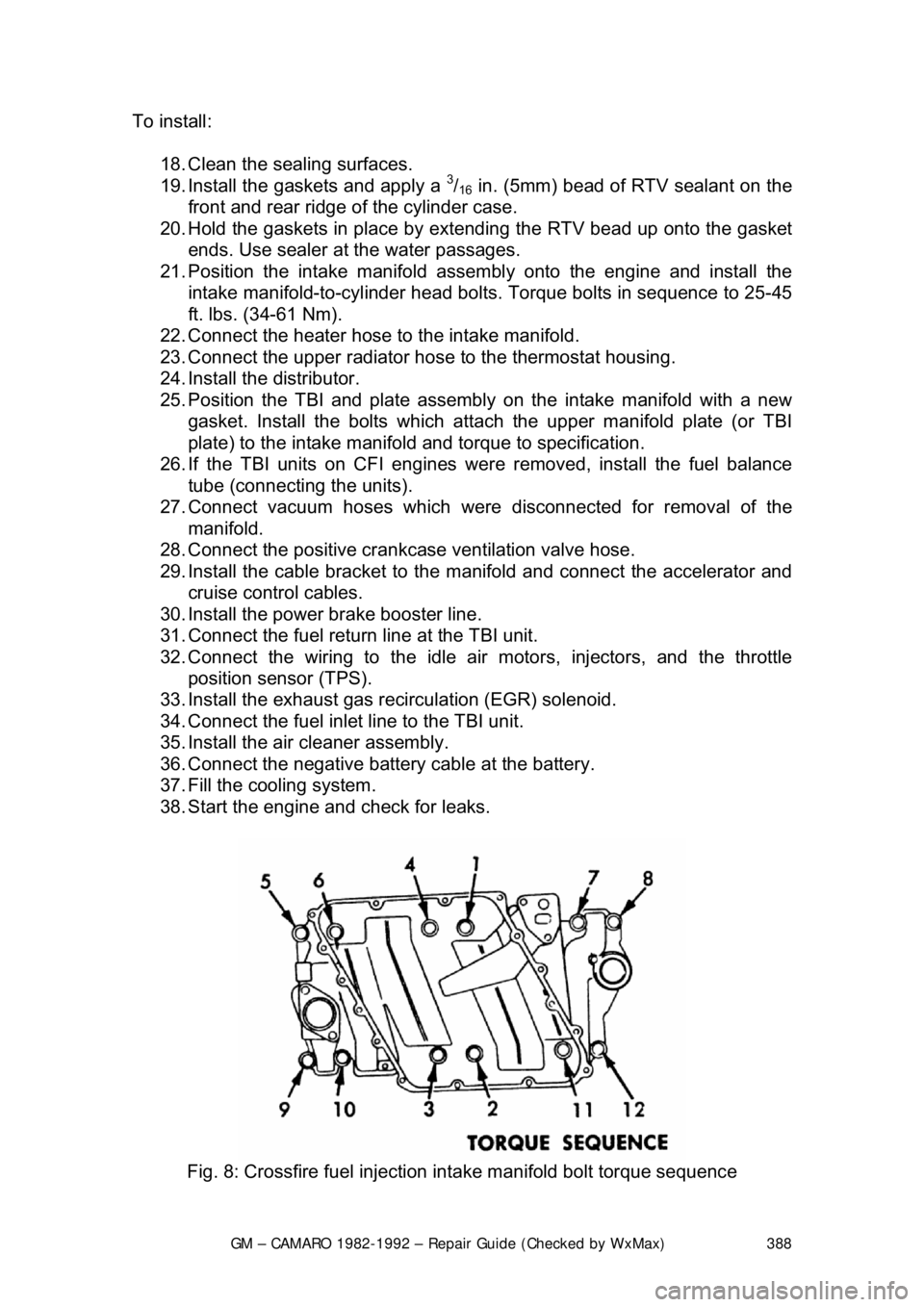
intake manifold-to-cylinder head bolts. Torque bolts in sequence to 25-45
ft. lbs. (34-61 Nm).
22. Connect the heater hose to the intake manifold.
23. Connect the upper radiator hose to the thermostat housing.
24. Install the distributor.
25. Position the TBI and plate assembly on the intake manifold with a new
gasket. Install the bolts which attach the upper manifold plate (or TBI
plate) to the intake manifold and torque to specification.
26. If the TBI units on CFI engines were removed, install the fuel balance
tube (connecting the units).
27. Connect vacuum hoses which were disconnected for removal of the manifold.
28. Connect the positive crankcase ventilation valve hose.
29. Install the cable bracket to the m anifold and connect the accelerator and
cruise control cables.
30. Install the power brake booster line.
31. Connect the fuel return line at the TBI unit.
32. Connect the wiring to the idle air motors, injectors, and the throttle
position sensor (TPS).
33. Install the exhaust gas re circulation (EGR) solenoid.
34. Connect the fuel inlet line to the TBI unit.
35. Install the air cleaner assembly.
36. Connect the negative battery cable at the battery.
37. Fill the cooling system.
38. Start the engine and check for leaks.
Fig. 8: Crossfire fuel injection intake manifold bolt torque sequence
Page 547 of 875

GM – CAMARO 1982-1992 – Repair Guide (Checked by WxMax) 547
EXHAUST GAS RECIRCULATION (EGR) SYSTEM
OPERATION
All models are equipped with
this system, which consists of a metering valve, a
vacuum line to the carburet or or intake manifold, and cast-in exhaust passages
in the intake manifold. The EGR valve is controlled by vacuum, which opens
and closes in response to the vacuum signals to admit exhaust gases into the
air/fuel mixture. The exhaust gases lower peak combustion temperatures,
reducing the formation of NOx. The valve is closed at idle and wide open
throttle, but is open between the two extreme positions.
There are actually four types of EGR systems: Ported, Positive Back-Pressure,
Negative Backpressure and Digital. The pr inciple of all the systems are the
same; the only difference is in the me thod used to control how the EGR valve
opens.
Too much EGR flow at idle, cruise or during cold operation may result in the
engine stalling after cold start, the engine stalling at idle after deceleration,
vehicle surge during cruise and rough idle . If the EGR valve is always open, the
vehicle may not idle. Too little or no EGR flow allows combustion temperatures
to rise, which could result in spar k knock (detonation), engine overheating
and/or emission test failure.
A Thermal Vacuum Switch (TVS) or vacuum control solenoid may sometimes\
be used in combination with the EGR va lve. The TVS will close off vacuum
during cold operation. A va cuum control solenoid uses Pulse Width Modulation
(PWM) to turn the solenoid ON and OFF numerous times a second and varies
the amount of ON time (pulse width) to vary the amount of ported vacuum
supplied the EGR valve.
PORTED VALVE
In the ported system, the amount of ex haust gas admitted into the intake
manifold depends on a ported vacuum signal. A ported vacuum signal is one
taken from the carburetor above the th rottle plates; thus, the vacuum signal
(amount of vacuum) is dependent on how far the throttle plates are opened.
When the throttle is closed (idle or dec eleration) there is no vacuum signal.
Thus, the EGR valve is closed, and no exhaust gas enters the intake mani\
fold.
As the throttle is opened, a vacuum is produced, which opens the EGR valve,
admitting exhaust gas into the intake manifold.
POSITIVE BACKPRE SSURE VALVE
This valve operates the same as the ported, except, it has an internal air bleed
that acts as a vacuum regulator. T he bleed valve controls the amount of
vacuum inside the vacuum chamber duri ng operation. When the valve receives
sufficient exhaust backpressure through the hollow shaft, it closes the bleed; at
this point the EGR valve opens.
Page 707 of 875
GM – CAMARO 1982-1992 – Repair Guide (Checked by WxMax) 707
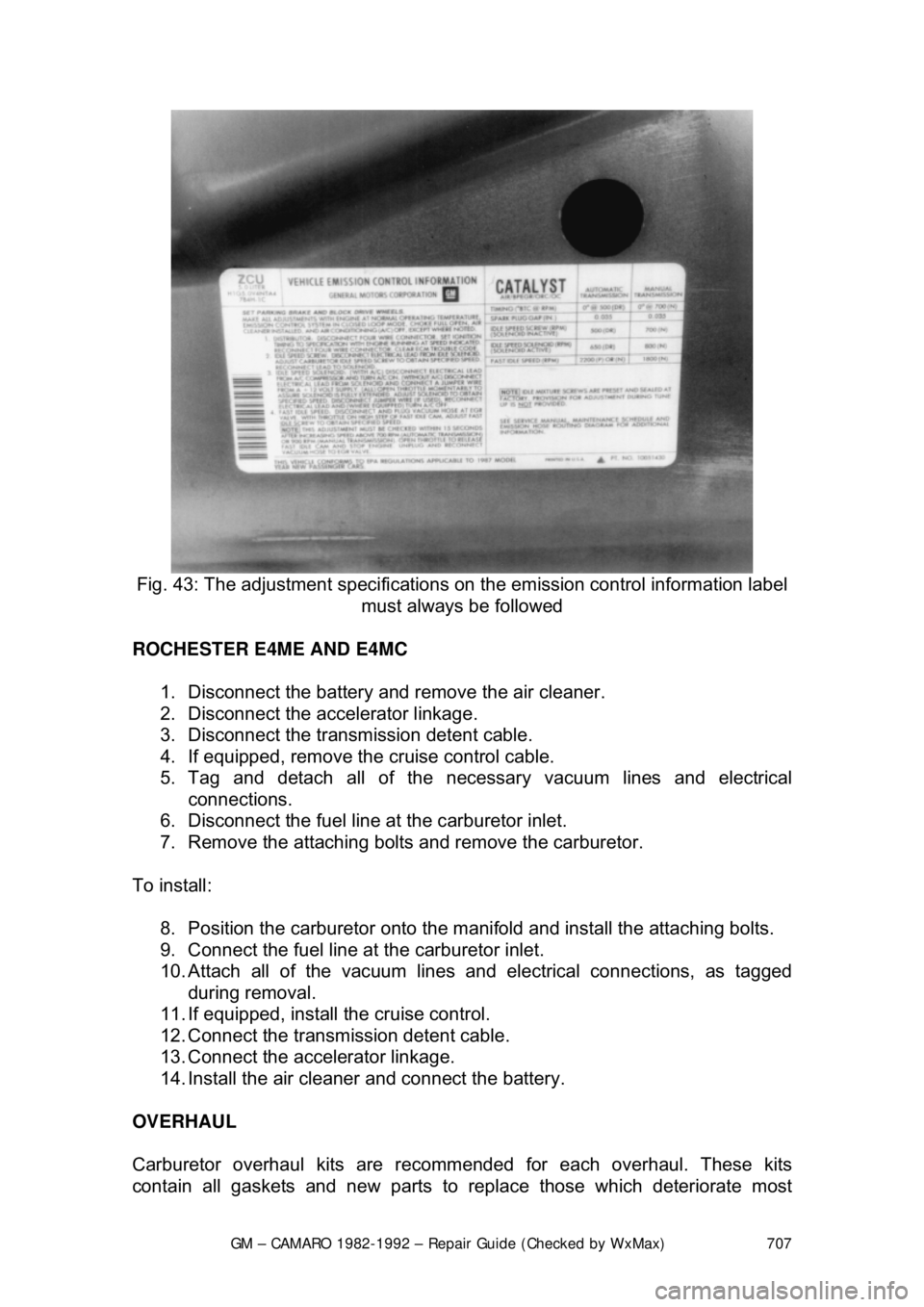
Fig. 43: The adjustment specifications on the emission control information label
must always be followed
ROCHESTER E4ME AND E4MC 1. Disconnect the battery and remove the air cleaner.
2. Disconnect the accelerator linkage.
3. Disconnect the transmission detent cable.
4. If equipped, remove the cr uise control cable.
5. Tag and detach all of the necessa ry vacuum lines and electrical
connections.
6. Disconnect the fuel line at the carburetor inlet.
7. Remove the attaching bolts and remove the carburetor.
To install: 8. Position the carburetor onto the manifold and install the attaching bolts.
9. Connect the fuel line at the carburetor inlet.
10. Attach all of the vacuum lines and electrical connections, as tagged
during removal.
11. If equipped, install the cruise control.
12. Connect the transmission detent cable.
13. Connect the accelerator linkage.
14. Install the air cleaner and connect the battery.
OVERHAUL
Carburetor overhaul kits are reco mmended for each overhaul. These kits
contain all gaskets and new parts to re place those which deteriorate most
Page 714 of 875
GM – CAMARO 1982-1992 – Repair Guide (Checked by WxMax) 714
4. Start the car and observe the fuel
pressure reading. It should be 9-13 psi
(62-90 kPa).
5. Relieve the fuel pressure.
6. Remove the fuel pressure gauge.
7. Reinstall the fuel line.
8. Start the car and che ck for fuel leaks.
9. Remove plug covering THERMAC va cuum port on the TBI and install the
air cleaner.
THROTTLE BODY
REMOVAL & INSTALLATION 1. Relieve the fuel system pressure.
2. Disconnect the THERMAC hose from the engine fitting and remove the
air cleaner.
3. Detach the electrical connectors at the idle air control, throttle position
sensor, and the injector.
4. Disconnect the throttle linkage, re turn spring, and cruise control (if
equipped).
5. Disconnect the throttle body vacuum hoses, fuel supply and fuel return
lines.
6. Disconnect the 3 bolts securing the throttle body and remove the throttle
body.
7. To install, reverse the removal procedures. Replace the manifold gasket
and O-rings.
8. Perform the minimum idle speed adjustment, if necessary.
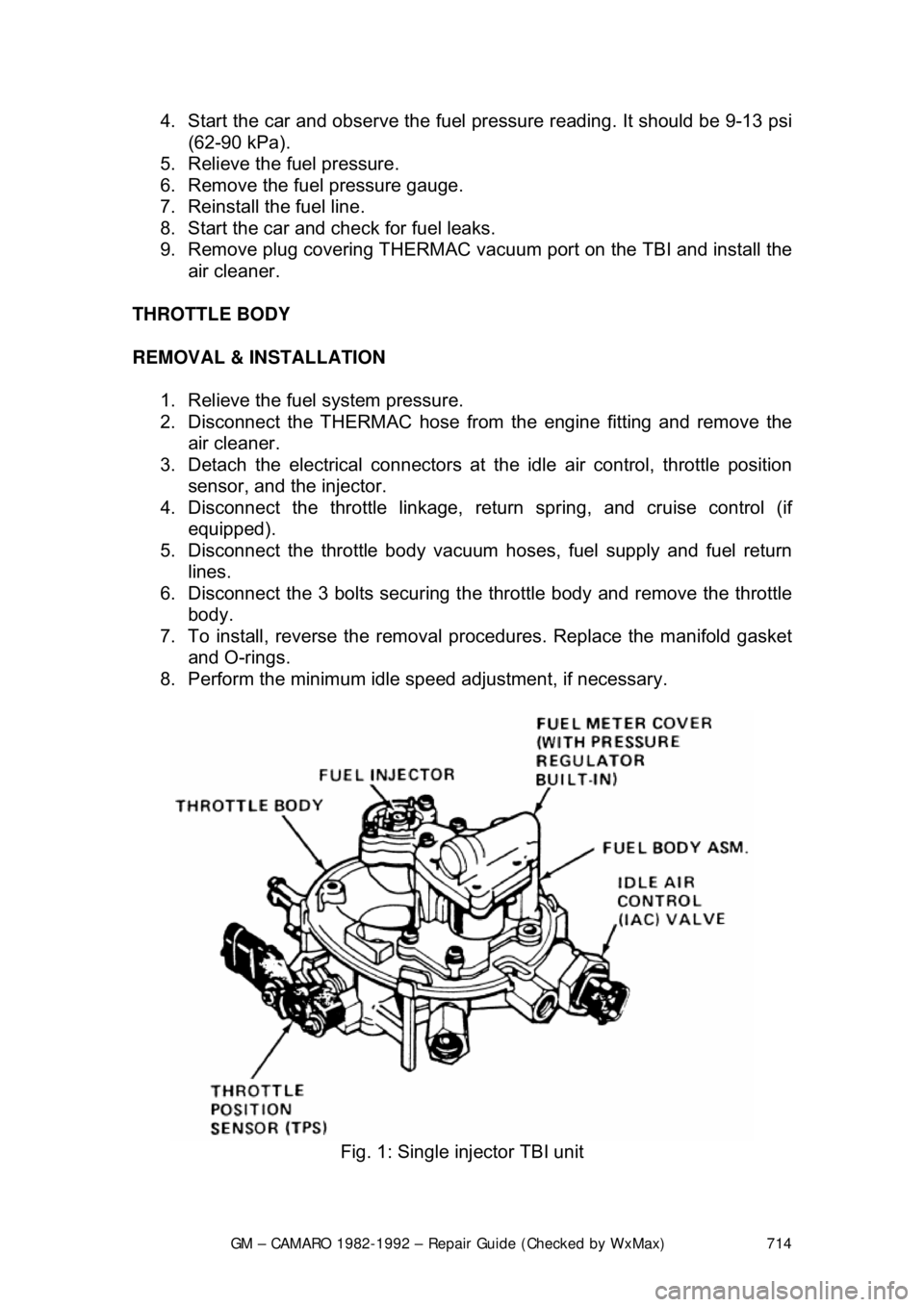
Fig. 1: Single injector TBI unit
Page 728 of 875

GM – CAMARO 1982-1992 – Repair Guide (Checked by WxMax) 728
5. Disconnect the throttle and cruise c
ontrol (if so equipped) cables at the
TBI unit.
6. Disconnect the fuel return and bal ance line connections from the rear TBI
unit.
7. Remove and discard the throttle cont rol rod retaining clip from the front
TBI unit throttle lever stud. A new clip must be used during reassembly.\
One throttle rod end bearing is permanently attached to the throttle lever stud of
the rear TBI unit, and must not be remov ed from it. If the throttle rod and
bearing assembly needs replacement, Th e entire rear throttle body must be
replaced.
8. Unbolt and remove the TBI unit.
To install: 9. Replacement of the manifold cover or either throttle body requires throttle
valve synchronizing and checking of the throttle rod alignment (see
"Preliminary Adjustments"). Before installing the replacement throttle
body unit(s) on the engine, perform the following steps:
a. If the tamper resistant plugs co vering the throttle stop screws are
in place, remove the plugs.
b. If the front TBI unit throttle syn chronizing screw has a welded
retaining collar, grind off the weld.
c. Block possible movement of the throttle lever, relieving the force
of the heavy spring against the throttle synchronizing screw. This
prevents the levers from coming into contact.
If the lever is not blocked before the thro ttle synchronizing screw is removed,
the screw may be damaged, and reinstallation will be accomplished only with
great difficulty.
d. Remove the synchronizing screw and collar. Discard the collar and reinstall the screw. The blocking from the throttle lever (installed in the
previous step) can now be removed.
CAUTION - The collar must be removed to prevent possible interference with
the air cleaner. Failure to do so c ould result in personal injury.
10. Use new gaskets and tighten the TB I bolts to 120-168 inch lbs. (13-19
Nm) during installation.
11. Perform the preliminary adjustm ents. These procedures must be
followed before further assembly.
12. Reconnect the fuel lines to the TBI units. Use a backup wrench to
prevent the nuts from tu rning in the TBI unit.
13. Reconnect the throttle cable and the cruise control cable.
14. Reconnect all related vacuum lines.
15. Reconnect the electrical connectors.
16. With the engine OFF, depress t he accelerator pedal to the floor and
release. Check for free return of the pedal.
Page 739 of 875

GM – CAMARO 1982-1992 – Repair Guide (Checked by WxMax) 739
3. Make sure the ignition switch has
been in the OFF position for at least 10
seconds and that all accessories are OFF.
4. Turn the ignition switch ON and the pump will run for about 2 seconds.
Note the system pressure with t he pump running, it should be between
40-47 psi.
The ignition switch may have to be cycled to the ON position more than once to
obtain maximum pressure. It is also norma l for the pressure to drop slightly
when the pump first stops, but it should then hold steady.
5. If the pressure is not as specified, verify that fuel pump operation is
heard in the tank.
6. If fuel pump operation is not heard, inspect the fuel pump relay and
wiring.
7. If fuel pump operation is heard, inspect the filter and lines for restriction.
8. Start the engine and make sure the pr essure decreases about 3-10 psi at
idle.
9. If fuel pressure does not decrease, inspect the fuel pressure regulator
and hose.
10. Disconnect the fuel pressure gauge.
THROTTLE BODY
REMOVAL & INSTALLATION 1. Disconnect the negative (-) battery c able and partially drain the radiator.
2. Remove the air inlet duct and unplug the IAC and TPS electrical connectors.
3. Label and disconnect the vacuum and coolant lines.
4. Disconnect the accelerator, thro ttle valve (transmission control) and
cruise control cables, as applicable.
5. Remove the throttle body attaching bolts, then separate the throttle body from the plenum.
6. Discard the gasket.
To install: 7. Install the throttle body to the plenum using a new gasket. Tighten the \
bolts to specification.
8. Engage the accelerator, throttle valve and cruise control cables, as
necessary. Make sure that the link ages do not hold the throttle open.
9. Connect the vacuum and coolant lines.
10. Install the air inlet duct and plug the IAC and TPS electrical connectors
into their sockets.
11. Connect the negative (-) battery cable and refill the radiator.
12. With the engine OFF, check to s ee that the accelerator pedal is free.
Depress the pedal to the floor and release.