lights CHEVROLET CAMARO 1982 Repair Guide
[x] Cancel search | Manufacturer: CHEVROLET, Model Year: 1982, Model line: CAMARO, Model: CHEVROLET CAMARO 1982Pages: 875, PDF Size: 88.64 MB
Page 209 of 875
GM – CAMARO 1982-1992 – Repair Guide (Checked by WxMax) 209
SIGNAL AND MARKER LIGHTS
REMOVAL & INSTALLATION
FRONT PARKING AND TURN SIGNAL
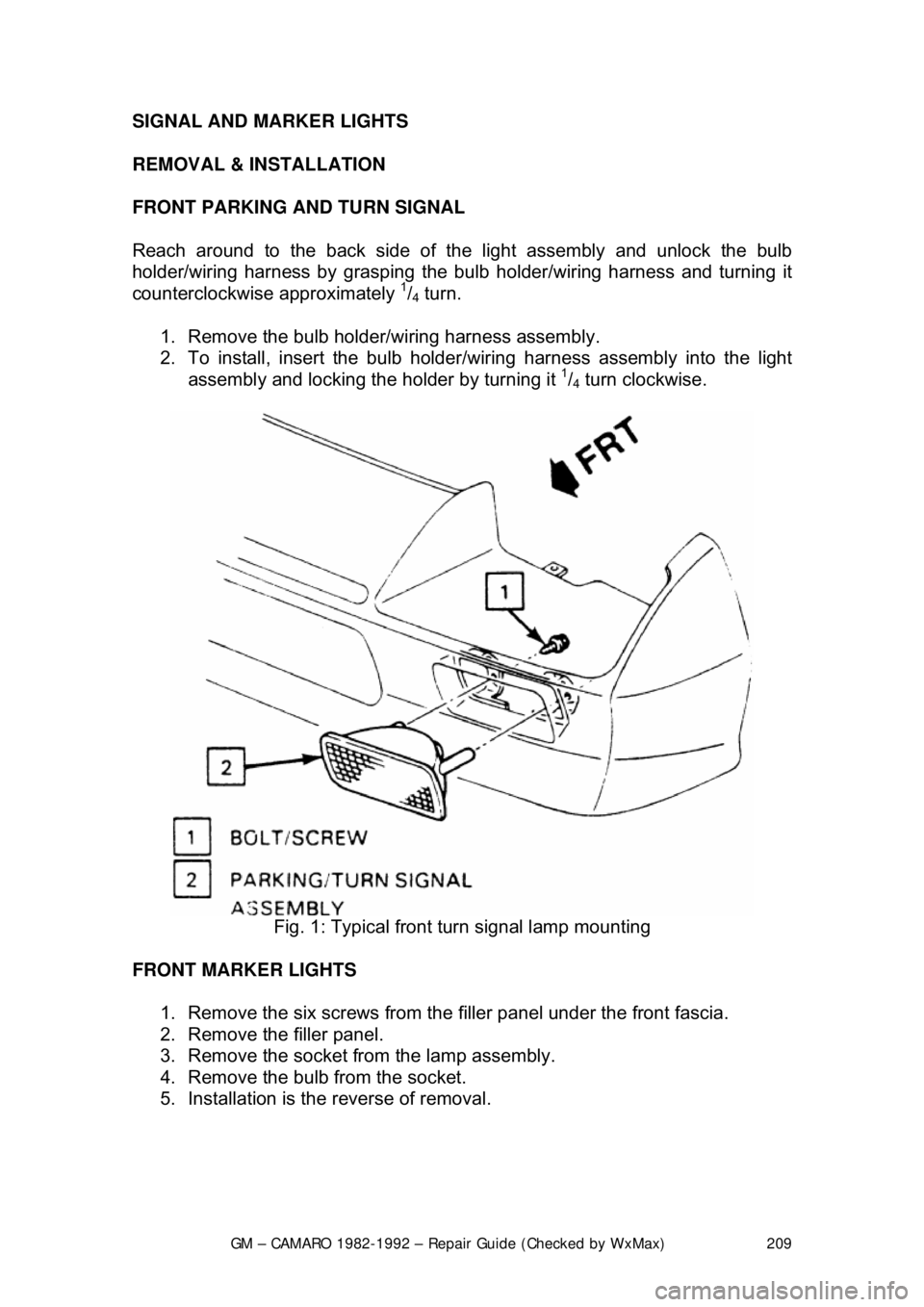
Reach around to the back side of t
he light assembly and unlock the bulb
holder/wiring harness by grasping the bul b holder/wiring harness and turning it
counterclockwise approximately
1/4 turn.
1. Remove the bulb holder/wiring harness assembly.
2. To install, insert the bulb holder /wiring harness assembly into the light
assembly and locking the holder by turning it
1/4 turn clockwise.
Fig. 1: Typical front turn signal lamp mounting
FRONT MARKER LIGHTS 1. Remove the six screws from the filler panel under the front fascia.
2. Remove the filler panel.
3. Remove the socket from the lamp assembly.
4. Remove the bulb from the socket.
5. Installation is the reverse of removal.
Page 211 of 875
GM – CAMARO 1982-1992 – Repair Guide (Checked by WxMax) 211
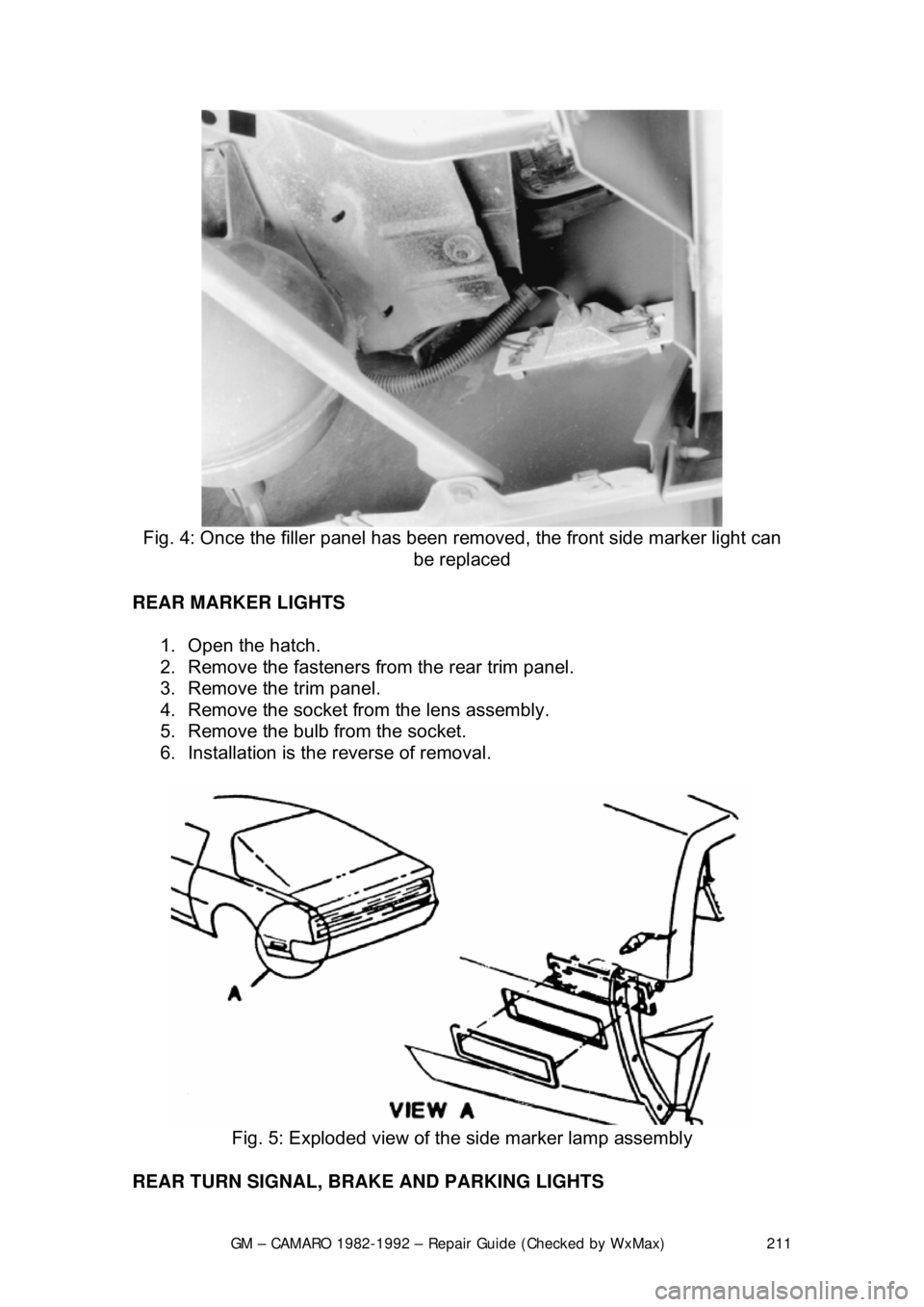
Fig. 4: Once the filler panel has been remo ved, the front side marker light can
be replaced
REAR MARKER LIGHTS 1. Open the hatch.
2. Remove the fasteners from the rear trim panel.
3. Remove the trim panel.
4. Remove the socket from the lens assembly.
5. Remove the bulb from the socket.
6. Installation is the reverse of removal.
Fig. 5: Exploded view of the side marker lamp assembly
REAR TURN SIGNAL, BRAKE AND PARKING LIGHTS
Page 216 of 875
GM – CAMARO 1982-1992 – Repair Guide (Checked by WxMax) 216
PASSENGER AREA LAMPS
The passenger area courtesy lamps can
be replaced by first removing the
appropriate trim panel, then removing the bulb from the socket. Most panels are
fastened by screws or snap-fasteners. Be careful not to force the trim panel off,
as you may damage it. Do not pry with tools which may damage the panel, use
tools designed for panel removal only.
LICENSE PLATE LIGHTS
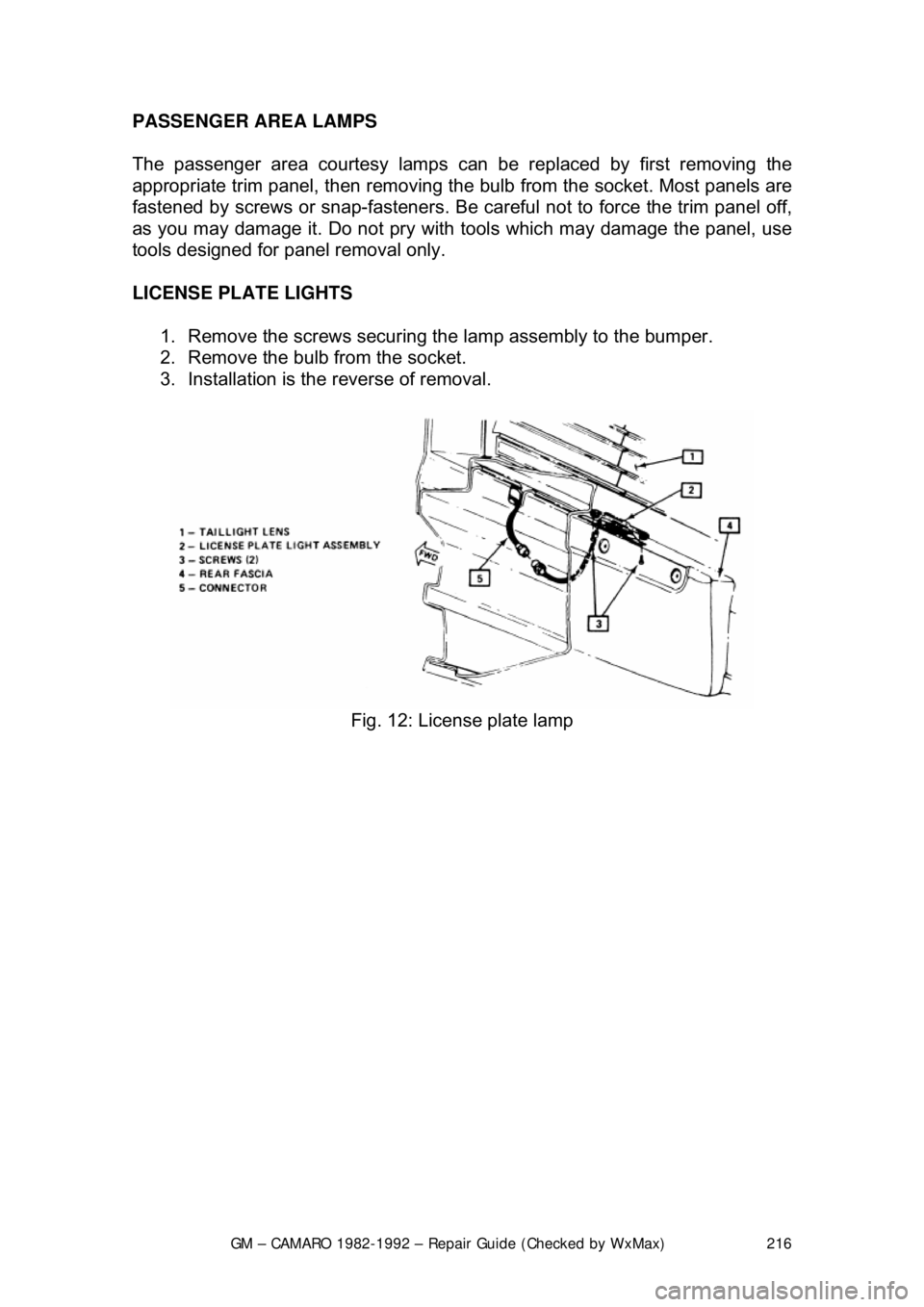
1. Remove the screws securing the lamp assembly to the bumper.
2. Remove the bulb from the socket.
3. Installation is the reverse of removal.
Fig. 12: License plate lamp
Page 217 of 875
GM – CAMARO 1982-1992 – Repair Guide (Checked by WxMax) 217
FOG LIGHTS
REMOVAL & INSTALLATION
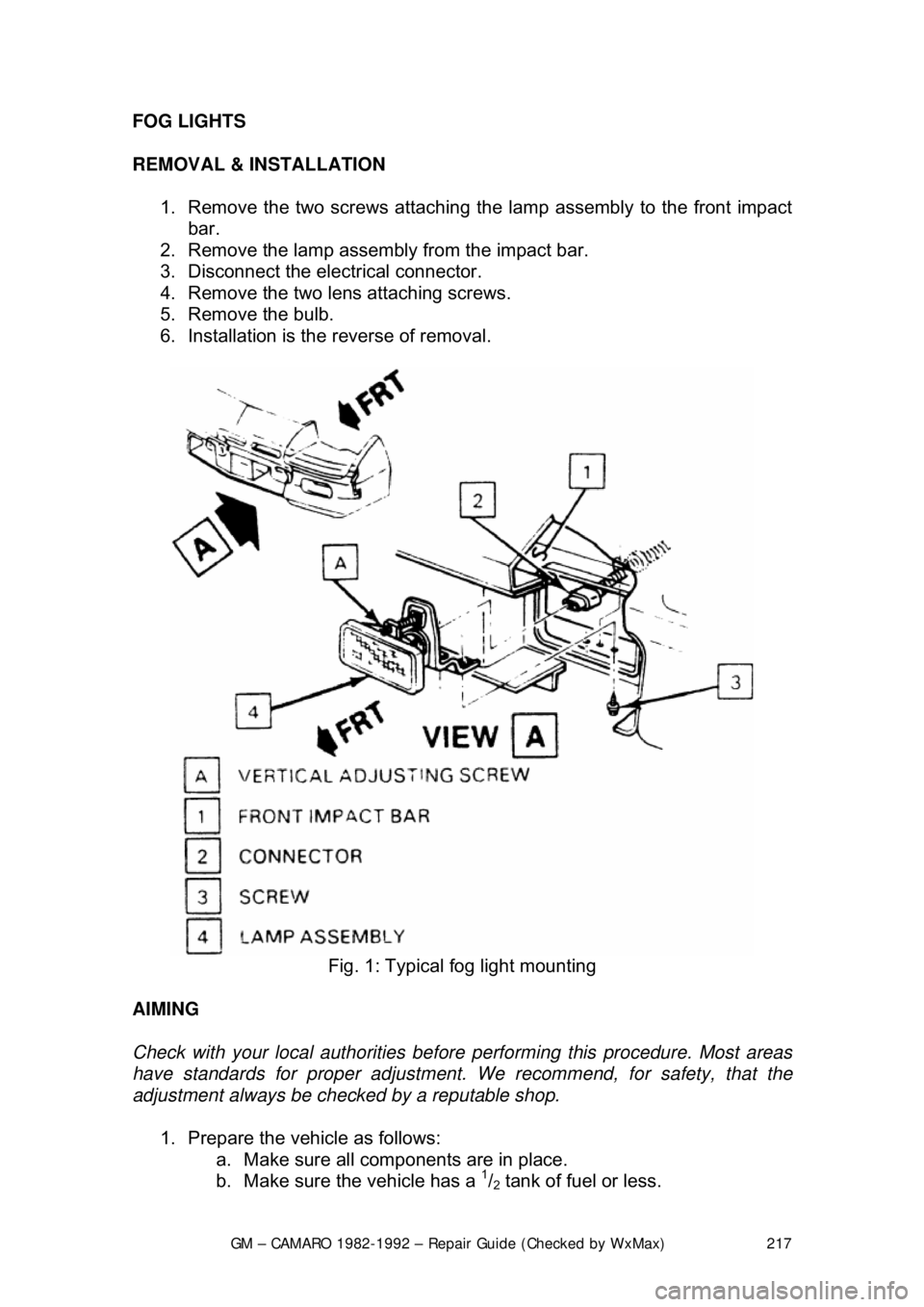
1. Remove the two screws attaching the lamp assembly to the front impact
bar.
2. Remove the lamp assembly from the impact bar.
3. Disconnect the electrical connector.
4. Remove the two lens attaching screws.
5. Remove the bulb.
6. Installation is the reverse of removal.
Fig. 1: Typical fog light mounting
AIMING
Check with your local authorities before performing this procedure. Most areas
have standards for proper adjustment. We recommend, for safety, that the
adjustment always be checked by a reputable shop.
1. Prepare the vehicle as follows: a. Make sure all com ponents are in place.
b. Make sure the vehicle has a
1/2 tank of fuel or less.
Page 291 of 875

GM – CAMARO 1982-1992 – Repair Guide (Checked by WxMax) 291
6. Remove the console cover.
7. Remove the shifter boot.
8. Remove the shifter mounting bolt
s and remove the shifter assembly.
9. Installation is the reverse of the removal procedure. Adjust the linkage as
detailed earlier.
BACK-UP LIGHT SWITCH
REMOVAL & INSTALLATION 1. Disconnect the negative battery terminal from the battery.
2. At the left-rear of the transmission, the back-up light switch is threaded
into the transmission case. The speed sensor is held in with a separate
bracket. Disconnect the electrical co nnector from the back-up light
switch.
3. Remove the back-up light swit ch from the transmission.
4. To install, reverse the remova l procedures. Coat the threads with
Teflon® tape. Please refer to the to rque chart for specifications. Place
the gear shift lever in the revers e position and check that the back-up
lights work.
EXTENSION HOUSING SEAL
REMOVAL & INSTALLATION
This seal controls transmission oil leakage around the driveshaft. Continued
failure of this seal usually indicates a worn output shaft bushing. If so, there will
be signs of the same wear on the driveshaft where it contacts the seal and
bushing. The seal is available and is fairly simple to install, with the proper tool.
1. Raise and safely support the rear of the vehicle to minimize transmission
oil loss when the driveshaft is removed.
2. Unbolt the driveshaft fr om the differential and center support bearing, if
equipped. Wrap tape around the bearing cu ps to keep them in place on
the universal joint and slide the sh aft out of the transmission.
3. Use an small pry tool to carefully pry out the old seal. Be careful not to
insert the tool too far into the hous ing or the bushing will be damaged.
Page 639 of 875

GM – CAMARO 1982-1992 – Repair Guide (Checked by WxMax) 639
In the HEI system, as in other electr
onic ignition systems, the breaker points
have been replaced wit h an electronic switch - a tr ansistor - which is located
within the ignition module. This switching transistor pe rforms the same function
the points did in a conventi onal ignition system; it simply turns the coil's primary
current on and off at the correct time. Essentially, electronic and conventional
ignition systems operate on t he same principle.
The module which houses the switching transistor is controlled (turned on and
off) by a magnetically gener ated impulse induced in the pickup coil. When the
teeth of the rotating timer align with t he teeth of the pole piece, the induced
voltage in the pickup coil signals the elec tronic module to open the coil primary
circuit. The primary current then decreases, and a high voltage is induced in the
ignition coil secondary windings, which is then directed through the rotor and
high voltage leads (spark plug wires) to fire the spark plugs.
In essence, the pickup coil module system simply replaces the conventional
breaker points and condenser. The condenser found within the distributor is for
radio suppression purposes only and has nothing to do with the ignition
process. The ignition module automatically controls the dwell period, increasing
it with increasing en gine speed. Since dwell is co ntrolled in this manner, it
cannot be adjusted. The module itse lf is non-adjustable/non-repairable and
must be replaced if found defective.
SYSTEM PRECAUTIONS
Before proceeding with troubleshooting, ta ke note of the following precautions:
TIMING LIGHT USE
Care should be exercised when connec ting a timing light or other pick-up
equipment. Do not force anything between the boots and wiring, or through the
silicone jacket. Connections should be made in parallel using an adapter.
Inductive pickup timing lights are the bes t kind to use with the ignition systems
covered by this information.
SPARK PLUG WIRES
The plug wires used with these systems are of a different construction than
conventional wires. When replacing them, make sure you get the correct wires,
since conventional wires will not carry the voltage. Also, handle the wires
carefully to avoid cracking or splitti ng them, and NEVER pierce the wires.
TACHOMETER USE
Not all tachometers will operate or indi cate correctly when used on an HEI or
C
3I system. While some tachometers ma y give a reading, this does not
necessarily mean the reading is correct. In addition, some tachometers hook up
differently from others. If you cannot fi gure out whether or not your tachometer
will work on your car, check with the tachometer manufacturer.
Page 654 of 875

GM – CAMARO 1982-1992 – Repair Guide (Checked by WxMax) 654
spark plug must fire 5° before each pist
on reaches TDC. This only holds true,
however, when the engine is at idle speed.
As the engine speed increases, the pist ons go faster. The spark plugs have to
ignite the fuel even sooner if it is to be completely ignited when the piston
reaches TDC.
If the ignition is set too far advanced (B TDC), the ignition and expansion of the
fuel in the cylinder will occu r too soon and try to force the piston down while it is
still traveling up. This causes engine ping. If the ignition spark is set too far
retarded, after TDC (ATDC), the pi ston will have already passed TDC and
started on its way down when the fuel is igni ted. This will cause the piston to be
forced down for only a portion of its trav el, resulting in poor engine performance
and lack of power.
When timing the engine, the Number 1 pl ug wire should be used to trigger the
timing light. On engines where timing is adjustable, the notch for the No. 1
cylinder is usually scribed across all th ree edges of the double sheaf pulley.
Another notch located 180° away from t he No. 1 cylinder notch is scribed only
across the center section of the pulley to make it distinguishable from the No. 1
cylinder notch.
There are two basic types of timing light s available. The first type of light
operates from the car's battery. Two al ligator clips connect to the battery
terminals, while a third wire connects to the spark plug with an adapter or to the
spark plug wire with an inductive pickup. This type of light is more expensive,
but the xenon bulb provides a nice bright flash which can even be seen in
sunlight. The second type replaces the battery source with 110-volt house
current. Some timing lights have other func tions built into them, such as dwell
meters, tachometers, or re mote starting switches. These are convenient, in that
they reduce the tangle of wires under t he hood, but may duplicate the functions
of tools you already have.
Because this car uses electronic ignition, you should use a timing light with an
inductive pickup. This pickup simply cl amps around the Number 1 spark plug
wire (in this case, the coil wire), elimin ating the adapter. It is not susceptible to
crossfiring or false triggering, which ma y occur with a conventional light due to
the greater voltages produc ed by these systems.
ADJUSTMENT
When adjusting the timing, refer to the instructions on the emission control
sticker inside the engine compartment. If th e instructions on the label disagree
with the procedure listed below, follo w the instructions on the label.
1982-87 VEHICLES 1. Locate the timing marks on the cran kshaft pulley and the front of the
engine.
Page 811 of 875

GM – CAMARO 1982-1992 – Repair Guide (Checked by WxMax) 811
CAUTION
- NEVER hook the batteries up in a series circuit or the entire
electrical system will go up in smoke, including the starter!
Vehicles equipped with a diesel engine may utilize two 12 volt batteries. If so,
the batteries are connected in a parallel circuit (positive terminal to positive
terminal, negative terminal to negative te rminal). Hooking the batteries up in
parallel circuit increases battery cranki ng power without increasing total battery
voltage output. Output remains at 12 vo lts. On the other hand, hooking two 12
volt batteries up in a series circuit (positive terminal to negative terminal,
positive terminal to negative terminal) incr eases total battery output to 24 volts
(12 volts plus 12 volts).
JUMP STARTING PRECAUTIONS
• Be sure that both batteries are of t he same voltage. Vehicles covered by
this information and most vehicles on the road today utilize a 12 volt
charging system.
• Be sure that both batteries are of the same polarity (have the same
terminal, in most cases NEGATIVE grounded).
• Be sure that the vehicles are not touching or a short could occur.
• On serviceable batteries, be sure the v ent cap holes are not obstructed.
• Do not smoke or allow sparks anywhere near the batteries.
• In cold weather, make sure the battery electrolyte is not frozen. This can
occur more readily in a battery that has been in a state of discharge.
• Do not allow electrolyte to c ontact your skin or clothing.
JUMP STARTING PROCEDURE 1. Make sure that the voltages of the 2 batteries are the same. Most
batteries and charging systems are of the 12 volt variety.
2. Pull the jumping vehicle (with t he good battery) into a position so the
jumper cables can reach the dead battery and that vehicle's engine.
Make sure that the ve hicles do NOT touch.
3. Place the transmissions of both vehicles in Neutral (MT) or P (AT), as
applicable, then firmly set their parking brakes.
If necessary for safety reasons, the hazard lights on both vehicles may be
operated throughout the entir e procedure without significantly increasing the
difficulty of jumping the dead battery.
4. Turn all lights and accessories OFF on both vehicles. Make sure the ignition switches on both vehicles are turned to the OFF position.
5. Cover the battery cell caps with a rag, but do not cover the terminals.
6. Make sure the terminals on both batte ries are clean and free of corrosion
or proper electrical connection wil l be impeded. If necessary, clean the
battery terminals before proceeding.
7. Identify the positive (+) and negat ive (-) terminals on both batteries.
8. Connect the first jumper cable to the positive (+) terminal of the dead
battery, then connect the other end of that cable to the positive (+)
terminal of the booster (good) battery.