power steering CHEVROLET CAMARO 1982 Repair Guide
[x] Cancel search | Manufacturer: CHEVROLET, Model Year: 1982, Model line: CAMARO, Model: CHEVROLET CAMARO 1982Pages: 875, PDF Size: 88.64 MB
Page 428 of 875

GM – CAMARO 1982-1992 – Repair Guide (Checked by WxMax) 428
1. Disconnect the battery ground c
able. Drain the cooling system.
2. Remove the fan shroud or the upper radiator support and drive belts.
Remove the fan and pulley from the water pump.
3. Remove the alternator upper and lower brackets, air brace with brackets,
and power steering lower bra cket (move it aside).
4. Remove the radiator lower hose and the heater hose from the water
pump. Remove the water pump bolts and the water pump.
5. If A/C equipped, remove the comp ressor and move aside. Remove the
compressor mounting bracket.
6. Remove the damper pulley retain ing bolt and the damper pulley.
7. Remove the timing gear cover bolts and the timing gear cover.
With the timing gear cover removed, use a large screwdriver to pry the oil seal
from the cover. To install the new oil se al, lubricate it with engine oil and drive it
into place.
To install: 8. Prepare the mating surfaces for reinst allation of the timing gear cover.
Coat the new gasket with RTV sealer.
9. Install the timing gear cover and timing gear cover bolts. Torque the
cover bolts to specifications:
• V6 engines (M8 x 1.25 bolts): 13-22 ft. lbs. (18-30 Nm)
• V6 engines (M10 x 1.5 bolts): 20-35 ft. lbs. (27-48 Nm)
• V8 engines (all bolts): 69-130 inch lbs. (8-14 Nm)
10. Install the damper pulley by pulli ng the damper onto the crankshaft. Use
tool J-23523 or equivalent. Install t he damper pulley retaining bolt and
torque bolts to 67-85 ft lbs. (90-110 Nm).
11. If A/C equipped, install the compressor mounting bracket and
compressor.
12. Install the water pump and the water pump bolts.
13. Install the radiator lower hose and the heater hose to the water pump.
14. Install the alternator upper and lower brackets, air brace with brackets
and the power steering lower bracket.
15. Install the fan and pull ey to the water pump. Inst all the fan shroud or the
upper radiator support and drive belts and adjust.
16. Connect the battery ground cable.
17. Fill the cooling syst em, start the engine and check for leaks.
Page 476 of 875

GM – CAMARO 1982-1992 – Repair Guide (Checked by WxMax) 476
Before attempting to repair a threaded
hole, remove any snapped, broken or
damaged bolts or studs. Penetrating oil ca n be used to free frozen threads. The
offending item can usually be removed with locking pliers or using a screw/stud
extractor. After the hole is clear, the thread can be repaired, as shown in the
series of accompanying illustrations and in the kit manufacturer's instructions.
ENGINE PREPARATION
To properly rebuild an engine, you must fi rst remove it from the vehicle, then
disassemble and diagnose it. Ideally you should place your engine on an engine
stand. This affords you the best access to the engine components. Follow the
manufacturer's directions for using the stand with your particular engine.
Remove the flywheel or fl explate before installing the engine to the stand.
Now that you have the engine on a stand, and assuming that you have drained
the oil and coolant from the engine, it's ti me to strip it of all but the necessary
components. Before you start disassembli ng the engine, you may want to take
a moment to draw some pictures, or fabr icate some labels or containers to mark
the locations of various components and the bolts and/or studs which fasten
them. Modern day engines use a lot of littl e brackets and clips which hold wiring
harnesses and such, and these holders are often mounted on studs and/or bolts
that can be easily mixed up. The manufacturer spent a lot of time and money
designing your vehicle, and they wouldn't have wasted any of it by haphazardly
placing brackets, clips or fasteners on t he vehicle. If it's present when you
disassemble it, put it back when you asse mble, you will regret not remembering
that little bracket which holds a wire har ness out of the path of a rotating part.
You should begin by unbolting any accessories still attached to the engine, such
as the water pump, power steering pump, alternator, etc. Then, unfasten any
manifolds (intake or exhaust) which were not removed during the engine
removal procedure. Finally, remove any covers remaining on the engine such
as the rocker arm, front or timing cove r and oil pan. Some front covers may
require the vibration dam per and/or crank pulley to be removed beforehand.
The idea is to reduce the engine to the bar e necessities (cylinder head(s), valve
train, engine block, crankshaft, pistons and connecting rods), plus any other 'in
block' components such as oil pumps, balance shafts and auxiliary shafts.
Finally, remove the cylinder head(s) from the engine block and carefully place
on a bench. Disassembly instructions fo r each component follow later in this
section.
CYLINDER HEAD
There are two basic types of cylinder heads used on today’s automobiles:
the Overhead Valve (OHV) and the Over head Camshaft (OHC). The latter can
also be broken down into two subgr oups: the Single Overhead Camshaft
(SOHC) and the Dual Overhead Camshaft (DO HC). Generally, if there is only a
single camshaft on a head, it is just referred to as an OHC head. Also, an
engine with a OHV cylinder head is also known as a pushrod engine.
Page 573 of 875

GM – CAMARO 1982-1992 – Repair Guide (Checked by WxMax) 573
7. Install the retaining bracket.
8. Connect the negative battery cable.
ELECTRONIC ENGINE CONTROLS
COMPUTER COMMAND CO NTROL (CCC) SYSTEM
The Computer Command Control (CCC) Sy stem is an electronically controlled
exhaust emission system that can m onitor and control a large number of
interrelated emission cont rol systems. It can monitor various engine/vehicle
operating conditions and then use this in formation to control multiple engine
related systems. The CCC syst em is thereby making constant adjustments to
maintain optimum vehicle performance und er all normal driving conditions while
at the same time allowing the catalyti c converter to effectively control the
emissions of HC, CO and NO
x.
OPERATION
The Electronic Control Module (ECM) is required to maintain the exhaust
emissions at acceptable le vels. The module is a sma ll, solid state computer
which receives signals from many source s and sensors; it uses these data to
make judgements about operating conditions and then control output signals to
the fuel and emission systems to ma tch the current requirements.
Inputs are received from m any sources to form a complete picture of engine
operating conditions. Some inputs are simp ly Yes or No messages, such as that
from the Park/Neutral switch; the vehicle is either in gear or in Park/Neutral;
there are no other choices. Other data is sent in quantitative input, such as
engine rpm or coolant temperature. T he ECM is pre-programmed to recognize
acceptable ranges or combinations of si gnals and control the outputs to control
emissions while providing good driv eability and economy. The ECM also
monitors some output circuits, making sure that the components function as
commanded. For proper engine oper ation, it is essential that all input and output
components function properly and comm unicate properly with the ECM.
Since the control module is programmed to recognize the presence and value
of electrical inputs, it will also note the lack of a signal or a radical change in
values. It will, for example, react to the loss of signal from the vehicle speed
sensor or note that engine coolant temperature has risen beyond acceptable
(programmed) limits. Once a fault is recognized, a numeric code is assigned
and held in memory. The SERVICE ENGIN E SOON Malfunction Indicator Lamp
(MIL), will illuminate to advise the operator that the system has detected a fault.
More than one code may be stored. Although not every engine uses every
code, possible codes range from 12-999. Additionally, the same code may carry
different meanings relative to each engine or engine family. For example, on the
3.3L (VIN N) engine, code 46 indicates a fault found in the power steering
pressure switch circuit. The same code on the 5.7L (VIN F) engine indicates a
fault in the VATS anti-theft system.
Page 799 of 875

GM – CAMARO 1982-1992 – Repair Guide (Checked by WxMax) 799
The master cylinder is located in
the left rear section of the engine
compartment. The brake master cylinder consists of an aluminum body and a
translucent nylon reservoir with minimum fill indicators.
1. Check the master cylinder body for cracks. Inspect the area around the
master cylinder for brake fluid. Leaks are indicated if there is at least a
drop of fluid. A damp condition is not normal.
2. Inspect the level of the brake fluid to assure it is at the correct height.
Clean the top of the reservoir cap so t hat all dirt is removed. Remove the
cap(s) or reservoir cover and the reservoir diaphragm.
3. Inspect the brake fluid level. Add clean DOT-3 brake fluid as required to
bring the fluid level to the line located inside the neck of the reservoir fill
opening.
4. Install the reservoir cap.
WARNING - Any sudden decrease in the fluid level indicates a possible leak in
the system and should be check ed out immediately. Do not allow brake fluid to
spill on the vehicle's finish; it will remove the paint. In case of a spill, flush the
area with water and mild soap.
HYDRAULIC CLUTCH SYSTEM
FLUID RECOMMENDATIONS
• 1982-1991 - Delco Supreme II Brake fl uid or an equivalent fluid that
meets DOT-3 specifications
• 1992 - Hydraulic clutch fluid, GM part number 12345347 or equivalent
LEVEL CHECK
The clutch master cylinder is normally lo cated below the brake master cylinder.
The reservoir for it is located right bes ide the brake master cylinder and is made
of translucent nylon. The fl uid level of the reservoir sh ould be kept near the top
of the observation window. Before removing the cap to the reservoir, clean all
dirt from the area. This will prevent syst em contamination due to particles falling
into the reservoir when the caps are removed.
POWER STEERING PUMP
FLUID RECOMMENDATIONS
• GM power steering fluid, or equivalent.
Page 800 of 875
GM – CAMARO 1982-1992 – Repair Guide (Checked by WxMax) 800
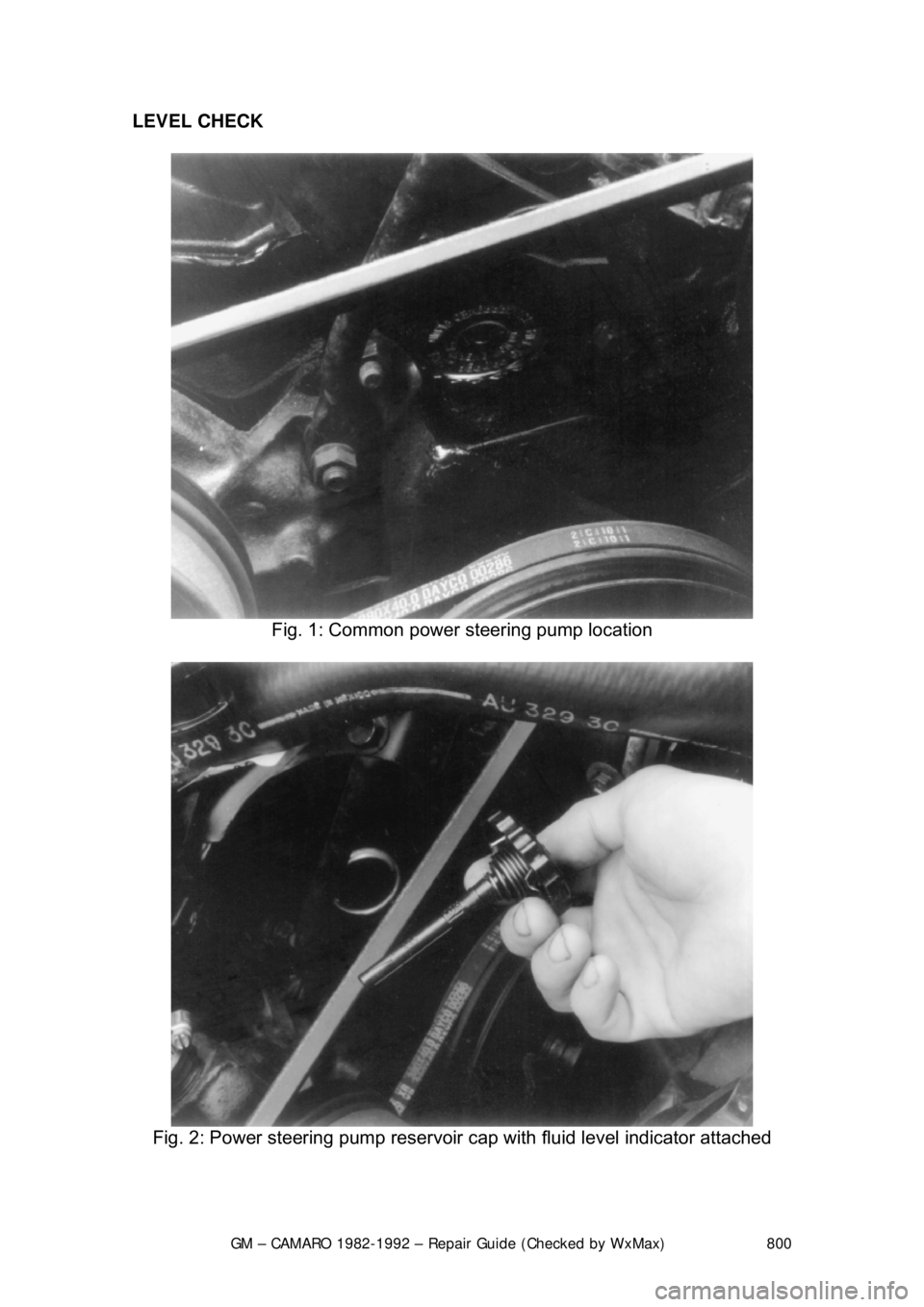
LEVEL CHECK
Fig. 1: Common power steering pump location
Fig. 2: Power steering pump reservoir cap with fluid level indicator attached
Page 801 of 875
GM – CAMARO 1982-1992 – Repair Guide (Checked by WxMax) 801
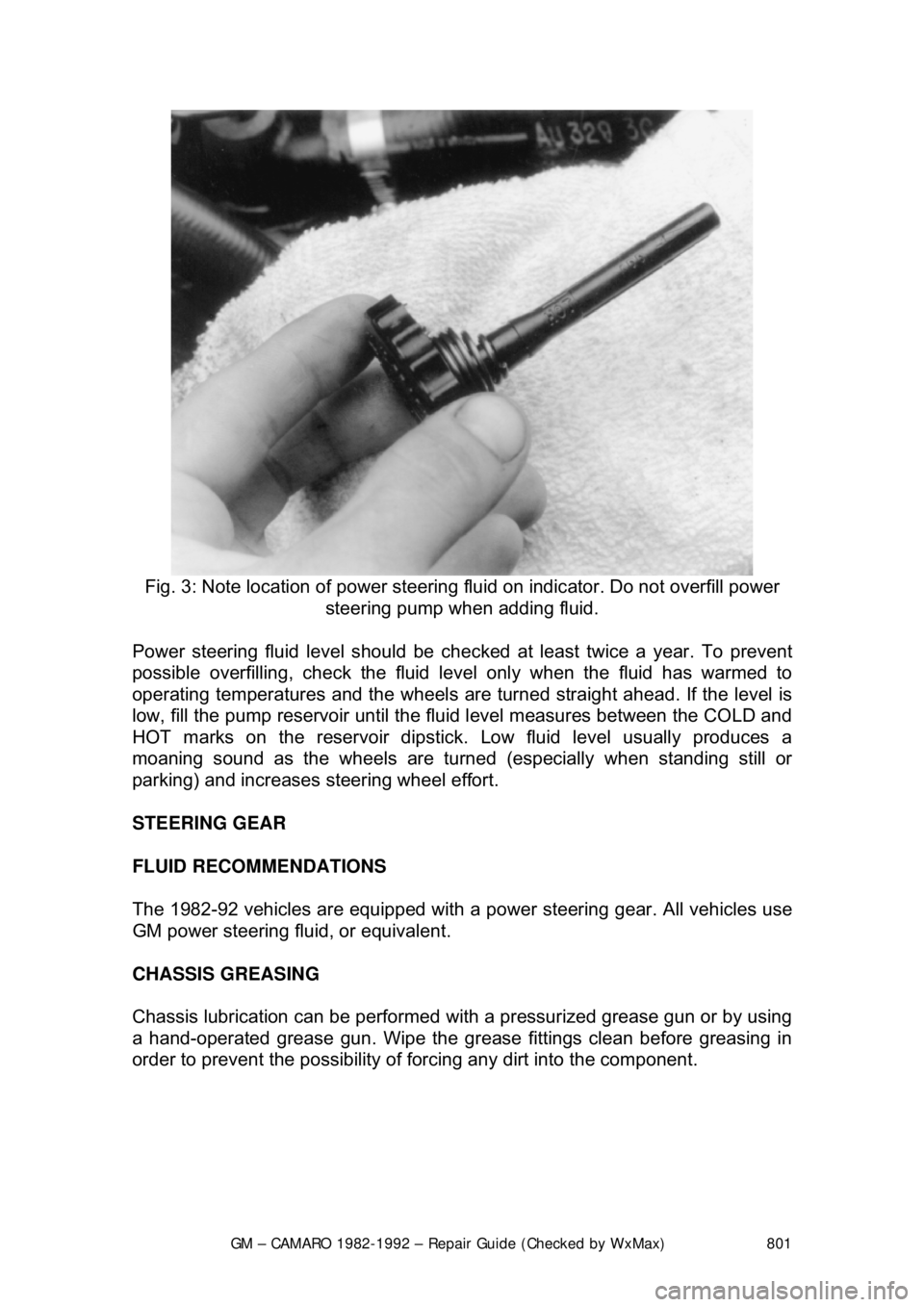
Fig. 3: Note location of power steering fluid on indicator. Do not overfill power
steering pump when adding fluid.
Power steering fluid level s hould be checked at least twice a year. To prevent
possible overfilling, check the fluid le vel only when the fluid has warmed to
operating temperatures and the wheels are turned straight ahead. If the level is
low, fill the pump reservoir until the flui d level measures between the COLD and
HOT marks on the reservoir dipstick. Low fluid level usually produces a
moaning sound as the wheels are turned (especially when standing still or
parking) and increases st eering wheel effort.
STEERING GEAR
FLUID RECOMMENDATIONS
The 1982-92 vehicles are equipped with a pow er steering gear. All vehicles use
GM power steering fluid, or equivalent.
CHASSIS GREASING
Chassis lubrication can be performed with a pressurized grease gun or by using
a hand-operated grease gun. Wipe the grease fittings clean before greasing in
order to prevent the possibility of fo rcing any dirt into the component.
Page 864 of 875
GM – CAMARO 1982-1992 – Repair Guide (Checked by WxMax) 864
8. Rotate both inner and out
er tie rod housings rearward to the limit of ball
joint travel before tightening clamps . Make sure clamp slots and sleeve
slots are aligned before tightening cl amps. Make sure tightened bolts will
be in horizontal position to 45 degrees upward (in the forward direction)
when the tie rod is in its normal positi on. Make sure the tie rod end stays
in position relative to the rod duri ng the tightening operation. Tighten the
clamps, and then return the assembly to the center of its travel.
9. Install ball stud nuts and torque to 35 ft. lbs. (47 Nm) Then tighten (do not
loosen) further as required to align cotter pin holes in studs and nuts.
Install new cotter pins.
10. Lubricate new tie rod ends and lower the vehicle.
POWER STEERING GEAR
ADJUSTMENTS
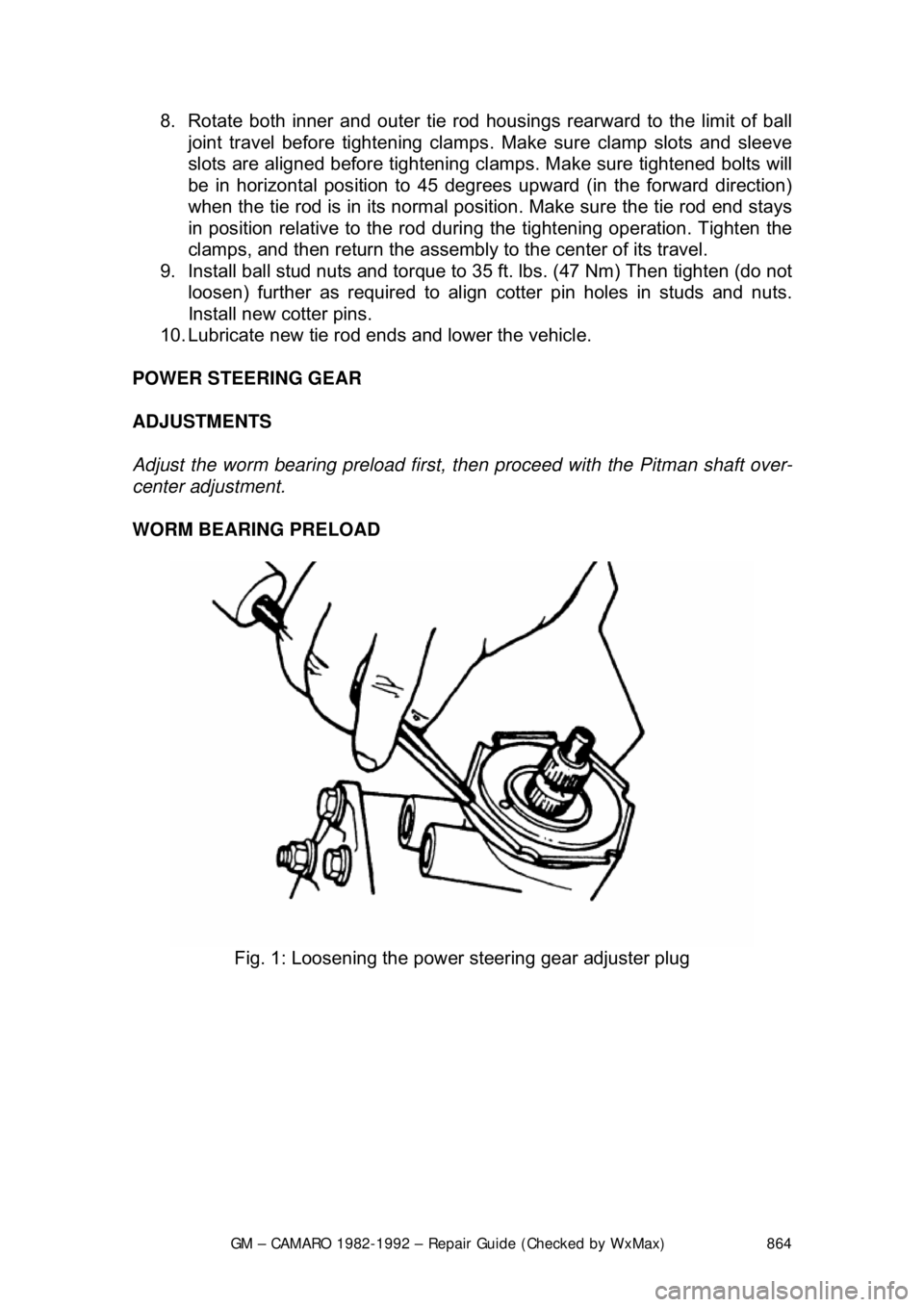
Adjust the worm bearing preload first, then proceed with the Pitman shaft over-
center adjustment.
WORM BEARING PRELOAD
Fig. 1: Loosening the power steering gear adjuster plug
Page 866 of 875
GM – CAMARO 1982-1992 – Repair Guide (Checked by WxMax) 866
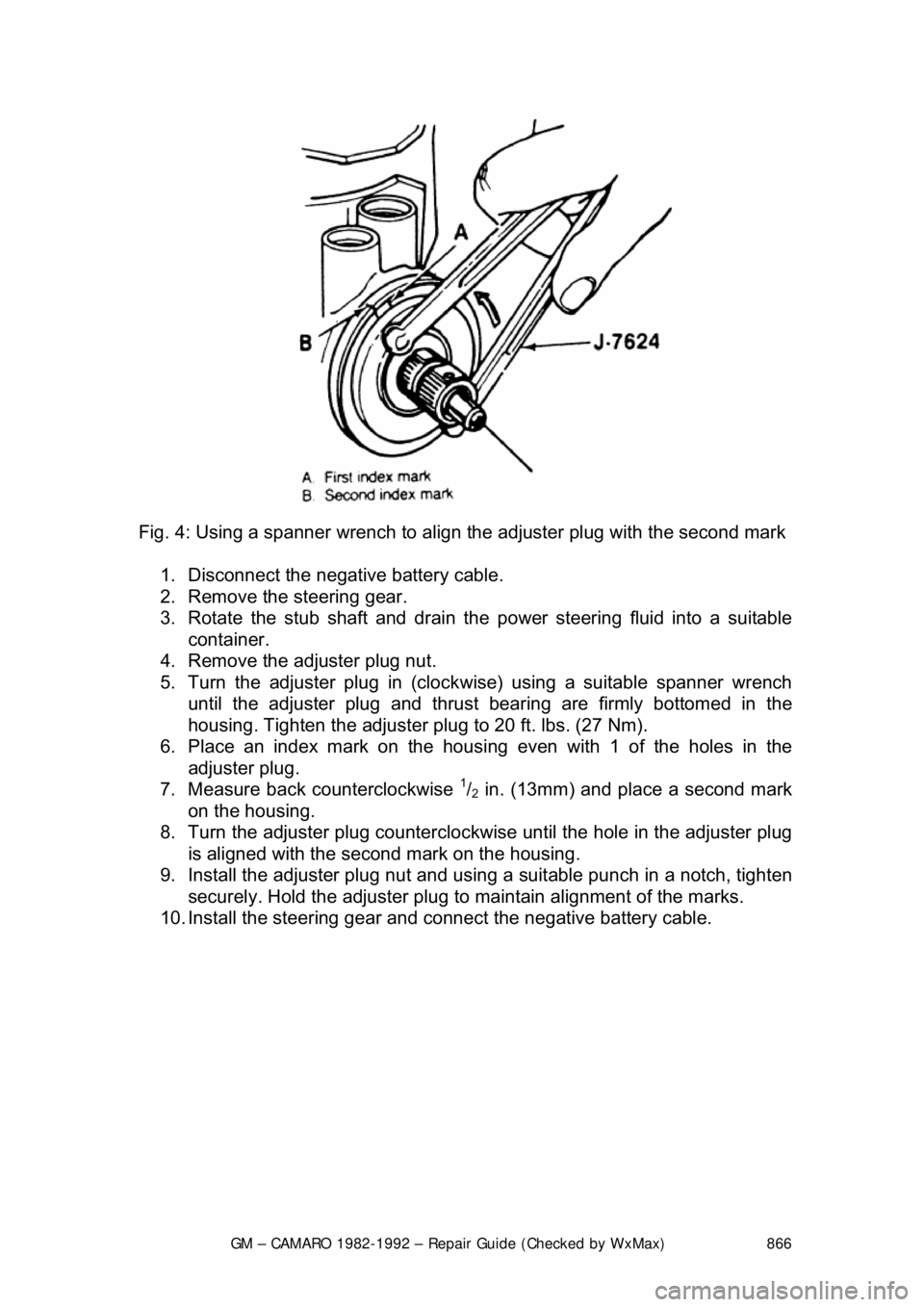
Fig. 4: Using a spanner wrench to align the adjuster plug with the second mark
1. Disconnect the negative battery cable.
2. Remove the steering gear.
3. Rotate the stub shaft and drain the power steering fluid into a suitable
container.
4. Remove the adjuster plug nut.
5. Turn the adjuster plug in (clock wise) using a suitable spanner wrench
until the adjuster plug and thrust bearing are firmly bottomed in the
housing. Tighten the adjuster plug to 20 ft. lbs. (27 Nm).
6. Place an index mark on the housi ng even with 1 of the holes in the
adjuster plug.
7. Measure back counterclockwise
1/2 in. (13mm) and place a second mark
on the housing.
8. Turn the adjuster plug counterclock wise until the hole in the adjuster plug
is aligned with the second mark on the housing.
9. Install the adjuster plug nut and using a suitable punch in a notch, tighten
securely. Hold the adjuster plug to ma intain alignment of the marks.
10. Install the steering gear and c onnect the negative battery cable.
Page 868 of 875
GM – CAMARO 1982-1992 – Repair Guide (Checked by WxMax) 868
3. Rotate the stub shaft and drain the
power steering fluid into a suitable
container.
4. Turn the Pitman shaft adjuster screw counterclockwise until fully
extended, then turn back 1 full turn.
5. Rotate the stub shaft from stop-to -stop and count the number of turns.
6. Starting at either stop, turn the stub shaft back half the total number of
turns. This is the "Center" posit ion of the gear. When the gear is
centered, the flat on the stub sha ft should face upward and be parallel
with the side cover, and the master spline on the Pitman shaft should be\
in line with the adjuster screw.
7. Rotate the stub shaft 45 degrees each side of the center using a suitable
torque wrench with the hand le in the vertical position. Record the worm
bearing preload measured on or near the center gear position.
8. Adjust the over-center drag torque by loosening the adjuster locknut and
turning the Pitman shaft adjuster screw clockwise until the correct drag
torque is obtained: Add 6-10 inch lbs. (0.7-1.1 Nm) of torque to the
previously measured wo rm bearing preload torque. Tighten the adjuster
locknut to 20 ft. lbs. (27 Nm). Prev ent the adjuster screw from turning
while tightening the adju ster screw locknut.
9. Install the steering gear and c onnect the negative battery cable.
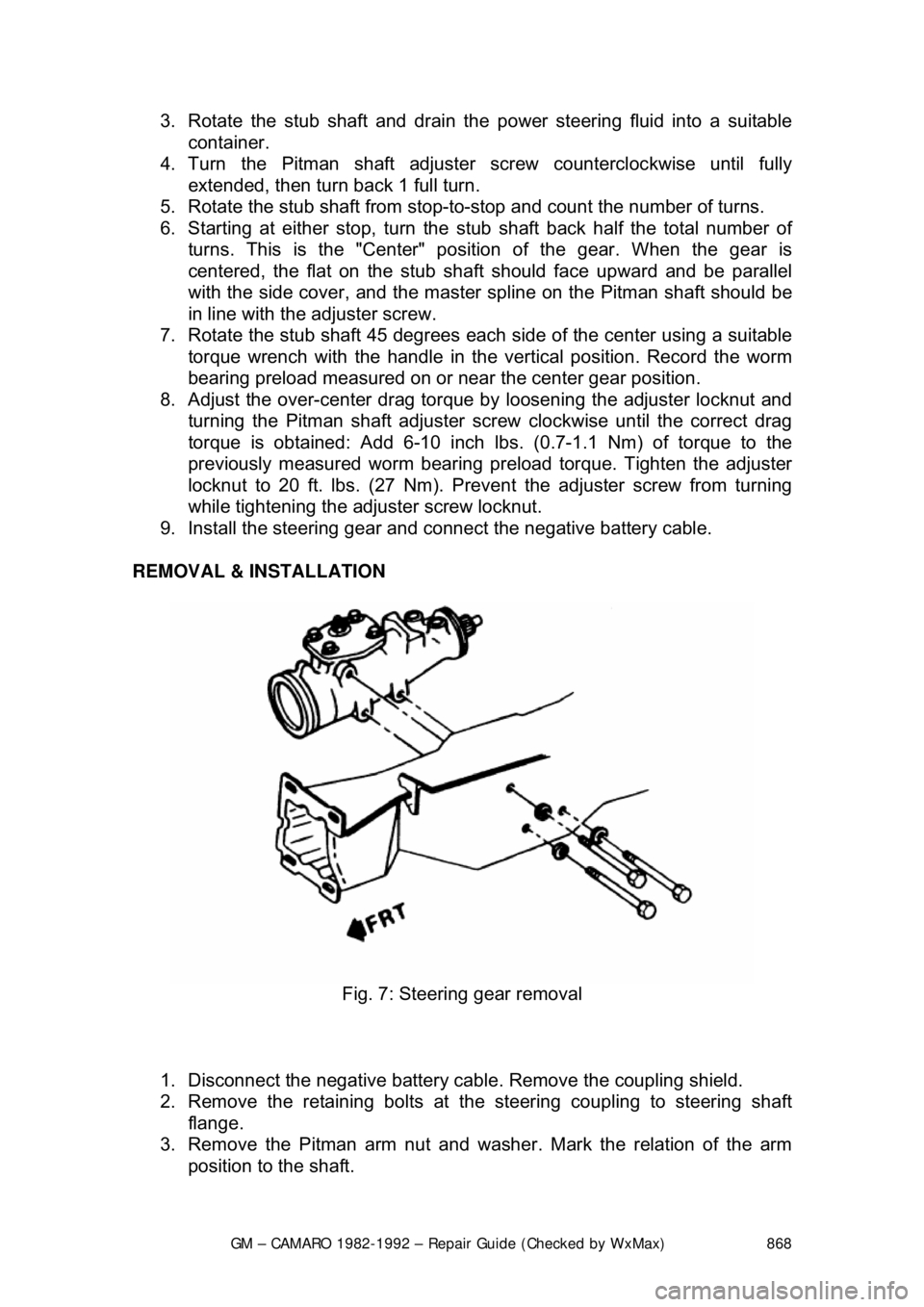
REMOVAL & INSTALLATION
Fig. 7: Steering gear removal
1. Disconnect the negative battery cabl e. Remove the coupling shield.
2. Remove the retaining bolts at t he steering coupling to steering shaft
flange.
3. Remove the Pitman arm nut and wa sher. Mark the relation of the arm
position to the shaft.
Page 869 of 875
GM – CAMARO 1982-1992 – Repair Guide (Checked by WxMax) 869
4. Remove Pitman arm using spec
ial tool J-6632 or its equal.
5. Remove the steering box to fram e bolts. Remove the steering box.
On vehicles with power steering, remo ve the fluid hoses and cap them to
prevent foreign material from entering the system.
To install:
6. Position the steering box and secure with the steering box-to-frame bolts.
7. Install the Pitman arm to the matchmarks made earlier.
8. Install the Pitman arm nut and washer.
9. Install the retaining bolts at the st eering coupling to steering shaft flange.
10. Install the coupling shield.
11. Connect the negative battery cable.
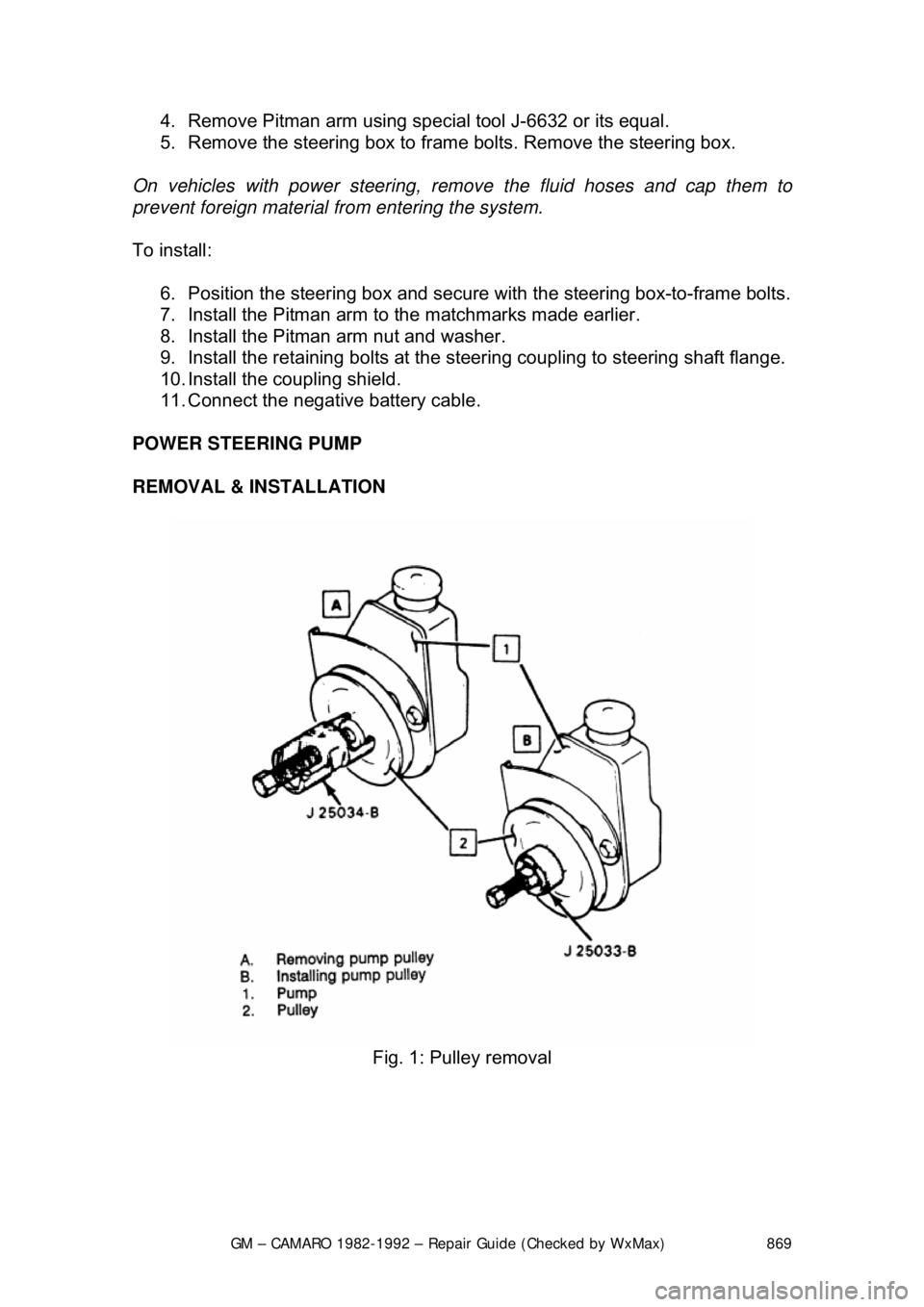
POWER STEERING PUMP
REMOVAL & INSTALLATION
Fig. 1: Pulley removal