seats CHEVROLET CAMARO 1982 Repair Guide
[x] Cancel search | Manufacturer: CHEVROLET, Model Year: 1982, Model line: CAMARO, Model: CHEVROLET CAMARO 1982Pages: 875, PDF Size: 88.64 MB
Page 490 of 875

GM – CAMARO 1982-1992 – Repair Guide (Checked by WxMax) 490
To replace cast-in type valve guides, t
hey must be drilled out, then reamed to
accept replacement guides. This must be done on a fixture which will allow
centering and leveling off of the original valve seat or guide, otherwise a serious
guide-to-seat misalignment may occur maki ng it impossible to properly machine
the seat.
Replaceable-type guides are pressed into the cylinder head. A hammer and a
stepped drift or punch may be used to inst all and remove the guides. Before
removing the guides, measure the protrusi on on the spring side of the head and
record it for installation. Use the stepped drift to hammer out the old guide from
the combustion chamber side of the head. When installing, determine whether
or not the guide also seal s a water jacket in the head, and if it does, use the
recommended sealing agent. If there is no water jacket, grease the valve guide
and its bore. Use the stepped drift, and hamme r the new guide into the cylinder
head from the spring side of the cylinder head. A stack of washers the same
thickness as the measured protrusion may help the installation process.
VALVE SEATS
Before any valve seat machining can be performed, the guides must be within
factory recommended specifications.
If any machining or replacements were made to the valve guides, the seats
must be machined.
If the seats are in good condition, the va lves can be lapped to the seats, and the
cylinder head assembled. See the valves in formation for instructions on lapping.
If the valve seats are worn, cracked or damaged, they must be serviced by a
machine shop. The valve seat must be per fectly centered to the valve guide,
which requires very accurate machining.
CYLINDER HEAD SURFACE
If the cylinder head is war ped, it must be machined flat. If the warpage is
extremely severe, the head may need to be replaced. In some instances, it may
be possible to straighten a warped head enough to allow machining. In either
case, contact a professional machine shop for service.
CRACKS AND PHYSICAL DAMAGE
Certain cracks can be repaired in both ca st iron and aluminum heads. For cast
iron, a tapered threaded insert is inst alled along the length of the crack.
Aluminum can also use the tapered inse rts, however welding is the preferred
method. Some physical damage can be repaired through brazing or welding.
Contact a machine shop to get expert advice for your particular dilemma.
ASSEMBLY
Page 652 of 875
GM – CAMARO 1982-1992 – Repair Guide (Checked by WxMax) 652
6. Connect the negative battery cable.
MODULE
It is not necessary to remove t he distributor from the vehicle.
1. Disconnect the negative battery cable.
2. Remove the distributor cap, rotor and pickup coil.
3. Remove the 2 module attaching screws and lift the module up. Remove
the leads from the module, observi ng the colors on each lead. These
leads can not be interchanged.
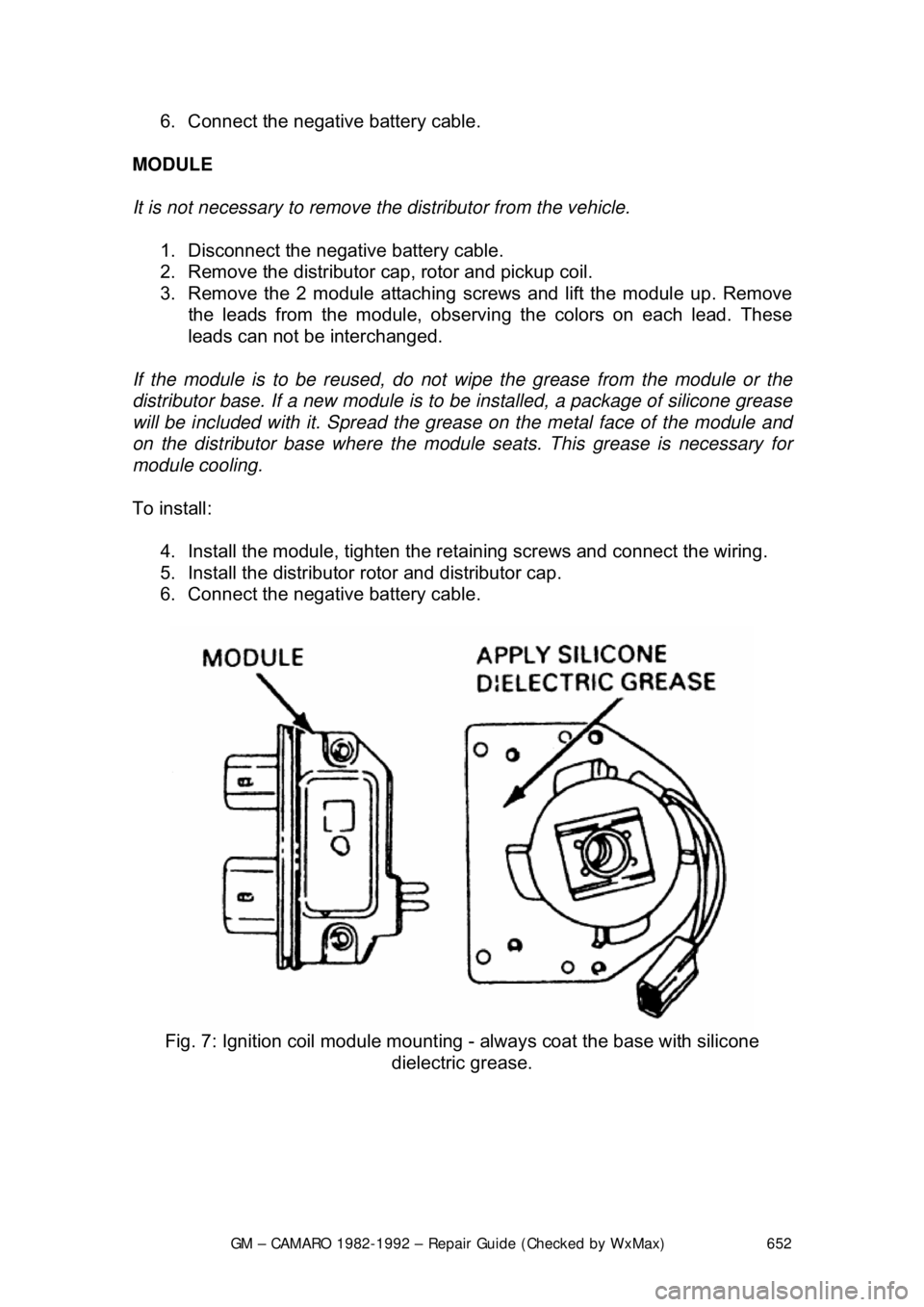
If the module is to be reused, do not wi pe the grease from the module or the
distributor base. If a new module is to be installed, a package of silicone grease
will be included with it. Spr ead the grease on the metal face of the module and
on the distributor base wher e the module seats. This grease is necessary for
module cooling.
To install: 4. Install the module, tighten the reta ining screws and connect the wiring.
5. Install the distributor rotor and distributor cap.
6. Connect the negative battery cable.
Fig. 7: Ignition coil module mounting - always coat the base with silicone
dielectric grease.
Page 710 of 875

GM – CAMARO 1982-1992 – Repair Guide (Checked by WxMax) 710
•
Check the pump passages and the jet(s) for dirt, improper seating of the
discharge checkball or t he temperature bypass disc and/or scores in the
pumpwell. Check the condition of t he pump discharge check ball spring,
replace as necessary
• Check the pump linkage for excessiv e wear; repair or replace as
necessary
HARD STARTING-POOR COLD OPERATION
• Check the choke valve and linkage for excessive wear, binds or
distortion
• Test the vacuum break diaphragm(s) for leaks
• Clean or replace the fuel filter
• Inspect the float valve fo r sticking, dirt, etc.
• Also check the items under "Flooding"
POOR PERFORMANCE-POOR GAS MILEAGE
• Clean all fuel and vacuum passages in the castings
• Check the choke valve fo r freedom of movement
• Check the Mixture Control (M/C) soleno id for sticking, binding or leaking
• Check the air valve and secondary me tering rod for binding conditions. If
the air valve or metering rod is da maged or the metering rod adjustment
is changed from the factory setting, the air horn assembly must be
replaced. Also check the air valve le ver spring for proper installation
ROUGH IDLE
• Inspect the gasket and gasket mating su rfaces on the casting for nicks,
burrs or damage to the sealing beads
• Check the operation and sealing of the mixture control solenoid
• Clean all of the idle field passages
• If removed, inspect the idle mixture needle for ridges, burrs or being bent
• Check the throttle lever and valves for binds, nicks. or other damage
• Check all of the diaphragms for possible ruptures or leaks
After cleaning and checking all components, reassemble the carburetor, using
new parts and referring to the exploded view. When reassembling, make sure
that all screws and jets are tight in their seats, but do not overtighten as the tips
will be distorted. Tighten al l screws gradually, in rotation. Do not tighten needle
valves into their seats; uneven jetting will result. Always use new gaskets. Be
sure to follow all assembly and adjustment procedures.
Before performing any service on the carburet or, it is essential that it be placed
on a suitable holding fixtur e, such as tool J-9789-118, BY-30-15 or equivalent.
Without the use of the holding fixture, it is possible to damage throttle valves or
other parts of the carburetor.
Page 719 of 875

GM – CAMARO 1982-1992 – Repair Guide (Checked by WxMax) 719
11. Lubricate the new large O-ring with cl
ean engine oil and install it directly
over the backup washer. Be sure t he O-ring is seated properly and is
flush with the top of the fuel meter body surface.
12. Lubricate the new small O-ring with clean engine oil and install it on the
nozzle end of the injector. Push t he O-ring on far enough to contact the
filter.
WARNING - Do not attempt to reverse this procedure and install the backup
washer and O-ring after the injector is located in the cavity. To do so will
prevent proper seating of the O-ring in th e cavity recess which could result in a
fuel leak and possible fire.
13. Install the injector by aligning the raised lug on the injector base with the
notch cast into the fuel meter body . Push down on the injector making
sure it is fully seated in the cavity. In jector installation is correct when the
lug is seated in the notch and the electrical terminals are parallel to the
throttle shaft.
14. Using new gaskets on the fuel mete r cover and a new dust seal, install
the cover to the fuel meter body. Use an appropriate thread locking
compound on the cover attaching screws.
15. Connect the injector electrical c onnector by pushing straight down until
seated firmly in place.
16. Connect the negative battery cable.
17. With the engine OFF and the igniti on ON, check for fuel leaks.
18. Install the air cleaner.
ADJUSTMENTS
MINIMUM IDLE SPEED
Minimum idle speed should only be adjus ted when installing a replacement
throttle body. The idle stop screw is used to regulate the minimum idle speed of
the engine. The throttle body is adjusted at the factory, then covered with a cap
or plug to discourage unnecessary readjustment.
2.5L ENGINES 1. Remove the air cleaner and pl ug the THERMAC vacuum port.
2. Disconnect the TV cable from the th rottle control bracket to allow access
to the idle adjustment screw.
3. Remove the throttle stop screw plug or cap.
4. Connect a tachometer to the engine.
5. Disconnect the Idle Air Control (IAC) valve connector.
6. Start the engine with the transmi ssion in PARK (auto transmission) or
NEUTRAL (manual transmission) and allow the engine speed to
stabilize. All accessories (A/C, rear defogger, etc.) should be OFF.
7. Install tool J-33047 in t he idle air passage of the throttle body. Be certain
that the tool seats fully in t he passage and no air leaks exist.