seats CHEVROLET CAMARO 1982 Repair Guide
[x] Cancel search | Manufacturer: CHEVROLET, Model Year: 1982, Model line: CAMARO, Model: CHEVROLET CAMARO 1982Pages: 875, PDF Size: 88.64 MB
Page 41 of 875

GM – CAMARO 1982-1992 – Repair Guide (Checked by WxMax) 41
1. Determine the rear view mirror suppor
t position on the windshield. Support is
to be located at the center of the glass 271/8 in. (69cm) from the base of the
glass to the base of the support.
2. Mark the location on the outside of the glass with wax pencil or crayon.
Make a larger diameter circle around t he mirror support circle on the outside
of the glass surface.
3. On the inside of the glass surface, clean the large circle with a paper towel
and domestic scouring cleanser, gla ss cleaning solution or polishing
compound. Rub until the area is comple tely clean and dry. When dry, clean
the area with an alcohol saturated paper towel to remove any traces of
scouring powder or cleaning solution from this area.
4. With a piece of fine grit (No. 320 or No. 360) emery cloth or sandpaper, sand
the bonding surface of the new rear view mirror support or factory installed
support. If original rear view mirror support is to be reused, all traces of the
factory installed adhesive must be re moved prior to reinstallation.
5. Wipe the sanded mirror support with a clean paper towel saturated with alcohol and allow it to dry.
6. Follow the directions on the manufac turer's kit to prepare the rear view
mirror support prior to inst allation on the glass.
7. Properly position the support to it s premarked location, with rounded end
pointed upward, press the support agai nst the glass for 30-60 seconds,
exerting steady pressure against the gla ss. After five minutes, any excess
adhesive may be removed with an alcohol moistened paper towel or glass
cleaning solution.
8. Install the mirror.
SEATS
REMOVAL & INSTALLATION
1. Operate the seat to the full-forwar d position. If a six-way power seat is
operable, operate the seat to the full-forward and up positions. Where
necessary to gain access to the adjuste r-to-floor pan attaching nuts, remove
the adjuster rear foot covers and/or carpet retainers.
2. Remove the track covers where nec essary; then remove the adjuster-to-
floor pan rear attaching nuts. Operate t he seat to the full-rearward position.
Remove the adjuster front foot covers ; then remove the adjuster-to-floor pan
front attaching nuts.
3. Remove the seat assembly from the car.
4. Check that both seat adjusters ar e parallel and in phase with each other.
5. Install the adjuster-to- floor pan attaching nuts by moving the seat forward
and rearward and torque nuts to 15-21 ft. lbs. (20-28 Nm).
6. Check the operation of the seat a ssembly to full limits of travel.
Page 55 of 875
GM – CAMARO 1982-1992 – Repair Guide (Checked by WxMax) 55
BRAKE LIGHT SWITCH
REMOVAL & INSTALLATION
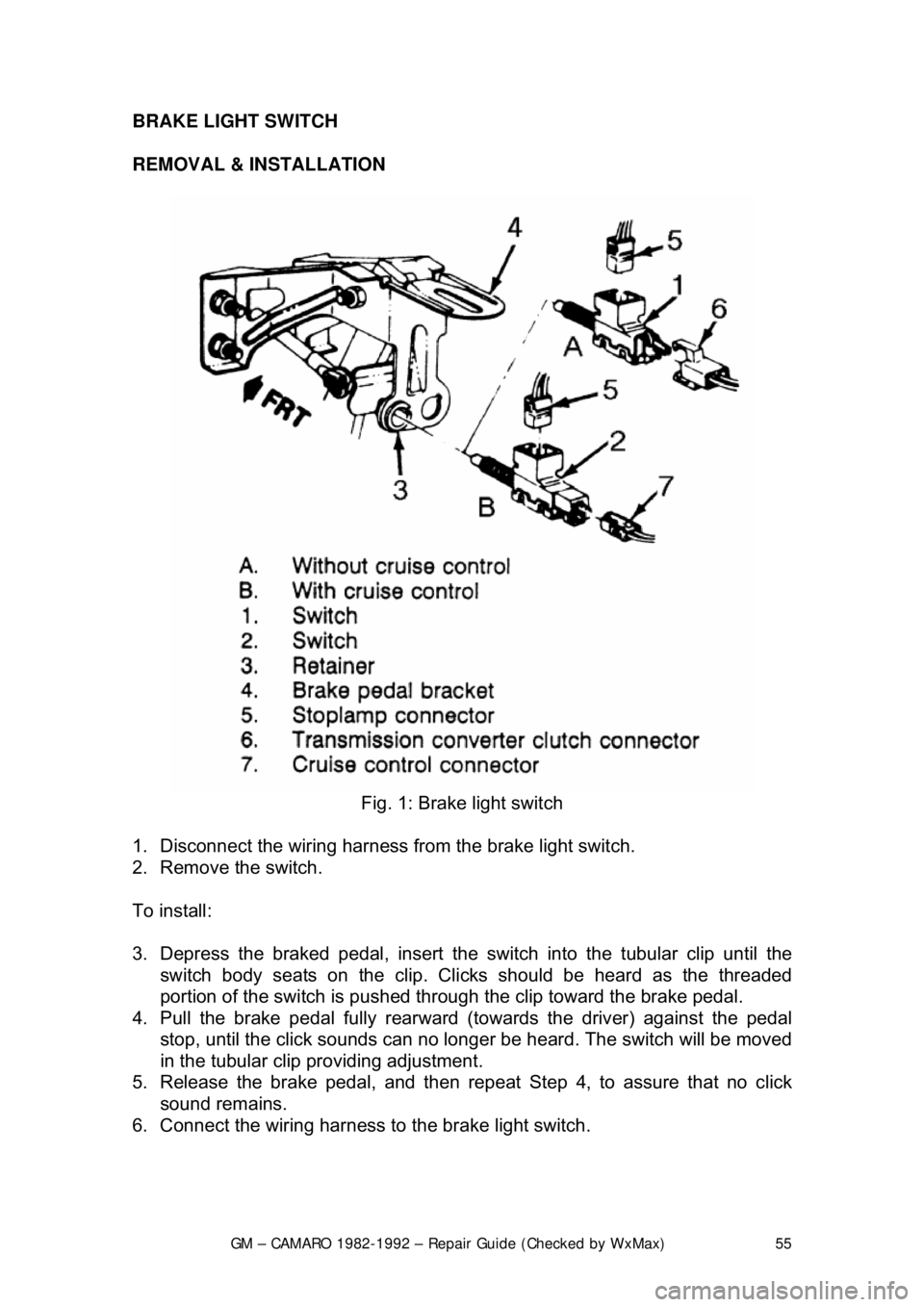
Fig. 1: Brake light switch
1. Disconnect the wiring harness fr om the brake light switch.
2. Remove the switch.
To install:
3. Depress the braked pedal, insert the switch into the tubular clip until the
switch body seats on the clip. Cli cks should be heard as the threaded
portion of the switch is pushed through the clip toward the brake pedal.\
4. Pull the brake pe dal fully rearward (towards the driver) against the pedal
stop, until the click sounds can no long er be heard. The switch will be moved
in the tubular clip providing adjustment.
5. Release the brak e pedal, and then repeat Step 4, to assure that no click
sound remains.
6. Connect the wiring harness to the brake light switch.
Page 411 of 875

GM – CAMARO 1982-1992 – Repair Guide (Checked by WxMax) 411
1. Disconnect the negative battery cable.
2. Relieve the fuel system pressure
and drain the engine coolant from the
radiator into a suitable container.
3. Remove the intake manifold and the spark plugs.
4. Remove the dipstick tube and bra cket. Raise and support the vehicle
safely. Drain the oil and remove the oil filter. Lower the vehicle.
5. Remove the exhaust manifolds.
6. Remove the drive belt(s).
7. Remove the air conditioning compresso r and bracket, reposition it aside.
Do not disconnect the lines.
8. Remove the power steering pump and bracket, reposition it aside.
9. Remove the alternator and br acket, reposition it aside.
10. Remove the ground cable from the rear of the cylinder head and remove
the engine lift bracket.
11. Remove the rocker arm covers.
12. Loosen the rocker arms until the pushrods can be removed.
13. Remove the cylinder head bolts and remove the cylinder heads.
To install: 14. Clean the gasket mating surfaces of all components. Be careful not to
nick or scratch any surfaces as this will allow leak paths. Clean the bolt
threads in the cylinder bl ock and on the head bolts. Dirt will affect bolt
torque.
15. Place the head gaskets in pos ition over the dowel pins.
16. Install the cylinder heads.
17. Coat the cylinder head bolts th reads with GM sealer 1052080 or
equivalent, and install the bolts. Tight en the bolts in the proper sequence
to:
• 1982-1987 engines: 70 ft lbs. (90 Nm)
• 1988-1992 engines: 1st step: 40 ft lbs. (55 Nm); 2nd step: tighten
an additional 1/4 (90 degree) turn
18. Install the pushrods a nd loosely retain them wit h the rocker arms. Make
sure the lower ends of the pushrods ar e in the lifter seats. Refer to the
rocker arm procedures outlined ea rlier in this section.
19. Install the power steering pump br acket and pump. Do the same for the
air conditioning compressor bracket and compressor.
20. Install the ground cable to t he rear of the cylinder head.
21. Install the exhaust manifolds.
22. Install the dipstick tube and bracket.
23. Install the intake manifold.
24. Install the alternator bracket and alternator.
25. Install the drive belt(s).
26. Install the spark plugs.
27. Fill the cooling system with the proper type and quantity of coolant. Install
a new oil filter and fill the crankca se with the proper type and quantity of
oil.
28. Connect the negative battery cable, star t the vehicle and check for leaks.
Page 466 of 875
GM – CAMARO 1982-1992 – Repair Guide (Checked by WxMax) 466
wear. Worn piston rings, scored or wo
rn cylinder bores, blown head gaskets,
sticking or burnt valves, and worn valve seats are all possible culprits. A check
of each cylinder's compression will help locate the problem.
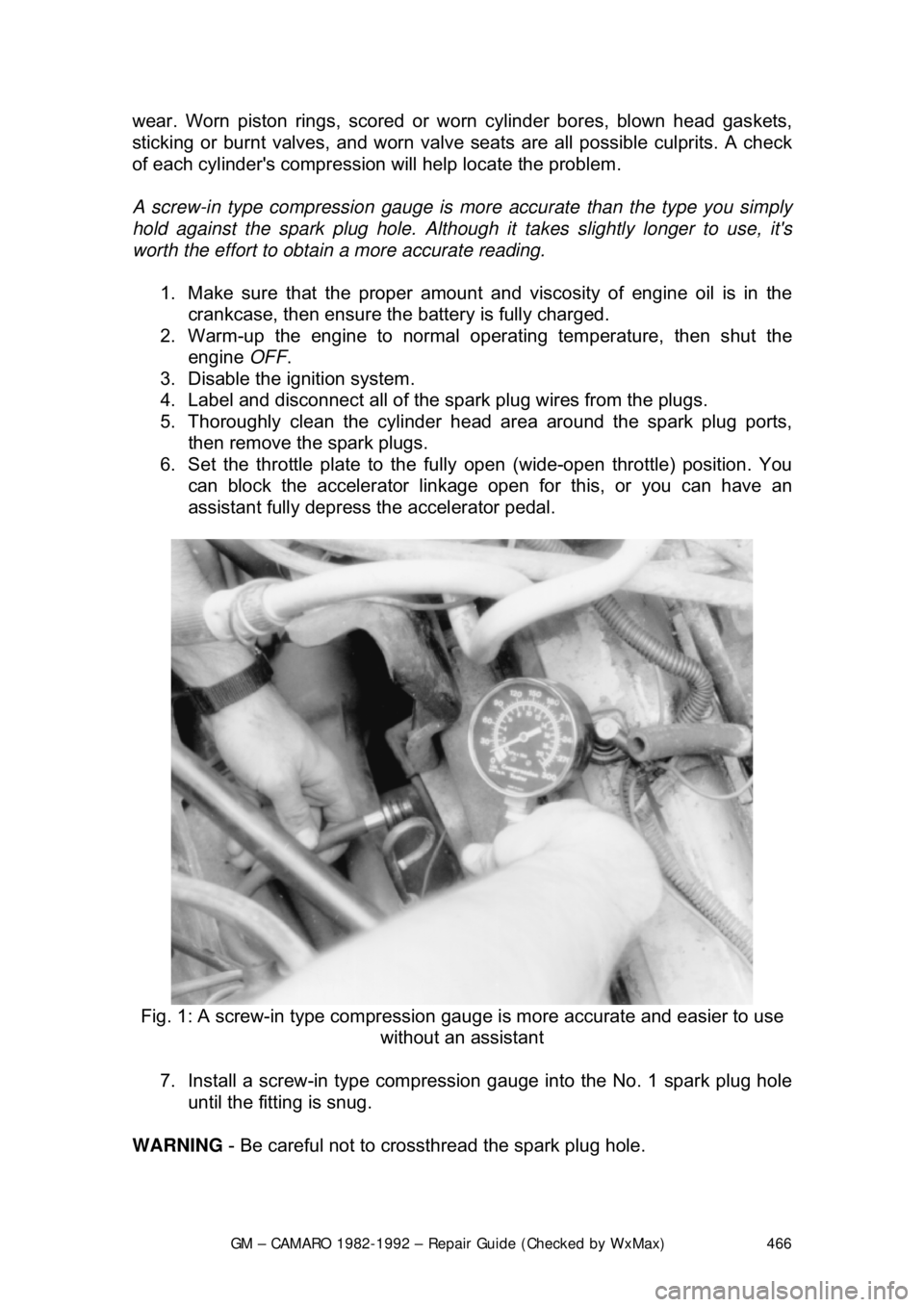
A screw-in type compression gauge is more accurate than the type you simply
hold against the spark plug hole. Although it takes slightly longer to use, it's
worth the effort to obtain a more accurate reading.
1. Make sure that the proper amount and viscosity of engine oil is in the
crankcase, then ensure the battery is fully charged.
2. Warm-up the engine to normal operat ing temperature, then shut the
engine OFF.
3. Disable the ignition system.
4. Label and disconnect all of the spark plug wires from the plugs.
5. Thoroughly clean the cylinder h ead area around the spark plug ports,
then remove the spark plugs.
6. Set the throttle plate to the fully open (wide-open throttle) position. You
can block the accelerator linkage open for this, or you can have an
assistant fully depress the accelerator pedal.
Fig. 1: A screw-in type compression gauge is more accurate and easier to use
without an assistant
7. Install a screw-in type compression gauge into the No. 1 spark plug hole
until the fitting is snug.
WARNING - Be careful not to crossthread the spark plug hole.
Page 472 of 875
GM – CAMARO 1982-1992 – Repair Guide (Checked by WxMax) 472
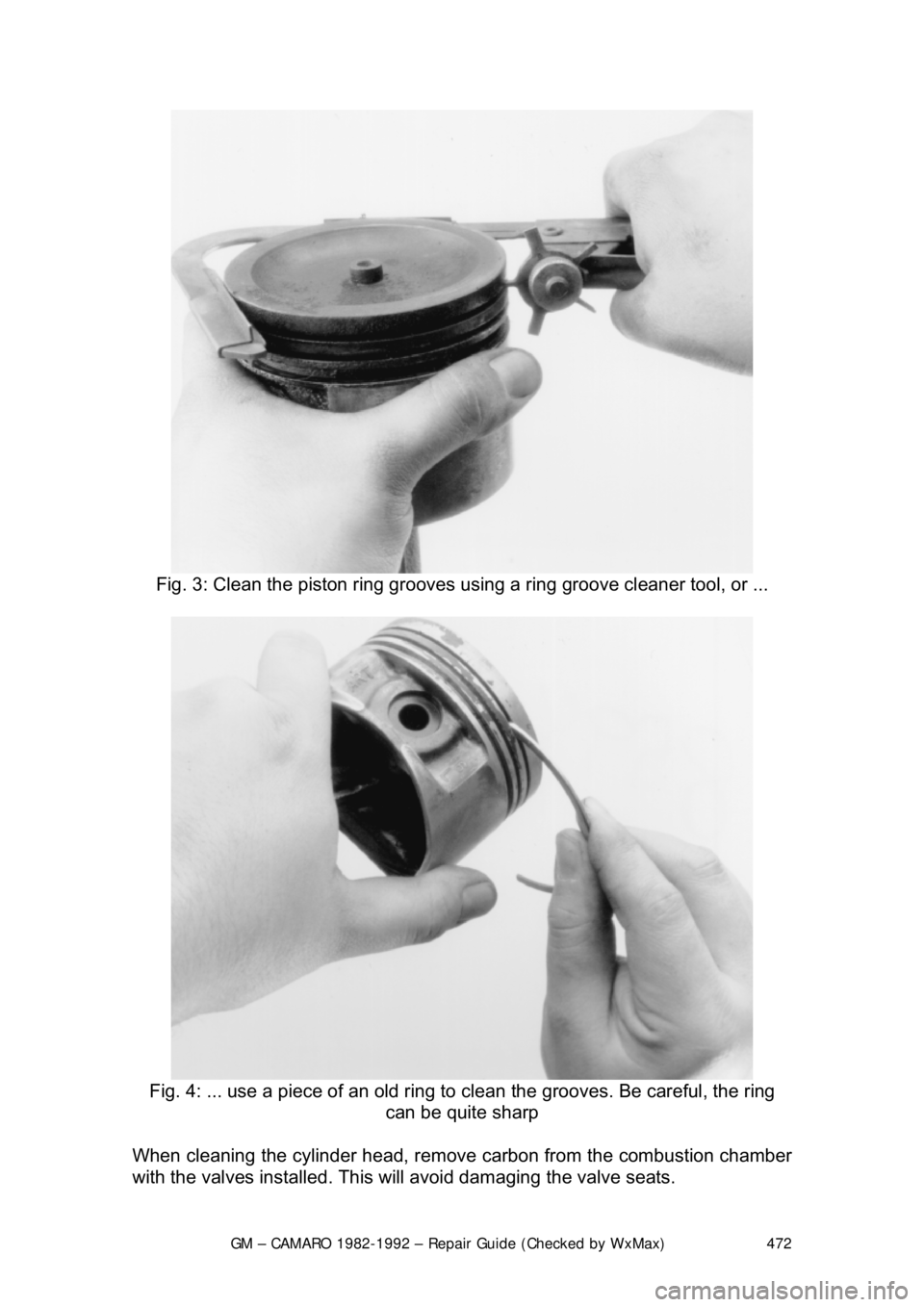
Fig. 3: Clean the piston ring grooves using a ring groove cleaner tool, or ...
Fig. 4: ... use a piece of an old ring to clean the grooves. Be careful,\
the ring
can be quite sharp
When cleaning the cylinder head, remove carbon from the combustion chamber
with the valves installed. This will avoid damaging the valve seats.
Page 477 of 875

GM – CAMARO 1982-1992 – Repair Guide (Checked by WxMax) 477
Most cylinder heads these days are made of
an aluminum alloy due to its light
weight, durability and heat transfer qualit ies. However, cast iron was the
material of choice in the past, and is st ill used on many vehicles today. Whether
made from aluminum or iron, all cylinder heads hav e valves and seats. Some
use two valves per cylinder, while the more hi-tech engines will utilize a multi-
valve configuration using 3, 4 and
even 5 valves per cylinder. When the va lve contacts the seat, it does so on
precision machined surfaces, which seal s the combustion chamber. All cylinder
heads have a valve guide for each valve. The guide centers the valve to the
seat and allows it to move up and down within it. The clearance between the
valve and guide can be critical. Too much clearance and the engine may
consume oil, lose vacuum and/or damage the seat. Too little, and the valve can
stick in the guide causing t he engine to run poorly if at all, and possibly causing
severe damage. The last component all cylinder heads have are valve springs.
The spring holds the valve against its s eat. It also returns the valve to this
position when the valve has been opened by the valve train or camshaft. The
spring is fastened to the valve by a retainer and valve locks (sometime\
s called
keepers). Aluminum heads will also have a valve spring shim to keep the spring
from wearing away the aluminum.
An ideal method of rebuilding the cylin der head would involve replacing all of
the valves, guides, seats, springs, et c. with new ones. However, depending on
how the engine was maintained, often this is not necessary. A major cause of
valve, guide and seat wear is an improperly tuned engine. An engine that is
running too rich, will often wash the lubric ating oil out of the guide with gasoline,
causing it to wear rapidly. Conversely, an engine which is running too lean will
place higher combustion temperatures on the valves and seats allowing them to
wear or even burn. Springs fall victim to the driving habits of the individual. A
driver who often runs the engine rpm to the redline will wear out or break the
springs faster then one that stays well below it. Unfortunately, mileage takes it
toll on all of the parts. G enerally, the valves, guides, springs and seats in a
cylinder head can be machined and re-used, saving you money. However, if a
valve is burnt, it may be wise to replace all of the valves, since they were all
operating in the same environment. The same goes for any other component\
on
the cylinder head. Think of it as an insurance policy against future problems
related to that component.
Unfortunately, the only way to find out wh ich components need replacing, is to
disassemble and carefully check each piece. After the cylinder head(s) are
disassembled, thoroughly clean all of the components.
DISASSEMBLY
Before disassembling the cylinder head, you may want to fabricate some
containers to hold the various parts, as some of them can be quite small (such
as keepers) and easily lost. Also keeping yourself and the components
organized will aid in assembly and reduce confusion. Where possible, try to
maintain a components original location; th is is especially important if there is
not going to be any machine work performed on the components.
Page 485 of 875
GM – CAMARO 1982-1992 – Repair Guide (Checked by WxMax) 485
CYLINDER HEAD
There are several things to check on
the cylinder head: valve guides, seats,
cylinder head surface flatness, cracks and physical damage.
VALVE GUIDES
Now that you know the valves are good, you can use them to check the guides,
although a new valve, if available, is preferred. Before you measure anything,
look at the guides carefully and inspect t hem for any cracks, chips or breakage.
Also if the guide is a removable style (a s in most aluminum heads), check them
for any looseness or evidence of movem ent. All of the guides should appear to
be at the same height from the spring s eat. If any seem lower (or higher) from
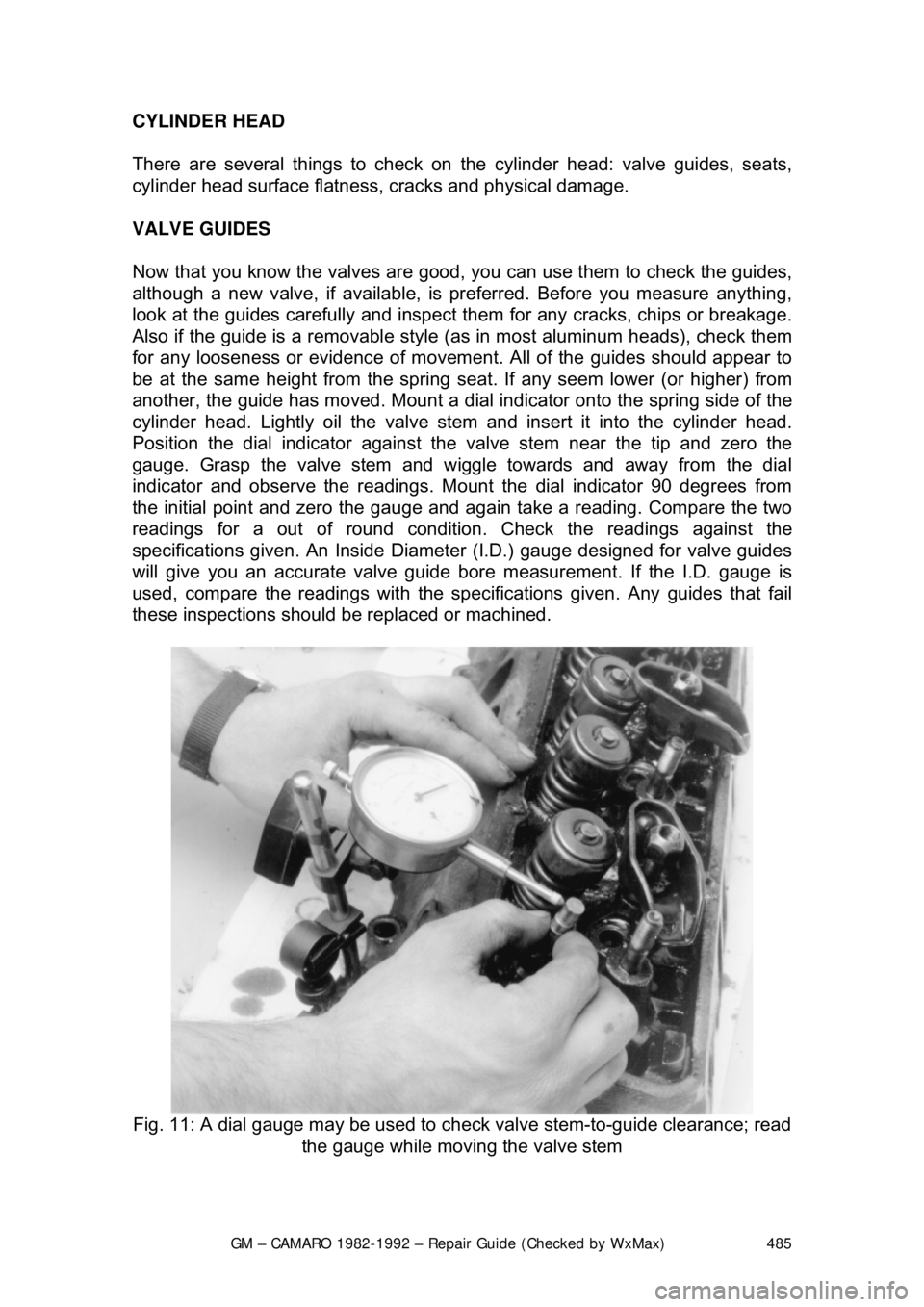
another, the guide has moved. Mount a dial indicator onto the spring side of the
cylinder head. Lightly oil the valve stem and insert it into the cylinder head.
Position the dial indicator against the valve stem near the tip and zero the
gauge. Grasp the valve stem and wiggle towards and away from the dial
indicator and observe the readings. Mount the dial indicator 90 degrees from
the initial point and zero the gauge and again take a reading. Compare the two
readings for a out of round condition. Check the readings against the
specifications given. An Inside Diamete r (I.D.) gauge designed for valve guides
will give you an accurate valve guide bore measurement. If the I.D. gauge is
used, compare the readings wit h the specifications given. Any guides that fail
these inspections should be replaced or machined.
Fig. 11: A dial gauge may be used to che ck valve stem-to-guide clearance; read
the gauge while moving the valve stem
Page 486 of 875
GM – CAMARO 1982-1992 – Repair Guide (Checked by WxMax) 486
VALVE SEATS
A visual inspection of the valve seats
should show a slightly worn and pitted
surface where the valve face contacts t he seat. Inspect the seat carefully for
severe pitting or cracks. Also, a seat t hat is badly worn will be recessed into the
cylinder head. A severely worn or rece ssed seat may need to be replaced. All
cracked seats must be replaced. A seat co ncentricity gauge, if available, should
be used to check the seat run-out. If run-out exceeds specifications the seat
must be machined (if no specification is given use 0.002 in. or 0.051mm).
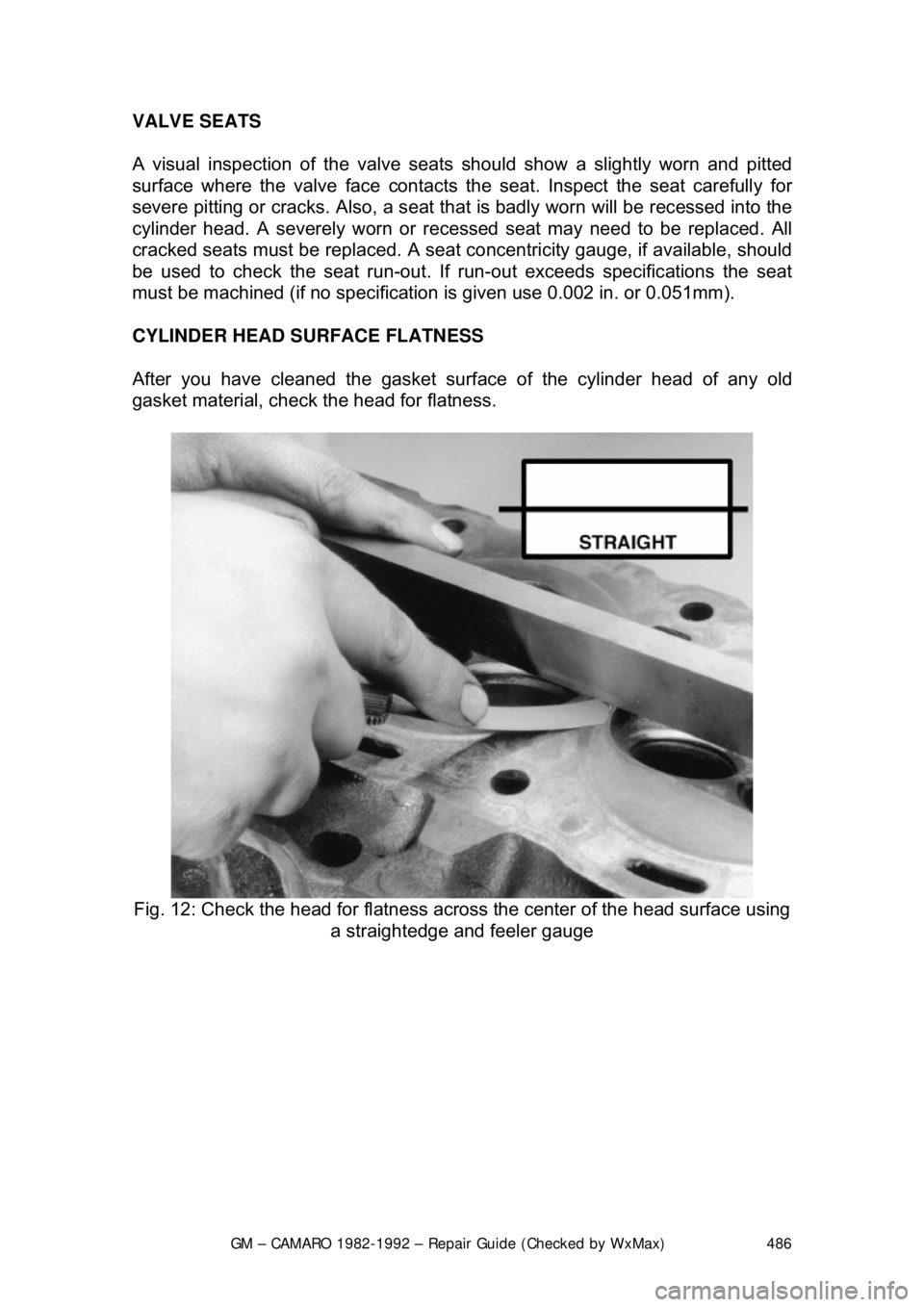
CYLINDER HEAD SURFACE FLATNESS
After you have cleaned the gasket surf ace of the cylinder head of any old
gasket material, check the head for flatness.
Fig. 12: Check the head for flatness across the center of the head surface using
a straightedge and feeler gauge
Page 488 of 875

GM – CAMARO 1982-1992 – Repair Guide (Checked by WxMax) 488
Physical damage is usually very eviden
t. For example, a broken mounting ear
from dropping the head or a bent or broken stud and/or bol t. All of these defects
should be fixed or, if irrepairabl e, the head should be replaced.
REFINISHING & REPAIRING
Many of the procedures given for refini shing and repairing the cylinder head
components must be performed by a ma chine shop. Certain steps, if the
inspected part is not worn, can be perfo rmed yourself inexpensively. However,
you spent a lot of time and effort so far, why risk trying to save a couple bucks if
you might have to do it all over again?
VALVES
Any valves that were not replaced s hould be refaced and the tips ground flat.
Unless you have access to a valve grinding machine, this should be done by a
machine shop. If the valves are in extr emely good condition, as well as the
valve seats and guides, they may be lapped in without performing machine
work.
It is a recommended practice to lap the valves even after machine work has
been performed and/or new valves hav e been purchased. This insures a
positive seal between the valve and seat.
LAPPING THE VALVES
Before lapping the valves to the seat s, read the rest of the cylinder head
information to insure that any related parts are in acceptable enough condition
to continue.
Before any valve seat machining and/or lapping can be performed, the guides
must be within factory re commended specifications.
1. Invert the cylinder head.
2. Lightly lubricate the va lve stems and insert them into the cylinder head in
their numbered order.
3. Raise the valve from the seat and apply a sma ll amount of fine lapping
compound to the seat.
4. Moisten the suction h ead of a hand-lapping tool and attach it to the head
of the valve.
5. Rotate the tool bet ween the palms of both hands , changing the position
of the valve on the valve seat and lifting the tool often to prevent
grooving.
6. Lap the valve until a smooth, polished circle is evident on the valve and
seat.
7. Remove the tool and the valve. Wi pe away all traces of the grinding
compound and store the valve to maintain its lapped location.
SPRINGS, RETAINERS AND VALVE LOCKS
Page 489 of 875

GM – CAMARO 1982-1992 – Repair Guide (Checked by WxMax) 489
There is no repair or refinishing possi
ble with the springs, retainers and valve
locks. If they are found to be worn or defective, they must be replaced with new
(or known good) parts.
CYLINDER HEAD
Most refinishing procedures dealing wit h the cylinder head must be performed
by a machine shop. Read the informati on below and review your inspection
data to determine whether or not machining is necessary.
VALVE GUIDE
If any machining or replacements are made to the valve guides, the seats must
be machined.
Unless the valve guides need machining or replacing, the only service to\
perform is to thoroughly clean them of any dirt or oil residue.
There are only two types of valve gu ides used on automobile engines: the
replaceable-type (all alumi num heads) and the cast-in in tegral-type (most cast
iron heads). There are four recommended methods for repairing worn guides.
• Knurling
• Inserts
• Reaming oversize
• Replacing
Knurling is a process in which metal is displaced and raised, thereby reducing
clearance, giving a true center, and providing oil control. It is the least
expensive way of repairing the valve guides . However, it is not necessarily the
best, and in some cases, a knurled valve guide will not stand up for more than a
short time. It requires a special knurle r and precision reaming tools to obtain
proper clearances. It would not be cost effective to purchase these tools, unless
you plan on rebuilding several of the same cylinder head.
Installing a guide insert involves machin ing the guide to accept a bronze insert.
One style is the coil-type wh ich is installed into a threaded guide. Another is the
thin-walled insert where the guide is ream ed oversize to accept a split-sleeve
insert. After the insert is installed, a s pecial tool is then run through the guide to
expand the insert, locking it to the guide. The insert is then reamed to the
standard size for proper valve clearance.
Reaming for oversize valves restores normal clearances and provides a true
valve seat. Most cast-in type guides can be reamed to accept an valve wi\
th an
oversize stem. The cost factor for this can become quite high as you will need
to purchase the reamer and new, oversize stem valves for all guides which
were reamed. Oversizes ar e generally 0.003 to 0.030 in. (0.076 to 0.762mm),
with 0.015 in. (0.381mm) being the most common.