ECU CHEVROLET CAMARO 1982 Repair Guide
[x] Cancel search | Manufacturer: CHEVROLET, Model Year: 1982, Model line: CAMARO, Model: CHEVROLET CAMARO 1982Pages: 875, PDF Size: 88.64 MB
Page 340 of 875

GM – CAMARO 1982-1992 – Repair Guide (Checked by WxMax) 340
10. Install the brake line j
unction block bolt at the ax le housing. Connect any
brake lines that were disconnected.
11. Install and secure the driveshaft a ligning the match marks made earlier.
12. Connect the shock absorbers to the axle and install the wheel
assemblies.
13. Lower the vehicle and replace any lost rear axle fluid.
DIFFERENTIAL ASSEMBLY
REMOVAL & INSTALLATION 1. Raise and safely support the vehicle.
2. Place a suitable contai ner under the differential. Remove the carrier
cover and drain the gear oil.
3. Remove the drive axles.
4. Mark the differential bearing caps L and R to make sure they will be
reassembled in their original location.
5. Using a suitable tool, remove the di fferential carrier. Be careful not to
damage the gasket sealing surface wh en removing the unit. Place the
right and left bearing outer races of the side bearing assemblies and
shims in sets with the marked different ial bearings caps so they can be
reinstalled in their original positions.
To install: 6. Inspect the differential carrier housi ng for foreign material. Check the ring
and pinion for chipped teeth, exce ssive wear and scoring. Check the
carrier bearings visually and by feel . Clean the differential housing and
replace components, as necessary.
7. Install the differential carrier. C heck the carrier bearing preload along
with the ring and pinion backlash, then adjust, as necessary. Tighten the
differential bearing cap bolts to 55 ft. lbs. (75 Nm) except on Borg-
Warner rear axles which are ti ghtened to 40 ft. lbs. (54 Nm).
8. Install the axles.
9. Install the carrier cover using a new gasket. Tighten the carrier cover
bolts to 20 ft. lbs. (27 Nm). Add the proper type and quantity of gear oil to
axle assembly.
Page 346 of 875

GM – CAMARO 1982-1992 – Repair Guide (Checked by WxMax) 346
battery, electricity is forced into the battery
, and the battery is returned to its fully
charged state.
Alternators are used on the modern autom obiles for they are lighter, more
efficient, can rotate at higher speeds and have fewer brush problems. In an
alternator, the field rotates while al l the current produced passes only through
the stators windings. The brushes bear agains t continuous slip rings rather than
a commutator. This causes the current produced to periodically reverse the
direction of its flow. Diodes (electrica l one-way switches) block the flow of
current from traveling in t he wrong direction. A series of diodes is wired together
to permit the alternating flow of the st ator to be converted to a pulsating, but
unidirectional flow at the alternator out put. The alternator's field is wired in
series with the voltage regulator.
Please refer to Engine Performance & Tune-up for ignition system testing
procedures.
IGNITION COIL
REMOVAL & INSTALLATION
INTERNALLY MOUNTED COIL 1. Disconnect and label the wires from cap.
2. Remove the distributor cap from the distributor.
3. On the distributor cap, remove t he coil cover attaching screws and the
cover.
4. Remove the ignition coil attaching screws and lift the coil from the cap.
To install: 5. Position the coil and secure it with the attaching screws. Be sure to install
the carbon button and rubber disc first.
6. Install the coil cover and attaching screws.
7. Install the distributor cap.
8. Connect the wires to the cap.
EXTERNALLY MOUNTED COIL 1. Label and disconnect the wires from the coil.
2. Remove the ignition coil mounting bolts and the coil.
To install: 3. To install, position the coil into place and se cure it with the mounting
bolts.
4. Connect the wires to the coil.
IGNITION MODULE
Page 356 of 875
GM – CAMARO 1982-1992 – Repair Guide (Checked by WxMax) 356
This procedure is to be performed with t
he alternator removed from the vehicle.
The new style CS alternators on 1987-92 vehicles are non-serviceable and
must be replaced as an assembly.
1. Make scribe marks on the end fram es to make reassembly easier.
2. Remove the 4 through-bolts and s eparate the drive end frame assembly
from the rectifier end frame assembly.
3. Remove the 3 diode trio attachi ng nuts and the 3 regulator attaching
screws.
4. Remove the diode trio and the regulator from the end frame.
To install: 5. Push the brushes into the brush hol der and install a brush retainer or a
tooth pick to hold the brushes in place.
6. Install the regulator into the alternator.
7. Install the diode trio.
8. Install the halves of the alternat or and secure the halves with the 4
through-bolts. After the alternator is assembled, remove the brush
retainer.
STARTER
REMOVAL & INSTALLATION
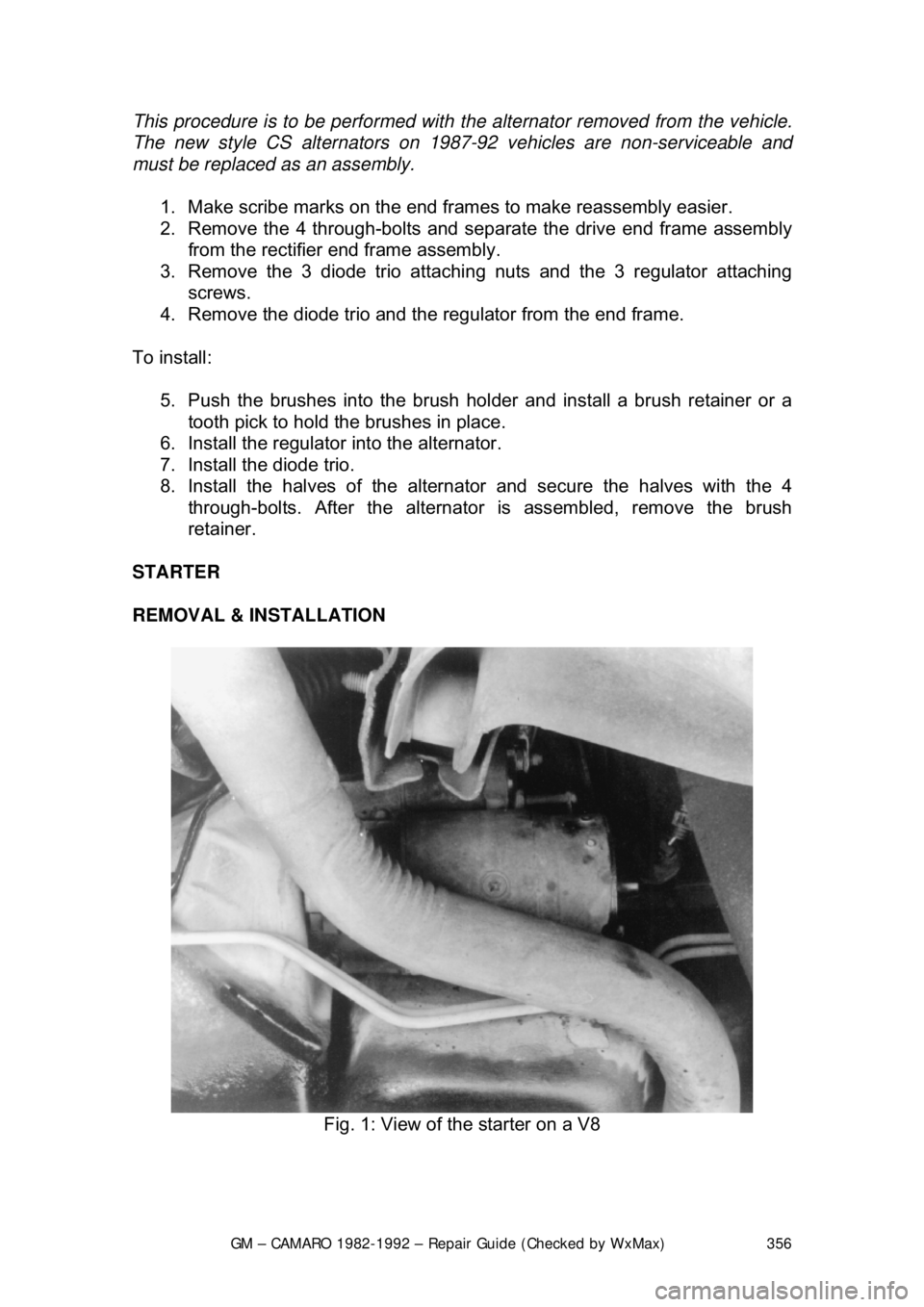
Fig. 1: View of the starter on a V8
Page 359 of 875

GM – CAMARO 1982-1992 – Repair Guide (Checked by WxMax) 359
3. Disconnect all wiring from the star
ter solenoid. Replace each nut as the
connector is removed (as thread sizes differ from connector to
connector). Note or tag the wiring positions for installation.
4. Remove the bracket from the st arter and the two mounting bolts. On
engines with a solenoid heat shield, remove the front bracket upper bolt
and detach the bracket fr om the starter.
5. Remove the front bracket bolt or nut. Lower the starter front end first, and
then remove the unit from the car.
To install: 6. Position the starter into place and se cure it with the front bracket bolt and
nut. Torque the two mounting bolts to 25-35 ft. lbs.
CAUTION - If shims were removed, they must be replaced to ensure proper
pinion-to-flywheel engagement.
7. On engines with a solenoid heat shield, attach the bracket to the starter.
Install the bracket to the starter and the two mounting bolts. Install the
front bracket upper bolt.
8. Connect all wiring to the starte r solenoid and tighten the nuts.
9. Lower the vehicle.
10. Connect the negative battery cable.
SOLENOID REPLACEMENT 1. Remove the screw and washer from the motor connector strap terminal.
2. Remove the two solenoid retaining screws.
3. Twist the solenoid housing clockwis e to remove the flange key from the
keyway in the housing. Then remove the housing.
4. To re-install the unit, place the re turn spring on the plunger and place the
solenoid body on the driv e housing. Turn counterclockwise to engage the
flange key. Place the two retaining screws in position and install the
screw and washer which secures the strap terminal. Install the unit on
the starter.
SENDING UNITS AND SENSORS
For additional information on engine sensors, refer to Engine Performance &
Tune-up and Engine Controls in this repair guide.
Page 403 of 875
GM – CAMARO 1982-1992 – Repair Guide (Checked by WxMax) 403
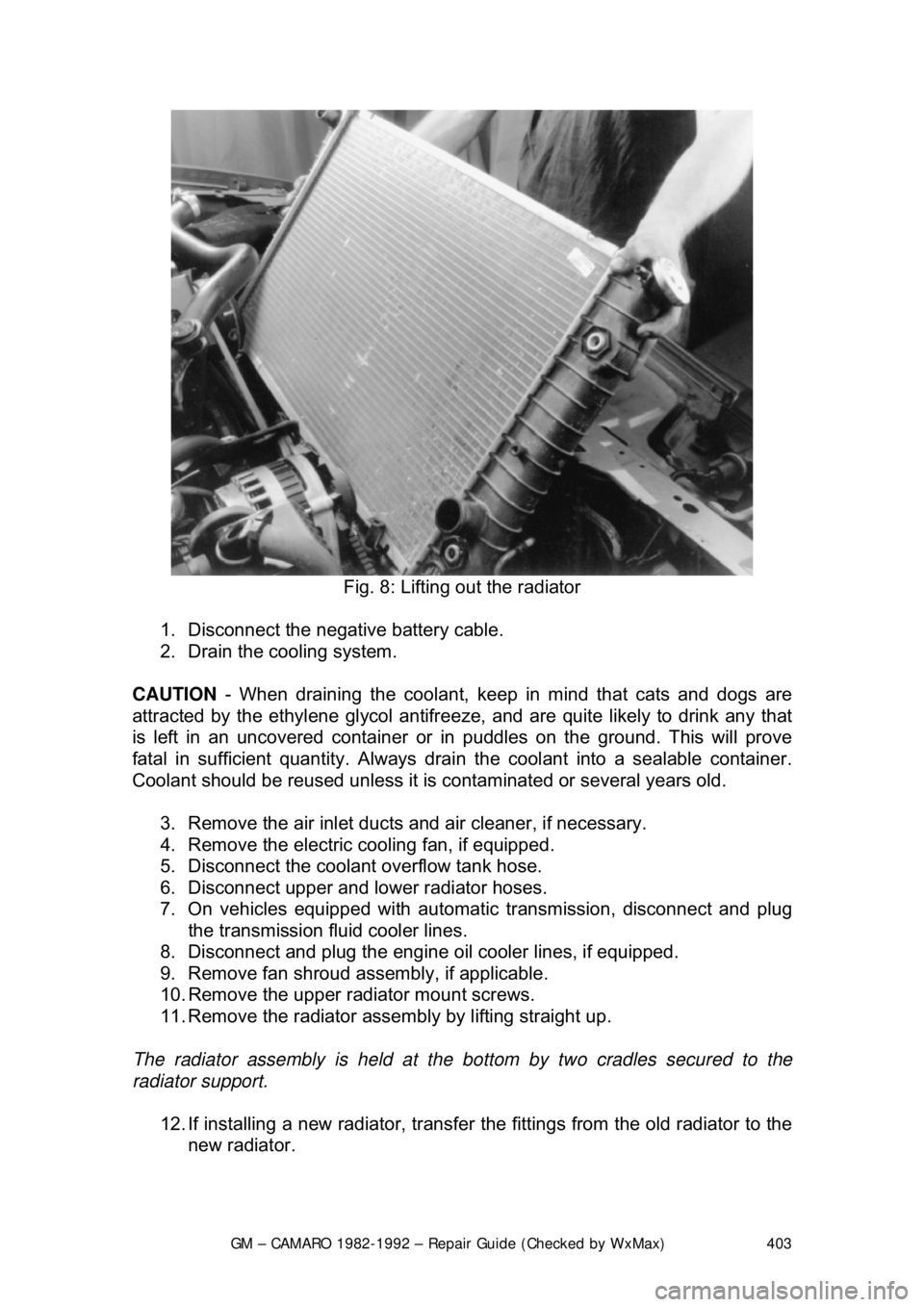
Fig. 8: Lifting out the radiator
1. Disconnect the negative battery cable.
2. Drain the cooling system.
CAUTION - When draining the coolant, keep in mind that cats and dogs are
attracted by the ethylene gl ycol antifreeze, and are quite likely to drink any that
is left in an uncovered container or in puddles on the ground. This will prove
fatal in sufficient quantity. Always drai n the coolant into a sealable container.
Coolant should be reused unless it is contaminated or several years old.
3. Remove the air inlet ducts and air cleaner, if necessary.
4. Remove the electric cooling fan, if equipped.
5. Disconnect the coolant overflow tank hose.
6. Disconnect upper and lower radiator hoses.
7. On vehicles equipped with automat ic transmission, disconnect and plug
the transmission fluid cooler lines.
8. Disconnect and plug the engine oil cooler lines, if equipped.
9. Remove fan shroud a ssembly, if applicable.
10. Remove the upper radiator mount screws.
11. Remove the radiator assembly by lifting straight up.
The radiator assembly is held at the bottom by tw o cradles secured to the
radiator support.
12. If installing a new radiat or, transfer the fittings from the old radiator to the
new radiator.
Page 422 of 875

GM – CAMARO 1982-1992 – Repair Guide (Checked by WxMax) 422
4. Drain the engine oil.
CAUTION
- Be sure that the catalytic c onverter is cool before proceeding.
5. Remove the air injection pipe at t he catalytic converter, if applicable.
6. Remove the catalytic converte r hanger bolts. Disconnect the exhaust
pipe at the manifold.
7. Remove the starter bolts, loosen t he starter brace, then lay the starter
aside.
8. Remove the front engine mount through-bolts.
9. Raise the engine enough to provide sufficient clearance for oil pan
removal.
10. Remove the oil pan bolts.
If the front crankshaft throw prohibits remo val of the pan, turn the crankshaft to
position the throw horizontally.
11. Remove the oil pan from the vehicle.
12. Remove the old RTV sealant or gasket from the oil pan and engine
block.
To install: 13. Run a
1/8 in. (3mm) bead of RTV around the oil pan sealing surface or
install a new gasket. Remember to keep the RTV on the INSIDE of the
bolt holes.
14. Install the pan and pan bolts. Torque the pan bolts to:
• 2.8L & 3.1L V6 (M6 x 1 X 16.0 bolts): 6-9 ft. lbs. (8-12 Nm)
• 2.8L & 3.1L V6 (M8 x 1.25 x 14.0 bolts ): 15-22 ft. lbs. (20-30 Nm)
• 1982-84 V8 engine (5/16-18 bolts): 165 inch lbs. (10 Nm)
• 1982-84 V8 engine (1/4-20 bolts): 80 inch lbs. (8 Nm)
• 1985 V8 engine (5/16-18 x 1.44 studs): minimum of 10 inch lbs.
• 1985 V8 engine (stud nuts): 150- 180 inch lbs. (17-20 Nm)
• 1985 V8 engine (1/4-20 x 0.56 bolts): 72-90 inch lbs. (8-10 Nm)
• 1985 V8 engine (1/4-20 x 0.50 x 0.56 studs): 72-90 inch lbs. (8-10
Nm)
• 1986-92 V8 engine (stud nuts): 150-250 inch lbs. (17-28 Nm)
• 1986-92 V8 engine (1/4-20 x 0.56 bolts): 72-130 inch lbs. (8-14
Nm)
• 1986-92 V8 engine (1/4-20 x 0.50 x 0.56 studs ): 72-130 inch lbs.
(8-14 Nm)
15. Lower the engine and install t he front engine mount through-bolts.
Torque bolts to 48 ft. lbs. (65 Nm).
16. Install the starter and starter brace, then secure using starter bolts.
17. Connect the exhaust pipe at the manifo ld. Install the catalytic converter
hanger bolts.
18. Install the air injection pipe at the catalytic converter.
19. Lower the vehicle.
20. Install the fan shroud assembly . Install the distributor cap.
21. Connect the negative battery cable at the battery and air cleaner.
Page 441 of 875

GM – CAMARO 1982-1992 – Repair Guide (Checked by WxMax) 441
2. Remove the fan, driv
e belts and water pump pul ley. Remove the valve
cover. Loosen the rocker arms and pivot them, then remove the
pushrods.
3. Remove the oil pump driveshaft and gear assembly. This is located
under a small plate secured by two bol ts near the oil filter. Remove the
spark plugs.
4. Mark the position of the distribut or rotor, housing, and engine block.
Remove the distributor.
5. Remove the valve lifters. They are located behind the pushrod cover.
6. Remove the timing gear cover.
7. Insert a screwdriver through the holes in the ti ming gear and remove the
2 camshaft thrust plate screws.
8. Pull the camshaft and gear assembly out through the front of the engine
block.
When removing the camshaft, be careful not to damage the camshaft bearings.
9. If the camshaft is to be removed from the timing gear, place the assembly in an arbor press and s eparate. CAUTION When removing the
timing gear from the camshaft, the thrust plate must be positioned so that
the woodruff key does not damage it.
To install: 10. To install the timing gear to the camshaft, press the assembly together
and measure the end clearance. T here should be 0.0015-0.0050 in.
(0.038-0.127mm) between the thrust plate and the camshaft.
If the clearance is less than 0.0015 in. (0 .038mm), replace the spacer ring; if
more than 0.0050 in. (0.127mm), replace the thrust ring.
11. Lubricate the camshaft, bearings, and lifters. Slide the camshaft
assembly into the engine and align the timing marks of the camshaft gear
and crankshaft gear.
12. Complete the installation by reversing the removal procedure.
V6 AND V8 ENGINES 1. Remove the engine from the vehicl e or remove all components from the
front of the engine (radi ator, grille, etc.).
2. Remove the timing gear cover and chain.
3. Mark the distributor rotor, housi ng and engine block, then remove the
distributor. Remove the fuel pump and fuel pump pushrod on carbureted
engines.
4. Remove the intake manifold and valve covers. Loosen the rocker arms
and pivot out of way. Remove the pushrods and valve lifters.
5. Remove the oil pump drive.
6. Slide the camshaft toward the front of the engine (be careful not to
damage the camshaft bearings).
Page 443 of 875

GM – CAMARO 1982-1992 – Repair Guide (Checked by WxMax) 443
Ensure that oil holes are properly al
igned. Replace camshaft rear plug, and
stake it into position to aid retention.
INSPECTION
CAMSHAFT LOBE LIFT
Check the lift of each lobe in consecutiv e order and make a note of the reading.
1. Remove the fresh air inlet tube a nd the air cleaner. Remove the heater
hose and crankcase ventilation hoses. Remove valve rocker arm
cover(s).
2. Remove the rocker arm stud nut or fulcrum bolts, fulcrum seat and rocker
arm.
3. Make sure the pushrod is in the valve tappet socket. Install a dial indicator so that the actuating poin t of the indicator is in the pushrod
socket (or the indicator ball socket adapter tool is on the end of the
pushrod) and in the same plane as the pushrod movement.
4. Disable the ignition and fuel systems.
5. Install a remote starter switch. Crank the engine with the ignition and fuel
system disabled. Turn the crankshaft ov er until the tappet is on the base
circle of the camshaft lobe. At this position, the pushrod will be in its
lowest position.
6. Zero the dial indicator. Continue to rotate the crankshaft slowly until the
pushrod is in the fully raised position.
7. Compare the total lift recorded on the dial indicator with the specification
shown on the Camshaft Specification chart.
To check the accuracy of the original in dicator reading, continue to rotate the
crankshaft until the indicator reads zero. If the lift on any lobe is below specified
wear limits listed, the ca mshaft and the valve tappet operating on the worn
lobe(s) must be replaced.
8. Install the rocker arm, fulcrum seat and stud nut or fulcrum bolts. Adjust
the valves, if required (r efer to the valves procedure in this section).
9. Install the valve rocker arm cover(s) and the air cleaner.
CAMSHAFT END PLAY
On all gasoline V8 engi nes, prying against the aluminum-nylon camshaft
sprocket, with the valve train load on t he camshaft, can break or damage the
sprocket. Therefore, the rocker arm adj usting nuts must be backed off, or the
rocker arm and shaft assembly must be loosened sufficiently to free the
camshaft. After checking the camshaft e nd play, check the valve clearance.
Adjust if required (refer to procedure in this section).
1. Push the camshaft toward the rear of the engine. Install a dial indicator or
equivalent so that the indicator point is on the camshaft sprocket
attaching screw.
Page 498 of 875

GM – CAMARO 1982-1992 – Repair Guide (Checked by WxMax) 498
3. Measure the gauge with the microm
eter and record the reading.
4. Again, hold the gauge square in t he bore, this time parallel to the
crankshaft centerline, and ge ntly tighten the lock. Again, you will tilt the
gauge back to remove it from the bore.
5. Measure the gaug e with the micrometer and record this reading. The
difference between these two readings is the out-of-round measurement
of the cylinder.
6. Repeat steps 1 through 5, each time going to the next lower position,
until you reach the bottom of the cyli nder. Then go to the next cylinder,
and continue until all of the cylinders have been measured.
The difference between these measurements will tell you all about the wear in
your cylinders. The measurements whic h were taken 90 degrees from the
crankshaft centerline will always reflect t he most wear. That is because at this
position is where the engine power presses the piston against the cylinder bore
the hardest. This is known as thrust wear. Take your top, 90 degree
measurement and compare it to your bottom, 90 degree measurement. The
difference between them is the taper. W hen you measure your pistons, you will
compare these readings to your pist on sizes and determine piston-to-wall
clearance.
CRANKSHAFT
Inspect the crankshaft for visible signs of wear or damage. All of the journals
should be perfectly round and smooth. Slight scores are normal for a used
crankshaft, but you should hardly feel them with your fingernail. When
measuring the crankshaft wit h a micrometer, you will take readings at the front
and rear of each journal, then turn t he micrometer 90 degrees and take two
more readings, front and rear. The differ ence between the front-to-rear readings
is the journal taper and the first-to -90 degree reading is the out-of-round
measurement. Generally, there should be no taper or out-of-roundness found,
however, up to 0.0005 in. (0.0127mm) fo r either can be overlooked. Also, the
readings should fall within the factory s pecifications for journal diameters.
If the crankshaft journals fall within specif ications, it is recommended that it be
polished before being returned to service. Polishing the crankshaft insures that
any minor burrs or high spots are smoot hed, thereby reducing the chance of
scoring the new bearings.
PISTONS AND CONNECTING RODS
PISTONS
The piston should be visually inspect ed for any signs of cracking or burning
(caused by hot spots or detonation), and scuffing or excessive wear on the
skirts. The wristpin attaches the piston to the connecting rod. The piston should
move freely on the wrist pin, both sliding and pivoting. Grasp the connecting rod
securely, or mount it in a vise, and tr y to rock the piston back and forth along
the centerline of t he wristpin. There should not be any excessive play evident
between the piston and the pin. If there are C-clips retaining the pin in the piston
Page 561 of 875

GM – CAMARO 1982-1992 – Repair Guide (Checked by WxMax) 561
3. Apply at least 7 in. Hg of vacuum
to the damper diaphragm unit. The
door should close. If it doesn't, che ck the diaphragm linkage for binding
and correct hookup.
4. With the vacuum still applied and t he door closed, clamp the tube to trap
the vacuum. If the door doesn't remain closed, there is a leak in the
diaphragm assembly.
REMOVAL & INSTALLATION
VACUUM MOTOR 1. Remove the air cleaner.
2. Disconnect the vacuum hose from the motor.
3. Drill out the spot welds with a
1/8 inch (3mm) bit, then enlarge as
necessary to remove the retaining strap.
4. Remove the retaining strap.
5. Lift up the motor and cock it to o ne side to unhook the motor linkage at
the control damper assembly.
To install: 6. In order to install t he new vacuum motor, drill a
7/64 inch (2.8mm) hole in
the snorkel tube as the c enter of the vacuum motor retaining strap.
7. Insert the vacuum motor linkage into the control damper assembly.
8. Use the motor retaining strap and a sheet metal screw to secure the
retaining strap and motor to the snorkel tube.
Make sure the screw does not interf ere with the operation of the damper
assembly. Shorten the screw if necessary.
TEMPERATURE SENSOR 1. Remove the air cleaner.
2. Disconnect the hoses at the air cleaner.
3. Pry up the tabs on the sensor reta ining clip and remove the clip and
sensor from the air cleaner.
To install: 4. Position sensor into air cleaner.
5. Install retaining clip.
6. Connect the hoses to the air cleaner.
7. Install the air cleaner.
AIR INJECTION REACTION (AIR) SYSTEM
OPERATION
The AIR management system is used to prov ide additional oxygen to continue
the combustion process after the exhaus t gases leave the combustion chamber.