head CHEVROLET CAMARO 1982 Repair Guide
[x] Cancel search | Manufacturer: CHEVROLET, Model Year: 1982, Model line: CAMARO, Model: CHEVROLET CAMARO 1982Pages: 875, PDF Size: 88.64 MB
Page 200 of 875

GM – CAMARO 1982-1992 – Repair Guide (Checked by WxMax) 200
9. Lubricate the speedometer cable
with an appropriate lubricant, being
sure to cover the lower thirds of the cable.
10. Insert the cable into the casi ng, then connect the cable and casing
assembly to the speedometer.
11. Install the instrument cluster, then install the cluster attaching screws.
12. Install the instrument cluster trim plate.
13. On models without cruise control, connect the speedometer cable strap
at the power brake booste r. On models with cruise control, connect the
speedometer cable at the cr uise control transducer.
14. Connect the negative battery cable at the battery.
WIPER SWITCH
REMOVAL & INSTALLATION
The wiper switch is part of the multi-function lever, located on the steering
wheel column.
1. Disconnect the electrical connector of the multi-function lever, located
under the instrument panel.
2. Remove the protective cover from the wire.
3. Grasp the lever firmly, twist and pull (the tang on the lever must align
with the socket) the lever straight out.
4. Pull the wire through the steering column.
To install: 5. Slide a music wire tool through the steering column and connect the
lever wire to the tool wire; pull t he wire through the steering column.
6. Push the control lever into the sp ring loaded socket (be sure to align the
tang).
7. Install the protective cover to the wire.
8. Connect the electrical connector of the multi-function lever.
HEADLIGHT SWITCH
REMOVAL & INSTALLATION 1. Disconnect the negative batte ry cable at the battery.
2. Remove the four screws from insi de the defroster duct (instrument panel
pad securing screws).
3. Remove the screws which are under the lip of the instrument panel pad.
4. Remove the instrument panel pad.
5. On models equipped with air condition ing, remove the instrument panel
cluster bezel and the cluster.
6. Remove the radio speaker bracket.
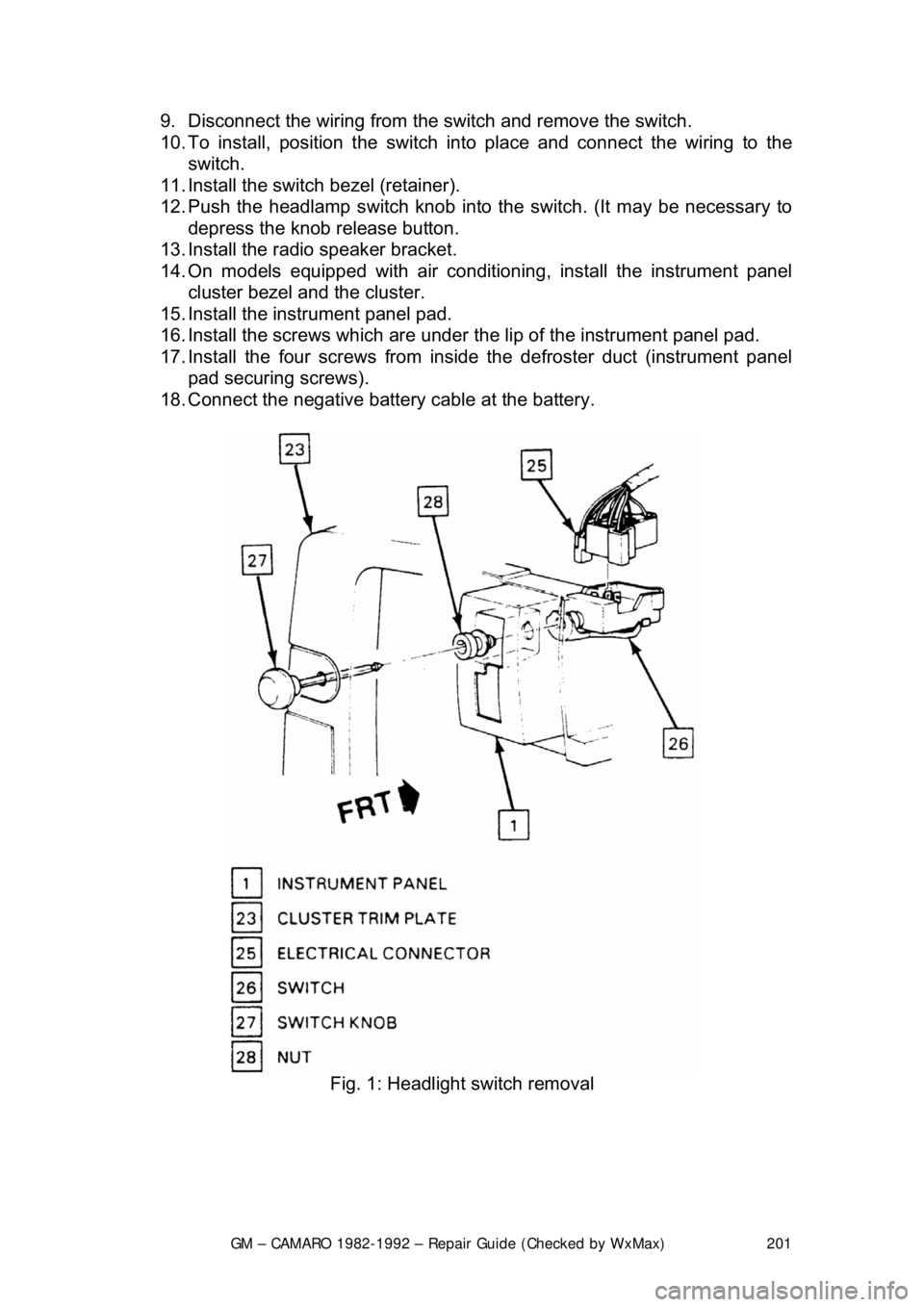
7. Pull the headlamp switch knob to the ON position, depress the locking
button for the knob and shaft (locat ed on the switch), and remove the
knob and shaft.
8. Remove the switch bezel (retainer).
Page 201 of 875
GM – CAMARO 1982-1992 – Repair Guide (Checked by WxMax) 201
9. Disconnect the wiring from the
switch and remove the switch.
10. To install, position t he switch into place and connect the wiring to the
switch.
11. Install the switch bezel (retainer).
12. Push the headlamp switch knob into the switch. (It may be necessary to
depress the knob release button.
13. Install the radio speaker bracket.
14. On models equipped with air conditioni ng, install the instrument panel
cluster bezel and the cluster.
15. Install the inst rument panel pad.
16. Install the screws which are under t he lip of the instrument panel pad.
17. Install the four screw s from inside the defroster duct (instrument panel
pad securing screws).
18. Connect the negative battery cable at the battery.
Fig. 1: Headlight switch removal
Page 203 of 875
GM – CAMARO 1982-1992 – Repair Guide (Checked by WxMax) 203
LIGHTING
HEADLIGHTS
REMOVAL & INSTALLATION
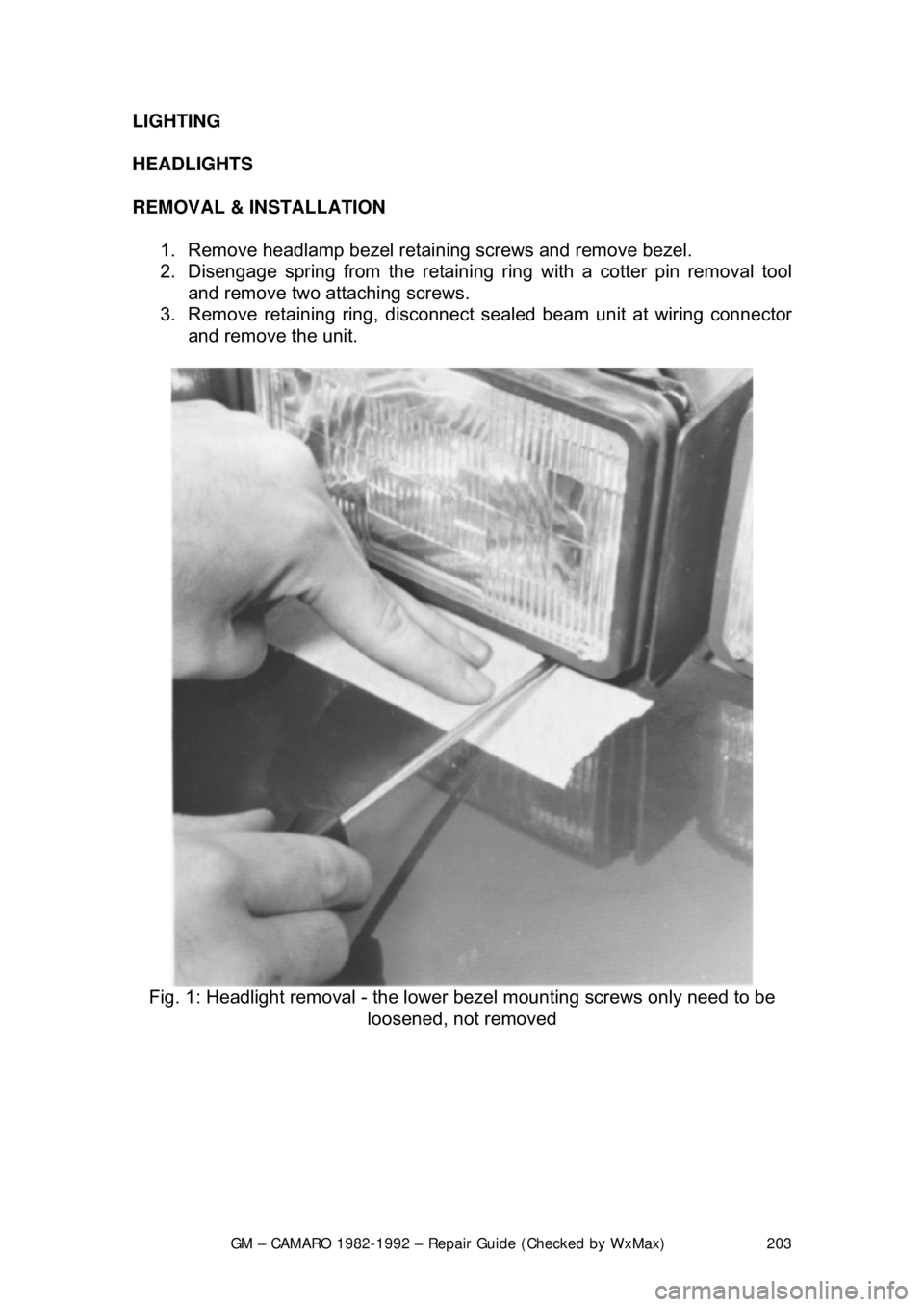
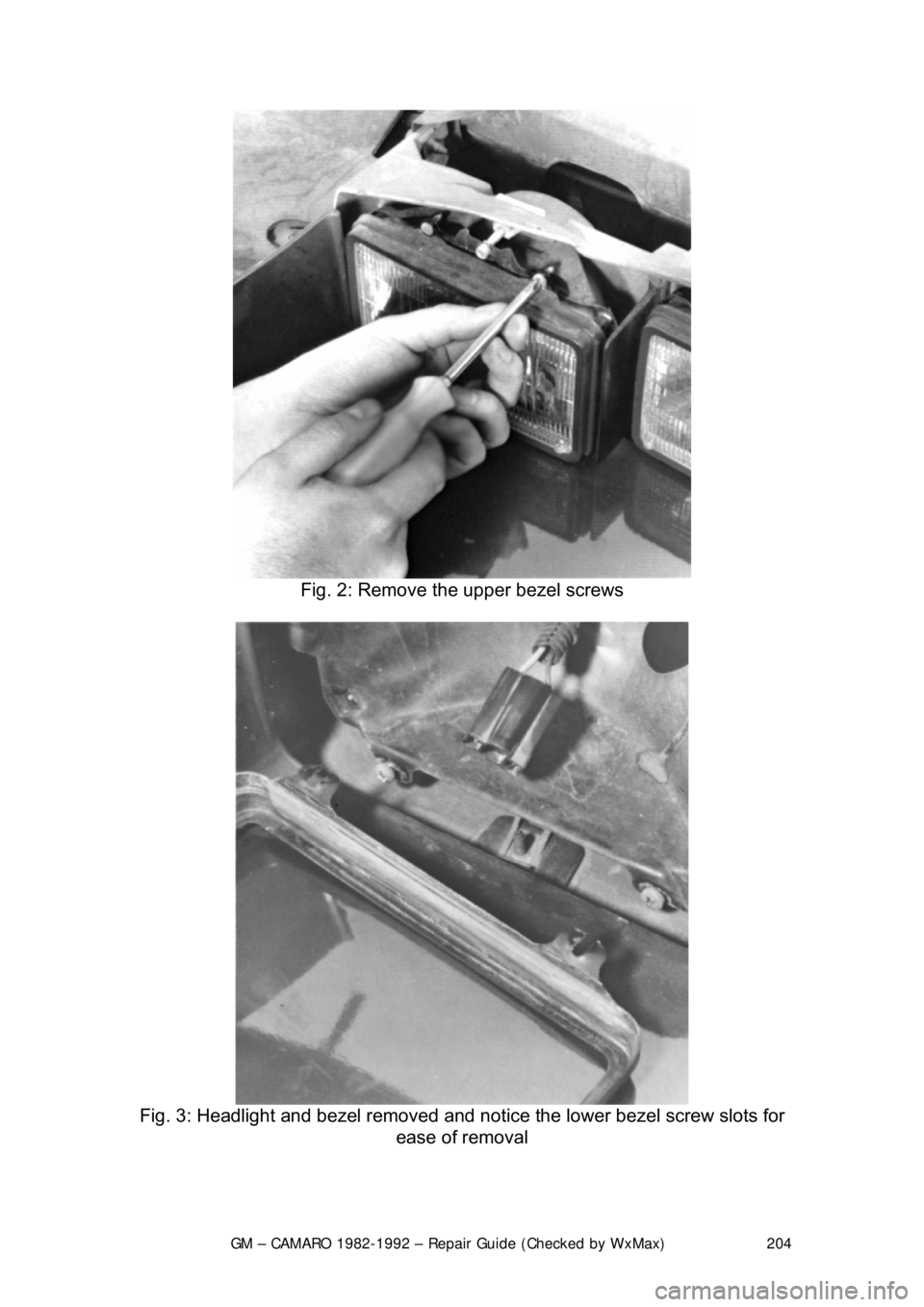
1. Remove headlamp bezel retain ing screws and remove bezel.
2. Disengage spring from the retaini ng ring with a cotter pin removal tool
and remove two attaching screws.
3. Remove retaining ring, disconnect sealed beam unit at wiring connector
and remove the unit.
Fig. 1: Headlight removal - the lowe r bezel mounting screws only need to be
loosened, not removed
Page 204 of 875
GM – CAMARO 1982-1992 – Repair Guide (Checked by WxMax) 204
Fig. 2: Remove the upper bezel screws
Fig. 3: Headlight and bezel removed and no tice the lower bezel screw slots for
ease of removal
Page 205 of 875
GM – CAMARO 1982-1992 – Repair Guide (Checked by WxMax) 205
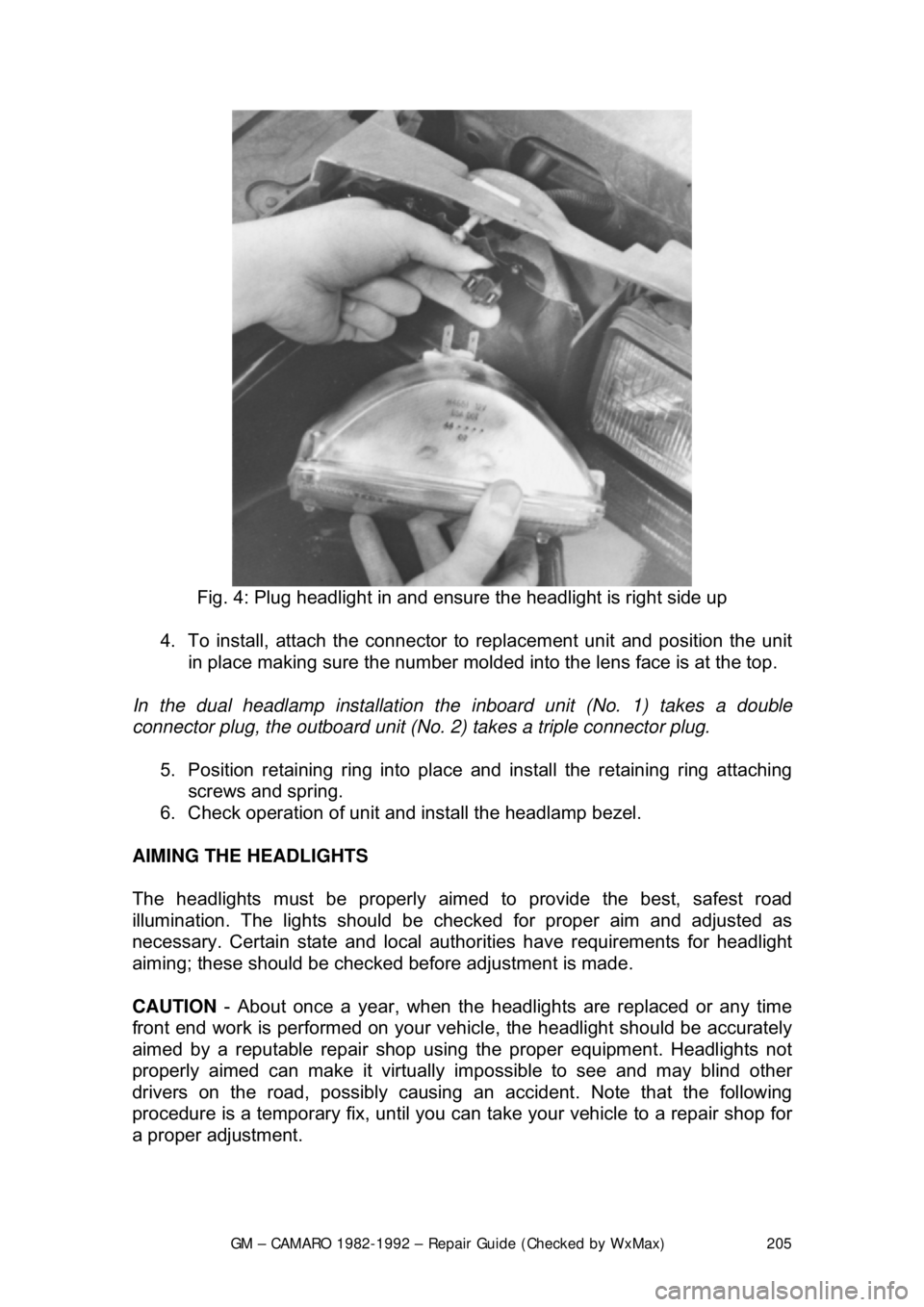
Fig. 4: Plug headlight in and ens ure the headlight is right side up
4. To install, attach the connector to replacement unit and position the unit
in place making sure the number molded in to the lens face is at the top.
In the dual headlamp installation the in board unit (No. 1) takes a double
connector plug, the outboard unit (No. 2) takes a triple connector plug.
5. Position retaining ring into place and install the retaining ring attaching
screws and spring.
6. Check operation of unit and install the headlamp bezel.
AIMING THE HEADLIGHTS
The headlights must be properly aimed to provide the best, safest road
illumination. The lights should be che cked for proper aim and adjusted as
necessary. Certain state and local author ities have requirements for headlight
aiming; these should be check ed before adjustment is made.
CAUTION - About once a year, w hen the headlights are r eplaced or any time
front end work is performed on your vehicl e, the headlight should be accurately
aimed by a reputable repai r shop using the proper equipment. Headlights not
properly aimed can make it virtually impossible to see and may blind other
drivers on the road, possibly causing an accident. Note that the following
procedure is a temporary fix, until you can take your vehicle to a repair shop for
a proper adjustment.
Page 206 of 875
GM – CAMARO 1982-1992 – Repair Guide (Checked by WxMax) 206
Headlight adjustment may
be temporarily made using a wall, as described
below, or on the rear of another vehicle. When adjust ed, the lights should not
glare in oncoming car or truck windshi elds, nor should they illuminate the
passenger compartment of vehi cles driving in front of you. These adjustments
are rough and should always be fine-t uned by a repair shop which is equipped
with headlight aiming t ools. Improper adjustments may be both dangerous and
illegal.
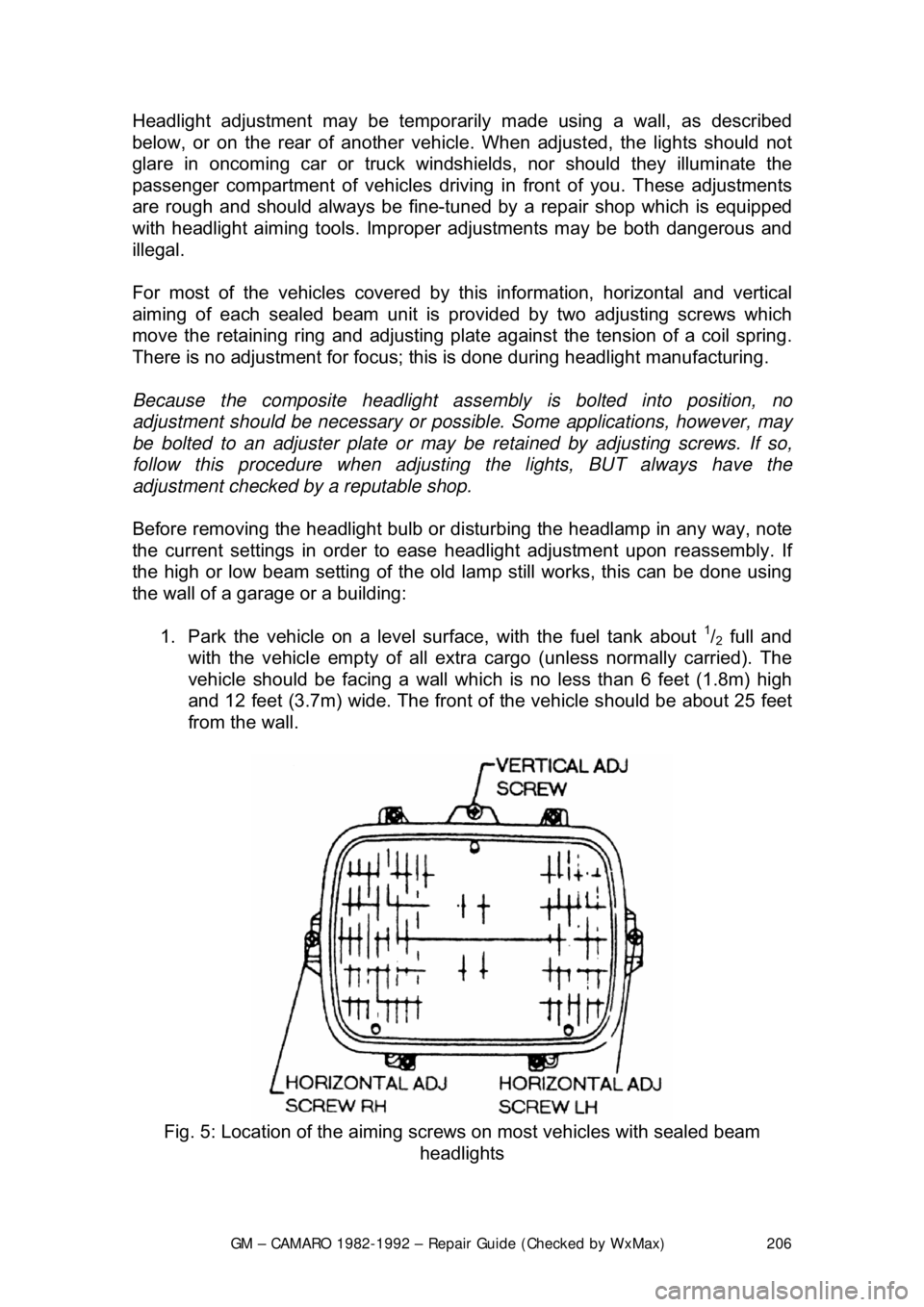
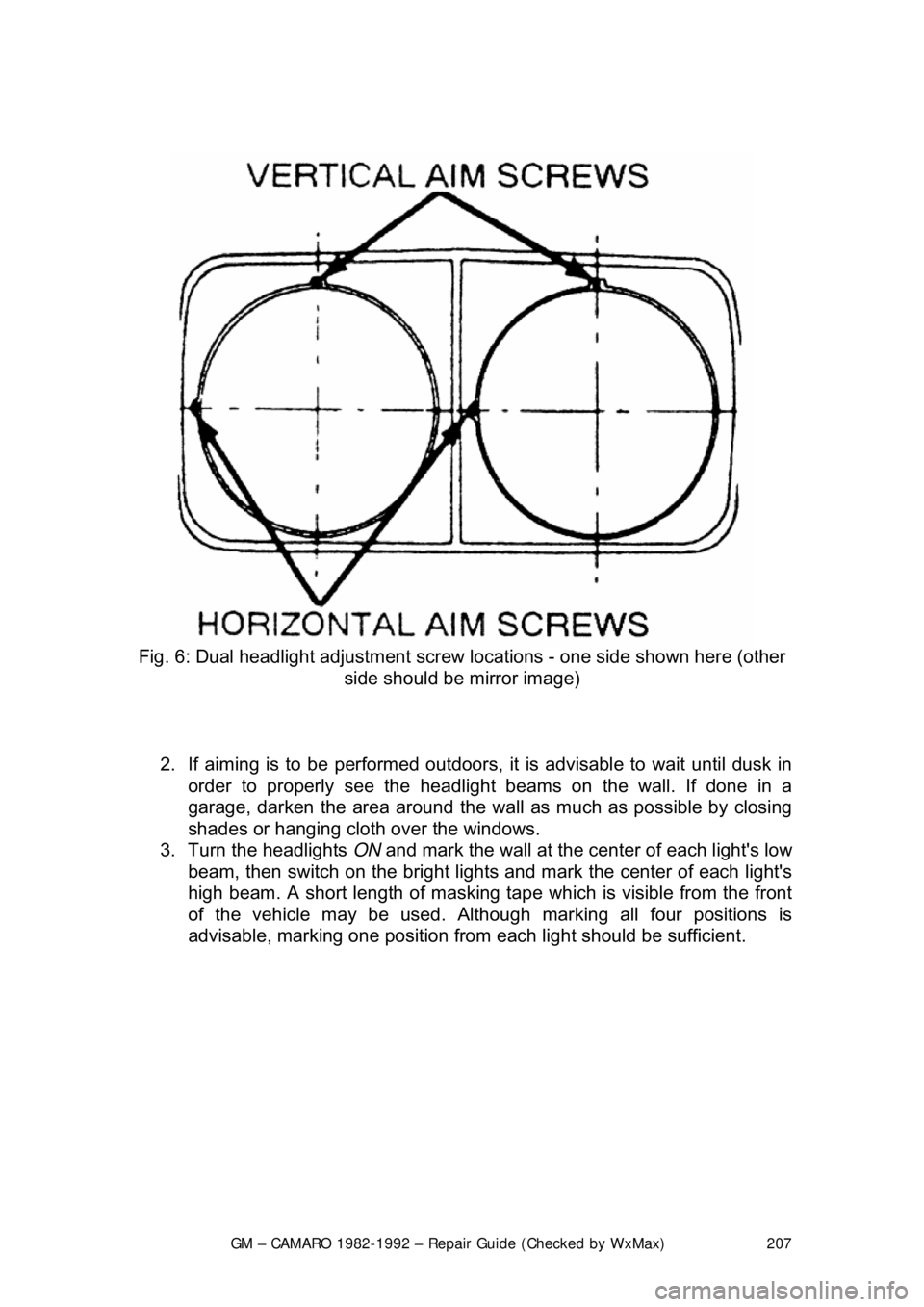
For most of the vehicles covered by th is information, horizontal and vertical
aiming of each sealed beam unit is provided by two adjusting screws which
move the retaining ring and adjusting plat e against the tension of a coil spring.
There is no adjustment for focus; this is done during headlight manufacturing.
Because the composite headlight asse mbly is bolted into position, no
adjustment should be necessary or possibl e. Some applications, however, may
be bolted to an adjuster plate or may be retained by adjusting screws. If so,
follow this procedure when adjusti ng the lights, BUT always have the
adjustment checked by a reputable shop.
Before removing the headlight bulb or di sturbing the headlamp in any way, note
the current settings in order to ease headlight adjustment upon reassembly. If
the high or low beam setting of the old la mp still works, this can be done using
the wall of a garage or a building:
1. Park the vehicle on a level su rface, with the fuel tank about
1/2 full and
with the vehicle empty of all extra cargo (unless normally carried). The
vehicle should be facing a wall whic h is no less than 6 feet (1.8m) high
and 12 feet (3.7m) wide. The front of the vehicle should be about 25 feet
from the wall.
Fig. 5: Location of the aiming screw s on most vehicles with sealed beam
headlights
Page 207 of 875
GM – CAMARO 1982-1992 – Repair Guide (Checked by WxMax) 207
Fig. 6: Dual headlight adjustment screw locations - one side shown here (other
side should be mirror image)
2. If aiming is to be performed outdoors, it is advisable to wait until dusk in
order to properly see t he headlight beams on the wall. If done in a
garage, darken the area around the wall as much as possible by closing
shades or hanging cloth over the windows.
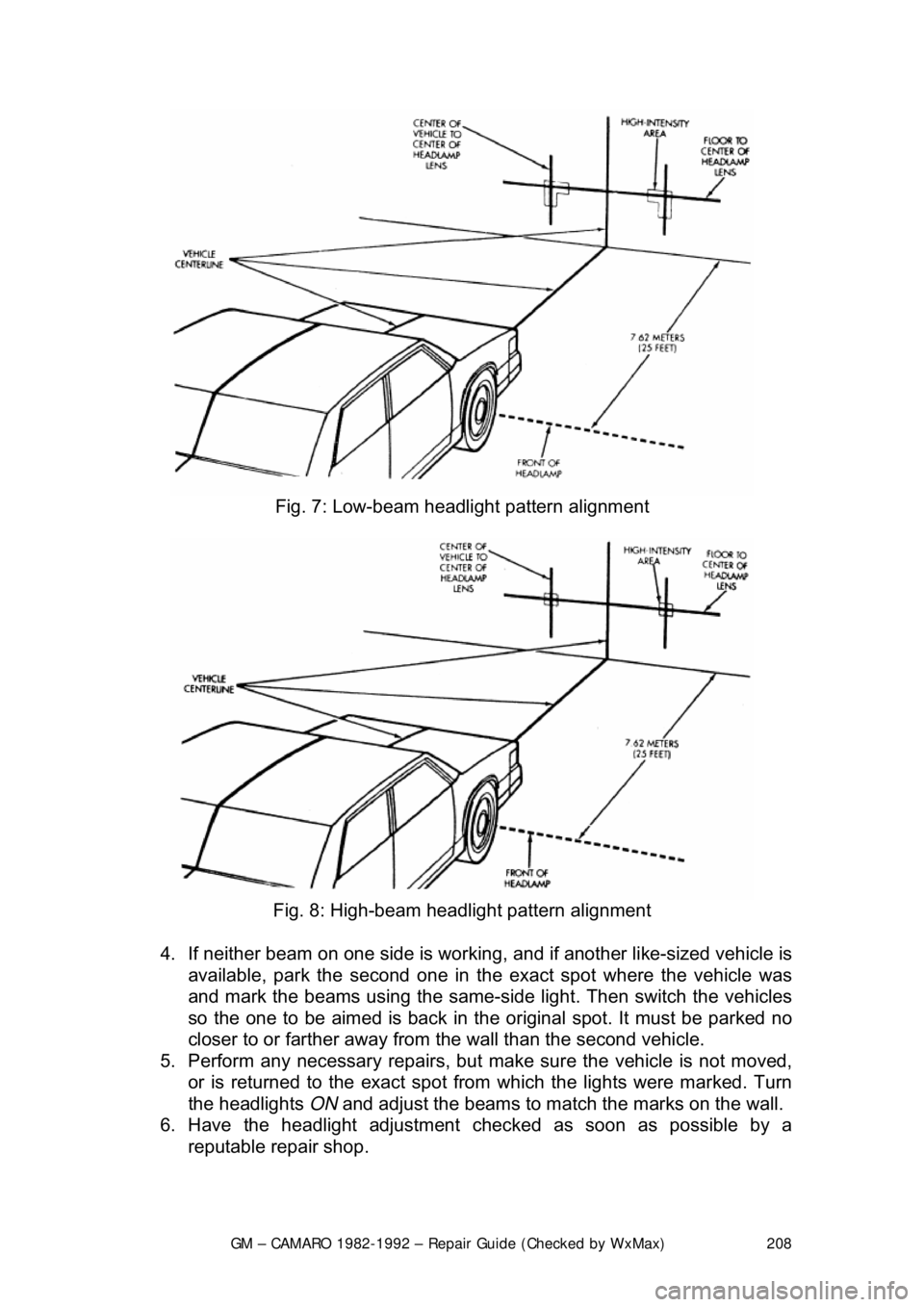
3. Turn the headlights ON and mark the wall at the center of each light's low
beam, then switch on the bright lights and mark the center of each light's
high beam. A short length of masking tape which is visible from the front
of the vehicle may be used. Althoug h marking all four positions is
advisable, marking one position from each light should be sufficient.
Page 208 of 875
GM – CAMARO 1982-1992 – Repair Guide (Checked by WxMax) 208
Fig. 7: Low-beam headlight pattern alignment
Fig. 8: High-beam headlight pattern alignment
4. If neither beam on one side is working, and if another like-sized vehicle is
available, park the sec ond one in the exact spot where the vehicle was
and mark the beams using the same-si de light. Then switch the vehicles
so the one to be aimed is back in the or iginal spot. It must be parked no
closer to or farther away from the wall than the second vehicle.
5. Perform any necessary repairs, but ma ke sure the vehicle is not moved,
or is returned to the exact spot from which the lights were marked. Turn
the headlights ON and adjust the beams to matc h the marks on the wall.
6. Have the headlight adjustment c hecked as soon as possible by a
reputable repair shop.
Page 223 of 875

GM – CAMARO 1982-1992 – Repair Guide (Checked by WxMax) 223
FUSIBLE LINKS
In addition to circuit breakers and fuses,
the wiring harness incorporates fusible
links to protect the wiring. Links are used rather than a fuse, in wiring circuits
that are not normally fused, such as th e ignition circuit. The fusible links are
color coded red in the charging and load circuits to match the color coding of
the circuits they protect. Each link is four gauges smaller than the cable it
protects, and is marked on the insulation with the gauge size because the
insulation makes it appear heavier than it really is. The engine compartment
wiring harness has several fusible links. The same size wire with a special
Hypalon insulation must be used w hen replacing a fusible link.
For more details, see the information on fusible links at the beginning of this
section.
The links are located in the following areas:
1. A molded splice at the starter solenoid Bat terminal, a 14 gauge red wire.
2. A 16 gauge red fusible link at the j unction block to protect the unfused
wiring of 12 gauge or larger wire. This link stops at the bulkhead
connector.
3. The alternator warning light and fiel d circuitry is protected by a 20 gauge
red wire fusible link used in the batte ry feed-to-voltage regulator number
3 terminal. The link is installed as a molded splice in the circuit at the
junction block.
4. The ammeter circuit is protected by two 20 gauge fusible links installed
as molded splices in the circuit at t he junction block and battery to starter
circuit.
REPLACEMENT 1. Determine the circuit that is damaged.
2. Disconnect the negative battery terminal.
3. Cut the damaged fuse link from the harness and discard it.
4. Identify and procure the proper fuse link and butt connectors.
5. Strip the wire about
1/2 in. (13mm) on each end.
6. Connect the fusible link and crimp the butt connectors making sure that the wires are secure.
7. Solder each connection with resin core solder, and wrap the connections
with plastic electrical tape.
8. Reinstall the wir e in the harness.
9. Connect the negative battery terminal and test the system for proper
operation.
CIRCUIT BREAKERS
Various circuit breakers are located under the instrument panel. In order to gain
access to these components, it may be ne cessary to first remove the under
dash padding. Most of the circuit breakers are located in the convenience
center or the fuse panel.
Page 287 of 875

GM – CAMARO 1982-1992 – Repair Guide (Checked by WxMax) 287
DRIVE TRAIN
MANUAL TRANSMISSION
UNDERSTANDING THE MANUAL TRANSMISSION
Because of the way an internal combus tion engine breathes, it can produce
torque (or twisting force) only withi n a narrow speed range. Most overhead
valve pushrod engines must turn at about 2500 rpm to produce their peak
torque. Often by 4500 rpm, they are prod ucing so little torque that continued
increases in engine speed produce no power increases.
The torque peak on overhead camshaft engines is, generally, much higher, but
much narrower.
The manual transmission and clutch are employed to vary the relationship
between engine RPM and the speed of the w heels so that adequate power can
be produced under all circumst ances. The clutch allows engine torque to be
applied to the transmission input shaft gradually, due to mechanical slippage.
The vehicle can, consequently, be star ted smoothly from a full stop.
The transmission changes the ratio between the rotating speeds of the engine
and the wheels by the use of gears. 4-speed or 5-speed transmissions are most
common. The lower gears al low full engine power to be applied to the rear
wheels during acceleration at low speeds.
The clutch driveplate is a thin disc, the center of which is splined to the
transmission input shaft. Both sides of the disc are covered with a layer of
material which is similar to brake li ning and which is capable of allowing
slippage without roughness or excessive noise.
The clutch cover is bolted to the engine flywheel and incorporates a diaphragm
spring which provides the pressure to engage the clutch. The cover also houses
the pressure plate. When the clutch pe dal is released, the driven disc is
sandwiched between the pressu re plate and the smooth surface of the flywheel,
thus forcing the disc to turn at th e same speed as the engine crankshaft.
The transmission contains a mainshaft which passes all the way through the
transmission, from the clutch to the dr iveshaft. This shaft is separated at one
point, so that front and rear portions can turn at different speeds.
Power is transmitted by a countershaft in the lower gears and reverse. The
gears of the countershaft mesh with gear s on the mainshaft, allowing power to
be carried from one to the other. Countershaft gears are often integral with that
shaft, while several of the mainshaft gea rs can either rotate independently of
the shaft or be locked to it. Shifting from one gear to the next causes one of the
gears to be freed from rotating with the shaft and locks another to it. Gears are
locked and unlocked by internal dog clutc hes which slide between the center of
the gear and the shaft. The forward gears us ually employ synchronizers; friction