warning CHEVROLET CAMARO 1982 Repair Guide
[x] Cancel search | Manufacturer: CHEVROLET, Model Year: 1982, Model line: CAMARO, Model: CHEVROLET CAMARO 1982Pages: 875, PDF Size: 88.64 MB
Page 577 of 875

GM – CAMARO 1982-1992 – Repair Guide (Checked by WxMax) 577
MALFUNCTION INDICATOR LAMP
The primary function of the MIL is to adv
ise the operator and the technician that
a fault is detected, and, in most cases, a code is stored. Under normal
conditions, the malfunction indicator la mp will illuminate when the ignition is
turned ON. Once the engine is started and running, the ECM will perform a
system check and extinguish the lamp if no fault is found.
Additionally, the lamp can be used to retrieve stored codes after the system is
placed in the Diagnostic Mode. Codes ar e transmitted as a series of flashes
with short or long pauses. When the syst em is placed in the Field Service
Mode, the dash lamp will indicate open loop or closed loop function to the
technician.
INTERMITTENTS
If a fault occurs intermittently, such as a loose connector pin breaking contact
as the vehicle hits a bump, the ECM will note the fault as it occurs and energize
the dash warning lamp. If the problem se lf-corrects, as with the terminal pin
again making contact, the dash lamp will extinguish after 10 seconds but\
a code
will remain stored in the ECM memory.
When an unexpected code appe ars during diagnostics, it may have been set
during an intermittent failure that self-c orrected; the codes are still useful in
diagnosis and should not be discounted.
OXYGEN SENSOR
OPERATION
An oxygen sensor is used on all models. The sensor protrudes into the exhaust
stream and monitors the oxygen content of the exhaust gases. The difference
between the oxygen content of the exhaust gases and that of the outside air
generates a voltage si gnal to the ECM. The ECM monitors this voltage and,
depending upon the value of the signal rece ived, issues a command to adjust
for a rich or a lean condition.
No attempt should ever be made to meas ure the voltage output of the sensor.
The current drain of any conventional vo ltmeter would be such that it would
permanently damage the sensor.
Page 594 of 875

GM – CAMARO 1982-1992 – Repair Guide (Checked by WxMax) 594
REMOVAL & INSTALLATION
1. Disconnect the negative battery cable.
2. Raise and safely support the vehicle.
3. Disconnect the VSS electrical wiring.
4. Remove the retaining bolt.
5. Have a clean container to catch the transmission fluid and remove the
VSS.
6. Remove and discard the O-ring.
To install: 7. Lubricate a new O-ring with a thin f ilm of transmission fluid. Install the O-
ring and VSS.
8. Install the retaining bolt.
9. Connect the electrical wiring.
10. Lower the vehicle.
11. Connect the negative battery cable.
12. Refill transmission to proper level.
TROUBLE CODES
SELF DIAGNOSTICS
READING CODES
The following procedure applies to mode ls with the 12 pin diagnostic connector
only.
1. Turn the ignition switch OFF. Locate the Assembly Line Diagnostic Link
(ALDL), usually under the instrument panel. It may be within a plastic
cover or housing labeled DIAGNOSTIC CONNECTOR. This link is used
to communicate with the ECM.
2. Use a small jumper wire to connect Terminal B of the ALDL to Terminal
A. As the ALDL connector is viewed from the front, Terminal A is on the
extreme right of the upper row; Terminal B is second from the right on
the upper row.
3. After the terminals are connected, turn the ignition switch to the ON
position but do not start the engine. T he dash warning lamp should begin
to flash Code 12. The code will disp lay as one flash, a pause and two
flashes. Code 12 is not a fault code. It is used as a system
acknowledgment or handshake code; its presence indicates that the
ECM can communicate as requested. Code 12 is used to begin every
diagnostic sequence.
4. After Code 12 has been transmitted 3 times, the fault codes, if any, will
each be flashed in the same manner th ree times. The codes are stored
and transmitted in numeric order from lowest to highest.
The order of codes in the memory does not indicate the order of occurrence.
Page 629 of 875

GM – CAMARO 1982-1992 – Repair Guide (Checked by WxMax) 629
as much voltage to fire the plug at hi
gh speeds than at idle. The improved
air/fuel ratio control of modern fuel injection combin ed with the higher voltage
output of modern ignition systems will often allow an engine to run significantly
longer on a set of standard spark plugs, but keep in mind that efficiency will
drop as the gap widens (along wit h fuel economy and power).
When you're removing spark plugs, work on one at a time. Don't start by
removing the plug wires all at once, because, unless you number them, they
may become mixed up. Take a minute before you begin and number the wires
with tape.
1. Disconnect the negative battery cabl e, and if the vehicle has been run
recently, allow the engine to thoroughly cool.
2. Carefully twist the spark plug wire boot to loosen it, then pull upward and
remove the boot from the plug. Be su re to pull on the boot and not on the
wire, otherwise the connector locat ed inside the boot may become
separated.
3. Using compressed air, blow any water or debris from the spark plug well
to assure that no harmful contam inants are allowed to enter the
combustion chamber when the spark plug is removed. If compressed air
is not available, use a rag or a brush to clean the area.
Remove the spark plugs when the engine is cold, if possible, to prevent damage
to the threads. If removal of the plugs is difficult, apply a few drops of
penetrating oil or silicone spray to t he area around the base of the plug, and
allow it a few minutes to work.
4. Using a spark plug socket that is equipped with a rubber insert to
properly hold the plug, turn the spar k plug counterclockwise to loosen
and remove the spark pl ug from the bore.
WARNING - Be sure not to use a flexible extension on the socket. Use of a
flexible extension may allow a shear fo rce to be applied to the plug. A shear
force could break the plug off in the cylinder head, leading to costly a\
nd
frustrating repairs.
To install:
5. Inspect the spark plug boot for t ears or damage. If a damaged boot is
found, the spark plug wire must be replaced.
6. Using a wire feeler gauge, check and adjust the spark plug gap. When
using a gauge, the proper size shoul d pass between the electrodes with
a slight drag. The next larger size should not be able to pass while the\
next smaller size should pass freely.
7. Carefully thread the plug into the bor e by hand. If resistance is felt before
the plug is almost completely th readed, back the plug out and begin
threading again. In small, hard to r each areas, an old spark plug wire and
boot could be used as a th reading tool. The boot will hold the plug while
you twist the end of the wire and t he wire is supple enough to twist
before it would allow t he plug to crossthread.
Page 630 of 875

GM – CAMARO 1982-1992 – Repair Guide (Checked by WxMax) 630
WARNING
- Do not use the spark plug socke t to thread the plugs. Always
carefully thread the plug by hand or us ing an old plug wire to prevent the
possibility of crossthreading and damaging the cylinder head bore.
8. Carefully tighten the spark plug. If the plug you are installing is equipped
with a crush washer, seat the plug, then tighten about
1/4 turn to crush
the washer. If you are installing a t apered seat plug, tighten the plug to
specifications provided by the vehicle or plug manufacturer.
9. Apply a small amount of silicone di electric compound to the end of the
spark plug lead or inside the spark pl ug boot to prevent sticking, then
install the boot to the spark plug and pus h until it clicks into place. The
click may be felt or hear d, then gently pull back on the boot to assure
proper contact.
INSPECTION & GAPPING
Check the plugs for deposits and wear. If they are not going to be replaced,
clean the plugs thoroughly. Remember t hat any kind of deposit will decrease
the efficiency of the plug. Plugs can be cleaned on a spark plug cleaning
machine, which can sometimes be found in service stations, or you can do an
acceptable job of cleaning with a stiff br ush. If the plugs are cleaned, the
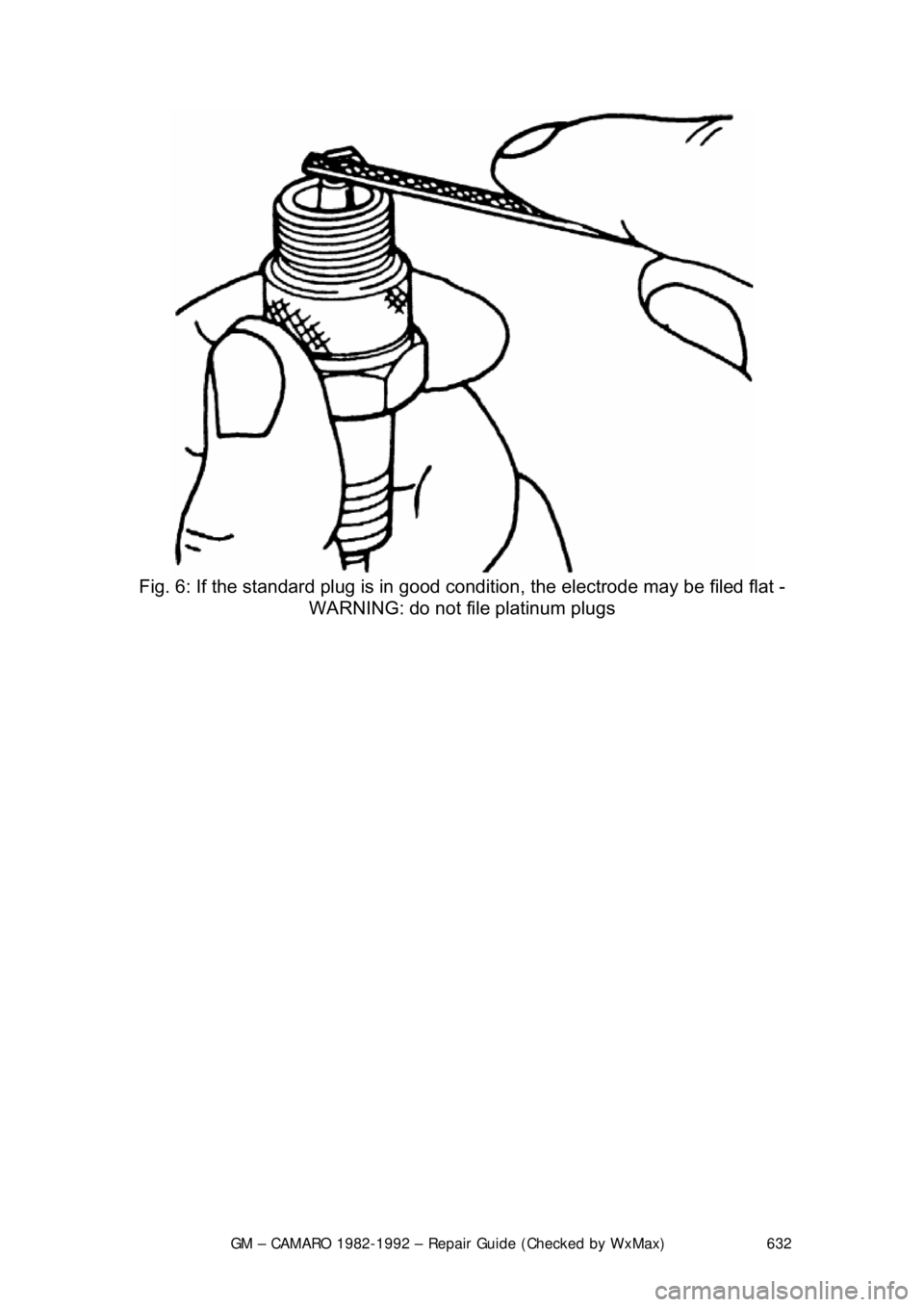
electrodes must be filed flat. Use an igni tion points file, not an emery board or
the like, which will leave deposits. The electrodes must be filed perfectly flat
with sharp edges; rounded edges reduce the s park plug voltage by as much as
50%.
Check spark plug gap before installati on. The ground electrode (the L-shaped
one connected to the body of the plug) mu st be parallel to the center electrode
and the specified size wire gauge (please refer to the Tune-Up Specifications
chart for details) must pass between t he electrodes with a slight drag.
NEVER adjust the gap on a used platinum type spark plug .
Always check the gap on new plugs as they are not always set correctly a\
t the
factory. Do not use a flat feeler g auge when measuring the gap on a used plug,
because the reading may be inaccurate. A round-wire type gapping tool is the
best way to check the gap. The co rrect gauge should pass through the
electrode gap with a slight drag. If you're in doubt, try one size smaller and one
larger. The smaller gauge should go through easily, while the larger one\
shouldn't go through at all. Wire gapping tools usually have a bending tool
attached. Use that to adjust the side electrode until the proper distance is
obtained. Absolutely never attempt to bend the center electrode. Also, be
careful not to bend the side electrode too fa r or too often as it may weaken and
break off within the engine, requiring remova l of the cylinder head to retrieve it.
Page 632 of 875
GM – CAMARO 1982-1992 – Repair Guide (Checked by WxMax) 632
Fig. 6: If the standard plug is in good c ondition, the electrode may be filed flat -
WARNING: do not file platinum plugs
Page 655 of 875

GM – CAMARO 1982-1992 – Repair Guide (Checked by WxMax) 655
2. Clean off the marks and coat them wit
h white paint or chalk, if necessary,
so that they may be seen.
3. Run the engine until it reaches no rmal operating temperature, then shut
off the engine.
4. With the ignition OFF, connect a ta chometer to the distributor, and a
timing light with an inductive pickup lead to the No. 1 spark plug wire.
WARNING - Never pierce a secondary ignition wire in order to connect a timing
light. A pierced wire may lead to engine misfiring and driveability problems.
5. To properly set the ignition timing , the EST must be placed in the bypass
mode. a. On the 2.5L engine, refer to t he emission control label for the
procedure.
If the label is missing or unreadable, c ontact your Chevrolet dealer for a
replacement.
b. On 2.8L and 5.0L ca rbureted engines, disconnect the 4-wire EST
connector at the distributor. (Fault code 42 may be set in ECM memory,
and must be cleared once the procedur e is completed). Proceed to Step
7.
c. On 2.8L, 5.0L and 5.7L fuel inje cted engines, with the engine RUNNING
and all accessories off, use a jumper wire to connect diagnostic terminal
B and ground terminal A of the 12-terminal Assembly Line Diagnostic
Link (ALDL) usually located under t he left side of the instrument panel.
DO NOT disconnect the 4-wir e EST connector at the distributor. Aim the
timing light at the timing mark; the li ne on the balancer or pulley will line
up with the timing mark. Increase engine speed and check for timing
advance. If the timing still advances with engine speed, perform Step 6. If
timing does not advance with engi ne speed, proceed to Step 7.
If timing advances with engine speed, it will be necessary to disconnect the
single-wire Set Timing connector. (Faul t code 42 may be set in ECM memory,
and must be cleared once the procedure is completed).
6. Remove the jumper wire from t he ALDL, and shut off the ignition.
Disconnect the Set Timing connector, usually located under the plastic
cover above the heater unit, in the engi ne compartment. (The wire in this
connector is normally Tan/Black.)
7. With the engine running and all accessories off, aim the light at the timing
mark. The line on the balancer or pulle y will line up with the timing mark.
If a change in timing is necessary, loosen the hold-down clamp bolt at
the base of the distributor . While observing the timing mark, rotate the
distributor slightly unt il the line indicates the correct timing. Use the
timing specification on the emi ssion control label in the engine
compartment. If this label is missi ng or damaged, refer to the Tune-Up
Specifications chart in this Section.
Page 656 of 875

GM – CAMARO 1982-1992 – Repair Guide (Checked by WxMax) 656
8. Once the timing is set to specific
ation, tighten the distributor hold-down
clamp. Recheck the timing to make su re it did not change while the bolt
was being tightened.
9. Remove the jumper wire from the ALDL connector, if applicable, with the
engine still running. (Usually, if this is performed before the engine is
shut off, no trouble codes will be stored.)
10. Turn the engine OFF, then remove the timing light and tachometer.
Reconnect the number 1 spark plug wire, if disconnected.
11. Attach the 4-wire EST connector at the distributor, or reconnect the Set
Timing connector, if applicable.
12. Check for fault code 42, and clear, if necessary, by disconnecting the
negative battery cable for at least 30 seconds.
To prevent ECM damage, the key must be in the OFF position when
disconnecting or reconnecting battery cables.
1988-90 VEHICLES
When adjusting the timing, refer to the instructions on the emission control
sticker inside the engine compartment. If th e instructions on the label disagree
with the procedure listed below, follo w the instructions on the label.
1. Locate the timing marks on the cran kshaft pulley and the front of the
engine.
2. Clean off the marks and coat them with white paint or chalk, so that they
may be easily seen.
3. Run the engine until it reaches no rmal operating temperature, then shut
off the engine.
4. With the ignition OFF, connect a ta chometer to the distributor, and a
timing light with an inductive pickup lead to the No. 1 spark plug wire.
WARNING - Never pierce a secondary ignition wire in order to connect a timing
light. A pierced wire may lead to engine misfiring and driveability problems.
5. Start the engine. With the engine running and all accessories off, use a
jumper wire to connect diagnostic terminal B and ground terminal A of
the 12-terminal Assembly Line Diagnostic Link (ALDL), located under the
instrument panel.
If jumping the ALDL terminals does not prevent timing advance, the EST
bypass wire will have to be disconnected instead.
6. Aim the timing light at the timing mark. The line on the balancer or pulley
will line up with the timing mark. If a change in timing is necessary,
loosen the hold-down clamp bolt at t he base of the distributor. While
observing the timing mark, rotate the distributor slightly until the line
indicates the correct timing. Use t he timing specification on the emission
control label in the engine compartm ent. If this label is missing or
damaged, refer to the Tune- Up Specifications chart in this Section.
Page 658 of 875
GM – CAMARO 1982-1992 – Repair Guide (Checked by WxMax) 658
Connect the timing light power leads
according to the manufacturer's
instructions.
WARNING - Never pierce a secondary ignition wire in order to connect a timing
light. A pierced wire may lead to engine misfiring and driveability problems.
5. Start the engine. With the engine running at normal operating
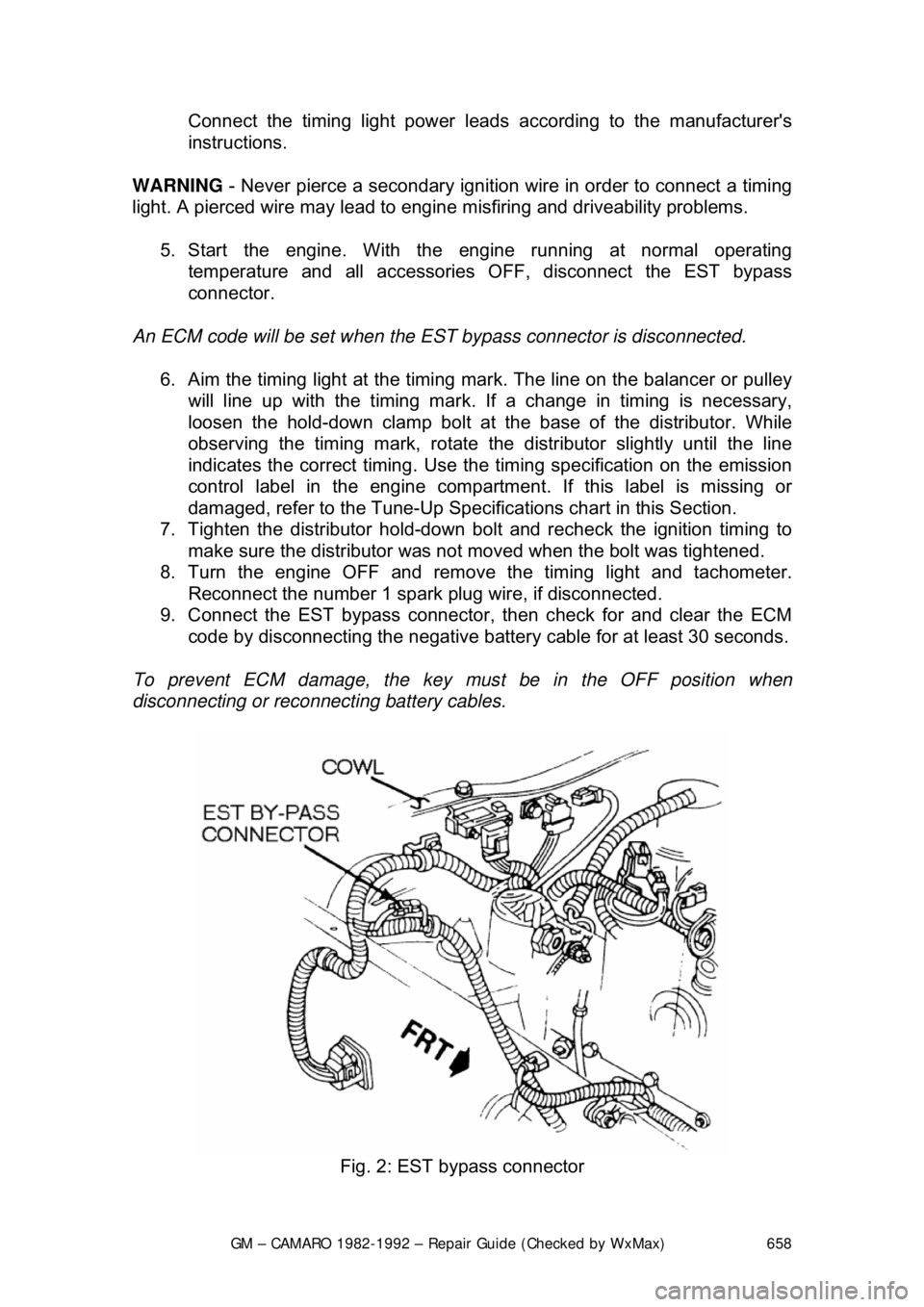
temperature and all accessories OFF, disconnect the EST bypass
connector.
An ECM code will be set when the EST bypass connector is disconnected.
6. Aim the timing light at the timing mark. The line on the balancer or pulley
will line up with the timing mark. If a change in timing is necessary,
loosen the hold-down clamp bolt at t he base of the distributor. While
observing the timing mark, rotate the distributor slightly until the line
indicates the correct timing. Use t he timing specification on the emission
control label in the engine compartm ent. If this label is missing or
damaged, refer to the Tune- Up Specifications chart in this Section.
7. Tighten the distributor hold-down bolt and recheck the ignition timing to
make sure the distributor was not moved when the bolt was tightened.
8. Turn the engine OFF and remove the timing light and tachometer.
Reconnect the number 1 spark plug wire, if disconnected.
9. Connect the EST bypass connector , then check for and clear the ECM
code by disconnecting the negative battery cable for at least 30 seconds.
To prevent ECM damage, the key must be in the OFF position when
disconnecting or reconnecting battery cables.
Fig. 2: EST bypass connector
Page 716 of 875

GM – CAMARO 1982-1992 – Repair Guide (Checked by WxMax) 716
INJECTOR REPLACEMENT
Use care in removing injectors to prev
ent damage to the electrical connector
pins on top of the injector, the fuel injector fuel filter and nozzle. The fuel injector
is serviced as a complete assembly on ly and should never be immersed in any
type of cleaner.
SINGLE INJECTOR UNITS 1. Relieve the fuel system pressure.
2. Remove the air cleaner.
3. Detach the injector connector by squeezing the two tabs together and
pulling straight up.
4. Remove the screws securing the fuel meter cover. Note the location of
any short screws for correct placement during reassembly.
CAUTION - DO NOT remove the four screws se curing the pressure regulator to
the fuel meter cover. The fuel pressure regulator includes a large spring under
heavy tension which could cause personal injury if released.
5. With the old fuel meter gasket in place to prevent damage to the casting,
use a prytool and fulcrum to pry the inje ctor carefully until it is free from
the fuel meter body.
6. Remove the injector.
7. Remove the large O-ring and steel back-up washer at the top of the
injector cavity in the fuel meter body.
8. Remove the small O-ring located at the bottom of the injector cavity.
To Install: 9. Lubricate the new, small O-ring with automatic transmission fluid; then,
push the new O-ring on the nozzle end of the injector up against the
injector fuel filter.
10. Install the steel backup washer in the recess of the fuel meter body.
Lubricate the new large O-ring with automatic transmission fluid, then
install the O-ring directly above t he backup washer, pressing the O-ring
down into the cavity recess. The O-ri ng is properly installed when it is
flush with the casting surface.
WARNING - Do not attempt to reverse this procedure and install the backup
washer and O-ring after the injector is located in the cavity. To do so will
prevent proper seating of the O-ring in th e cavity recess which could result in a
fuel leak and possible fire.
11. Install the injector by using a pushing/twisting mo tion to center the nozzle
O-ring in the bottom of the injector cavity and aligning the raised lug on
the injector base with the notch cast into the fuel meter body. Push down
on the injector making sure it is fully seated in the cavity. Injector
installation is correct when the lug is seated in the notch and the
electrical terminals are parallel to the throttle shaft.
Page 719 of 875

GM – CAMARO 1982-1992 – Repair Guide (Checked by WxMax) 719
11. Lubricate the new large O-ring with cl
ean engine oil and install it directly
over the backup washer. Be sure t he O-ring is seated properly and is
flush with the top of the fuel meter body surface.
12. Lubricate the new small O-ring with clean engine oil and install it on the
nozzle end of the injector. Push t he O-ring on far enough to contact the
filter.
WARNING - Do not attempt to reverse this procedure and install the backup
washer and O-ring after the injector is located in the cavity. To do so will
prevent proper seating of the O-ring in th e cavity recess which could result in a
fuel leak and possible fire.
13. Install the injector by aligning the raised lug on the injector base with the
notch cast into the fuel meter body . Push down on the injector making
sure it is fully seated in the cavity. In jector installation is correct when the
lug is seated in the notch and the electrical terminals are parallel to the
throttle shaft.
14. Using new gaskets on the fuel mete r cover and a new dust seal, install
the cover to the fuel meter body. Use an appropriate thread locking
compound on the cover attaching screws.
15. Connect the injector electrical c onnector by pushing straight down until
seated firmly in place.
16. Connect the negative battery cable.
17. With the engine OFF and the igniti on ON, check for fuel leaks.
18. Install the air cleaner.
ADJUSTMENTS
MINIMUM IDLE SPEED
Minimum idle speed should only be adjus ted when installing a replacement
throttle body. The idle stop screw is used to regulate the minimum idle speed of
the engine. The throttle body is adjusted at the factory, then covered with a cap
or plug to discourage unnecessary readjustment.
2.5L ENGINES 1. Remove the air cleaner and pl ug the THERMAC vacuum port.
2. Disconnect the TV cable from the th rottle control bracket to allow access
to the idle adjustment screw.
3. Remove the throttle stop screw plug or cap.
4. Connect a tachometer to the engine.
5. Disconnect the Idle Air Control (IAC) valve connector.
6. Start the engine with the transmi ssion in PARK (auto transmission) or
NEUTRAL (manual transmission) and allow the engine speed to
stabilize. All accessories (A/C, rear defogger, etc.) should be OFF.
7. Install tool J-33047 in t he idle air passage of the throttle body. Be certain
that the tool seats fully in t he passage and no air leaks exist.