change time CHEVROLET CAMARO 1993 User Guide
[x] Cancel search | Manufacturer: CHEVROLET, Model Year: 1993, Model line: CAMARO, Model: CHEVROLET CAMARO 1993Pages: 358, PDF Size: 15.6 MB
Page 233 of 358
You should look for this on the oil
container, and use
only those oils that
display the logo.
GM Goodwrench@
oil (in Canada, GM
Engine Oil) meets all
the requirements for
your vehicle.
Engine Oil Additives:
Don’t add anything to your oil. Your
Chevrolet dealer is ready
to advise if you
think something should be added.
When to Change Engine Oil:
See if any one of these is true for you:
0 Most trips are less than 4 miles (6
km).
It’s below freezing outside and most
trips are less than
10 miles (16 km).
The engine is at low speed most of the
time (as
in door-to-door delivery, or in
stop-and-go traffic).
0 You tow a trailer often.
0 Most trips are through dusty places.
If any one of these is true for your
vehicle, then you need to change your
oil
and filter every 3,000 miles (5 000 km)
or 3 months - whichever comes first. If none
of them is true, change the oil
every
7,500 miles (12 500 km) or 12
months - whichever comes first. Change
the filter at the first oil change and at
every other
oil change after that.
Engine Block Heater:
An engine block heater can be a big help
if you have to park outside in very cold
weather,
0 OF (- 1 8 O C) or colder. If your
vehicle has this option, see “Engine Block
Heater’’
in the Index.
ProCarManuals.com
Page 237 of 358
Automatic Transmission Fluid
When to Check and Change:
A good time to check your automatic
transmission fluid level is when the
engine oil is changed. Refer
to the
Maintenance Schedule
to determine when
to change your fluid. See “Scheduled
Maintenance Services” in the Index.
How to Check:
Because this operation can be a little
difficult, you may choose to have this
done at a Chevrolet dealership Service
Department.
If you do it yourself, be sure to follow all
the instructions here,
or you could get a
false reading
on the dipstick. damage
your transmission.
Too
much can mean that some of thr
fluid could come
out and fall on hc
~.: engine parts, starting a fire. Be sure
to get an accurate reading if you ~“* check your transmission fluid. ~, \- ~
%it at least 30 minutes before checking
he transmission fluid level
if you have
>een driving:
D When outside temperatures are above
At high speed for quite a while.
0 In heavy traffic - especially in hot
While pulling a trailer.
90°F (32°C).
weather. To
get the right reading, the fluid should
be at normal operating temperature,
which is 180°F to 200°F
(82°C to 93°C).
To check transmission fluid hot: Get
the vehicle warmed up by driving
about
15 miles (24 km) when outside
temperatures are above
50°F (10OC). If
it’s colder than
50°F (lO”C), drive the
vehicle in
D (Third Gear) until the engine
temperature gage moves and then remains
steady for ten minutes. Then follow the
hot check procedures.
To check transmission fluid cold: A cold
check is made after the vehicle has been
sitting for eight hours
or more with the
engine off and
is used only as a reference.
Let the engine run at idle for five minutes
233 = =
ProCarManuals.com
Page 239 of 358
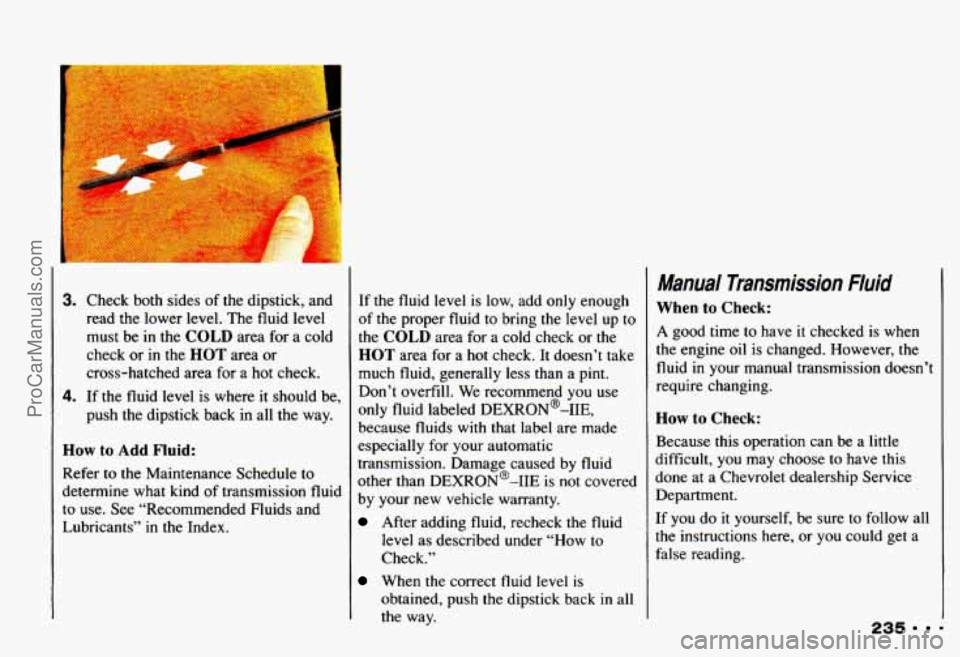
3. Check both sides of the dipstick, and
read the lower level. The fluid level
must be
in the COLD area for a cold
check or in the
HOT area or
cross-hatched area for a
hot check.
4. If the fluid level is where it should be,
push the dipstick back
in all the way.
How to Add Fluid:
Refer to the Maintenance Schedule to
determine what kind of transmission fluid
to use. See “Recommended Fluids and
Lubricants” in the Index. If the fluid level is low, add only enough
of the proper fluid to bring the level up to
the COLD area for
a cold check or the
HOT area for a hot check. It doesn’t take
much fluid, generally less than a pint.
Don’t overfill. We recommend you use
only fluid labeled
DEXRON@-IIE,
because fluids with that label are made
especially for your automatic
transmission. Damage caused by
fluid
other than DEXRON@-IIE is not covered
by your new vehicle warranty.
After adding fluid, recheck the fluid
level as described under “How to
Check.”
obtained, push the dipstick back
in all
the way.
When the correct fluid level is
Manual Transmission Fluid
When to Check:
A good time to have it checked is when
the engine oil is changed. However, the
fluid in your manual transmission doesn’t
require changing.
How to Check:
Because this operation can be a little
difficult, you may choose to have this
done at a Chevrolet dealership Service
Department.
If
you do it yourself, be sure to follow all
the instructions here, or you could get a
false reading.
235 9
ProCarManuals.com
Page 250 of 358
Service & Appearance Care
I
246
Replacing Brake System Parts
The braking system on a modern vehicle is complex. Its many parts have to be
of
top quality and work well together if the
vehicle is to have really good braking.
Vehicles we design and test have
top-quality
GM brake parts in them, as
your Chevrolet does when it is
new.
When you replace parts of your braking
system
- for example, when your brake
linings wear down and you have to have
new ones put in
- be sure you get new
genuine GM replacement parts. If you
don’t, your brakes may no longer work
properly. For example, if someone puts
in
brake linings that are wrong for your
vehicle, the balance between your front
and rear brakes
can change, for the worse.
The braking performance you’ve come to
expect can change in many other ways if
someone puts
in the wrong replacement
brake parts.
Battery
Every new Chevrolet has a Delco
Freedoma battery.
You never have to add
water to one of these. When it’s time for a
new battery, we recommend a Delco
Freedom@ battery. Get one that has the
catalog number shown
on the original
battery’s label.
ProCarManuals.com
Page 263 of 358
Rust or dirt on a wheel, or on
- the parts to which it is fastened,
can make wheel
nuts become loose
after a time. The wheel could come
off and cause an accident. When
you change a wheel, remove any
rust
or dirt from places where the
wheel attaches
to the vehicle. In an
emergency,
you can use a cloth or a
paper towel to do this; but be sure to
use a scraper
or wire brush later, if
you need to, to get all the rust or dirt
off. (See “Changing
a Flat Tire” in
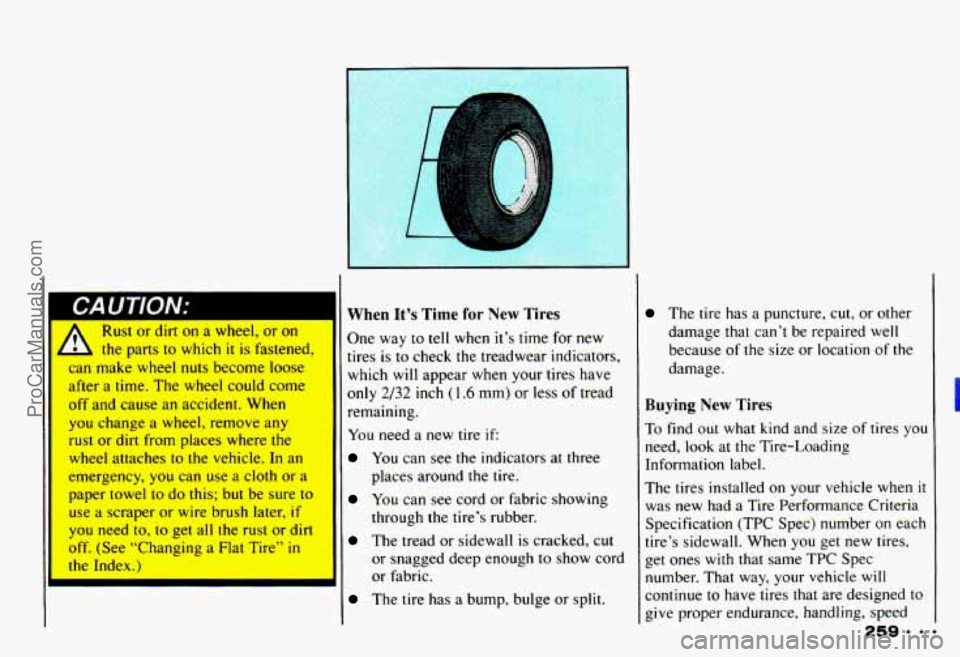
When It’s Time for New Tires
One way to tell when it’s time for new
tires
is to check the treadwear indicators,
which will appear when your tires have
only
2/32 inch (1.6 mm) or less of tread
remaining.
You need a new tire if:
You can see the indicators at three
places around the tire.
through the tire’s rubber.
or snagged deep enough to show cord
or fabric.
You can see cord or fabric showing
The tread or sidewall is cracked, cut
The tire has a bump, bulge or split.
The tire has a puncture, cut, or other
damage that can’t be repaired well
because
of the size or location of the
damage.
Buying New Tires
To find out what kind and size of tires you
need, look at the Tire-Loading
Information label.
The tires installed on your vehicle when
it
was new had a Tire Performance Criteria
Specification (TPC Spec) number
on each
tire’s sidewall. When you get new tires,
get ones
with that same TPC Spec
number. That way, your vehicle
will
continue to have tires that are designed to
give proper endurance, handling, speed
ProCarManuals.com
Page 320 of 358
Cuslomer Assistance Information
GM Participation in
Better Business Bureau
MediationlArbitration
Program*
General Motors reserves the right to
change eligibility limitations and/or to
discontinue its participation in this
program,
Our experience has shown that the
Customer Satisfaction Procedure
described earlier
in this part has been very
successful
in achieving customer
satisfaction. However,
if you have not
been substantially satisfied, Chevrolet
wants you to be aware of
GM's voluntary
participation
in a no-charge mediation/arbitration
program called BBB
AUTO LINE. This progmm is
administered by the Council
of Better
Business Bureaus through local Better
Business Bureaus. The program can
resolve individual disputes involving
vehicle repairs and the interpretation
of
your New Vehicle Limited Warranty.
We prefer that
you not resort to BBB
AUTO LINE
until after a final decision is
made under the Customer Satisfaction
Procedure. However, you may file a claim
at any time by contacting your local
Better Business Bureau (BBB)
at the
following toll-free number:
1-800-955-5 100. For further information about
filing a claim.
you may also write
to:
BBB AUTO
LINE
Council of Better Business Bureaus
4200 Wilson Boulevard
Suite
800
Arlington. VA 22203
In order to file a claim, you will have to
provide your name and address, the
vehicle identification number (VIN)
of
your vehicle. and a statement of the
nature of your complaint. BBB staff may
try to help resolve your dispute through
mediation.
If mediation is not successful.
or
if you do not wish to participate in
ProCarManuals.com
Page 340 of 358
9 9 9 336
Inflation . Tire Pressure ......... 257
Instrument Panel ............... 96
Instrument Panel and Clusters ..... 98
Instrument Panel. Cleaning the Top
of ..................... 269
Interior Lights ................. 86
Jump Starting ................ 185
Keys ........................ 48
Lane Change Indicator.
Turn Signal
and .............. 77
Lap-Shoulder Belt (Safety
Belts)
...................... 21
Larger Children (Seats and
Safety Belts)
................. 43
Latches. Front Seatback .......... 14
Leaving the Freeway ........... 162
Leaving Your Vehicle with the
Engine Running
.............. 72
Lighter. Ashtray and ............. 94
Lights Air Bag System
.............. 26
Anti-lock Brake System
Brake System Warning
........ 100
Bulb Replacement ........... 279
Check Gages ............... 105
Courtesy .................... 86
Daytime Running ............. 85
Fog ........................ 86
Front Map ................... 87
Gages and Indicators. Warning . . 99
Interior ..................... 86
Warning ................. 101
Low Coolant ................ 105
Low Oil ................... 105
Main Control ................ 85
Operation of ................. 84
Safety Belt Reminder .......... 20
Service Engine Soon ......... 103
Traffic ..................... 134
Lights On Reminder ............. 85
Limited-Slip Rear Axle .......... 70
Loading Your Vehicle .......... 255
Locks
Door
....................... 50
Power Door ................. 51
Long Distance. Driving a ........ 163
Loss of Control ............... 151
Low Coolant Light ............. 105
Low Oil Light ................ 105
Malfunction Indicator Lamp ... 103
ProCarManuals.com
Page 346 of 358
Index
... 342
TTop Sunshades .............. 90
Tachometer
.................... 99
Tank. Filling Your ............. 222
Temperature Control Knob
....... 110
Theft ......................... 52
Theft Deterrent Feature/
Delco-Loc
I1 ................ 124
How to Change Your Security
Code
.................... 127
Setting Your Security
Code
.................... 124
Shutting
off the .............. 125
Unlocking the Audio System after a Power Failure
....... 126
Thermostat
................... 242
Tilt Wheel
..................... 76
Tips. Steering
................. 146 Tips. Ventilation
................ 1 14
Tire Loading
.................. 255
Tires
........................ 256
Balance. Wheel
Alignment and
............ 262
Buying New
................ 259
Chains .................... 264
Inflation Pressure
............ 257
Changing a Flat
............. 205
Inspection and Rotation
....... 258
Temperature Grades
.......... 261
Total Weight on Your
Vehicle’s
................. 176
Traction Grades
............. 261
Treadwear
.................. 26 1
Uniform Quality Grading ...... 260
When It’s Time for New
...... 259
White Sidewall
.............. 272 Tone.
Setting the
AM/FM Stereo with Cassette
Delco-Base@ AMEM Stereo
Tape
Player
................ 118
with Compact Disc Player
... 122
Top Strap (Child Restraints)
....... 37
Torque Lock (Automatic
Towing Transmission)
............... 169
A Trailer
................... 173
Front Hook-Ups
............. 191
Rear Hook-Ups
............. 192
Your Vehicle
................ 190
Traffic Lights ................. 134
Traffic Officer
................ 136
ProCarManuals.com