change time CHEVROLET CAMARO 1993 Owners Manual
[x] Cancel search | Manufacturer: CHEVROLET, Model Year: 1993, Model line: CAMARO, Model: CHEVROLET CAMARO 1993Pages: 358, PDF Size: 15.6 MB
Page 4 of 358
Please keep this manual in your Chevrolet, so it will be there if you ever need it when you’re on the road. If you
sell the vehicle, please leave this manual in it
so the new owner can use it.
This manual includes the latest information at the time it was\
printed. We reserve the right to make changes in
the product after that time without further notice. For vehicle\
s first sold in Canada, substitute the name
“General Motors
of Canada Limited” for Chevrolet Motor Division whenever it appe\
ars in this manual.
I
For Canadian Owners Who Prefer a French Language Manual
Aux propribtaires canadiens: Vous pouvez vous procurer un exemplaire de ce guide en francais chez votre concessionaire
ou au
DGN Marketing Services Ltd., 1500 Bonhill Rd., Mississauga, Ontario L5T 1C7.
Published by
Chevrolet Motor Division
General Motors Corporation General
Motors, GM and the GM emblem,
Chevroiet and the Chevrolet emblem, and Camaro
and the Camaro emblem are registered trademarks of
General Motors Corporation.
0 Copyright 1992 General Motors Corporation, Chevrolet Motor Division. All Rights Reserved.
...2
ProCarManuals.com
Page 64 of 358
Features 8t Controls
When starting your engine in very cold
weather (below
0°F or - I SOC), do this:
1. With your foot off the accelerator
pedal,
turn the ignition key to Start
and hold it there. When the engine
starts, let go of the key. Use the
accelerator pedal to maintain engine
speed,
if you have to, until your
engine has run for
a while.
2. If your engine still won’t start (or
starts
but then stops), it could be
flooded
with too much gasoline. Try
pushing your accelerator pedal all the
way to the floor and holding
it there
as you hold the key in Start for about
three seconds.
If the vehicle starts
briefly but then stops again, do the
same thing, but this time keep the
pedal down for five or
six seconds.
This clears the extra gasoline from
the engine.
NOTICE:
1 Your engine is designed to work
with the electronics in your vehicle.
If you add electrical parts or
accessories, you could change
th
way the fuel injection system
operates. Before adding electrlcal
equipment, check with your dealer.
II
If you don’t, your engine might not
perform properly.
If you ever have
to have your
vehicle towed, see the part
of thi
Manual that tells how to do it
without damaging your vehicle.
See “Towing Your Vehicle’’
in th
Index
I I
ProCarManuals.com
Page 82 of 358
Features & Controls
Headlight HighLow Beam
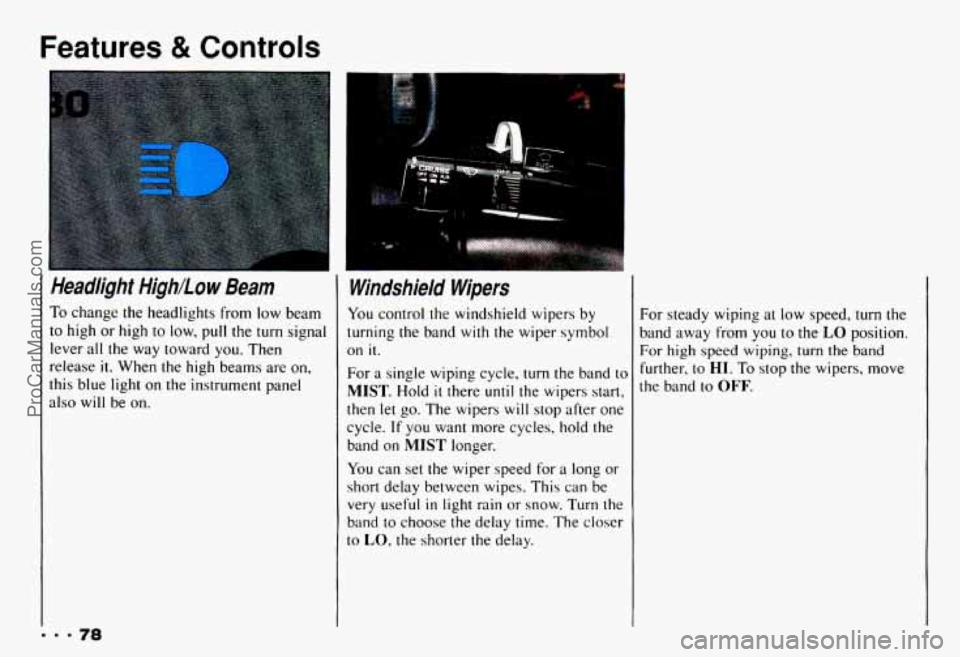
To change the headlights from low beam
to high or high
to low, pull the turn signal
lever all
the way toward you. Then
release
it. When the high beams are on,
this blue light on the instrument panel
also will
be on.
. e*. 5 r
Windsmpers
You control the windshield wipers by
turning the band with the wiper symbol
on it.
For a single wiping cycle, turn the band
to
MIST. Hold it there until the wipers start,
then let go. The wipers
will stop after one
cycle.
If you want more cycles, hold the
band on
MIST longer.
You can set the wiper speed for a long or
short delay between wipes. This can be
very useful
in light rain or snow. Turn the
band to choose the delay time. The closer
to LO, the shorter the delay. For
steady wiping at
low speed, turn the
band away from you
to the LO position.
For high speed wiping, turn the band
further,
to HI. To stop the wipers, move
the band
to OFF.
99978
ProCarManuals.com
Page 117 of 358
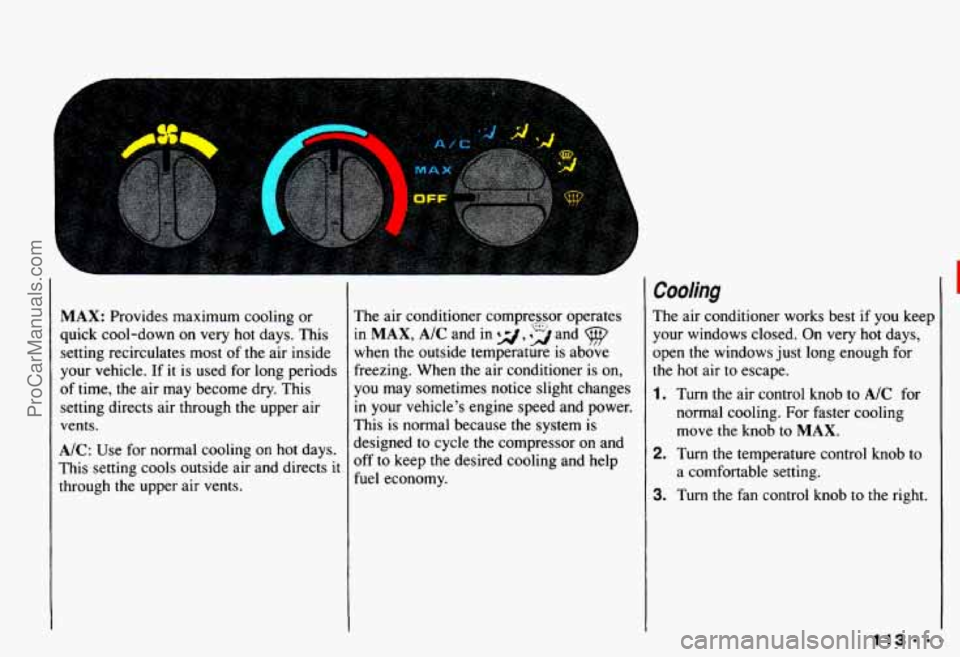
MAX: Provides maximum cooling or
quick cool-down
on very hot days. This
setting recirculates most of
the air inside
your vehicle. If it is used for long periods
of time, the air may become dry. This
setting directs air through the upper air
vents.
A/C: Use for normal cooling on hot days.
This setting cools outside air and directs
it
through the upper air vents.
The air conditioner compressor operates
in MAX, A/C and in 9, t2 and 9
when the outside temperature is above
freezing. When the air conditioner is on,
you may sometimes notice slight changes
in your vehicle’s engine speed and power.
rhis is normal because the system is
designed to cycle the compressor on and
Dff to keep the desired cooling and help
fuel economy.
Cooling
The air conditioner works best if you keep
your windows closed. On very hot days,
open
the windows just long enough for
the hot air to escape.
1. Turn the air control knob to A/C for
normal cooling. For faster cooling
move
the knob to MAX.
2. Turn the temperature control knob to
3. Turn the fan control knob to the right.
a comfortable setting.
ProCarManuals.com
Page 139 of 358
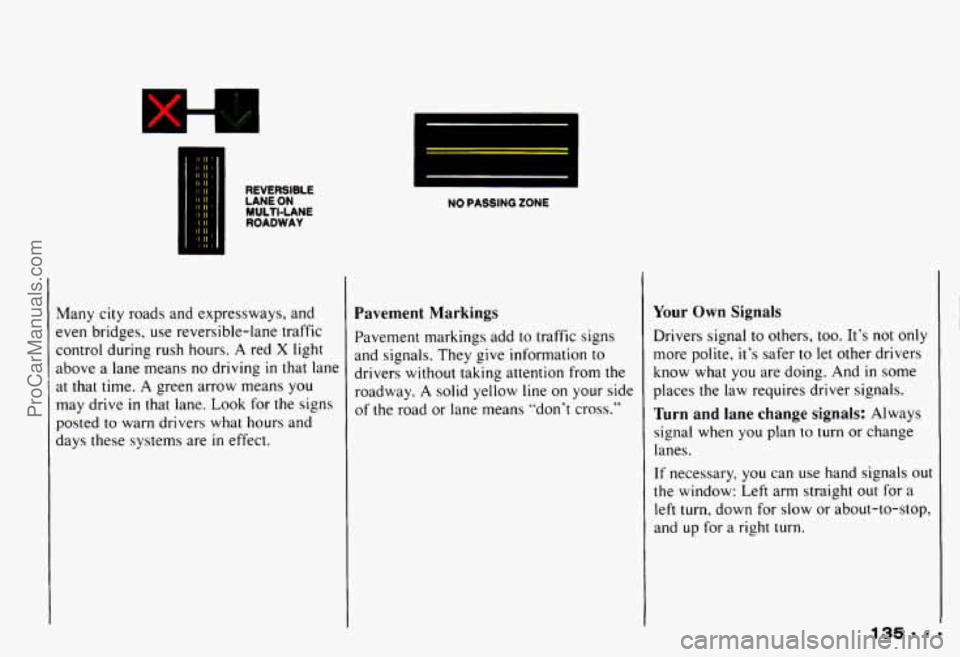
REVERSIBLE
LANE ON
ROADWAY MULTI-LANE
Many city roads and expressways, and
2ven bridges, use reversible-lane traffic
control during rush hours. A red
X light
above a lane means no driving
in that lane
at that time. A green arrow means you
may drive
in that lane. Look for the signs
posted to warn drivers what hours and
days these systems are
in effect.
NO PASSING ZONE
Pavement Markings
Pavement markings add to traffic signs
and signals. They give information to
drivers without taking attention from the
roadway. A solid yellow line on your side
of the road or lane means “don’t cross.”
Your Own Signals
Drivers signal to others, too. It’s not only
more polite, it’s safer
to let other drivers
know what you are doing. And
in some
places the law requires driver signals.
Turn and lane change signals: Always
signal when
you plan to turn or change
lanes.
If necessary, you can use hand signals out
the window: Left arm straight out for a
left
turn, down for slow or about-to-stop,
and up for a right turn.
ProCarManuals.com
Page 148 of 358
Your Driving and the Road
I
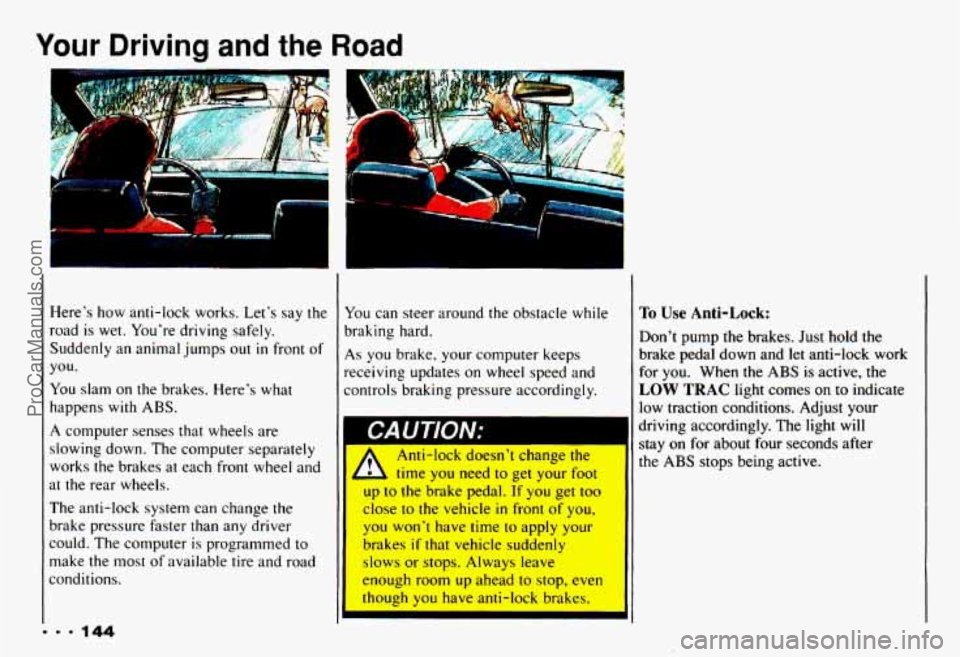
Here's how anti-lock works. Let's say the
road is wet. You're driving safely.
Suddenly an animal jumps out
in front of
you.
You slam on
the brakes. Here's what
happens with ABS.
A computer senses that wheels are
slowing down. The computer separately
works the brakes at each front wheel and
at the rear wheels.
The anti-lock system can change
the
brake pressure faster than any driver
could. The computer is programmed
to
make the most of available tire and road
conditions.
1
You can steer around the obstacle while
braking hard.
As you brake, your conlputer keeps
receiving updates
on wheel speed and
controls braking pressure accordingly.
I CAUTION;
A
Anti-lock doesn't change the
time
you need to get your foot
up
to the brake pedal. If you get too
close
to the vehicle in front of you,
1 you won't have time to apply your
brakes
if that vehicle suddenly
slows or stops. Always leave
enough room up ahead
to stop, even
though
you have anti-lock brakes.
I'o Use Anti-Lock:
Don't pump the brakes. Just hold the
brake pedal down and
let anti-lock work
for you. When the
ABS is active, the
LOW TRAC light comes on to indicate
low traction conditions. Adjust your
driving accordingly. The light will
stay on for about four seconds after
the
ABS stops being active.
ProCarManuals.com
Page 155 of 358
If other cars are lined up to pass a
slow vehicle, wait your turn.
But take
care that someone isn’t
trying to pass
you as you pull out
to pass the slow
vehicle. Remember to glance over
your shoulder and check the blind
spot.
Check your mirrors, glance over your
shoulder, and start your left lane
change signal before moving out of
the right lane to pass. When you are
far enough ahead of the passed vehicle
to see its front in your inside mirror,
activate your right lane change signal
and move back into the right lane. (Remember
that your right outside
mirror is convex. The vehicle you
just
passed may seem to be farther away
from you than
it really is.)
Try not to pass more than one vehicle
at a time on two-lane roads.
Reconsider before passing the next
vehicle.
Don’t overtake a slowly moving
vehicle too rapidly. Even though the
brake lights are not flashing,
it may be
slowing down or starting to turn.
If you’re being passed, make
it easy
for the following driver
to get ahead
of you. Perhaps you can ease a little
to
the right.
Loss of Control
Let’s review what driving experts say
about what happens when the three
control systems (brakes, steering and
acceleration) don’t have enough friction
where the tires meet the road
to do what
the driver has asked.
In any emergency, don’t give up. Keep
trying to steer and constantly seek an
escape route or area of less danger.
Skidding
In a skid, a driver can lose control of the
vehicle. Defensive drivers avoid most
skids by taking reasonable care suited
to
existing conditions, and by not
“overdriving” those conditions.
But skids
are always possible.
ProCarManuals.com
Page 168 of 358
Your Driving and the Road
m.. 164
0 Weather Forecasts: What’s the
weather outlook along
your route?
Should you delay your trip a short
time to avoid a major storm system?
0 Maps: Do you have up-to-date
maps?
On the Road
Unless you are the only driver, it is good
to share the driving task
with others.
Limit turns behind the wheel to about
100 miles (160 km) or two hours at a
sitting. Then, either change drivers or stop
for some refreshment like coffee, tea or
soft drinks and some limbering up.
But do
stop and move around. Eat lightly along
the way. Heavier meals tend to make
some people sleepy. On two-lane highways
or undivided
multilane highways that do not have
controlled access, you’ll want to watch
for some situations not usually found on
freeways. Examples are: stop signs and
signals, shopping centers
with direct
access to the highway, no passing zones
and school zones, vehicles turning left
and right off the road, pedestrians, cyclists, parked vehicles, and even
animals.
Highway Hypnosis
Is there actually such a condition as
“highway hypnosis”? Or
is it just plain
falling asleep at the wheel? Call
it
highway hypnosis, lack of awareness, or
whatever.
There is something about an easy stretch
of road
with the same scenery, along with
the hum of the tires on the road, the drone
of the engine, and the rush
of the wind
against the vehicle that can make you
sleepy. Don’t let
it happen to you! If it
does, your vehicle can leave the road in
less than a second, and you could crash
and be injured.
ProCarManuals.com
Page 178 of 358
Your Driving and the Road
I NOTICE:
AAtnage your vehicle and result i~
jtly repairs not covered by you.
warranty.
To pull a trailer correctly,
follow the advice
in this section.
I
Your vehicle can tow a trailer if it is
equipped
with the proper trailer towing
equipment.
To identify what the vehicle
trailering capacity
is for your vehicle, you
should read the information in “Weight
of the Trailer” that appears later
in this
section. But trailering is different than just
driving your vehicle by itself. Trailering
means changes
in handling, durability, and fuel economy.
Successful, safe
trailering takes correct equipment, and
it has to be used properly.
That’s the reason for this section, In it are
many time-tested, important trailering
tips and safety rules. Many of these are
important for your safety and that of your
passengers.
So please read this section
carefully before you pull a trailer.
Load-pulling components such as the
engine, transmission, wheel assemblies,
and tires are forced to work harder against
the drag of the added weight. The engine
is required to operate at relatively higher
speeds and under greater loads, generating extra
heat. What’s more,
the
trailer adds considerably to wind
resistance, increasing the pulling
requirements.
If You Do Decide to Pull a Trailer
If you do, here are some important points.
There are many different laws having
to do
with trailering. Make sure your
rig
will be legal, not only where you
live but also where you’ll be driving.
A good source for this information
can be state or provincial police.
ProCarManuals.com
Page 215 of 358
I
A Rust or dirt on the wheel, or on
the parts to which it is fastened,
can make the wheel nuts become
loose after a time. The wheel could
come off and cause an accident.
When you change a wheel, remove
any rust or dirt from the places
where the wheel attaches to the
vehicle. In an emergency, you can
use a cloth or a paper towel to do
this; but be sure to use a scraper or
wire brush later, if you need to, to
get all the rust or dirt off.
I
I
1
1
!
I
I
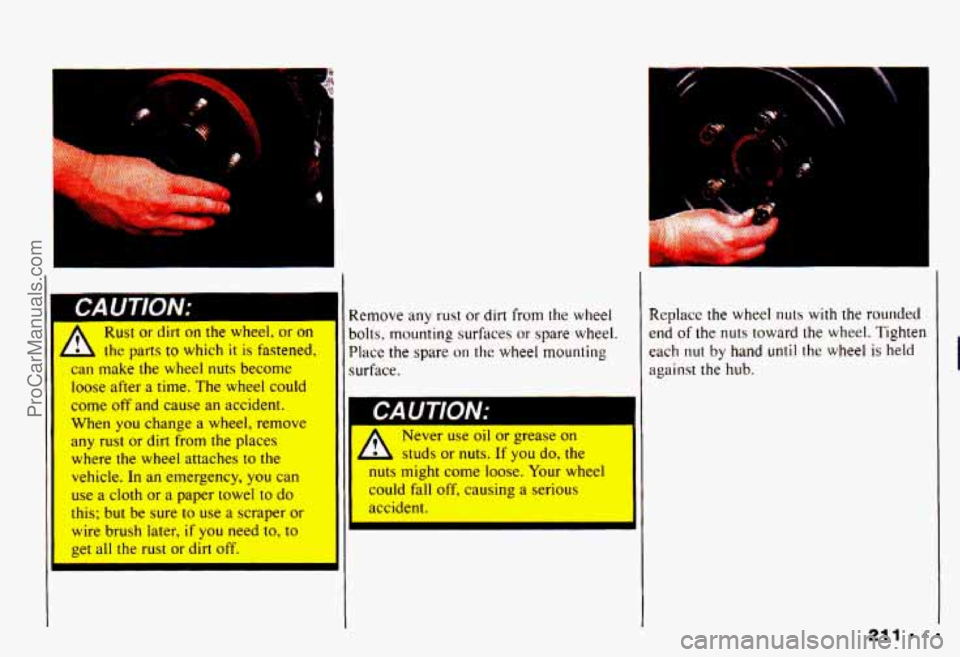
Remove any rust or dirt from the wheel
3olts, mounting surfaces or spare wheel.
Place the spare on the wheel mounting
surfxe.
A
Never use oil or grease on
studs or nuts. If you do, the
nuts might come loose. Your wheel
could
fall off, causing a serious
accident.
i
Replace the wheel nuts with the roundec-1
end of the nuts toward the wheel. Tighten
each nut by hand until the wheel is held
against the hub.
211
ProCarManuals.com