cooling CHEVROLET CAMARO 1993 User Guide
[x] Cancel search | Manufacturer: CHEVROLET, Model Year: 1993, Model line: CAMARO, Model: CHEVROLET CAMARO 1993Pages: 358, PDF Size: 15.6 MB
Page 202 of 358
Problems on the Road
and crack the engine, radiator,
heater core and other parts.
Use the
recommended coolant.
‘I
A You can be burne4 if you spill
- L coolant on hot engine parts.
Coolant contains ethylene glycol
and
it will burn if the engine parts
are hot enough. Don’t spill coolant
on
a hot engine.
9.198
When the coolant in the coolant recovery
tank is at or above
FULL COLD, start
your vehicle.
If the overheat warning continues, there’s
one more thing you can
try. You can add
the proper coolant
mix directly to the
radiator, but be sure the cooling system is
cool before you do
it.
I
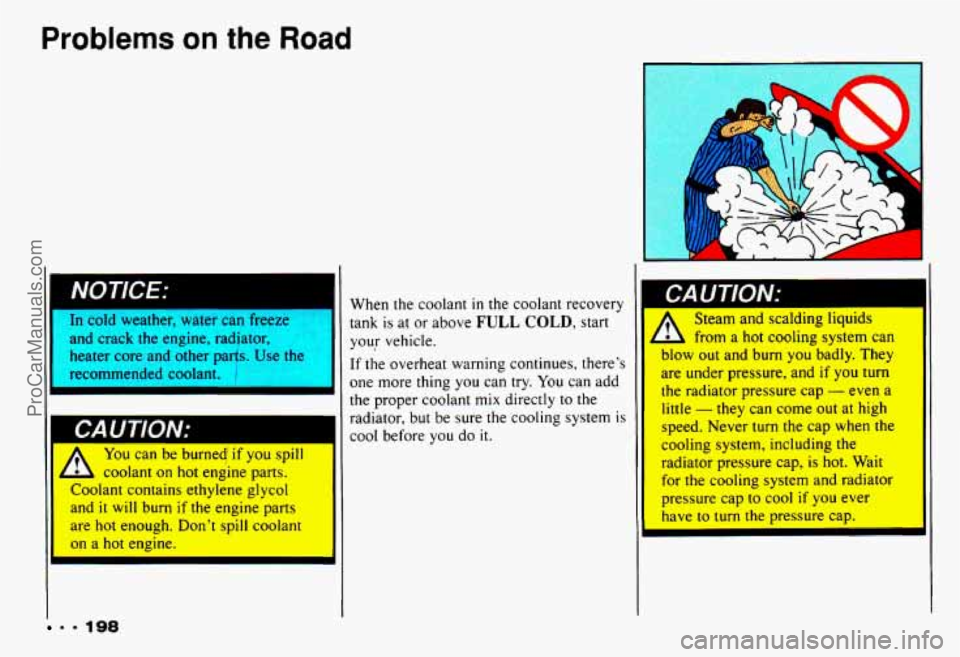
CAUTION:
Steam and scalding liquids
from a hot cooling system can
blow out and burn you badly. They
are under pressure, and
if you turn
the radiator pressure cap
- even a
little
- they can come out at high
speed. Never
turn the cap when the
cooling system, including the
radiator pressure cap,
is hot. Wait
for the cooling system and radiator
pressure cap to cool
if you ever
have to turn the pressure cap.
ProCarManuals.com
Page 203 of 358
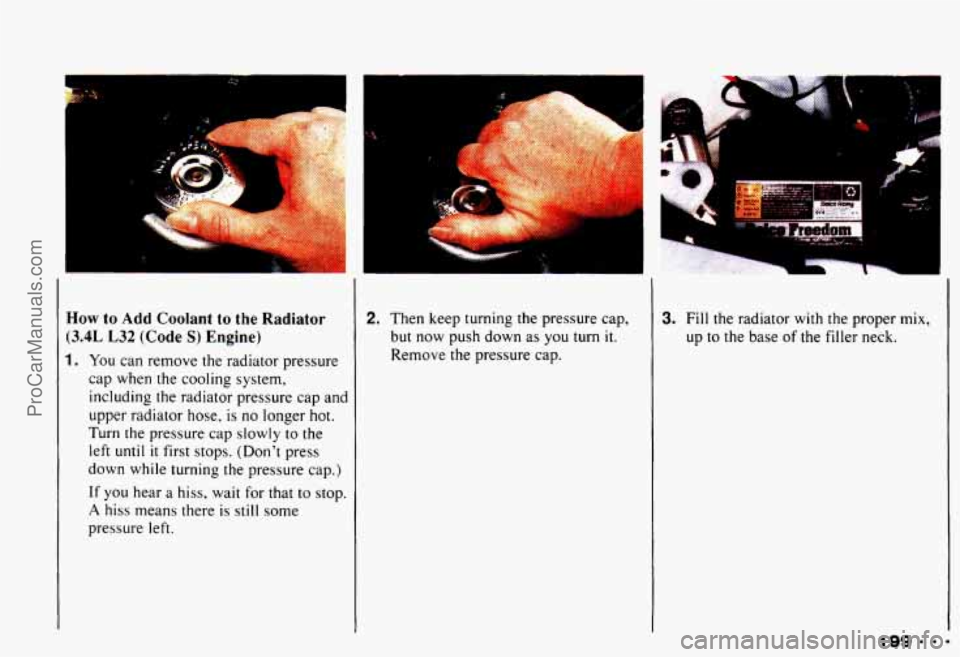
How to Add Coolant to the Radiator
(3.4L L32 (Code S) Engine)
1. You can remove the radiator pressure
cap when the cooling system,
including the radiator pressure cap and
upper radiator hose, is
no longer hot.
Turn the pressure cap slowly
to the
left
until it first stops. (Don't press
down while turning the pressure cap.)
If you hear a hiss, wait for that to stop.
A hiss means there is still some
pressure left.
2. Then keep turning the pressure cap,
but now push down
as you turn it.
Remove the pressure cap.
P
3. Fill the radiator with the proper mix,
up to the base
of the filler neck.
ProCarManuals.com
Page 205 of 358
m
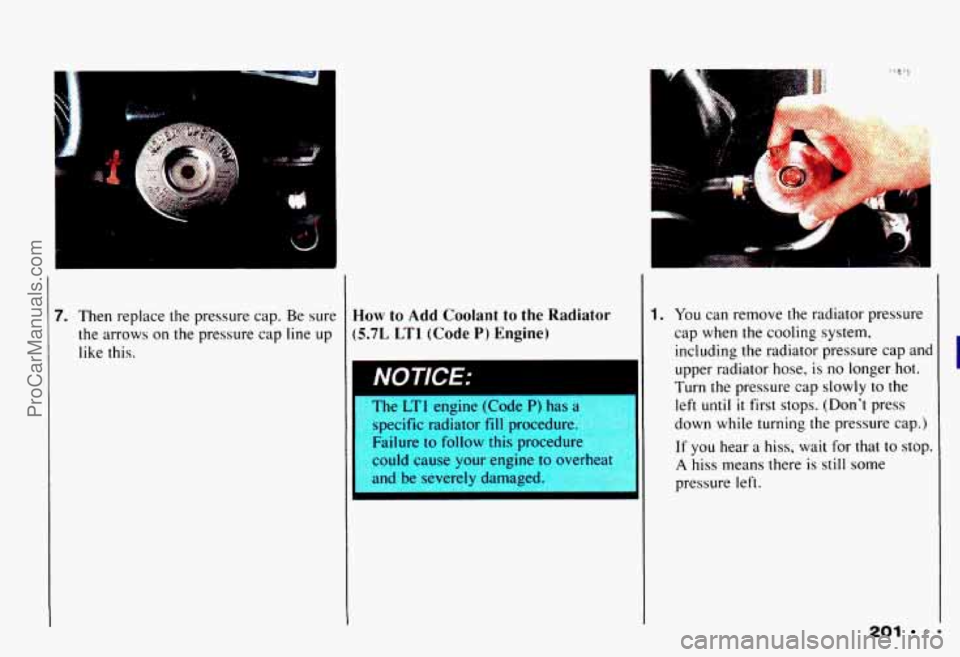
7. Then replace the pressure cap. Be sure
the arrows on the pressure cap line up
like this. Hom7 to Add Coolant to the Radiator
(5.7L LTl (Code P) Engine)
.
II
'he 1 engine (Code P) ha
;pecmc radiator fill procedure.
%lure to follow this procedure
1. You can remove the radiator pressure
cap when the
cooling system,
including the radiator pressure cap and
upper radiator hose,
is no longer hot.
Turn the pressure cap
slowly to the
left
until it first stops. (Don't press
down while turning the pressure cap.)
If you hear a hiss, wait for that to stop.
A hiss means there is still some
pressure left.
201 -
ProCarManuals.com
Page 242 of 358
Service & Appearance Care
What to Use:
Standard and Limited-Slip Differential
Use Axle Lubricant (GM Part No.
1052271) or SAE 8OW-90 GL-5 gear
lubricant.
Engine Coolant
The following explains your cooling
system and how
to add coolant when it
is low. If
you have a problem with
engine overheating or if you need to add
coolant to your radiator, see “Engine
Overheating”
in the Index.
I
The proper coolant for your Chevrolet
will:
0
0
0
0
0
Give freezing protection down to
-34°F (-37°C).
Give boiling protection up to 262°F
(128°C).
Protect against rust and corrosion.
Help keep the proper engine
temperature.
Let
the warning lights work as they
should.
ProCarManuals.com
Page 268 of 358
Service & Appearance Care
Tire Chains
IL
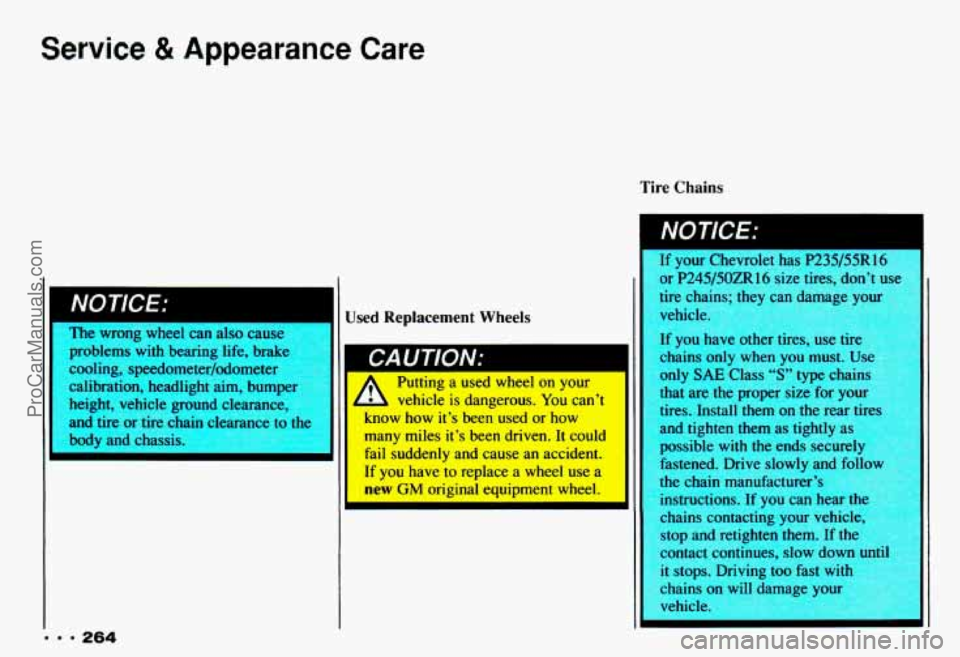
The wrong wheel can also cause
problems with bearing life, brake
cooling, speedometer/odometer
y!g@
calibration, headlight aim, bumper32
‘ i.i _. /8*
. .I )
height, vehicle ground clearance,
and tire or tire chain clearance to the
body and chassis. 1
... 264
Used Replacement Wheels
ruwllg it uscu WIIGGI UII yuul
vehicle is dangerous. You can’t
nnOW how it’s been used or how
many miles it’s been driven. It could
fail suddenly and cause an accident.
If you have to replace a wheel use a
new GM original equipment wheel.
Ib
If your Chevrolet has P235/55R16
or
P245/50ZRlf; cize tire. don’t 11c~ I
tire chains: the --In dm e vow I
I
vehicle.
If
you ,.-ve other tires, “st; LIIC
chains only when you must. Use
only
SAE Class “S” type chains
that are the proper size for
y
tires. Install them on the rear tires
and tighten them as tightly as
possible
with the ends securel)
fastened. Drive slowly and
folio
stop and retighten them. If the I
the chain manufacturer’s
instructions.
If you can hear th
chains contacting your vehicle
contact continues, slow down until
I
it stops. Driving too fast wit
chains on will damage yourg
vchicle.
I
ProCarManuals.com
Page 286 of 358
Service & Appearance Care
Capacities (Approximate)
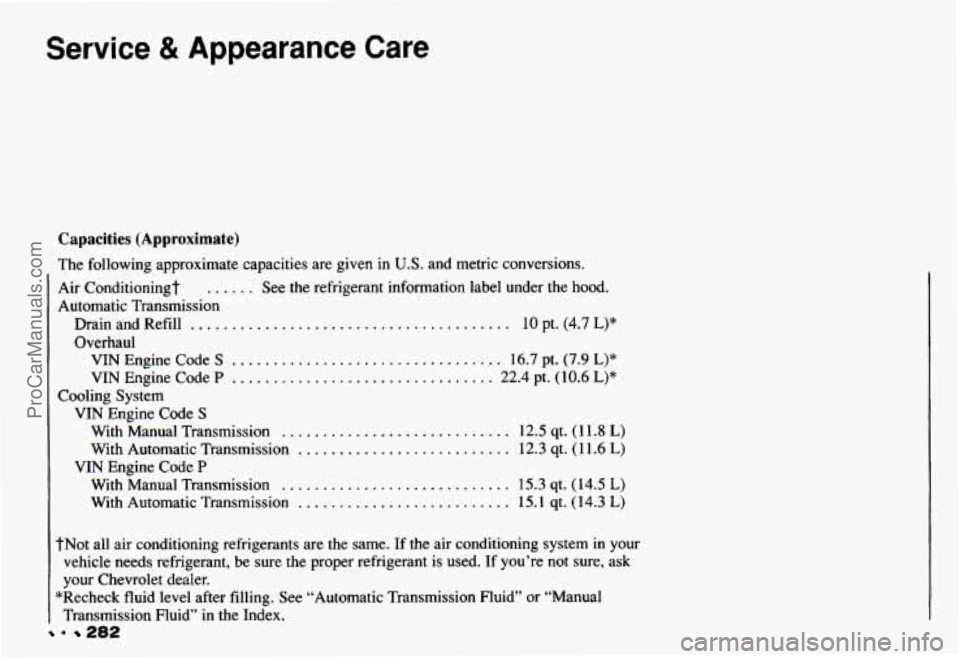
The following approximate capacities are given in U.S. and metric conversions.
Air Conditioningt
...... See the refrigerant information label under the hood.
Automatic Transmission
Drain and Refill
....................................... 10 pt. (4.7 L)*
Overhaul VIN Engine Code
S ................................. 16.7 pt. (7.9 L)*
VIN Engine Code P ................................ 22.4 pt. (10.6 L)*
Cooling System
VIN Engine Code
S
With Manual Transmission ............................ 12.5 qt. (11.8 L)
With Automatic Transmission .......................... 12.3 qt. ( 11.6 L)
With Manual Transmission ............................ 15.3 qt. ( 14.5 L)
With Automatic Transmission .......................... 15.1 qt. (14.3 L)
VIN Engine Code P
tNot all air conditioning refrigerants are the same. If the air conditioning system in your
vehicle needs refrigerant, be sure the proper refrigerant is us\
ed. If you’re not sure, ask
your Chevrolet dealer.
Transmission Fluid” in the Index.
*Recheck fluid level
after filling. See “Automatic Transmission Fluid” or “Manual
. 282
ProCarManuals.com
Page 299 of 358
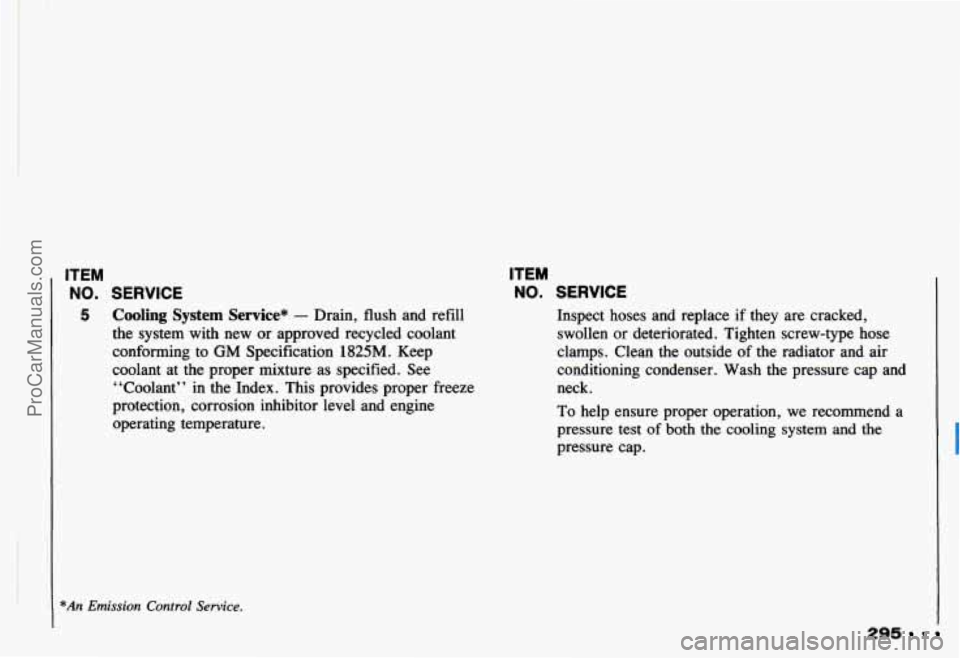
ITEM
NO. SERVICE
5 Cooling System Service* - Drain, flush and refill
the system with new or approved recycled coolant
conforming to
GM Specification 1825M. Keep
coolant at the proper mixture as specified. See
“Coolant”
in the Index. This provides proper freeze
protection, corrosion inhibitor level and engine
operating temperature.
*An Emission Control Service.
ITEM
NO. SERVICE
Inspect hoses and replace if they are cracked,
swollen or deteriorated. Tighten screw-type hose
clamps. Clean the outside of the radiator and air
conditioning condenser. Wash the pressure cap and
neck.
To help ensure proper operation, we recommend a
pressure test
of both the cooling system and the
pressure cap.
295
ProCarManuals.com
Page 336 of 358
... 332
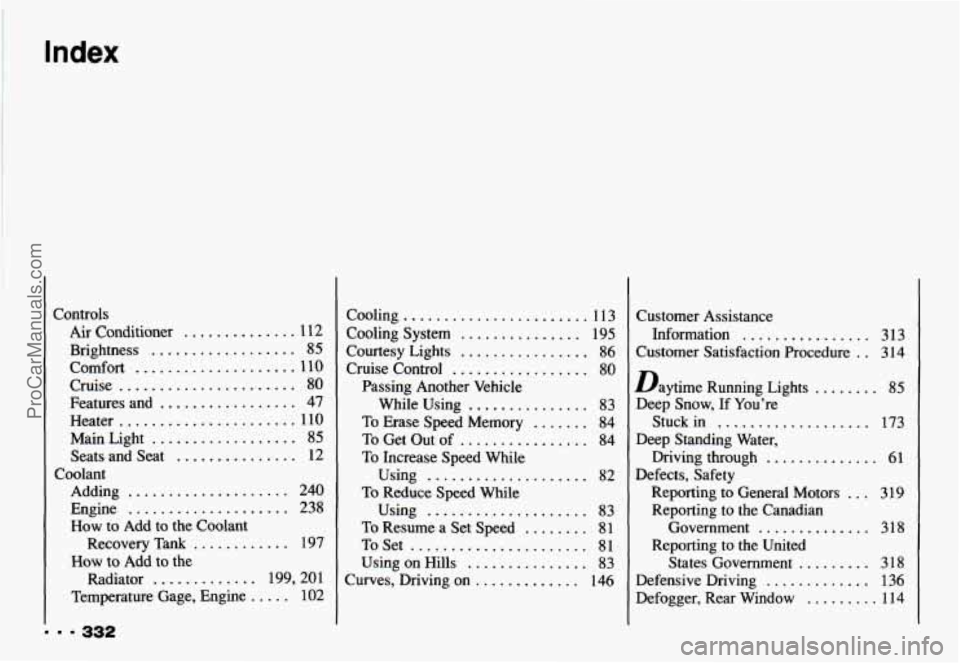
Controls
Air Conditioner .............. 11 2
Brightness .................. 85
comfort .................... 110
Cruise ...................... 80
Features and ................. 47
Heater ...................... 110
Main Light .................. 85
Seats and Seat ............... 12
Adding .................... 240
Engine .................... 238
Recovery Tank ............ 197
Radiator ............. 199. 201
Temperature Gage. Engine ..... 102
Coolant
How to Add to the Coolant
How to Add to the Cooling
....................... 113
Cooling System ............... 195
Courtesy Lights ................ 86
Cruise Control ................. 80
Passing Another Vehicle
While Using
............... 83
To Erase Speed Memory ....... 84
To Get Out of ................ 84
To Increase Speed While
Using
.................... 82
To Reduce Speed While
Using
.................... 83
To Resume a Set Speed ........ 81
ToSet ...................... 81
Using on Hills ............... 83
Curves. Driving on ............. 146
Customer Assistance
Information
................ 313
Customer Satisfaction Procedure . . 314
Daytime Running Lights ........ 85
Deep Snow. If You’re
Stuck in
................... 173
Deep Standing Water. Driving through
.............. 61
Defects. Safety Reporting to General Motors
... 319
Reporting to the Canadian Government
.............. 318
Reporting to the United States Government
......... 318
Defensive Driving ............. 136
Defogger. Rear Window ......... 114
ProCarManuals.com
Page 356 of 358
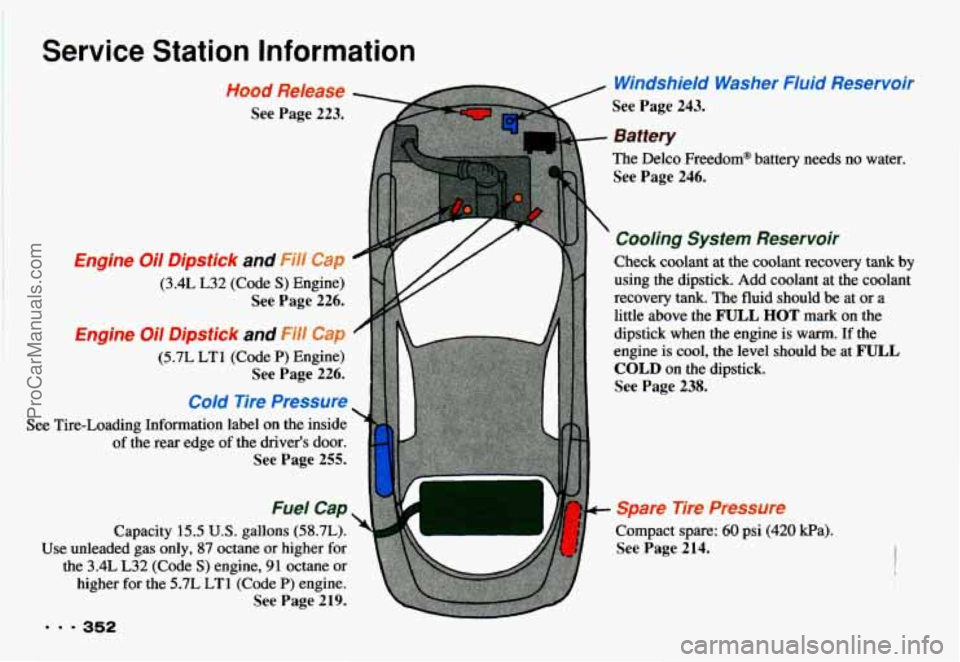
Service Station Information
Hood Release
See Page 223.
Engine Oil Dipstick and Fill Cap
(3.4L L32 (Code S) Engine)
See Page 226.
Engine Oil Dipstick and Fill Cap
(5.7L LT1 (Code P) Engine)
See Page 226.
Cold Tire Pressure
See Tire-Loading Information label on the inside
of the
rear edge of the driver's door.
See Page 255.
Fuel Cap
Capacity 15.5.U.S. gallons (58.7L).
Use unleaded gas only, 87 octane
or higher for
the 3.4L
L32 (Code S) engine, 91 octane or
higher
for the 5.7L LT1 (Code P) engine.
See Page 219.
Windshield Washer Fluid Reservorr
See Page 243.
Battery
The Delco Freedom@ battery needs no water.
See Page 246.
Cooling System Reservoir
Check coolant at the coolant recovery tank by
using the dipstick. Add coolant at the coolant
recovery tank. The fluid should be at
or a
little above
the FULL HOT mark on the
dipstick when
the engine is warm. If the
engine is cool, the level should be at
FULL
COLD on the dipstick.
See Page 238.
_?are Tire Pressure
Compact spare: 60 psi (420 kPa).
See Page 214.
ProCarManuals.com