engine CHEVROLET CAMARO 1993 User Guide
[x] Cancel search | Manufacturer: CHEVROLET, Model Year: 1993, Model line: CAMARO, Model: CHEVROLET CAMARO 1993Pages: 358, PDF Size: 15.6 MB
Page 64 of 358
Features 8t Controls
When starting your engine in very cold
weather (below
0°F or - I SOC), do this:
1. With your foot off the accelerator
pedal,
turn the ignition key to Start
and hold it there. When the engine
starts, let go of the key. Use the
accelerator pedal to maintain engine
speed,
if you have to, until your
engine has run for
a while.
2. If your engine still won’t start (or
starts
but then stops), it could be
flooded
with too much gasoline. Try
pushing your accelerator pedal all the
way to the floor and holding
it there
as you hold the key in Start for about
three seconds.
If the vehicle starts
briefly but then stops again, do the
same thing, but this time keep the
pedal down for five or
six seconds.
This clears the extra gasoline from
the engine.
NOTICE:
1 Your engine is designed to work
with the electronics in your vehicle.
If you add electrical parts or
accessories, you could change
th
way the fuel injection system
operates. Before adding electrlcal
equipment, check with your dealer.
II
If you don’t, your engine might not
perform properly.
If you ever have
to have your
vehicle towed, see the part
of thi
Manual that tells how to do it
without damaging your vehicle.
See “Towing Your Vehicle’’
in th
Index
I I
ProCarManuals.com
Page 65 of 358
Driving through Deep Standing
Water
NOTiCE:
[f you drive too quickly throul
deep puddles or standing wt :r,
water can come
in through your
engine’s air intake and badly
damage your engine.
If you can’t
avoid deep puddle< nr standing
water, drive throul them very
slowly
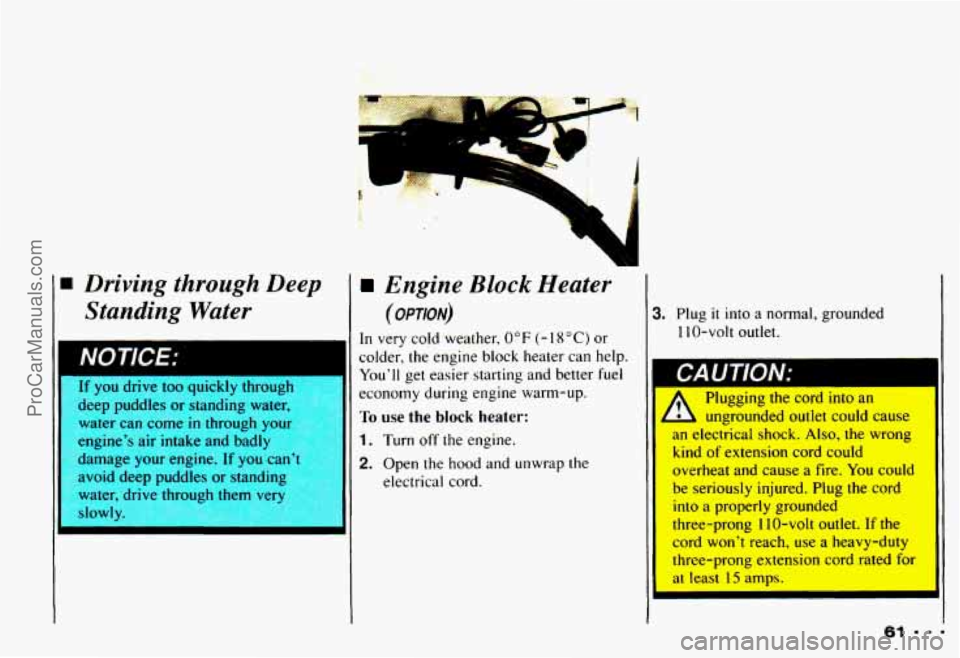
Engine Block Heater
(OPTION)
In very cold weather, 0 OF (- 1 8 “C) or
colder, the engine block heater can help.
You’ll get easier starting and better fuel
economy during engine warm-up.
To use the block heater:
1. Turn off the engine.
2. Open the hood and unwrap the
electrical cord.
3. Plug it into a normal, grounded
1 10-volt outlet.
CA UTiON:
A
Plugging the cord into an
ungrounded outlet could cause
I
an electrical shock. Also, the wrong
kind of extension cord could
overheat and cause a fire. You could
be seriously injured. Plug the cord into a properly grounded
three-prong
1 10-volt outlet. If the
cord won’t reach, use a heavy-duty
three-prong extension cord rated
for
at least 15 amps.
ProCarManuals.com
Page 66 of 358
Features & Controls
I NOTICE:
I HTI~~ you-ve usea me DIOCK neater, I- sure to store the cord as it was
,-fore, to keep
it aw-f from movin
engine parts.
If you h’t ; $&add ,$a;!$$$,.
be damaged.
I
, . ,Q i ,,<.> . , t!!! h,~
I
How long should you keep the block
heater plugged in? The answer depends
on the weather, the kind of oil you have,
and some other things. Instead of trying to
list everything here, we ask
that you
contact
a Chevrolet dealer in the area
where you’ll be parking your vehicle. The
dealer can give
you the best advice for
that particular area,
... 62
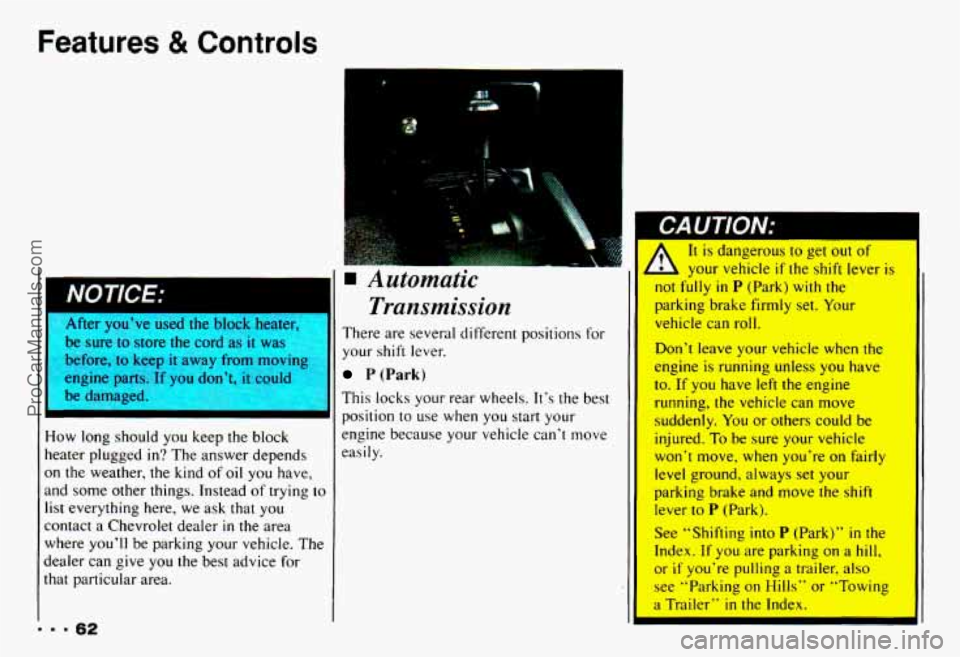
Automatic
Transmission
There are several different positions for
your shift lever.
P (Park)
This locks your rear wheels. It’s the best
position to use when you start your
engine because your vehicle can’t move
easily.
It is dangerous to get out of
your vehicle
if rhe shift lever is
not fully in P (Park) with the
parking brake
firmly set. Your
vehicle can roll.
Don’t leave your vehicle when the
engine
is running unless you have
to. If you have left the engine
running, the vehicle can move
suddenly.
You or others could be
injured. To be sure your vehicle
won’t move, when you’re on fairly
level ground, always set your
parking brake and move the shift lever to
P (Park).
See “Shifting into
P (Park)” in the
Index.
If you are parking on a hill,
or if you’re pulling a trailer, also
see “Parking on Hills” or “Towing
a Trailer” in the Index.
ProCarManuals.com
Page 67 of 358
I
Ensure the shift lever is fully in P (Park)
range before starting the engine. Your
Chevrolet has a brake-transmission shift
interlock. You have
to fully apply your
regular brakes
before you can shift from
P (Park) when the ignition key is in the
0 R (Reverse)
Use this gear to back up.
11 NOTICE:
I Shifting to K (Reverse) while your
Run position. If you cannot shift out of vehicle is moving forward could
P (Park), ease pressure on the shift lever damage your transmission. Shift to
- push the shift lever all the way into R only after your vehicle is stopped.
P (Park) and also release the shift lever
button on floor shift console models as
you maintain brake application. Then
move the shift lever into the gear you
wish. (Press the shift lever button before
moving
the shift lever on tloor shift
console models.) See "Shifting out of
P (Park)" in this part.
To rock your vehicle back and forth to
damaging your transmission, see "Stuck:
In Sand, Mud, Ice or Snow, If You're"
in the Index.
L get out of snow, ice or sand without
N (Neutral)
In this position, your engine doesn't
connect
with the wheels. To restart when
you're already moving, use
N (Neutral)
only.
Also, use N when your vehicle is
being towed.
639 9
ProCarManuals.com
Page 68 of 358
Features & Controls
.
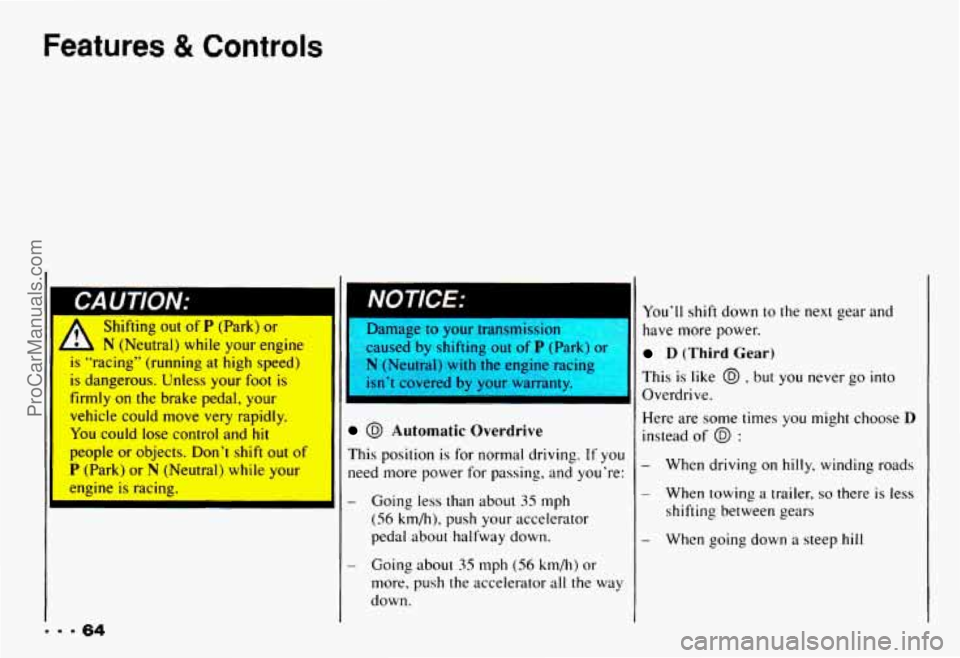
Shifting out of Y (Park) or
N (Neutral) while your engine
13 “racing” (running at high speed)
is dangerous. Unless your foot is
firmly on the brake pedal, your
vehicle could move very rapidly.
You could lose control and
hit
people or objects. Don’t shift out of
P (Park) or N (Neutral) while your
engine
is racing.
I I Damage to your transmission
caused by shifting out of P (Park) o
N (Neutral) with the engine racin;
isn’t covered by your warranty. ~ I
@ Automatic Overdrive
This position is for normal driving. If you
need more power for passing, md you’re:
- Going less than about 35 mph
(56 km/h), push your accelerator You’ll
shift down
to the next gear and
have more power.
D (Third Gear)
This is like @I , but you never go into
Overdrive.
Here are some times you might choose
D
instead of @ :
- When driving on hilly, winding roads
- When towing a trailer. so there is less
shifting between gears
pedal abou; halfway down.
I- When going down a steep hill
- Going about 35 mph (56 km/h) or
more, push the accelerator all the way
down.
ProCarManuals.com
Page 69 of 358
D 2 (Second Gear)
rhis position gives you more power but
.ower fuel economy. You can use 2 on
lills. It can help control your speed as
you go down steep mountain roads, but
:hen you would also want to use your
xakes
off and on.
NOTICE:
Don't drive in 2 (Second Gear)
more than 5 miles (8 km), or at
speeds over
55 mph (88 kmh)
you can damage your transmissi
Use @ or D as much as possible.
Don't
shift into 2 unless you are golng
slower than 65 mph ( 105 km/h), 1
you can damage your engine.
1 (First Gear) (V6 Engine)
This position gives you even more power
(but lower fuel economy) than
2. You can
use
it on very steep hills, or in deep snow
or mud. If the selector lever is put
in 1,
the transmission won't shift into first gear
until the vehicle is going slowly enough.
65.
ProCarManuals.com
Page 70 of 358
Features & Controls
r
If your rear wheels can’t rotat
don’t try to drive.
This might
happen if you were stuck
in v
deep sand or mud or were up
, , against a solid object. You
damage your transmission
Also, if you stop when goi
uphill, don’t hold your vehi
there
with only the accelerat
pedal. This could overheat an
damage the transmission.
Use your
brakes or shift into
P (Park) to hold
9.966
Maximum engine speed is limited to
protect driveline components from
improper operation.
Manual Transmission
Five-Speed
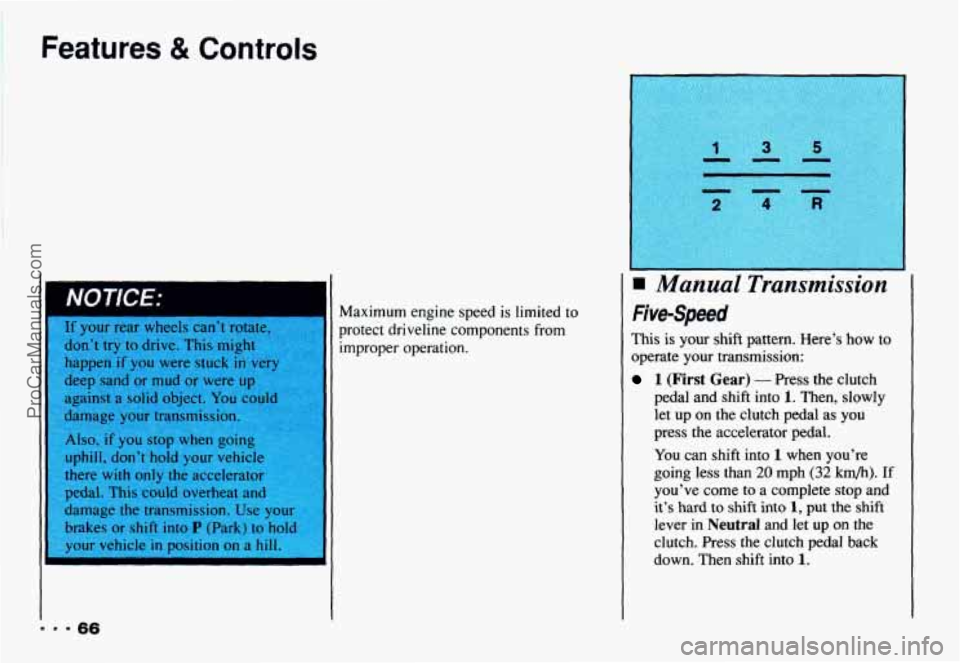
This is your shift pattern. Here’s how to
operate your transmission:
1 (First Gear) - Press the clutch
pedal and shift into
1. Then, slowly
let up on the clutch pedal as you
press the accelerator pedal.
You can shift into
1 when you’re
going less than
20 mph (32 km/h). If
you’ve come to a complete stop and
it’s hard to shift into
1, put the shift
lever in
Neutral and let up on the
clutch.
Press the clutch pedal back
down. Then shift into
1.
ProCarManuals.com
Page 71 of 358
0
2 (Second Gear) - Press the clutch
pedal as you let up on the accelerator
pedal and shift into
2. Then, slowly
let up
on the clutch pedal as you
press
the accelerator pedal.
3,4 and 5 (Third, Fourth and Fifth
Gears)
- Shift into 3,4 and 5 the
same way
you do for 2. Slowly let up
on the clutch pedal as you press the
accelerator pedal.
To Stop - Let up on the accelerator
pedal and press the brake pedal. Just
before the vehicle stops, press the
clutch pedal and the brake pedal, and
shift to
Neutral.
0
0 Neutral - Use this position when
you start or idle your engine.
R (Reverse) - To back up, press
down the clutch pedal and shift into
R. Let up on the clutch pedal slowly
while pressing the accelerator pedal.
m-
- ~~
NOTICE:
Shift to K (Reverse) only atter your
vehicle is stopped. Shifting to
R (Reverse) while your vehicl
moving could darnage-pur
transmission. .I :.: , .. , LC.; 96’ b~ ,.? * ., )I
Also, use Reverse, along with the parking
brake, for parking your vehicle.
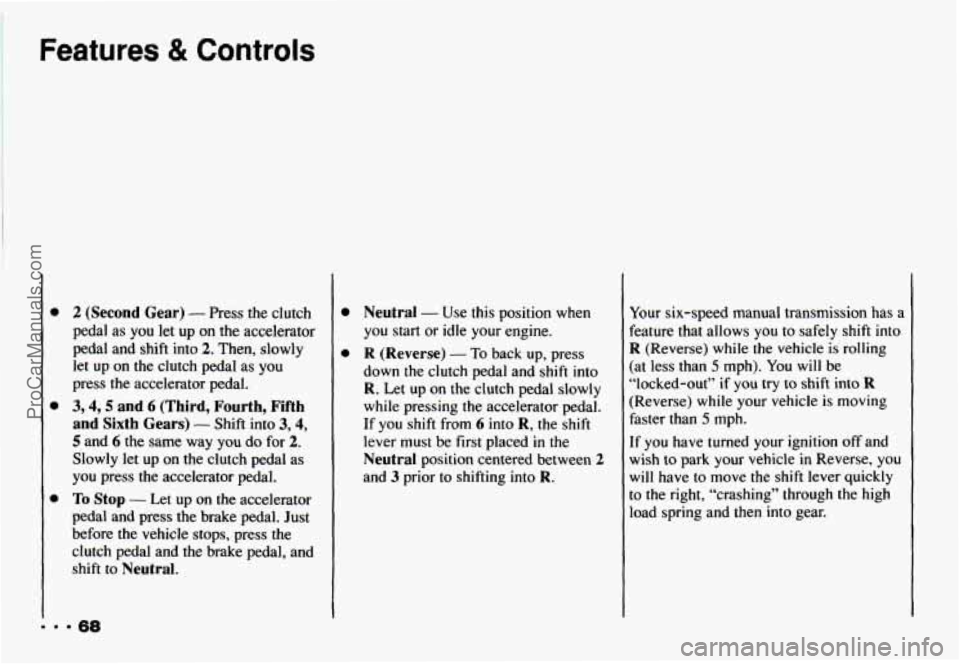
Six-Speed
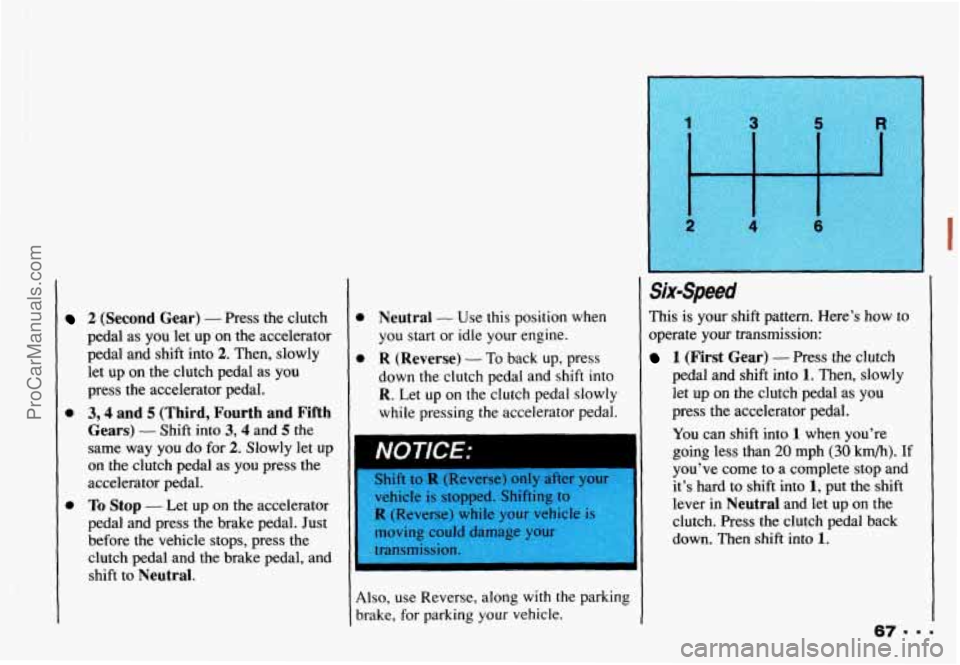
This is your shift pattern. Here’s how to
operate your transmission:
1 (First Gear) - Press the clutch
pedal and shift into
1. Then, slowly
let up on the clutch pedal as you
press the accelerator pedal.
You can shift into 1 when you’re
going less than
20 mph (30 km/h). If
you’ve come to a complete stop and
it’s hard to shift into
1, put the shift
lever in
Neutral and let up on the
clutch. Press the clutch pedal back
down. Then shift into
1.
I
ProCarManuals.com
Page 72 of 358
Features & Controls
0
0
0
2 (Second Gear) - Press the clutch
pedal as you let up on the accelerator
pedal and shift into
2. Then, slowly
let up on the clutch pedal as you
press the accelerator pedal.
3,4,S and 6 (Third, Fourth, Fifth
and Sixth Gears)
- Shift into 3,4,
5 and 6 the same way you do for 2.
Slowly let up on the clutch pedal as
you press the accelerator pedal.
To Stop - Let up on the accelerator
pedal and press
the brake pedal. Just
before the vehicle stops, press the
clutch pedal and the brake pedal, and
shift to
Neutral. Neutral
- Use this position when
you start or idle your
engine.
R (Reverse) - To back up, press
down the clutch pedal and shift into
R. Let up on the clutch pedal slowly
while pressing the accelerator pedal.
If
you shift from 6 into R, the shift
lever must be first placed
in the
Neutral position centered between 2
and 3 prior to shifting into R.
Your six-speed manual transmission has a
feature that allows you to safely shift into
R (Reverse) while the vehicle is rolling
(at less than
5 mph). You will be
“locked-out”
if you try to shift into R
(Reverse) while your vehicle is moving
faster than
5 mph.
If
you have turned your ignition off and
wish to park your vehicle
in Reverse, you
will have to move the shift lever quickly
to the right, “crashing” through the high
load spring and then into gear.
ProCarManuals.com
Page 73 of 358
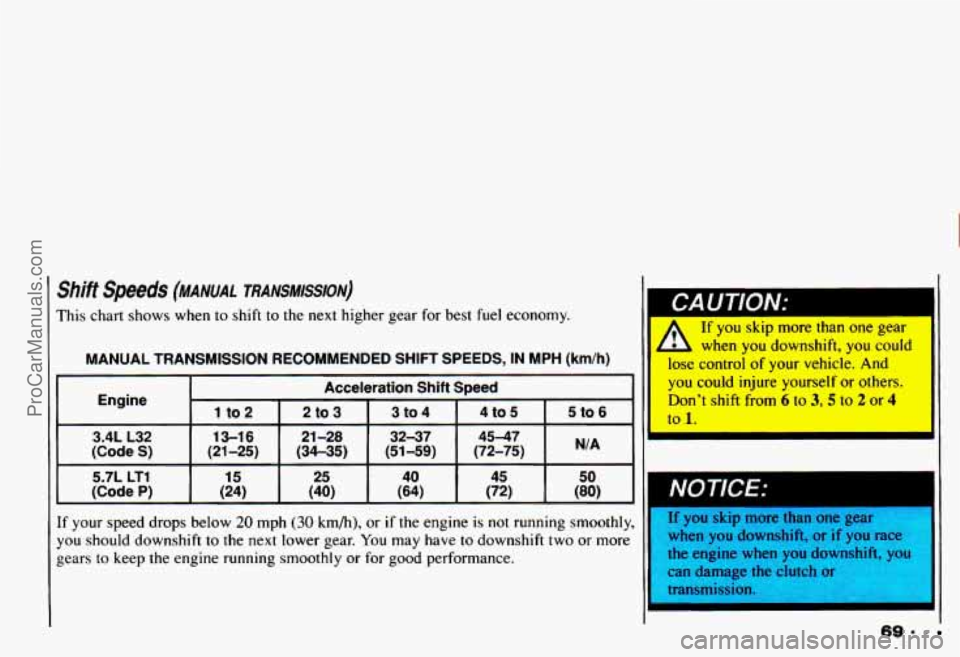
shift speeds (MANUAL TRANSMISSION)
This chart shows when to shift to the next higher gear for best fuel economy. , If you skip more than one gear I
-‘L when youdownshift, you could MANUAL TRANSMISSION RECOMMENDED SHIFT SPEEDS, IN MPH (km/h) , , lose control of your vehicle. And I
-
Engine
3.4L L32 13-16
I (Code S) I (21-25)
5.7L LT1 (24)
(Code P)
15
Acceleration Shift Speed you could injure yourself or others.
Don’t shift from
6 to 3, 5 to 2 or 4 2 to 3
(72-75) (51
-59) (34-35) 4547
32-37
21 -28
5 to 6 4 to 5
3 to 4
N/A
25 50 45 40
-
(40) (80) (72)
(64)
If your speed drops below 20 mph (30 km/h), or if the engine is not running smoothly,
you should downshift to the next lower gear. You may have to downshift two
or more
gears to keep the engine running smoothly or for
good performance.
NOTICE:
If you skip more than one gear
when
you downshift, or if you race
the engine when you downshift, you
can damage
the clutch or
transmission.
I- -1 I I
69..
ProCarManuals.com