flat tire CHEVROLET CAMARO 1993 User Guide
[x] Cancel search | Manufacturer: CHEVROLET, Model Year: 1993, Model line: CAMARO, Model: CHEVROLET CAMARO 1993Pages: 358, PDF Size: 15.6 MB
Page 217 of 358
J
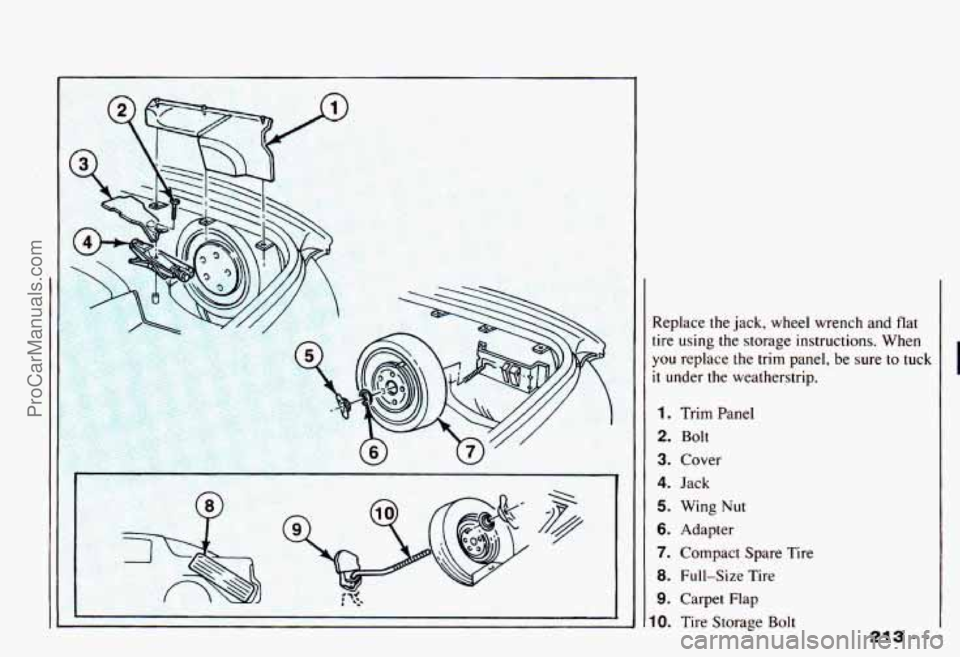
Replace the jack, wheel wrench and flat
tire using the storage instructions. When
you replace the trim panel, be sure to tuck
it under the weatherstrip.
1. Trim Panel
2. Bolt
3. Cover
4. Jack
5. Wing Nut
6. Adapter
7. Compact Spare Tire
8. Full-Size Tire
9. Carpet Flap
IO. Tire Storage Bolt
2
ProCarManuals.com
Page 218 of 358
Problems on the Road
II , Storing aJacK, a tlre or otner I
4 equipment in the passenger
Ldmpartment of the vehicle could
cause injury. In a sudden
stop or
collision, loose equipment could
strike someone. Store all these
in the
proper place.
Compact Spare
Although the compact spare was fully
inflated when your vehicle was new, it
can lose air after a time. Check the
inflation pressure regularly.
It should be
60 psi (420 kPa). The compact spare is
made to go up to 3,000 miles (5 000 km),
so you can finish your trip and have your
full-size tire repaired or replaced where
you want. Of course,
it’s best to replace
your spare
with a full-size tire as soon as
you can. Your spare
will last longer and
be
in good shape in case you need it
again.
NOTICE:
lr tne compact spare 1s use0 as a
rear tire, do not drive faster than
50 mph (80 km/h). Damage to the
rear axle may occur
if the compac
snare
is driven faster than 50 mnh
( 0 km/h). This speed limitatia
does
not apply when the COI
ware is used as a front tire.
ProCarManuals.com
Page 259 of 358
CAPACITY WEIGHT BBW TIRE SIZE
INFORMATION
Loading Your Vehicle
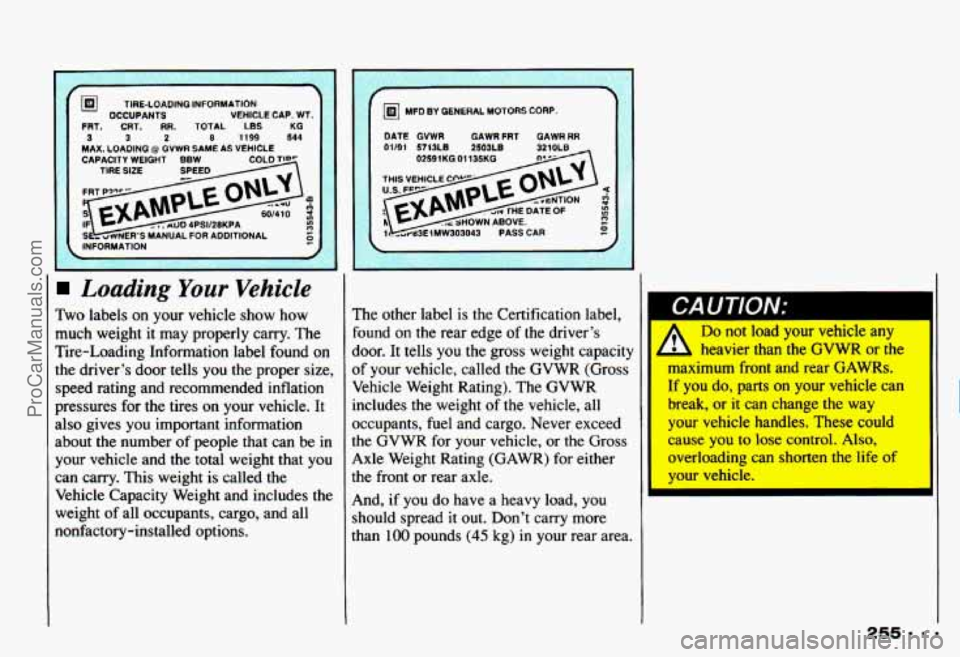
Two labels on your vehicle show how
much weight it may properly carry. The
Tire-Loading Information label found on
the driver’s door tells
you the proper size,
speed rating and recommended inflation
pressures for
the tires on your vehicle. It
also gives you important information
about the number of people that can be in
your vehicle and the total weight that
you
can carry. This weight is called the
Vehicle Capacity Weight and includes the
weight of all occupants, cargo, and all
nonfactory-installed options.
DATE GVWR GAWRFRT GAWR RR 01/91 5713LB ZS03LB <. .
v)
The other label is the Certification label,
found on
the rear edge of the driver’s
door. It tells you the gross weight capacity
of your vehicle, called the GVWR (Gross
Vehicle Weight Rating). The GVWR
includes the weight of the vehicle, all
occupants, fuel and cargo. Never exceed
the GVWR for your vehicle,
or the Gross
Axle Weight Rating (GAWR) for either
the front or rear axle.
And,
if you do have a heavy load, you
should spread it out. Don’t carry more
than
100 pounds (45 kg) in your rear area.
Do not load your vehicle any
- L heavier than the GVWR or the
maximum front and rear GAWRs.
If you do, parts on your vehicle can
break, or
it can change the way
your vehicle handles. These could
cause you to lose control.
Also,
overloading can shorten the life of , ,
II
ProCarManuals.com
Page 261 of 358
CAUTION:
Poorly maintained and
improperly used tires are
dangerous.
a
m
a
Overloading your tires can cause
overheating as
a result of too
much friction. You could have
an
air-out and a serious accident. See
“Loading Your Vehicle” in the
Index.
Underinflated tires pose the
same
danger as overloaded tires. The
resulting accident could cause
serious
injury. Check all tires
frequently to maintain the
recommended
pressure. Tire
pressure should
be checked when
your tires are cold.
Overinflated tires
are more likely
to be cut, punctured, or broken by
a sudden impact, such as when
you
hit a pothole. Keep tires at the
recommended pressure.
Worn, old tires can cause
accidents.
If your tread is badly
worn, or if your tires have been
damaged, replace them.
I
Inflation - Tire Pressure
The Tire-Loading Information label
which
is on the driver’s door shows the
correct inflation pressures for your tires,
when they’re cold. “Cold” means your
vehicle has been sitting for at least three
hours or driven no more than a mile.
If your vehicle is equipped
with
P245/50ZR16 tires and you’ll be
driving at speeds higher than
100 mph
(160 km/h) where it is legal, raise the
“cold” inflation pressure of each tire to
35 psi (240 kPa). When you end this very
high speed driving, reduce the “cold”
inflation pressures to those listed on the
Tire Loading Information label. Never
inflate the tires higher than the maximum
“cold” inflation pressures stated on the
sidewall of the tires. Don’t let anyone tell
you that
underinflation
or overinflation is all
right. It’s not.
If your tires don’t
haveenougha
n)
you can get
e Too muc
Too much heal
Tire overloading
Bad wear
Bad handli
Bad fuel econ
I If your tires have too much air
(overinflation), you
can get’
Unusual wear
’ 0 Bad handling
e Rough ri,,
Needless damage fi~111
hazards.
~
I
ProCarManuals.com
Page 262 of 358
Service & Appearance Care
9 9 9 258
When to Check: Check your tires once a
month
or more. Don’t forget your
compact spare tire. It should be at
60 psi
(420 kPa).
How to Check: Use a good quality
pocket-type gage to check tire pressure.
Simply looking at the tires will not tell
you the pressure, especially if you have
radial tires
- which may look properly
inflated even if they’re underinflated.
If your tires have valve caps, be sure to
put them back on. They help prevent
leaks by keeping out
dirt and moisture.
L
’
Tire Inspection and Rotation
To make your tires last longer, have them
inspected and rotated at the mileages
recommended
in the Maintenance
Schedule. See “Scheduled Maintenance
Services”
in the Index.
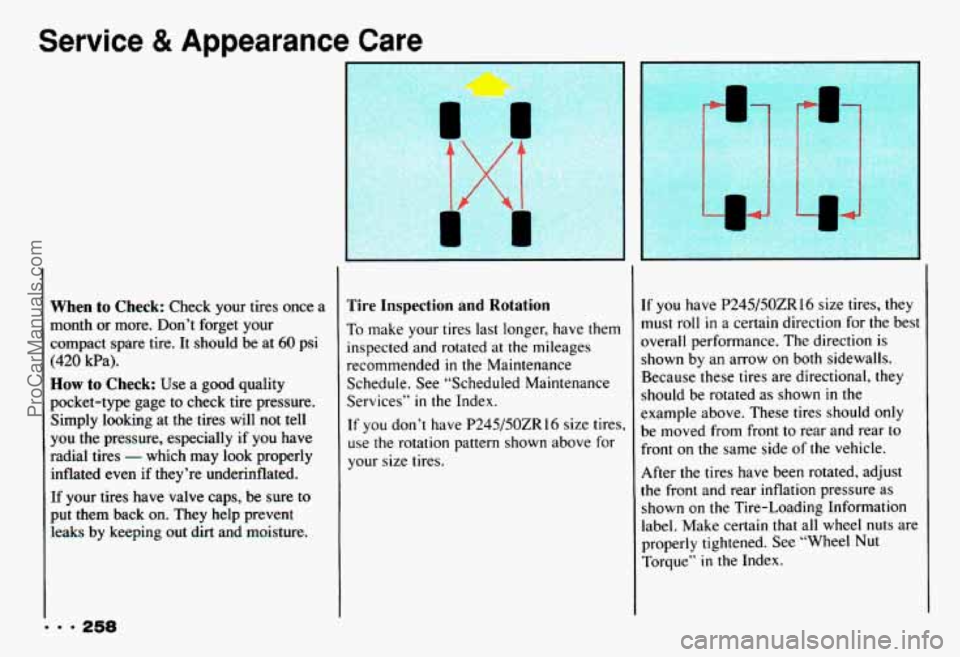
If you don’t have
P245/50ZR 16 size tires,
use the rotation pattern shown above for
your size tires. If
you have P245/50ZR16 size tires, they
must roll
in a certain direction for the best
overall performance. The direction is
shown by an arrow on both sidewalls.
Because these tires are directional, they
should
be rotated as shown in the
example above. These tires should only
be moved from front to rear and rear to
front on the same side of the vehicle.
After the tires have been rotated, adjust
the front and rear inflation pressure as
shown on the Tire-Loading Information
label. Make certain that all wheel nuts are
properly tightened. See “Wheel
Nut
Torque” in the Index.
ProCarManuals.com
Page 263 of 358
Rust or dirt on a wheel, or on
- the parts to which it is fastened,
can make wheel
nuts become loose
after a time. The wheel could come
off and cause an accident. When
you change a wheel, remove any
rust
or dirt from places where the
wheel attaches
to the vehicle. In an
emergency,
you can use a cloth or a
paper towel to do this; but be sure to
use a scraper
or wire brush later, if
you need to, to get all the rust or dirt
off. (See “Changing
a Flat Tire” in
When It’s Time for New Tires
One way to tell when it’s time for new
tires
is to check the treadwear indicators,
which will appear when your tires have
only
2/32 inch (1.6 mm) or less of tread
remaining.
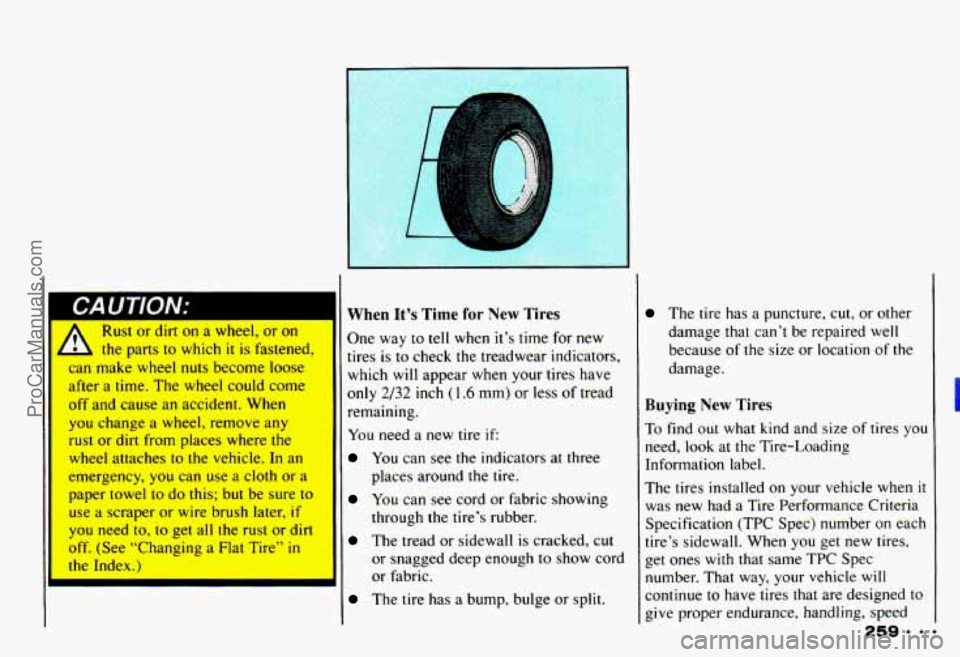
You need a new tire if:
You can see the indicators at three
places around the tire.
through the tire’s rubber.
or snagged deep enough to show cord
or fabric.
You can see cord or fabric showing
The tread or sidewall is cracked, cut
The tire has a bump, bulge or split.
The tire has a puncture, cut, or other
damage that can’t be repaired well
because
of the size or location of the
damage.
Buying New Tires
To find out what kind and size of tires you
need, look at the Tire-Loading
Information label.
The tires installed on your vehicle when
it
was new had a Tire Performance Criteria
Specification (TPC Spec) number
on each
tire’s sidewall. When you get new tires,
get ones
with that same TPC Spec
number. That way, your vehicle
will
continue to have tires that are designed to
give proper endurance, handling, speed
ProCarManuals.com
Page 266 of 358
Service & Appearance Care
represent higher levels of performance on
the laboratory test wheel than the
minimum required by law.
Warning: The temperature grade for this
tire is established for a tire that is properly
inflated and not overloaded. Excessive
speed, underinflation, or excessive
loading, either separately or
in
combination, can cause heat buildup and
possible tire failure. Those grades
are molded on the sidewalls
of passenger car tires.
While the tires available as standard or
optional equipment on General Motors
vehicles may vary with respect to these
grades, all such tires meet General Motors
performance standards and have been
approved for use
on General Motors
vehicles.
All passenger type (P Metric)
tires must conform
to Federal safety
requirements
in addition to these grades.
Wheel Alignment and Tire Balance
The wheels on your vehicle were aligned
and balanced carefully at the factory to
give you the longest tire life and best
overall performance.
In most cases, you will not need to have
your wheels aligned again. However,
if
you notice unusual tire wear or your
vehicle pulling one way or the other, the
alignment may need to be reset.
If you
notice your vehicle vibrating when
driving on a smooth road, your wheels
may need to be rebalanced.
... 262
ProCarManuals.com
Page 290 of 358
Maintenance Schedule
Introduction: A Word about Maintenance
9 286
We at General Motors want to help you keep your vehicle in
good working condition. But we don’t know exactly how
you’ll drive it.
You may drive very short distances only a
few times a week. Or you may drive long distances all the
time in very hot, dusty weather.
You may use your vehicle
in making deliveries. Or you may drive it to work, to do
errands, or in many other ways.
Because of all the different ways people use their
GM
vehicles, maintenance needs vary. You may even need more
frequent checks and replacements than you will find in the
schedules in this part. So please read this part and note how
you drive. If you have any questions on how to keep your
vehicle in good condition, see your Chevrolet dealer, the
place many GM owners choose to have their maintenance
work done. Your dealer can be relied upon to use proper
parts and practices.
Your Vehicle and the Environment
Proper vehicle maintenance not only helps keep your vehicle
in
good working condition, but it also helps the
environment.
All recommended maintenance procedures are
important. Improper vehicle maintenance or the removal of
important components can significantly affect the quality of
the air
we breathe. Improper fluid levels or even the wrong
tire inflation can increase the level of emissions from your vehicle.
To help protect our environment, and to help keep
your vehicle
in good condition, please maintain your vehicle
properly.
ProCarManuals.com
Page 303 of 358
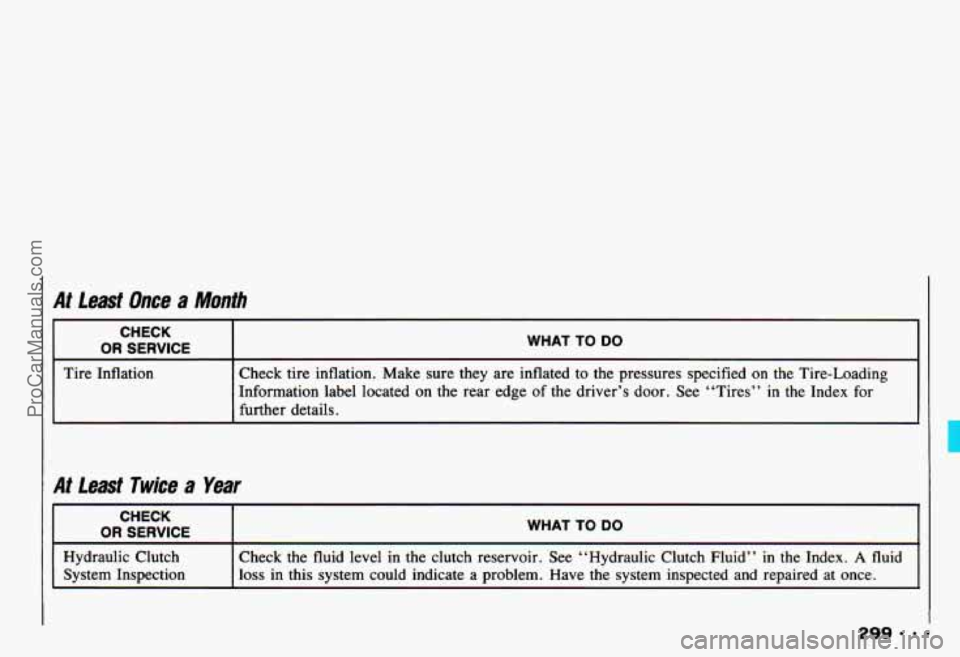
At least Once a Month
CHECK
OR SERVICE I WHAT TO DO
Tire Inflation Check tire inflation. Make sure they are inflated to the pressures specified on the Tire-Loading
Information label located on the rear edge
of the driver’s door. See “Tires” in the Index for
further details.
At least Twice a Year
CHECK
I OR SERVICE I WHAT TO DO
Hydraulic Clutch Check the fluid level in the clutch reservoir. See “Hydraulic Clutch Fluid” in the Index. A fluid
System Inspection loss in this system could indicate a problem. Have the system inspected and repaired at once.
ProCarManuals.com
Page 334 of 358
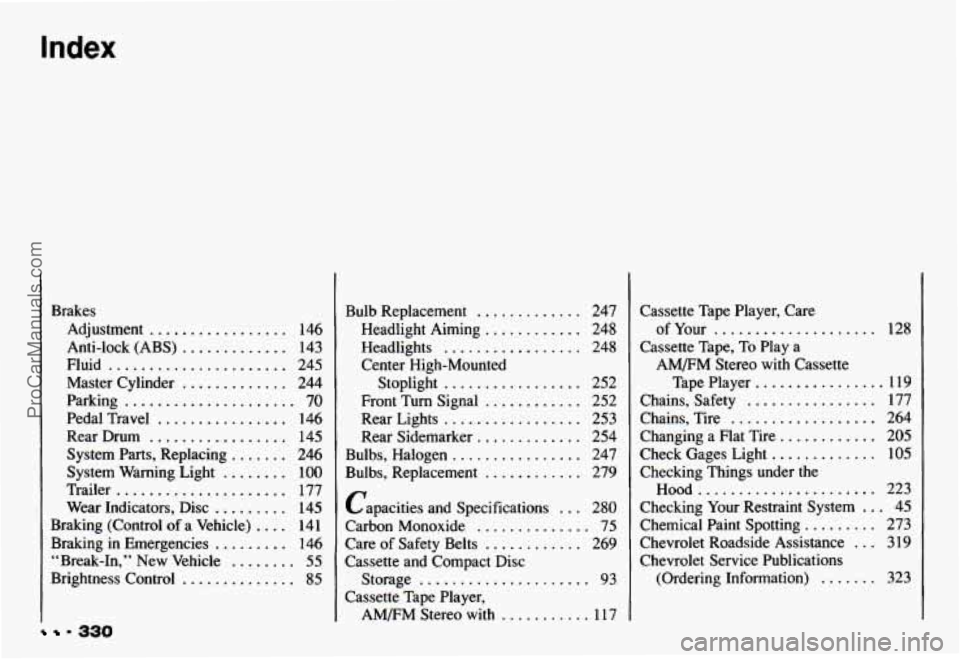
9 330
Brakes Adjustment
................. 146
Anti-lock (ABS)
............. 143
Fluid
...................... 245
Master Cylinder
............. 244
Parking
..................... 70
Pedal Travel
................ 146
Rear Drum
................. 145
System Parts. Replacing
....... 246
System Warning Light
........ 100
Trailer
..................... 177
Wear Indicators. Disc
......... 145
Braking (Control
of a Vehicle) .... 141
Braking
in Emergencies ......... 146
“Break.1n.
.. New Vehicle ........ 55
Brightness Control .............. 85
Bulb Replacement ............. 247
Headlight Aiming
............ 248
Headlights
................. 248
Center High-Mounted
Stoplight
................. 252
Front Turn Signal
............ 252
Rear Lights
................. 253
Rear Sidemarker
............. 254
Bulbs. Replacement
............ 279
Bulbs. Halogen
................ 247
Capacities and Specifications
... 280
Carbon Monoxide
.............. 75
Care of Safety Belts
............ 269
Cassette and Compact Disc
Storage
..................... 93
Cassette Tape Player.
AM/FM Stereo with ........... 11 7 Cassette Tape Player. Care
Cassette Tape.
To Play a
of Your .................... 128
AM/FM Stereo with Cassette
Tape Player
................ 119
Chains. Safety
................ 177
Chains. Tire
.................. 264
Changing
a Flat Tire ............ 205
Check Gages Light
............. 105
Checking Things under the
Hood ...................... 223
Checking Your Restraint System
... 45
Chemical Paint Spotting
......... 273
Chevrolet Roadside Assistance
... 319
Chevrolet Service Publications (Ordering Information)
....... 323
ProCarManuals.com