heating CHEVROLET CAMARO 1993 User Guide
[x] Cancel search | Manufacturer: CHEVROLET, Model Year: 1993, Model line: CAMARO, Model: CHEVROLET CAMARO 1993Pages: 358, PDF Size: 15.6 MB
Page 187 of 358
Part 5
P
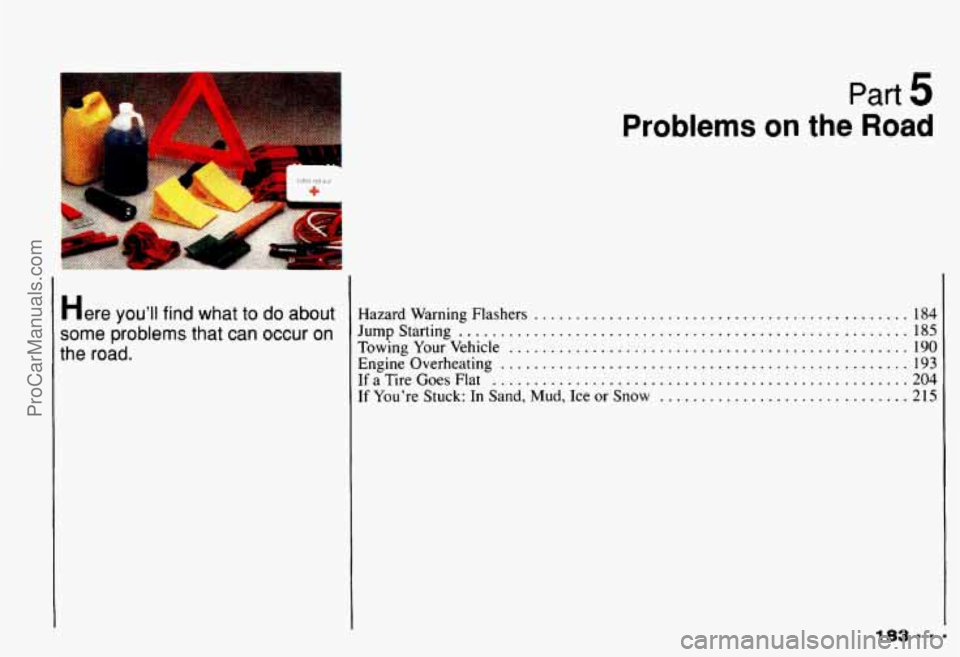
Here you’ll find what to do about
some problems that can occur on
the road.
rroblems on the Road
Hazard Warning Flashers ............................................. 184
Jump Starting ...................................................... 185
Towing Your Vehicle ................................................ 190
Engine Overheating ................................................. 193
If a Tire Goes Flat .................................................. 204
If You’re Stuck: In Sand, Mud, Ice or Snow .............................. 215
ProCarManuals.com
Page 197 of 358
I
c
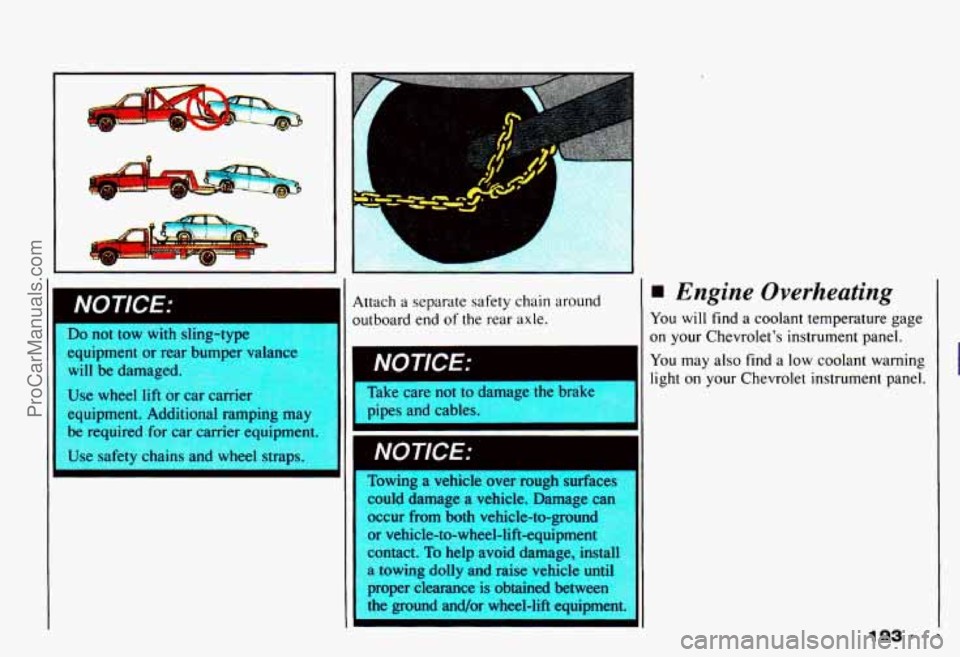
Do not tow with sling-type
eauipment or rear bumDer valance
equipment. Additional ramping may
be required for car carrier equipment.
Use safety chains and wheel straps. Attach
a separate
safety chain around
outboard end
of the rear axle.
NOTICE: I
could damage a vehicle. Damage can
occur from both vehicle-to-ground
or vehicle-to-wheel-lift-equipment
To help avoid damage, install
g dolly and raise vehicle until
er clearance is obtained between
the ground and/or wheel-lift equipment.
Engine Overheating
You will find a coolant temperature gage
on your Chevrolet's instrument panel.
You may also find a low coolant warning
light on your Chevrolet instrument panel.
193 9
ProCarManuals.com
Page 201 of 358
eng~ witho
r
u -.. .
tolar .-
[f there seems to be no leak, check to see
f the electric engine fan is running. If the
:ngine is overheating, the fan should be
-unning.
If it isn’t, your vehicle needs
iervice.
I I
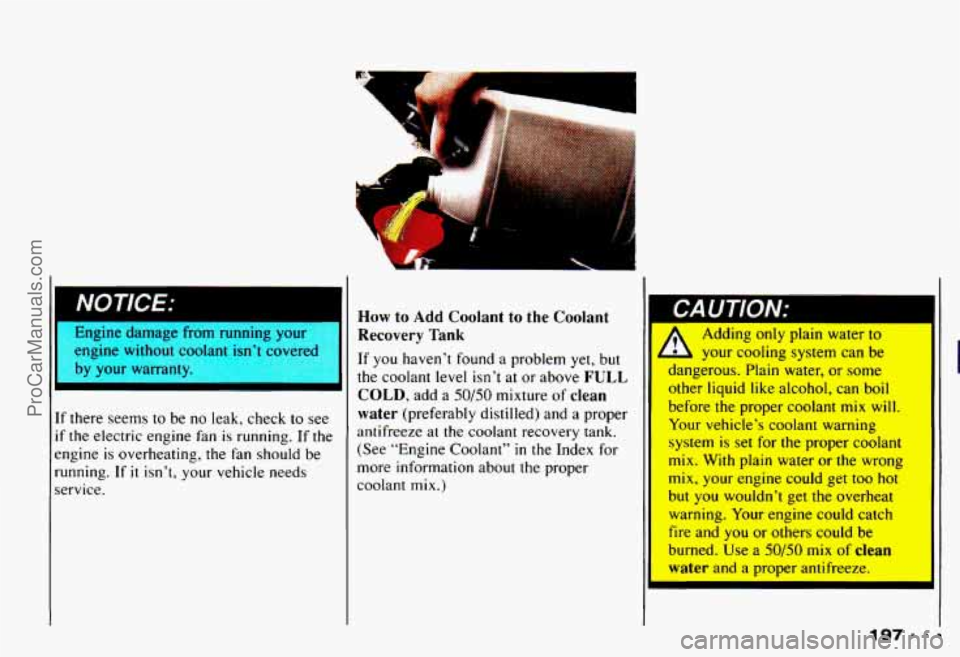
How to Add Coolant to the Coolant
Recovery Tank
If you haven’t found a problem yet, but
the coolant level isn’t
at or above FULL
COLD,
add a 50/50 mixture of clean
water
(preferably distilled) and a proper
antifreeze at the coolant recovery tank.
(See “Engine Coolant”
in the Index for
more information about the proper
coolant
mix.)
A Adding only plain water to
L your cooling system can be
dangerous. Plain water, or some
I
other liquid like alcohol, can boil
before the proper coolant
mix will.
Your vehicle’s coolant warning
system
is set for the proper coolant
mix. With plain water or the wrong
mix, your engine could get too hot
but you wouldn’t get the overheat
warning. Your engine could catch
fire and you or others could
be
burned. Use a 50/50 mix of clean
water
and a proper antifreeze.
197-
ProCarManuals.com
Page 242 of 358
Service & Appearance Care
What to Use:
Standard and Limited-Slip Differential
Use Axle Lubricant (GM Part No.
1052271) or SAE 8OW-90 GL-5 gear
lubricant.
Engine Coolant
The following explains your cooling
system and how
to add coolant when it
is low. If
you have a problem with
engine overheating or if you need to add
coolant to your radiator, see “Engine
Overheating”
in the Index.
I
The proper coolant for your Chevrolet
will:
0
0
0
0
0
Give freezing protection down to
-34°F (-37°C).
Give boiling protection up to 262°F
(128°C).
Protect against rust and corrosion.
Help keep the proper engine
temperature.
Let
the warning lights work as they
should.
ProCarManuals.com
Page 244 of 358
Service & Appearance Care
1
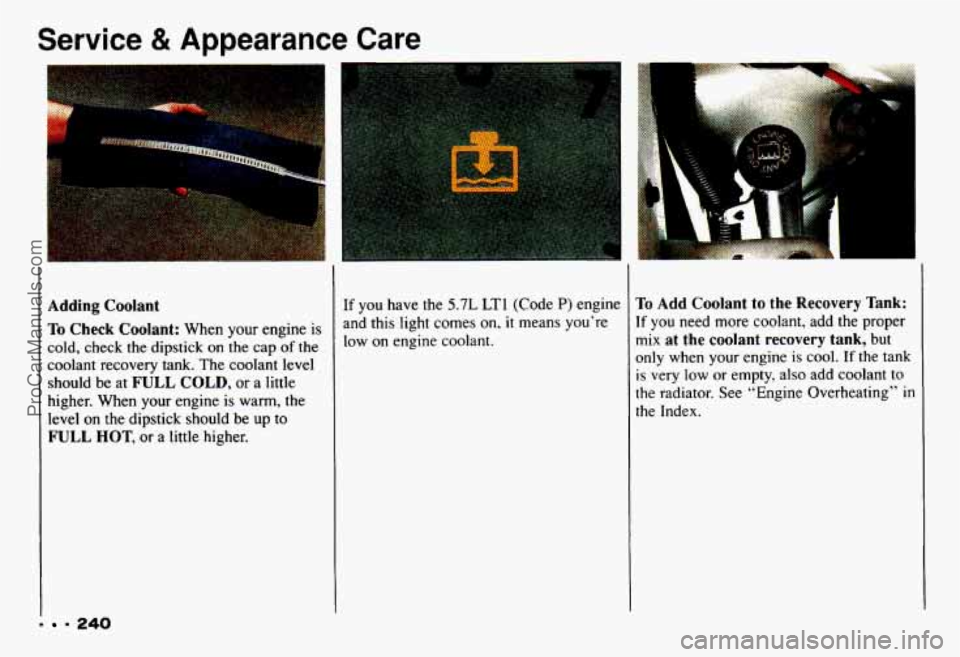
Adding Coolant
To Check Coolant: When your engine is
cold, check the dipstick on the cap of the
coolant recovery tank. The coolant level
should be at
FULL COLD, or a little
higher. When your engine is warm, the
level on the dipstick should be up to
FULL HOT, or a little higher.
If you have the 5.7L LTl (Code P) engine
and this light comes on,
it means you’re
low on engine coolant.
To Add Coolant to the Recovery Tank:
If you need more coolant, add the proper
mix
at the coolant recovery tank, but
only when your engine
is cool. If the tank
is very low or empty, also add coolant to
the radiator. See “Engine Overheating” in
the Index.
9 240
ProCarManuals.com
Page 245 of 358
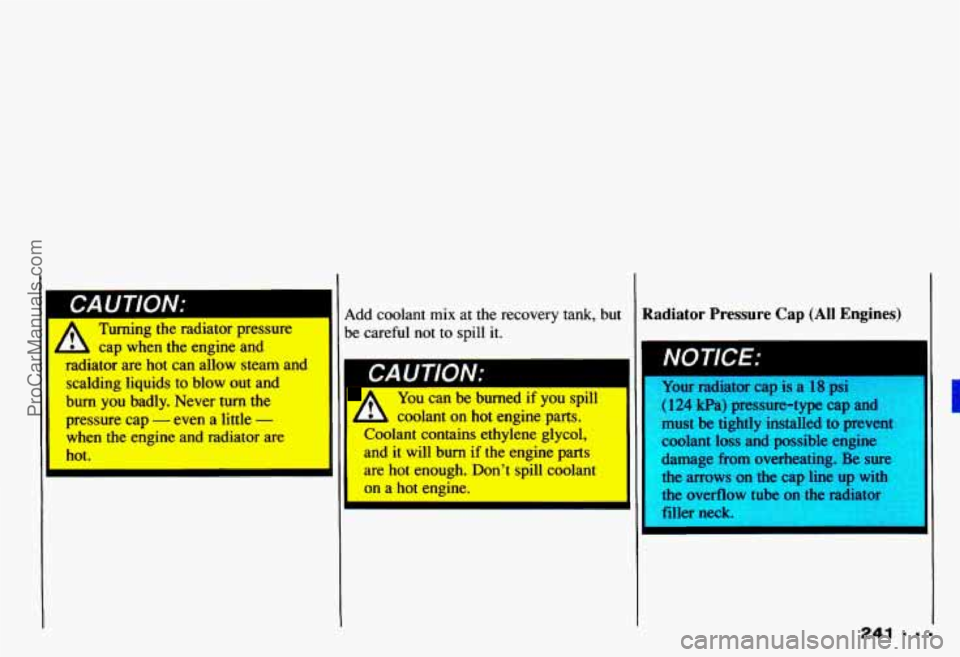
Turning the radiator pressure
L cap when the engine and
radiator
are hot can allow steam and
scalding liquids to blow out and
burn you badly. Never turn the
pressure
cap - even a little -
when the engine and radiator are
,dd coolant mix at the recovery tank, but
e careful not to spill it.
CA U TION:
I
I
You can be burned if you spill
coolant on hot engine parts.
Coolant contains ethylene glycol,
and it will burn
if the engine parts
are hot enough. Don’t spill coolant
on a hot engine.
Radiator Pressure Cap (All Engines)
~ NOTICE:
Your radiator cap is a 18 psi
(124 kPa) pressure-type cap and
must be tightly installed to prevent
coolant loss and possible engine
damage from overheating. Be sure
the arrows on the cap line
up with
the ovefflow tube on the radiator
filler neck.
ProCarManuals.com
Page 261 of 358
CAUTION:
Poorly maintained and
improperly used tires are
dangerous.
a
m
a
Overloading your tires can cause
overheating as
a result of too
much friction. You could have
an
air-out and a serious accident. See
“Loading Your Vehicle” in the
Index.
Underinflated tires pose the
same
danger as overloaded tires. The
resulting accident could cause
serious
injury. Check all tires
frequently to maintain the
recommended
pressure. Tire
pressure should
be checked when
your tires are cold.
Overinflated tires
are more likely
to be cut, punctured, or broken by
a sudden impact, such as when
you
hit a pothole. Keep tires at the
recommended pressure.
Worn, old tires can cause
accidents.
If your tread is badly
worn, or if your tires have been
damaged, replace them.
I
Inflation - Tire Pressure
The Tire-Loading Information label
which
is on the driver’s door shows the
correct inflation pressures for your tires,
when they’re cold. “Cold” means your
vehicle has been sitting for at least three
hours or driven no more than a mile.
If your vehicle is equipped
with
P245/50ZR16 tires and you’ll be
driving at speeds higher than
100 mph
(160 km/h) where it is legal, raise the
“cold” inflation pressure of each tire to
35 psi (240 kPa). When you end this very
high speed driving, reduce the “cold”
inflation pressures to those listed on the
Tire Loading Information label. Never
inflate the tires higher than the maximum
“cold” inflation pressures stated on the
sidewall of the tires. Don’t let anyone tell
you that
underinflation
or overinflation is all
right. It’s not.
If your tires don’t
haveenougha
n)
you can get
e Too muc
Too much heal
Tire overloading
Bad wear
Bad handli
Bad fuel econ
I If your tires have too much air
(overinflation), you
can get’
Unusual wear
’ 0 Bad handling
e Rough ri,,
Needless damage fi~111
hazards.
~
I
ProCarManuals.com
Page 333 of 358
Index
Adding Coolant .............. 240
Add-on Electrical Equipment
.... 275
AirBags
...................... 25
How the System Works
........ 27
Servicing Your Chevrolet with
the System
................ 30
System Light
................ 26
Air Cleaner
................... 230
Air Conditioner Controls
......... 11 2
Air Control Knob
............... 110
Air Filter Replacement
.......... 231
Alignment and Tire Balance.
Wheel
..................... 262
Aluminum Wheels
............. 271
AM ......................... 127 AM/FM Stereo
With Cassette Tape Player
...... 1 17
With Compact Disc Player.
Delco-Base@ ............. 12 1
AM Stereo ................... 128
Antenna. Fixed Mast
........... 129
Anti-lock Brakes (ABS)
......... 143
System Warning Light
........ 101
To Use
.................... 144
Appearance Care
.............. 265
Appearance Care and Maintenance Materials
........ 274
Appearance Care. Service and
.... 217
Ashtray and Lighter
............. 94
Ashtray. Front
................. 94
Audio Systems
................. 11 5
Audio Systems. Comfort Controls and
................ 109 Automatic Transmission
......... 62
Automatic Transmission Fluid
.... 233
Axle. Limited-Slip Rear
.......... 70
Axle. Rear
................... 237
Backing Up (with a Trailer)
..... 178
Balance. Wheel Alignment
and Tire
................... 262
Battery
...................... 246
Beams. High
.................. 154
Before Leaving on a Long Trip
... 163
Belt. Lap-Shoulder
.............. 21
Better Business Bureau MediatiodArbitration Program
GM Participation
in ........ 316
Bi-Level Heating
............... 111
Blizzard. If You’re Caught in a ... 172
Box. Glove .................... 92
329 . .
ProCarManuals.com
Page 337 of 358
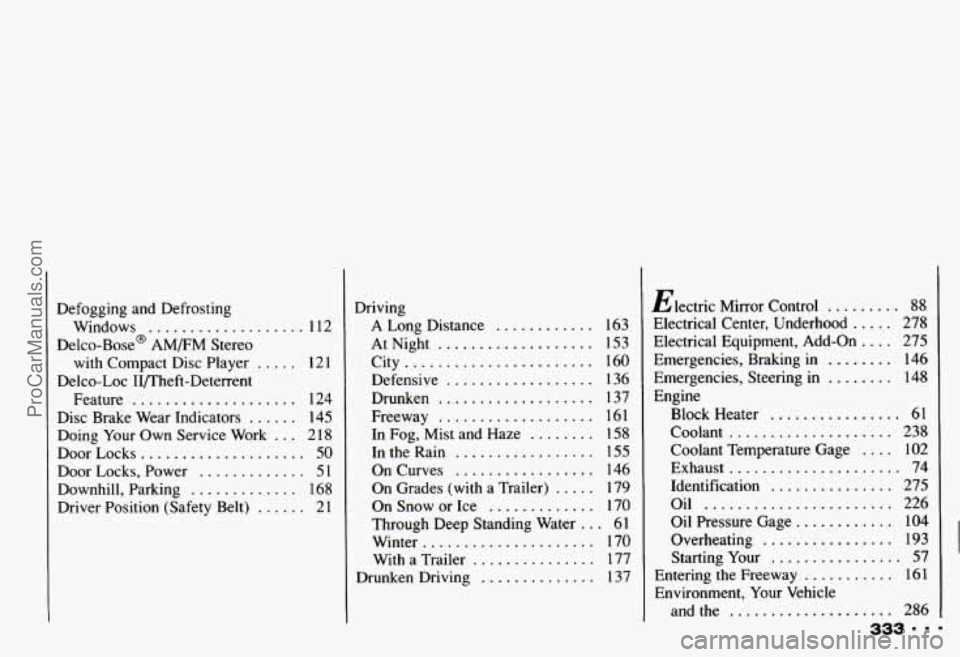
Defogging and Defrosting
Delco-Base@ AM/FM Stereo
Delco-Loc II/Theft-Deterrent Feature
.................... 124
Disc Brake Wear Indicators ...... 145
Doing Your Own Service Work ... 218
Door Locks .................... 50
Door Locks. Power ............. 5 1
Downhill. Parking ............. 168
Driver Position (Safety Belt) ...... 21
Windows ................... 1 12
with Compact Disc Player ..... 121
Driving
A Long Distance
............
AtNight ...................
City .......................
Defensive ..................
Drunken ...................
In Fog. Mist and Haze ........
In the Rain .................
On Curves .................
On Grades (with a Trailer) .....
On Snow or Ice .............
Through Deep Standing Water . .
Winter .....................
With a Trailer ...............
Drunken Driving ..............
Freeway ...................
163
153
1 60
136
137
161
158
155
146
179
170 61
170 177
137
Electric Mirror Control ......... 88
Electrical Center. Underhood ..... 278
Electrical Equipment. Add-on .... 275
Emergencies. Braking in ........ 146
Emergencies. Steering in ........ 148
Engine
Block Heater
................ 61
Coolant .................... 238
Coolant Temperature Gage .... 102
Exhaust ..................... 74
Identification ............... 275
Oil ....................... 226
Oil Pressure Gage ............ 104
Starting Your ................ 57
Entering the Freeway ........... 161
Environment. Your Vehicle
andthe
.................... 286
Overheating ................ 193
333. . .
ProCarManuals.com
Page 339 of 358
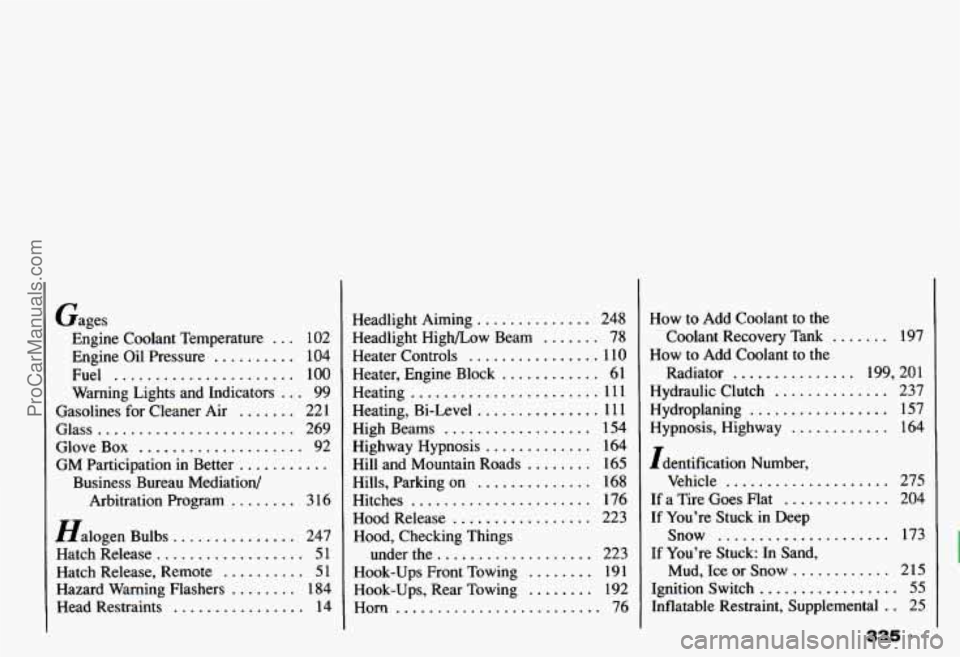
Gages Engine Coolant Temperature
... 102
Engine Oil Pressure .......... 104
Fuel ...................... 100
Warning Lights and Indicators ... 99
Gasolines for Cleaner Air ....... 221
Glass ........................ 269
Glove Box .................... 92
GM Participation in Better ...........
Business Bureau Mediation/
Arbitration Program
........ 3 16
Halogen Bulbs ............... 247
Hatch Release .................. 51
Hatch Release. Remote .......... 51
Hazard Warning Flashers ........ 184
Head Restraints ................ 14
Headlight Aiming .............. 248
Headlight Highbow Beam ....... 78
Heater Controls ................ 110
Heater. Engine Block ............ 61
Heating ....................... 11 1
Heating. Bi-Level ............... 111
High Beams .................. 154
Highway Hypnosis ............. 164
Hill and Mountain Roads ........ 165
Hills. Parking on .............. 168
Hitches ...................... 176
Hood Release ................. 223
Hood. Checking Things
under the
................... 223
Hook-Ups Front Towing ........ 19 1
Hook-Ups. Rear Towing ........ 192
Horn ......................... 76
How to Add Coolant to the
Coolant Recovery Tank
....... 197
How to Add Coolant to the
Radiator
............... 199. 201
Hydraulic Clutch .............. 237
Hydroplaning ................. 157
Hypnosis. Highway ............ 164
Identification Number.
Vehicle
.................... 275
If a Tire Goes Flat ............. 204
If You’re Stuck in Deep
Snow
..................... 173
If You’re Stuck: In Sand.
Mud. Ice or Snow ............ 215
Ignition Switch ................. 55
Inflatable Restraint. Supplemental . . 25
335 . .
ProCarManuals.com