check engine CHEVROLET CAMARO 1993 Owner's Manual
[x] Cancel search | Manufacturer: CHEVROLET, Model Year: 1993, Model line: CAMARO, Model: CHEVROLET CAMARO 1993Pages: 358, PDF Size: 15.6 MB
Page 239 of 358
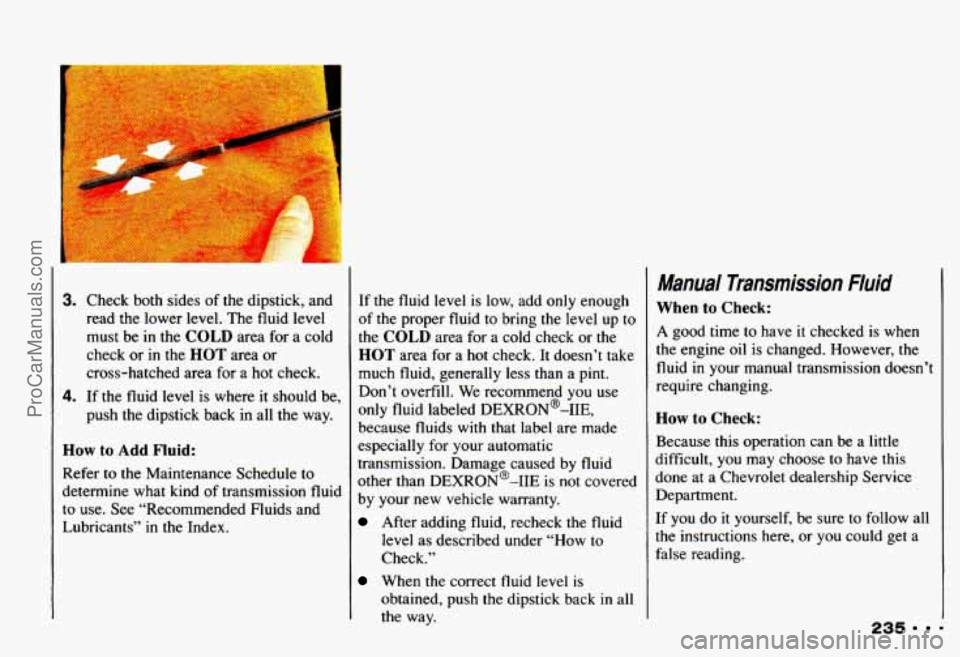
3. Check both sides of the dipstick, and
read the lower level. The fluid level
must be
in the COLD area for a cold
check or in the
HOT area or
cross-hatched area for a
hot check.
4. If the fluid level is where it should be,
push the dipstick back
in all the way.
How to Add Fluid:
Refer to the Maintenance Schedule to
determine what kind of transmission fluid
to use. See “Recommended Fluids and
Lubricants” in the Index. If the fluid level is low, add only enough
of the proper fluid to bring the level up to
the COLD area for
a cold check or the
HOT area for a hot check. It doesn’t take
much fluid, generally less than a pint.
Don’t overfill. We recommend you use
only fluid labeled
DEXRON@-IIE,
because fluids with that label are made
especially for your automatic
transmission. Damage caused by
fluid
other than DEXRON@-IIE is not covered
by your new vehicle warranty.
After adding fluid, recheck the fluid
level as described under “How to
Check.”
obtained, push the dipstick back
in all
the way.
When the correct fluid level is
Manual Transmission Fluid
When to Check:
A good time to have it checked is when
the engine oil is changed. However, the
fluid in your manual transmission doesn’t
require changing.
How to Check:
Because this operation can be a little
difficult, you may choose to have this
done at a Chevrolet dealership Service
Department.
If
you do it yourself, be sure to follow all
the instructions here, or you could get a
false reading.
235 9
ProCarManuals.com
Page 240 of 358
Service & Appearance Care
~1 NOTICE: Ill Then, follow these steps:
100 mucn or too mtIe nula can
damage your transmission.
Too
much can mean that some of the
fluid could come out and fall on hn
engine parts, starting a fire. Be s
to get an accurate reading if you
check your transmission
fluid
1. Remove the filler plug.
2. Check that the lubricant level is up to
the bottom of the filler plug hole.
11 3. If the fluid level is good, install the
plug and be sure
it is fully seated. If
the fluid level is low, add more fluid
as described in the next steps.
II
Check the fluid level only when your
engine is
off, the vehicle is parked on a
level place and the transmission is cool
enough for you to rest your fingers on the
transmission case.
How to Add Fluid:
Here’s how to add fluid. Refer to the
Maintenance Schedule to determine what
kind
of fluid to use. See “Recommended
Fluids and Lubricants”
in the Index.
1. Remove the filler plug.
2. Add fluid at the filler plug hole. Add
only enough fluid to bring the fluid
level
up to the bottom of the filler
plug hole.
3. Install the filler plug. Be sure the plug
is fully seated.
... 236
ProCarManuals.com
Page 244 of 358
Service & Appearance Care
1
Adding Coolant
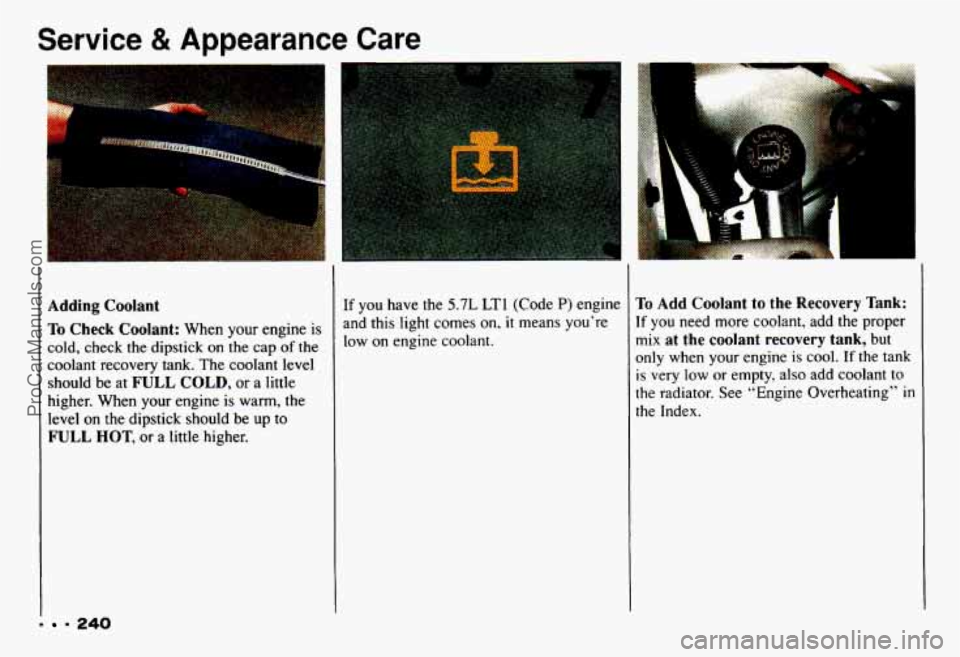
To Check Coolant: When your engine is
cold, check the dipstick on the cap of the
coolant recovery tank. The coolant level
should be at
FULL COLD, or a little
higher. When your engine is warm, the
level on the dipstick should be up to
FULL HOT, or a little higher.
If you have the 5.7L LTl (Code P) engine
and this light comes on,
it means you’re
low on engine coolant.
To Add Coolant to the Recovery Tank:
If you need more coolant, add the proper
mix
at the coolant recovery tank, but
only when your engine
is cool. If the tank
is very low or empty, also add coolant to
the radiator. See “Engine Overheating” in
the Index.
9 240
ProCarManuals.com
Page 246 of 358
Service & Appearance Care
When you replace your radiator pressure
cap. an
AC3 cap is recommended.
Thermostat
Engine coolant temperature is controlled
by a thermostat in the engine coolant
system. The thermostat stops the flow
of
coolant through the radiator until the
coolant reaches a preset temperature.
When you replace
your thermostat, an
AC@ thermostat is recommended.
3.4L L32 (Code S)
Power Steering Fluid
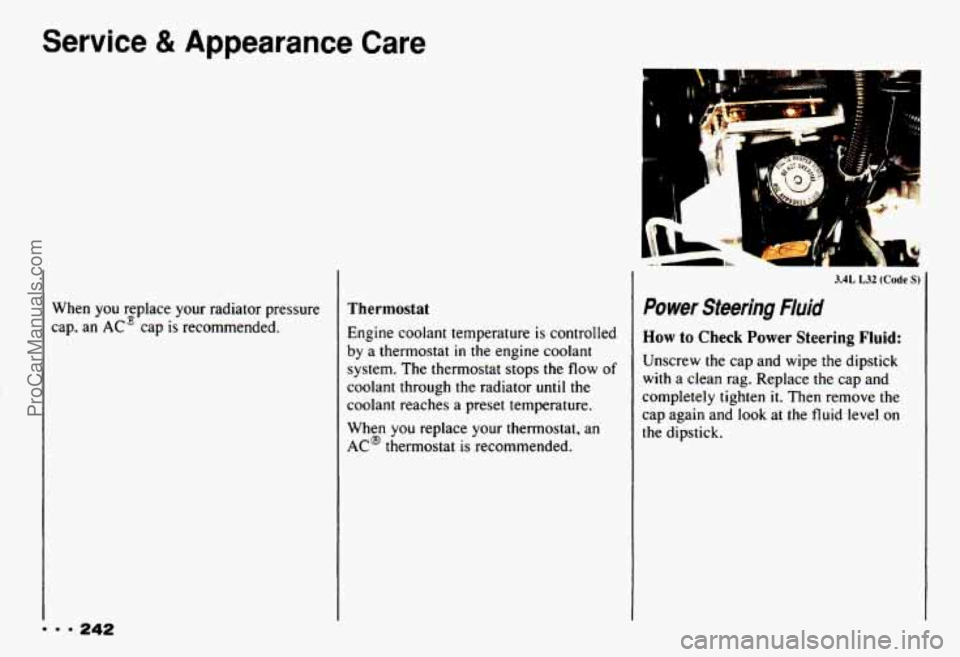
How to Check Power Steering Fluid:
Unscrew the cap and wipe the dipstick
with a clean rag. Replace the cap and
completely tighten
it. Then remove the
cap again and look at the fluid level
on
the dipstick.
ProCarManuals.com
Page 249 of 358
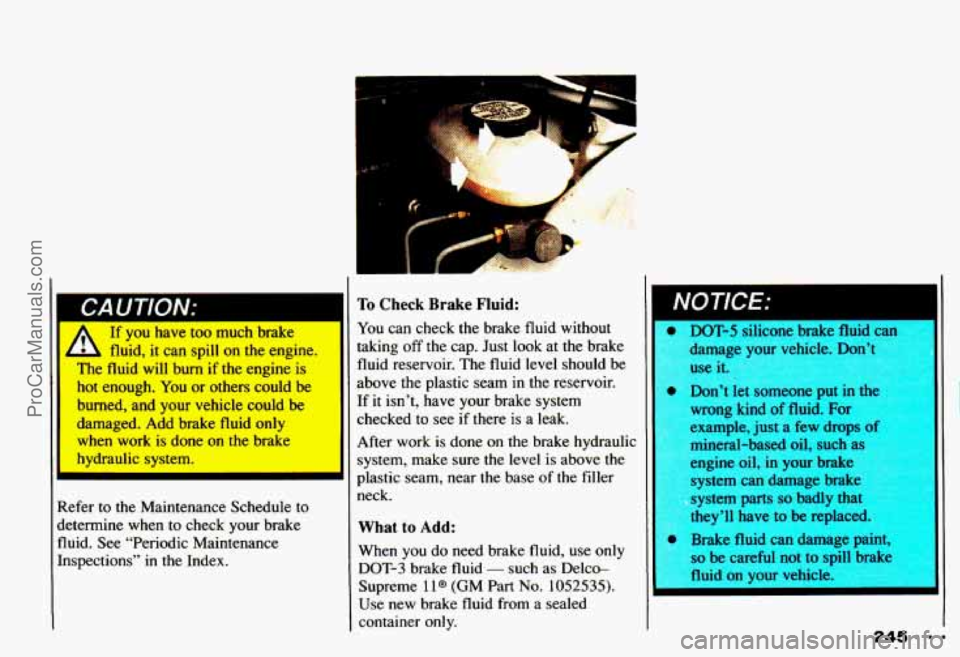
I I A If you have too much brake
L , fluid, it can spill on the engine.
‘-L: fluid will burn if the engine is
hot enough. You or others could be
burned, and your vehicle could be
damaged. Add brake fluid only
when work is done
on the brake
hydraulic system.
Refer to the Maintenance Schedule
to
determine when to check your brake
fluid. See “Periodic Maintenance
Inspections” in the Index.
- Y
tE
fl
a1
11
c1
A
s:
P
b Check Brake Fluid:
ou can check the brake fluid without
king
off the cap. Just look at the brake
.uid reservoir. The fluid level should be
bove the plastic seam in the reservoir.
: It isn’t, have your brake system
hecked to see
if there is a leak.
,fter work
is done on the brake hydraulic
ystem, make sure the level
is above the
lastic seam, near
the base of the filler
eck.
dhat to Add:
When you do need brake fluid, use only
DOT-3 brake fluid - such as Delco-
Supreme
1 l@ (GM Part No. 1052535).
Use new brake fluid from a sealed
container only.
*I
NOTICE: I
0 DOT-5 silicone brake fluid can
damage your vehicle. Don’t
use it.
0 Don’t let someone put in the
wrong kind of fluid. For
example, just a few drops
mineral-based oil, such a5
engine oil, in your brake
system can damage brake
system parts
so badly that
they’ll have to be replaced.
Srake fluid can damage p----.,
-0 be careful not to snill brake
ProCarManuals.com
Page 280 of 358
Service & Appearance Care
9 276
Fuses and Circuit
Breakers
The wiring circuits in your vehicle are
protected from short circuits by a
combination of fuses, circuit breakers,
and fusible thermal links in the wiring itself. This greatly reduces the chance of
fires caused by electrical problems.
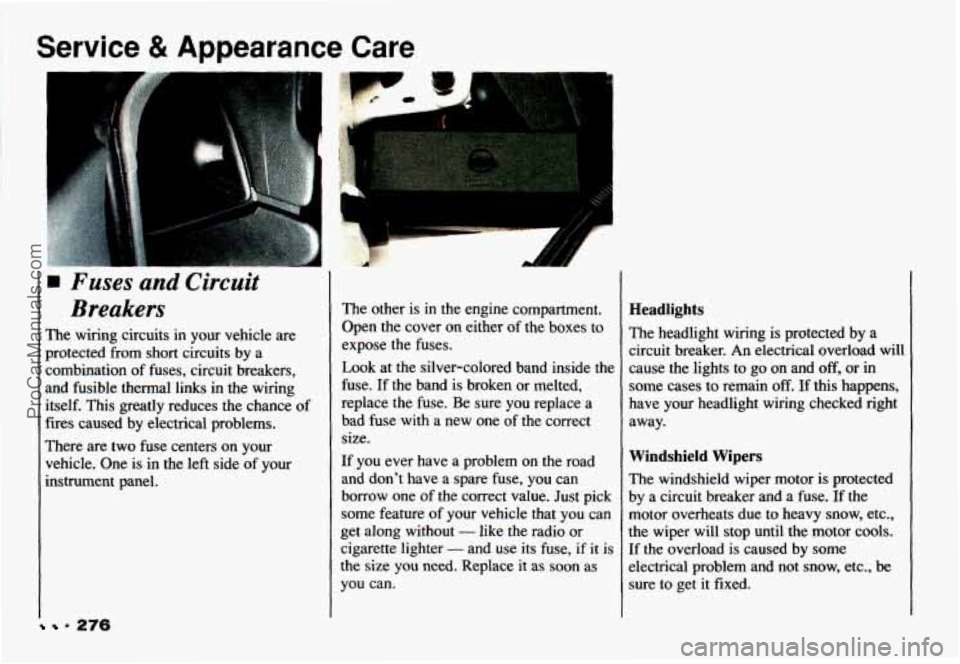
There are
two fuse centers on your
vehicle. One is
in the left side of your
instrument panel.
The other is in the engine compartment.
Open the cover on either of the boxes to
expose the fuses.
Look at the silver-colored band inside the
fuse. If the band
is broken or melted,
replace the fuse. Be sure you replace a
bad fuse with a new one
of the correct
size.
If you ever have a problem on the road
and don’t have a spare fuse, you can
borrow one
of the correct value. Just pick
some feature of your vehicle that you can
get along without
- like the radio or
cigarette lighter
- and use its fuse, if it is
the size you need. Replace
it as soon as
you can.
Headlights
The headlight wiring is protected by a
circuit breaker.
An electrical overload will
cause the lights to go on and off, or in
some cases to remain
off. If this happens,
have your headlight wiring checked right
away.
Windshield Wipers
The windshield wiper motor is protected
by a circuit breaker and a fuse.
If the
motor overheats due to heavy snow, etc.,
the wiper will stop until the motor cools.
If the overload is caused by some
electrical problem and not snow, etc., be
sure to get it fixed.
ProCarManuals.com
Page 286 of 358
Service & Appearance Care
Capacities (Approximate)
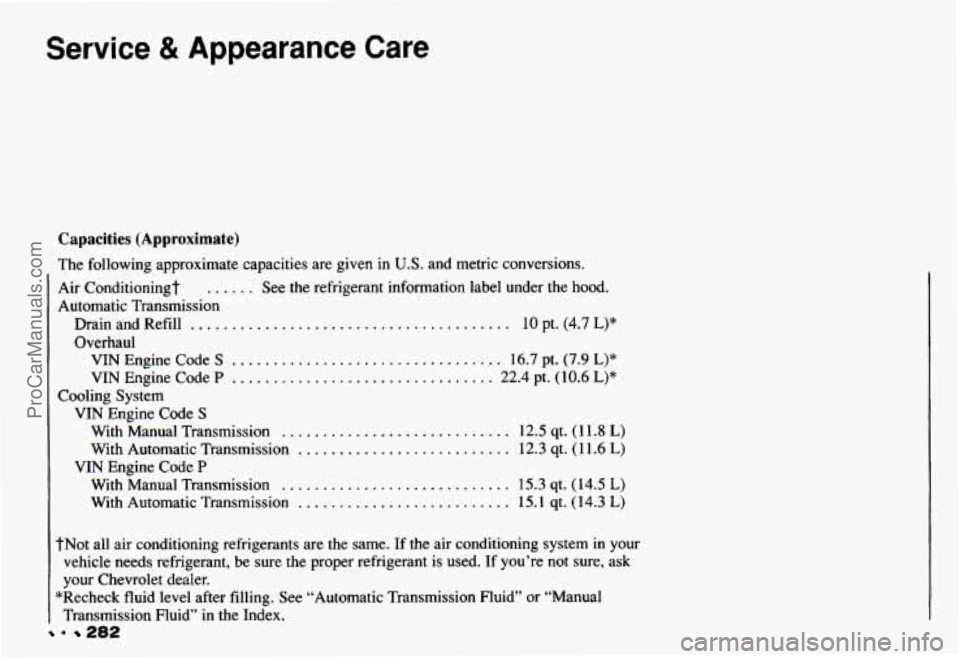
The following approximate capacities are given in U.S. and metric conversions.
Air Conditioningt
...... See the refrigerant information label under the hood.
Automatic Transmission
Drain and Refill
....................................... 10 pt. (4.7 L)*
Overhaul VIN Engine Code
S ................................. 16.7 pt. (7.9 L)*
VIN Engine Code P ................................ 22.4 pt. (10.6 L)*
Cooling System
VIN Engine Code
S
With Manual Transmission ............................ 12.5 qt. (11.8 L)
With Automatic Transmission .......................... 12.3 qt. ( 11.6 L)
With Manual Transmission ............................ 15.3 qt. ( 14.5 L)
With Automatic Transmission .......................... 15.1 qt. (14.3 L)
VIN Engine Code P
tNot all air conditioning refrigerants are the same. If the air conditioning system in your
vehicle needs refrigerant, be sure the proper refrigerant is us\
ed. If you’re not sure, ask
your Chevrolet dealer.
Transmission Fluid” in the Index.
*Recheck fluid level
after filling. See “Automatic Transmission Fluid” or “Manual
. 282
ProCarManuals.com
Page 287 of 358
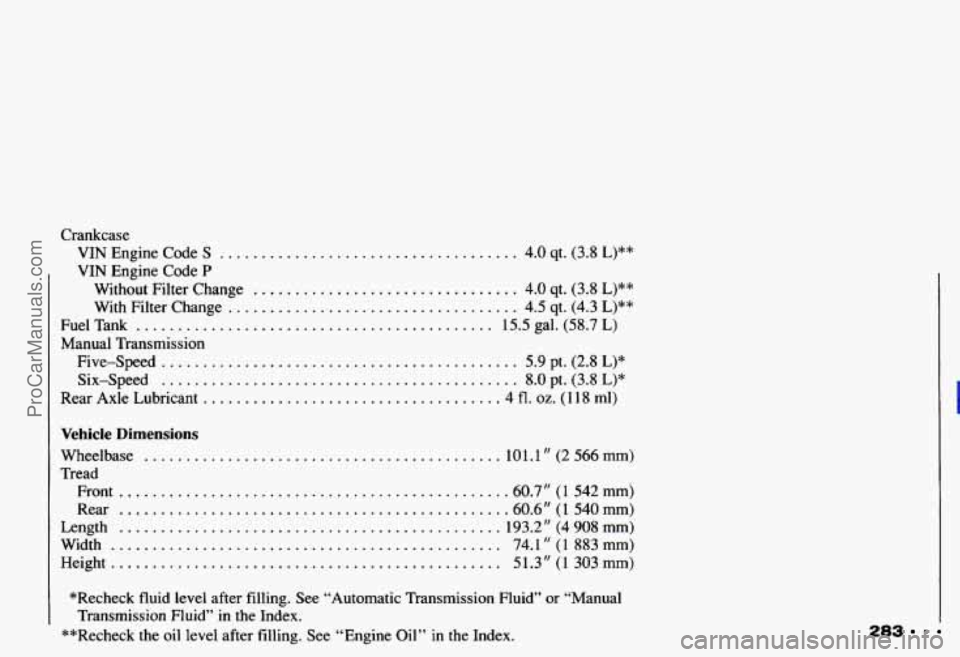
Crankcase VIN Engine Code
S .................................... 4.0 qt. (3.8 L)**
VIN Engine Code
P
Without Filter Change ................................ 4.0 qt. (3.8 L)**
With Filter Change
................................... 4.5 qt. (4.3 L)**
Fuel Tank
........................................... 15.5 gal. (58.7 L)
Manual Transmission Five-Speed
........................................... 5.9 pt. (2.8 L)*
Six-Speed ........................................... 8.0 pt. (3.8 L)*
Rear Axle Lubricant .................................... 4 fl. 02. (1 18 ml)
Vehicle Dimensions
Wheelbase ........................................... 101.1 “ (2 566 mm)
Tread Front
.............................................. .60.7“ (1 542 mmj
Rear
.............................................. .60.6” (1 540 mm)
Length
.............................................. 193.2” (4 908 mm)
Width
............................................... 74.1 “ (1 883 mm)
Height
............................................... 5 1.3“ (1 303 mm)
*Recheck fluid level after filling. See “Automatic Transmissio\
n Fluid”
or “Manual
Transmission Fluid” in the Index.
**Recheck the oil level after filling. See “Engine Oil” in the Index.
I
283
ProCarManuals.com
Page 289 of 358
IMPORTANT: I
KEEP ENGINE OIL
AT THE PROPER
LEVEL AND CHANGE AS I
This part covers the
maintenance required
for your
Chevrolet . Your vehicle needs
these services to retain its safety.
dependability and emission
control performance
.
Section
.
Part
Maintenance Schedule
Introduction: A Word about Maintenance ........................... 286
Your Vehicle and the Environment
............................ 286
How This Part
Is Organized ................................. 287
A . Scheduled Maintenance Services ............................... 289
Using Your Maintenance Schedules
........................... 289
Selecting the Right Schedule
................................. 289
Schedule
I ................................................ 290
Schedulen
............................................... 292
Explanation
of Scheduled Maintenance Services ................. 294
B . Owner Checks and Services ................................... 298
At Each Fuel Fill
.......................................... 298
At Least Once a Month ..................................... 299
At Least Twice a Year ...................................... 299
At Least Once a Year ....................................... 300
C . Periodic Maintenance Inspections .............................. 303
D . Recommended Fluids and Lubricants ........................... 305 I
E . MaintenanceRecord ......................................... 308
piqm I
Have you purched the GM Protection Plan ? The Plan
supplements
your new car warranties .
See your GM dealer for details .
285 .
ProCarManuals.com
Page 298 of 358
Maintenance Schedule
Section A: Scheduled Maintenance Services (Cont.)
Eirplanation of Scheduled Maintenance Semices
Below are explanations of the services listed in Schedule I
and Schedule 11.
The proper fluids and lubricants
to use are listed in Section
D. Make sure whoever services your vehicle uses these. All
ITEM
NO. SERVICE
1 Engine Oil and Filter Change* - Always use SG
Energy Conserving I1 oils of proper viscosity. The
SG designation may be shown alone or in
combination with others, such as
SGKC, SG/CD,
or SF, SG, CC, etc. To determine the preferred
viscosity for your vehicle’s engine (e.g., SAE
5W-30 or 10W-30), see “Engine Oil” in the Index.
2 Chassis Lubrication - If your vehicle is equipped
with grease fittings, lubricate the suspension and
steering linkage. Lubricate the transmission shift
linkage. parts should be replaced and all necessary repairs done
before
you or anyone else drives the vehicle.
NOTE: To determine your engine’s displacement and code, see ‘‘Engine Identification” in the Index.
ITEM
NO. SERVICE
3 Tire and Wheel Rotation and Inspection - For
proper wear and maximum tire life, rotate your tires
following the instructions in this manual. See “Tires, Inspection and Rotation’’
in the Index.
Check the tires for uneven wear or damage. If
you
see irregular or premature wear, check the wheel
alignment. Check for damaged wheels also.
Inspect the belt for cracks, fraying, wear and proper
tension. Replace
as needed.
4 Engine Accessory Drive Belt Inspection* -
I
*An Emission Control Service.
9 294
ProCarManuals.com