maintenance CHEVROLET CAMARO 1993 Owners Manual
[x] Cancel search | Manufacturer: CHEVROLET, Model Year: 1993, Model line: CAMARO, Model: CHEVROLET CAMARO 1993Pages: 358, PDF Size: 15.6 MB
Page 3 of 358
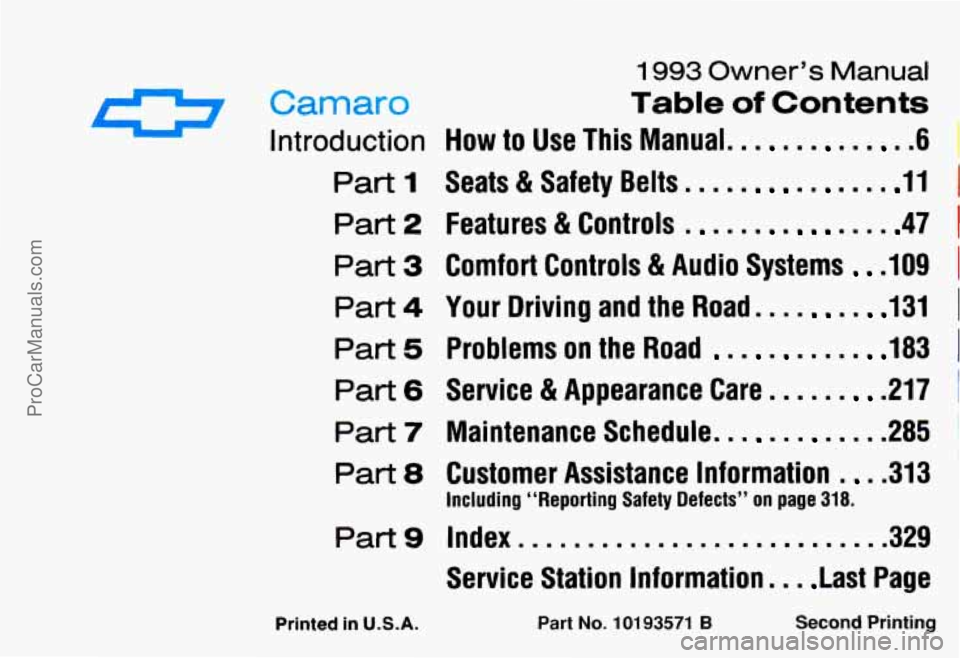
1993 Owner’s Manual
Carnaro Table of Contents
Introduction HOW to Use This Manual. - 61
Part I Seats & Safety Belts m 11 I
Part 2 Features & Controls m 47 I
Part 3 Comfort Controls & Audio Systems A09
Part 4 Your Driving and the Road 131
Part 5 Problems on the Road 183
Part 6 Service & Appearance Care 217
Part 7 Maintenance Schedule. . m 285
Part 8 Customer Assistance Information 313
including “Reporting Safety Defects” on page 318.
Part9 Indexm= mm....................... 329
Service Station Information Last Page
Part No. 101 93571 B Second Printing
Printed in U.S.A.
ProCarManuals.com
Page 8 of 358
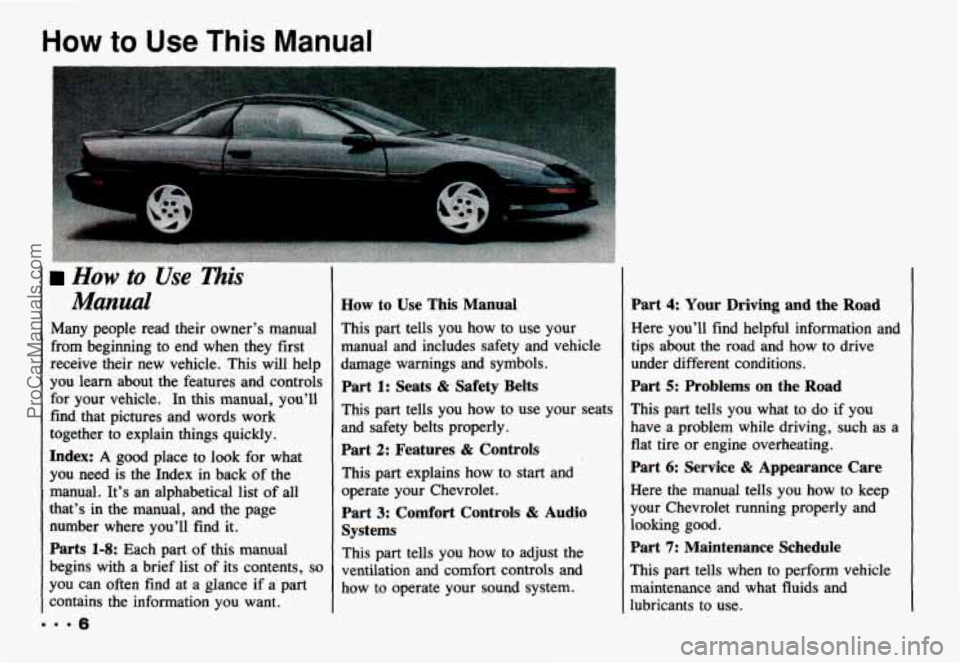
How to Use This Manual
How to Use This
Manual
Many people read their owner’s manual
from beginning to end when they first
receive their new vehicle. This will help
you learn about the features and controls
for your vehicle. In this manual, you’ll
find that pictures and words work
together to explain things quickly.
Index: A good place to look for what
you need is
the Index in back of the
manual. It’s an alphabetical list of all
that’s
in the manual, and the page
number where you’ll find it.
Parts 1-8: Each part of this manual
begins with a brief list of its contents,
so
you can often find at a glance if a part
contains the information you want.
How to Use This Manual
This part tells you how to use your
manual and includes safety and vehicle
damage warnings and symbols.
Part 1: Seats & Safety Belts
This part tells you how to use your seats
and safety belts properly.
Part 2: Features & Controls
This part explains how to start and
operate your Chevrolet.
Part 3: Comfort Controls & Audio
Systems
This part tells you how to adjust the
ventilation and comfort controls and
how to operate your sound system.
Part 4: Your Driving and the Road
Here you’ll find helpful information and
tips about the road and how to drive
under different conditions.
Part 5: Problems on the Road
This part tells you what to do if you
have a problem while driving, such as a
flat tire or engine overheating.
Part 6: Service & Appearance Care
Here the manual tells you how to keep
your Chevrolet running properly and
looking
good.
Part 7: Maintenance Schedule
This part tells when to perform vehicle
maintenance and what fluids and
lubricants to use.
ProCarManuals.com
Page 34 of 358
Seats & Safety Belts
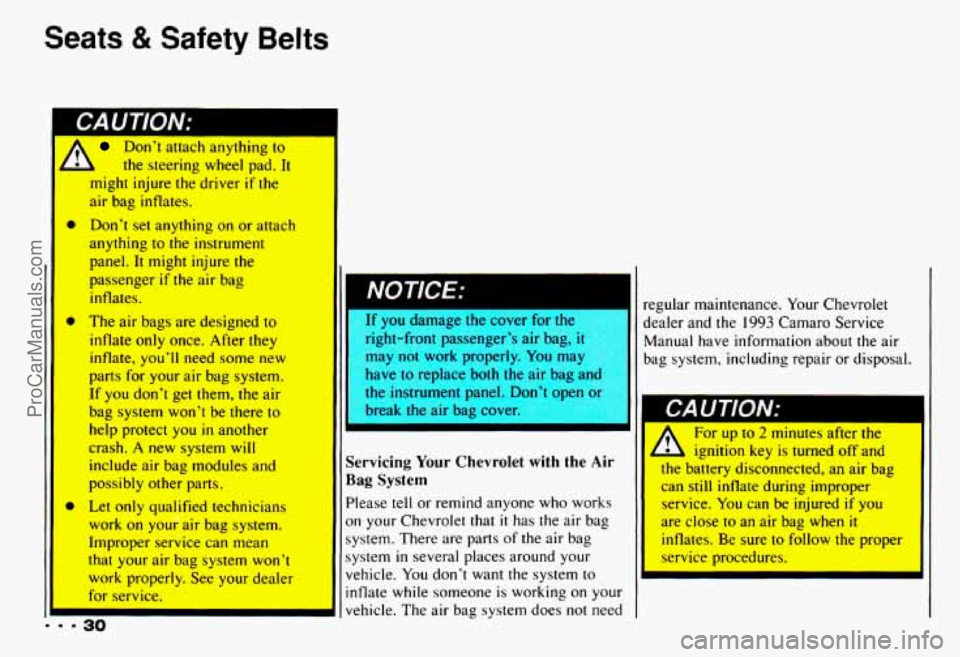
CAUTlON;
on’t attach anything to
~ :e steering wheel pad. It
0
0
0
-* 9 30
might injure thedriver if the
air bag inflates.
Don’t set anything on or attach
anything
to the instrument
panel.
It might injure the
passenger
if the air bag
inflates.
The air bags are designed
to
inflate only once. After they
inflate, you’ll need some new
parts for your air bag system.
If you don’t get them, the air
bag system won’t be there
to
help protect you in another
crash.
A new system will
include air bag modules and
possibly other parts.
Let only qualified technicians
work on you# air bag system.
Improper service can mean
that your air bag system
won’t
work properly. See your dealer
for service.
I
may not work properly. You may
have
to replace both the air bag a
%ak the air bag cover.
: instrument panel. Don’ pen or
Servicing Your Chevrolet with the Air
Bag System
Please tell or remind anyone who works
on your Chevrolet that it has the air bag
system. There are parts of the air bag
system
in several places around your
vehicle. You don’t want the system to
inflate while someone is working on your
vehicle. The air bag system does not need regular maintenance.
Your Chevrolet
dealer and the
1993 Camaro Service
Manual have information about the air
bag system, including repair
or disposal.
I A For up to 2 minutes after the
L ignition key is turned off and
the battery disconnected, an air bag
can still inflate during improper
service.
You can be injured if you
are close to an air bag when it
inflates. Be sure to follow the proper
service procedures.
ProCarManuals.com
Page 136 of 358
Your Driving and the Road
A
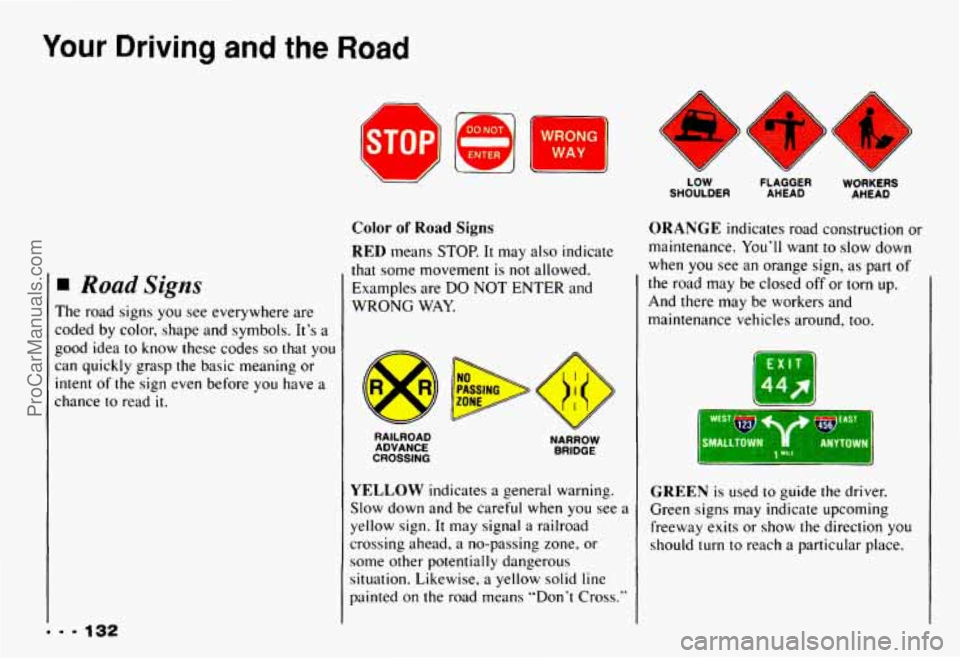
Road Sigpts
The road signs you see everywhere are
coded by color, shape and symbols.
It’s a
good idea
to know these codes so that you
can quickly grasp the basic meaning or
intent of the sign even before you have a
chance
to read it.
ISTOPI L ENTER
WRONG
WAY
Color of Road Signs
RED means STOP. It may also indicate
that some movement
is not allowed.
Examples are
DO NOT ENTER and
WRONG WAY.
RAILROAD
ADVANCE
CROSSING
YELLOW indicates a general warning.
Slow down and be careful when you see a
yellow sign.
It may signal a railroad
crossing ahead,
a no-passing zone, or
some other potentially dangerous
situation. Likewise,
a yellow solid line
painted on the road means
“Don’t Cross.”
LOW FLAGGER
SHOULDER AHEAD
ORANGE indicates road construction or
maintenance. You’ll want
to slow down
when
you see an orange sign, as part of
the road may be closed off or torn
up.
And there may be workers and
maintenance vehicles around,
too.
SyRLL I uwfl RWYTDW
GREEN is used to guide the driver.
Green signs
may indicate upcoming
freeway exits or show the direction you
should
turn to reach a particular place.
ProCarManuals.com
Page 185 of 358
Maintenance When Trailer Towing
Your vehicle will need service more often
when you're pulling a trailer. See the
Maintenance Schedule for more on this.
Things that are especially important
in
trailer operation are automatic
transmission
fluid (don't overfill), engine
oil, axle lubricant. belts. cooling system,
and brake adjustment. Each of these is
covered
in this manual, and the Index will
help you find them quickly. If you're
trailering, it's
a good idea to review these
sections before
you start your trip.
Check periodically to see that all hitch
nuts
and bolts are tight.
ProCarManuals.com
Page 221 of 358
Part b
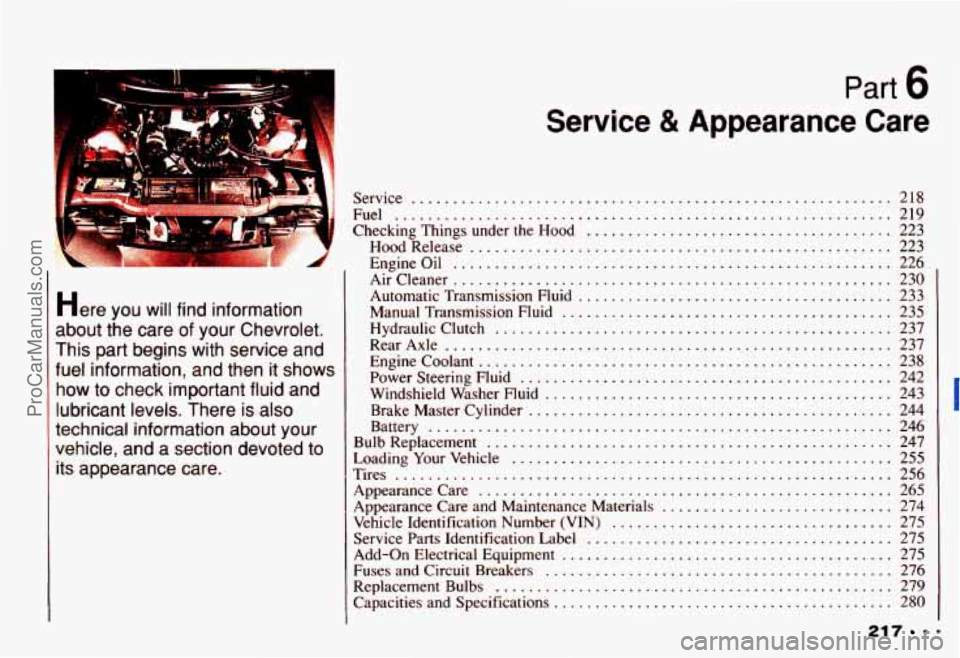
Here you will find information
about the care
of your Chevrolet .
This part begins with service and
fuel information. and then it shows
how
to check important fluid and
lubricant levels
. There is also
technical information about your
vehicle. and a section devoted to
its appearance care
.
Service & Appearance Care
Service .......................................................... 218
Fuel
............................................................ 219
Checking Things under the Hood
..................................... 223
HoodRelease
................................................... 223
Engineoil
...................................................... 226
Aircleaner
..................................................... 230
Automatic Transmission Fluid
...................................... 233
Manual Transmission Fluid
........................................ 235
Hydraulicclutch
................................................ 237
RearAxle
...................................................... 237
Enginecoolant
.................................................. 238
Power Steering Fluid
............................................. 242
Windshield Washer Fluid
.......................................... 243
Brake Master Cylinder
............................................ 244
Battery
........................................................ 246
Bulb Replacement
................................................. 247
Loading Your Vehicle
.............................................. 255
Appearance Care and Maintenance Materials
............................ 274
Vehicle Identification Number (VIN)
.................................. 275
Service Parts Identification Label
..................................... 275
Add-on Electrical Equipment
........................................ 275
Fuses and Circuit Breakers
.......................................... 276
Replacement Bulbs
................................................ 279
Capacities and Specifications
......................................... 280
Tires
............................................................ 256
Appearancecare
.................................................. 265
217
ProCarManuals.com
Page 222 of 358
Service & Appearance Care
1
Service
Your Chevrolet dealer knows your vehicle
best and wants you
to be happy with it.
We hope you’ll
go to your dealer for all
your service needs. You’ll get genuine
GM parts and GM-trained and supported
service people.
We hope you’ll want to keep your GM
vehicle all GM. Genuine GM parts have
one
of these marks.
Doing Your Own Service Work
If you want to do some of your own
service work, you’ll want to get the
proper Chevrolet Service Manual. It tells
you much more about how
to service your
Chevrolet than this manual can.
To order
the proper service manual, see
“Service Publications”
in the Index.
You should keep
a record with all parts
receipts and list the mileage and the date
of any service work you perform. See
“Maintenance Record”
in the Index.
You can be injured if you try to
L do service work on a vehicle
hout knowing enough about it.
Be sure you have sufficient
knowledge, experience, and the
proper replacement
parts and
tools before you attempt any
vehicle maintenance
task.
Be sure to use the proper nuts,
bolts and other fasteners.
“English and “metric’”
fasteners can be easily
confused.
If you use the wrong
fasteners,
parts can later break
or fall
off. You couId be hurt.
ProCarManuals.com
Page 234 of 358
Service & Appearance Care
I What to Do with Used Oil:
Us& engine oil contains things
- L that have mused skin cancer in
laboratory animals. Don’t let used
oil stay on your skin for very long.
Clean your skin and nails with soap
and water, or a good hand cleaner.
Wash or properly throw away
clothing or rags containing used
engine oil.
I
Used oil can be a real threat to the
environment.
If you change your own oil,
be sure to drain all free-flowing oil from the filter before disposal. Don’t ever
dispose
of oil by putting it in the trash,
pouring it on the ground, into sewers, or into streams or bodies
of water. Instead,
recycle it by taking it to a place that
collects used oil. If you have a problem
properly disposing of your used oil, ask
your dealer, a service station
or a local
recycling center for help.
air Cleaner 3.4L L32 (Code S)
tefer to the Maintenance Schedule to
letermine when to replace the air filter.
iee “Scheduled Maintenance Services’’ in
he Index.
... 230
ProCarManuals.com
Page 237 of 358
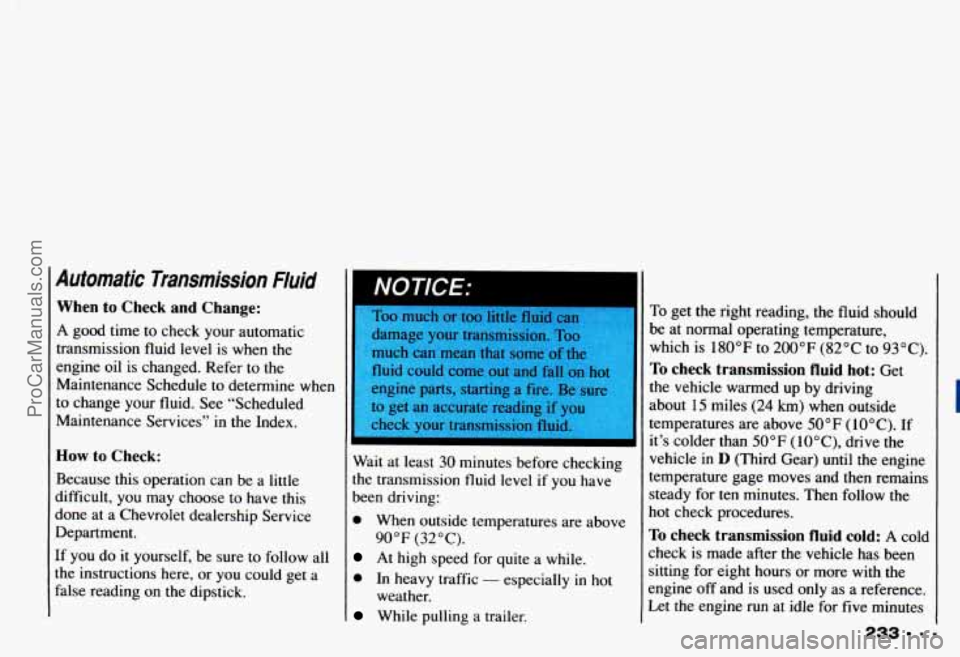
Automatic Transmission Fluid
When to Check and Change:
A good time to check your automatic
transmission fluid level is when the
engine oil is changed. Refer
to the
Maintenance Schedule
to determine when
to change your fluid. See “Scheduled
Maintenance Services” in the Index.
How to Check:
Because this operation can be a little
difficult, you may choose to have this
done at a Chevrolet dealership Service
Department.
If you do it yourself, be sure to follow all
the instructions here,
or you could get a
false reading
on the dipstick. damage
your transmission.
Too
much can mean that some of thr
fluid could come
out and fall on hc
~.: engine parts, starting a fire. Be sure
to get an accurate reading if you ~“* check your transmission fluid. ~, \- ~
%it at least 30 minutes before checking
he transmission fluid level
if you have
>een driving:
D When outside temperatures are above
At high speed for quite a while.
0 In heavy traffic - especially in hot
While pulling a trailer.
90°F (32°C).
weather. To
get the right reading, the fluid should
be at normal operating temperature,
which is 180°F to 200°F
(82°C to 93°C).
To check transmission fluid hot: Get
the vehicle warmed up by driving
about
15 miles (24 km) when outside
temperatures are above
50°F (10OC). If
it’s colder than
50°F (lO”C), drive the
vehicle in
D (Third Gear) until the engine
temperature gage moves and then remains
steady for ten minutes. Then follow the
hot check procedures.
To check transmission fluid cold: A cold
check is made after the vehicle has been
sitting for eight hours
or more with the
engine off and
is used only as a reference.
Let the engine run at idle for five minutes
233 = =
ProCarManuals.com
Page 239 of 358
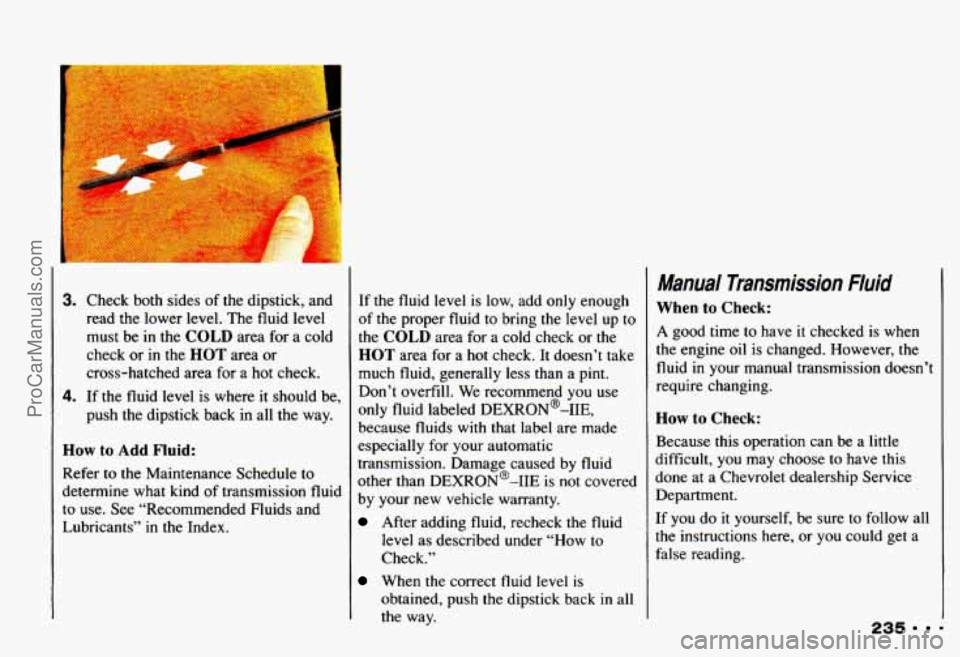
3. Check both sides of the dipstick, and
read the lower level. The fluid level
must be
in the COLD area for a cold
check or in the
HOT area or
cross-hatched area for a
hot check.
4. If the fluid level is where it should be,
push the dipstick back
in all the way.
How to Add Fluid:
Refer to the Maintenance Schedule to
determine what kind of transmission fluid
to use. See “Recommended Fluids and
Lubricants” in the Index. If the fluid level is low, add only enough
of the proper fluid to bring the level up to
the COLD area for
a cold check or the
HOT area for a hot check. It doesn’t take
much fluid, generally less than a pint.
Don’t overfill. We recommend you use
only fluid labeled
DEXRON@-IIE,
because fluids with that label are made
especially for your automatic
transmission. Damage caused by
fluid
other than DEXRON@-IIE is not covered
by your new vehicle warranty.
After adding fluid, recheck the fluid
level as described under “How to
Check.”
obtained, push the dipstick back
in all
the way.
When the correct fluid level is
Manual Transmission Fluid
When to Check:
A good time to have it checked is when
the engine oil is changed. However, the
fluid in your manual transmission doesn’t
require changing.
How to Check:
Because this operation can be a little
difficult, you may choose to have this
done at a Chevrolet dealership Service
Department.
If
you do it yourself, be sure to follow all
the instructions here, or you could get a
false reading.
235 9
ProCarManuals.com