key CHEVROLET CAMARO 1993 Owner's Manual
[x] Cancel search | Manufacturer: CHEVROLET, Model Year: 1993, Model line: CAMARO, Model: CHEVROLET CAMARO 1993Pages: 358, PDF Size: 15.6 MB
Page 77 of 358
I
If you cannot shift out of P (Park), ease
pressure
on the shift lever - push the
shift lever all the way into
P (Park) and
also release the shift lever button on
floor shift console models as you
maintain brake application. Then move the
shift lever into the gear you wish.
(Press the shift lever button before
moving the shift lever.)
If you ever hold the brake pedal down but
still can’t shift
out of P (Park), try this:
1. Turn the key to Off.
2. Apply and hold the brake until the end
3. Shift to N (Neutral).
4. Start the vehicle and then shift to the
drive gear
you want.
5. Have the vehicle fixed as soon as you
of
Step 4.
can.
Parking Your Vehicle
(MANUAL TRANSMISSION)
Before
you get out of your vehicle, put
your manual transmission
in R (Reverse)
and
firmly apply the parking brake.
If you are parking on a
hill, or if your
vehicle is equipped to tow a trailer, see
“Parking on Hills”
or “Towing a Trailer”
in the Index.
ProCarManuals.com
Page 93 of 358
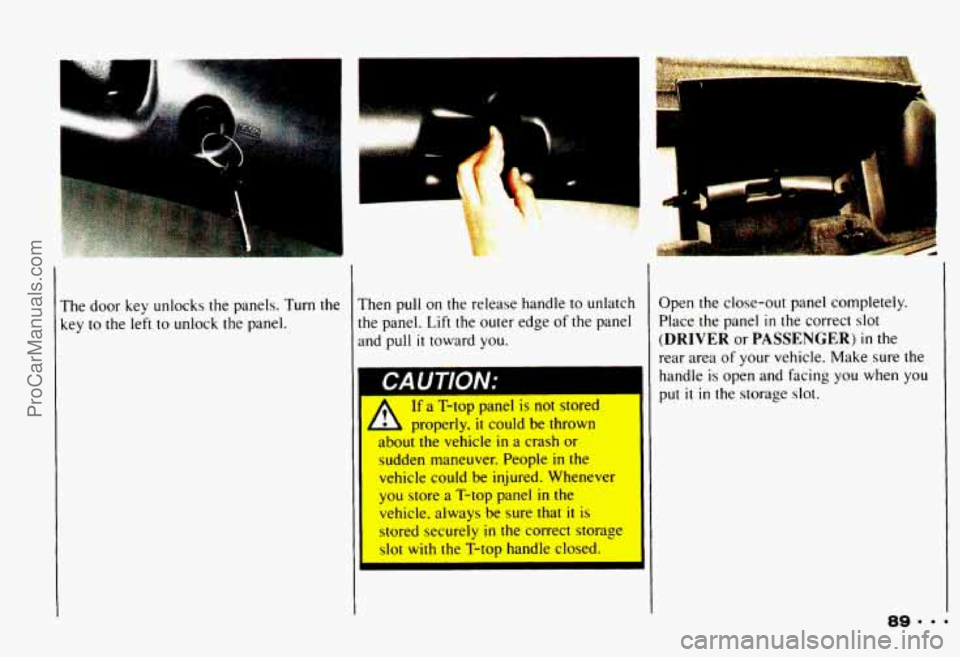
The door key unlocks the panels. Turn the
key
to the left to unlock the panel.
. .-
Then pull on the release handle to unlatch
the panel. Lift the outer edge of the panel
and pull
it toward you.
If a '1-top panel is not stored
properly,
it could be thrown
sudden maneuver. People
in the
vehicle could be injured. Whenever
you store
a T-top panel in the
vehicle. always be sure that
it is
stored securely in the correct storage
slot with the T-top handle closed. Open the
close-out panel completely.
Place the panel
in the correct slot
(DRIVER or PASSENGER) in the
rear area of
your vehicle. Make sure the
handle
is open and facing you when you
put it in the storage slot.
ProCarManuals.com
Page 94 of 358
Features & Controls
I
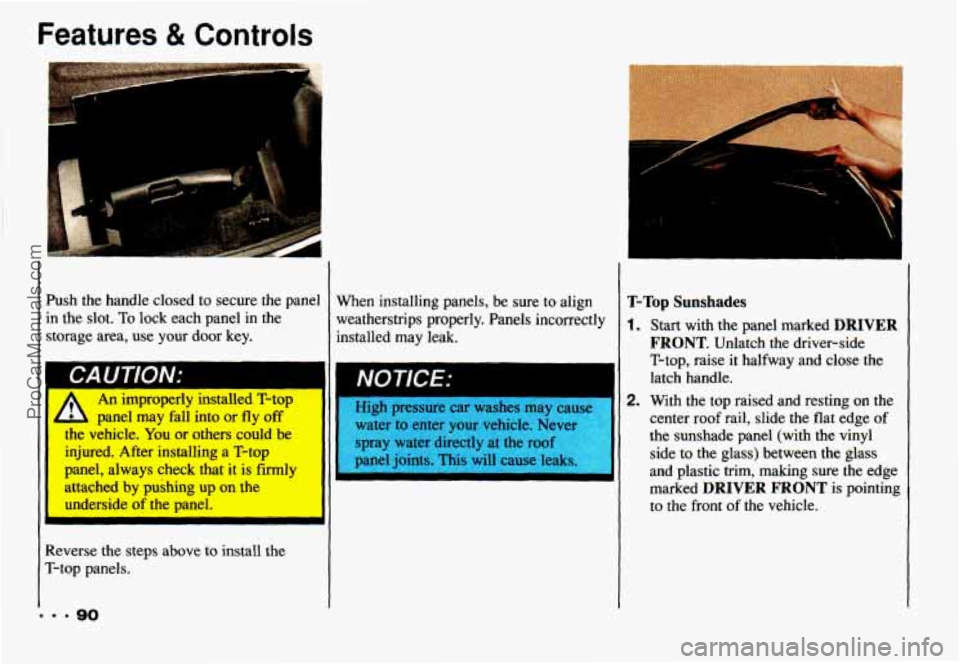
Push the handle closed to secure the panel in the slot.
To lock each panel in the
storage area, use your door key.
An improperly 111sw1ea l-rop
me vehicle. You
or others could be
injured. After installing a T-top
panel, always
check that it is firmly
attached by pushing up on the
L panel may fall into or fly off High pressure car washes may cause 1
water to enter your vehicle. Neve]
spray water directly at the roof
panel joints. This will cause leaks
underside of
the panel.
I
Reverse the steps above to install the
T-top panels.
... 90
When installing panels, be sure to align
weatherstrips properly. Panels incorrectly
installed may leak. T-Top Sunshades
1. Start with the panel marked DRIVER
FRONT. Unlatch the driver-side
T-top, raise it halfway and close the
latch handle.
2. With the top raised and resting on the
center
roof rail, slide the flat edge of
the sunshade panel (with the vinyl
side
to the glass) between the glass
and plastic trim, making sure the edge
marked
DRIVER FRONT is pointing
to the front of the vehicle.
ProCarManuals.com
Page 96 of 358
Features & Controls
Storage and
Compartments
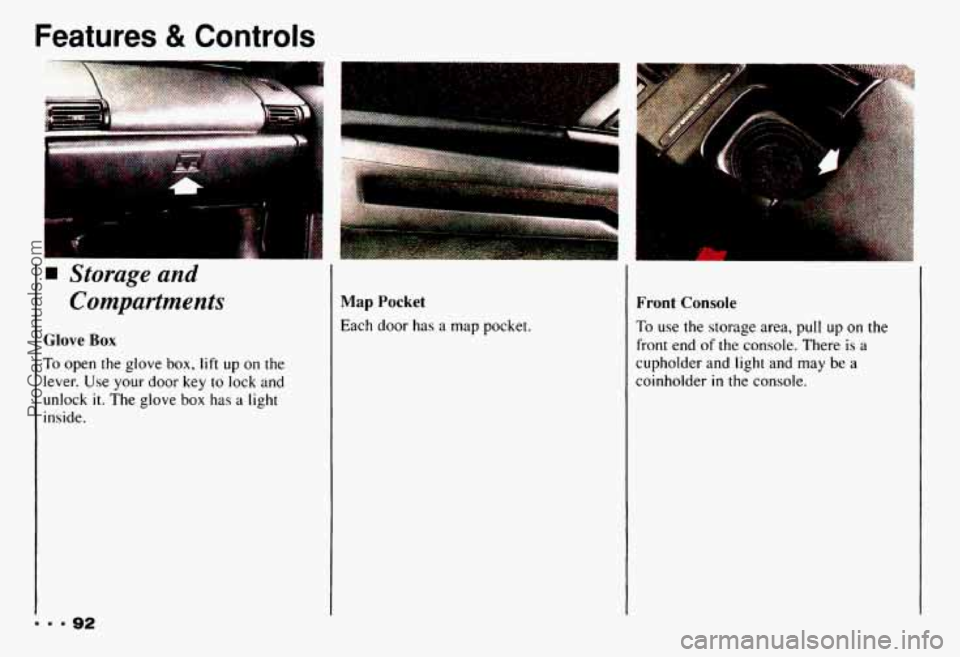
Glove Box
To open the glove box, lift up on the
lever.
Use your door key to lock and
unlock it. The glove box has a light
inside.
Map Pocket
Each door has a map pocket.
Front Console
To use the storage area, pull up on the
front end of the console. There is a
cupholder and light and may be a
coinholder
in the console,
ProCarManuals.com
Page 103 of 358
Trip Odometer
The trip odometer can tell you how far
your vehicle has been driven since you
last set the trip odometer to zero.
To set the trip odometer to zero, press the
knob.
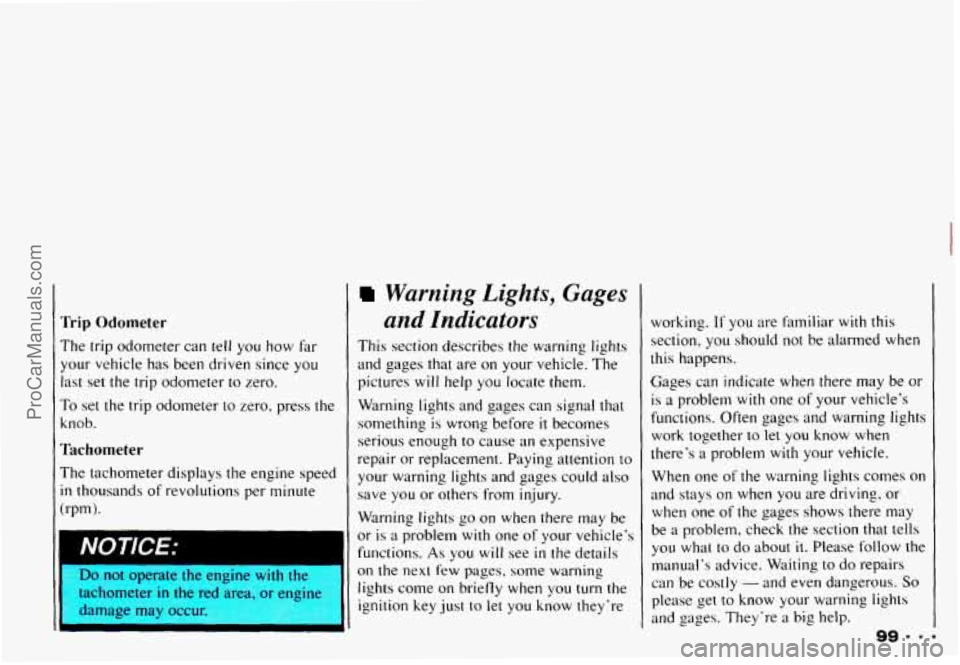
Tachometer
The tachometer displays the engine speed
in thousands of revolutions per minute
(rpm).
NOTICE:
Do not operate the engine with th-
tachometer in the red :are:* nr en~~
damage may occur.
Warning Lights, Gages
and Zndicators
This section describes the warning lights
and gages that are
on your vehicle. The
pictures will help you locate them.
Warning lights and gages can signal that
something is wrong before
it becomes
serious enough
to cause an expensive
repair
or replacement. Paying attention to
your warning lights and gages could also
save you or others from injury.
Warning lights
go on when there may be
or is a problem with one
of your vehicle’s
functions.
As you will see in the details
on the next few pages, some warning
lights come on briefly when
you turn the
ignition key just to let you know they‘re working.
If you
are familiar with this
section,
you should not be alarmed when
this happens.
Gages can indicate when there may be or
is a problem with one of your vehicle’s
functions. Often gages and warning lights
work together to let
you know when
there’s a problem with your vehicle.
When one
of the warning lights comes on
and stays on when you are driving. or
when one
of the gages shows there may
be a problem, check the section that tells
you what
to do about it. Please follow the
manual’s advice. Waiting
to do repairs
can
be costly - and even dangerous. So
please get to know your warning lights
and gages. They‘re
a big help.
ProCarManuals.com
Page 106 of 358
Features 8t Controls
f
I
I
. ’ 102
If the light stays on or comes on when
you’re driving, stop
as soon as possible
and turn the key off. Then start the engine
to reset the system. If the light still stays
on, or comes on again while you’re
driving, your Chevrolet needs service.
Unless the regular brake system warning
light is also on, you
will still have brakes,
but not anti-lock brakes. If the regular
brake system warning
light is also on, see
“Brake System Warning Light” earlier
in
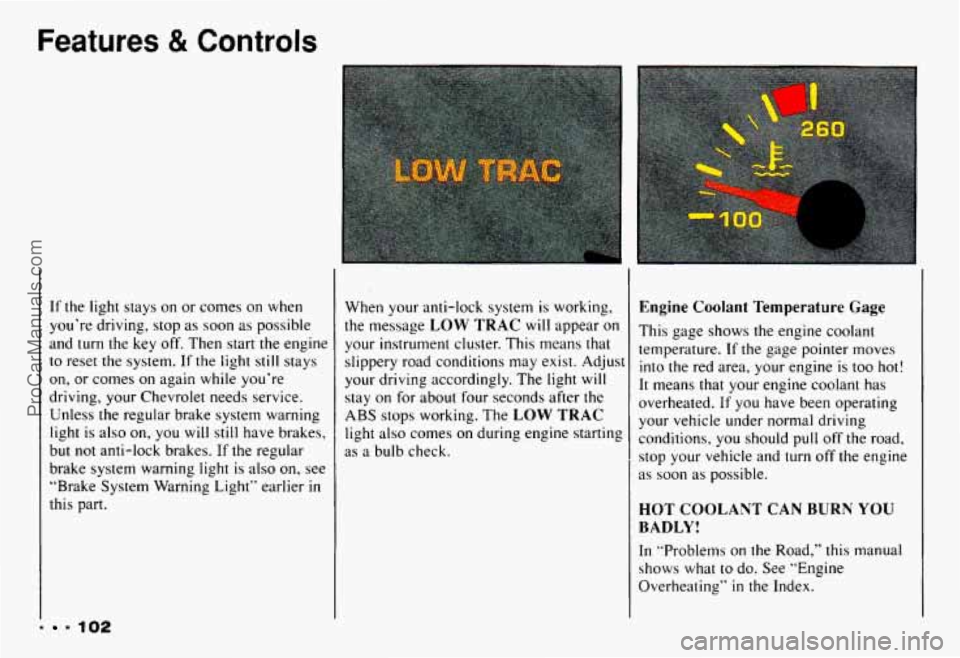
this part. When your anti-lock system is working,
the message
LOW TRAC will appear on
your instrument cluster. This means that
slippery road conditions may exist. Adjust
your driving accordingly. The light
will
stay on for about four seconds after the
ABS stops working. The
LOW TRAC
light also comes on during engine starting
as
a bulb check.
Engine Coolant Temperature Gage
This gage shows the engine coolant
temperature.
If the gage pointer moves
into the red area, your engine is
too hot!
It means that your engine coolant has
overheated. If you have been operating
your vehicle under normal driving
conditions, you should
pull off the road,
stop your vehicle and
turn off the engine
as soon as possible.
HOT COOLANT CAN BURN YOU
BADLY!
In ”Problerns on the Road,” this manual
shows
what to do. See “Engine
Overheating”
in the Index.
ProCarManuals.com
Page 128 of 358
Comfort Controls & Audio Systems
To Stop the Disc Player
0
0
Turn the power off or turn the ignition
key off. The disc stays in the player
and will resume playing at the point
where
it stopped.
Press
ST-PL to stop playing the disc
and switch to radio. Press ST-PL to
restart the disc at the point where
it
stopped.
Press
EJCT to eject the disc and the
radio will play. The disc
will start
playing at track
1 when you reinsert it.
Theft-Deterrent Feature
Delco-Loc I1 is a security feature for the
compact disc player. It can be used or
ignored. If ignored, the system functions
normally.
If it is used, your system won’t
be usable
if it’s ever stolen.
Setting Your Security Code
The instructions below tell you how to
enter a security
code into the system. If
your vehicle loses battery power for any
reason,
you must enter the security code
again before the system
will turn on.
1. Write down any six digit number and
2. Turn the ignition switch to the Acc
3. Turn the audio system off.
4. Press and hold 1 and 4 together until
keep it in a safe place.
or
Run position.
“---” shows on the display.
I. 9 124
ProCarManuals.com
Page 142 of 358
Your Driving and the Road
... 138
In most cases, these deaths are the result
of someone who was drinking and
driving. Over
25,000 motor
vehicle-related deaths occur each year
because
of alcohol, and thousands of
people are injured.
Just how much alcohol is too much if a
person plans to drive? Ideally, no one
should drink alcohol and then drive.
But
if one does, then what’s “too much”? It
can be a lot less than many might think.
Although it depends on each person and
situation, here is some general
information on the problem. The
Blood Alcohol Content (BAC) of
someone who
is drinking depends upon
four things:
How much alcohol is
in the drink.
The drinker’s body weight.
The amount
of food that is consumed
before and during drinking.
The length of time
it has taken the
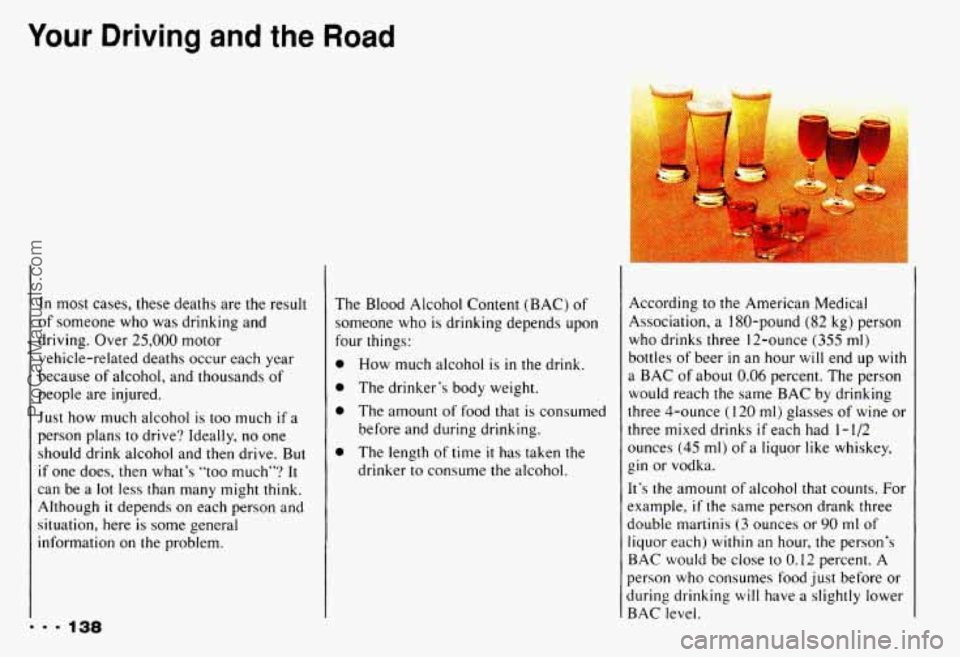
drinker to consume the alcohol. According to the American Medical
Association,
a 180-pound
(82 kg) person
who drinks three 12-ounce
(355 ml)
bottles of beer in an hour will end up with
a BAC of about 0.06 percent. The person
would reach the same BAC by drinking
three 4-ounce
(120 ml) glasses of wine or
three mixed drinks
if each had 1-1/2
ounces (45 ml) of a liquor like whiskey,
gin or vodka.
It’s the amount of alcohol that counts. For
example,
if the same person drank three
double martinis
(3 ounces or 90 ml of
liquor each) within an hour, the person’s
BAC would
be close to 0.12 percent, A
person who consumes food just before or
during
drinking will have a slightly lower
BAC level.
ProCarManuals.com
Page 188 of 358
Problems on the Road
1
A
... 184
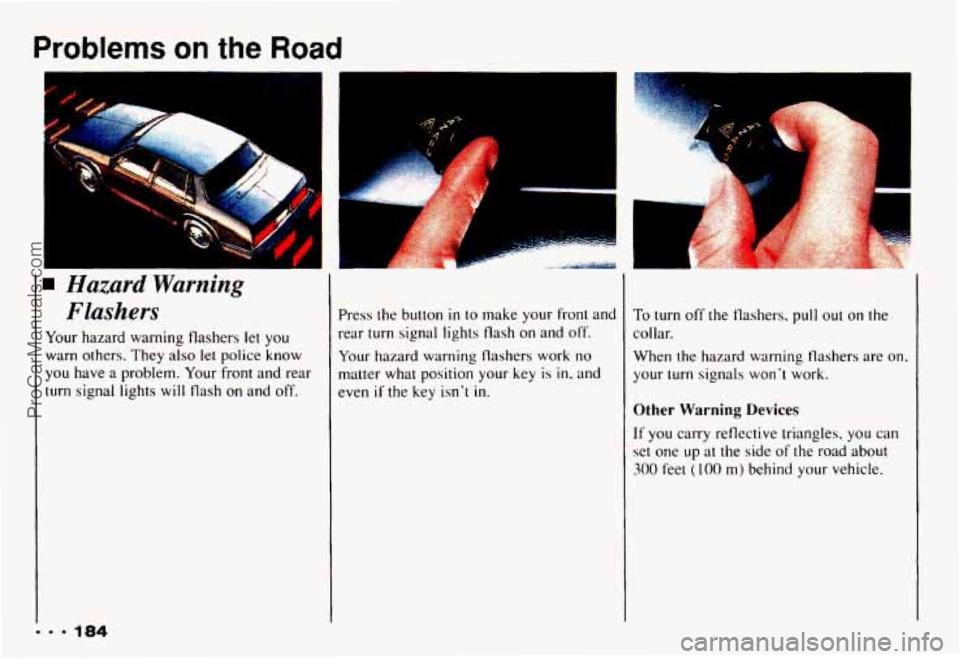
Hazard Warning
Flashers
Your hazard warning flashers let you
warn others. They also let police know
you have a problem. Your front and rear
turn signal lights
will flash on and off.
Press the button in to make your fronl and
rear
turn signal lights flash on and off.
Your hazard warning flashers work no
matter what position your key
is in, and
even
if the key isn‘t in.
To turn off the flashers. pull out on the
collar.
When the hazard warning tlashers are on,
your turn signals won’t work.
Other Warning Devices
If you carry retlective triangles, you can
set one
up at the side of the road about
300 feet (100 m> behind your vehicle.
ProCarManuals.com
Page 195 of 358
When your vehicle is being towed, have
the ignition
key off. The steering wheel
should be clamped
in a straight-ahead
position,
with a clamping device designed
for towing service.
Do not use the
vehicle’s steering column lock for this.
The transmission should be in Neutral
and the parking brake released.
Don’t have your vehicle towed on the rear
wheels, unless you must.
If the vehicle
must be towed on the rear wheels, don’t
EO more than 35 mDh (55 kmh) or I
CAUTION:
RA
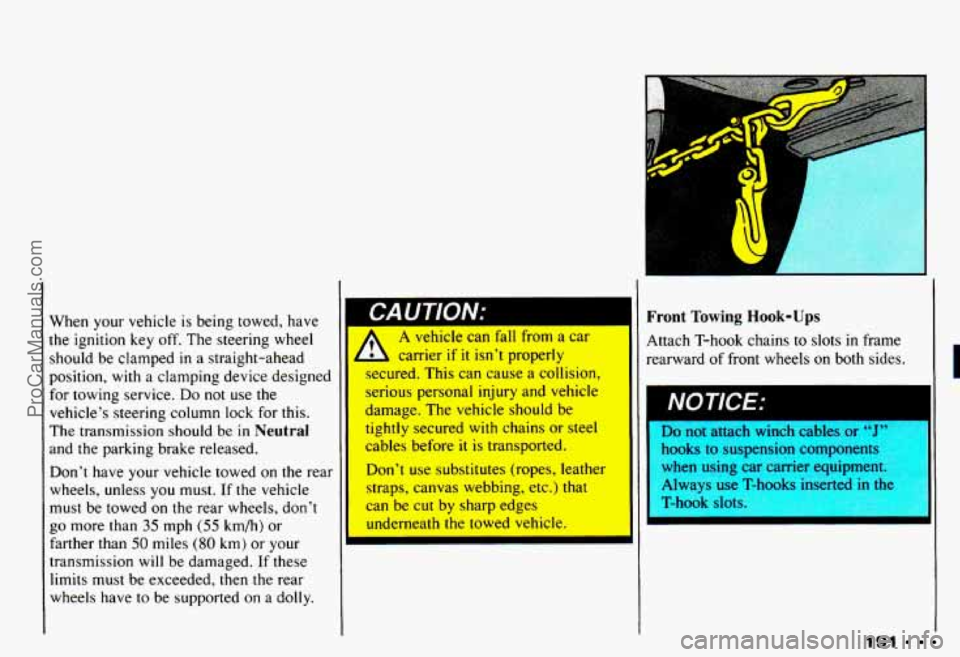
I Front Towing Hook-Ups
A vehicle can fall from a car
Attach T-hook chains to slots in frame
carrier if
it isn’t properly rearward of front wheels on both sides.
secured. This can cause a collision,
tightly secured with chains or steel
cables before
it is transported.
Don’t
use substitutes (ropes, leather
straps, canvas webbing, etc.) that
can be cut by sharp edges
underneath the towed vehicle.
Farther than
50 miles (80 km j or your
transmission
will be damaged. If these
limits must be exceeded, then
the rear
wheels have to be supported on
a dolly.
I.
I
Do not attach winch cables or
1 hooks to suspension components
en using car carrier equipment
I Always use T-hooks inserted in the
I I
I T-hook slots. II
191 ProCarManuals.com