transmission CHEVROLET CAMARO 1993 Owner's Manual
[x] Cancel search | Manufacturer: CHEVROLET, Model Year: 1993, Model line: CAMARO, Model: CHEVROLET CAMARO 1993Pages: 358, PDF Size: 15.6 MB
Page 88 of 358
Features & Controls
I
I
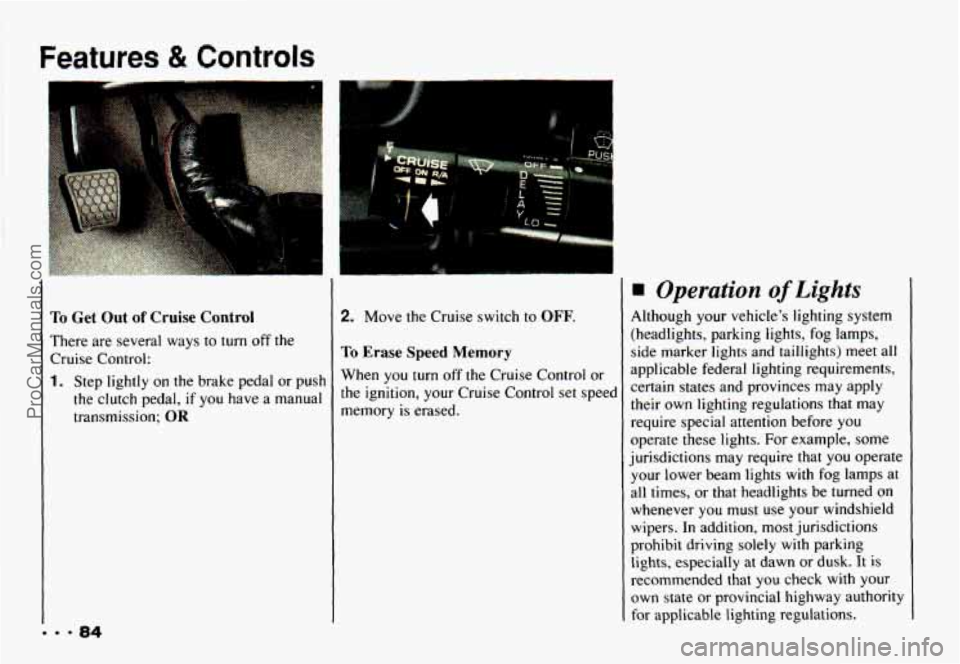
I'o Get Out of Cruise Control
There are several ways to turn off the
Cruise Control:.
1. Step lightly on the brake pedal or push
the clutch pedal,
if you have a manual
transmission:
OR
2. Move the Cruise switch to OFF.
To Erase Speed Memory
When you turn off the Cruise Control or
the ignition, your Cruise Control set speed
memory
is erased.
Operation of Lights
Although your vehicle's lighting system
(headlights, parking lights,
fog lamps,
side marker lights and taillights) meet all
applicable federal lighting requirements,
certain states and provinces may apply
their own lighting regulations that may
require special attention before you
operate these lights. For example, some
jurisdictions may require that
you operate
your lower beam lights with fog lamps at
all times, or that headlights be turned on
whenever you must use your windshield
wipers.
In addition, most jurisdictions
prohibit driving solely with parking
lights, especially at dawn or dusk. It is
recommended that you check with your
own state or provincial highway authority
for applicable lighting regulations.
ProCarManuals.com
Page 98 of 358
Features & Contr
I
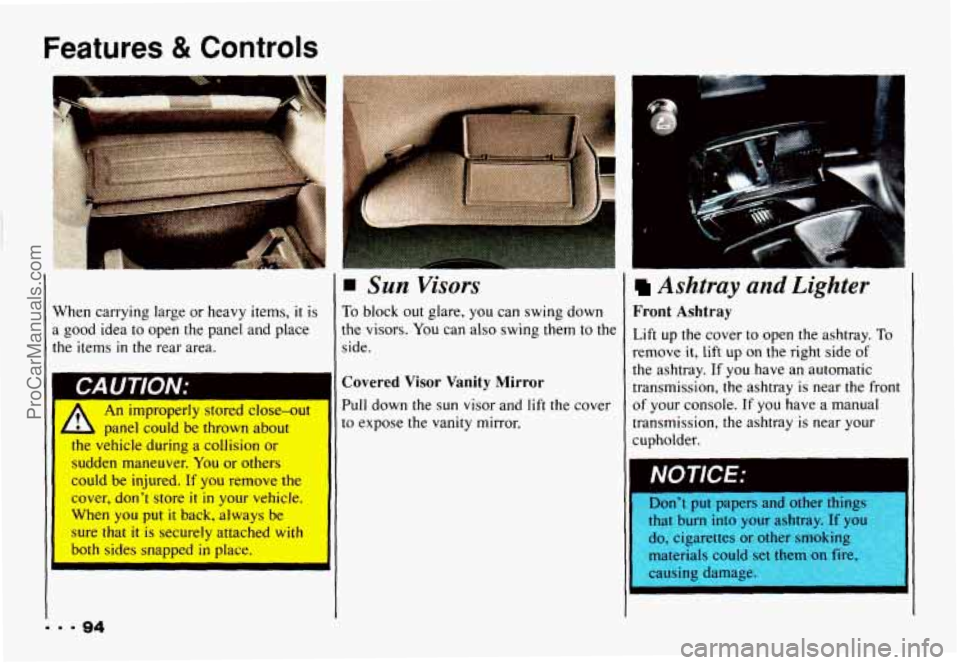
When carrying large or heavy items, it is
a good idea to open the panel and place
the items
in the rear area.
I
A An improperly stored close-out
, panel could be thrown about
I
Sun Visors
To block out glare, you can swing down
the visors. You can also swing them to the
side
.
Covered Visor Vanity Mirror
Pull down the sun visor and lift the cover
to expose the vanity mirror.
the vehicle during a collision or
sudden maneuver. You
or others
could be injured. If you remove the
cover, don’t store it in your vehicle.
When
you put it back, always be
sure
that it is securely attached with
both
sides snapped in place.
I
u
Ashtray and Lighter
Front Ashtray
Lift up the cover to open the ashtray. To
remove it, lift up on the right side of
the ashtray. If you have an automatic
transmission, the ashtray is near the front
of your console. If you have a manual
transmission, the ashtray is near your
cupholder.
Don’t put papers and 0th
t It burn into your ashtrc If you
cigarettes or other srr- --kg
naterials cot set them on
:awing dam, :.
IgS I
I
ProCarManuals.com
Page 101 of 358
Instrument Panel
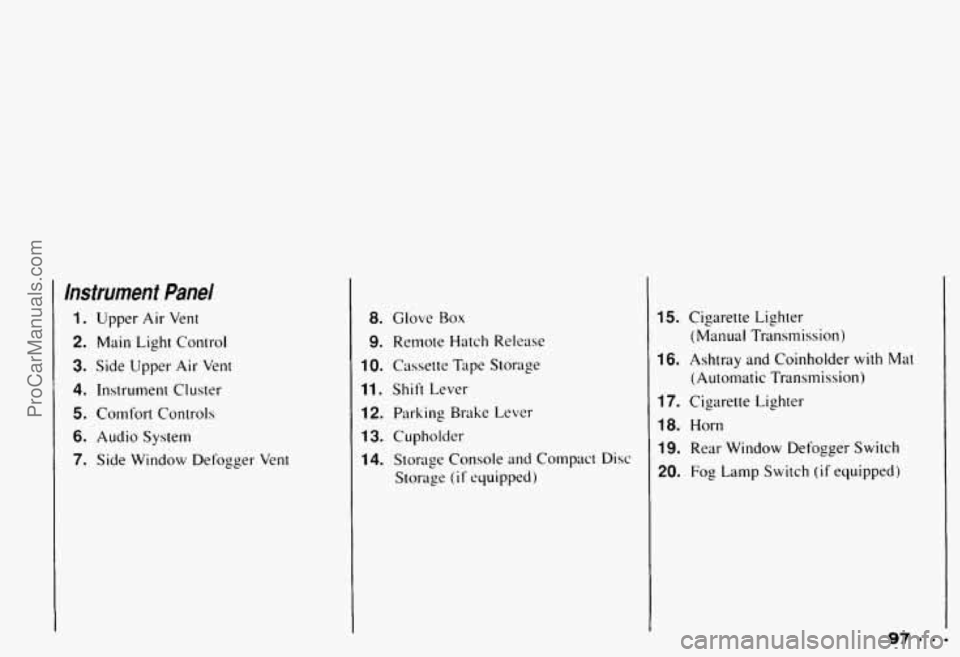
1. Upper Air Vent
2. Main Light Control
3. Side Upper Air Vent
4. Instrument Cluster
5. Comfort Controls
6. Audio System
7. Side Window Defogger Vent
8. Glove Box
9. Remote Hatch Release
10. Cassette Tape Storage
11. Shift Lever
12. Parking Brake Lever
13. Cupholder
14. Storage Console and Compact Disc
Storage
(if equipped)
15. Cigarette Lighter
16. Ashtray and Coinholder with Mat
17. Cigarette Lighter
18. Horn
19. Rear Window Defogger Switch
20. Fog Lamp Switch (if equipped)
(Manual Transmission)
(Automatic Transmission)
97.9- ProCarManuals.com
Page 169 of 358
What can you do about highway
hypnosis'? First, be aware that
it can
happen.
Then here are some tips:
Make sure your vehicle is well
ventilated,
with a comfortably cool
interior.
Keep your eyes moving. Scan the road
ahead and
to the sides. Check your
rearview mirrors frequently and your
instruments from time
to time. This
can help you avoid a fixed stare. Wear
good sunglasses
in bright light.
Glare can cause drowsiness.
But don't
wear sunglasses
at night. They will
drastically reduce your overall vision
at
the very time you need all the
seeing power you have.
If you get sleepy,
pull off the road into
a rest, service, or parking area and
take a nap, get some exercise, or both.
For safety, treat drowsiness on the
highway as an emergency.
As in any driving situation. keep pace
with traffic and allow adequate following
distances.
Hill and Mountain
Roads
Driving on steep hills or mountains is
different from driving
in flat or rolling
terrain. If you drive regularly
in steep
country. or
if you're planning to visit
there, here are some tips that can make
your trips safer and more enjoyable.
0 Keep your vehicle in good shape.
Check all fluid levels and also the
brakes, tires, cooling system and
transmission. These parts can work
hard on mountain roads.
1659 *
ProCarManuals.com
Page 171 of 358
Know how to go uphill. You may
want
to shift down to a lower gear.
The lower gears help cool your engine
and transmission, and
you can climb
the
hill better.
Stay
in your own lane when driving
on two-lane roads in hills or
mountains. Don’t swing wide or cut
across the center of the road. Drive at
speeds that let you stay
in your own
lane. That way, you won’t be surprised
by a vehicle coming toward you
in the
same lane.
It takes longer to pass another vehicle
when you’re going uphill. You’ll want
to leave extra room to pass. If a
vehicle is passing you and doesn’t
have enough room, slow down
to
make it easier for the other vehicle to
get
by.
As you go over the top of a hill, be
alert. There could be something
in
your lane, like a stalled car or an
accident.
0
You may see highway signs on
mountains that warn
of special
problems. Examples are long grades,
passing or no-passing
zones, a falling
rocks area, or winding roads. Be alert
to these and take appropriate action.
Winter driving can present special problems. See
“Winter Driving” in the
Index.
ProCarManuals.com
Page 173 of 358
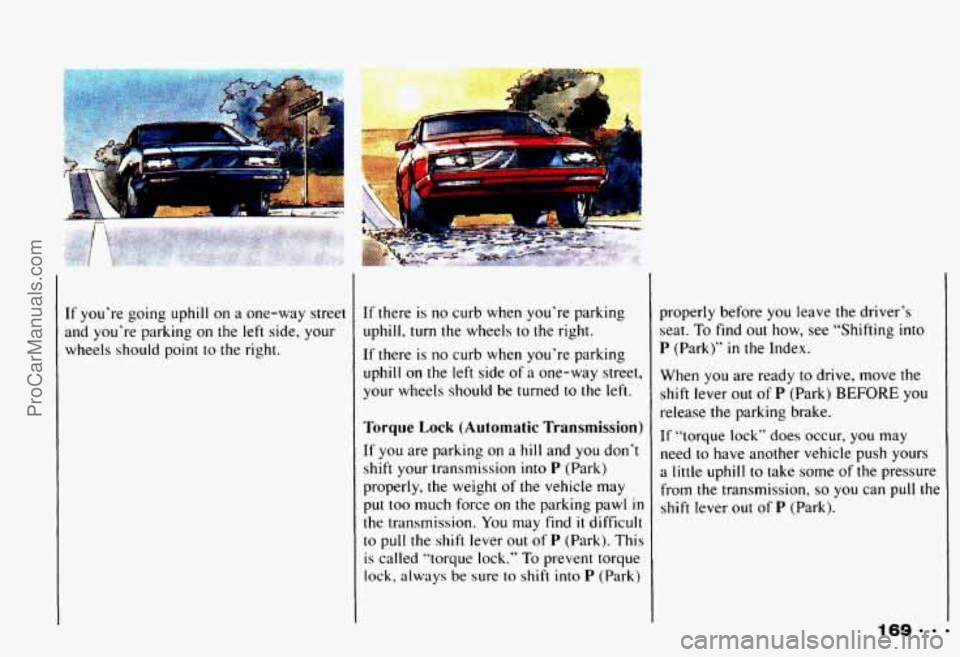
If you’re going uphill on a one-way street
and you’re parking on the left side, your wheels should point to the right. If there is no curb when you’re parking
uphill, turn the wheels
to the right.
If there is no curb when you’re parking
uphill on the left side of a one-way street,
your wheels should be turned to the left.
Torque Lock (Automatic Transmission)
If you are parking on a hill and you don’t
shift your transmission into
P (Park)
properly, the weight
of the vehicle may
put
too much force on the parking pawl in
the transmission. You may find it difficult
to pull the
shift lever out of P (Park). This
is called “torque lock.” To prevent torque
lock, always
be sure to shift into P (Park) properly before
you leave the driver’s
seat.
To find out how, see “Shifting into
P (Park)” in the Index.
When you are ready to drive, move the
shift lever out of
P (Park) BEFORE you
release the parking brake.
If “torque lock” does occur, you may
need to have another vehicle push yours
a little uphill to take some of the pressure
from the transmission,
so you can pull the
shift lever out of
P (Park).
ProCarManuals.com
Page 178 of 358
Your Driving and the Road
I NOTICE:
AAtnage your vehicle and result i~
jtly repairs not covered by you.
warranty.
To pull a trailer correctly,
follow the advice
in this section.
I
Your vehicle can tow a trailer if it is
equipped
with the proper trailer towing
equipment.
To identify what the vehicle
trailering capacity
is for your vehicle, you
should read the information in “Weight
of the Trailer” that appears later
in this
section. But trailering is different than just
driving your vehicle by itself. Trailering
means changes
in handling, durability, and fuel economy.
Successful, safe
trailering takes correct equipment, and
it has to be used properly.
That’s the reason for this section, In it are
many time-tested, important trailering
tips and safety rules. Many of these are
important for your safety and that of your
passengers.
So please read this section
carefully before you pull a trailer.
Load-pulling components such as the
engine, transmission, wheel assemblies,
and tires are forced to work harder against
the drag of the added weight. The engine
is required to operate at relatively higher
speeds and under greater loads, generating extra
heat. What’s more,
the
trailer adds considerably to wind
resistance, increasing the pulling
requirements.
If You Do Decide to Pull a Trailer
If you do, here are some important points.
There are many different laws having
to do
with trailering. Make sure your
rig
will be legal, not only where you
live but also where you’ll be driving.
A good source for this information
can be state or provincial police.
ProCarManuals.com
Page 183 of 358
Turn Signals When Towing a Trailer
When you tow a trailer, your vehicle has to
have a different turn signal flasher and
extra wiring. The green arrows on your
instrument panel will flash whenever you
signal a turn or lane change. Properly
hooked up, the trailer lights will also flash,
telling other drivers you’re about to
turn,
change lanes or stop.
When towing a trailer, the green arrows on
your instrument panel will flash for turns
even if the bulbs on the trailer are burned
out. Thus,
you may think drivers behind
you are seeing your signal when they are
not. It’s important to check occasionally to
be sure the trailer bulbs are still working.
Driving on Grades
Reduce speed and shift to a lower gear
before you start down a long or steep
downgrade. If
you don’t shift down, you
might have to use your brakes
so much
that they would get hot and no longer work well.
On a long uphill grade, shift down and
reduce your speed to around
45 mph
(70 km/h) to reduce the possibility of
engine and transmission overheating. If you
are towing a trailer and you
have an automatic transmission with
Overdrive, you may prefer to drive
in D
instead of Overdrive (or, as you need to,
a lower gear). Or, if you have a manual
transmission
with fifth (or sixth) gear
and you are towing a trailer, it’s better
not to use
fifth (or sixth) gear. Just drive
in fourth gear (fifth gear
if you have
a six-speed manual transmission)
(or, as you need to, a lower gear.
ProCarManuals.com
Page 184 of 358
Your Driving and the Road
I
180
Parking on Hills
You really should not park your vehicle,
with a trailer attached, on a hill. If
something goes wrong, your rig could
start to move. People can be injured, and
both your vehicle and the trailer can be
damaged.
But if you ever have to park your rig on a
hill, here's how to do it:
1. Apply your regular brakes, but don't
shift into
P (Park) yet, or into gear for
a manual transmission.
2. Have someone place chocks under the
trailer wheels.
3. When the wheel chocks are in place,
release the regular brakes-until the
chocks absorb the load.
4. Reapply the regular brakes. Then
apply your parking brake, and then shift to
P (Park), or R (Reverse) for
a manual transmission.
5. Release the regular brakes.
When You Are Ready to Leave after
Parking on
a Hill
1. Apply your regular brakes and hold
the pedal down while you:
0 Start your engine;
0 Shift into a gear; and
0 Release the parking brake.
2. Let up on the brake pedal.
3. Drive slowly until the trailer is clear
4. Stop and have someone pick up and
of the chocks.
store the chocks.
ProCarManuals.com
Page 185 of 358
Maintenance When Trailer Towing
Your vehicle will need service more often
when you're pulling a trailer. See the
Maintenance Schedule for more on this.
Things that are especially important
in
trailer operation are automatic
transmission
fluid (don't overfill), engine
oil, axle lubricant. belts. cooling system,
and brake adjustment. Each of these is
covered
in this manual, and the Index will
help you find them quickly. If you're
trailering, it's
a good idea to review these
sections before
you start your trip.
Check periodically to see that all hitch
nuts
and bolts are tight.
ProCarManuals.com