transmission CHEVROLET CAMARO 1993 User Guide
[x] Cancel search | Manufacturer: CHEVROLET, Model Year: 1993, Model line: CAMARO, Model: CHEVROLET CAMARO 1993Pages: 358, PDF Size: 15.6 MB
Page 69 of 358
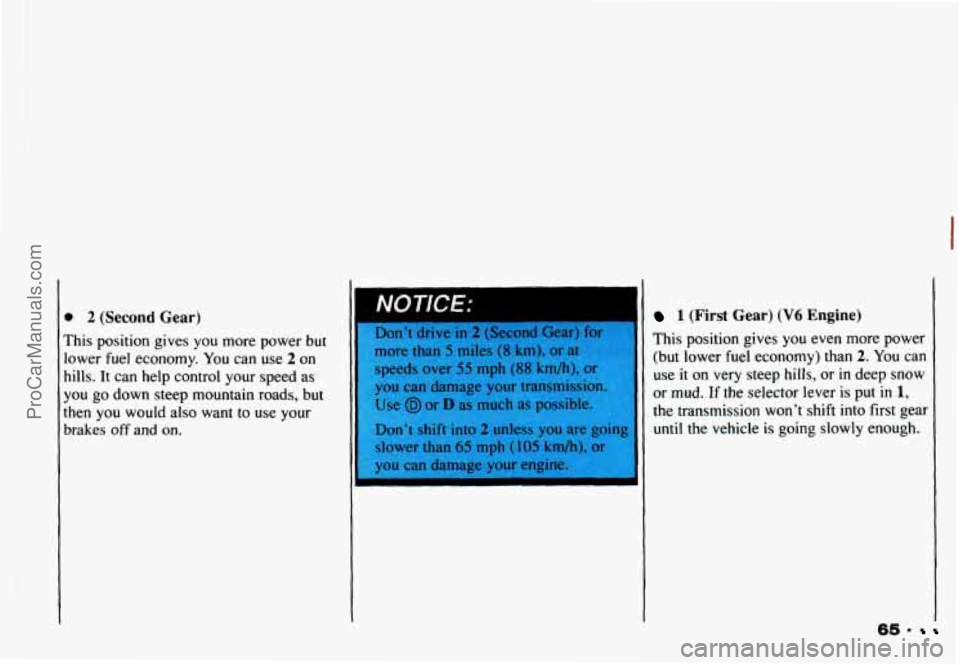
D 2 (Second Gear)
rhis position gives you more power but
.ower fuel economy. You can use 2 on
lills. It can help control your speed as
you go down steep mountain roads, but
:hen you would also want to use your
xakes
off and on.
NOTICE:
Don't drive in 2 (Second Gear)
more than 5 miles (8 km), or at
speeds over
55 mph (88 kmh)
you can damage your transmissi
Use @ or D as much as possible.
Don't
shift into 2 unless you are golng
slower than 65 mph ( 105 km/h), 1
you can damage your engine.
1 (First Gear) (V6 Engine)
This position gives you even more power
(but lower fuel economy) than
2. You can
use
it on very steep hills, or in deep snow
or mud. If the selector lever is put
in 1,
the transmission won't shift into first gear
until the vehicle is going slowly enough.
65.
ProCarManuals.com
Page 70 of 358
Features & Controls
r
If your rear wheels can’t rotat
don’t try to drive.
This might
happen if you were stuck
in v
deep sand or mud or were up
, , against a solid object. You
damage your transmission
Also, if you stop when goi
uphill, don’t hold your vehi
there
with only the accelerat
pedal. This could overheat an
damage the transmission.
Use your
brakes or shift into
P (Park) to hold
9.966
Maximum engine speed is limited to
protect driveline components from
improper operation.
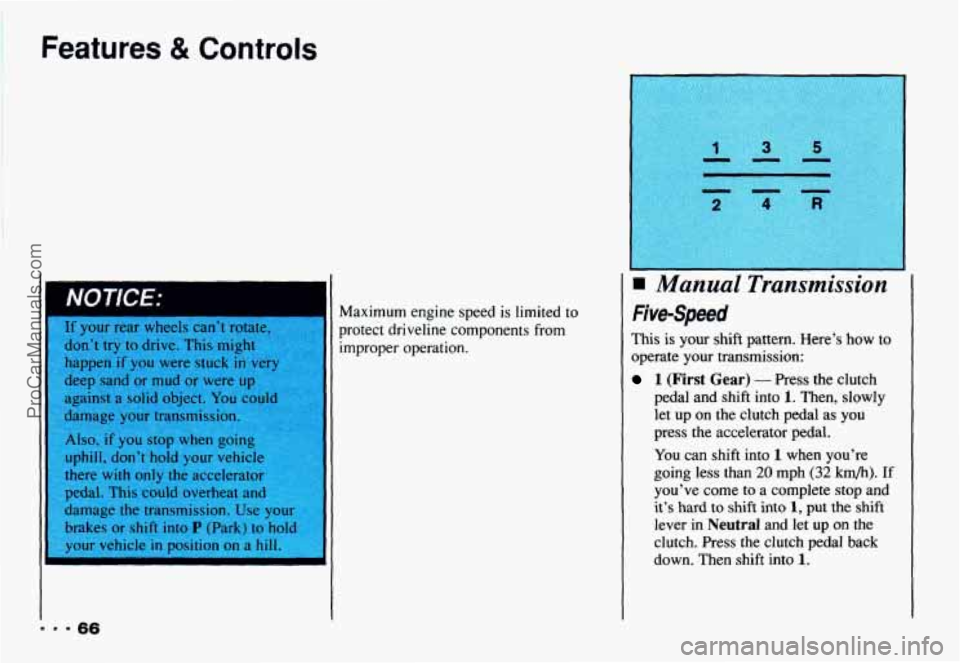
Manual Transmission
Five-Speed
This is your shift pattern. Here’s how to
operate your transmission:
1 (First Gear) - Press the clutch
pedal and shift into
1. Then, slowly
let up on the clutch pedal as you
press the accelerator pedal.
You can shift into
1 when you’re
going less than
20 mph (32 km/h). If
you’ve come to a complete stop and
it’s hard to shift into
1, put the shift
lever in
Neutral and let up on the
clutch.
Press the clutch pedal back
down. Then shift into
1.
ProCarManuals.com
Page 71 of 358
0
2 (Second Gear) - Press the clutch
pedal as you let up on the accelerator
pedal and shift into
2. Then, slowly
let up
on the clutch pedal as you
press
the accelerator pedal.
3,4 and 5 (Third, Fourth and Fifth
Gears)
- Shift into 3,4 and 5 the
same way
you do for 2. Slowly let up
on the clutch pedal as you press the
accelerator pedal.
To Stop - Let up on the accelerator
pedal and press the brake pedal. Just
before the vehicle stops, press the
clutch pedal and the brake pedal, and
shift to
Neutral.
0
0 Neutral - Use this position when
you start or idle your engine.
R (Reverse) - To back up, press
down the clutch pedal and shift into
R. Let up on the clutch pedal slowly
while pressing the accelerator pedal.
m-
- ~~
NOTICE:
Shift to K (Reverse) only atter your
vehicle is stopped. Shifting to
R (Reverse) while your vehicl
moving could darnage-pur
transmission. .I :.: , .. , LC.; 96’ b~ ,.? * ., )I
Also, use Reverse, along with the parking
brake, for parking your vehicle.
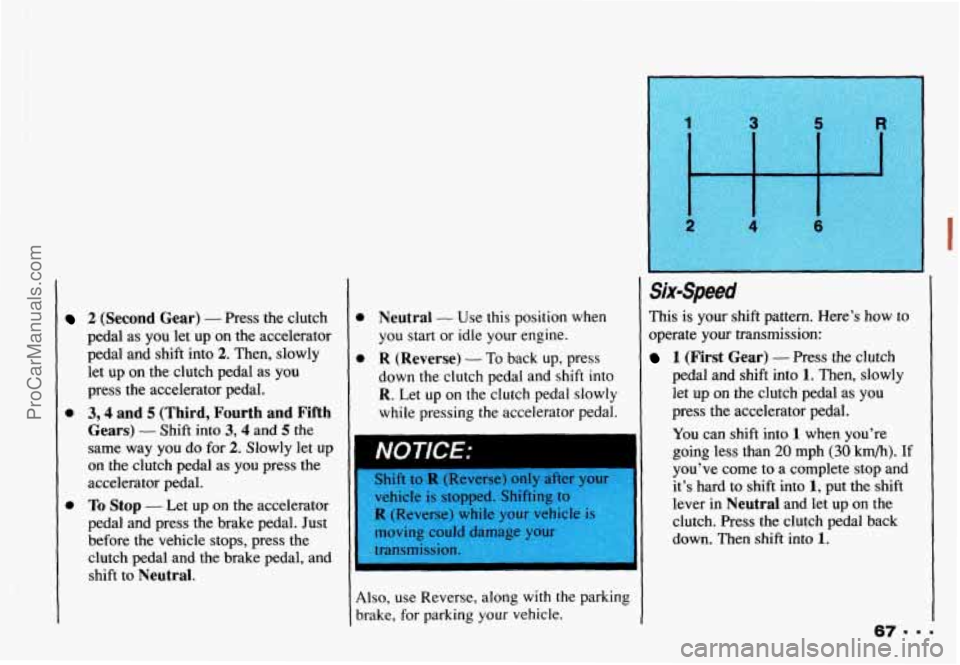
Six-Speed
This is your shift pattern. Here’s how to
operate your transmission:
1 (First Gear) - Press the clutch
pedal and shift into
1. Then, slowly
let up on the clutch pedal as you
press the accelerator pedal.
You can shift into 1 when you’re
going less than
20 mph (30 km/h). If
you’ve come to a complete stop and
it’s hard to shift into
1, put the shift
lever in
Neutral and let up on the
clutch. Press the clutch pedal back
down. Then shift into
1.
I
ProCarManuals.com
Page 72 of 358
Features & Controls
0
0
0
2 (Second Gear) - Press the clutch
pedal as you let up on the accelerator
pedal and shift into
2. Then, slowly
let up on the clutch pedal as you
press the accelerator pedal.
3,4,S and 6 (Third, Fourth, Fifth
and Sixth Gears)
- Shift into 3,4,
5 and 6 the same way you do for 2.
Slowly let up on the clutch pedal as
you press the accelerator pedal.
To Stop - Let up on the accelerator
pedal and press
the brake pedal. Just
before the vehicle stops, press the
clutch pedal and the brake pedal, and
shift to
Neutral. Neutral
- Use this position when
you start or idle your
engine.
R (Reverse) - To back up, press
down the clutch pedal and shift into
R. Let up on the clutch pedal slowly
while pressing the accelerator pedal.
If
you shift from 6 into R, the shift
lever must be first placed
in the
Neutral position centered between 2
and 3 prior to shifting into R.
Your six-speed manual transmission has a
feature that allows you to safely shift into
R (Reverse) while the vehicle is rolling
(at less than
5 mph). You will be
“locked-out”
if you try to shift into R
(Reverse) while your vehicle is moving
faster than
5 mph.
If
you have turned your ignition off and
wish to park your vehicle
in Reverse, you
will have to move the shift lever quickly
to the right, “crashing” through the high
load spring and then into gear.
ProCarManuals.com
Page 73 of 358
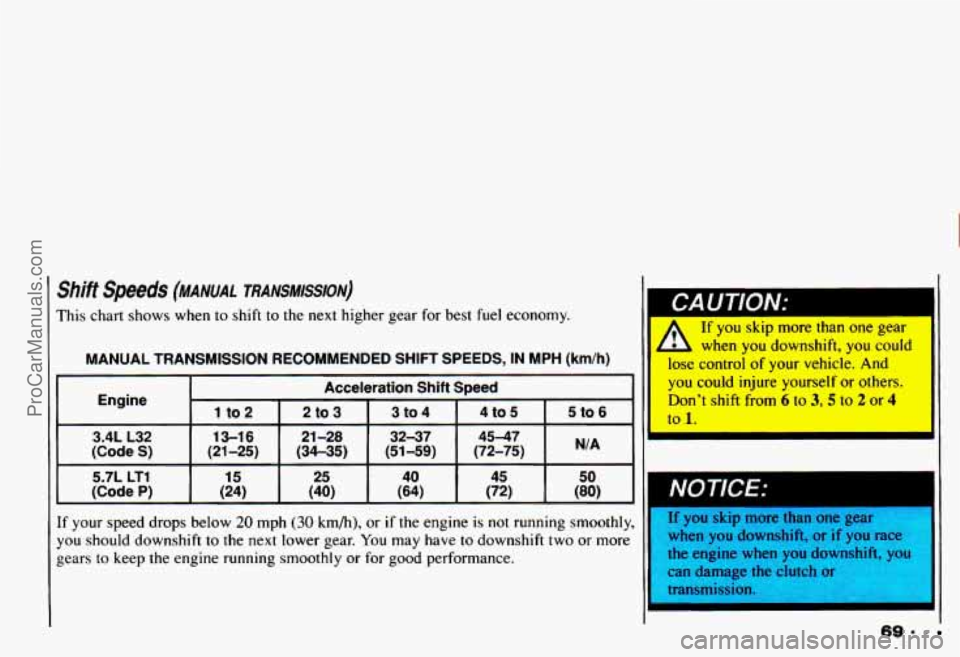
shift speeds (MANUAL TRANSMISSION)
This chart shows when to shift to the next higher gear for best fuel economy. , If you skip more than one gear I
-‘L when youdownshift, you could MANUAL TRANSMISSION RECOMMENDED SHIFT SPEEDS, IN MPH (km/h) , , lose control of your vehicle. And I
-
Engine
3.4L L32 13-16
I (Code S) I (21-25)
5.7L LT1 (24)
(Code P)
15
Acceleration Shift Speed you could injure yourself or others.
Don’t shift from
6 to 3, 5 to 2 or 4 2 to 3
(72-75) (51
-59) (34-35) 4547
32-37
21 -28
5 to 6 4 to 5
3 to 4
N/A
25 50 45 40
-
(40) (80) (72)
(64)
If your speed drops below 20 mph (30 km/h), or if the engine is not running smoothly,
you should downshift to the next lower gear. You may have to downshift two
or more
gears to keep the engine running smoothly or for
good performance.
NOTICE:
If you skip more than one gear
when
you downshift, or if you race
the engine when you downshift, you
can damage
the clutch or
transmission.
I- -1 I I
69..
ProCarManuals.com
Page 75 of 358
If you are on a hill: See “Parking on
Hills” in the Index. That section shows
how to turn your front wheels.
If you are towing a trailer and are
parking on any
hill: See “Towing a
Trailer”
in the Index. That section shows
what
to do first to keep the trailer from
moving.
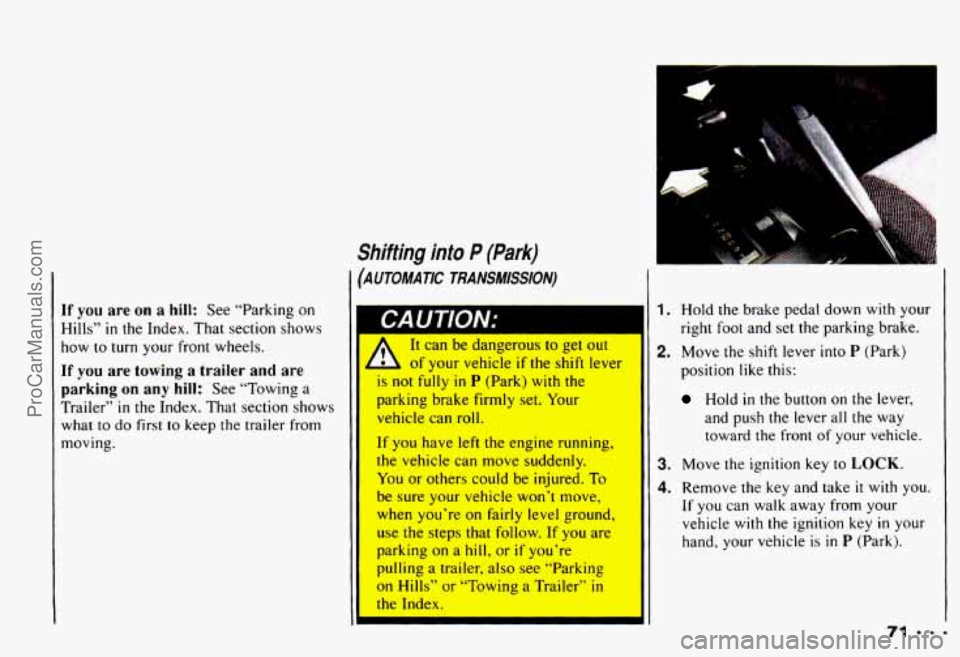
Shifting into P (Park)
(AUTOMATIC TRANSMISSION)
It can IX aangerous to get out
- of your vehicle if the shift lever
is not fully in P (Park) with the
parking brake firmly set. Your
vehicle can roll.
If you have left the engine running,
the vehicle can move suddenly.
You
or others could be injured. To
be sure your vehicle won’t move,
when you’re on fairly level ground,
use the steps that follow. If you are
parking on a hill, or if you’re
pulling
a trailer, also see “Parking
on Hills” or “Towing a Trailer” in
the Index.
1. Hold the brake pedal down with your
2. Move the shift lever into P (Park)
right foot and set the parking brake.
position like this:
Hold in the button on the lever,
and push the lever all the way toward the front
of your vehicle.
3. Move the ignition key to LOCK.
4. Remove the key and take it with you.
If you can walk away from your
vehicle
with the ignition key in your
hand, your vehicle is
in P (Park).
ProCarManuals.com
Page 76 of 358
Features & Controls
.eaving Your Vehicle with the
rngine Running
AUTOMATIC TRANSMISSION)
A It can be dangerous to leave
,A your vehicle with the engine
running. Your vehicle could move
suddenly
if the shift lever is not
fully in P (Park) with the parking
brake firmly set. And, if you leave
the vehicle with the engine running,
it could overheat and even catch
fire. You or others could be injured.
Don’t leave your vehicle
with the
I I engine running unless you have to.
If you have to leave your vehicle with the
engine running, be sure your vehicle
is in
P (Park) and your parking brake is firmly
set before you leave it. After you’ve
moved the shift lever into the
P (Park)
position, hold the regular brake pedal
down. Then, see
if you can move the shift
lever away from
P (Park) without first
pushing the button. If you can, it means
that the shift lever wasn’t fully locked
into
P (Park).
Shifting out of P (Park)
(AUTOMATIC TRANSMISSION)
Your Chevrolet has a brake-transmission
shift interlock. You have
to fully apply
your regular brake before you can shift
from
P (Park) when the ignition is in
the Run position. See “Automatic
Transmission”
in the Index.
ProCarManuals.com
Page 77 of 358
I
If you cannot shift out of P (Park), ease
pressure
on the shift lever - push the
shift lever all the way into
P (Park) and
also release the shift lever button on
floor shift console models as you
maintain brake application. Then move the
shift lever into the gear you wish.
(Press the shift lever button before
moving the shift lever.)
If you ever hold the brake pedal down but
still can’t shift
out of P (Park), try this:
1. Turn the key to Off.
2. Apply and hold the brake until the end
3. Shift to N (Neutral).
4. Start the vehicle and then shift to the
drive gear
you want.
5. Have the vehicle fixed as soon as you
of
Step 4.
can.
Parking Your Vehicle
(MANUAL TRANSMISSION)
Before
you get out of your vehicle, put
your manual transmission
in R (Reverse)
and
firmly apply the parking brake.
If you are parking on a
hill, or if your
vehicle is equipped to tow a trailer, see
“Parking on Hills”
or “Towing a Trailer”
in the Index.
ProCarManuals.com
Page 79 of 358
Running Your Engine While You’re Parked (AUTOMATIC TRANsMIssIoN)
It’s better not to park with the engine running. But if you ever have to, here are some
things
to know.
1 CAUTION:
umg tne engme wltn tne alr system control OII coula allow aangerous
L exhaust into your vehicle (see the earlier Caution under “Engine Exhaust”).\
Also, idling in a closed-in place can let deadly carbon monoxide
(CO) into your
vehicle even if the fan switch is at the highest setting. One place this can \
happen
is a garage. Exhaust - with CO - can come in easily. NEVER park in a garage
with the engine running.
Another closed-in place can
be a blizzard. (See “Blizzard” in the Index.)
11 can oe udngeruus LO gel out 01 yuur veriiue 11 lhe sriill lever is riui rully in
I L P (Park) with the parking brake firmly set. Your vehicle can roll. Don’t leave
your vehicle when the engine is running unless you have
to. If you’ve left the
engine running, the vehicle can move suddenly. You
or others could be injured.
To be sure your vehicle won’t move, even when you’re on fairly level ground,
always set your parking brake and move the shift lever
to P (Park).
C you are parking on a hill, or if you’re pulling a trailer, also see “Parking on Hills” or
Towing a Trailer”
in the Index.
Windows
Manual Windows
Use the window crank
to open and close
each
door window.
ProCarManuals.com
Page 84 of 358
Features & Controls
II
washer fluid, follow the
manufacturer’? instructiopc
fnr
adding water.
Don’t mix warGI with
ready-to-use washer
fluic..
Water can cause the solutinn tn
freeze and damage your
washer
fluid tank and other
parts of the washer systen
Also, water doesn’t clean as
well as washer fluid.
Fill your washer fluid tank
only
3/4 full when it’s ver
cold. This allows
fo
expansion, which COUI(
damage the tank if it is
completely full.
Don’t use radiator anurreeze In
your windshield washer. It can
and paint. damage yolw
wacher cvctpm
-=-8O I
Cruise Control (opmv)
With Cruise Control, you can maintain a
speed of about
25 mph (40 km/h) or more
without keeping your foot on the
accelerator. This can really help on long
trips. Cruise Control does not work
at
speeds below about 25 mph (40 km/h).
When
you apply your brakes, or push the
clutch pedal,
if you have a manual
transmission, the Cruise Control shuts off.
Cruise Control can be
1 L dangerous where you
can’t drive safely at a steady
speed.
So, don’t use your
Cruise Control
on winding
roads or
in heavy traffic.
dangerous
on slippery roads.
On such roads, fast changes in
tire traction can cause needless
wheel spinning, and you
could
lese control. hn’t use Cruise
* Cruise Control can be
ProCarManuals.com