wheel CHEVROLET CAMARO 1993 Owner's Manual
[x] Cancel search | Manufacturer: CHEVROLET, Model Year: 1993, Model line: CAMARO, Model: CHEVROLET CAMARO 1993Pages: 358, PDF Size: 15.6 MB
Page 152 of 358
Your Driving and the Road
Steering in Emergencies
There are times when steering can be
more effective than braking. For example,
you come over a
hill and find a truck
stopped
in your lane, or a car suddenly
pulls out from nowhere, or a child darts
out from between parked cars and stops
right
in front of you. You can avoid these
problems by braking
- if you can stop in
time. But sometimes you can’t; there isn’t
room. That’s the time for evasive action
- steering around the problem. Your
Chevrolet can perform very well
in
emergencies like these. First apply your
brakes. It is better
to remove as much
speed as you can from a possible
collision. Then steer around the problem,
to the left or right depending on the space
available.
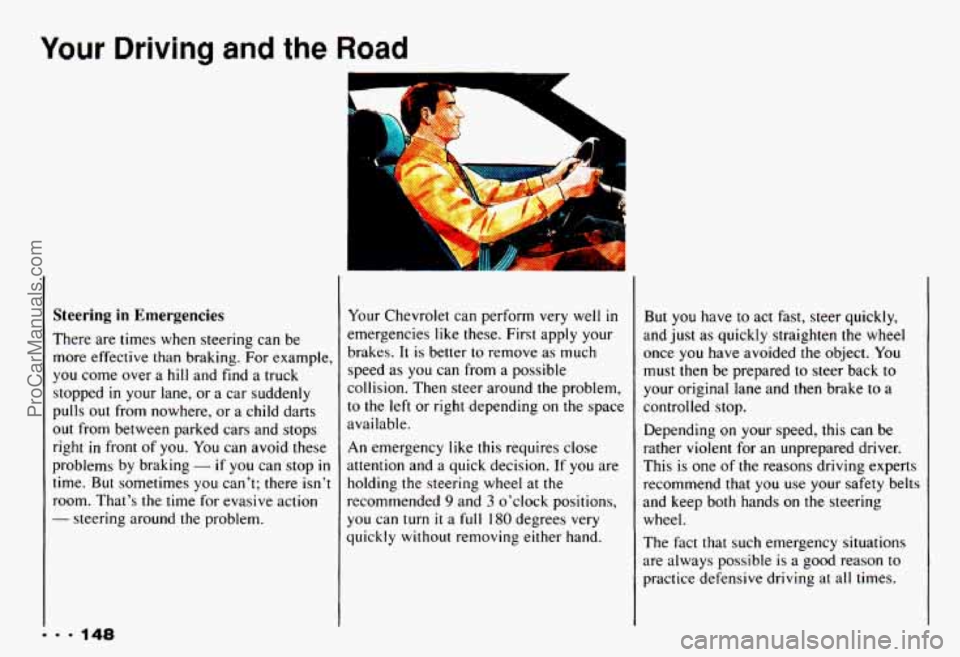
An emergency like this requires close
attention and a quick decision. If you are
holding the steering wheel at the
recommended
9 and 3 o’clock positions,
you can
turn it a full 180 degrees very
quickly without removing either hand.
But you have to act fast, steer quickly,
and just as quickly straighten the wheel
once you have avoided the object.
You
must then be prepared to steer back to
your original lane and then brake to a
controlled stop.
Depending on your speed, this can be
rather violent for an unprepared driver.
This is one of the reasons driving experts
recommend that you use your safety belts
and keep both hands on the steering
wheel.
The fact that such emergency situations
are always possible is a good reason
to
practice defensive driving at all times.
ProCarManuals.com
Page 153 of 358
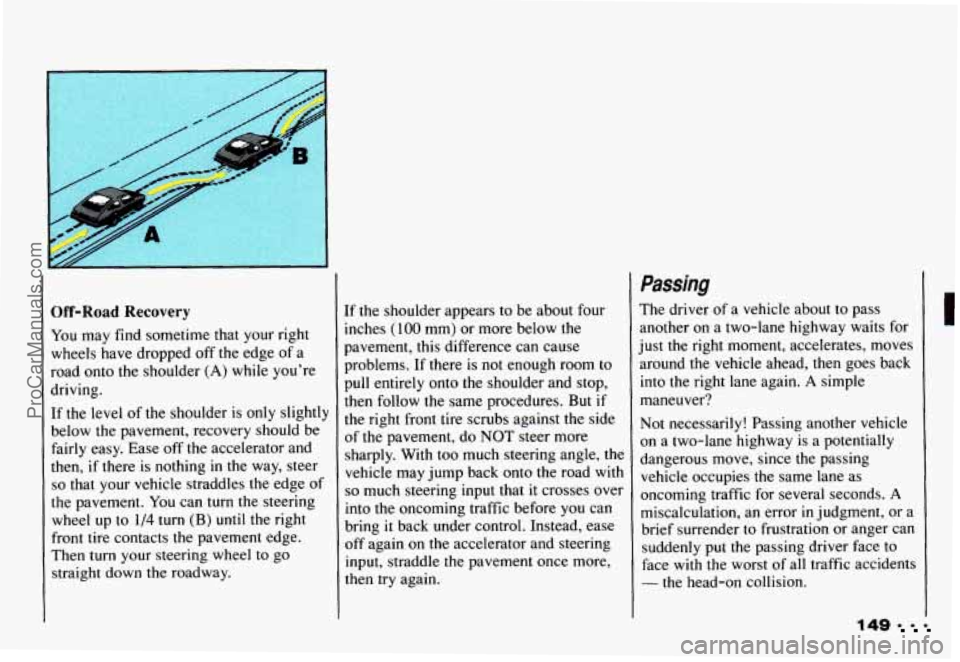
I Off-Road Recovery
You may find sometime that your right
wheels have dropped off the edge of a
road onto the shoulder
(A) while you’re
driving.
If the level of
the shoulder is only slightly
below the pavement, recovery should be
fairly easy. Ease off the accelerator and
then,
if there is nothing in the way, steer
so that your vehicle straddles the edge of
the pavement. You can turn
the steering
wheel up to 1/4 turn (B) until the right
front tire contacts the pavement edge.
Then turn your steering wheel to go
straight down the roadway. If
the shoulder appears to be about four
inches
(100 mm) or more below the
pavement, this difference can cause
problems. If there is not enough room to
pull entirely onto the shoulder and stop,
then follow the same procedures. But
if
the right front tire scrubs against the side
of the pavement, do NOT steer more
sharply. With too much steering angle, the
vehicle may jump back onto the road with
so much steering input that it crosses over
into the oncoming traffic before you can
bring
it back under control. Instead, ease
off again on the accelerator and steering
input, straddle the pavement once more,
then try again.
Passing
The driver of a vehicle about to pass
another on a two-lane highway waits for
just the right moment, accelerates, moves
around the vehicle ahead,
then goes back
into the right lane again.
A simple
maneuver?
Not necessarily! Passing another vehicle
on a two-lane highway is a potentially
dangerous move, since
the passing
vehicle occupies the same lane as
oncoming traffic for several seconds.
A
miscalculation, an error in judgment, or a
brief surrender to frustration or anger can
suddenly put the passing driver face to
face
with the worst of all traffic accidents
- the head-on collision.
149
ProCarManuals.com
Page 156 of 358
Your Driving and the Road
The three types of skids correspond to
your Chevrolet’s three control systems. In
the braking skid your wheels aren’t
rolling. In the steering or cornering skid,
too much speed or steering in a curve
causes tires to slip and lose cornering
force. And
in the acceleration skid too
much throttle causes the driving wheels to
spin.
A cornering skid and an acceleration skid
are best handled by easing your foot off
the accelerator pedal. If your vehicle
starts to slide (as when you turn a corner
on a wet, snow- or ice-covered road),
ease your
foot off the accelerator pedal as
soon as you feel the vehicle start to slide.
Quickly steer the way
you want the vehicle to
go. If you
start steering quickly
enough, your vehicle will straighten out.
As it does, straighten the front wheels.
Of course, traction
is reduced when water,
snow, ice, gravel, or other material is on
the road. For safety, you’ll want to
slow
down and adjust your driving to these
conditions. It is important to slow down
on slippery surfaces because stopping
distance will be longer and vehicle control more limited. While
driving on a surface
with reduced
traction,
try your best to avoid sudden
steering, acceleration, or braking
(including engine braking by shifting to a
lower gear). Any sudden changes could
cause the tires to slide.
You may not
realize the surface is slippery until your
vehicle is skidding. Learn to recognize
warning clues
- such as enough
water, ice or packed snow on the road to
make
a “mirrored surface” - and slow
down when you have any doubt.
Remember:
Any anti-lock braking system
(ABS) helps avoid only the braking skid.
Steer the way you want to go.
ProCarManuals.com
Page 167 of 358
Driving a Long
Distance
Although most long trips today are made
on freeways, there are
still many made on
regular highways.
Long-distance driving on freeways and
regular highways
is the same in some
ways. The
trip has to be planned and the
vehicle prepared, you drive at
higher-than-city speeds, and there are
longer turns behind the wheel. You’ll
enjoy your trip more
if you and your
vehicle are
in good shape. Here are some
:ips for a successful long trip.
Before Leaving on a Long Trip
Make sure you’re ready. Try to be well
rested. If you must start when you’re not
fresh
- such as after a day’s work -
don’t plan to make too many miles that
first part of the journey. Wear comfortable
clothing and shoes you can easily drive
in.
Is your vehicle ready for a long trip? If
you keep
it serviced and maintained, it’s
ready to go. If
it needs service, have it
done before starting out. Of course, you’ll
find experienced and able service experts
in Chevrolet dealerships all across North
America. They’ll be ready and willing to
help
if you need it. Here
are some things you can check
before a trip:
0
0
0
0
0
Windshield Washer Fluid: Is the
reservoir
full? Are all windows clean
inside and outside?
Wiper Blades: Are they in good
shape?
Fuel, Engine Oil, Other Fluids:
Have you checked all levels?
Lights: Are they all working? Are the
lenses clean?
Tires: They are vitally important to a
safe, trouble-free trip.
Is the tread
good enough for long-distance
driving? Are the tires all inflated to
the recommended pressure?
163 -
ProCarManuals.com
Page 168 of 358
Your Driving and the Road
m.. 164
0 Weather Forecasts: What’s the
weather outlook along
your route?
Should you delay your trip a short
time to avoid a major storm system?
0 Maps: Do you have up-to-date
maps?
On the Road
Unless you are the only driver, it is good
to share the driving task
with others.
Limit turns behind the wheel to about
100 miles (160 km) or two hours at a
sitting. Then, either change drivers or stop
for some refreshment like coffee, tea or
soft drinks and some limbering up.
But do
stop and move around. Eat lightly along
the way. Heavier meals tend to make
some people sleepy. On two-lane highways
or undivided
multilane highways that do not have
controlled access, you’ll want to watch
for some situations not usually found on
freeways. Examples are: stop signs and
signals, shopping centers
with direct
access to the highway, no passing zones
and school zones, vehicles turning left
and right off the road, pedestrians, cyclists, parked vehicles, and even
animals.
Highway Hypnosis
Is there actually such a condition as
“highway hypnosis”? Or
is it just plain
falling asleep at the wheel? Call
it
highway hypnosis, lack of awareness, or
whatever.
There is something about an easy stretch
of road
with the same scenery, along with
the hum of the tires on the road, the drone
of the engine, and the rush
of the wind
against the vehicle that can make you
sleepy. Don’t let
it happen to you! If it
does, your vehicle can leave the road in
less than a second, and you could crash
and be injured.
ProCarManuals.com
Page 172 of 358
Your Driving and the Road
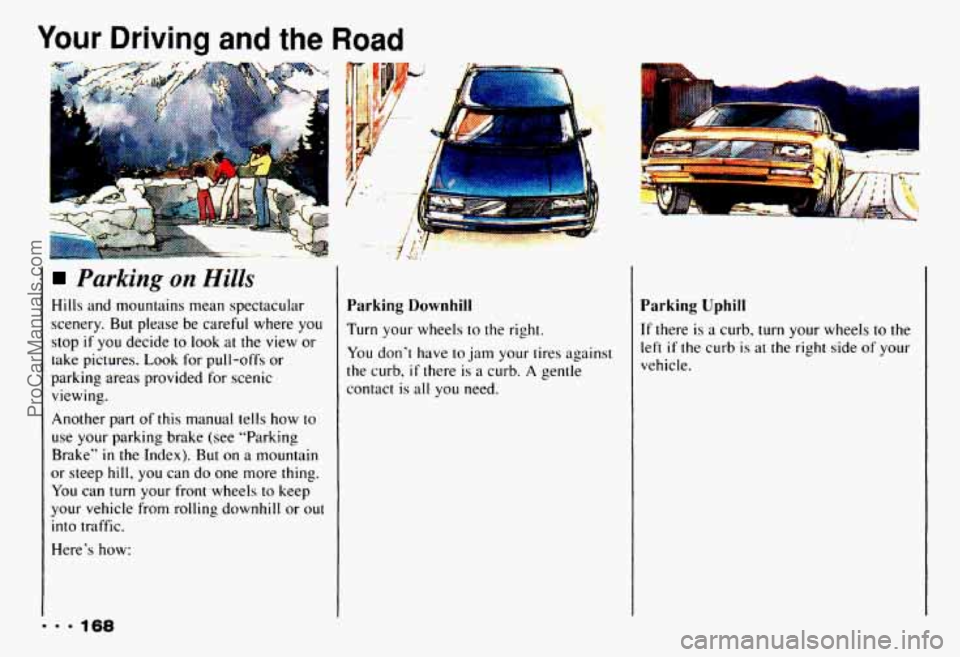
Parking on Hills
Hills and mountains mean spectacular
scenery.
But please be careful where you
stop
if you decide to look at the view or
take pictures. Look for pull-offs or
parking areas provided for scenic
viewing.
Another part
of this manual tells how to
use your parking brake (see "Parking
Brake"
in the Index). But on a mountain
or steep
hill, you can do one more thing.
You can
turn your front wheels to keep
your vehicle from rolling downhill or out
into traffic.
Here's how:
Parking Downhill
Turn your wheels to the right.
You don't have to jam
your tires against
the curb,
if there is a curb. A gentle
contact
is all you need.
-m
Parking Uphill
If there is a curb, turn your wheels to the
left
if the curb is at the right side of your
vehicle.
ProCarManuals.com
Page 173 of 358
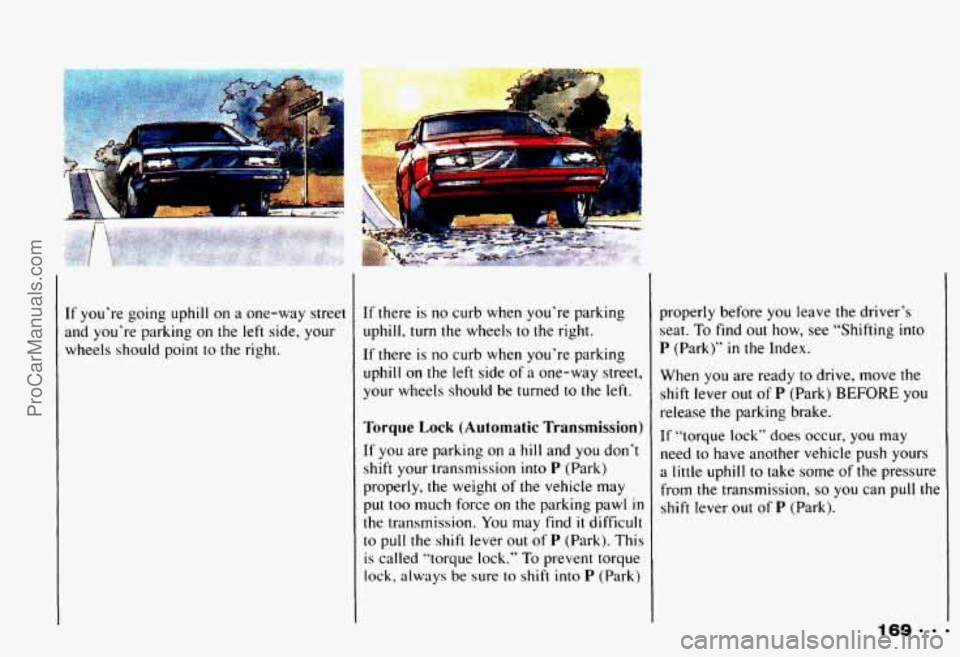
If you’re going uphill on a one-way street
and you’re parking on the left side, your wheels should point to the right. If there is no curb when you’re parking
uphill, turn the wheels
to the right.
If there is no curb when you’re parking
uphill on the left side of a one-way street,
your wheels should be turned to the left.
Torque Lock (Automatic Transmission)
If you are parking on a hill and you don’t
shift your transmission into
P (Park)
properly, the weight
of the vehicle may
put
too much force on the parking pawl in
the transmission. You may find it difficult
to pull the
shift lever out of P (Park). This
is called “torque lock.” To prevent torque
lock, always
be sure to shift into P (Park) properly before
you leave the driver’s
seat.
To find out how, see “Shifting into
P (Park)” in the Index.
When you are ready to drive, move the
shift lever out of
P (Park) BEFORE you
release the parking brake.
If “torque lock” does occur, you may
need to have another vehicle push yours
a little uphill to take some of the pressure
from the transmission,
so you can pull the
shift lever out of
P (Park).
ProCarManuals.com
Page 175 of 358
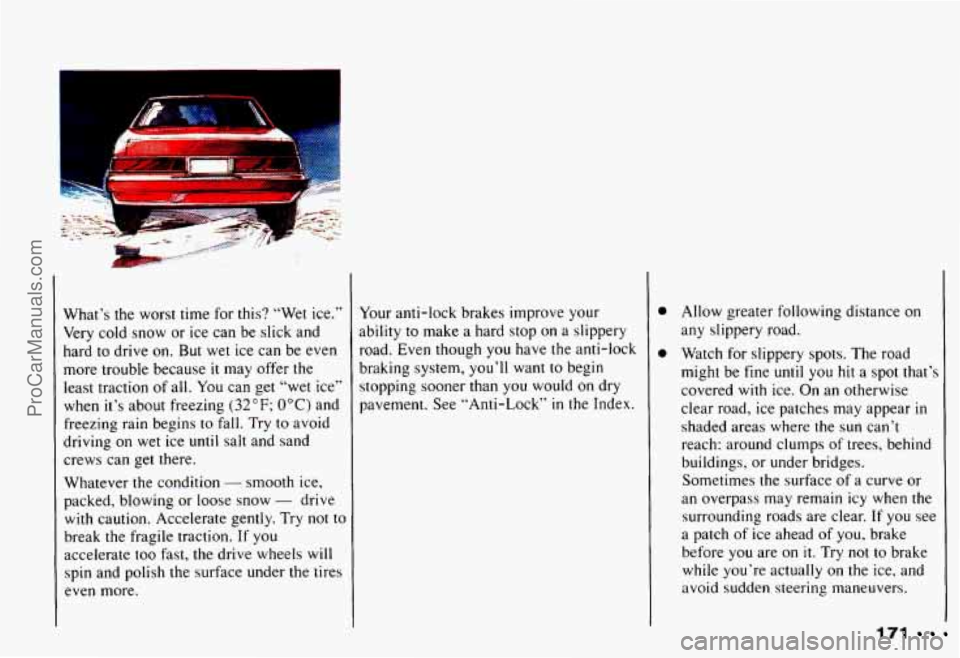
What’s the worst time for this? “Wet ice.”
Very cold snow or ice can be slick and
hard
to drive on. But wet ice can be even
more trouble because
it may offer the
least traction
of all. You can get “wet ice”
when it’s about freezing
(32°F; OOC) and
freezing
rain begins to fall. Try to avoid
driving on wet ice
until salt and sand
crews can get there.
Whatever
the condition - smooth ice,
packed, blowing or loose snow
- drive
with caution. Accelerate gently. Try not to
break the fragile traction. If you
accelerate
too fast, the drive wheels will
spin and polish the surface under the tires
even more. Your
anti-lock brakes improve your
ability
to make a hard stop on a slippery
road. Even though you have the anti-lock
braking system, you’ll want to begin
stopping sooner than you would on
dry
pavement. See “Anti-Lock” in the Index.
0
0
Allow greater following distance on
any slippery road.
Watch for slippery spots. The road
might be fine
until you hit a spot that’s
covered
with ice. On an otherwise
clear road, ice patches
may appear in
shaded areas where the sun can’t
reach: around clumps of trees, behind
buildings, or under bridges.
Sometimes
the surface of a curve or
an overpass may remain icy when the
surrounding roads are clear.
If you see
a patch of ice ahead of you, brake
before you are on
it. Try not to brake
while you’re actually on the ice, and
avoid sudden steering maneuvers.
171
ProCarManuals.com
Page 178 of 358
Your Driving and the Road
I NOTICE:
AAtnage your vehicle and result i~
jtly repairs not covered by you.
warranty.
To pull a trailer correctly,
follow the advice
in this section.
I
Your vehicle can tow a trailer if it is
equipped
with the proper trailer towing
equipment.
To identify what the vehicle
trailering capacity
is for your vehicle, you
should read the information in “Weight
of the Trailer” that appears later
in this
section. But trailering is different than just
driving your vehicle by itself. Trailering
means changes
in handling, durability, and fuel economy.
Successful, safe
trailering takes correct equipment, and
it has to be used properly.
That’s the reason for this section, In it are
many time-tested, important trailering
tips and safety rules. Many of these are
important for your safety and that of your
passengers.
So please read this section
carefully before you pull a trailer.
Load-pulling components such as the
engine, transmission, wheel assemblies,
and tires are forced to work harder against
the drag of the added weight. The engine
is required to operate at relatively higher
speeds and under greater loads, generating extra
heat. What’s more,
the
trailer adds considerably to wind
resistance, increasing the pulling
requirements.
If You Do Decide to Pull a Trailer
If you do, here are some important points.
There are many different laws having
to do
with trailering. Make sure your
rig
will be legal, not only where you
live but also where you’ll be driving.
A good source for this information
can be state or provincial police.
ProCarManuals.com
Page 182 of 358
Your Driving and the Road
178
weight of the trailer. And always keep in
mind that the vehicle you are driving is
now a good deal longer and not nearly so
responsive as your vehicle is by itself,
Before you start, check the trailer hitch
and platform, safety chains, electrical
connector, lights, tires and mirror
adjustment. If the trailer has electric
brakes, start your vehicle and trailer
moving and then apply the trailer brake
controller by hand
to be sure the brakes
are working. This lets you check your
electrical connection
at the same time.
During your trip, check occasionally to be
sure that the load is secure, and that the
lights and any trailer brakes are still
working.
Following Distance
Stay at least twice as far behind the
vehicle ahead as you would when driving
your vehicle without a trailer. This can
help you avoid situations that require
heavy braking and sudden turns.
Passing
You’ll need more passing distance up
ahead when you’re towing a trailer. And,
because you’re a good deal longer, you’ll
need to go much farther beyond the
passed vehicle before you can return
to
your lane.
Backing Up
Hold the bottom of the steering wheel
with one hand. Then, to move the trailer
to the left, just move that hand
to the left.
To move the trailer to the right, move
your hand
to the right. Always back up
slowly and,
if possible, have someone
guide you.
Making Turns
When you’re turning with a trailer, make
wider turns than normal.
Do this so your
trailer won’t strike
soft shoulders, curbs,
road signs, trees, or other objects. Avoid
jerky or sudden maneuvers. Signal well
in
advance.
ProCarManuals.com