Warranty CHEVROLET CAMARO 1993 Owners Manual
[x] Cancel search | Manufacturer: CHEVROLET, Model Year: 1993, Model line: CAMARO, Model: CHEVROLET CAMARO 1993Pages: 358, PDF Size: 15.6 MB
Page 10 of 358
How to Use This Manual
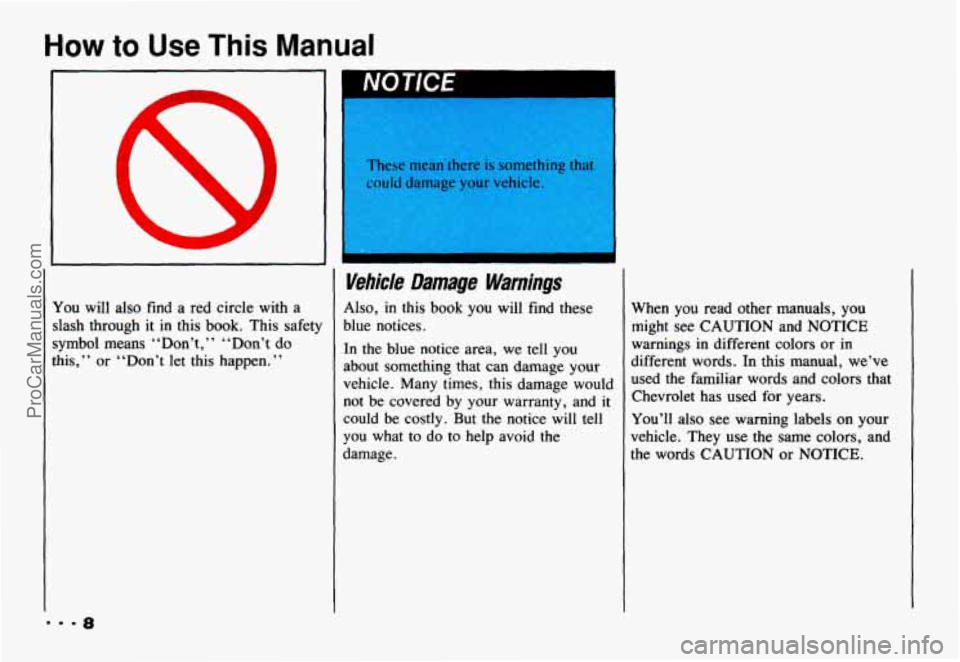
Tou will also find a red circle with a
lash through it in this book. This safety
ymbol means “Don’t,
” “Don’t do
lis,” or “Don’t let this happen.”
Vehicle Damage Warnings
Also, in this book you will find these
blue notices,
In the blue notice area, we tell you
about something that can damage your
vehicle. Many times, this damage would
not be covered by your warranty, and it
could be costly. But
the notice will tell
you what to do to help avoid the
damage. When you
read other manuals, you
might see
CAUTION and NOTICE
warnings in different colors
or in
different words. In this manual, we’ve
used the familiar words
and colors that
Chevrolet has used for years.
You’ll also see warning labels
on your
vehicle. They use the same colors, and
the words
CAUTION or NOTICE.
ProCarManuals.com
Page 68 of 358
Features & Controls
.
Shifting out of Y (Park) or
N (Neutral) while your engine
13 “racing” (running at high speed)
is dangerous. Unless your foot is
firmly on the brake pedal, your
vehicle could move very rapidly.
You could lose control and
hit
people or objects. Don’t shift out of
P (Park) or N (Neutral) while your
engine
is racing.
I I Damage to your transmission
caused by shifting out of P (Park) o
N (Neutral) with the engine racin;
isn’t covered by your warranty. ~ I
@ Automatic Overdrive
This position is for normal driving. If you
need more power for passing, md you’re:
- Going less than about 35 mph
(56 km/h), push your accelerator You’ll
shift down
to the next gear and
have more power.
D (Third Gear)
This is like @I , but you never go into
Overdrive.
Here are some times you might choose
D
instead of @ :
- When driving on hilly, winding roads
- When towing a trailer. so there is less
shifting between gears
pedal abou; halfway down.
I- When going down a steep hill
- Going about 35 mph (56 km/h) or
more, push the accelerator all the way
down.
ProCarManuals.com
Page 108 of 358
Features & Controls
It you keep driving your vehicle
with this
fight on, after a while
emission controls won’t work
well, your fuel economy won’t be
good and your engine may
not rul
as smoothly. This could lead tc
costly repairs not covered by y
warranty.
... 104
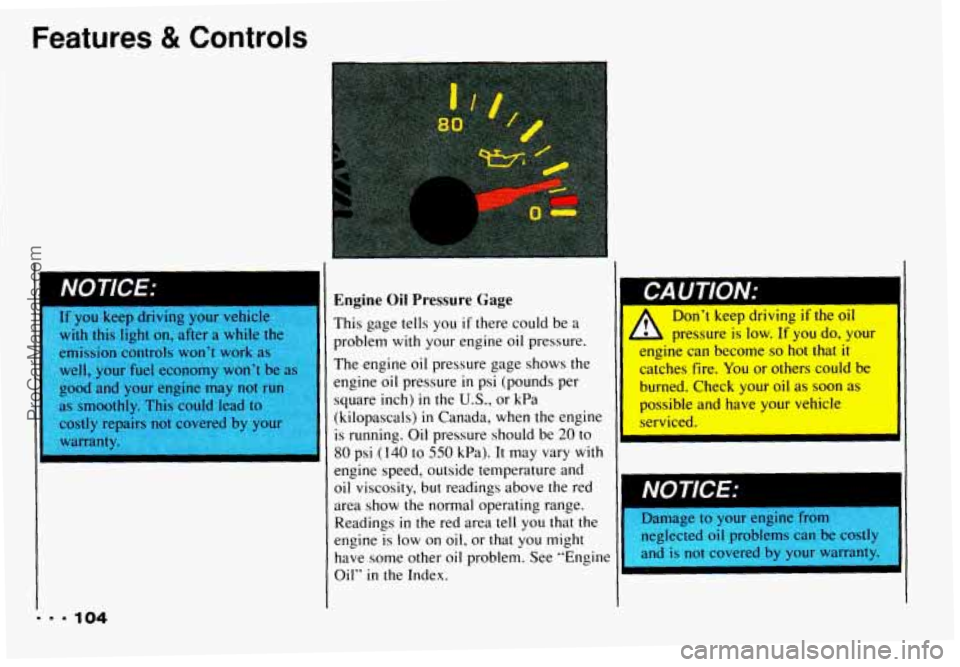
Engine Oil Pressure Gage
This gage tells you if there could be a
problem with your engine oil pressure.
The engine oil pressure gage shows the
engine oil pressure
in psi (pounds per
square inch)
in the U.S., or kPa
(kilopascals)
in Canada, when the engine
is running. Oil pressure should be 20 to
80 psi (140 to 550 kPa). It may vary with
engine speed, outside temperature and
oil viscosity, but readings above the red
area show the normal operating range.
Readings
in the red area tell you that the
engine is
low on oil, or that you might
have some other oil problem. See “Engine
Oil”
in the Index.
Don’t keep driving if the oil
h pressure is low. If you do, your
cllgine can become
so hot that it
I catches fire. You or others could be
burned. Check your
oil as soon as
possible and have your vehicle
serviced.
I NOTICE:
‘I
3
Damage your engine from
neglected oil problems can be costl)
ProCarManuals.com
Page 109 of 358
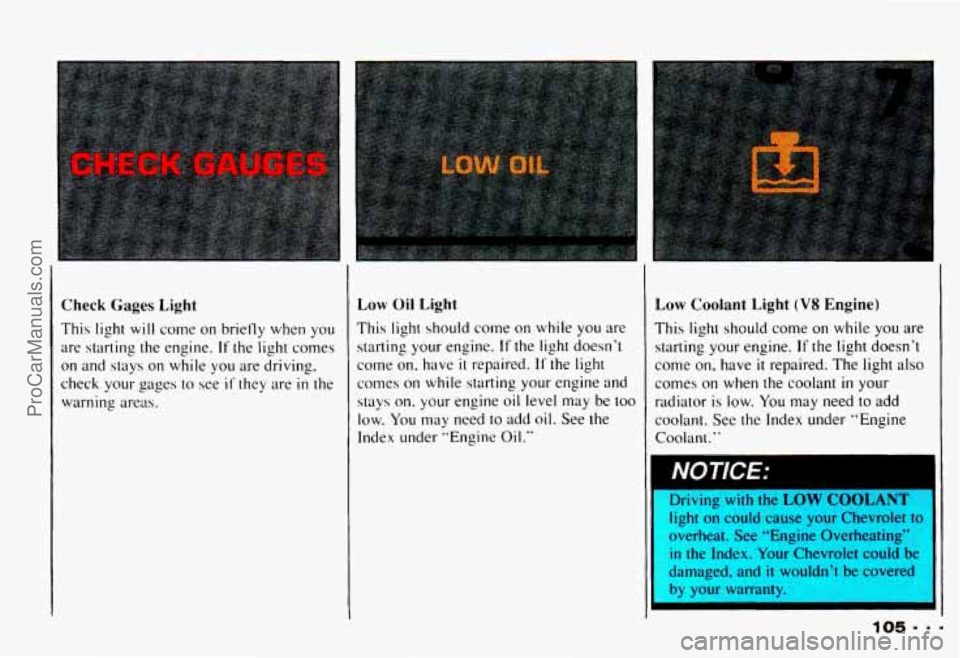
Check Gages Light
This light will come on briefly when you
are starting the engine.
If the light comes
on and stays
on while you are driving.
check your gages
to see if they are in the
warning areas.
Low Oil Light
This light should come on while you are
starting your engine.
If the light doesn’t
come on. have
it repaired. If the light
comes on while starting your engine and
stays on. your engine
oil level may be too
low. You may need to add oil. See the
Index under “Engine
Oil.“
Low Coolant Light (V8 Engine)
This light should come on while you are
starting your engine.
If the light doesn’t
come on, have
it repaired. The light also
comes on when the coolant
in your
radiator is low.
You may need to add
coolant. See
the Index under “Engine
Coolant.“
.. Drtvlng wilt Lllr uw vv wwvuIIA I’
light on could cause your Chevrolet tc
overheat. See “Engine Overheating”
in the Index. Your Chevrolet could be
damaged, and
it wouldn’t be covered
by your warranty.
ProCarManuals.com
Page 178 of 358
Your Driving and the Road
I NOTICE:
AAtnage your vehicle and result i~
jtly repairs not covered by you.
warranty.
To pull a trailer correctly,
follow the advice
in this section.
I
Your vehicle can tow a trailer if it is
equipped
with the proper trailer towing
equipment.
To identify what the vehicle
trailering capacity
is for your vehicle, you
should read the information in “Weight
of the Trailer” that appears later
in this
section. But trailering is different than just
driving your vehicle by itself. Trailering
means changes
in handling, durability, and fuel economy.
Successful, safe
trailering takes correct equipment, and
it has to be used properly.
That’s the reason for this section, In it are
many time-tested, important trailering
tips and safety rules. Many of these are
important for your safety and that of your
passengers.
So please read this section
carefully before you pull a trailer.
Load-pulling components such as the
engine, transmission, wheel assemblies,
and tires are forced to work harder against
the drag of the added weight. The engine
is required to operate at relatively higher
speeds and under greater loads, generating extra
heat. What’s more,
the
trailer adds considerably to wind
resistance, increasing the pulling
requirements.
If You Do Decide to Pull a Trailer
If you do, here are some important points.
There are many different laws having
to do
with trailering. Make sure your
rig
will be legal, not only where you
live but also where you’ll be driving.
A good source for this information
can be state or provincial police.
ProCarManuals.com
Page 198 of 358
Problems on the Road
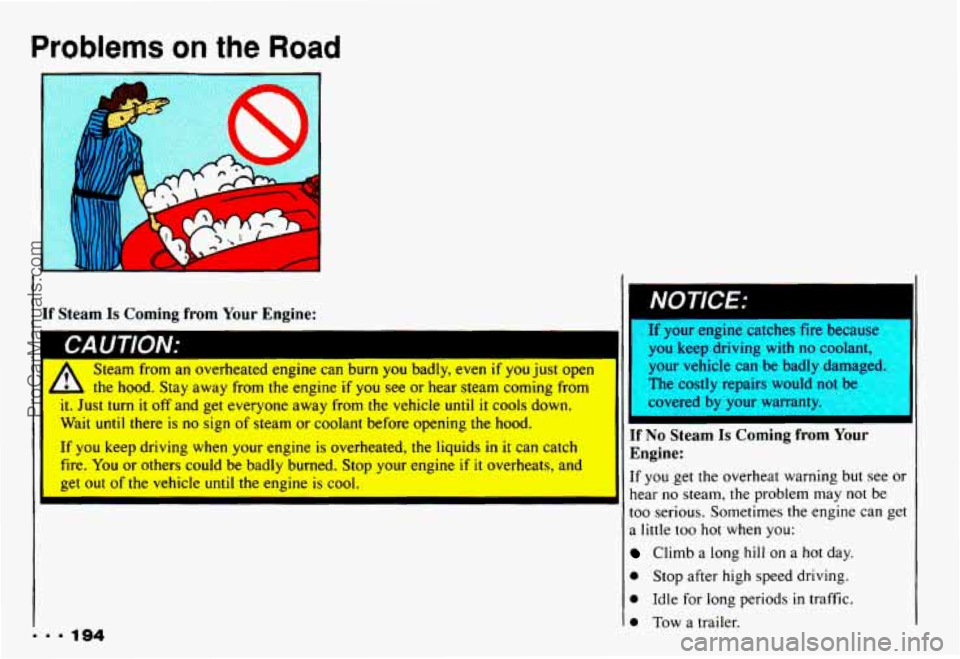
If Steam Is Coming from Your Engine:
W1Ldr-W II LUU I ILJN.'
Steam from an overheated engine can bum you badly, even if you just open
k the hood. Stay away from the engine if you see or hear steam coming from
x. Just turn it off and get everyone away from the vehicle until it cools down.
Wait
until there is no sign of steam or coolant before opening the hood.
If you keep driving when your engine is overheated, the liquids in it can catch
fire. You or others could be badly burned. Stop your engine if it overheats, and
get out of the vehicle until the engine is cool,
... 194
11 your engine catches fire because
I you keep driving with no coolant,
I1
E
I1
h
tC
a
0
a
a
your vehicle can be badly damaged
The
costly repairs would not be
covered by your warranty.
F No Steam Is Coming from Your
hgine:
'you get the overheat warning but see or
ear
no steam, the problem may not be
)o serious. Sometimes the engine can get
little too
hot when you:
Climb a long hill on a hot day.
Stop after high speed driving.
1 Idle for long periods in traffic.
1 Tow a trailer.
ProCarManuals.com
Page 226 of 358
Service & Appearance Care
Fuels in Foreign Countries
If you plan on driving in another country
outside the
U.S. or Canada, unleaded fuel
may be hard to find.
Do not use leaded
gasoline.
If you use even one tankful,
your emission controls won’t work well or at all. With continuous use, spark plugs
can get fouled, the exhaust system can
corrode, and your engine oil can
deteriorate quickly.
Your vehicle’s oxygen
sensor will be damaged.
All of that means
costly repairs that wouldn’t be covered by
your warranty.
c L. 222
To check on fuel availability, ask an auto
club,
or contact a major oil company that
does business in the country where you’ll
be driving.
You can also write us at the following
address for advice. Just tell us where
you’re going and give your Vehicle
Identification Number (VIN).
General Motors of Canada Ltd.
International Export Sales
P.O. Box 828
Oshawa, Ontario L1H 7N1
Canada
I
Filling Your Tank
Gasoline vapor is highly
flammable. It burns violently,
and that can cause very bad injuries. Don’t smoke if you’re near gasoline
or refueling your vehicle. Keep
, sparks, flames, and smoking
C
materials away from gasoline.
‘I
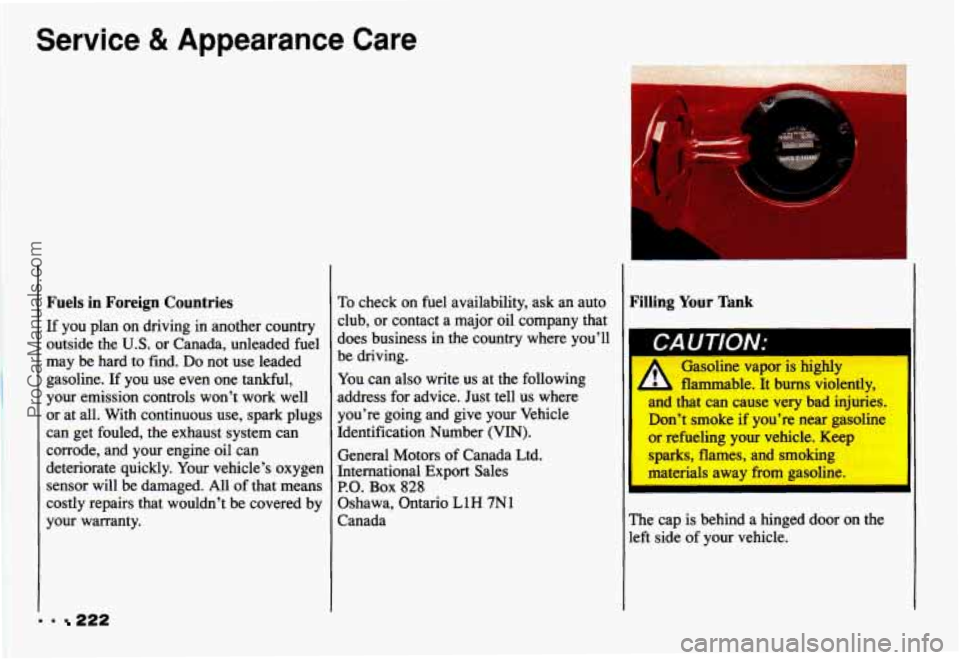
The cap is behind a hinged door on the
left side of your vehicle.
ProCarManuals.com
Page 232 of 358
Service & Appearance Care
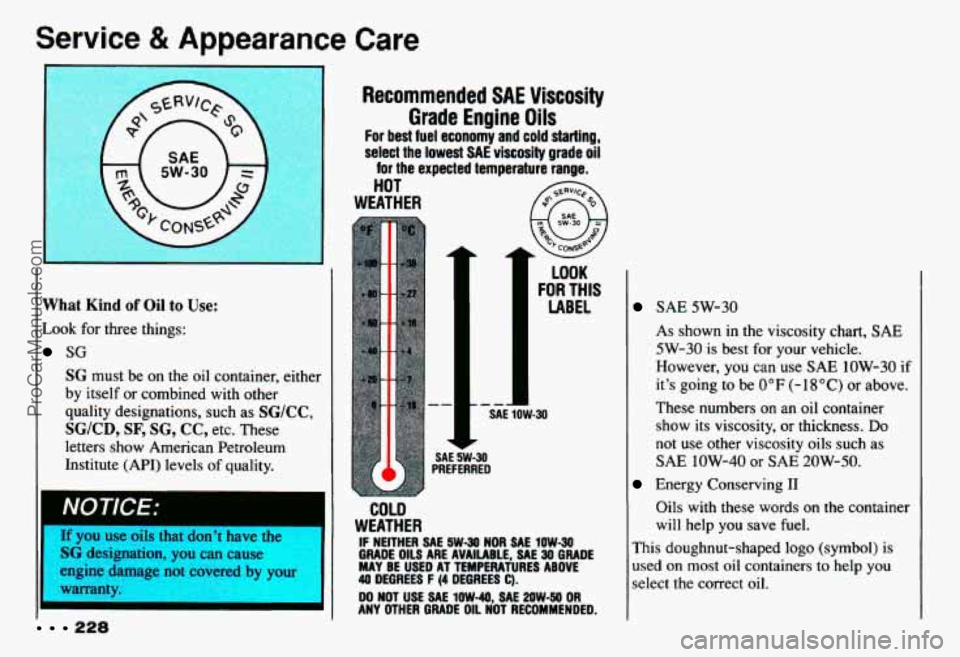
Recommended SAE Viscosity
Grade Engine Oils
For best fuel economy and cold starting,
select the lowest
SAE viscosity grade oil
for the expected temperature range.
HOT
I WEATHER
What Kind of Oil to Use:
Look for three things:
SG
SG must be on the oil container, either
by itself or combined with other
quality designations, such as
SG/CC,
SG/CD,
SF, SG, CC, etc. These
letters show American Petroleum
Institute
(API) levels of quality.
I NVIIC't:
LOOK
FOR THIS
LABEL
SAE 1OW-30
SAE !?W-30 PREFERRED
I
WEATHER If you use oils that don't have the
SG designation, you can cause GRADE OILS ARE AVAILABLE, SAE 30 GRADE
engine damage not covered by yc MAY BE USED AT T \TURES ABOVE
warranty.
IF NEITHER SAE 5W-30 NOR SAE 1OW-30
40 DEGREES F (4 DLY..LLV C).
ANY OTHER GRADE OIL NOT RECOMMENDED.
DO
NOT USE SAE lOW-40, ME 2OW-50 OR
SAE 5W-30
As shown in the viscosity chart, SAE
5W-30 is best for your vehicle.
However, you can use SAE 1OW-30
if
it's going to be 0°F (-18°C) or above.
These numbers on an oil container show its viscosity, or thickness.
Do
not use other viscosity oils such as
SAE
1OW-40 or SAE 20W-50.
Energy Conserving I1
Oils with these words on the container
will help you save fuel.
This doughnut-shaped logo (symbol) is used
on most oil containers to help you
select the correct oil.
228
ProCarManuals.com
Page 239 of 358
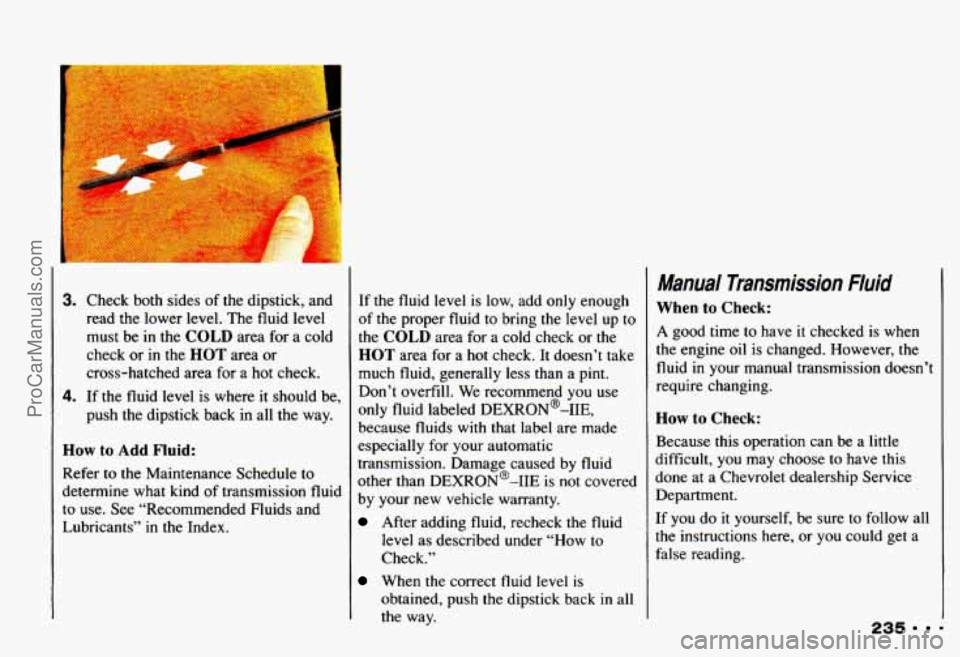
3. Check both sides of the dipstick, and
read the lower level. The fluid level
must be
in the COLD area for a cold
check or in the
HOT area or
cross-hatched area for a
hot check.
4. If the fluid level is where it should be,
push the dipstick back
in all the way.
How to Add Fluid:
Refer to the Maintenance Schedule to
determine what kind of transmission fluid
to use. See “Recommended Fluids and
Lubricants” in the Index. If the fluid level is low, add only enough
of the proper fluid to bring the level up to
the COLD area for
a cold check or the
HOT area for a hot check. It doesn’t take
much fluid, generally less than a pint.
Don’t overfill. We recommend you use
only fluid labeled
DEXRON@-IIE,
because fluids with that label are made
especially for your automatic
transmission. Damage caused by
fluid
other than DEXRON@-IIE is not covered
by your new vehicle warranty.
After adding fluid, recheck the fluid
level as described under “How to
Check.”
obtained, push the dipstick back
in all
the way.
When the correct fluid level is
Manual Transmission Fluid
When to Check:
A good time to have it checked is when
the engine oil is changed. However, the
fluid in your manual transmission doesn’t
require changing.
How to Check:
Because this operation can be a little
difficult, you may choose to have this
done at a Chevrolet dealership Service
Department.
If
you do it yourself, be sure to follow all
the instructions here, or you could get a
false reading.
235 9
ProCarManuals.com
Page 243 of 358
What to Use:
Use a mixture of one-half clean water
(preferably distilled) and one-half
antifreeze that meets
“GM Specification
1825M,” which won’t damage aluminum
parts. You can also use a recycled coolant
conforming to
GM Specification 1825M
with a complete coolant flush and refill.
If you use this mixture, you don’t need to
add anything else.
Adding only plain water to
- b your coding system can be
dangerous. Plain water, or some
other liquid like alcohol, can boil
before the proper coolant mix will.
Your vehicle’s coolant warning
system is set for the proper coolant I
mix. With plain water or the wrong
mix, your engine could get too hot
but you wouldn’t get the overheat
warning. Your
engine could catch
fire and YOU or others could be
burned. Use a 50/50 mix of clean
water and a proper antifreeze.
--
I If you use an improper coolant mix,
your engine could overheat and be
badly damaged. The repair cost
wouldn’t be covered by your
warranty.
Too much water in 1-
mix can freeze and crack the engine,
radiator, heater core and other parts.
239
ProCarManuals.com