mirror CHEVROLET CAMARO 1993 Owners Manual
[x] Cancel search | Manufacturer: CHEVROLET, Model Year: 1993, Model line: CAMARO, Model: CHEVROLET CAMARO 1993Pages: 358, PDF Size: 15.6 MB
Page 51 of 358
Part 2
Features & Controls
Keys .............................................................. 48
.... DoorLocks ......................................................... 50
Theft .............................................................. 52
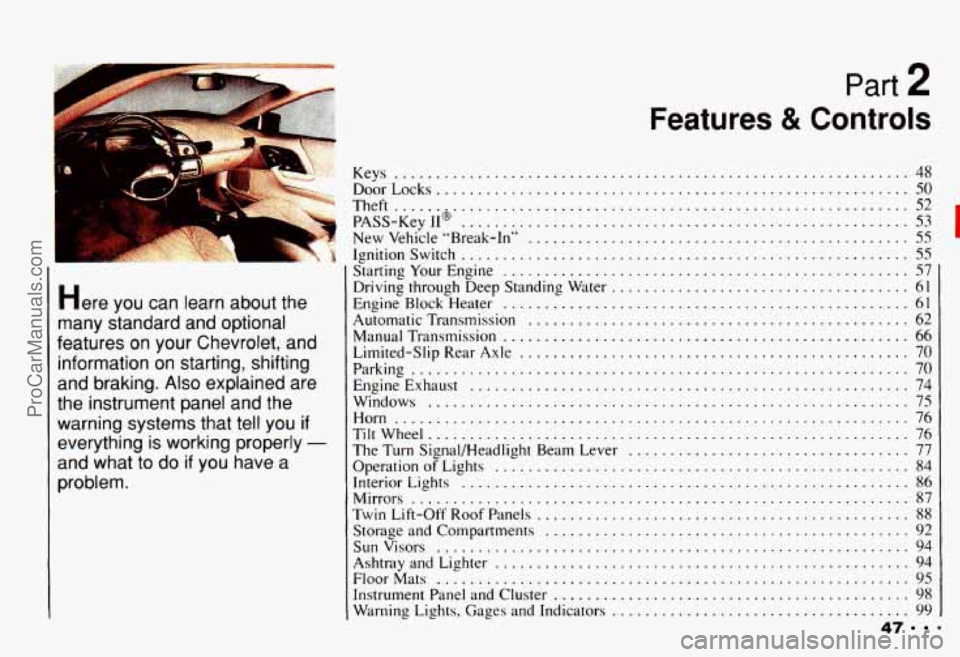
Here you can learn about the
many standard and optional
features on your Chevrolet. and
information
on starting. shifting
and braking
. Also explained are
the instrument panel and the
warning systems that tell you if
everything is working properly
-
and what to do if you have a
problem .
PASS-Key II@ ...................................................... 53
New Vehicle "Break-In" .............................................. 55
Ignitionswitch ...................................................... 55
Starting Your Engine ................................................. 57
Driving through Deep Standing Water
.................................... 61
Engine Block Heater
................................................. 61
Automatic Transmission .............................................. 62
ManualTransmission ................................................. 66
Limited-Slip Rear Axle
............................................... 70
Parking
............................................................ 70
EngineExhaust
..................................................... 74
Windows
.......................................................... 75
Horn
.............................................................. 76
Tiltwheel
.......................................................... 76
Operation of Lights
.................................................. 84
Interior Lights ...................................................... 86
Mirrors ............................................................ 87
Twin Lift-off Roof Panels
............................................. 88
Storage and Compartments ............................................ 92
Sunvisors
......................................................... 94
Ashtray and Lighter .................................................. 94
FloorMats ......................................................... 95
Instrument Panel and Cluster ........................................... 98
Warning Lights
. Gages and Indicators .................................... 99
47
The Turn Signal/Headlight Beam Lever .................................. 77
ProCarManuals.com
Page 61 of 358
I
rn
1
I
I
NOTICE:
I. If your key seems stuck in LOCK 1
and you can’t turn it, be sure it is all 5
the way in. If it is, then turn the
steering wheel left and right whil
you turn the key hard. But turn
tt
key only with your hand. Usir
tool
to force it could break the key
or
the ignition switch. If none of thi:
works,
then your vehicle nvAr
service.
T
i
ietained Accessory Power (RAP)
f you have power door locks, your
lehicle
has a feature called Retained
kcessory Power (RAP). With RAP your power
door locks, electric mirrors, power
windows, audio system and remote hatch
release will continue
to work up to 10
minutes after the ignition key is turned to
Off and neither door is opened.
If a door is opened, the audio system and
power windows will shut off. The power
door locks, electric mirrors and remote
hatch release will work
until you shut the
door. Once you have shut the
door, these
accessories
will continue to work for
approximately
35 seconds. After this
time you
will not be able to use these
accessories
until the next time you open
a
door or turn on the ignilion.
Starting Your Engine
Automatic Transmission: Move your
shift lever to P (Park) or N (Neutral).
Your engine won’t start
in any other
position
- that’s a safety feature. To
restart when you’re already moving,
use
N (Neutral) only.
NOTICE: I
Don‘t try to shilt to P (Park) if your
Chevrolet is moving.
If you do, vou
could damage the transmission,
Shift
to P (Park) o
V
ProCarManuals.com
Page 91 of 358
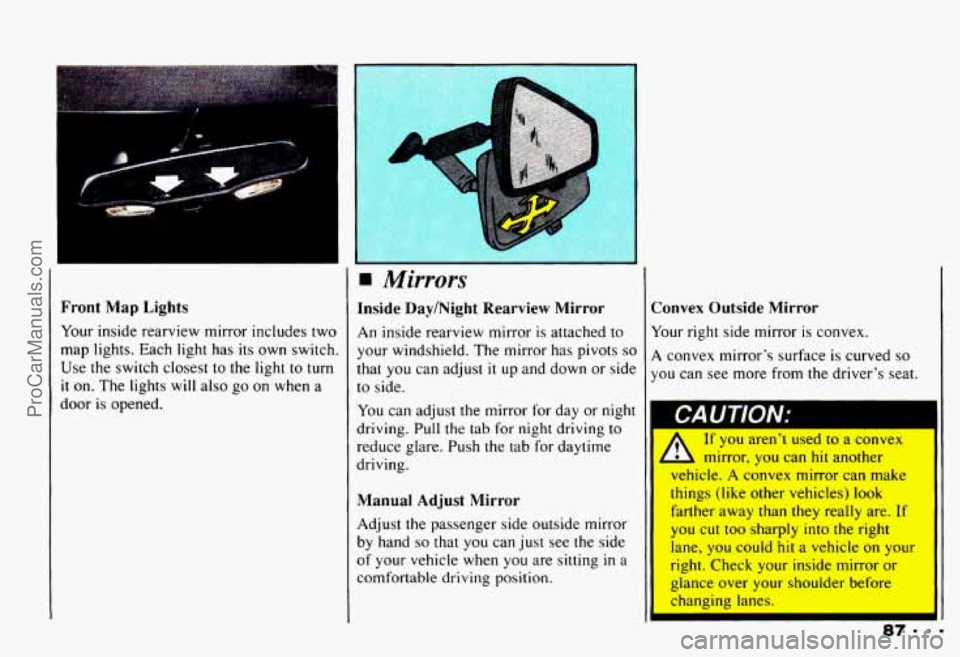
Front Map Lights
Your inside rearview mirror includes two
map lights. Each light has its own switch.
Use the switch closest to the light to
turn
it on. The lights will also go on when a
door is opened.
I
1
I'
. . . .. . .. . , . . .
Mirrors
Inside Day/Night Rearview Mirror
An inside rearview mirror is attached to
your windshield, The mirror has pivots
so
that you can adjust it up and down or side
to side.
You can adjust the mirror for day or night
driving. Pull the tab for
night driving to
reduce glare. Push the tab for daytime
driving.
Convex Outside Mirror
Your right side mirror is convex.
A convex mirror's surface is curvec so
you can see more from the driver's seat,
If you aren't used to a convex
L mirror, you can hit another
vehicle.
A convex mirror can make
things (like other vehicles) look
Manual Adjust Mirror
Adjust the passenger side outside mirror you cut too sharply into the right
by hand
so that you can just see the side lane, you could hit a vehicle on your
of your vehicle when you are sitting
in a right. Check your inside mirror or
comfortable driving position. glance over your shoulder before
farther
away than they really are.
If
changing lanes.
I
87.9-
ProCarManuals.com
Page 92 of 358
Features & Controls
t
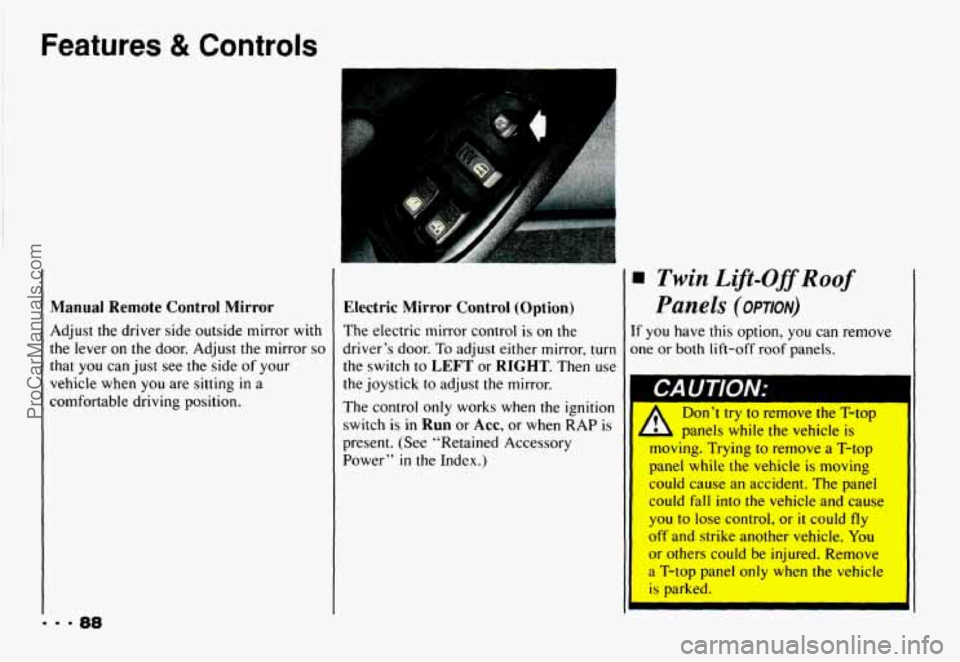
Manual Remote Control Mirror
Adjust the driver side outside mirror with
the lever
on the door. Adjust the mirror so
that you can just see the side of your
vehicle when
you are sitting in a
comfortable driving position.
Electric Mirror Control (Option)
The electric mirror control is on the
driver’s door.
To adjust either mirror, turn
the switch to LEFT or RIGHT. Then use
the joystick to adjust the mirror.
The control only works when the ignition
switch is
in Run or Acc, or when RAP is
present. (See “Retained Accessory
Power”
in the Index.)
Twin Lift-OffRoof
Panels (oPnoN)
f you have this option, you can remove
me or both lift-off roof
panels.
CAUTION: 1
Don’t try to remove the T-top
panels while the vehicle
is
moving. Trying to remove a T-top
panel
while the vehicle is moving
could cause an accident. The panel
could
fall into the vehicle and cause
you to lose control, or
it could fly
off and strike another vehicle. You
or others could be injured. Remove
a T-top panel only when the vehicle
I is parked.
ProCarManuals.com
Page 98 of 358
Features & Contr
I
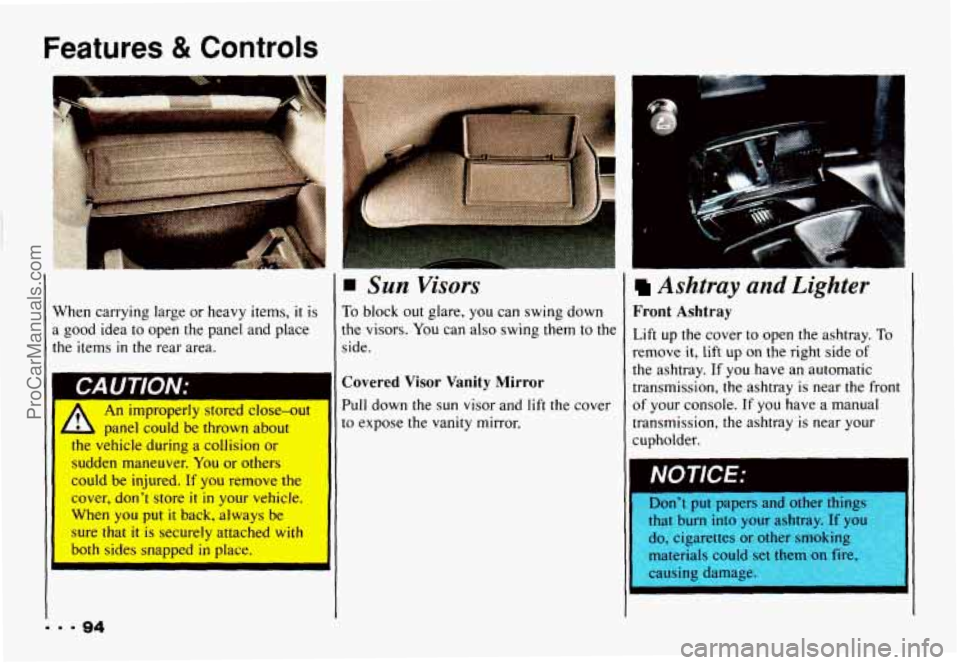
When carrying large or heavy items, it is
a good idea to open the panel and place
the items
in the rear area.
I
A An improperly stored close-out
, panel could be thrown about
I
Sun Visors
To block out glare, you can swing down
the visors. You can also swing them to the
side
.
Covered Visor Vanity Mirror
Pull down the sun visor and lift the cover
to expose the vanity mirror.
the vehicle during a collision or
sudden maneuver. You
or others
could be injured. If you remove the
cover, don’t store it in your vehicle.
When
you put it back, always be
sure
that it is securely attached with
both
sides snapped in place.
I
u
Ashtray and Lighter
Front Ashtray
Lift up the cover to open the ashtray. To
remove it, lift up on the right side of
the ashtray. If you have an automatic
transmission, the ashtray is near the front
of your console. If you have a manual
transmission, the ashtray is near your
cupholder.
Don’t put papers and 0th
t It burn into your ashtrc If you
cigarettes or other srr- --kg
naterials cot set them on
:awing dam, :.
IgS I
I
ProCarManuals.com
Page 155 of 358
If other cars are lined up to pass a
slow vehicle, wait your turn.
But take
care that someone isn’t
trying to pass
you as you pull out
to pass the slow
vehicle. Remember to glance over
your shoulder and check the blind
spot.
Check your mirrors, glance over your
shoulder, and start your left lane
change signal before moving out of
the right lane to pass. When you are
far enough ahead of the passed vehicle
to see its front in your inside mirror,
activate your right lane change signal
and move back into the right lane. (Remember
that your right outside
mirror is convex. The vehicle you
just
passed may seem to be farther away
from you than
it really is.)
Try not to pass more than one vehicle
at a time on two-lane roads.
Reconsider before passing the next
vehicle.
Don’t overtake a slowly moving
vehicle too rapidly. Even though the
brake lights are not flashing,
it may be
slowing down or starting to turn.
If you’re being passed, make
it easy
for the following driver
to get ahead
of you. Perhaps you can ease a little
to
the right.
Loss of Control
Let’s review what driving experts say
about what happens when the three
control systems (brakes, steering and
acceleration) don’t have enough friction
where the tires meet the road
to do what
the driver has asked.
In any emergency, don’t give up. Keep
trying to steer and constantly seek an
escape route or area of less danger.
Skidding
In a skid, a driver can lose control of the
vehicle. Defensive drivers avoid most
skids by taking reasonable care suited
to
existing conditions, and by not
“overdriving” those conditions.
But skids
are always possible.
ProCarManuals.com
Page 156 of 358
Your Driving and the Road
The three types of skids correspond to
your Chevrolet’s three control systems. In
the braking skid your wheels aren’t
rolling. In the steering or cornering skid,
too much speed or steering in a curve
causes tires to slip and lose cornering
force. And
in the acceleration skid too
much throttle causes the driving wheels to
spin.
A cornering skid and an acceleration skid
are best handled by easing your foot off
the accelerator pedal. If your vehicle
starts to slide (as when you turn a corner
on a wet, snow- or ice-covered road),
ease your
foot off the accelerator pedal as
soon as you feel the vehicle start to slide.
Quickly steer the way
you want the vehicle to
go. If you
start steering quickly
enough, your vehicle will straighten out.
As it does, straighten the front wheels.
Of course, traction
is reduced when water,
snow, ice, gravel, or other material is on
the road. For safety, you’ll want to
slow
down and adjust your driving to these
conditions. It is important to slow down
on slippery surfaces because stopping
distance will be longer and vehicle control more limited. While
driving on a surface
with reduced
traction,
try your best to avoid sudden
steering, acceleration, or braking
(including engine braking by shifting to a
lower gear). Any sudden changes could
cause the tires to slide.
You may not
realize the surface is slippery until your
vehicle is skidding. Learn to recognize
warning clues
- such as enough
water, ice or packed snow on the road to
make
a “mirrored surface” - and slow
down when you have any doubt.
Remember:
Any anti-lock braking system
(ABS) helps avoid only the braking skid.
Steer the way you want to go.
ProCarManuals.com
Page 157 of 358
Driving at Night
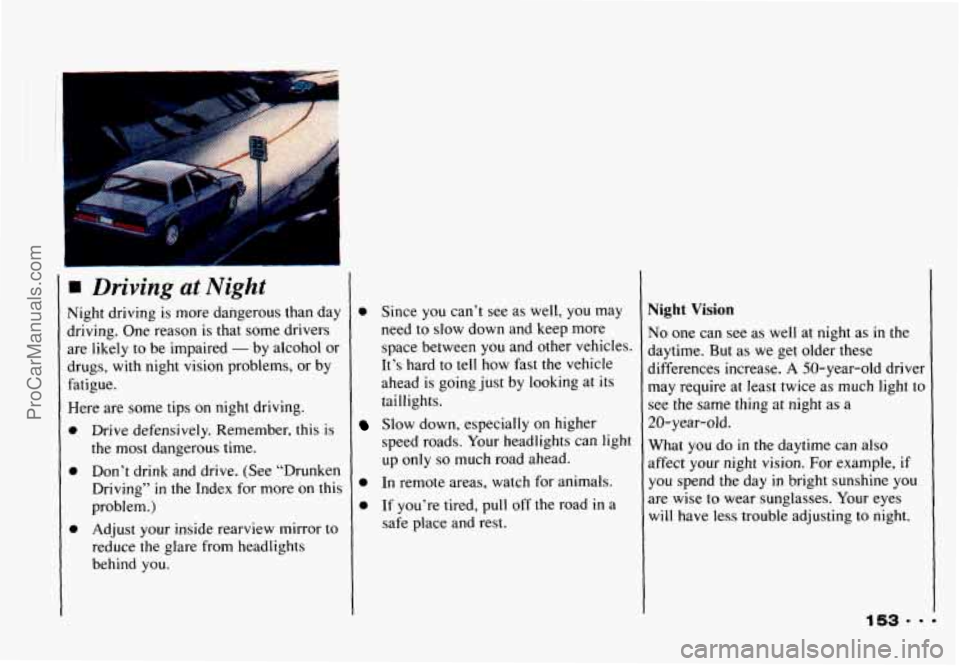
Night driving is more dangerous than day
driving. One reason is that some drivers
are likely to be impaired
- by alcohol or
drugs, with night vision problems, or by
fatigue.
Here are some tips on night driving.
0
e
e
Drive defensively. Remember, this is
the most dangerous time.
Don’t drink and drive. (See “Drunken
Driving’’
in the Index for more on this
problem.)
Adjust your inside rearview mirror to
reduce
the glare from headlights
behind you.
0
0
0
Since you can’t see as well, you may
need to slow down and keep more
space between you and other vehicles.
It’s hard to tell how fast the vehicle
ahead is going just by looking at its
taillights.
Slow down, especially
on higher
speed roads. Your headlights can light
up only
so much road ahead.
In remote areas, watch for animals.
If you’re tired, pull off the road
in a
safe place and rest.
Night Vision
No one can see as well at night as in the
daytime. But as we get older these
differences increase. A 50-year-old driver
may require at least twice as much light to
see
the same thing at night as a
20-year-old.
What you do
in the daytime can also
affect your night vision. For example,
if
you spend the day in bright sunshine you
are wise to wear sunglasses. Your eyes
will have less trouble adjusting to night.
ProCarManuals.com
Page 159 of 358
When you follow another vehicle on a
freeway or highway, use low beams. True,
most vehicles now have day/night mirrors
that enable the driver to reduce glare. But
outside mirrors are not of this type and
high beams from behind can bother the
driver ahead.
A Few More Night Driving Suggestions
Keep your windshield and all the glass on
your vehicle clean
- inside and out.
Glare at night is made much worse by dirt
on the glass. Even the inside of the glass
can build
up a film caused by dust.
Tobacco smoke also makes inside glass
surfaces very filmy and can be a vision
hazard
if it’s left there. Dirty
glass makes lights dazzle and flash
more than clean glass would, making the
pupils of your eyes contract repeatedly.
You might even want to keep a cloth and
some glass cleaner
in your vehicle if you
need to clean your glass frequently.
Remember that your headlights light
up
far less of a roadway when you are in a
turn or curve.
Keep your eyes moving; that
way, it’s
easier to pick
out dimly lighted objects.
Just as your headlights should be checked
regularly for proper aim,
so should your
eyes be examined regularly. Some drivers
suffer from
night blindness - the
inability to see
in dim light - and aren’t
even aware of
it.
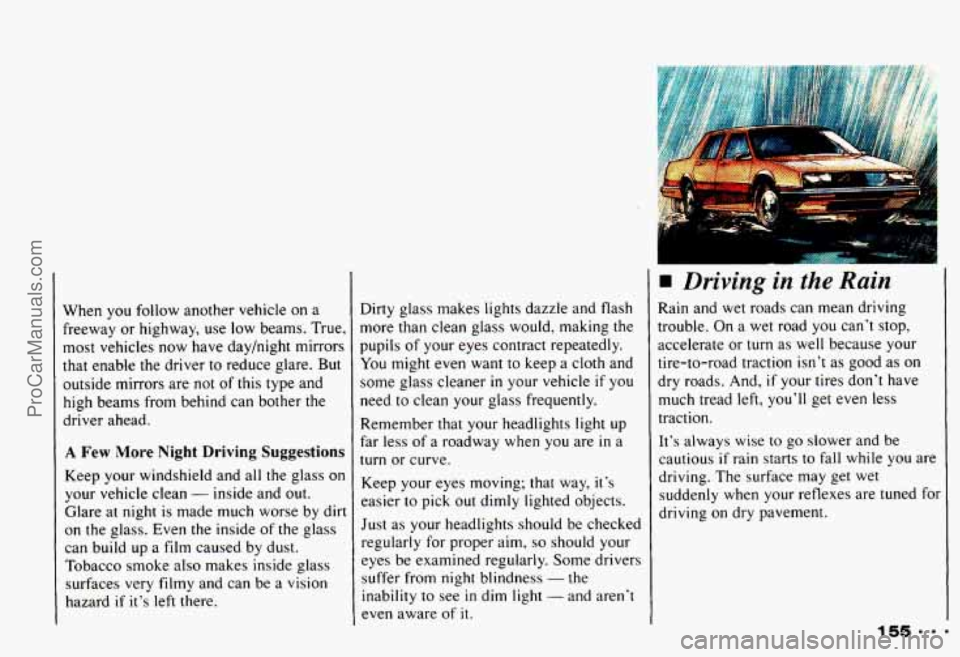
Driving in the Rain
Rain and wet roads can mean driving
trouble. On a wet road you can’t stop,
accelerate or
turn as well because your
tire-to-road traction isn’t as good as on
dry roads. And,
if your tires don’t have
much tread left,
you’ll get even less
traction.
It’s always wise to go slower and be
cautious
if rain starts to fall while you are
driving. The surface may get wet
suddenly when your reflexes are tuned for
driving on
dry pavement.
ProCarManuals.com
Page 165 of 358
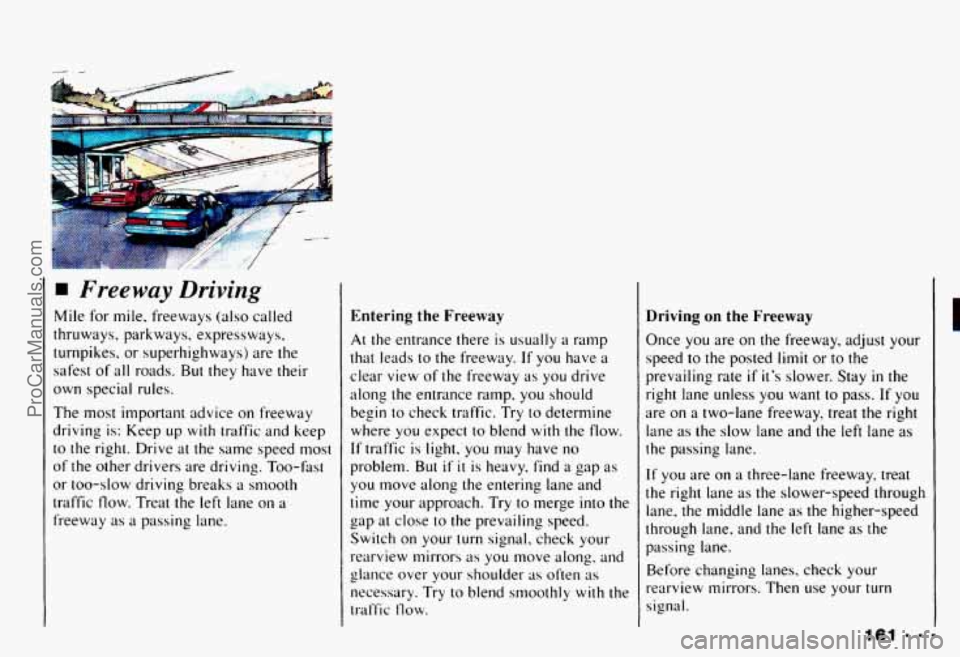
Freeway Driving
Mile for mile. freeways (also called
thruways, parkways, expressways,
turnpikes, or superhighways) are the
safest
of all roads. But they have their
own special rules.
The
most important advice on freeway
driving
is: Keep up with traffic and keep
to the right. Drive at the same speed most
of the other drivers are driving. Too-Past
or too-slow driving breaks a smooth
traffic flow. Treat the left lane on
a
freeway as a passing lane.
Entering the Freeway
At the entrance there is usually a ramp
that leads to the freeway.
If you have a
clear view of the freeway as you drive
along the entrance ramp, you should
begin
to check traffic. Try to determine
where
you expect to blend with the flow.
If traffic is light. you may have no
problem. But if it is heavy. find a gap as
you move along the entering lane and
time your approach. Try
to merge into the
gap
at close to the prevailing speed.
Switch on your
turn signal, check your
rearview mirrors
as you move along, and
glance over your shoulder as often as
necessary. Try
to blend smoothly with the
traffic flow.
Driving on the Freeway
Once you are on the freeway, adjust your
speed to the posted
limit or to the
prevailing rate
if it's slower. Stay in the
right lane unless
you want to pass. If you
are on a two-lane freeway, treat the right
lane as the
slow lane and the left lane as
the passing lane.
If you are on a three-lane freeway, treat
the right lane as the slower-speed through
lane, the middle lane as the higher-speed
through lane, and the left lane as the
passing lane.
Before changing lanes, check your
rearview mirrors. Then use your turn
signal.
I
ProCarManuals.com