battery CHEVROLET CAMARO 1994 4.G User Guide
[x] Cancel search | Manufacturer: CHEVROLET, Model Year: 1994, Model line: CAMARO, Model: CHEVROLET CAMARO 1994 4.GPages: 292, PDF Size: 15.35 MB
Page 151 of 292
Downloaded from www.Manualslib.com manuals search engine Jump Starting
If your battery has run down, you may
want to use another vehicle and some
jumper cables to start your Chevrolet. But
please follow the steps below to do it
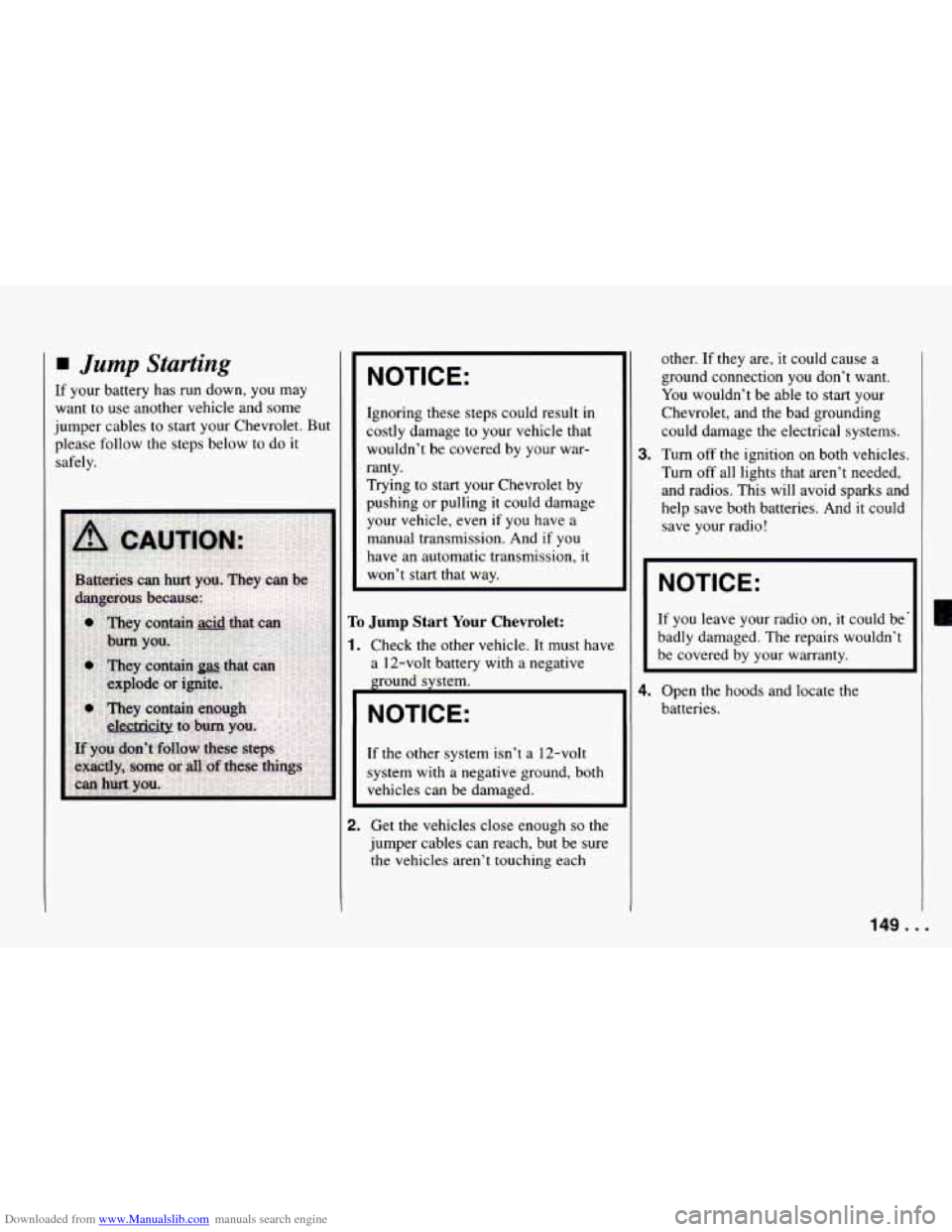
safely. NOTICE:
Ignoring these steps could result in
costly damage to your vehicle that
wouldn’t be covered by your war-
ranty.
Trying to start your Chevrolet by
pushing or pulling
it could damage
your vehicle, even
if you have a
manual transmission. And if you
have an automatic transmission,
it
won’t start that way.
To Jump Start Your Chevrolet:
1. Check the other vehicle. It must have
a 12-volt battery with a negative
ground system.
NOTICE:
If the other system isn’t a 12-volt
system with a negative ground, both
vehicles can be damaged.
2. Get the vehicles close enough so the
jumper cables can reach, but be sure
the vehicles aren’t touching each other.
If they are,
it could cause a
ground connection you don’t want.
You wouldn’t be able to start your
Chevrolet, and the bad grounding
could damage the electrical systems.
3. Turn off the ignition on both vehicles.
Turn off all lights that aren’t needed,
and radios. This
will avoid sparks and
help save both batteries. And
it could
save your radio!
NOTICE:
If you leave your radio on, it could be’
badly damaged. The repairs wouldn’t
be covered
by your warranty.
4. Open the hoods and locate the
batteries.
149 ...
Page 152 of 292
Downloaded from www.Manualslib.com manuals search engine Problems on the Road
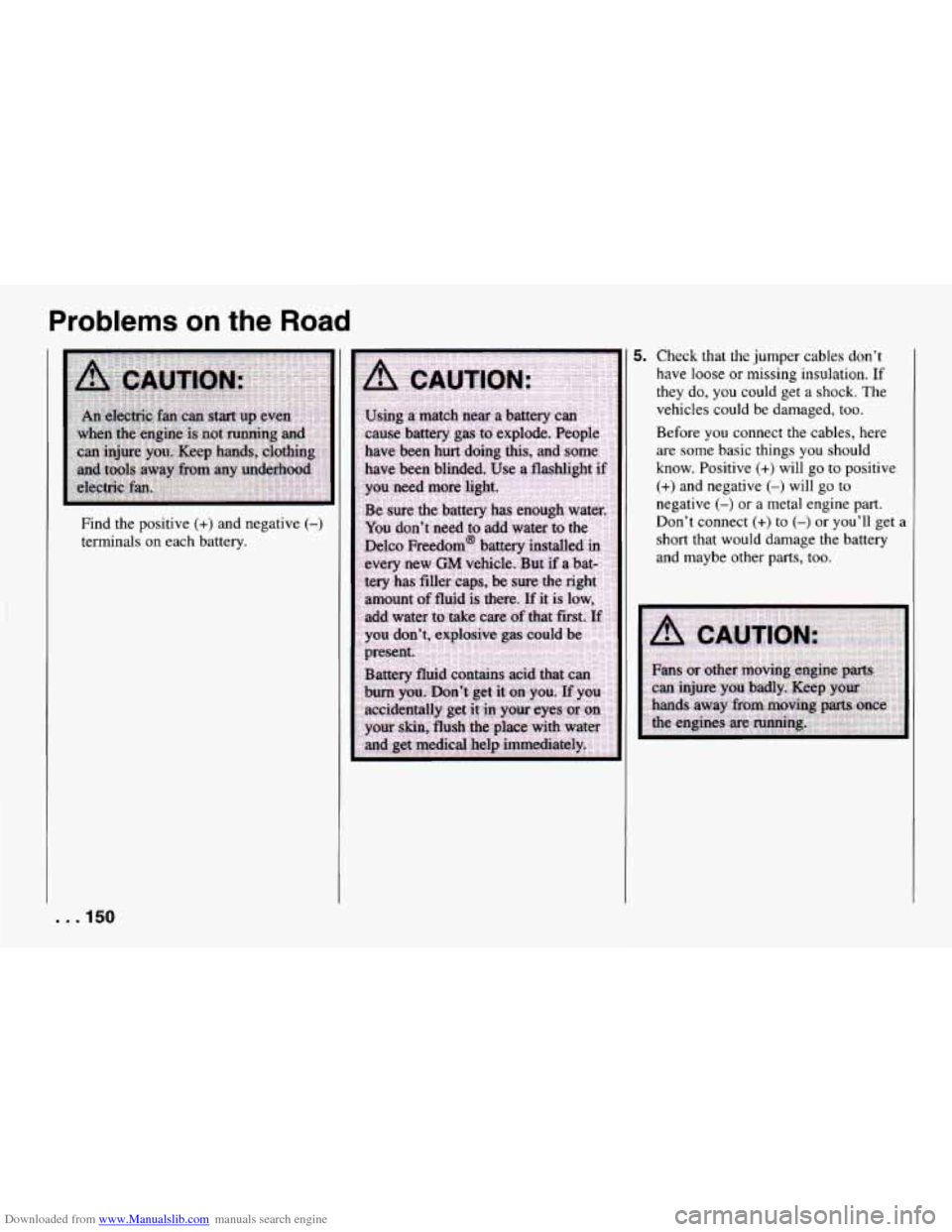
Find the positive (+> and negative (-j
terminals on each battery.
5. Check that the jumper cables don’t
have loose or missing insulation. If
they do, you could get a shock. The
vehicles could be damaged, too.
Before you connect the cables, here
are some basic things you should
know. Positive (+) will go to positive
(+) and negative (-) will go to
negative
(-j or a metal engine part.
Don’t connect
(+) to (-) or you’ll get a
short that would damage the battery
and maybe other parts, too.
. . .150
Page 153 of 292
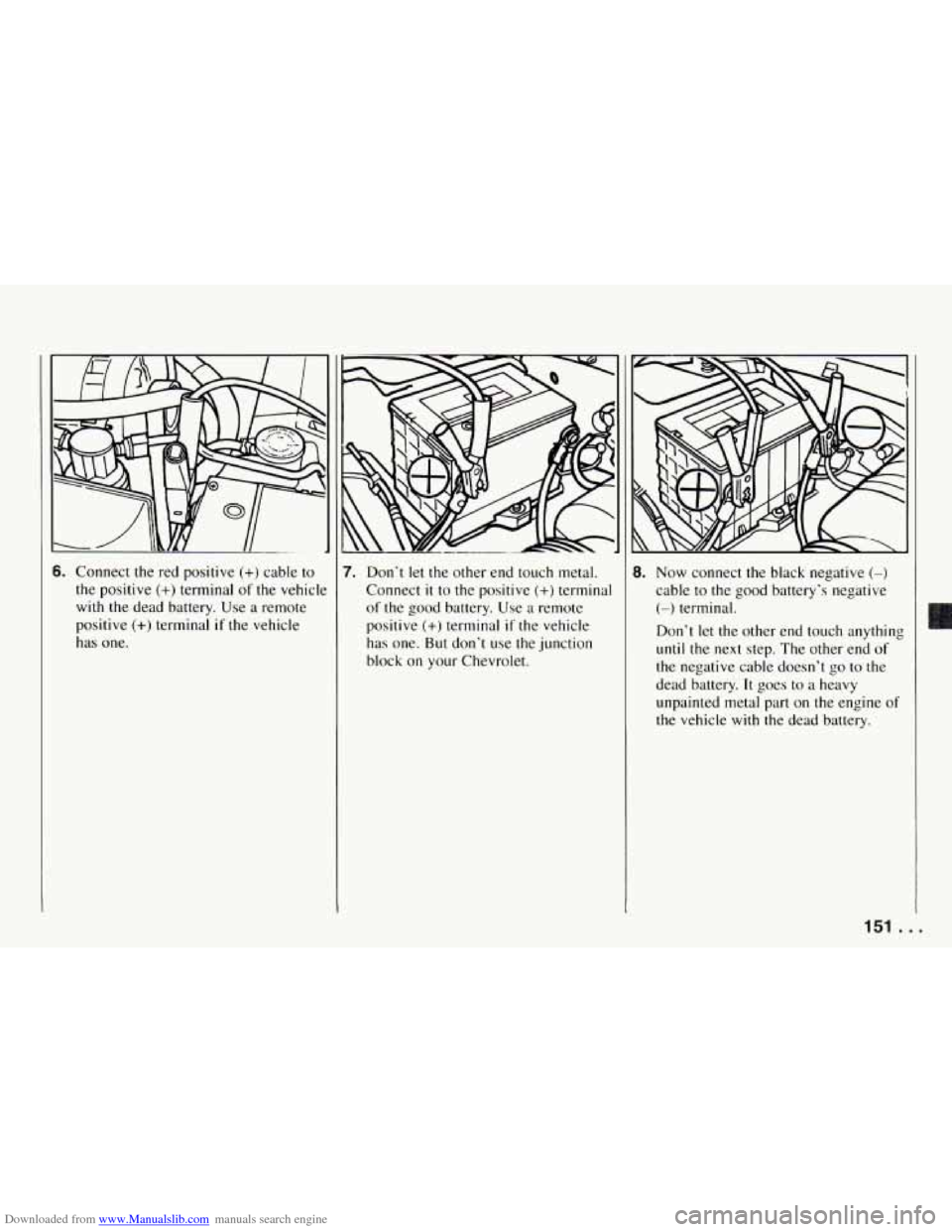
Downloaded from www.Manualslib.com manuals search engine 6. Connect the red positive (+) cable to
the positive
(+) terminal of the vehicle
with the dead battery. Use a remote
positive
(+) terminal if the vehicle
has one.
7. Don‘t let the other end touch metal.
Connect
it to the positive (+) terminal
of the good battery. Use a remote
positive
(+) terminal if the vehicle
has one. But don’t use the junction
block
on your Chevrolet.
a. Now connect the black negative (-)
cable to the good battery’s negative
(-) terminal.
Don’t let the other end touch anything
until the next step. The other end of
the negative cable doesn’t go to the
dead battery.
It goes to a heavy
unpainted metal part
on the engine of
the vehicle with the dead battery.
151 .,
Page 154 of 292
Downloaded from www.Manualslib.com manuals search engine Problems on the Road
9.
0.
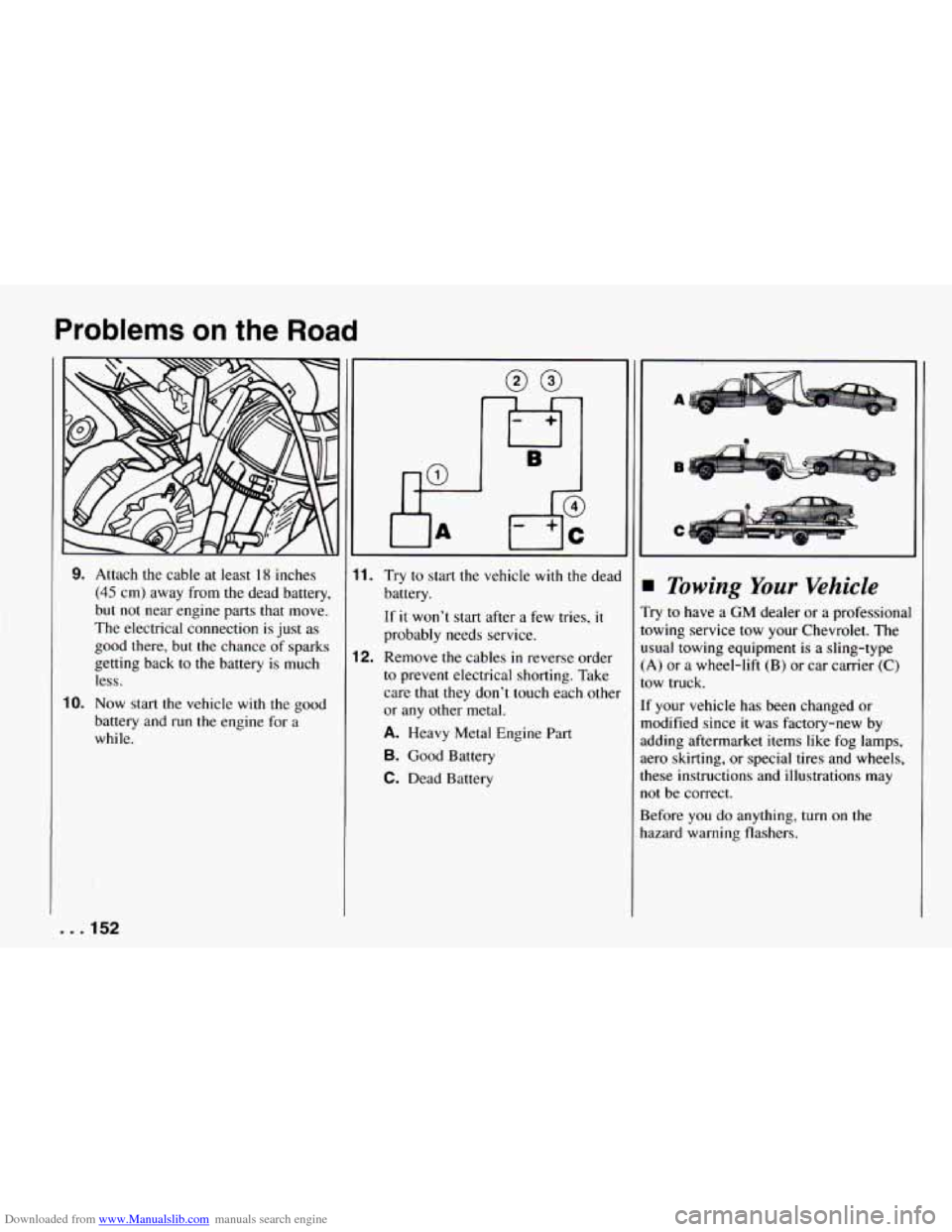
Attach the cable at least 18 inches
(45 cm) away from the dead battery,
but not near engine parts that move.
The electrical connection is just
as
good there, but the chance of sparks
getting back to the battery is much
less.
Now start the vehicle
with the good
battery and
run the engine for a
while.
-. 152
1.
2.
Try to start the vehicle with the dead
battery.
If it won't start after a few tries, it
probably needs service.
Remove the cables
in reverse order
to prevent electrical shorting. Take
care that they don't touch each other
or any other metal.
A. Heavy Metal Engine Part
B. Good Battery
c. Dead Battery
A
I Towing Your Vehicle
?y to have a GM dealer or a professional
]wing service tow your Chevrolet. The
sua1 towing equipment is a sling-type
A) or a wheel-lift (B) or car carrier (C)
3w truck.
f your vehicle has been changed or
nodified since
it was factory-new by
Idding aftermarket items like fog lamps,
Lero skirting, or special tires and wheels,
hese instructions and illustrations may
tot be correct.
3efore you do anything, turn on the
lazard warning flashers.
Page 181 of 292
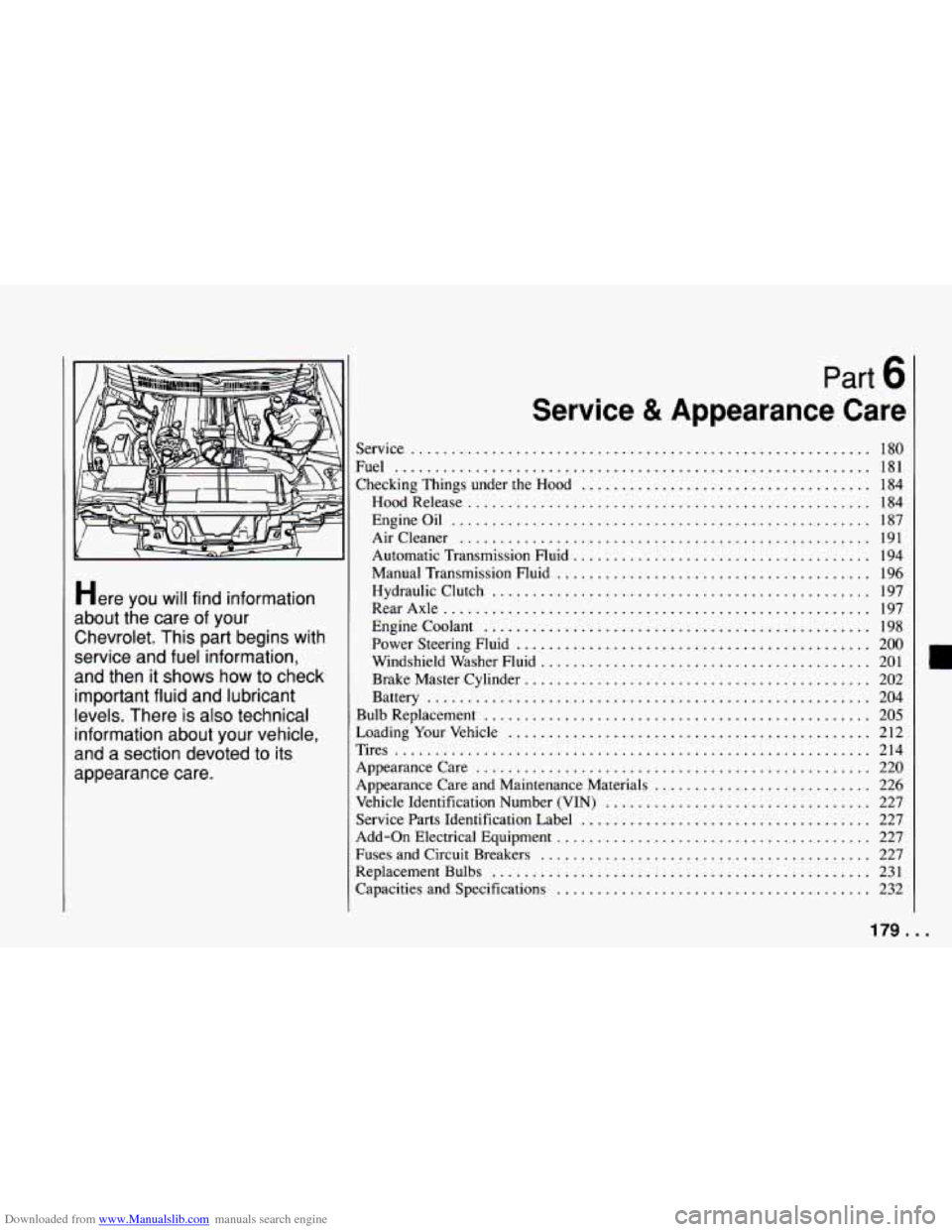
Downloaded from www.Manualslib.com manuals search engine Here you will find information
about the care of your
Chevrolet
. This part begins with
service and fuel information.
and then
it shows how to check
important fluid and lubricant
levels
. There is also technical
information about your vehicle.
and a section devoted to its
appearance care
.
Part 0
Service & Appearance Care
Service .........................................................
Fuel ...........................................................
Checking Things under the Hood ....................................
HoodRelease ..................................................
EngineOil ....................................................
Aircleaner ...................................................
Automatic Transmission Fluid .....................................
Manual Transmission Fluid .......................................
Hydraulic Clutch ...............................................
RearAxle .....................................................
Enginecoolant ................................................
Power Steering Fluid ............................................
Windshield Washer Fluid .........................................
Brake Master Cylinder ...........................................
Battery .......................................................
Bulb Replacement ................................................
LoadingYourVehicle .............................................
Tires ...........................................................
Appearancecare .................................................
Appearance Care and Maintenance Materials ...........................
Vehicle Identification Number (VIN) .................................
Service Parts Identification Label ....................................
Add-on Electrical Equipment .......................................
Fuses and Circuit Breakers .........................................
Replacement Bulbs ...............................................
Capacities and Specifications .......................................
180
181
184
184
187 191
194
196
197
197
198
200
201
202
204
205
212
214
220
226
227
227
227
227
231
232
179 ...
Page 187 of 292
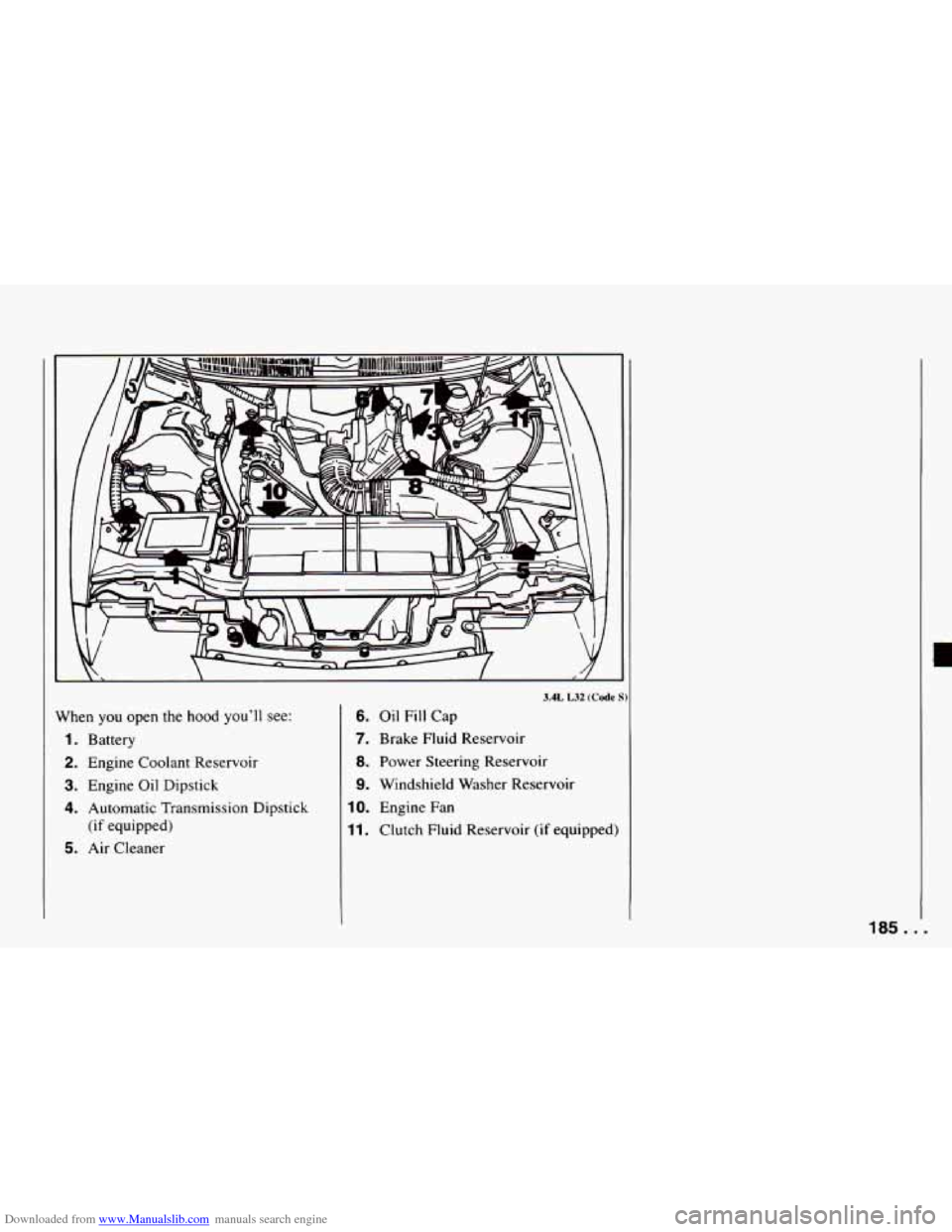
Downloaded from www.Manualslib.com manuals search engine When you open the hood you'll see:
1. Battery
2. Engine Coolant Reservoir
3. Engine Oil Dipstick
4. Automatic Transmission Dipstick
5. Air Cleaner (if equipped)
3.4L L32 (Code S
6. Oil Fill Cap
7. Brake Fluid Reservoir
8. Power Steering Reservoir
9. Windshield Washer Reservoir
10. Engine Fan
11. Clutch Fluid Reservoir (if equipped)
L
185 ...
Page 188 of 292
Downloaded from www.Manualslib.com manuals search engine Service and Appearance Care
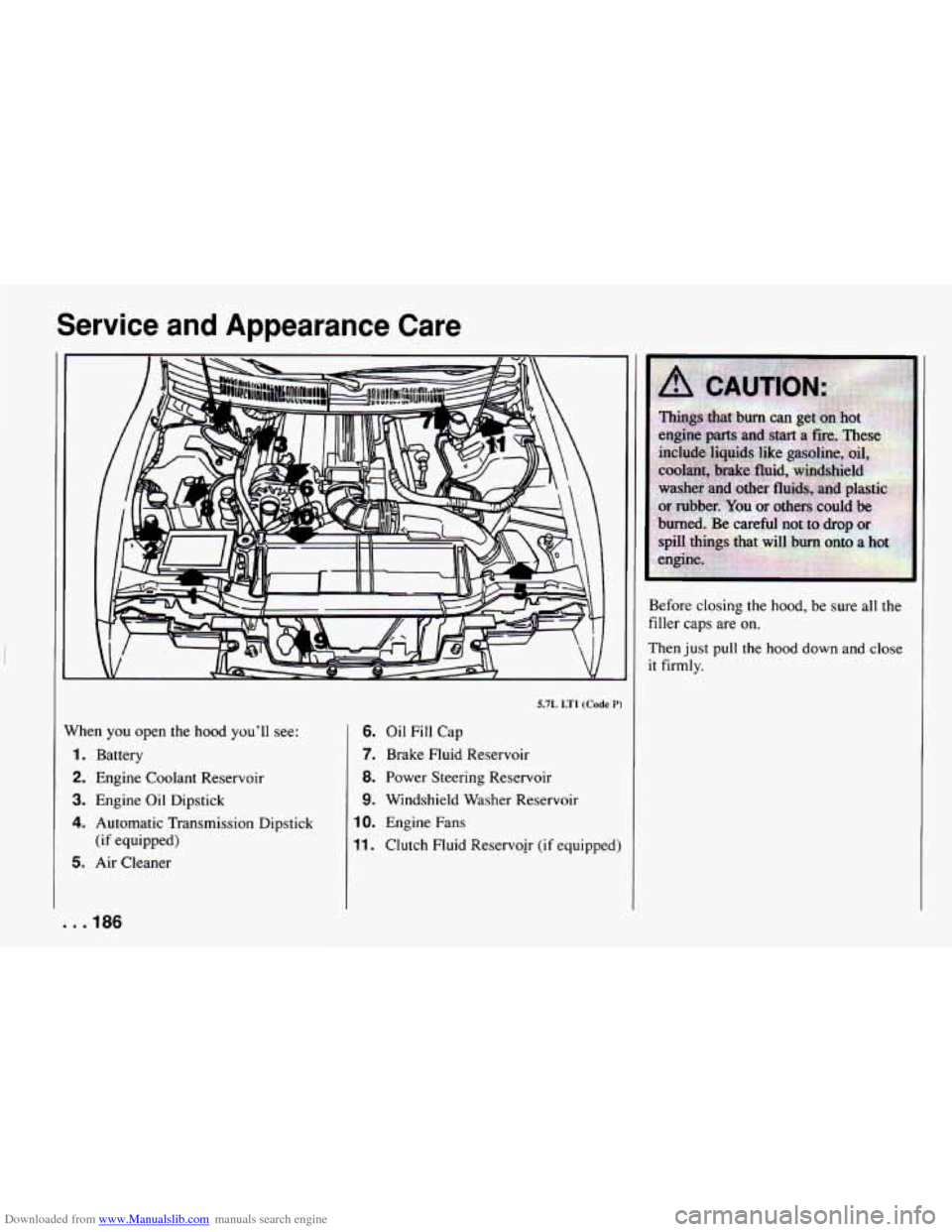
5.7L LT1 (Code P)
Vhen you open the hood you’ll see:
1. Battery
2. Engine Coolant Reservoir
3. Engine Oil Dipstick
4. Automatic Transmission Dipstick
5. Air Cleaner
(if equipped)
6. Oil Fill Cap
7. Brake Fluid Reservoir
8. Power Steering Reservoir
9. Windshield Washer Reservoir
10. Engine Fans
11. Clutch Fluid Reservoir (if equipped) Before
closing the hood, be sure all the
filler
caps are on.
Then just pull the hood down and close
it firmly.
. . .186
Page 206 of 292
Downloaded from www.Manualslib.com manuals search engine Service and Appevmance Care
If you have rear drum brakes, they don’t
have wear indicators, but
if you ever hear
a rear brake rubbing noise, have the rear
brake linings inspected. Also, the rear
brake drums should be removed and
inspected each time the tires are removed
for rotation or changing. When you have
the front brakes replaced, have
the rear
brakes inspected, too.
Brake linings should always be replaced
as complete axle sets.
Brake Pedal Travel
See your dealer if the brake pedal does
not return to normal height, or
if there is a
rapid increase in pedal travel. This could
be a sign of brake trouble.
Brake Adjustment
Every time you make a moderate brake
stop, your disc brakes adjust for wear.
If
you rarely make a moderate or heavier
stop, then your brakes might not adjust
correctly.
If you drive in that way, then -
very carefully - make a few moderate
brake stops about
every 1,000 miles
(I 600 km), so your brakes will adjust
properly.
. . .204
If your brake pedal goes down farther
than normal, your rear drum brakes may
need adjustment. Adjust them by backing
up and firmly applying the brakes
a few
times.
Replacing Brake System Parts
The braking system on a modern vehicle
is complex. Its many parts have to be of
top quality and work well together
if the
vehicle is to have really good braking.
Vehicles we design and test have
top-quality
GM brake parts in them, as
your Chevrolet does when it is new.
When you replace parts of your braking
system
- for example, when your brake
linings wear down and you have to have
new ones put
in - be sure you get new
genuine GM replacement parts. If you
don’t, your brakes may no longer work
properly. For example,
if someone puts in
brake linings that are wrong for your
vehicle, the balance between your front
and rear brakes can change, for
the worse.
The braking performance you’ve come to
expect can change
in many other ways if
someone puts in the wrong replacement
brake parts.
Battery
Every new Chevrolet has a Delco
Freedoms battery.
You never have to add
water to one of these. When it’s time for a
new battery, we recommend a Delco
Freedoma battery. Get one that has the
catalog number shown on the original
battery’s label.
Vehicle Storage
If you’re not going to drivi your vehicle
for
25 days or more, take off the black,
negative
(-) cable from the battery. This
will help keep your battery from running
down.
Page 235 of 292
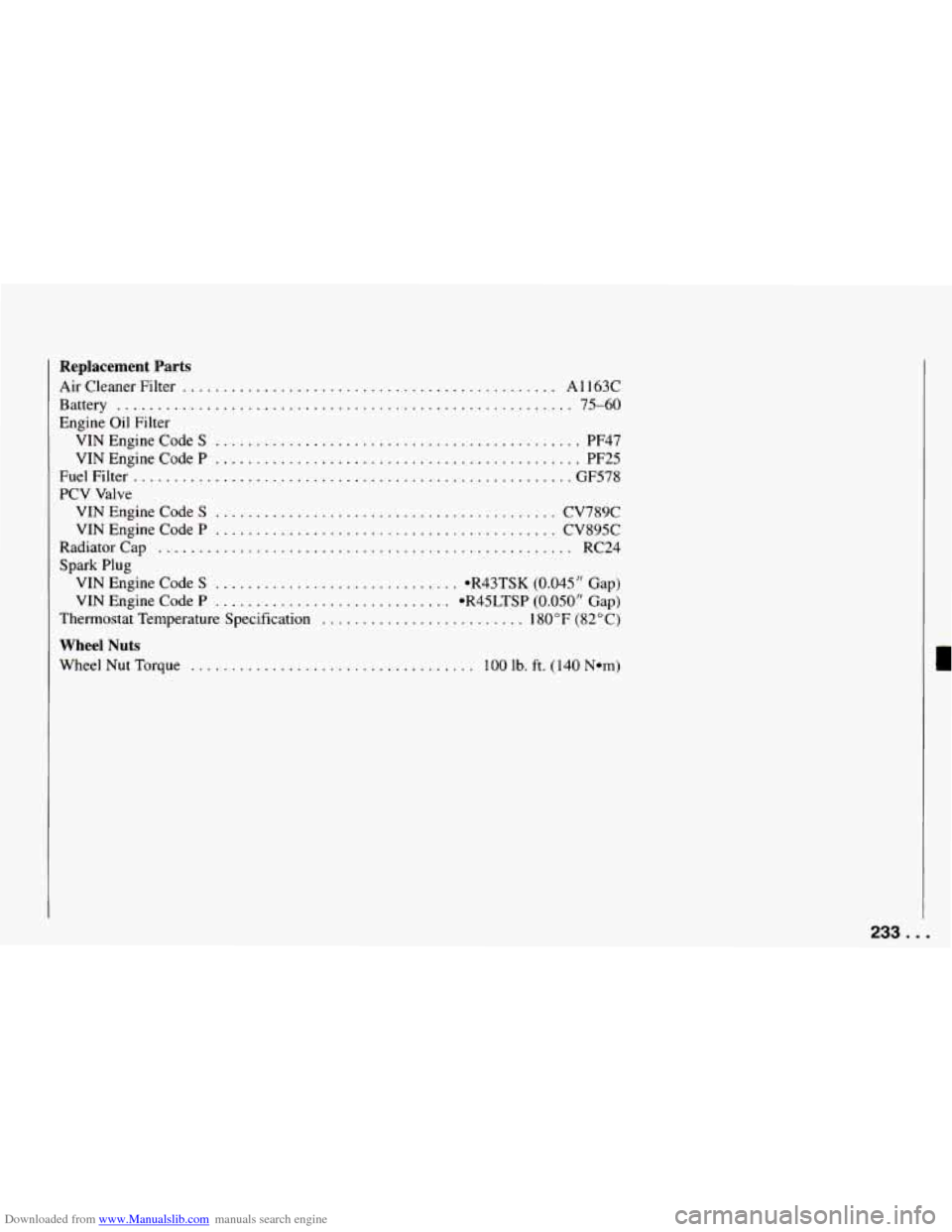
Downloaded from www.Manualslib.com manuals search engine Replacement Parts
AirCleanerFilter .............................................. A1163C
Battery
........................................................ 75-60
Engine Oil Filter
VINEngineCodeS
............................................. PF47
VIN Engine Code
P ............................................. PF25
FuelFilter
...................................................... GF578
PCV Valve VIN Engine Code
S .......................................... CV789C
VIN Engine Code
P .......................................... CV895C
VIN Engine Code S .............................. oR43TSK (0.045" Gap)
VIN Engine Code P
............................. oR45LTSP (0.050" Gap)
Thermostat Temperature Specification
......................... 180" F (82" C)
Wheel
Nut Torque ................................... 100 Ib. ft. (140 Nom)
Radiatorcap ................................................... RC24
Spark Plug
Wheel Nuts
233. ..
Page 269 of 292
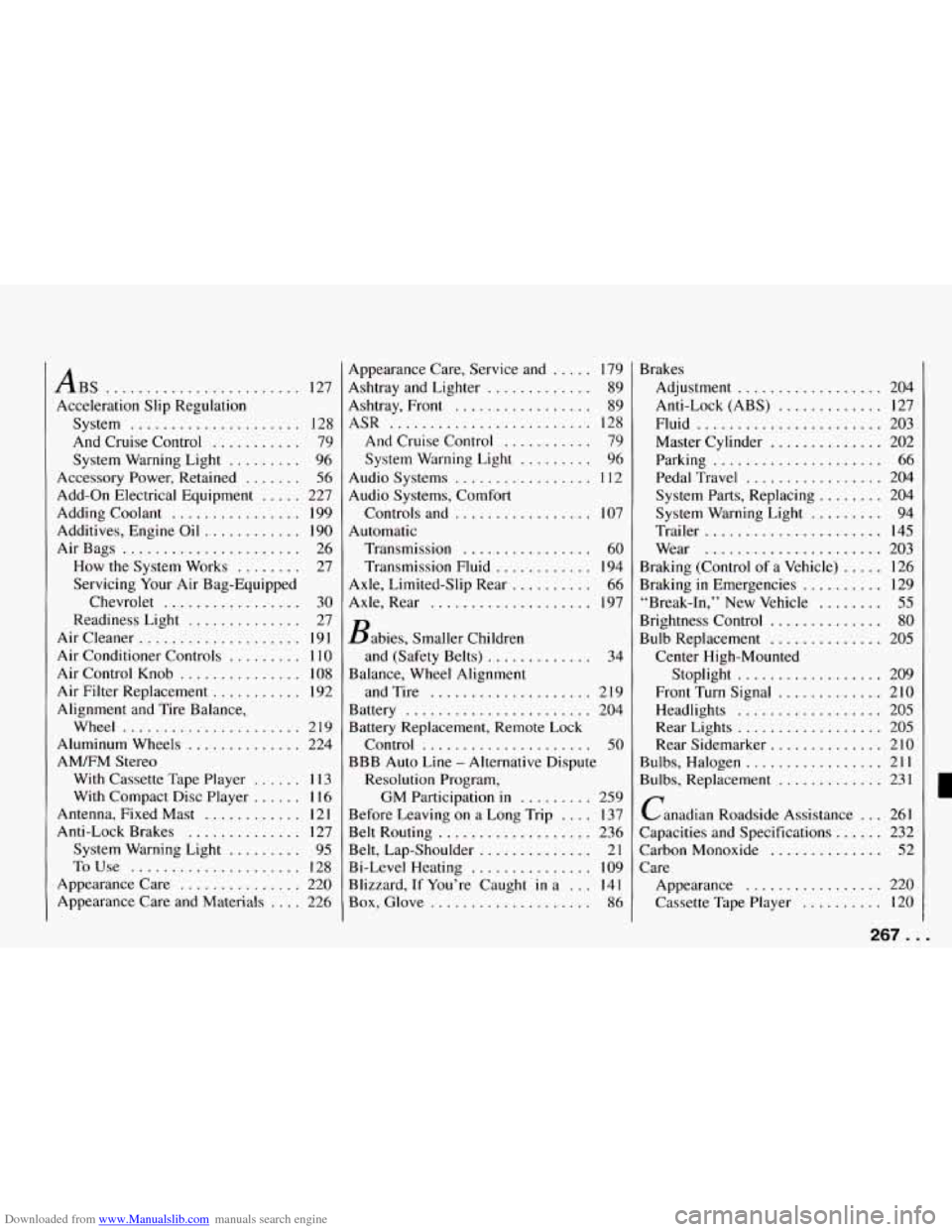
Downloaded from www.Manualslib.com manuals search engine ........................ 127
Acceleration Slip Regulation
System
..................... 128
System Warning Light
......... 96
Accessory Power. Retained
....... 56
Add-on Electrical Equipment
..... 227
And
Cruise Control
........... 79
Adding Coolant
................ 199
Additives. Engine Oil
............ 190
AirBags
...................... 26
How the System Works
........ 27
Servicing Your Air Bag-Equipped
Chevrolet
................. 30
Readiness Light .............. 27
Air Cleaner
.................... 19 I
Air Conditioner Controls ......... 1 10
Air Control Knob
............... 108
Air Filter Replacement ........... 192
Alignment and Tire Balance.
Wheel
...................... 219
Aluminum Wheels
.............. 224
AMFM Stereo
With Cassette Tape Player
...... I13
With Compact Disc Player ...... 116
Antenna. Fixed Mast
............ 121
Anti-Lock Brakes
.............. 127
System Warning Light
......... 95
To Use
..................... 128
Appearance Care
............... 220
Appearance Care and Materials
.... 226 Appearance Care.
Service and
..... 179
Ashtray and Lighter
............. 89
Ashtray. Front
................. 89
ASR ......................... 128
And Cruise Control
........... 79
System Warning Light ......... 96
Audio Systems ................. I 12
Audio Systems. Comfort Controls and
................. 107
Automatic
Transmission
................ 60
Transmission Fluid
............ I94
Axle. Limited-Slip Rear
.......... 66
Axle. Rear
.................... 197
Babies. Smaller Children
and (Safety Belts)
............. 34
Balance. Wheel Alignment
and Tire
.................... 219
Battery
....................... 204
Battery Replacement. Remote Lock
Control
..................... 50
BBB Auto Line - Alternative Dispute
Resolution Program. GM Participation
in ......... 259
Before Leaving
on a Long Trip .... 137
Belt Routing
................... 236
Belt. Lap-Shoulder
.............. 2 1
Bi-Level Heating ............... I09
Blizzard.
If You’re Caught in a ... 141
Box. Glove .................... 86 Brakes
Adjustment
.................. 204
Anti-Lock (ABS)
............. 127
Fluid ....................... 203
Master Cylinder
.............. 202
Parking
..................... 66
Pedal Travel
................. 204
System Parts. Replacing
........ 204
System Warning Light
......... 94
Trailer
...................... 145
Wear
...................... 203
Braking (Control of
a Vehicle) ..... 126
Braking
in Emergencies .......... 129
“Break.111.
.. New Vehicle ........ 55
Brightness Control .............. 80
Bulb Replacement
.............. 205
Center High-Mounted
Stoplight
.................. 209
Front Turn Signal
............. 210
Headlights
.................. 205
Rear Lights
.................. 205
Rear Sidemarker .............. 2 IO
Bulbs. Halogen ................. 211
Bulbs. Replacement
............. 231
Canadian Roadside Assistance
... 261
Capacities and Specifications
...... 232
Carbon Monoxide
.............. 52
Care Appearance
................. 220
Cassette Tape Player
.......... 120