maintenance CHEVROLET CAMARO 1994 4.G Owners Manual
[x] Cancel search | Manufacturer: CHEVROLET, Model Year: 1994, Model line: CAMARO, Model: CHEVROLET CAMARO 1994 4.GPages: 292, PDF Size: 15.35 MB
Page 3 of 292
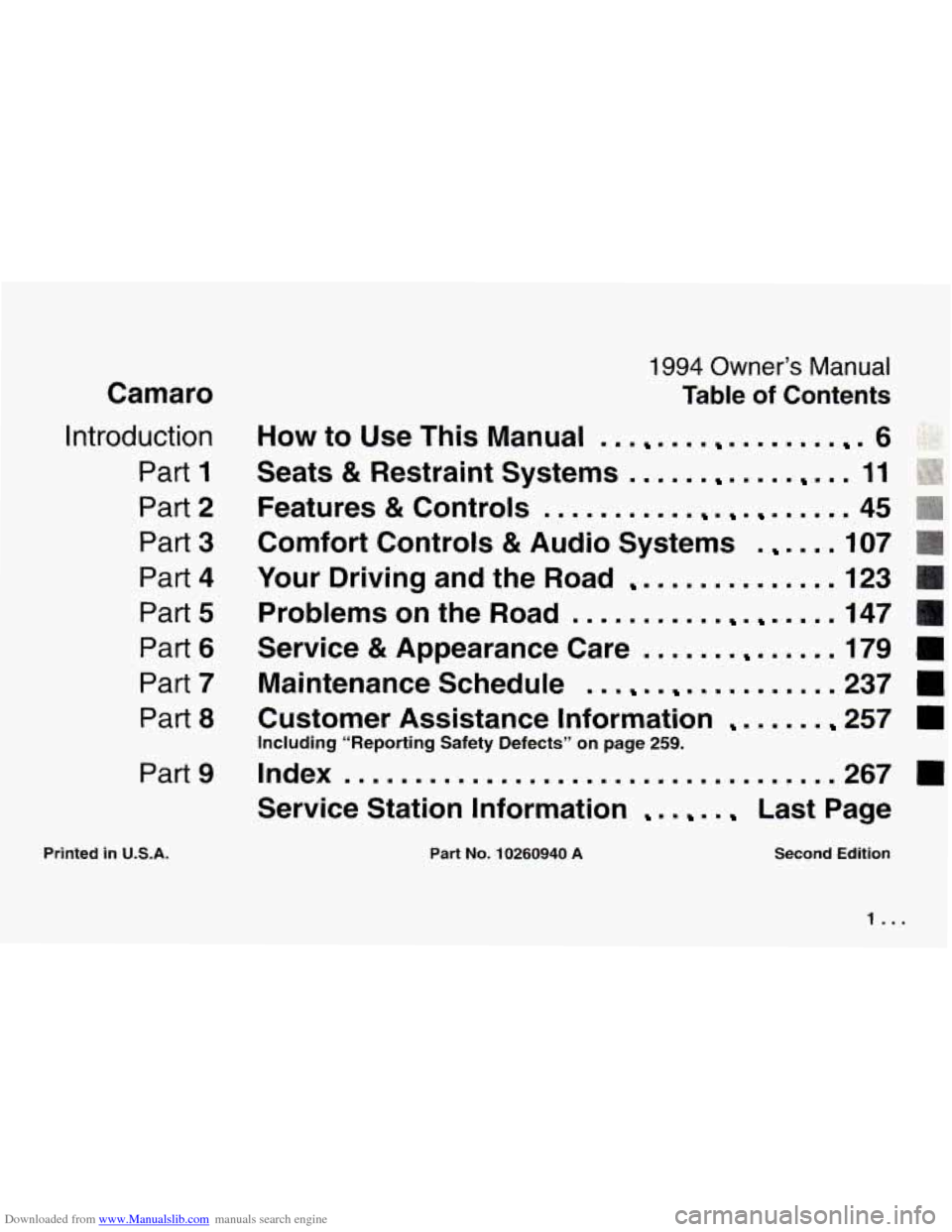
Downloaded from www.Manualslib.com manuals search engine Camaro
introduction Part
1
Part 2
Part 3
Part 4
Part 5
Part 6
Part 7
Part 8
Part 9
1994 Owner’s Manual
Table of Contents
HOW to Use This Manual 6
Seats 81 Restraint Systems 11
Features & Controls 45
Comfort Controls & Audio Systems = 107
Your Driving and the
Road 123
Problems on the Road
147
Service
& Appearance Care 179
Maintenance Schedule
m = = 237
Customer Assistance Information 257
Including “Reporting Safety Defects” on page 259.
Index mm...=..=.....mmm.=.m===m=m======== 267
Service Station Information Last Page
Printed in U.S.A. Part No. 10260940 A Second Edition
1 ...
Page 8 of 292
Downloaded from www.Manualslib.com manuals search engine How to Use This Manual
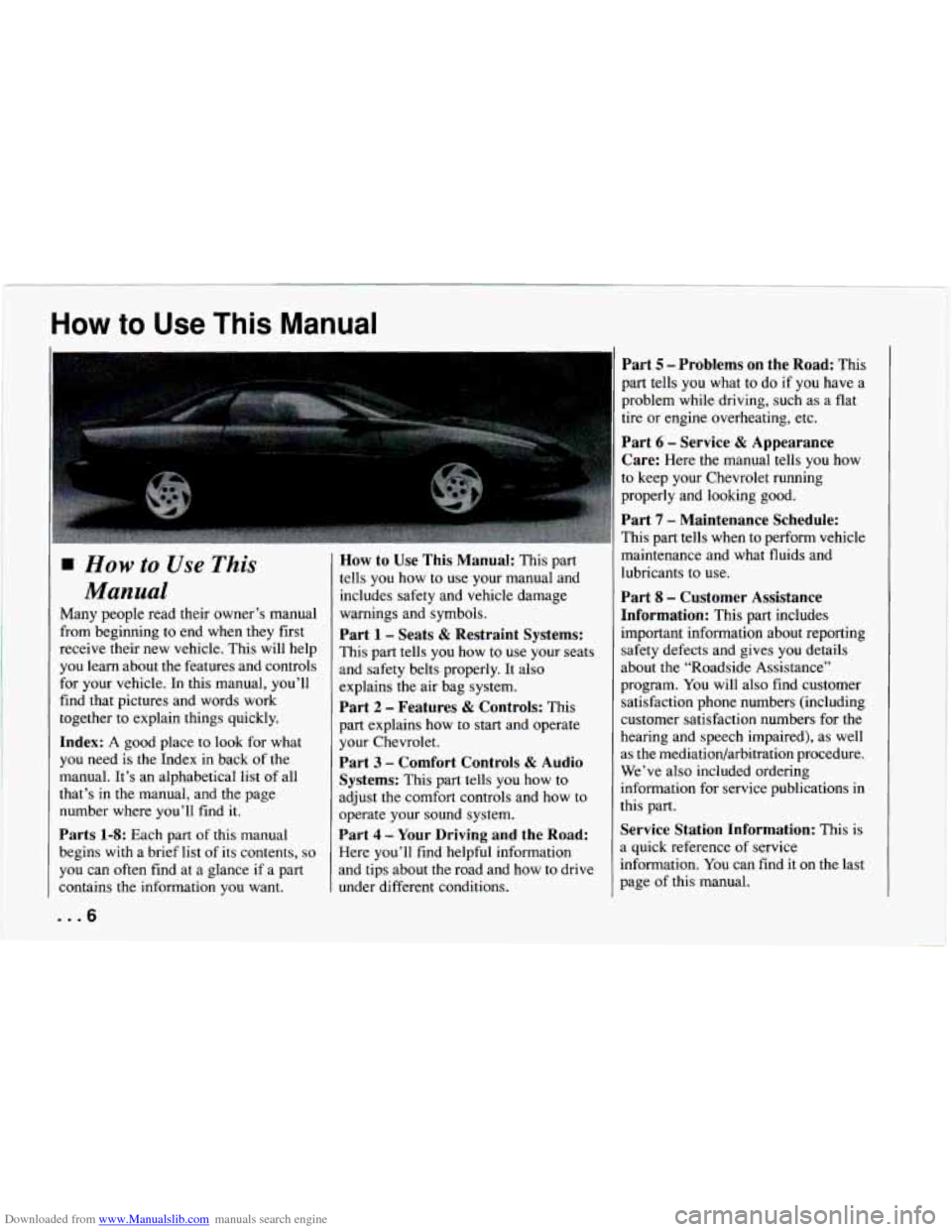
How to Use This
Manual
Many people read their owner’s manual
from beginning to end when they first
receive their new vehicle. This will help
you learn about the features and controls
for your vehicle. In this manual, you’ll
find that pictures and words work
together to explain things quickly.
Index: A good place to look for what
you need is the Index
in back of the
manual. It’s an alphabetical list of all
that’s in the manual, and the page
number where you’ll find
it.
Parts 1-8: Each part of this manual
begins with a brief list of its contents,
so
you can often find at a glance if a part
contains the information you want.
... 6
How to Use This Manual: This part
tells you how to use your manual and
includes safety and vehicle damage
warnings and symbols.
Part 1 - Seats & Restraint Systems:
This part tells you how to use your seats
and safety belts properly.
It also
explains the air bag system.
Part 2 - Features & Controls: This
part explains how to start and operate
your Chevrolet.
Part 3 - Comfort Controls & Audio
Systems:
This part tells you how to
adjust the comfort controls and how to
operate your sound system.
Part 4 - Your Driving and the Road:
Here you’ll find helpful information
and tips about the road and how to drive
under different conditions.
Part 5 - Problems on the Road: This
part tells
you what to do if you have a
problem while driving, such as a flat
tire or engine overheating, etc.
Part 6 - Service & Appearance
Care:
Here the manual tells you how
to keep your Chevrolet running
properly and looking good.
Part 7 - Maintenance Schedule:
This part tells when to perform vehicle
maintenance and what fluids and
lubricants to use.
Part 8 - Customer Assistance
Information:
This part includes
important information about reporting safety defects and gives you details
about the “Roadside Assistance”
program.
You will also find customer
satisfaction phone numbers (including
customer satisfaction numbers for the
hearing and speech impaired), as well
as the mediatiodarbitration procedure.
We’ve also included ordering
information for service publications
in
this part.
Service Station Information: This is
a quick reference of service
information.
You can find it on the last
page of this manual.
Page 28 of 292
Downloaded from www.Manualslib.com manuals search engine ’ Seats and Restraint Systems
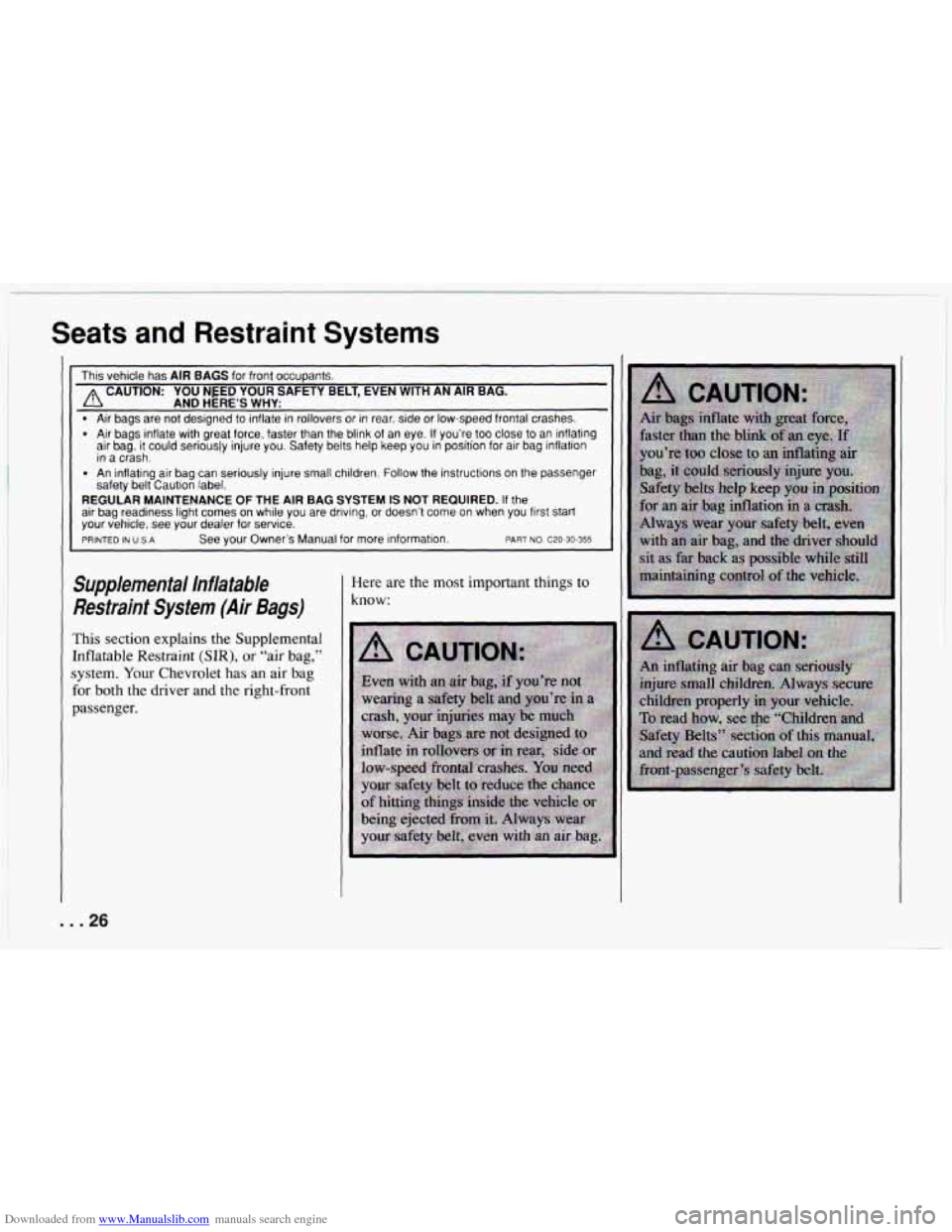
This vehicle has AIR BAGS for front occupants.
A CAUTION: YOU NEED YOUR SAFETY BELT, EVEN WITH AN AIR BAG.
AND HERE’S WHY:
Air bags are not designed to inflate in rollovers or in rear, side or low-speed frontal crashes.
Air bags inflate with great force, faster than the blink of an eye.
If you’re too close to an inflating
air bag, it could seriously injure you. Safety belts help keep\
you in position for air bag inflation
in a crash.
. An inflating air bag can seriously injure small children. Follow t\
he instructions on the passenger
safety belt Caution label.
REGULAR MAINTENANCE OF THE AIR BAG SYSTEM IS NOT REQUIRED. If the
air bag readiness light comes on while you are driving, or doesn’t come on when you first start
your vehicle, see your dealer for service.
PRINTED IN U.5.A See your Owner’s Manual for more information. PART NO. C20-30-355
Supplemental lnfhtable
Restraint System (Air Bags)
This section explains the Supplemental
Inflatable Restraint
(SIR), or “air bag,”
system.
Your Chevrolet has an air bag
for both the driver
and the right-front
passenger. Here
are the most important things to
know:
... 26
Page 32 of 292
Downloaded from www.Manualslib.com manuals search engine Seats and Restraint Systems
Is the smoke from an air bag inflation
harmful?
The particles emitted during air bag
inflation are not harmful to most people.
Some people with respiratory ailments
may experience difficulty breathing if
they stay in the vehicle with the windows
closed after air bag inflation.
So, if your
air bag inflates, you
and any passengers
should exit the vehicle if and when it is
safe to do
so. If you or your passengers
can’t get out
of the vehicle, try to get
fresh air by opening
a window, turning on
the fan, or opening a door.
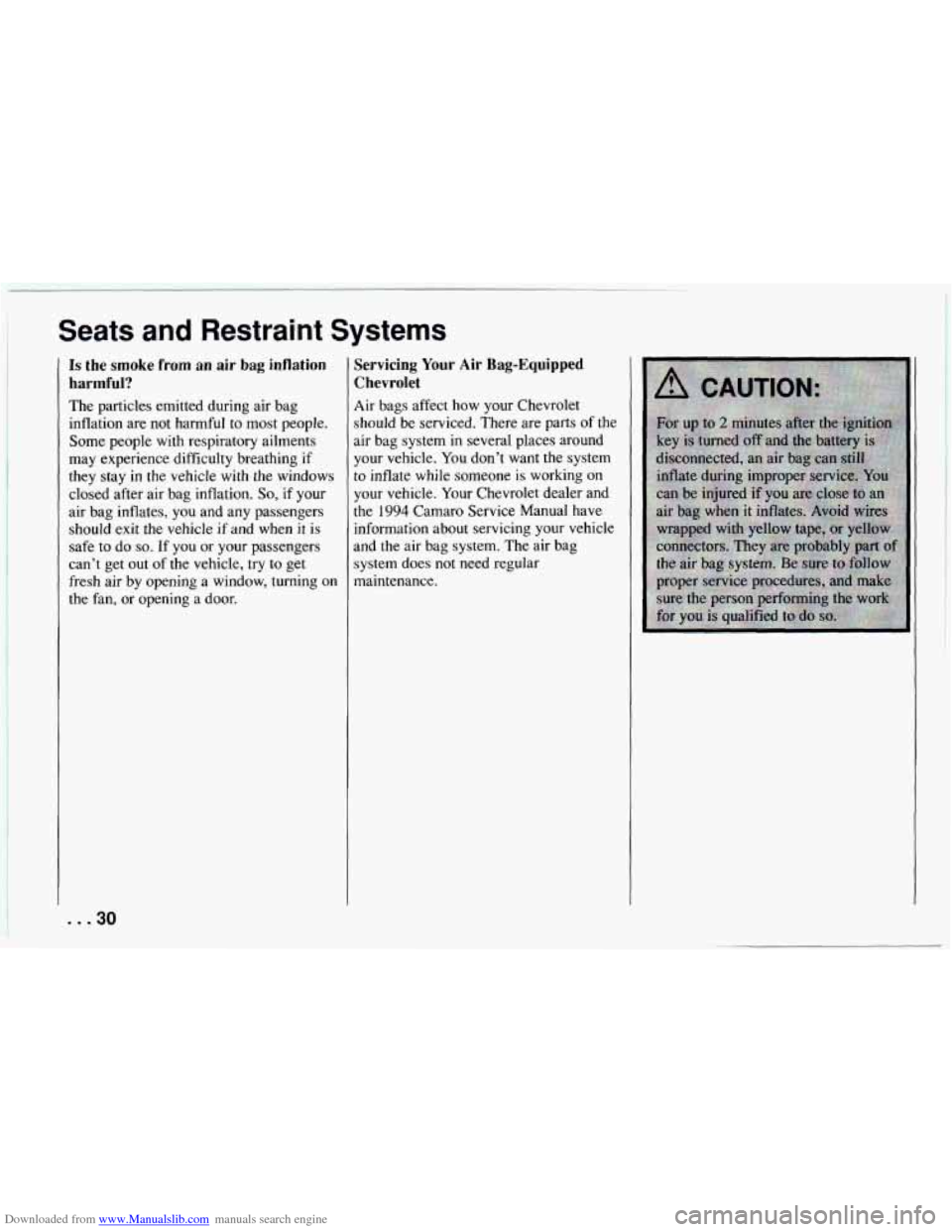
Servicing Your Air Bag-Equipped
Chevrolet
Air bags affect how your Chevrolet
should be serviced. There are parts of the
air bag system in several places around
your vehicle. You don’t want the system
to inflate while someone is working on
your vehicle. Your Chevrolet dealer and
the
1994 Camaro Service Manual have
information about servicing your vehicle
and the air bag system. The air bag
system does not need regular
maintenance.
... 30
Page 148 of 292
Downloaded from www.Manualslib.com manuals search engine Your Driving and the Road
Driving on Grades
Reduce speed and shift to a lower gear
before you start down a long or steep
downgrade. If you don’t shift down, you
might have to use your brakes
so much
that they would get hot and no longer
work well.
On a long uphill grade, shift down and
reduce your speed to around
45 mph
(70 kmh) to reduce the possibility of
engine and transmission overheating.
If you are towing a trailer and you
have an automatic transmission with
Overdrive, you may prefer to drive
in “D’
instead of Overdrive (or, as you need to,
a lower gear). Or,
if you have a manual
transmission with fifth (or sixth) gear
and you are towing a trailer, it’s better
not to use fifth (or sixth) gear. Just drive
in fourth gear (fifth gear if you have a
six-speed manual transmission) (or, as you
need to, a lower gear).
Parking on Hills
You really should not park your vehicle,
with a trailer attached, on a
hill. If
something goes wrong, your rig could
start to move. People can be injured, and both your vehicle and the trailer can be
damaged.
But if you
ever have to park your
rig on a
hill, here’s how to do it:
1. Apply your regular brakes, but don’t
shift into
“P’ (Park) yet, or into gear
for a manual transmission.
2. Have someone place chocks under the
3. When the wheel chocks are in place,
release the regular brakes until the
chocks absorb the load.
trailer wheels.
4. Reapply the
regular brakes. Then
apply your parking brake, and then
shift to
“P” (Park), or “R” (Reverse)
for a manual transmission.
5. Release the regular brakes.
When You Are Ready to Leave after
Parking on a Hill
1. Apply your regular brakes and hold
the pedal down while you:
Start your engine;
0 Shift into a gear; and
Release the parking brake.
2. Let up on the brake pedal.
3. Drive slowly until the trailer is clear
4. Stop ahd have someone pick up and
of the
chocks.
store the chocks.
Maintenance When Trailer Towing
Your vehicle will need service more often
when you’re pulling a trailer. See the
Maintenance Schedule for more on this.
Things that are especially important in
trailer operation are automatic
transmission fluid (don’t overfill), engine
oil, axle lubricant, belts, cooling system,
and brake adjustment. Each of these is
covered in this manual, and
the Index will
help you find them quickly. If you’re
trailering, it’s a good idea to review these
sections before you start your
trip.
Check periodically to see that all hitch
nuts and bolts are tight.
. . ,146
Page 181 of 292
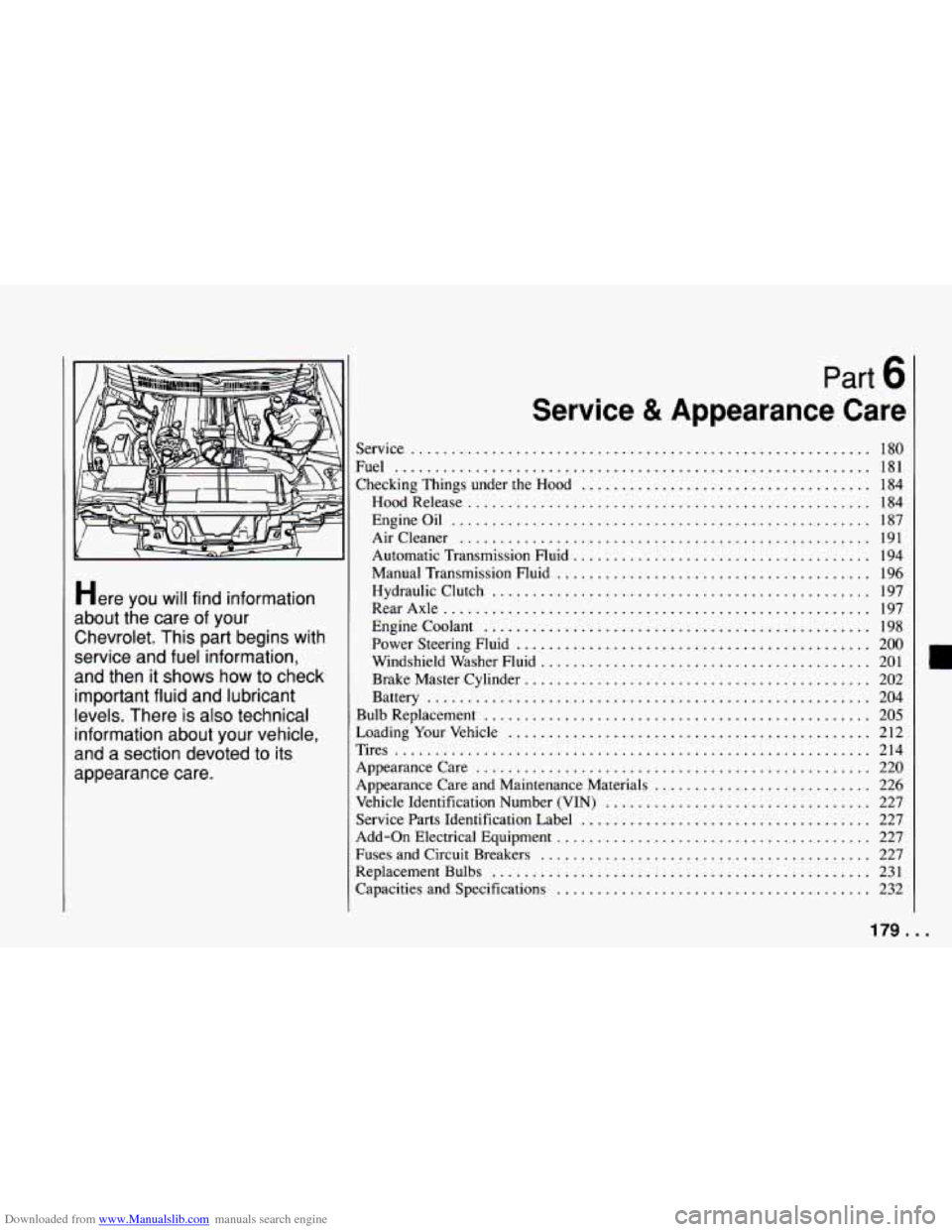
Downloaded from www.Manualslib.com manuals search engine Here you will find information
about the care of your
Chevrolet
. This part begins with
service and fuel information.
and then
it shows how to check
important fluid and lubricant
levels
. There is also technical
information about your vehicle.
and a section devoted to its
appearance care
.
Part 0
Service & Appearance Care
Service .........................................................
Fuel ...........................................................
Checking Things under the Hood ....................................
HoodRelease ..................................................
EngineOil ....................................................
Aircleaner ...................................................
Automatic Transmission Fluid .....................................
Manual Transmission Fluid .......................................
Hydraulic Clutch ...............................................
RearAxle .....................................................
Enginecoolant ................................................
Power Steering Fluid ............................................
Windshield Washer Fluid .........................................
Brake Master Cylinder ...........................................
Battery .......................................................
Bulb Replacement ................................................
LoadingYourVehicle .............................................
Tires ...........................................................
Appearancecare .................................................
Appearance Care and Maintenance Materials ...........................
Vehicle Identification Number (VIN) .................................
Service Parts Identification Label ....................................
Add-on Electrical Equipment .......................................
Fuses and Circuit Breakers .........................................
Replacement Bulbs ...............................................
Capacities and Specifications .......................................
180
181
184
184
187 191
194
196
197
197
198
200
201
202
204
205
212
214
220
226
227
227
227
227
231
232
179 ...
Page 182 of 292
Downloaded from www.Manualslib.com manuals search engine Service and Appearance Care
AC1 GM -
Service
Your Chevrolet dealer knows your vehicll
best and wants you to be happy with it.
We hope you’ll
go to your dealer for all
your service needs. You’ll get genuine
GM parts and GM-trained and supported
service people.
We hope you’ll want to keep your
GM
vehicle all GM. Genuine GM parts have
one of these marks.
Doing Your Own Service Work
If you want to do some of your own
service work, you’ll want to get
the
proper Chevrolet Service Manual. It tells
you much more about how to service your
Chevrolet than this manual can.
To order
the proper service manual, see “Service
Publications” in the Index.
Your vehicle has an air bag system.
Before attempting to do your own service
work, see “Servicing Your Air Bag
-
Equipped Chevrolet” in the Index.
You should keep a record with all parts
receipts and list
the mileage and the date
of any service work you perform. See
“Maintenance Record” in the Index.
. . .I80
Page 193 of 292
Downloaded from www.Manualslib.com manuals search engine When to Change Engine Oil:
See if any one of these is true for you:
0 Most trips are less than 4 miles
(6 km).
It’s below freezing outside and most
trips are less than
10 miles (1 6 km).
The engine is at low speed most of the
time (as in door-to-door delivery, or
in
stop-and-go traffic).
0 You tow a trailer often.
@ Most trips are through dusty places.
If any one
of these is true for your
vehiclej
then you need to change your oil
and filter every 3,000 miles (5 000 km) or
3 months - whichever comes first.
If none of them is true, change the oil
every
7,500 miles (12 500 km) or 12
months - whichever comes first. Change
the filter at the first oil change and at
every other oil change after that.
Engine Coolant Heater (Engine Block
Heater):
An engine coolant heater can be a big
help
if you have to park outside in very
cold weather,
0” F (- 18 “C) or colder. If
your vehicle has this option, see “Engine
Coolant Heater”
in the Index.
What to Do with Used Oil:
Did you know that used engine oil
contains elements that may be unhealthy
for your skin and could even cause
cancer? Don’t let used oil stay on your
skin for very long. Clean your skin and
nails with soap and water, or a good hand
cleaner. Wash or properly throw away
clothing or rags containing used engine
oil. (See the manufacturer’s warnings
about the use and disposal
of oil
products.)
Used oil can be a real threat to the
environment. If
you change your own oil,
be sure to drain all free-flowing oil from
the filter before disposal. Don’t ever
dispose of oil by putting it in the trash,
pouring
it on the ground, into sewers, or
into streams
or bodies of water. Instead,
recycle it by taking it to a place that
collects used oil. If you have a problem
properly disposing of your used oil, ask
your dealer, a service station or a local
recycling center for help.
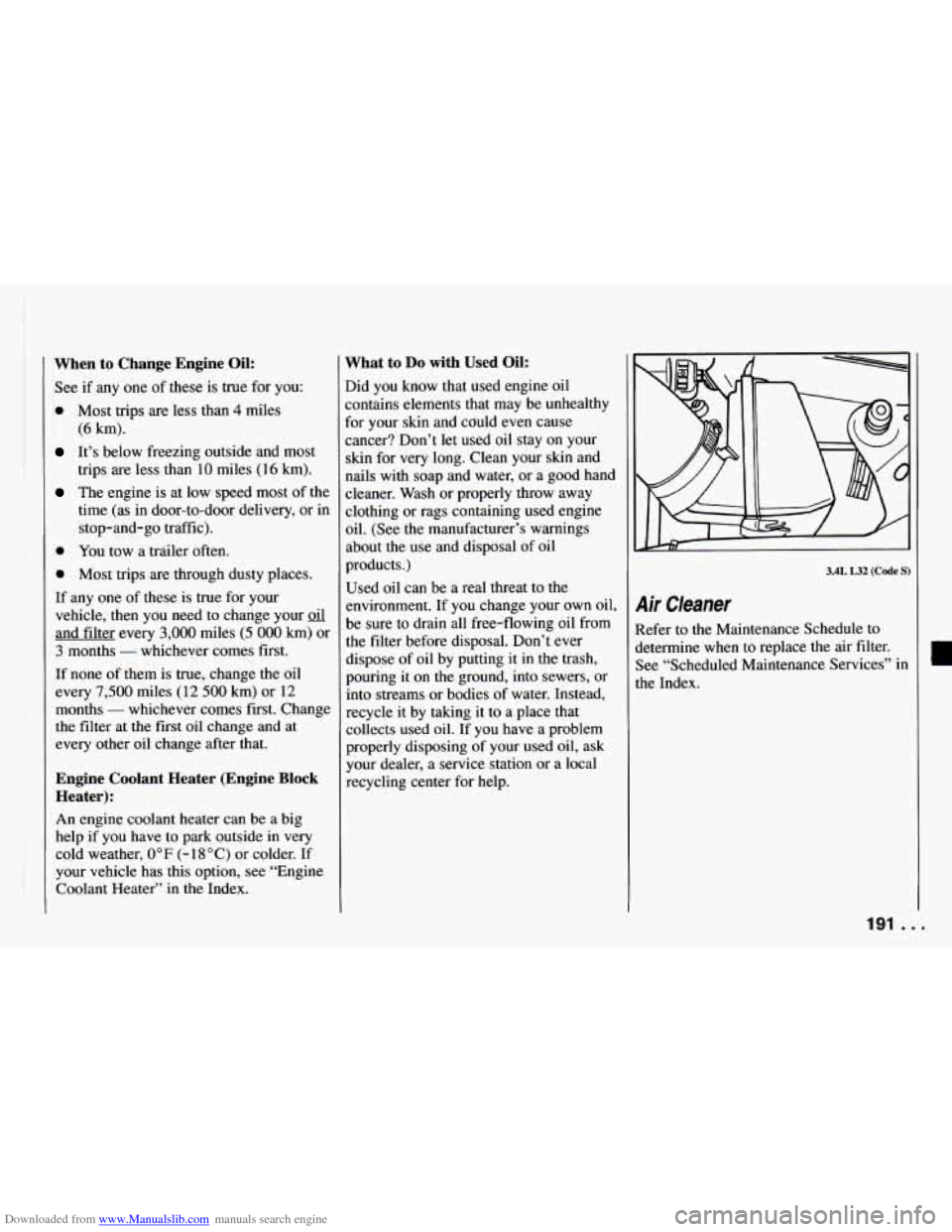
3.4L L32 (Code S
air Cleaner
tefer to the Maintenance Schedule to
letermine when
to replace the air filter.
;ee “Scheduled Maintenance Services” ir
he Index.
191 ...
Page 196 of 292
Downloaded from www.Manualslib.com manuals search engine Service and Appearance Care
Automatic Transmission FIuid
When to Check and Change:
A good time to check your automatic
transmission fluid level is when the
engine oil is changed. Refer to the
Maintenance Schedule to determine when
to change your fluid. See “Scheduled
Maintenance Services” in the Index.
How to Check:
Because this operation can be a little
difficult, you may choose to have this
done at a Chevrolet dealership Service
Department.
If
you do it yourself, be sure to follow all
the instructions here, or
you could get a
false reading on the dipstick.
NOTICE:
Too much or too little fluid can dam-
age your transmission.
Too much can
mean that some of the fluid could
come out and fall on hot engine parts
or exhaust system, starting a fire. Be
sure to get an accurate reading if you
check your transmission fluid.
. . ,194
Wait at least 30 minutes before checking
the transmission fluid level
if you have
been driving:
When outside temperatures are above
90°F (32°C).
0 At high speed for quite a while.
0 In heavy traffic - especially in hot
weather.
While pulling a trailer.
To get the right reading, the fluid should
be at normal operating temperature,
which is 180°F to
200°F (82°C to 93°C).
To check transmission fluid hot: Get
the vehicle warmed up
by driving
about
15 miles (24 km) when outside
temperatures are above 50°F (10°C). If
it’s colder than
50°F (lO”C), drive the
vehicle
in “D” (Third Gear) until the
engine temperature gage moves and then
remains steady for ten minutes. Then
follow the hot check procedures.
To check transmission fluid cold: A cold
check is made after the vehicle has been
sitting for eight hours or more with the
engine off and is used only as a reference.
Let the engine run at idle for five minutes
if outside temperatures are 50°F
( 10°C)
or more. If it’s colder than 50°F (lO”C),
you may have to idle the engine longer. Should the fluid level
be
low during a
cold check, you must perform a hot check
before adding fluid This will give you a
more accurate reading
of the fluid level.
To check the fluid hot or cold:
Park your vehicle on a level place.
With the parking brake applied, place
With your foot on the brake pedal,
the shift lever
in
“P’ (Park).
move the shift lever through each gear
range, pausing for about three seconds in each range. Then, position the shift
lever in
“F’” (Park).
minutes or more.
Let the engine run at idle for three
Page 197 of 292
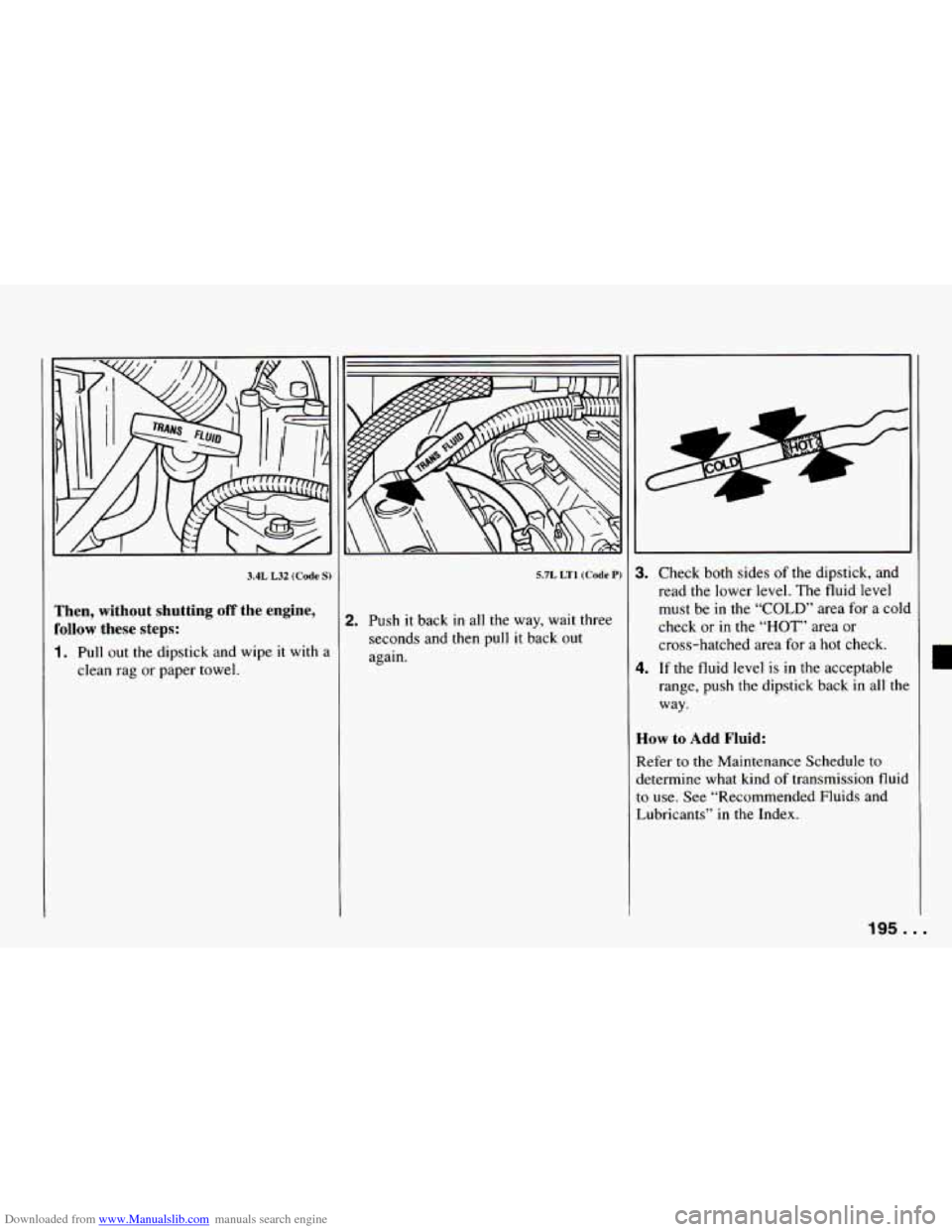
Downloaded from www.Manualslib.com manuals search engine 3.4L L32 (Code S)
Then, without shutting off the engine,
follow these
steps:
1. Pull out the dipstick and wipe it with a
clean rag or paper towel.
5.7L LT1 (Code P)
2. Push it back in all the way, wait three
seconds and then pull
it back out
again.
3. Check both sides of the dipstick, and
read the lower level. The fluid level
must be
in the “COLD’ area for a cold
check or
in the “HOT” area or
cross-hatched area for a hot check.
4. If the fluid level is in the acceptable
range, push the dipstick back
in all the
way.
How to Add Fluid:
Refer to the Maintenance Schedule to
determine what kind of transmission fluid
to use. See “Recommended Fluids and
Lubricants” in the Index.
195 ...