ignition CHEVROLET CAMARO 1994 4.G User Guide
[x] Cancel search | Manufacturer: CHEVROLET, Model Year: 1994, Model line: CAMARO, Model: CHEVROLET CAMARO 1994 4.GPages: 292, PDF Size: 15.35 MB
Page 58 of 292
Downloaded from www.Manualslib.com manuals search engine Features and Controls
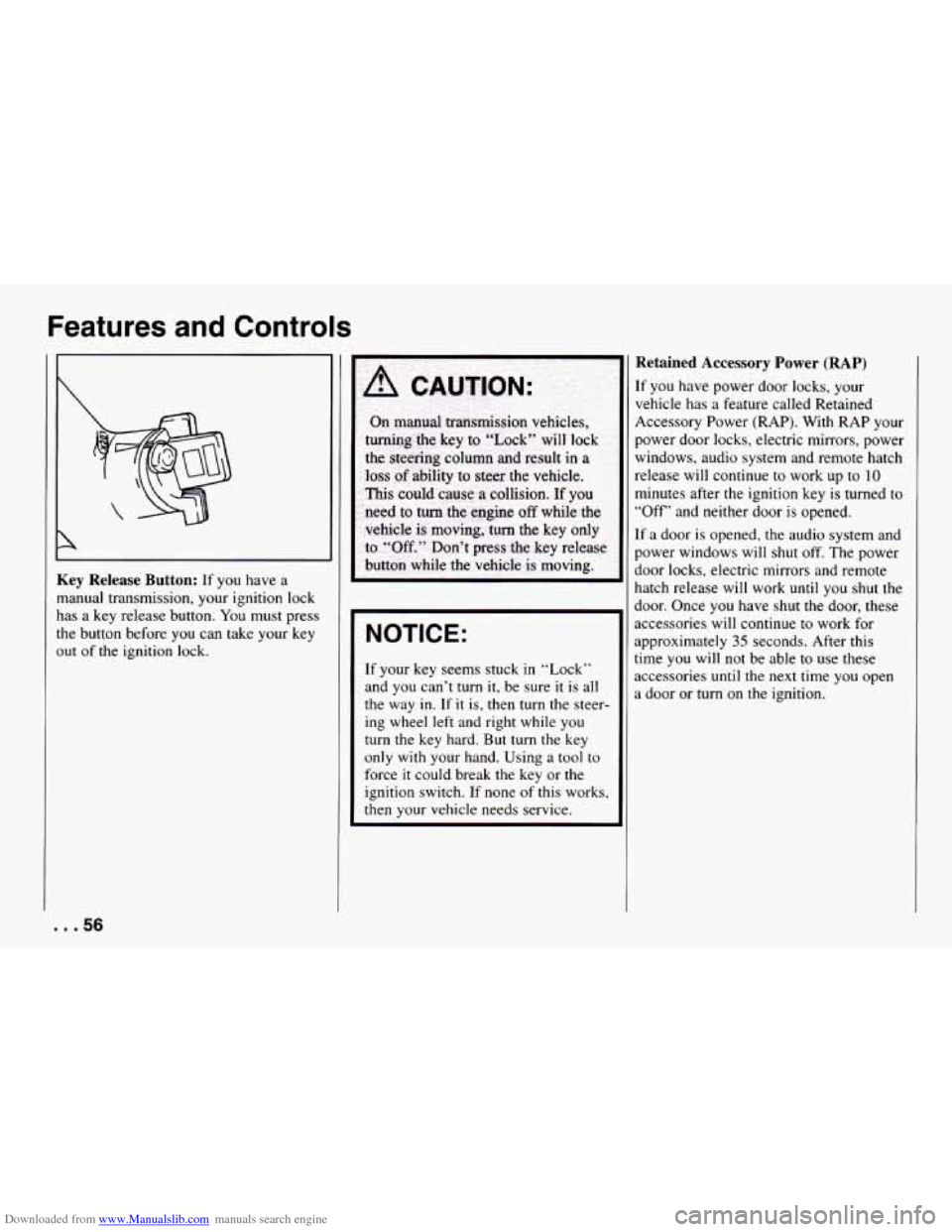
Key Release Button: If you have a
manual transmission, your ignition lock
has a key release button.
You must press
the button before
you can take your key
out
of the ignition lock.
NOTICE:
If your key seems stuck in “Lock”
and you can’t turn
it, be sure it is all
the way in. If it is, then turn the steer-
ing wheel left and right while you
turn the key hard. But turn the key
only with your hand. Using
a tool to
force it could break the key or the
ignition switch. If none
of this works,
then
your vehicle needs service.
Retained Accessory Power (RAP)
If you have power door locks, your
vehicle has a feature called Retained
Accessory Power (RAP). With RAP your
power door locks, electric mirrors, power
windows, audio system and remote hatch
release
will continue to work up to 10
minutes after the ignition key is turned to
“Off’ and neither door
is opened.
If
a door is opened, the audio system and
power windows will shut off. The power
door locks, electric mirrors and remote
hatch release
will work until you shut the
door. Once you have shut the door, these
accessories
will continue to work for
approximately
35 seconds. After this
time you will not be able to use these
accessories until the next time you open
a door or
turn on the ignition.
... 56
Page 59 of 292
Downloaded from www.Manualslib.com manuals search engine Starting Your Engine
Autamatic Transmission: Move your
shift lever to
“P” (Park) or “N’ (Neutral).
Your engine won’t start
in any other
position
- that’s a safety feature. To
restart when you’re already moving,
use
“N’ (Neutral) only.
NOTICE:
Don’t try to shift to “P’ (Park) if your
Chevrolet is moving. If you do, you
could damage
the transmission. Shift
to
“P” (Park) only when your vehicle
is stopped.
Manual Transmission: The gear selector
should be in neutral. Hold the clutch
pedal to the floor and start the engine.
Your vehicle won’t start if
the clutch
pedal is not all the way down
- that’s a
safety feature.
To start your V6 engine:
NOTICE:
Holding your key in “Start” for
longer than
15 seconds at a time will
cause your battery to be drained
much sooner. And the excessive heat
can damage your starter motor.
2. If your engine won’t start (or starts
but then stops),
it could be flooded
with too much gasoline. Try pushing
your accelerator pedal all the way to
the floor and holding
it there as you
hold the key in “Start” for about
three seconds. If the vehicle starts
briefly but then stops again, do the
same thing, but this time keep the
pedal down for five or
six seconds.
This clears the extra gasoline from
the engine.
NOTICE:
Your engine is designed to work with
the electronics
in your vehicle. If you
add electrical parts or accessories,
you could change the way the
fuel
injection system operates. Before
adding electrical equipment, check
with your dealer. If you don’t, your
engine might not perform properly.
If you ever have to have your
vehicle towed, see the part of this
manual that tells how to do
it without
damaging your vehicle. See “Towing
Your Vehicle”
in the Index.
1. Without pushing the accelerator pedal
turn your ignition
key to “Start.”
When
the engine starts, let go of the
key. The idle speed will
go down as
your engine gets warm.
57.
Page 60 of 292
Downloaded from www.Manualslib.com manuals search engine Features and Controls
To start your V8 engine:
1. Without pushing the accelerator
pedal,
turn the ignition key to “Start.”
When the engine starts, let go of the
key. The idle speed will go down as
your engine gets warm.
NOTICE:
Holding your key in “Start” for
longer than
15 seconds at a time will
cause your battery to be drained
much sooner. And
the excessive heat
can damage your starter motor.
2. If it doesn’t start within 10 seconds,
push the accelerator pedal all the
way to the floor, while you hold the
ignition key in “Start.” When the
engine starts,
let go of the key and let
up on the accelerator pedal. Wait
about
15 seconds between each try to
help avoid draining your battery. When starting
your engine
in very cold
weather (below
0°F or -18”C), do this:
1.
2.
With your foot off the accelerator
pedal,
turn the ignition key to “Start”
and hold it there. When the engine
starts, let go of the key. Use the
accelerator pedal to maintain engine
speed, if you have to,
until your
engine has
run for a while.
If your engine still won’t start (or
starts but then stops),
it could be
flooded
with too much gasoline. Try
pushing your accelerator pedal all the
way to the floor and holding
it there
as you hold the key
in “Start” for
about three seconds. If the vehicle
starts briefly but then stops again, do
the same thing, but this time keep the
pedal down for
five or six seconds.
This clears the extra gasoline from
the engine.
NOTICE:
Your engine is designed to work with
the electronics in your vehicle. If you
add electrical parts or accessories,
you could change the way
the fuel
injection system operates. Before
adding electrical equipment, check
with your dealer. If you don’t, your
engine might not perform properly.
If you ever have to have your vehicle
towed, see the
part of this manual
that tells how to do it without damag-
ing your vehicle. See “Towing Your
Vehicle” in the Index.
Driving through Deep
Standing Water
NOTICE:
If you drive too quickly through deep
puddles or standing water, water can
come in through your engine’s air
intake and badly damage your
engine. If
you can’t avoid deep
puddles or standing water, drive
through them very slowly.
... 58
Page 62 of 292
Downloaded from www.Manualslib.com manuals search engine Features and Controls
Automatic Transmission
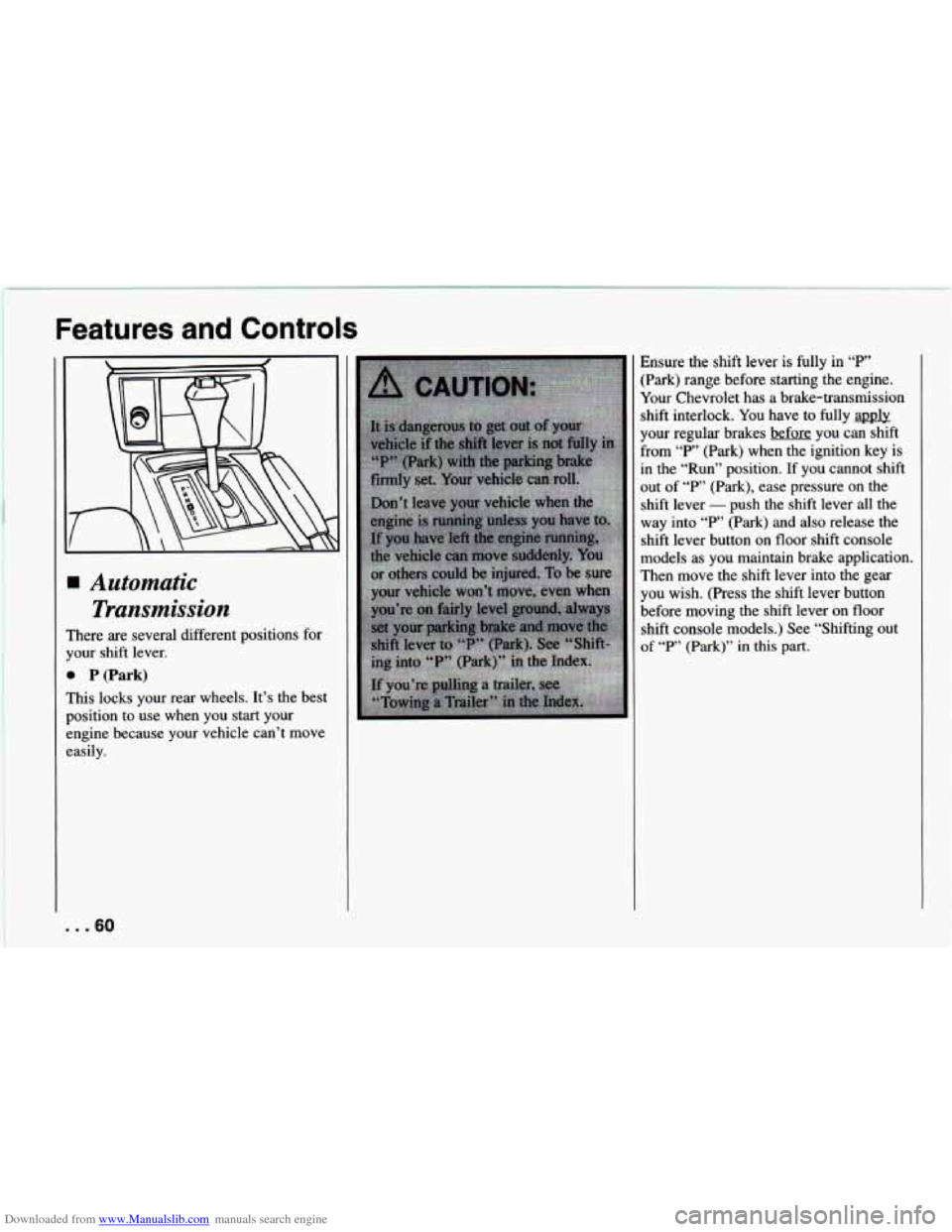
rhere are several different positions for
Tour shift lever.
B P (Park)
rhis locks your rear wheels. It’s the best
losition to use when you start your
:ngine because your vehicle can’t move
:asily. Ensure the shift
lever
is fully in “P’
:Park) range before starting the engine.
Your Chevrolet has a brake-transmission
shift interlock.
You have to fully apuly
your regular brakes before
you can shift
From
“P’ (Park) when the ignition key is
In the “Run” position. If you cannot shift
]ut of
“P’ (Park), ease pressure on the
shift lever
- push the shift lever all the
way into
“P’ (Park) and also release the
shift lever button on floor shift console
models as you maintain brake application.
I‘hen move the shift lever into the gear
you wish. (Press the shift lever button
before moving the shift lever on floor
shift console models.) See “Shifting out
Df “P’ (Park)” in this part.
. ..60
Page 66 of 292
Downloaded from www.Manualslib.com manuals search engine Features and Controls
a
a
0
0
0
2 (Second Gear) - Press the clutch
pedal as you let up on the accelerator
pedal and shift into
“2.” Then, slowly
let up on the clutch pedal as you
press the accelerator pedal.
3,4,5 and 6 (Third, Fourth, Fifth
and Sixth Gears)
- Shift into “3,”
“4,” “5” and “6” the same way you do
for
“2.” Slowly let up on the clutch
pedal
as you press the accelerator
pedal.
To Stop - Let up on the accelerator
pedal and press the brake pedal. Just
before the vehicle stops, press
the
clutch pedal and the brake pedal, and
shift to “Neutral.”
Neutral - Use this position when
you start or idle your engine.
R (Reverse) - To back up, press
down the clutch pedal and shift into
“R.” Let
up on the clutch pedal slowly
while pressing the accelerator pedal.
If you shift from
“6” into “R,” the
shift lever must be first placed in the
“Neutral” position centered between
“2” and “3” prior to shifting into “R.”
Your six-speed manual transmission has a
feature that allows you to safely shift into
“R’ (Reverse) while the vehicle is rolling
(at less than
5 mph). You will be
“locked-out”
if you try to shift into “R’
(Reverse) while your vehicle is moving
faster than
5 mph.
If
you have turned your ignition off and
wish to park your vehicle
in Reverse, you
will have to move the shift lever quickly
to the right, “crashing” through the high
load spring and then into gear.
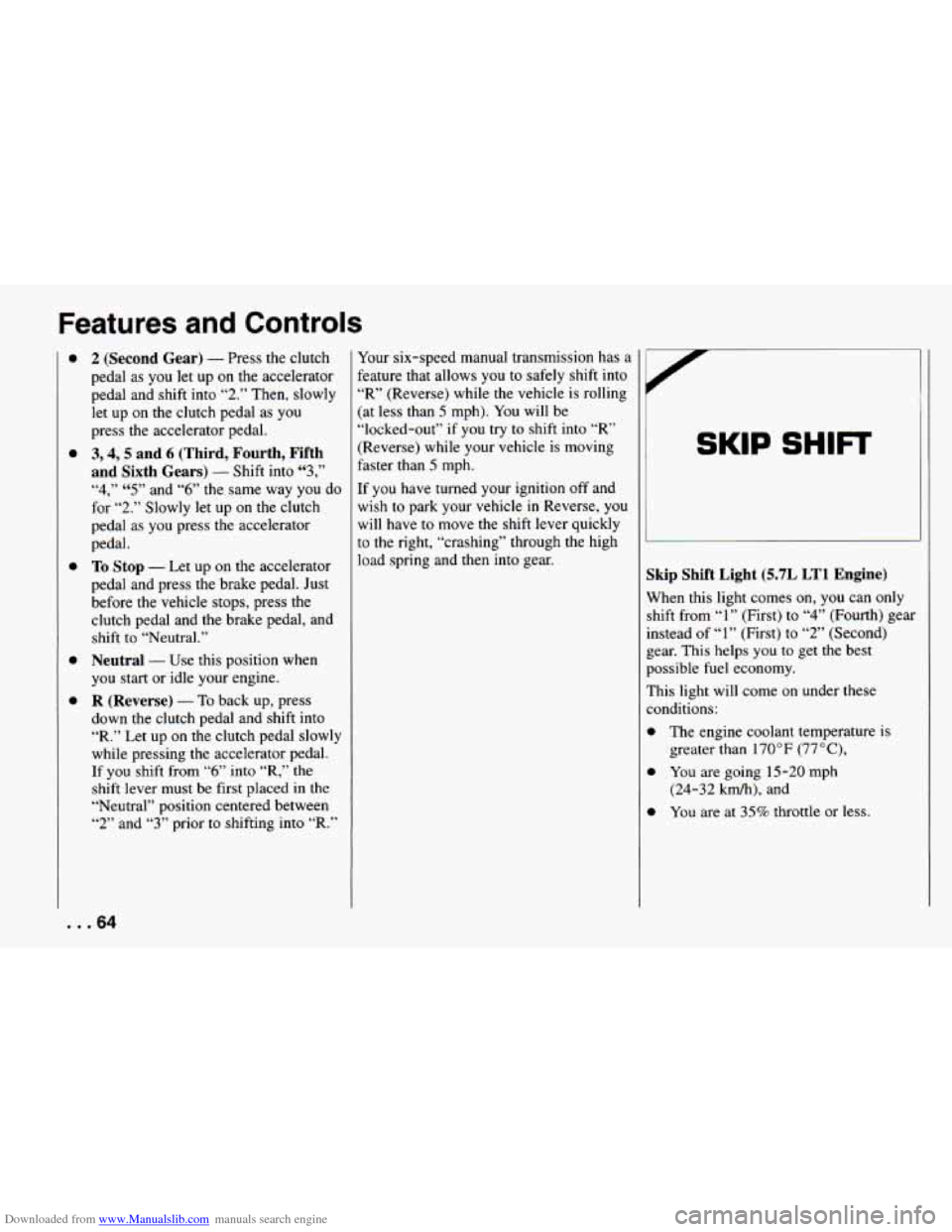
SKIP SHIFT
Skip Shift Light (5.7L LT1 Engine)
When this light comes on, you can only
shift from “1” (First) to
“4” (Fourth) gear
instead of
“1” (First) to “2” (Second)
gear. This helps you
to get the best
possible fuel economy.
This light will come on under these
conditions:
0 The engine coolant temperature is
0 You are going 15-20 mph
0 You are at 35% throttle or less.
greater than
170°F
(77”C),
(24-32 km/h), and
... 64
Page 68 of 292
Downloaded from www.Manualslib.com manuals search engine Features and Controls
I NOTICE:
I
If you skip more than one gear when
you downshift, or if you race the
engine when
you downshift, you can
damage the clutch or transmission.
Limited-Slip Rear Axle
[f you have this feature, your rear axle
:an give you additional traction on snow,
mud, ice, sand or gravel.
It works like a
standard axle most of the time, but when
me of the rear wheels has
no traction and
:he other does, the limited-slip feature
will allow the wheel with traction to
move the vehicle.
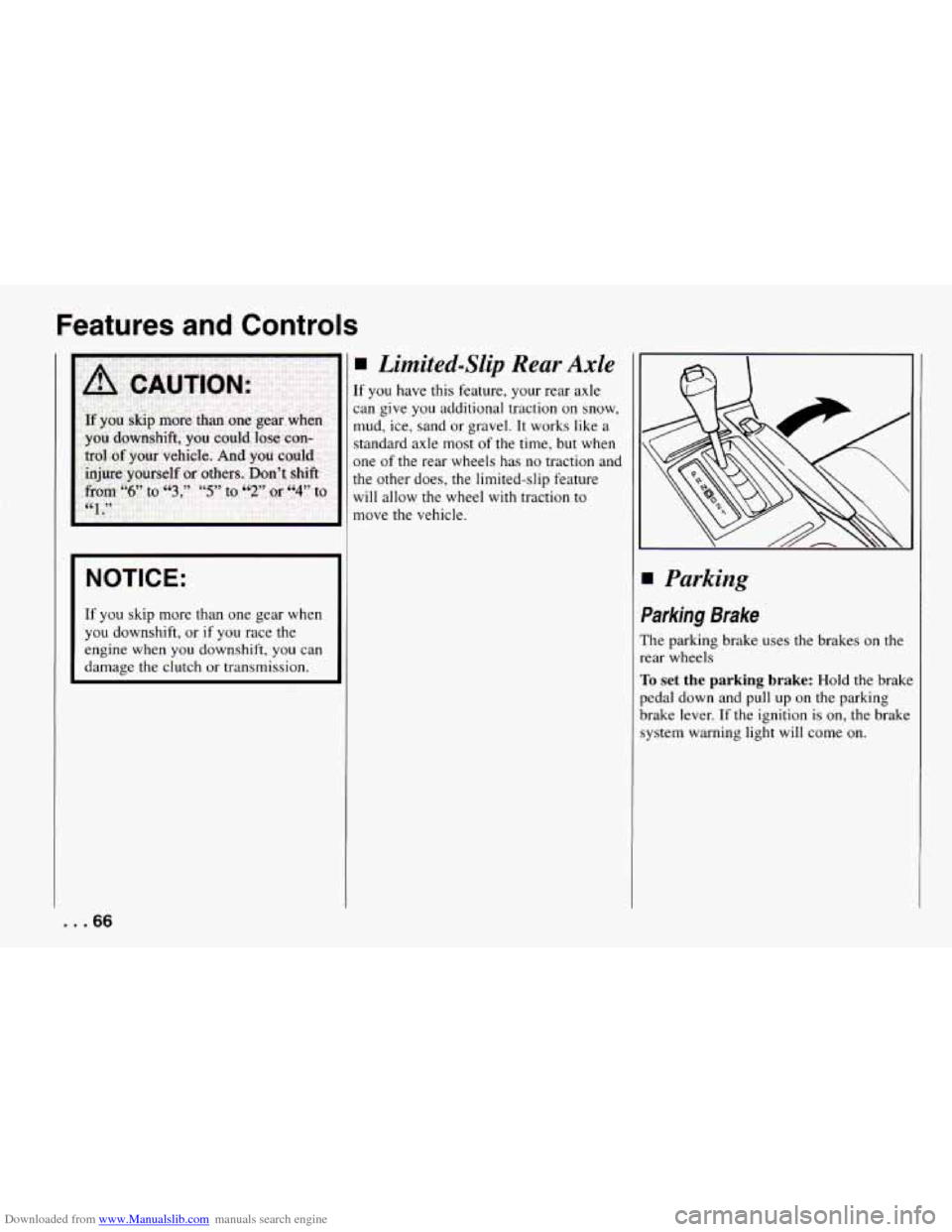
Parking
Parking Brake
The parking brake uses the brakes on the
rear wheels
To set the parking brake: Hold the brake
pedal down and pull up on the parking
brake lever.
If the ignition is on, the brake
system warning light will come on.
... 66
Page 70 of 292
Downloaded from www.Manualslib.com manuals search engine Features and Controls
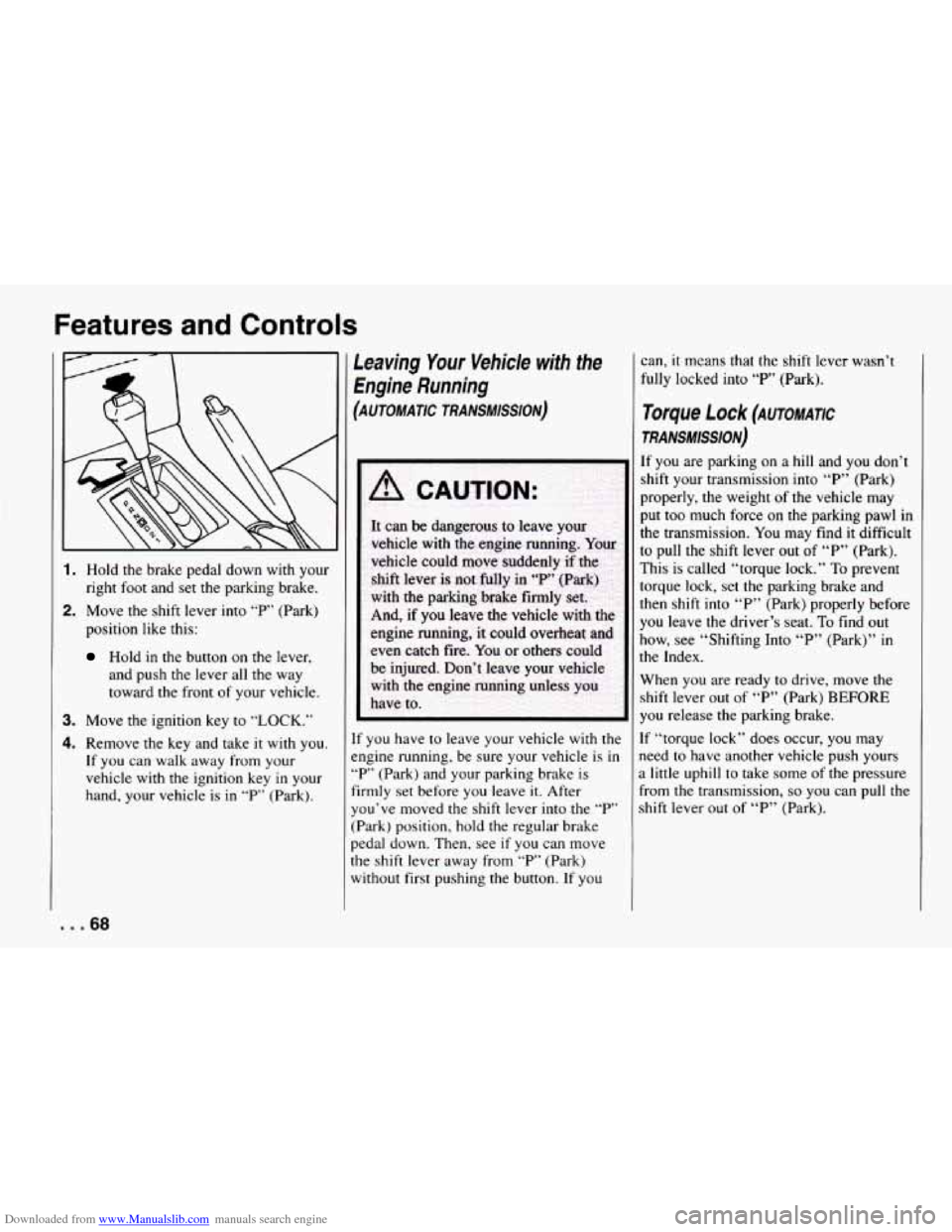
1. Hold the brake pedal down with your
right foot and set the parking brake.
2. Move the shift lever into “P’ (Park)
position like this:
Hold in the button on the lever,
and push the lever all the
way
toward the front of your vehicle.
3. Move the ignition key to “LOCK.”
4. Remove the key and take it with you.
If you can walk away from your
vehicle with
the ignition key in your
hand, your vehicle is in “P” (Park).
Leaving Your Vehicle with the
Engine Running
(AUTOMATIC TRANSMISSION)
If you have to leave your vehicle with the
engine running, be sure your vehicle is
in
“P’ (Park) and your parking brake is
firmly set before you leave it. After
you’ve moved the shift lever into the
“P’
(Park) position, hold the regular brake
pedal down. Then, see
if you can move
the shift lever away from “P” (Park)
without first pushing the button. If you can,
it means
that the shift lever wasn’t
fully locked into “P’ (Park).
Torque f Ock (AUTOMATIC
TRANS#lSSlON)
If you are parking on a hill and you don’t
shift your transmission into “P” (Park)
properly, the weight of the vehicle may
put too much force on the parking pawl in
the transmission.
You may find it difficult
to pull the shift lever out of “P” (Park).
This is called “torque lock.”
To prevent
torque lock, set
the parking brake and
then shift into “P” (Park) properly before
you leave the driver’s seat. To find out
how, see “Shifting Into “P” (Park)” in
the Index.
When you are ready to drive, move the
shift lever out of “P” (Park)
BEFORE
you release the parking brake.
If “torque lock” does occur, you may
need to have another vehicle push yours
a little uphill to take some of the pressure
From the transmission,
so you can pull the
shift lever out of “P” (Park).
... 68
Page 71 of 292
Downloaded from www.Manualslib.com manuals search engine Shifting out of P (Park)
[AUTOMATIC TRANSMISSION)
Your Chevrolet has a brake-transmission
shift interlock.
You have to fully apply
your regular brake before
you can shift
from
“P’ (Park) when the ignition is in
the
“Run” position. See “Automatic
Transmission” in the Index.
If you cannot shift out of “P’ (Park), ease
pressure on the shift lever
- push the
shift lever all the way into
“P’ (Park) and
release the shift lever button
as you
maintain brake application. Then press the
shift lever button and move the shift
lever into the gear you wish.
If you ever hold the brake pedal down but
still can’t shift out of “P” (Park), try this:
1. Turn the key to ‘bOff.”
2. Apply and hold the brake until the end
3. Shift to “N” (Neutral).
4. Start the vehicle and then shift to the
drive gear
you want.
of Step 4.
5. Have the vehicle fixed as soon as you
can.
Parking Your Vehicle
(MANUAL TRANSMISSION)
Before you get out of your vehicle, put
your
manual transmission in “R”
(Reverse) and firmly apply the parking
brake.
If your vehicle is equipped to tow a trailer,
see “Towing a Trailer”
in the Index.
69 ...
Page 81 of 292
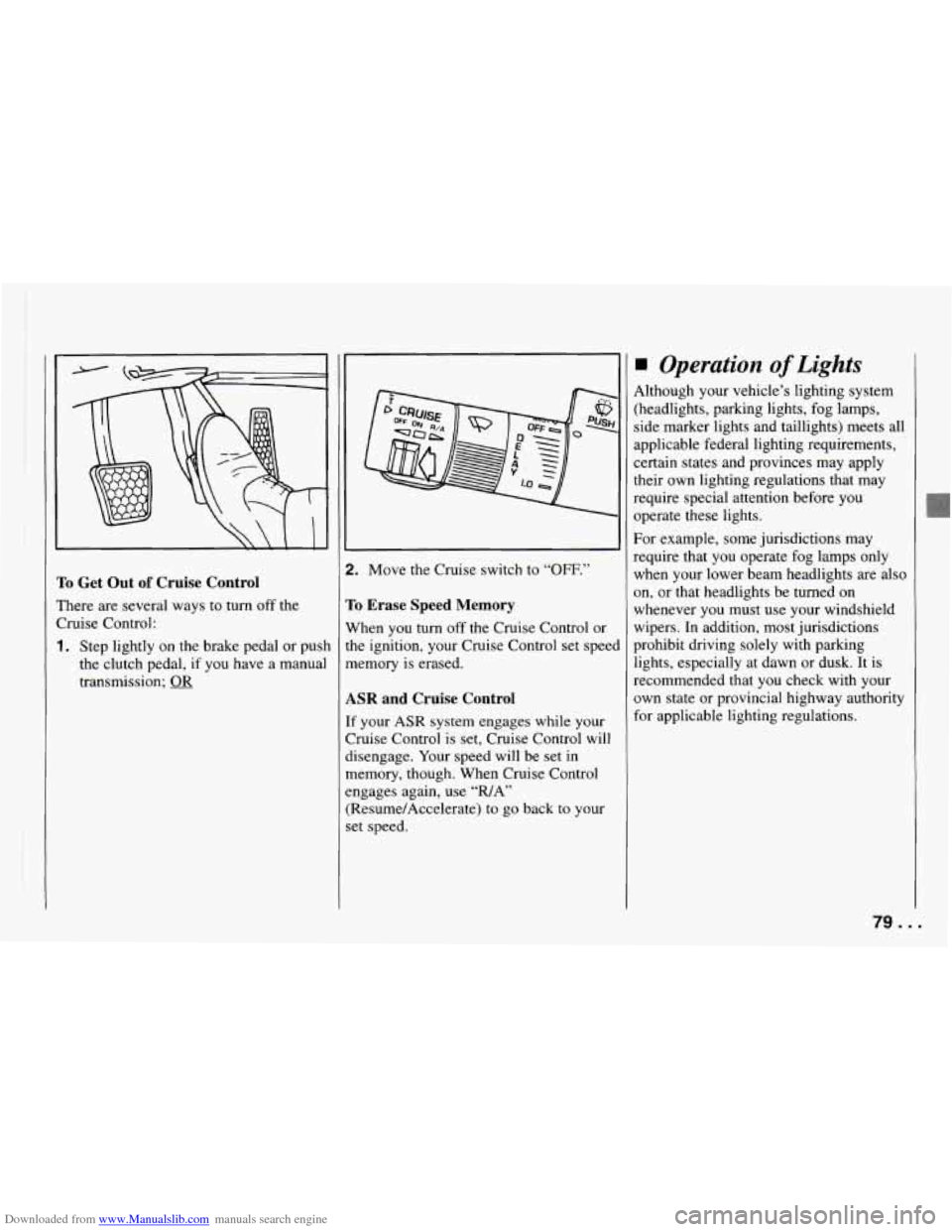
Downloaded from www.Manualslib.com manuals search engine To Get Out of Cruise Control
There are several ways to turn off the
Cruise Control:
1. Step lightly on the brake pedal or push
the clutch pedal, if you have a manual
transmission;
2. Move the Cruise switch to “OFF.”
To Erase Speed Memory
When you turn off the Cruise Control or
the ignition, your Cruise Control set speel
memory is erased.
ASR and Cruise Control
If your ASR system engages while your
Cruise Control is set, Cruise Control will
disengage. Your speed will be set in
memory, though. When Cruise Control
engages again, use “WAY’
(Resume/Accelerate) to
go back to your
set speed.
Operation of Lights
4lthough your vehicle’s lighting system
:headlights, parking lights, fog lamps,
side marker lights and taillights) meets all
ipplicable federal lighting requirements,
Zertain states and provinces may apply
:heir own lighting regulations that may
require special attention before you
>perate these lights.
For example, some jurisdictions may
require that you operate fog lamps only
when your lower beam headlights are also
m, or that headlights be turned on
whenever you must use your windshield
wipers. In addition, most jurisdictions
prohibit driving solely with parkmg
lights, especially at dawn or dusk. It is
recommended that you check with your
own state or provincial highway authority
for applicable lighting regulations.
/Y...
Page 82 of 292
Downloaded from www.Manualslib.com manuals search engine Features and Controls
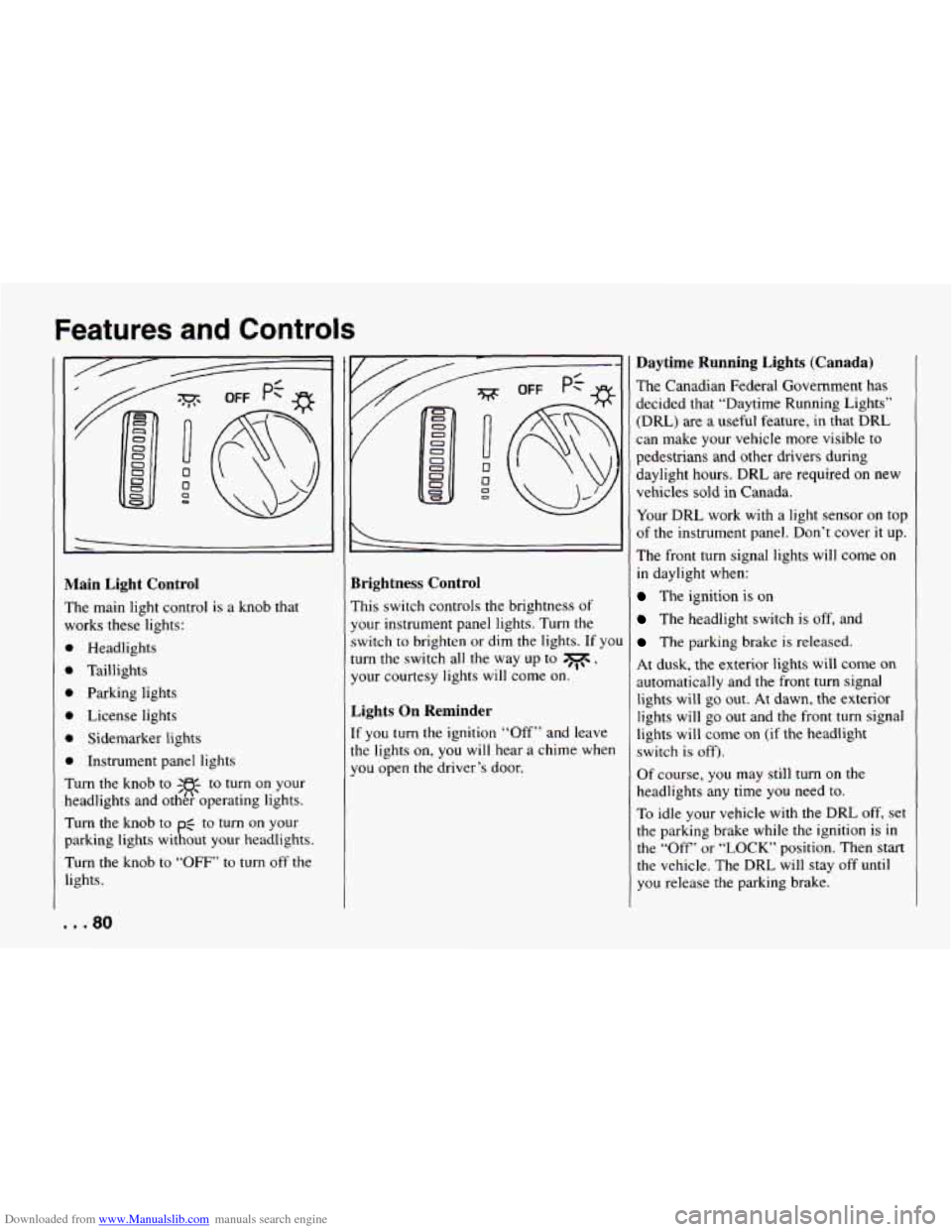
vlain Light Control
’he main light control is a knob that
vorks these lights:
b Headlights
b Taillights
Parking lights
b License lights
1 Sidemarker lights
b Instrument panel lights
rurn the knob to -w- to turn on your
leadlights and ot&?operating lights.
rurn the knob to
pg to turn on your
larking lights without your headlights.
rurn the knob to
“OFF’ to turn off the
ights.
Brightness Control
This switch controls the brightness of
your instrument panel lights. Turn the
switch to brighten or dim the lights. If yo1
turn the switch all the way up to
0w,
your courtesy lights will come on.
Lights On Reminder
If you turn the ignition “Off” and leave
the lights on, you will hear a chime when
you open the driver’s door.
Daytime Running Lights (Canada)
The Canadian Federal Government has
decided that “Daytime Running Lights”
(DRL) are
a useful feature, in that DRL
can make your vehicle more visible to
pedestrians and other drivers during
daylight hours.
DRL are required on new
vehicles sold in Canada.
Your DRL work with a light sensor on top
of the instrument panel. Don’t cover it up.
The front turn signal lights will come
on
in daylight when:
The ignition is on
The headlight switch is off, and
The parking brake is released.
At dusk, the exterior lights will come
on
automatically and the front turn signal
lights will go out. At dawn, the exterior
lights will go out and the front
turn signal
lights will come on (if the headlight
switch is off).
Of course,
you may still turn on the
headlights any time you need
to.
To idle your vehicle with the DRL off, set
the parking brake while the ignition is in
the
“Off” or “LOCK’ position. Then start
the vehicle. The DRL will stay
off until
you release the parking brake.