key CHEVROLET CAMARO 1994 4.G Owner's Manual
[x] Cancel search | Manufacturer: CHEVROLET, Model Year: 1994, Model line: CAMARO, Model: CHEVROLET CAMARO 1994 4.GPages: 292, PDF Size: 15.35 MB
Page 88 of 292
Downloaded from www.Manualslib.com manuals search engine Features and Controls
.:*:;r
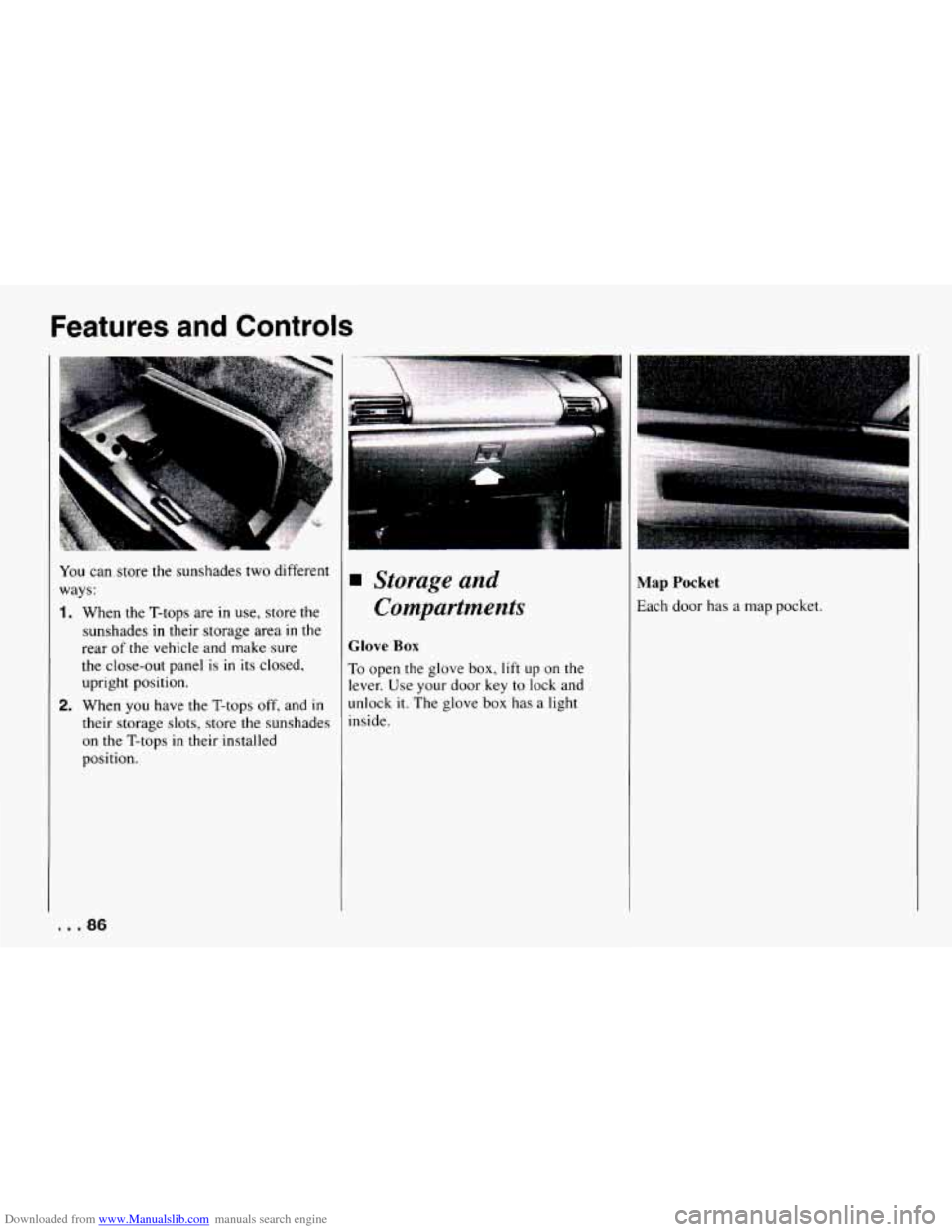
You can store the sunshades two different
ways:
1. When the T-tops are in use, store the
sunshades
in their storage area in the
rear
of the vehicle and make sure
the close-out panel
is in its closed,
upright position.
2. When you have the T-tops off, and in
their storage slots, store the sunshades
on the T-tops
in their installed
position.
Storage and
Compartments
Glove Box
To open the glove box, lift up on the
lever. Use your door key to lock
and
unlock it. The glove box has a light
inside.
Map Pocket
Each door has a map pocket.
... 86
Page 95 of 292
Downloaded from www.Manualslib.com manuals search engine Trip Odometer
The trip odometer can tell you how far
your vehicle has been driven since you
last set the trip odometer to.zero.
To set the trip odometer to zero, press the
hob.
Tachometer
The tachometer displays the engine speed
in thousands
of revolutions per minute
(rpm).
NOTICE:
Do not operate the engine with the
tachometer in the red area, or engine
damage may occur.
Warning Lights, Gages
and Indicators
This section describes the warning lights
and gages that may be on your vehicle.
The pictures will help you locate them.
Warning lights and gages can signal that
something is wrong before it becomes
serious enough to cause an expensive
repair or replacement. Paying attention to
your warning lights and gages could also
save you or others from injury.
Warning lights go on when there may be
or is a problem with one of your vehicle’s
functions.
As you will see in the details
on the next few pages, some warning
lights come on briefly when you turn the
ignition key just to let you know they’re
working.
If you are familiar with this
section, you should not be alarmed when
this happens.
Gages can indicate when there may be
or
is a problem with one of your vehicle’s
functions. Often gages and warning lights
work together to let you know when
there’s a problem with your vehicle. When one
of the warning lights comes on
and stays
on when you are driving, or
when one of the gages shows there may
be a problem, check the section that tells
you what to do about it. Please follow the
manual’s advice. Waiting to do repairs
can be costly
- and even dangerous. So
please get to know your warning lights
and gages. They’re a big help.
93 ...
Page 107 of 292
Downloaded from www.Manualslib.com manuals search engine UP TOP
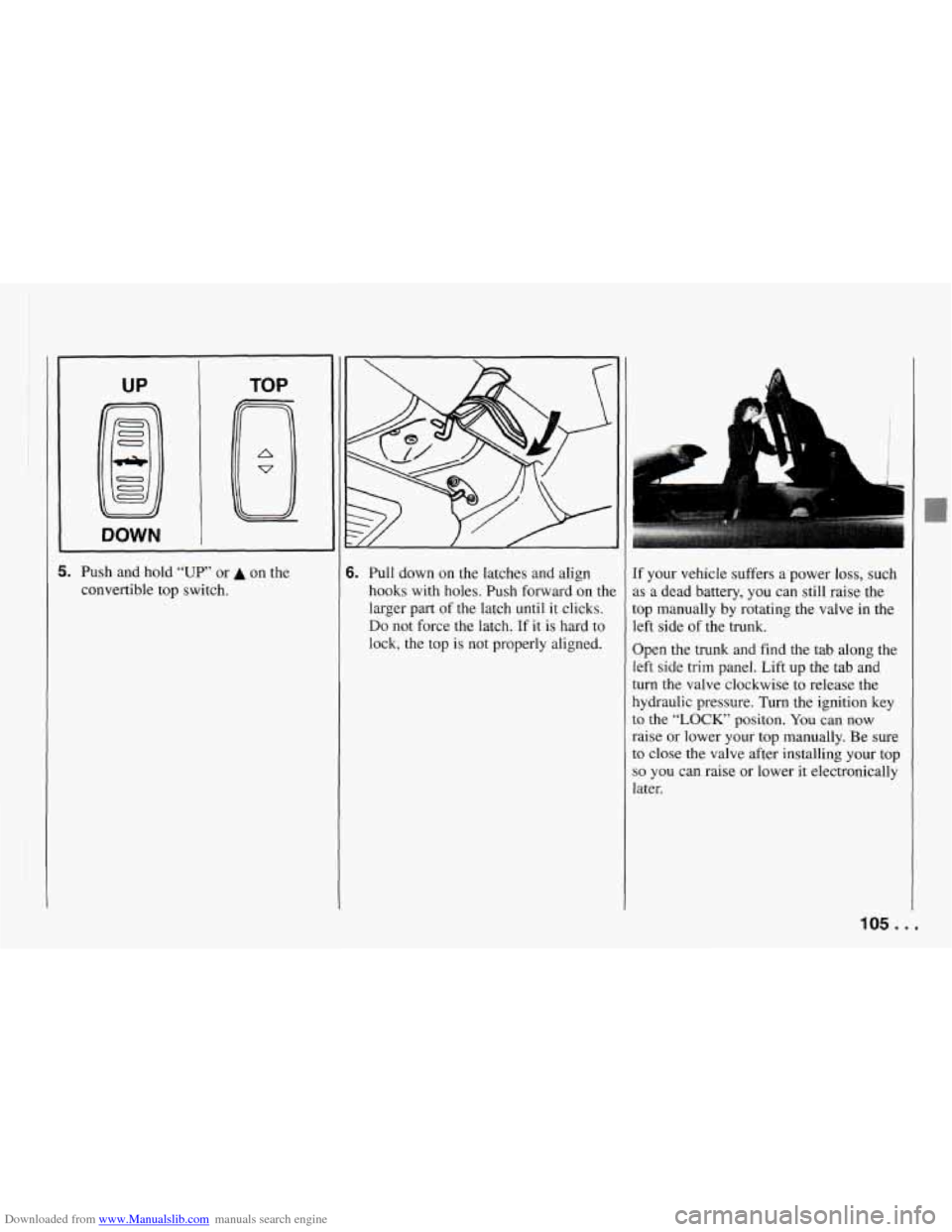
5. Push
and hold “UP” or A on the
convertible top switch. 6. Pull down on the latches and align
hooks with holes. Push forward on the
larger part
of the latch until it clicks.
Do not force the latch. If it is hard to
lock, the top is not properly aligned. If
your vehicle suffers a power
loss, such
as a dead battery, you can still raise the
top manually by rotating the valve in the
left side of the trunk.
Open the trunk and find the tab along the
left side trim panel. Lift up the tab and
turn the valve clockwise to release the
hydraulic pressure. Turn the ignition key
to the “LOCK’ positon. You can now
raise or lower your top manually. Be sure
to close the valve after installing your top
so you can raise or lower it electronically
Later.
105 ...
Page 120 of 292
Downloaded from www.Manualslib.com manuals search engine Comfort Controls and Audio Systems
To Play the Next Selection
Press “NEXT” to hear the next track now
(instead of waiting until
the present track
is finished).
If you press and hold this button or press
it more than once, the disc will advance
further.
To Replay the Current Selection
Press “PREV” to hear a track again.
If you press and hold this button, or press
it more than once, the disc will return to
previous tracks.
Reverse
Press and hold “REV” to rapidly return to
a favorite passage. Release
it to play the
passage.
Fast Forward
Press and hold “FWD’ to quickly
advance within
a track. Release it to
resume playing.
Scan
Press “SCAN” to listen to each track for
about
10 seconds. Press “RDM” or
“SCAN” to stop the scanning.
Compression
Press “COMP’ to make loud and soft
passages more nearly equal
in volume.
Random
Press “RDM” to hear a random selection
of tracks.
To Stop the Disc Player
0
0
0
Turn the power off or turn the ignition
key off. The disc stays
in the player
and will resume playing at the point
where
it stopped.
Press “ST-PL” to stop playing the disc
and switch to radio. Press “ST-PL,” to
restart
the disc at the point where it
stopped.
Press “EJCT” to eject the disc and the
radio
will play. The disc will start
playing
at track 1 when you reinsert it.
Theft-Deterrent Feature
Delco-Loc I1 is a security feature for the
compact disc player.
It can be used or
ignored. If ignored, the system functions
normally. If
it is used, your system won’t
be usable
if it’s ever stolen.
Setting Your Security Code
The instructions below tell you how to
enter a security code into the system. If
your vehicle loses battery power for
any
reason, you must enter the security code
again before the system
will turn on.
1. Write down any six-digit number and
2. Turn the ignition switch to the “Acc”
3. Turn the audio system off.
4. Press and hold pushbuttons “1” and
keep
it in a
safe place.
or
“Run” position.
“4” together until “---” shows on the
display.
You are now ready to enter your security
code. Don’t wait more than
15 seconds
between steps.
. . .118
Page 127 of 292
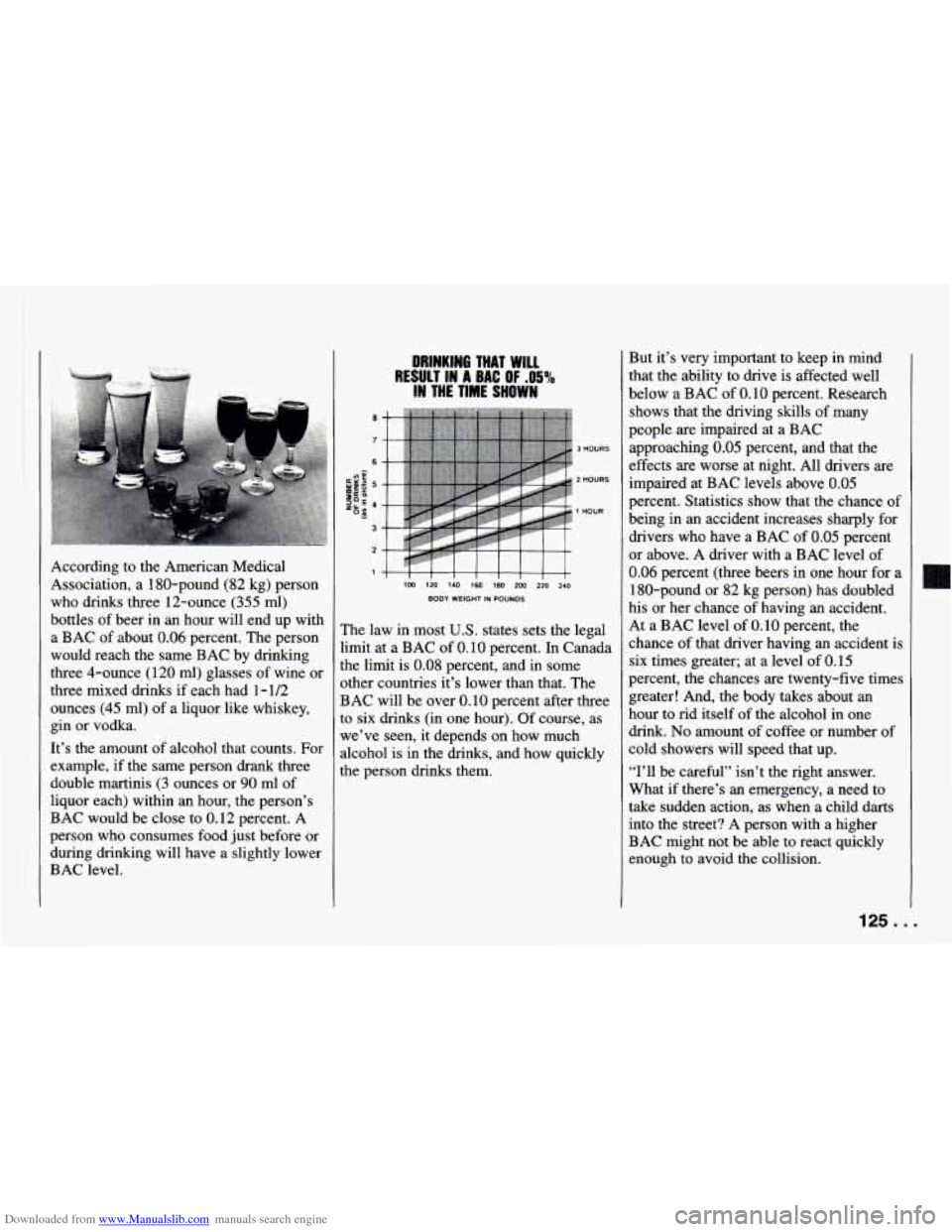
Downloaded from www.Manualslib.com manuals search engine According to the American Medical
Association, a 180-pound (82 kg) person who drinks three 12-ounce
(355 ml)
bottles of beer in an hour will end up with
a BAC of about
0.06 percent. The person
would reach the same BAC by drinking
three 4-ounce (1 20 ml) glasses of wine or
three mixed drinks if each had 1-1/2
ounces
(45 ml) of a liquor like whiskey,
gin or vodka.
It’s the amount of alcohol that counts. For
example, if the same person drank three
double martinis
(3 ounces or 90 ml of
liquor each) within an hour, the person’s
BAC would be close to 0.12 percent. A
person who consumes food just before or
during drinking will have a slightly lower
BAC level.
DRINKING THAT WILL
IN THE TIME SHOWN
RESULT IN A BAC OF .05%
100 120 140 160 1no 200 220 240
BODY WEIGHT IN POUNDS
The law in most U.S. states sets the legal
limit at a BAC
of 0.10 percent. In Canada
the limit is
0.08 percent, and in some
other countries it’s lower than that. The
BAC will be over 0.10 percent after three
to six drinks (in one hour). Of course, as
we’ve seen,
it depends on how much
alcohol is in the drinks, and how quickly
the person drinks them. But it’s
very important to keep in mind
that the ability to drive is affected well
below a BAC of 0.10 percent. Research
shows that the driving skills of many
people
are impaired at a BAC
approaching
0.05 percent, and that the
effects are worse at night. All drivers
are
impaired at BAC levels above 0.05
percent. Statistics show that the chance of
being in an accident increases sharply for
drivers who have a BAC of
0.05 percent
or above. A driver with a BAC level of
0.06 percent (three beers in one hour for a
180-pound or
82 kg person) has doubled
his or her chance of having an accident.
At a BAC level of
0.10 percent, the
chance of that driver having an accident is
six times greater; at a level of 0.15
percent, the chances are twenty-five times
greater! And, the body takes about
an
hour to rid itself of the alcohol in one
drink.
No amount of coffee or number of
cold showers will speed that up.
“I’ll be careful” isn’t the right answer.
What if there’s an emergency, a need to
take sudden action, as when a child darts
into the street? A person with a higher
BAC might not be able to react quickly
enough to avoid the collision.
125 ...
Page 150 of 292
Downloaded from www.Manualslib.com manuals search engine Problems on the Road
Hazard Warning
Flashers
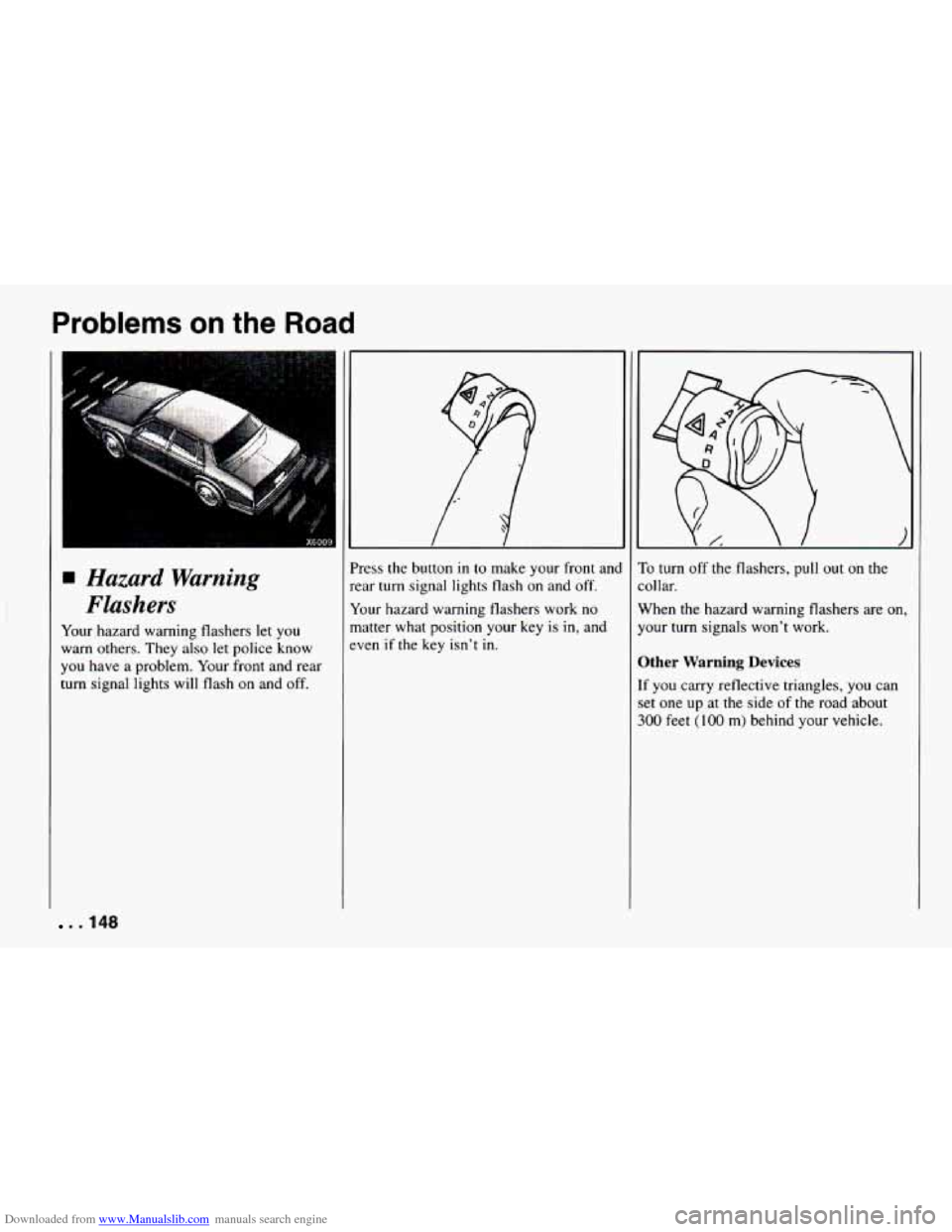
Your hazard warning flashers let you
warn others. They also
let police know
you have a problem. Your front and rear
turn signal lights will flash on and off. ’ress the button
in to make your front ant
ear turn signal lights
flash on and off.
(our hazard warning flashers work no
natter
what position your key is in, and
ven
if the key isn’t in.
i’I
C
V
Y
C
11
3
SI
b turn off the flashers, pull out on the
ol
1 ar.
Vhen the hazard warning flashers are on,
our turn signals won’t work.
Ither Warning Devices
f you carry reflective triangles, you can
et one up at the side of the road about
00 feet (100 m) behind your vehicle.
. ,148
Page 156 of 292
Downloaded from www.Manualslib.com manuals search engine Problems on the Road
When your vehicle is being towed, have
the ignition key off. The steering wheel
should be clamped
in a straight-ahead
position, with a clamping device designed
for towing service. Do not use the
vehicle’s steering
column lock for this,
The transmission should be in “Neutral”
and the parking brake released.
Don’t have your vehicle towed on the rear
wheels, unless
you must. If the vehicle
must be towed on the rear wheels, don’t
go more than 35 mph (55 km/h) or
farther than
50 miles (80 km) or your
transmission will be damaged. If these
limits
must be exceeded, then the rear
wheels have to be supported on a
dolly.
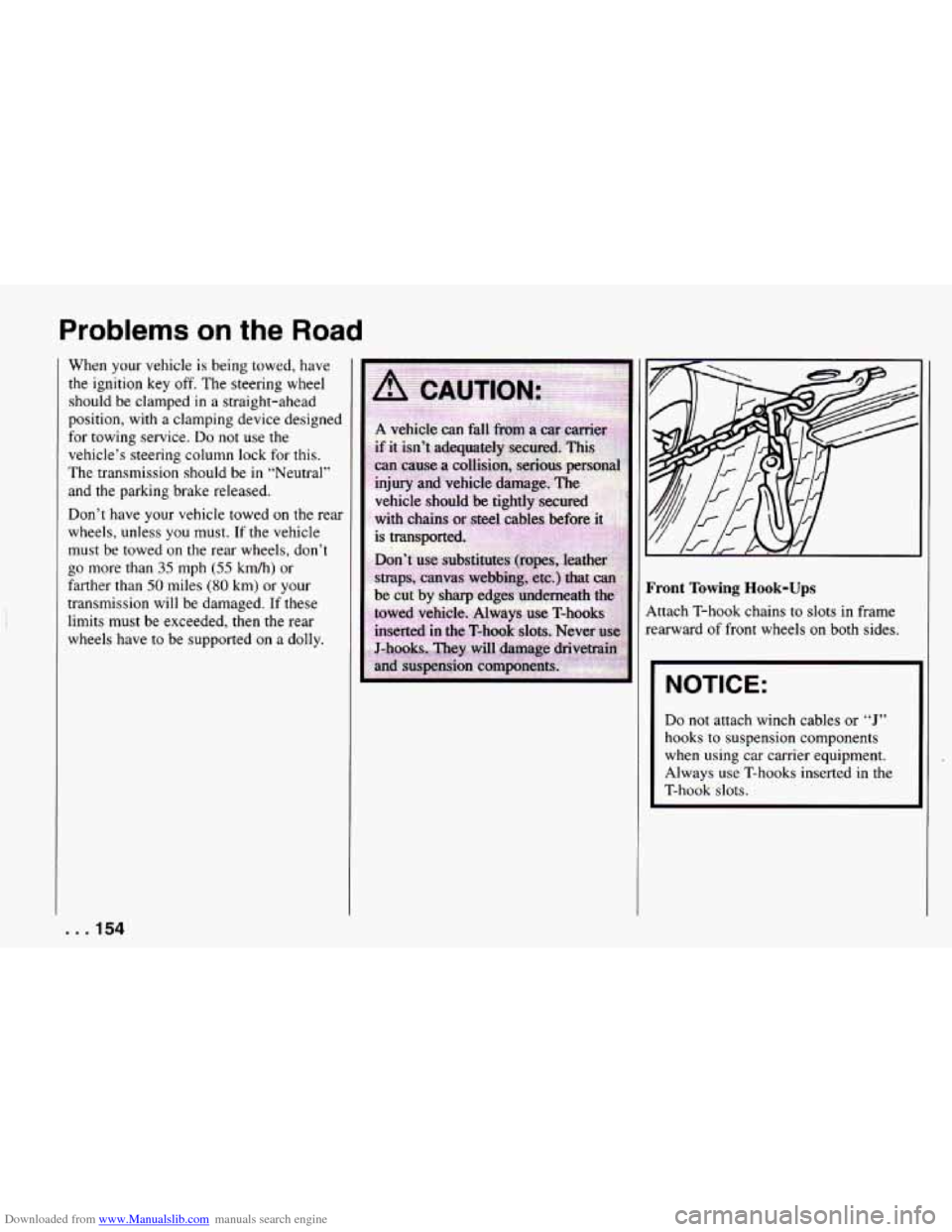
?ront Towing Hook-Ups
Ittach T-hook chains to slots in frame
*earward of front wheels on both sides.
NOTICE:
Do not attach winch cables or “J”
hooks to suspension components
when using car carrier equipment.
Always use T-hooks inserted in the
T-hook
slots.
. . .154
Page 169 of 292
Downloaded from www.Manualslib.com manuals search engine Changing a Flat lire
If a tire goes flat, avoid further tire and
wheel damage by driving slowly to a level
place.
Turn on your hazard warning
flashers. The following
steps will tell you how to
use
the jack and change a tire.
The equipment you’ll need is in the rear
area.
First
you must remove the close-out
panel. See “Close-Out Panel” in the
Index.
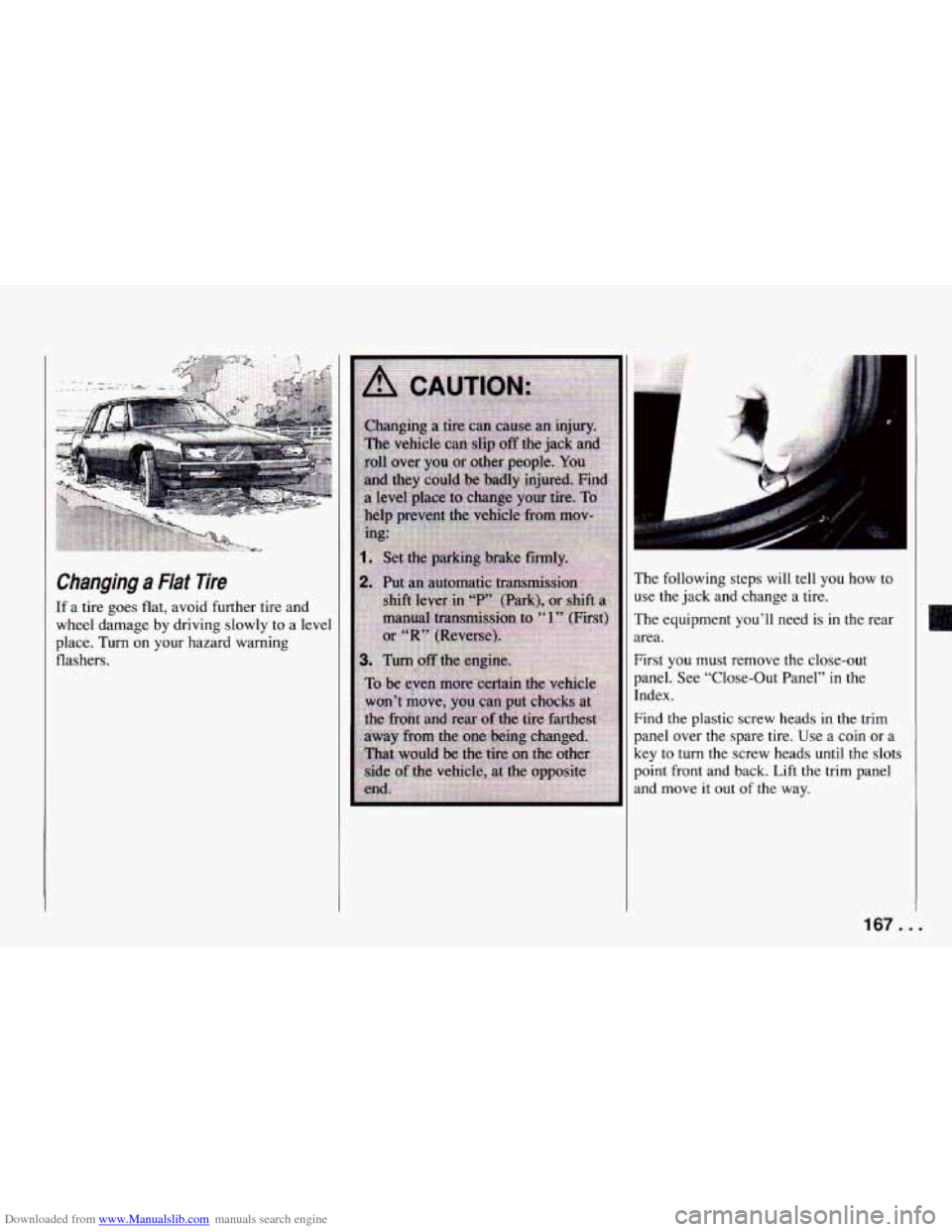
Find the plastic screw heads in the trim
panel over
the spare tire. Use a coin or a
key to turn the screw heads until the slots
point front and back. Lift the trim panel
and move
it out of the way.
167..
Page 172 of 292
Downloaded from www.Manualslib.com manuals search engine Problems on the Road
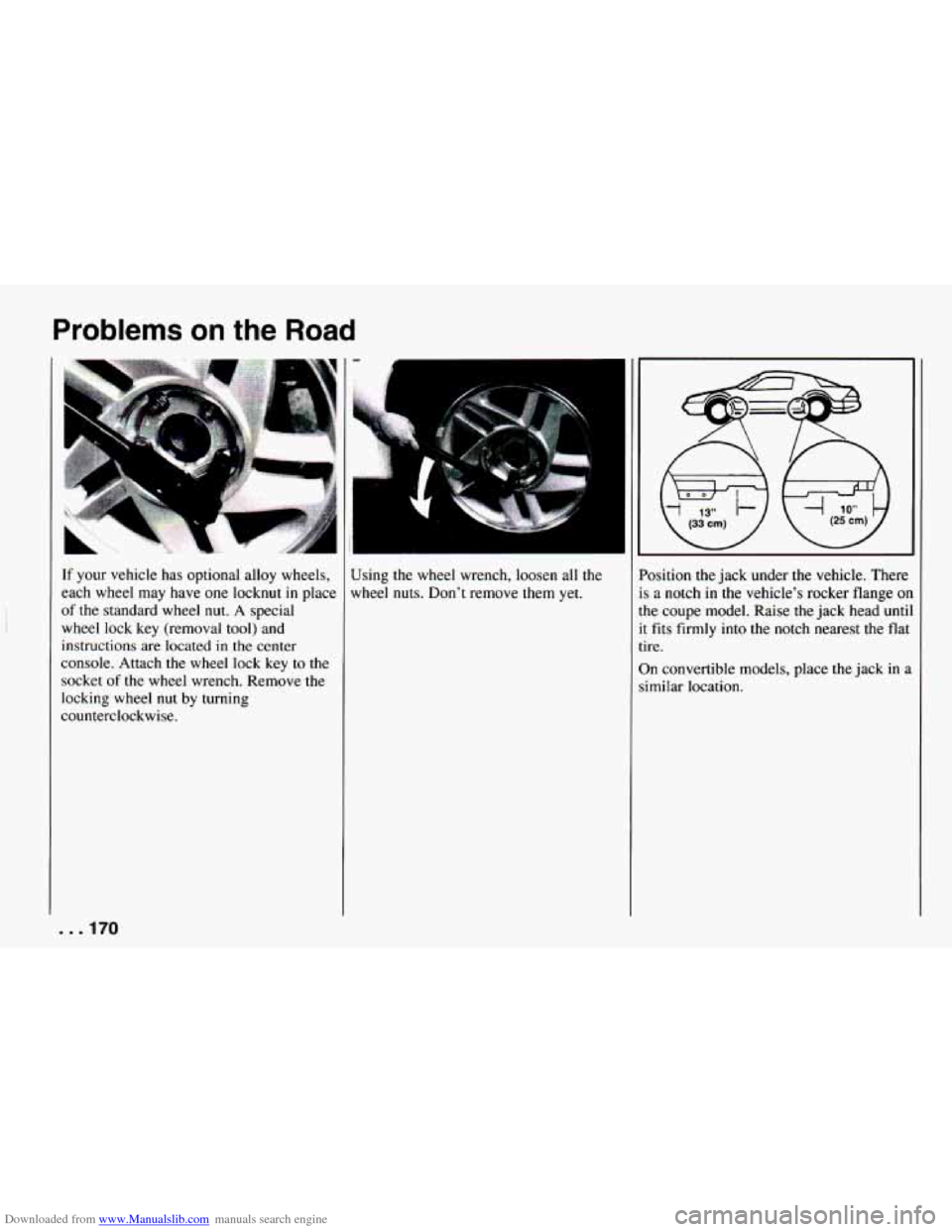
If your vehicle has optional alloy wheels,
each wheel may have one locknut
in place
of the standard wheel nut. A special
wheel lock key (removal tool) and
instructions are located
in the center
console. Attach the wheel lock key to the
socket
of the wheel wrench. Remove the
locking wheel
nut by turning
counterclockwise.
. . .I70
‘ .... .,..
!
Using the wheel wrench, loosen all the
wheel nuts. Don’t remove them yet. Position
the jack under the vehicle. There
is a notch
in the vehicle’s rocker flange on
the coupe model. Raise the jack head until
it fits firmly into the notch nearest the flat
tire.
On convertible models, place the jack in a
similar location.
Page 231 of 292
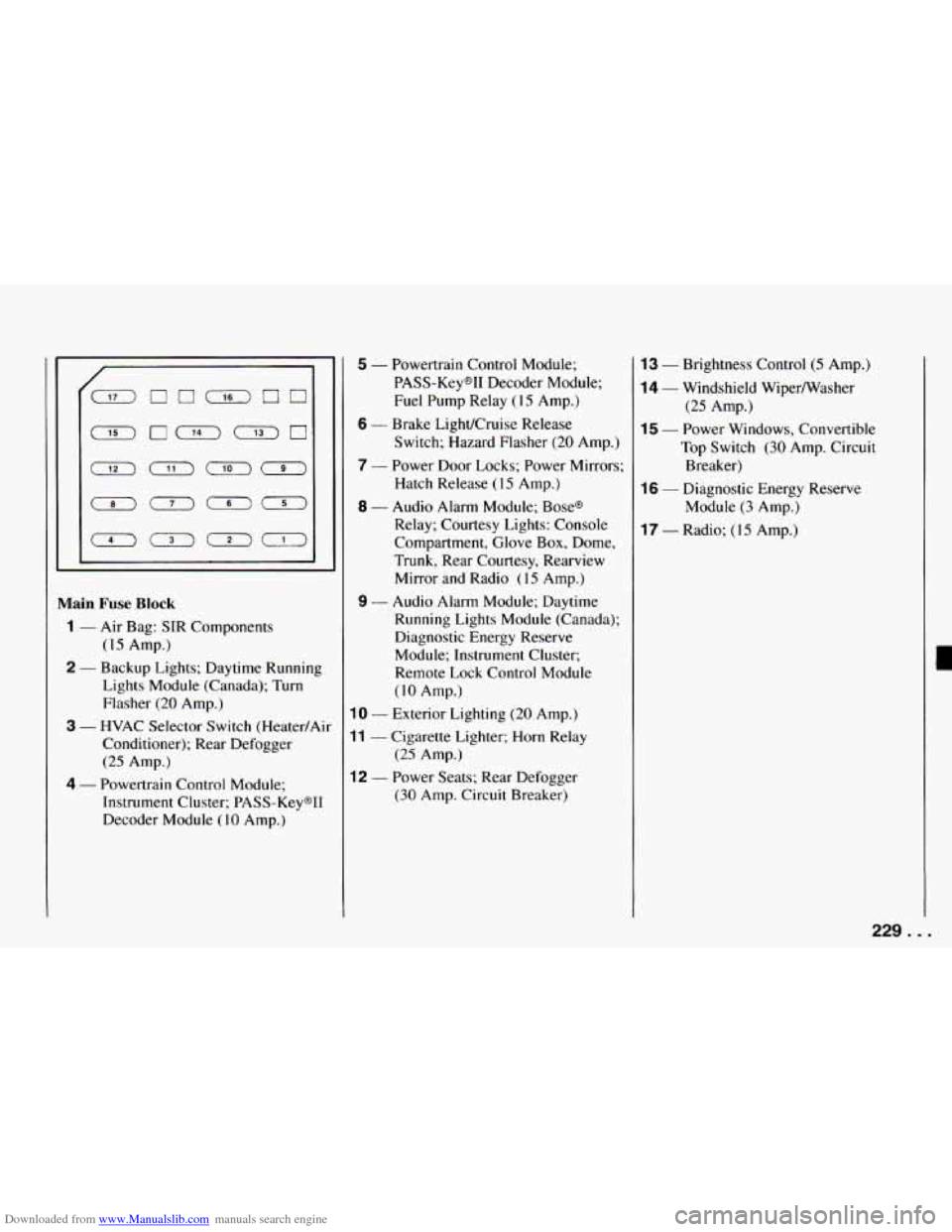
Downloaded from www.Manualslib.com manuals search engine Main Fuse Block
1 - Air Bag: SIR Components
2 - Backup Lights; Daytime Running
(15 Amp.)
Lights Module (Canada); Turn
Flasher
(20 Amp.)
3 - HVAC Selector Switch (Heater/Air
Conditioner); Rear Defogger
(25 Amp.)
4 - Powertrain Control Module;
Instrument Cluster; PASS-Keys11
Decoder Module
(10 Amp.)
5 - Powertrain Control Module;
PASS-Keys11 Decoder Module;
Fuel Pump Relay
(1 5 Amp.)
6 - Brake LighVCruise Release
Switch; Hazard Flasher
(20 Amp.)
7 - Power Door Locks; Power Mirrors;
Hatch Release
(15 Amp.)
8 - Audio Alarm Module; Bases
Relay; Courtesy Lights: Console
Compartment, Glove Box, Dome,
Trunk, Rear Courtesy, Rearview
Mirror and Radio
(1 5 Amp.)
9 - Audio Alarm Module; Daytime
Running Lights Module (Canada);
Diagnostic Energy Reserve
Module; Instrument Cluster;
Remote Lock Control Module
(IO Amp.)
10 - Exterior Lighting (20 Amp.)
11 - Cigarette Lighter; Horn Relay
12 - Power Seats: Rear Defogger
(25 Amp.)
(30 Amp. Circuit Breaker)
13 - Brightness Control (5 Amp.)
14 - Windshield Wipermasher
(25 Amp.)
15 - Power Windows, Convertible
Top Switch
(30 Amp. Circuit
Breaker)
16 - Diagnostic Energy Reserve
Module
(3 Amp.)
17 - Radio; ( 15 Amp.)
229. . .