power steering CHEVROLET CAMARO 1994 4.G Owners Manual
[x] Cancel search | Manufacturer: CHEVROLET, Model Year: 1994, Model line: CAMARO, Model: CHEVROLET CAMARO 1994 4.GPages: 292, PDF Size: 15.35 MB
Page 57 of 292
Downloaded from www.Manualslib.com manuals search engine New Vehicle
“Break-In”
NOTICE:
Your modern Chevrolet doesn’t need
an elaborate “break-in.” But it will
perform better
in the long run if you
follow these guidelines:
Keep your speed at
55 mph (88
km/h) or less for the first 500
miles (804 km).
Don’t drive at any one speed
-
fast or slow - for the first 500
miles (804 km). Don’t make
full-throttle starts.
Avoid making hard stops for the
first
200 miles (322 km) or so.
During this time your new brake
linings aren’t yet broken
in. Hard
stops with new linings can mean
premature wear and earlier
replacement. Follow this
“breaking-in” guideline every
time
you get new brake linings.
D
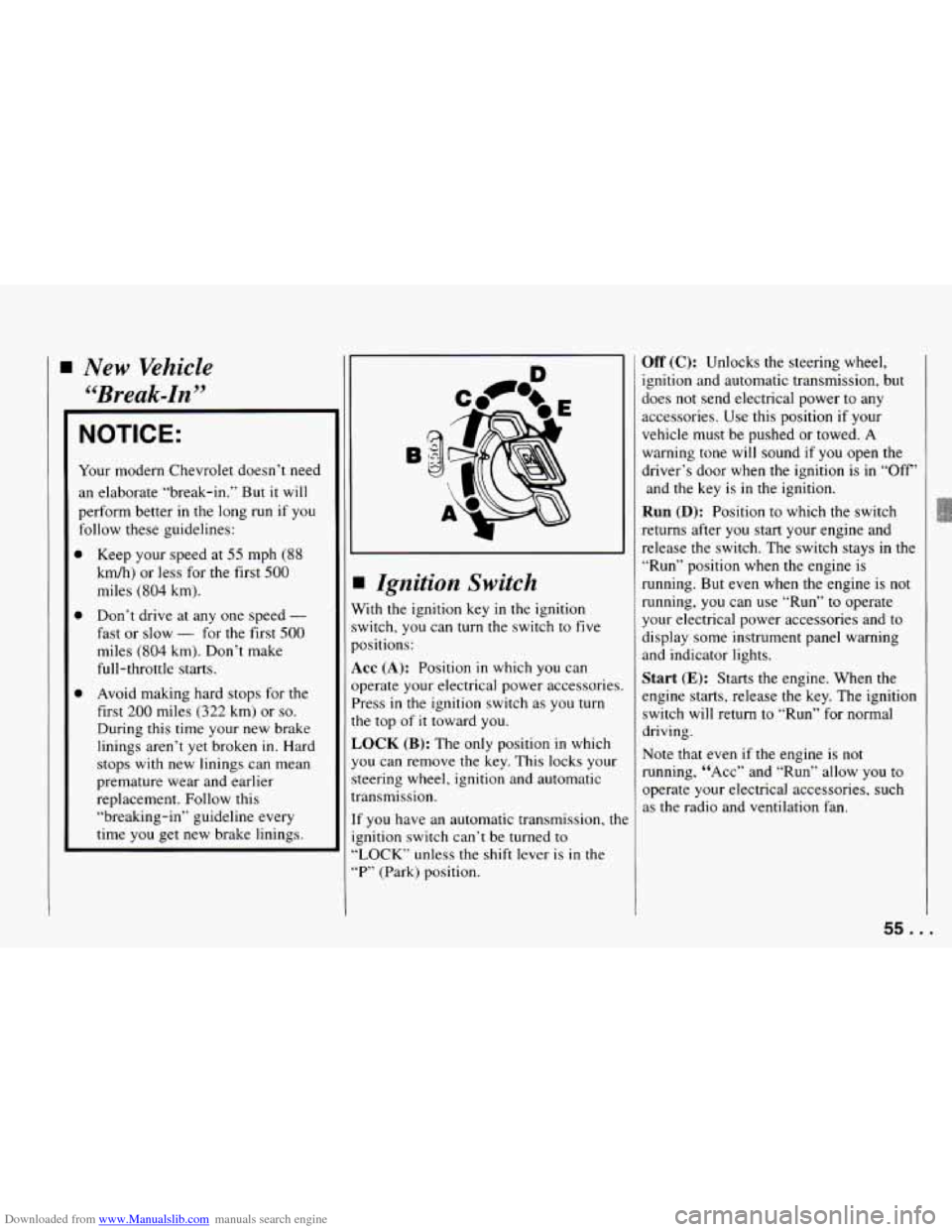
I Ignition Switch
Vith the ignition key in the ignition
witch,
you can turn the switch to five
lositions:
KC (A): Position in which you can
lperate your electrical power accessories.
’ress
in the ignition switch as you turn
?e top
of it toward you.
,OCK (B): The only position in which
ou can remove the key. This locks your
teering wheel, ignition and automatic
7ansmission.
f you have an automatic transmission, the
znition switch can’t be turned to
LOCK” unless the shift lever is
in the
“P” (Park) position.
Off (C): Unlocks the steering wheel,
ignition and automatic transmission, but
does not send electrical power to any
accessories.
Use this position if your
vehicle must be pushed or towed.
A
warning tone will sound if you open the
driver’s door when the ignition
is in “Off’
and the key is
in the ignition.
Run (D): Position to which the switch
returns after
you start your engine and
release the switch. The switch stays
in the
“Run” position when the engine is
running.
But even when the engine is not
running,
you can use “Run” to operate
your electrical power accessories and to
display some instrument panel warning
and indicator lights.
Start (E): Starts the engine. When the
engine starts, release the key. The ignition
switch will return to “Run” for normal
driving.
Note that even if the engine is not
running, “ACC” and “Run’’ allow
you to
operate your electrical accessories, such
as the radio and ventilation fan.
55. .
Page 132 of 292
Downloaded from www.Manualslib.com manuals search engine Your Driving and the Road
Steering
Power Steering
If you lase power steering assist because
the engine stops or the system
is not
functioning, you can steer but it will
take much more effort.
Steering Tips
Driving
on Curves
It’s important to take curves at a
reasonable speed.
A lot of the “driver lost control” accidents
mentioned
on the news happen on curves.
Here’s
why:
Experienced driver or beginner, each of
us is subject to the same laws of physics
when driving
on curves. The traction of
the tires against the road surface makes it
possible for the vehicle to change its path
when you
turn the front wheels. If there’s
no traction, inertia will keep the vehicle
going in
the same direction. If you’ve
ever tried to steer a vehicle
on wet ice,
you’ll understand this.
The traction you can get in a carve
depends
on the condition of your tires and
the road surface, the angle at which the
curve is banked, and your speed. While
you’re in
a curve, speed is the one factor
you can control.
I
Suppose you’re steering through a sharp
curve, Then
you suddenly accelerate.
Both control systems
- steering and
acceleration
- have to do their work
where the tires meet the road. Unless you
have traction control and the system is
on, adding the sudden acceleration can
demand too much of those places. You
can lose control.
What should you do if this ever happens?
Ease
up on the accelerator pedal, steer the
vehicle the way you want
it to go, and
slow down.
Speed limit signs near curves
warn that
you should adjust your speed. Of course,
the posted speeds are based on good
weather and road conditions. Under less
favorable conditions you’ll want to
go
slower.
If
you need to reduce your speed as you
approach a curve, do it before
you enter
the curve, while your front wheels are
straight ahead.
Try to adjust your speed
so you can
“drive” through the curve. Maintain a
reasonable, steady speed. Wait to
accelerate until you are opt
of the curve,
and then accelerate gently into the
straightaway.
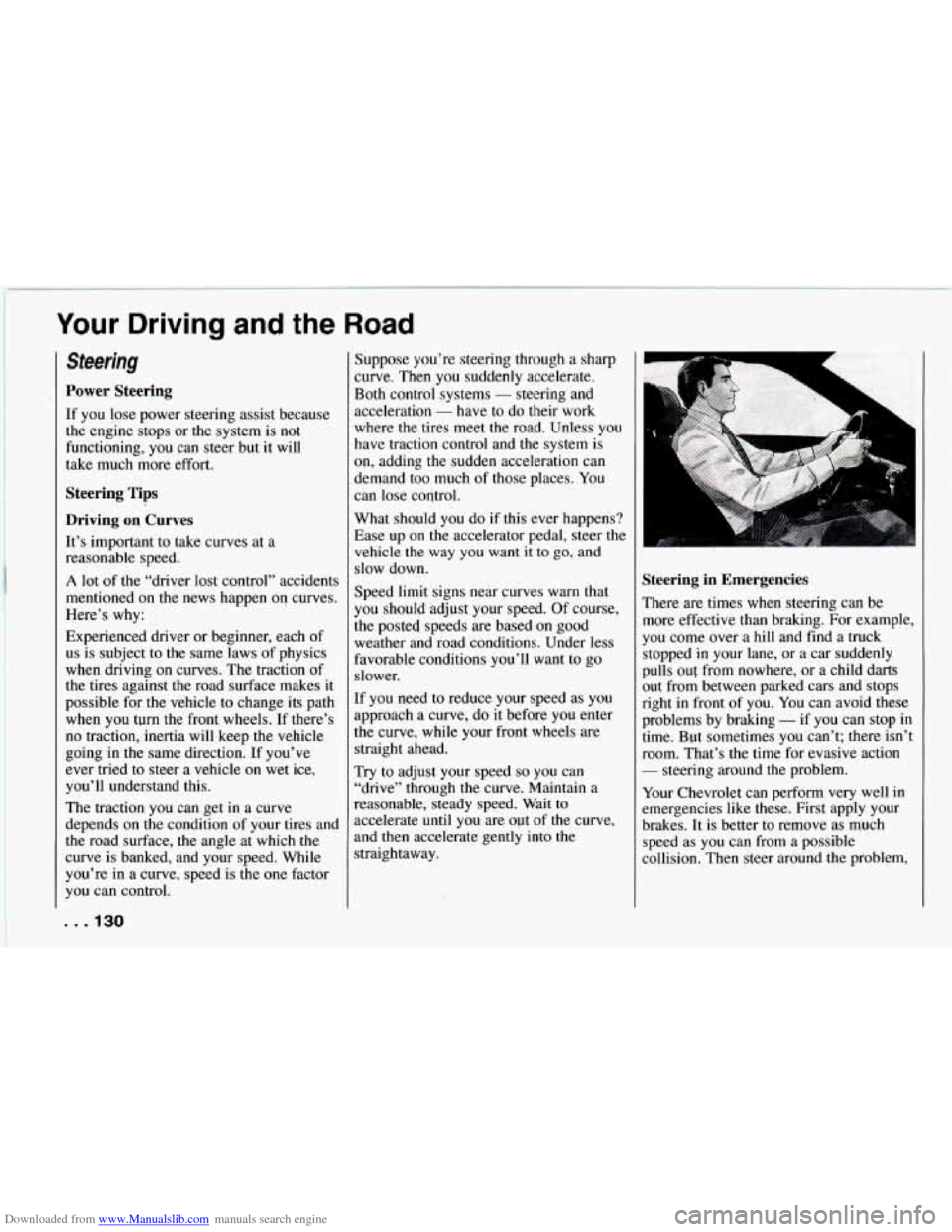
Steering in Emergencies
There are times when steering can be
more effective than braking. For example,
you come over a hill and find
a truck
stopped
in your lane, or a car suddenly
pulls
out from nowhere, or a child darts
out from between parked cars and stops
right in front
of you. You can avoid these
problems by braking
- if you can stop in
time. But sometimes you can’t; there isn’t
room. That’s the time for evasive action
- steering around the problem.
Your Chevrolet can perform very well in
emergencies like these. First apply your
brakes. It is better to remove as much
speed as you can from a possible
collision. Then steer around the problem,
. . ,130
Page 181 of 292
Downloaded from www.Manualslib.com manuals search engine Here you will find information
about the care of your
Chevrolet
. This part begins with
service and fuel information.
and then
it shows how to check
important fluid and lubricant
levels
. There is also technical
information about your vehicle.
and a section devoted to its
appearance care
.
Part 0
Service & Appearance Care
Service .........................................................
Fuel ...........................................................
Checking Things under the Hood ....................................
HoodRelease ..................................................
EngineOil ....................................................
Aircleaner ...................................................
Automatic Transmission Fluid .....................................
Manual Transmission Fluid .......................................
Hydraulic Clutch ...............................................
RearAxle .....................................................
Enginecoolant ................................................
Power Steering Fluid ............................................
Windshield Washer Fluid .........................................
Brake Master Cylinder ...........................................
Battery .......................................................
Bulb Replacement ................................................
LoadingYourVehicle .............................................
Tires ...........................................................
Appearancecare .................................................
Appearance Care and Maintenance Materials ...........................
Vehicle Identification Number (VIN) .................................
Service Parts Identification Label ....................................
Add-on Electrical Equipment .......................................
Fuses and Circuit Breakers .........................................
Replacement Bulbs ...............................................
Capacities and Specifications .......................................
180
181
184
184
187 191
194
196
197
197
198
200
201
202
204
205
212
214
220
226
227
227
227
227
231
232
179 ...
Page 187 of 292
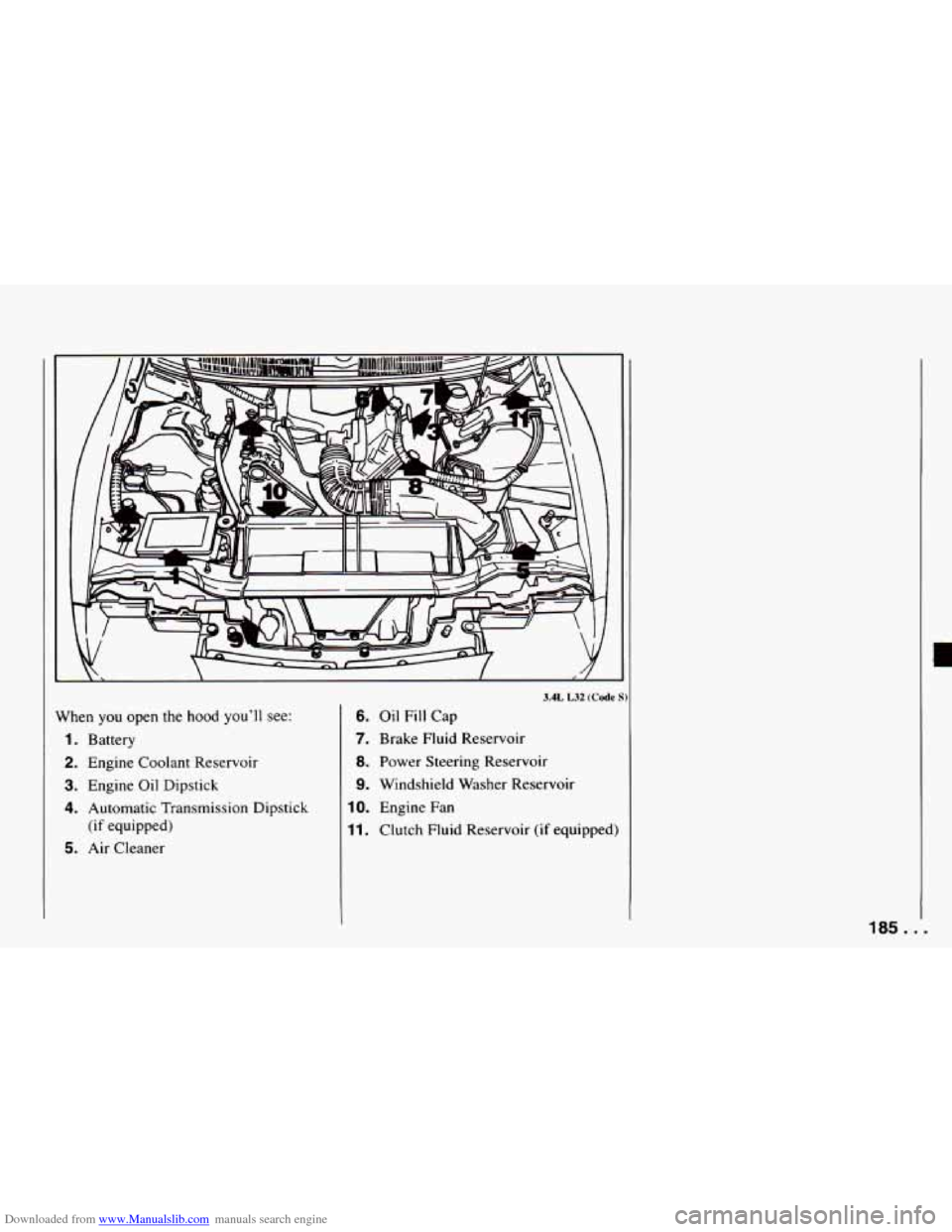
Downloaded from www.Manualslib.com manuals search engine When you open the hood you'll see:
1. Battery
2. Engine Coolant Reservoir
3. Engine Oil Dipstick
4. Automatic Transmission Dipstick
5. Air Cleaner (if equipped)
3.4L L32 (Code S
6. Oil Fill Cap
7. Brake Fluid Reservoir
8. Power Steering Reservoir
9. Windshield Washer Reservoir
10. Engine Fan
11. Clutch Fluid Reservoir (if equipped)
L
185 ...
Page 188 of 292
Downloaded from www.Manualslib.com manuals search engine Service and Appearance Care
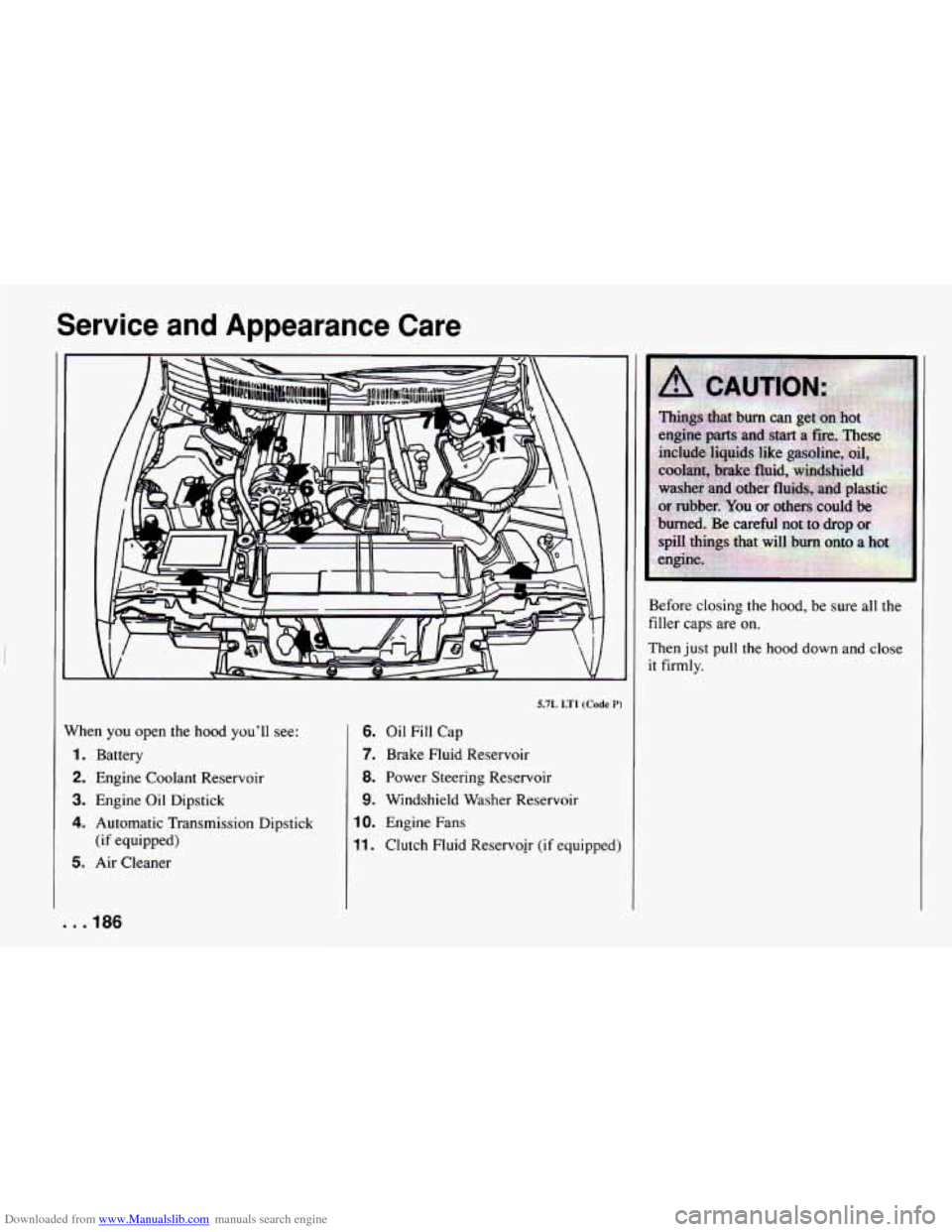
5.7L LT1 (Code P)
Vhen you open the hood you’ll see:
1. Battery
2. Engine Coolant Reservoir
3. Engine Oil Dipstick
4. Automatic Transmission Dipstick
5. Air Cleaner
(if equipped)
6. Oil Fill Cap
7. Brake Fluid Reservoir
8. Power Steering Reservoir
9. Windshield Washer Reservoir
10. Engine Fans
11. Clutch Fluid Reservoir (if equipped) Before
closing the hood, be sure all the
filler
caps are on.
Then just pull the hood down and close
it firmly.
. . .186
Page 202 of 292
Downloaded from www.Manualslib.com manuals search engine Service and Appearance Care
e CAUTION:
Turning the radiator pressure cap when the engine and radiator
are hot
can allow steam and scalding liquids
to
blow out and burn you badly.
Never
turn the pressure cap - even a
little
- when the engine and radiator
are hot.
Add coolant mix at the recovery tank, bul
be careful not to spill
it.
A CAUTION:
You can be burned if you spill
coolant on hot engine parts. Coolant
contains ethylene glycol,
and it will
bum if the engine parts are hot
enough. Don't spill coolant
on a
hot engine.
Radiator Pressure Cap (All Engines)
NOTICE:
Your radiator cap is a 18 psi
(1 24 kPa) pressure-type cap and
must be tightly installed to prevent
coolant
loss and possible engine
damage from overheating. Be sure
the arrows
on the cap line up with
the overflow tube on the radiator
filler neck.
When you replace your radiator pressure
cap, an
AC@ cap is recommended.
Thermostat
Engine coolant temperature is controlled
by a thermostat in the engine coolant
system. The thermostat stops the flow of
coolant through the radiator until the
coolant reaches a preset temperature.
When
you replace your thermostat, an
AC@ thermostat is recommended.
f
I I
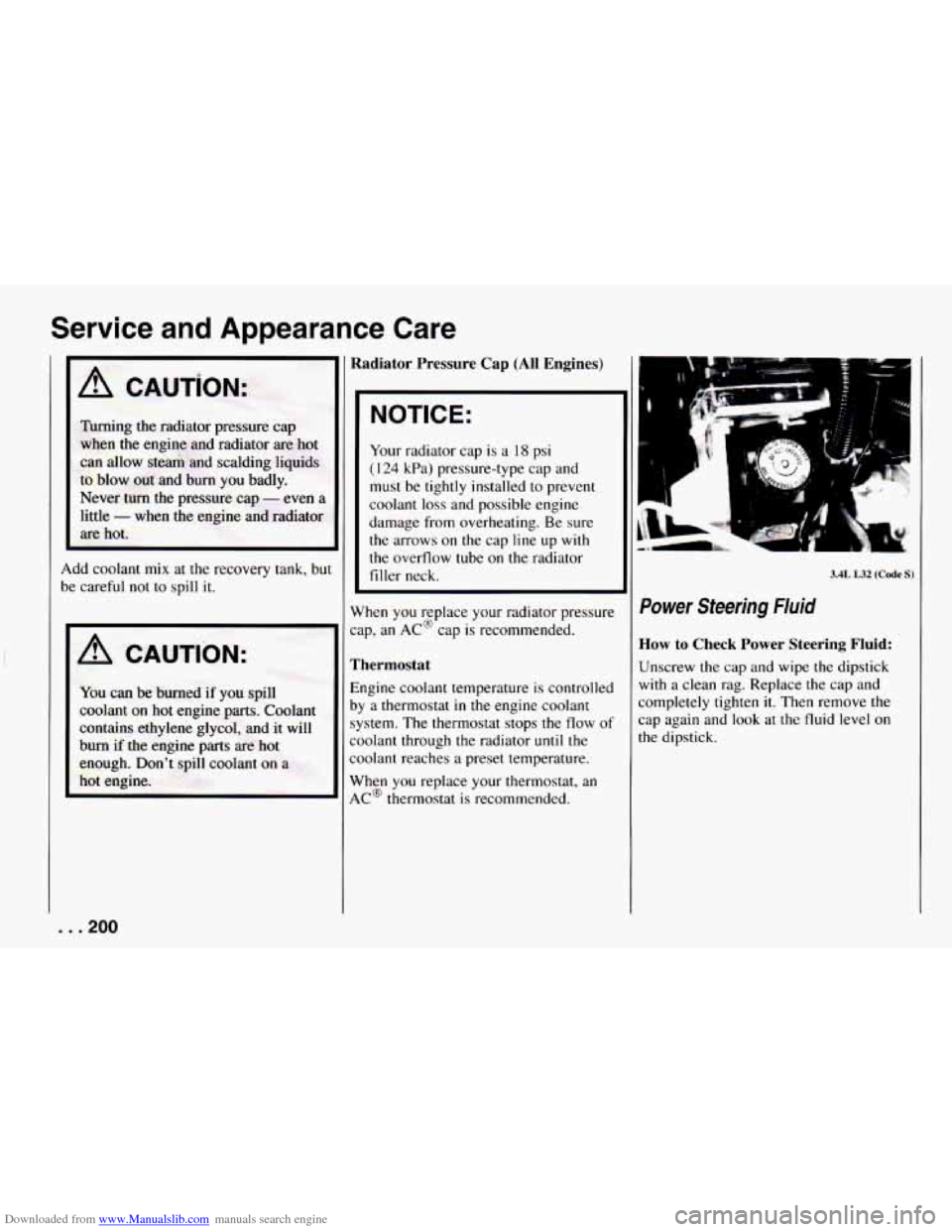
3.4L L32 (Code S)
Power Steering Fluid
How to Check Power Steering Fluid:
Unscrew the cap and wipe the dipstick
with a clean rag. Replace the cap and
completely tighten it. Then remove the
cap again and look
at the fluid level on
the dipstick.
. . .200
Page 203 of 292
Downloaded from www.Manualslib.com manuals search engine 0
0
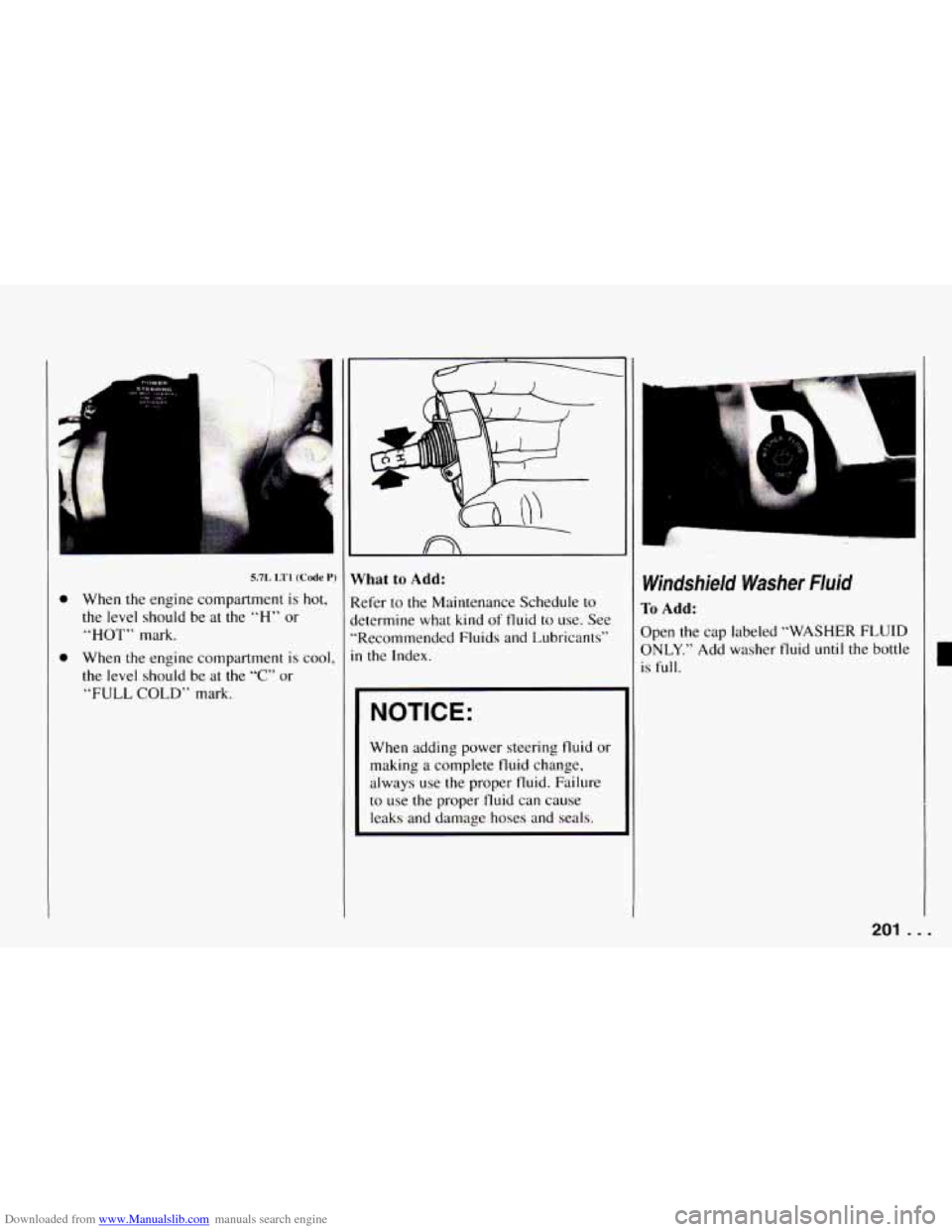
5.7L LTl (Code P)
When the engine compartment is hot,
the level should be at the
“H” or
“HOT” mark.
When the engine compartment is cool,
the level should be at
the “C” or
“FULL COLD” mark.
w1
Re
del
“R
in
n
hat to Add:
fer to the Maintenance Schedule to
:ermine what kind of fluid to use. See
ecommended Fluids and Lubricants”
the Index.
NOTICE:
When adding power steering fluid or
making a complete fluid change,
always use the proper fluid. Failure
to use the proper fluid can cause
leaks and damage hoses and seals.
I
/intishield Washer Fluid
3 Add:
pen the cap labeled “WASHER FLUID
NLY.” Add washer fluid until the bottle
full.
201 . . .
Page 251 of 292
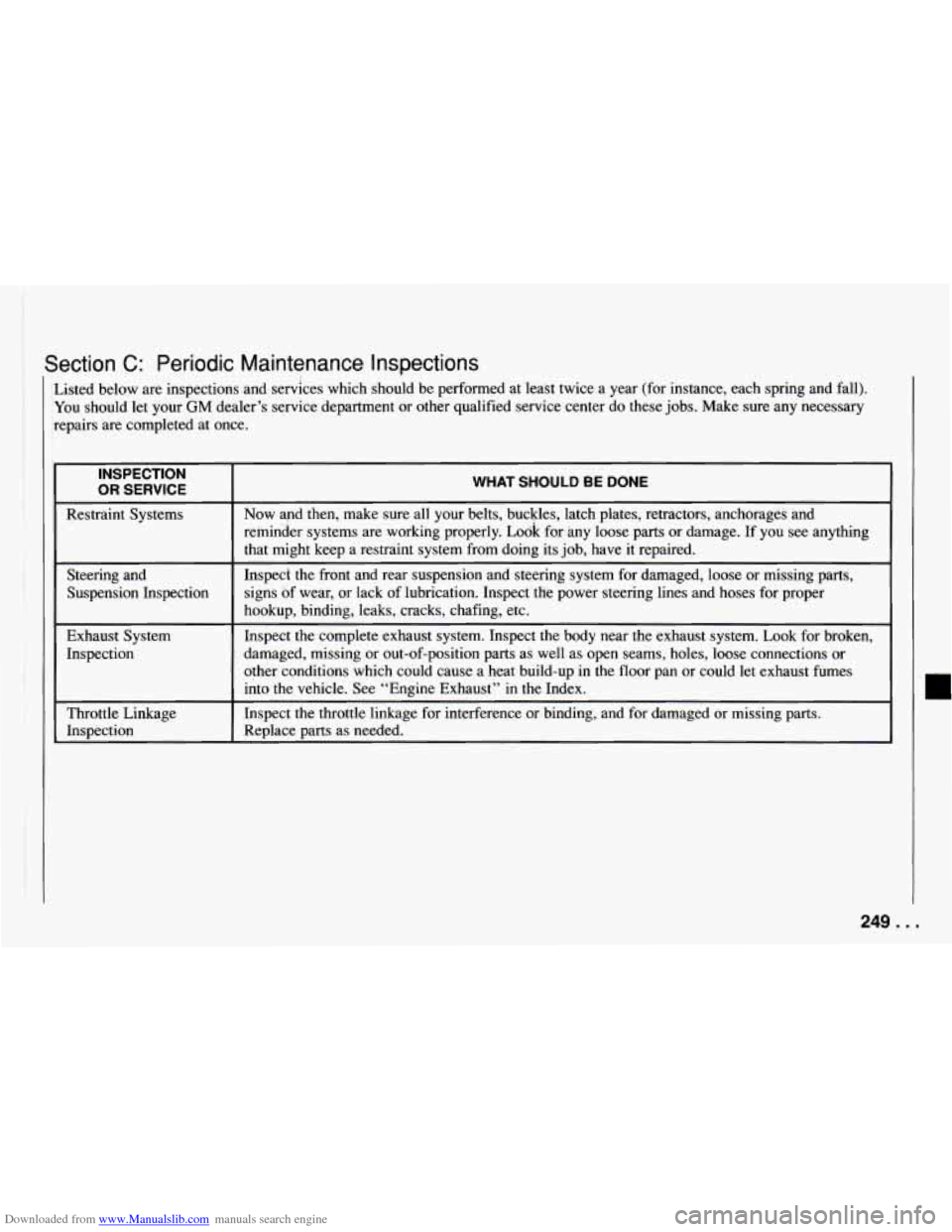
Downloaded from www.Manualslib.com manuals search engine ~ Section C: Periodic Maintenance Inspections
Listed below
are inspections and services which should be performed at least twice a year (for instance, each spring and fall).
You should let your
GM dealer’s service department or other qualified service center do these jobs. Make sure any necessary
repairs are completed at once.
INSPECTION
1 OR SERVICE WHAT
SHOULD BE DONE
Restraint Systems Now and then, make sure all your belts, buckles, latch plates, retractors, anchorages and
reininder systems are working properly. Lodk for any loose parts or damage.
If you see anything
that might keep a restraint system from doing its job, have it repaired.
Steering and Insped the front and rear suspension and steering system for damaged, loose or missing parts,
Suspension Inspection signs of wear, or lack of lubrication. Inspect the power steering lines and hoses for proper
Exhaust System Inspect the complete exhaust system. Inspect the body near the exhaust system. Look for broken,
Inspection damaged, missing or out-of-position parts as well as open seams, holes, loose connections or
hookup, binding, leaks,
cracks, chafing, etc.
other conditions which could cause a heat build-up in the floor pan or could let exhaust fumes
into the vehicle. See “Engine Exhaust” in the Index.
Throttle Linkage Inspect the throttle linkage for interference or binding, and for damaged
or missing parts.
Inspection Replace parts as needed.
L
249.. .
Page 253 of 292
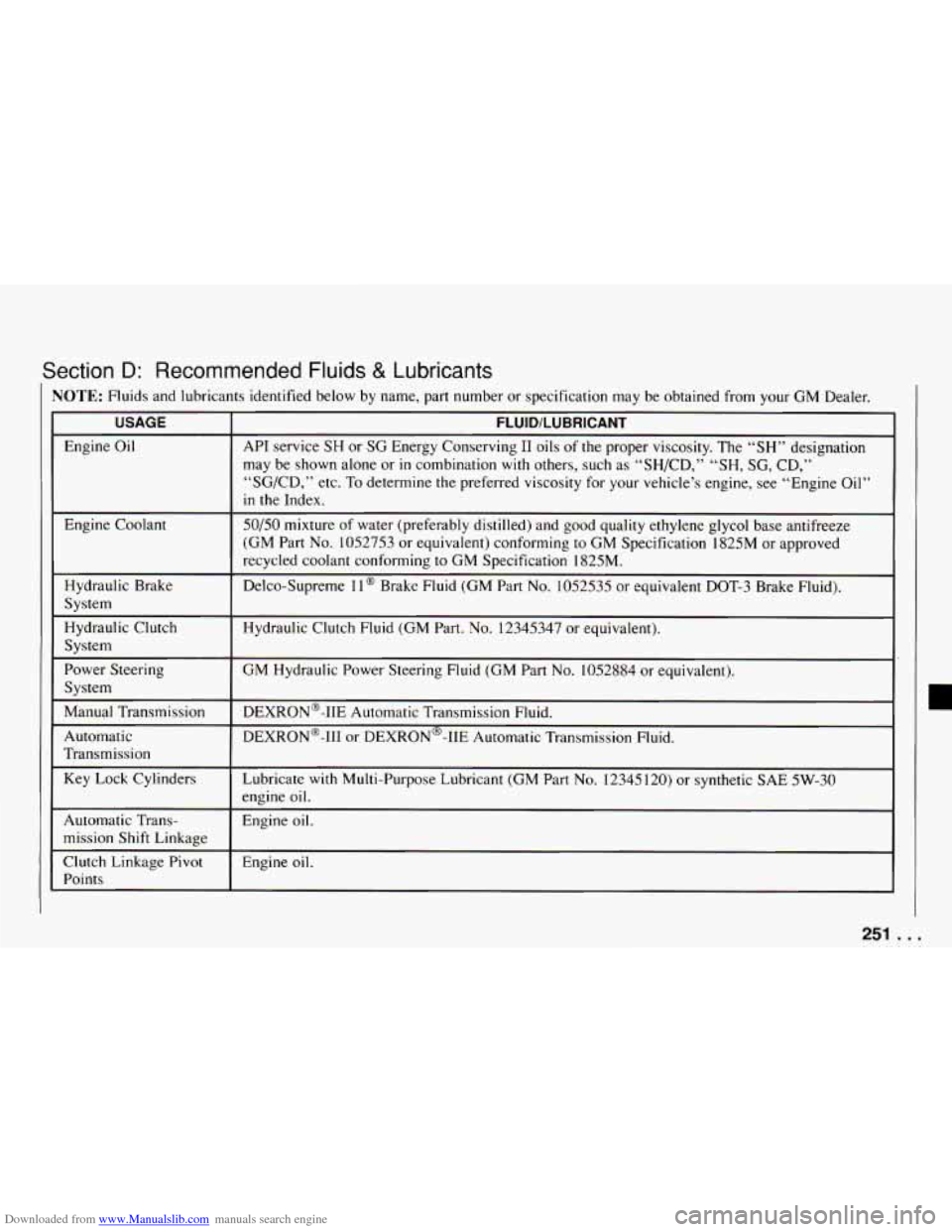
Downloaded from www.Manualslib.com manuals search engine Section D: Recommended Fluids & Lubricants
I NOTE: Fluids and lubricants identified below by name, part number or specification may be obtained from your GM Dealer.
USAGE
Engine Oil
Engine Coolant
Hydraulic Brake
System
Hydraulic Clutch
System
Power Steering
System
Manual Transmission
Automatic
Transmission
Key Lock Cylinders
Automatic Trans-
mission Shift Linkage
Clutch Linkage Pivot
Points
FLUID/LUBRICANT
API service SH or SG Energy Conserving I1 oils of the proper viscosity. The “SH” designation
may be shown alone
or in combination with others, such as “SH/CD,” “SH, SG, CD,”
“SG/CD,” etc.
To determine the preferred viscosity for your vehicle’s engine, see “Engine Oil”
in the Index.
50/50 mixture of water (preferably distilled) and good quality ethylene glycol base antifreeze
(GM Part No. 1052753 or equivalent) conforming to GM Specification 1825M or approved
recycled coolant conforming to GM Specification 1825M.
Delco-Supreme
11 @ Brake Fluid (GM Part No. 1052535 or equivalent DOT-3 Brake Fluid).
Hydraulic Clutch Fluid (GM Part.
No. 12345347 or equivalent).
- ~- -~~ --
~ M Hydraulic Power Steering Fluid (GM Part No. 1052884 or equivalent).
DEXRON@-IIE Automatic Transmission Fluid.
DEXRON@-111 or DEXRON@-IIE Automatic Transmission Fluid.
Lubricate with Multi-Purpose Lubricant (GM Part No. 12345
120) or synthetic SAE 5W-30
engine oil.
Engine oil.
Engine
oil.
251 . . .
Page 271 of 292
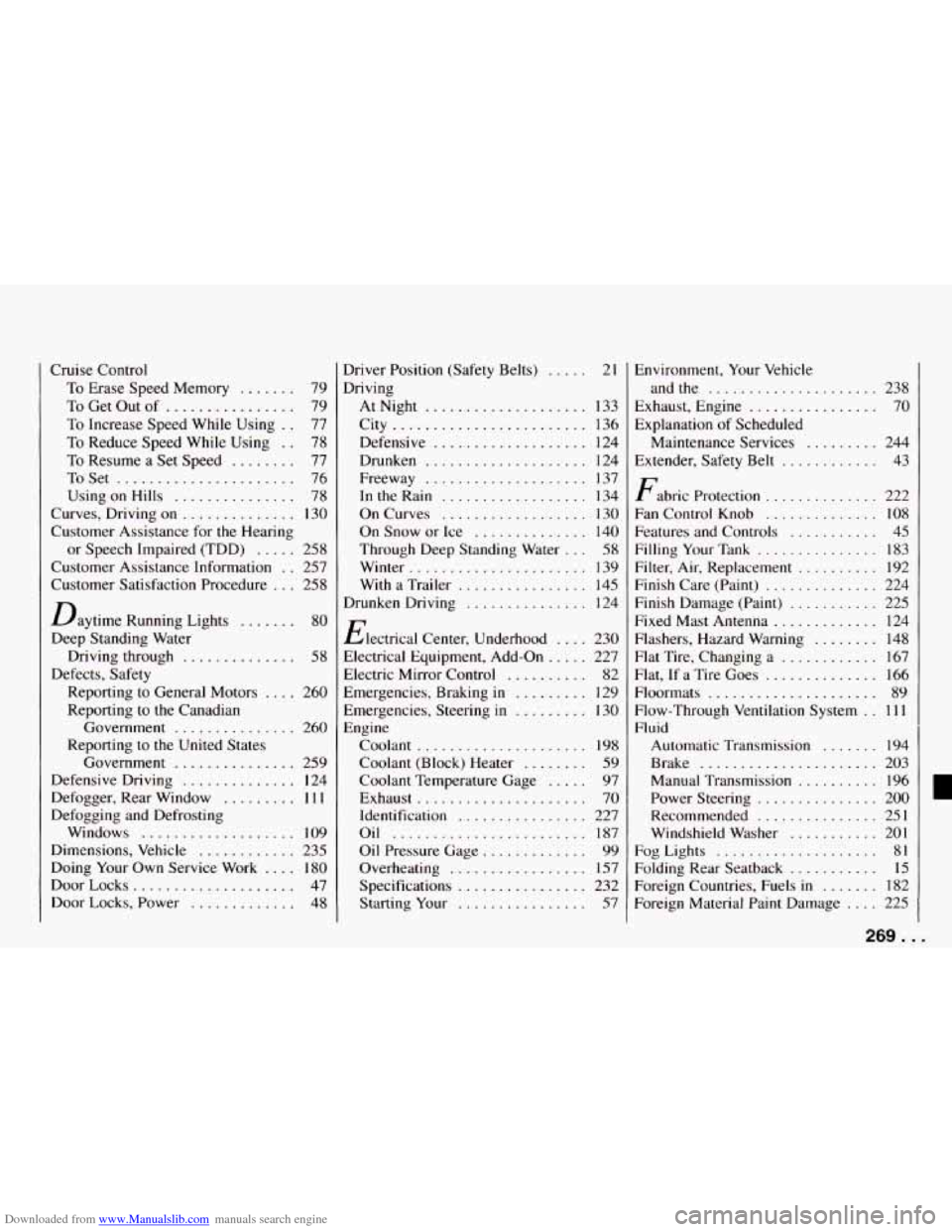
Downloaded from www.Manualslib.com manuals search engine Cruise Control To Erase Speed Memory
....... 79
To Get Out of
................ 79
To Increase Speed While Using
. . 77
To Reduce Speed While Using
. . 78
To Resume a Set Speed ........ 77
ToSet
...................... 76
Using on Hills
............... 78
Curves. Driving on
.............. 130
Customer Assistance for the Hearing
or Speech Impaired (TDD)
..... 258
Customer Assistance Information
. . 257
Customer Satisfaction Procedure
... 258
Daytime Running Lights
....... 80
Deep Standing Water
Driving through
.............. 58
Defects. Safety
Reporting to General Motors
.... 260
Reporting to the Canadian
Government
............... 260
Reporting to the United States
Government
............... 259
Defensive Driving
.............. 124
Defogger. Rear Window
......... 1 I1
Defogging and Defrosting
Windows
................... 109
Dimensions. Vehicle
............ 235
Doing Your Own Service Work
.... 180
Door Locks
.................... 47
Door Locks. Power
............. 48 Driver Position (Safety
Belts)
..... 21
Driving
AtNight
.................... 133
City
........................ 136
Defensive
................... 124
Drunken
.................... 124
Freeway
.................... 137
In the Rain .................. 134
On Curves
.................. 130
On Snow or Ice
.............. 140
Through Deep Standing Water
... 58
Winter
...................... 139
With a Trailer
................ 145
Drunken Driving
............... 124
Electrical Center. Underhood
.... 230
Electrical Equipment. Add-on
..... 227
Electric Mirror Control
.......... 82
Emergencies. Braking in
......... 129
Emergencies. Steering in
......... 130
Engine
Coolant
..................... 198
Coolant (Block) Heater
........ 59
Coolant Temperature Gage
..... 97
Exhaust
..................... 70
Identification
................ 227
Oil
........................ 187
Oil Pressure Gage
............. 99
Overheating
................. 157
Specifications
................ 232
Starting Your
................ 57 Environment.
Your Vehicle
andthe
..................... 238
Exhaust. Engine
................ 70
Explanation of Scheduled
Maintenance Services
......... 244
Extender. Safety Belt
............ 43
Fabric Protection
.............. 222
Fan Control Knob
.............. 108
Features and Controls
........... 45
Filling Your Tank
............... 183
Filter.
Air. Replacement .......... 192
Finish Care (Paint)
.............. 224
Finish Damage (Paint)
........... 225
Fixed Mast Antenna
............. 124
Flashers. Hazard Warning
........ 148
Flat Tire. Changing a ............ 167
Flat. If a Tire Goes
.............. 166
Floormats
..................... 89
Flow-Through Ventilation System . . I1 1
Fluid
Automatic Transmission
....... 194
Brake
...................... 203
Manual Transmission
.......... 196
Power Steering
............... 200
Recommended
............... 251
Windshield Washer
........... 201
FogLights
.................... 81
Folding Rear Seatback
........... 15
Foreign Countries. Fuels in ....... 182
Foreign Material Paint Damage
.... 225
269 . .