warning CHEVROLET CAMARO 1995 4.G User Guide
[x] Cancel search | Manufacturer: CHEVROLET, Model Year: 1995, Model line: CAMARO, Model: CHEVROLET CAMARO 1995 4.GPages: 388, PDF Size: 19.69 MB
Page 122 of 388
Downloaded from www.Manualslib.com manuals search engine The brake system warning light will also come on when
you set your parking brake, and it will stay
on if your
parking brake doesn’t release fully. If it stays
on after
your parking brake is fully released, it means you have a
brake problem.
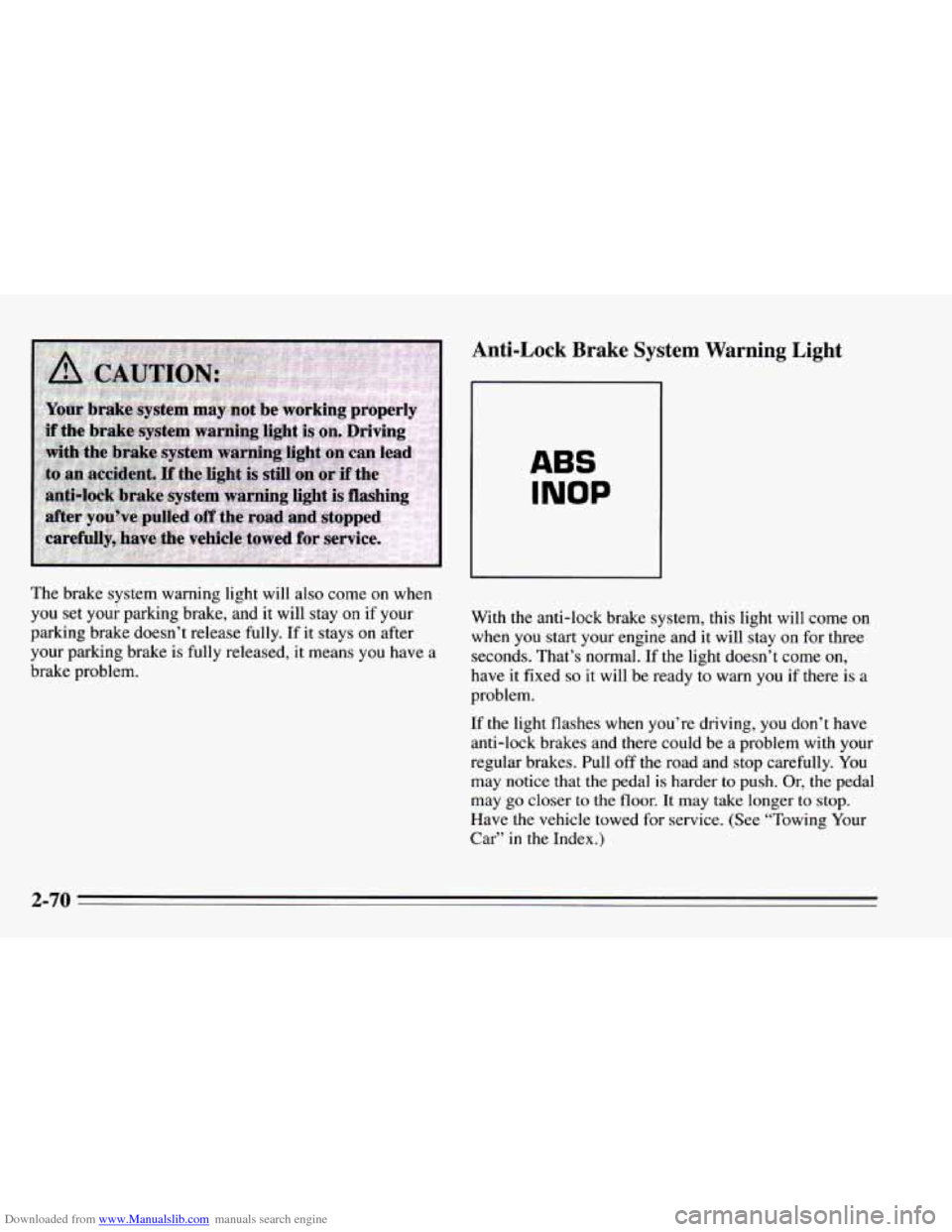
Anti-Lock Brake System Warning Light
INOP
With the anti-lock brake system, this light will come on
when
you start your engine and it will stay on for three
seconds. That’s normal. If the light doesn’t come
on,
have it fixed so it will be ready to warn you if there is a
problem.
If the light flashes
when you’re driving, you don’t have
anti-lock brakes and there could be a problem with your
regular brakes. Pull off the road and stop carefully. You
may notice that the pedal is harder to push. Or, the pedal
may go closer
to the floor. It may take longer to stop.
Have
the vehicle towed for service. (See “Towing Your
Car” in the Index.)
2-70
Page 123 of 388
Downloaded from www.Manualslib.com manuals search engine If the anti-lock brake system warning light stays on
longer than normal after you’ve started your engine, turn
the ignition off. Or, if the light comes
on and stays on
when you’re driving, stop as soon as possible and turn
the ignition off. Then start the engine again to reset the
system.
If the light still stays on, or comes on again
while you’re driving, your Chevrolet needs service. If
the light is on but
not flashing and the regular brake
system warning light isn’t on, you still have brakes, but
you don’t have anti-lock brakes.
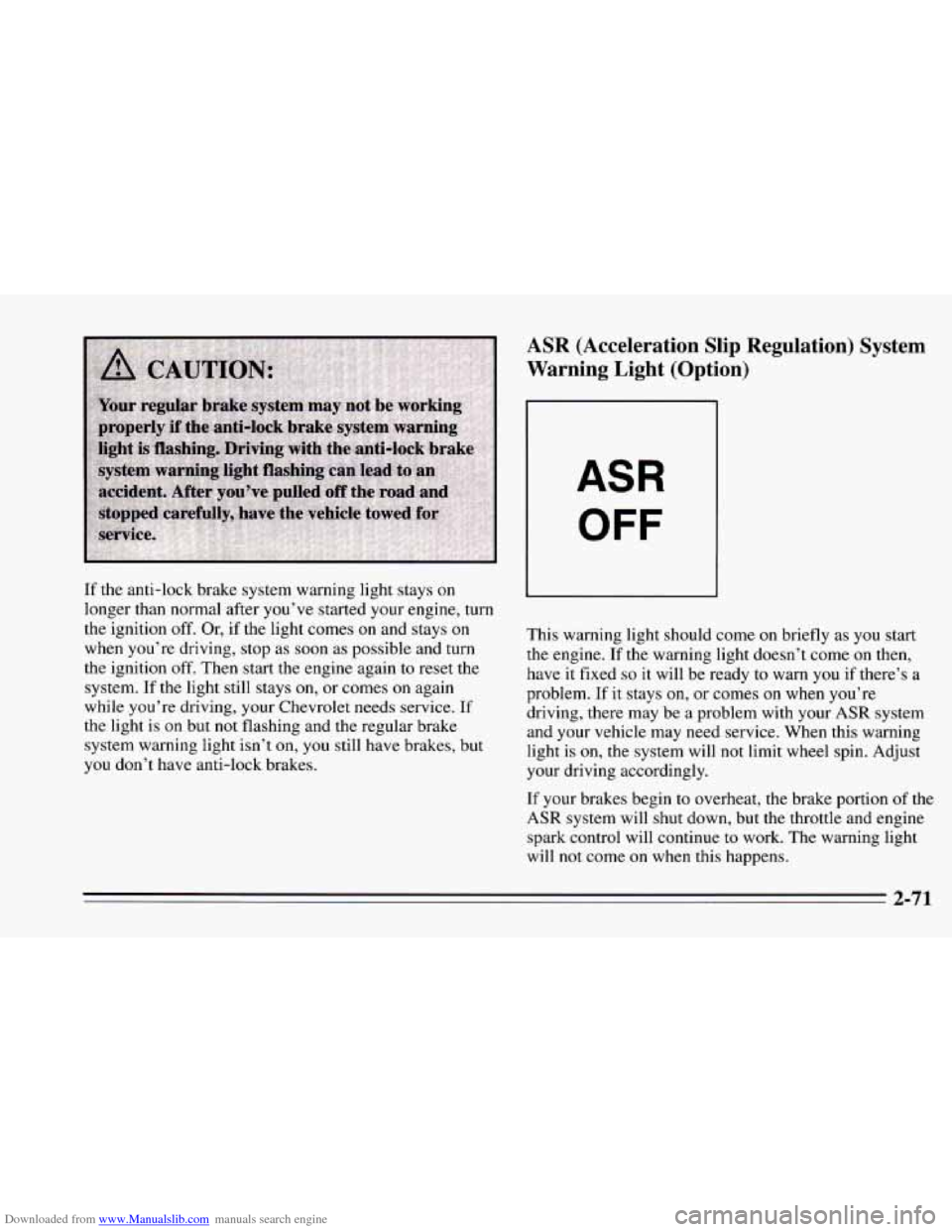
ASR (Acceleration Slip Regulation) System
Warning Light (Option)
ASR
OFF
This warning light should come on briefly as you start
the engine.
If the warning light doesn’t come on then,
have it fixed
so it will be ready to warn you if there’s a
problem. If it stays on, or comes
on when you’re
driving, there may be a problem with your
ASR system
and your vehicle may need service. When this warning
light is on, the system will not limit wheel spin. Adjust
your driving accordingly.
If your brakes begin
to overheat, the brake portion of the
ASR system will shut down, but the throttle and engine
spark control will continue to work. The warning light
will not come on when this happens.
2-71
Page 124 of 388
Downloaded from www.Manualslib.com manuals search engine The ASR system warning light may come on for the
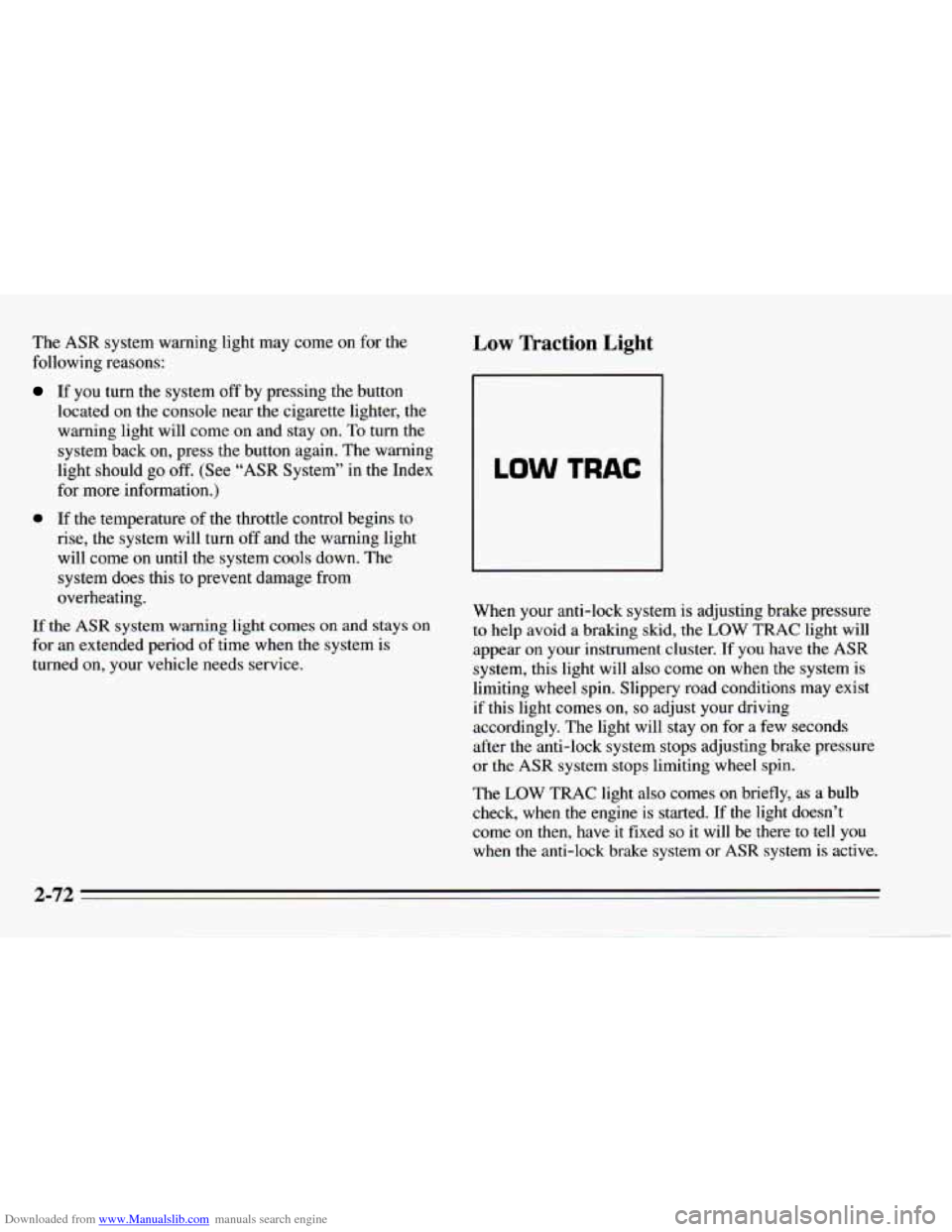
following reasons: Low Traction Light
If you turn the system off by pressing the button
located on the console near the cigarette lighter, the
warning light will come
on and stay on. To turn the
system back
on, press the button again. The warning
light should
go off. (See “ASR System” in the Index
for more information.)
0 If the temperature of the throttle control begins to
rise, the system will turn off and the warning light
will come on until the system cools down. The
system
does this to prevent damage from
overheating.
If the ASR system warning light comes on and stays on
for an extended period of time when the system is
turned on, your vehicle needs service. When your anti-lock
system is adjusting brake pressure to help avoid a braking skid, the LOW TRAC light will
appear on your instrument cluster. If you have the
ASR
system, this light will also come on when the system is
limiting wheel spin. Slippery road conditions may exist
if this light comes
on, so adjust your driving
accordingly. The light will stay on for a few seconds
after the anti-lock system stops adjusting brake pressure
or the
ASR system stops limiting wheel spin.
The
LOW TRAC light also comes on briefly, as a bulb
check, when
the engine is started. If the light doesn’t
come
on then, have it fixed so it will be there to tell you
when the anti-lock brake system or
ASR system is active.
2-72
Page 125 of 388
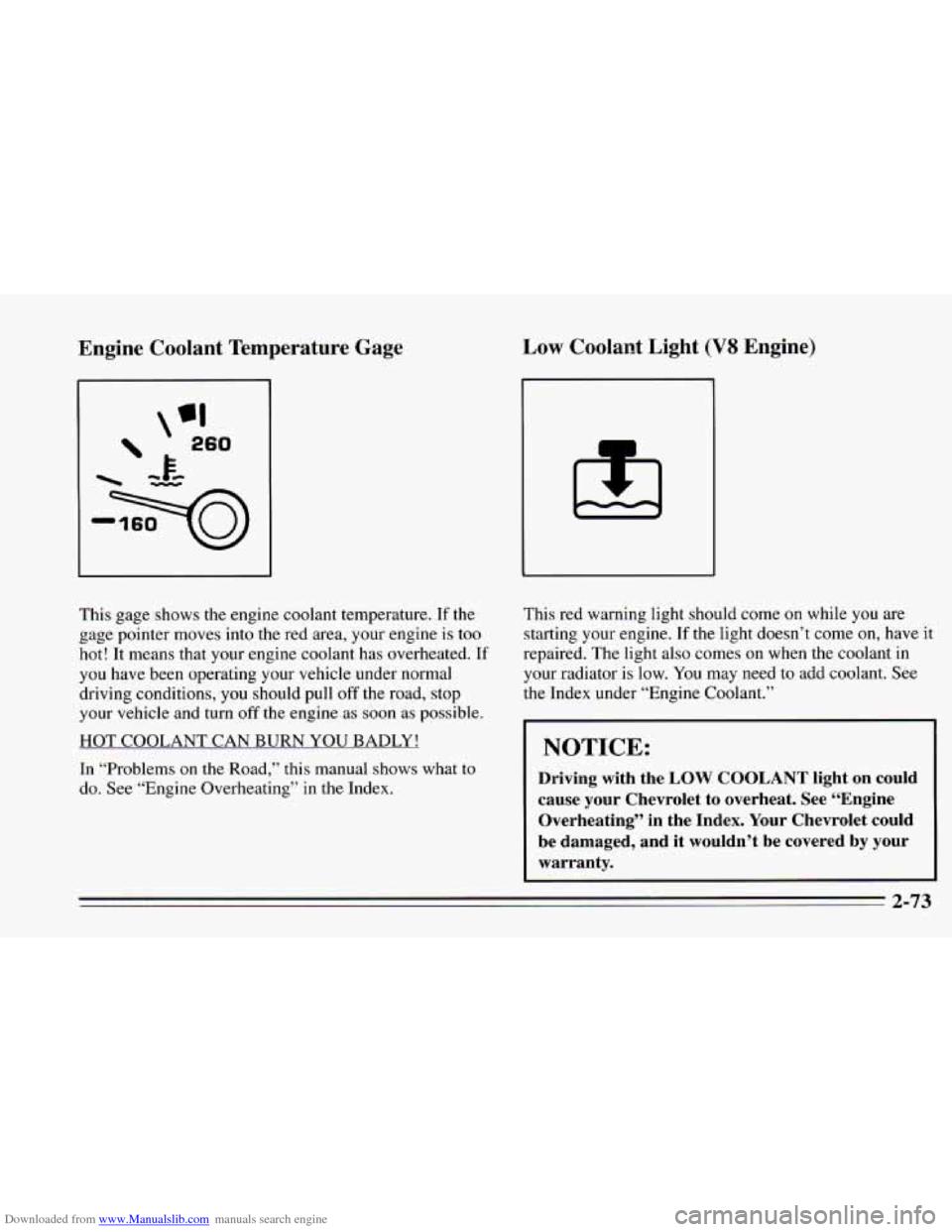
Downloaded from www.Manualslib.com manuals search engine Engine Coolant Temperature Gage Low Coolant Light (V8 Engine)
This gage shows the engine coolant temperature. If the
gage pointer moves into the red area, your engine is too
hot! It means that your engine coolant has overheated.
If
you have been operating your vehicle under normal
driving conditions, you should pull
off the road, stop
your vehicle and turn
off the engine as soon as possible.
HOT COOLANT CAN BURN YOU BADLY!
In “Problems
on the Road,” this manual shows what to
do. See “Engine Overheating” in the Index. This
red warning light should
come on while you are
starting your engine.
If the light doesn’t come on, have it
repaired. The light also comes on when the coolant in
your radiator is low. You may need to add coolant. See
the Index under “Engine Coolant.”
NOTICE:
Driving with the LOW COOLANT light on could
cause your Chevrolet to overheat. See “Engine
Overheating’’ in the Index. Your Chevrolet could
be damaged, and it wouldn’t be covered by your
warranty.
2-73
Page 129 of 388
Downloaded from www.Manualslib.com manuals search engine Low Oil Light
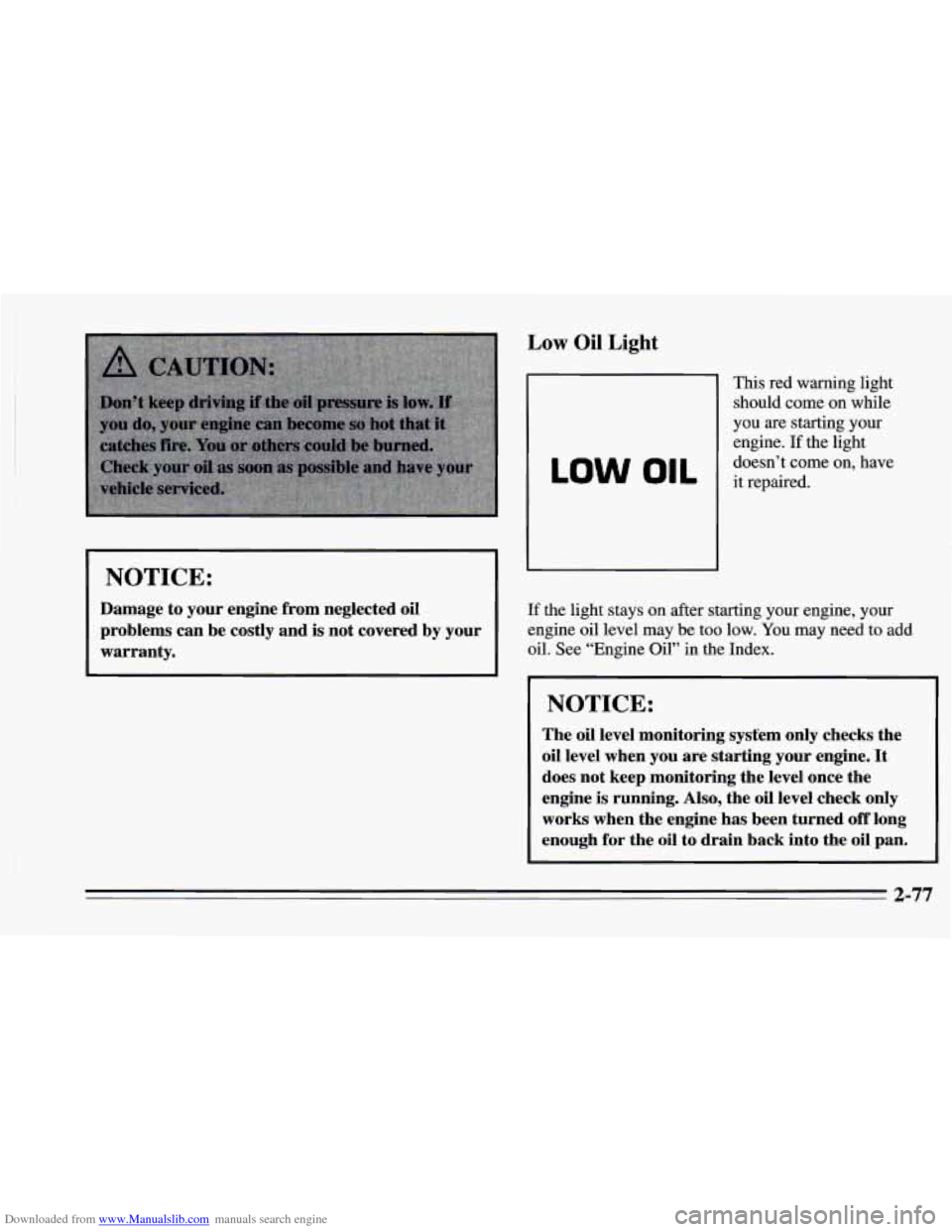
I
Damage to your engine from neglected oil
problems can be costly and
is not covered by your
warranty.
This red warning light
should come on while
you are starting your
engine. If the light
1 NOTICE:
If the light stays on after starting your engine, your
engine oil level may be too
low. You may need to add
oil. See “Engine
Oil” in the Index.
NOTICE:
The oil level monitoring system only checks the
oil level when you are starting your engine.
It
does not keep monitoring the level once the
engine
is running. Also, the oil level check only
works when the engine has been turned off long
enough for the oil to drain back into the oil pan.
2-77
Page 130 of 388
Downloaded from www.Manualslib.com manuals search engine Voltmeter
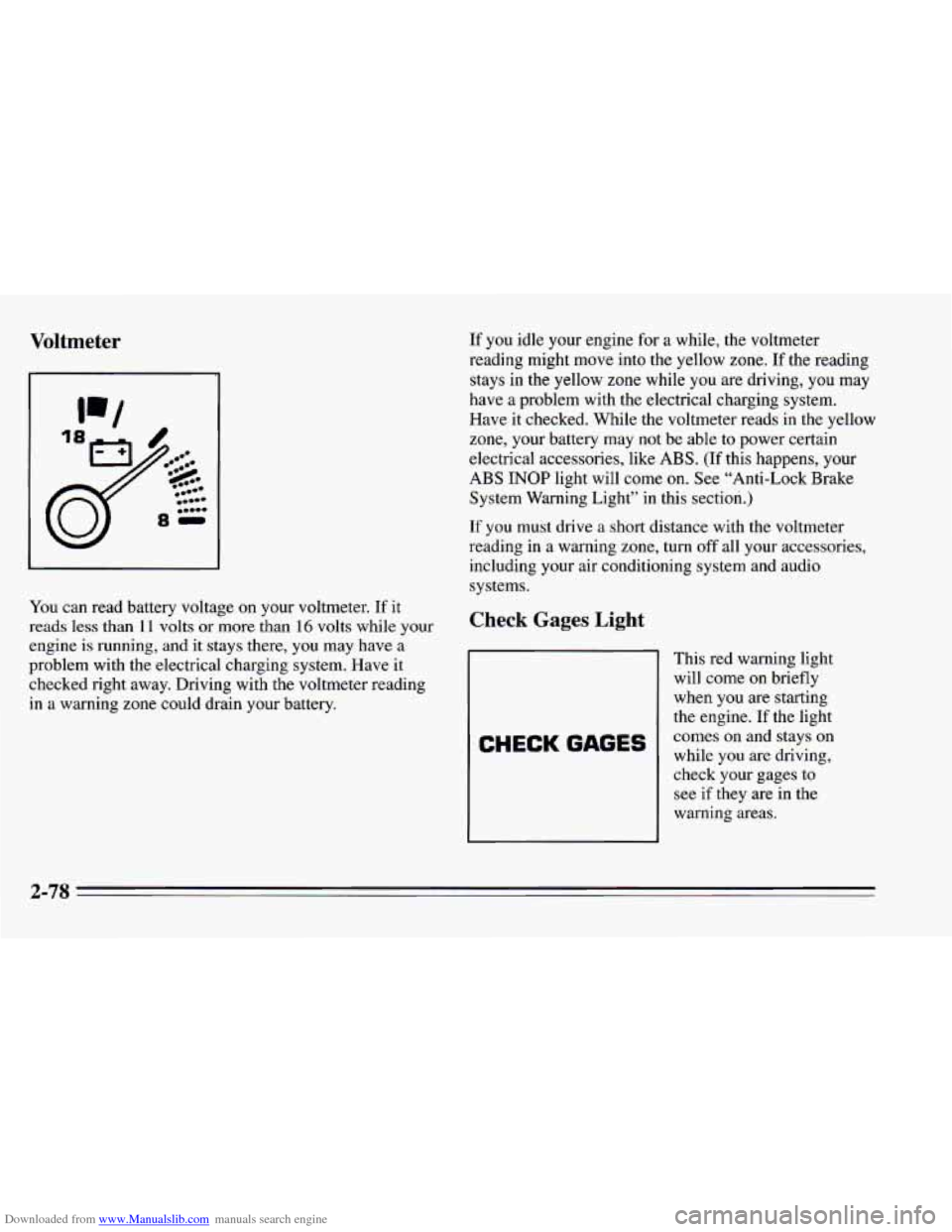
You can read battery voltage on your voltmeter. If it
reads less than
11 volts or more than 16 volts while your
engine is running, and
it stays there, you may have a
problem with the electrical charging system. Have it
checked right away. Driving with the voltmeter reading
in a warning zone could drain your battery.
If you idle your engine for a while, the voltmeter
reading might move into the yellow zone.
If the reading
stays in the yellow zone while you are driving, you may
have a problem with the electrical charging system.
Have it checked. While the voltmeter reads in the yellow
zone, your battery may
not be able to power certain
electrical accessories, like ABS.
(If this happens, your
ABS INOP light will come on. See “Anti-Lock Brake
System Warning Light” in this section.)
If you must drive a short distance with the voltmeter
reading in a warning zone, turn
off all your accessories,
including your air conditioning system and audio
systems.
Check Gages Light
CHECK GAGES
This red warning light
will come
on briefly
when you are starting
the engine.
If the light
comes on and stays on
while you are driving,
check your gages to
see if they are in the
warning areas.
2-78
Page 162 of 388
Downloaded from www.Manualslib.com manuals search engine Avoid needless heavy braking. Some people drive in
spurts
-- heavy acceleration followed by heavy braking
-- rather than keeping pace with traffic. This is a
mistake. Your brakes may
not have time to cool between
hard stops. Your brakes will wear out much faster if
you
do a lot of heavy braking. If you keep pace with the
traffic and allow realistic following distances, you will
eliminate a lot
of unnecessary braking. That means
better braking and longer brake life.
If your engine ever stops while you’re driving, brake
normally but don’t pump your brakes.
If you do, the
pedal may get harder to push down. If your engine
stops, you will still have some power brake assist. But
you will
use it when you brake. Once the power assist is
used up, it may take longer to stop and the brake pedal
will be harder
to push.
Anti-Lock Brakes (ABS)
Your Chevrolet has an advanced electronic braking
system that will help prevent a braking
skid.
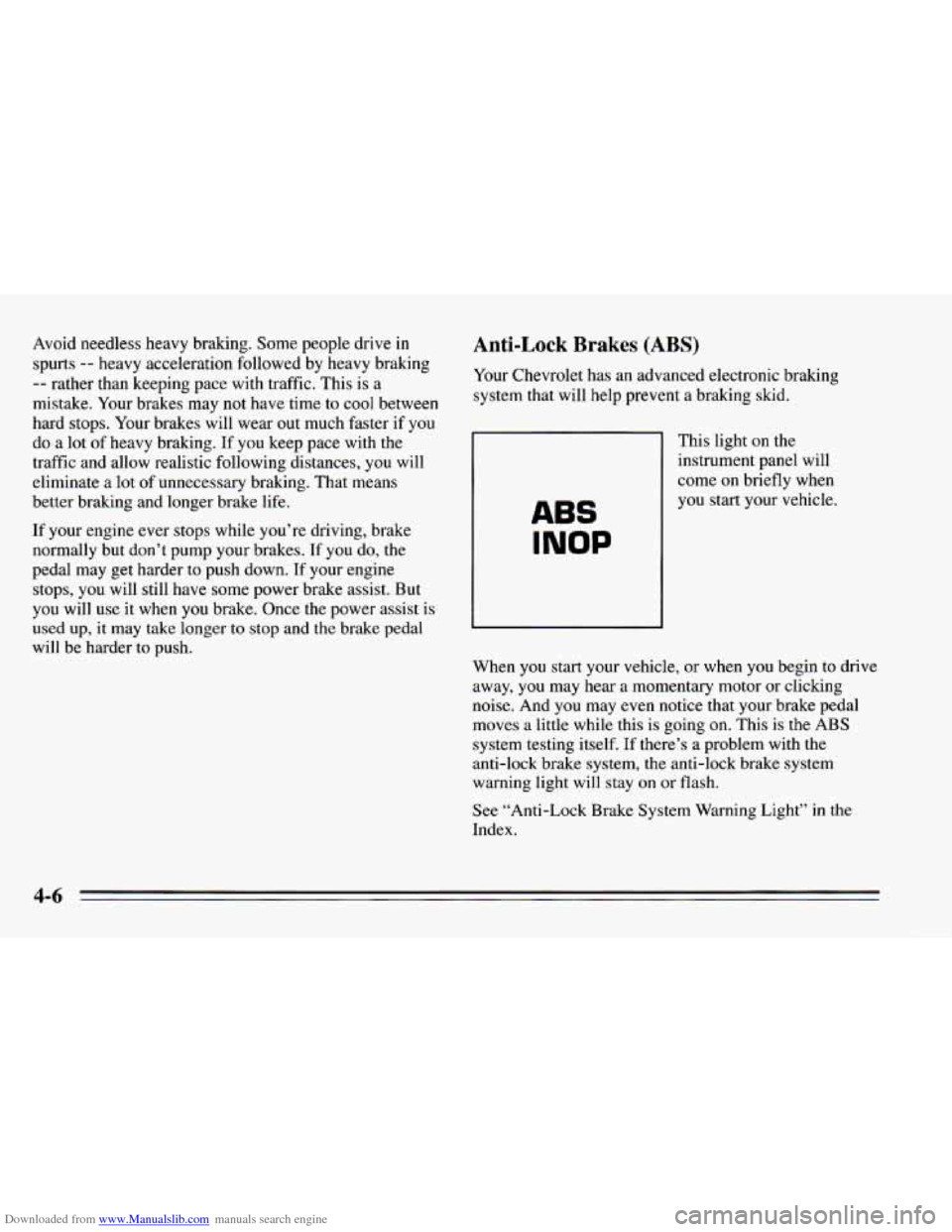
ABS
INOP
This light on the
instrument panel will
come on briefly when
you start your vehicle.
When
you start your vehicle, or when you begin to drive
away, you may hear a momentary motor or clicking
noise. And you may even notice that your brake pedal
moves a little while this is going on. This is the ABS
system testing itself. If there’s a problem with the
anti-lock brake system, the anti-lock brake system
warning light will stay
on or flash.
See “Anti-Lock Brake System Warning Light”
in the
Index.
Page 165 of 388
Downloaded from www.Manualslib.com manuals search engine ASR (Acceleration Slip Regulation) System
(Option: LT1 VS Engine)
Your vehicle may have a traction control system called
ASR that limits wheel spin. This is especially useful in
slippery road conditions. The system operates only if it
senses that one or both of the rear wheels are spinning or
beginning to lose traction.
When this happens, the system works the rear brakes
and reduces engine power (by closing the throttle and
managing engine spark)
to limit wheel spin.
The
LOW TRAC light will come on when your ASR
system is limiting wheel spin, See “Low Traction Light”
in the Index. You may feel the system working, or you
may notice some noise, but this is normal.
The
ASR system may operate on dry roads under some
conditions, and you may notice a reduction
in
acceleration when this happens. This is normal and
doesn’t mean there’s a problem with your vehicle.
Examples of these conditions include
a hard acceleration
in a turn, or an abrupt upshift or downshift. Also, when
the compact spare tire
is on the rear axle, the ASR
system will cycle and limit acceleration for about the
first
15 seconds of driving after each engine start.
If your vehicle is in cruise control when the ASR system
begins to
limit wheel spin, the cruise control will automatically
disengage. When road conditions allow
you to safely use
it again, you may re-engage the cruise
control. (See “Cruise Control”
in the Index.)
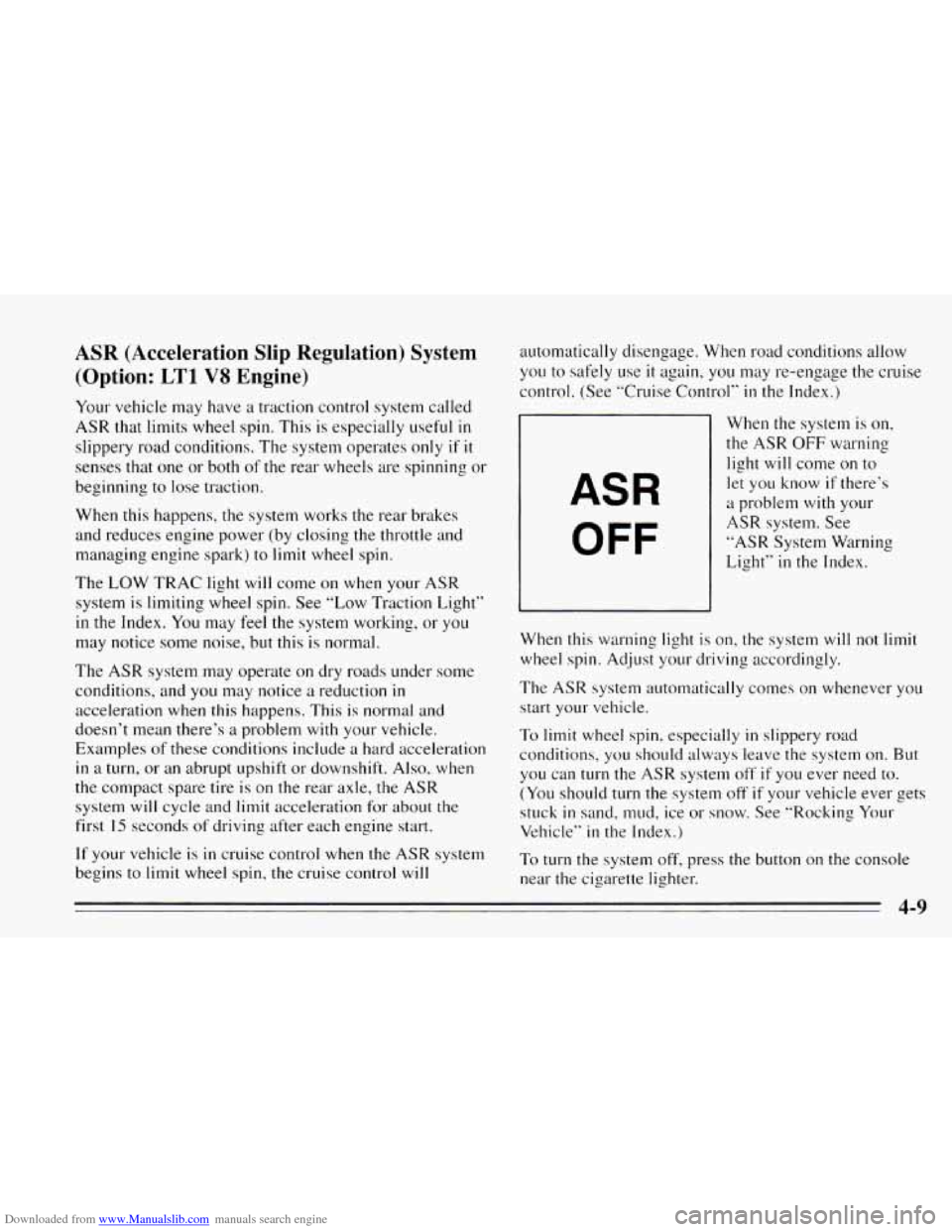
ASR
OFF
When the system is on,
the ASR OFF warning
light will come on to
let you know
if there’s
a problem with your
ASR system. See
“ASR System Warning
Light’’
in the Index.
When
this warning light is on, the system will not limit
wheel spin. Adjust your driving accordingly.
The
ASR system automatically comes on whenever you
start your vehicle.
To limit wheel spin, especially in slippery road
conditions,
you should always leave the system on. But
you can
turn the ASR system off if you ever need to.
(You should
turn the system off if your vehicle ever gets
stuck
in sand, mud, ice or snow. See “Rocking Your
Vehicle”
in the Index.)
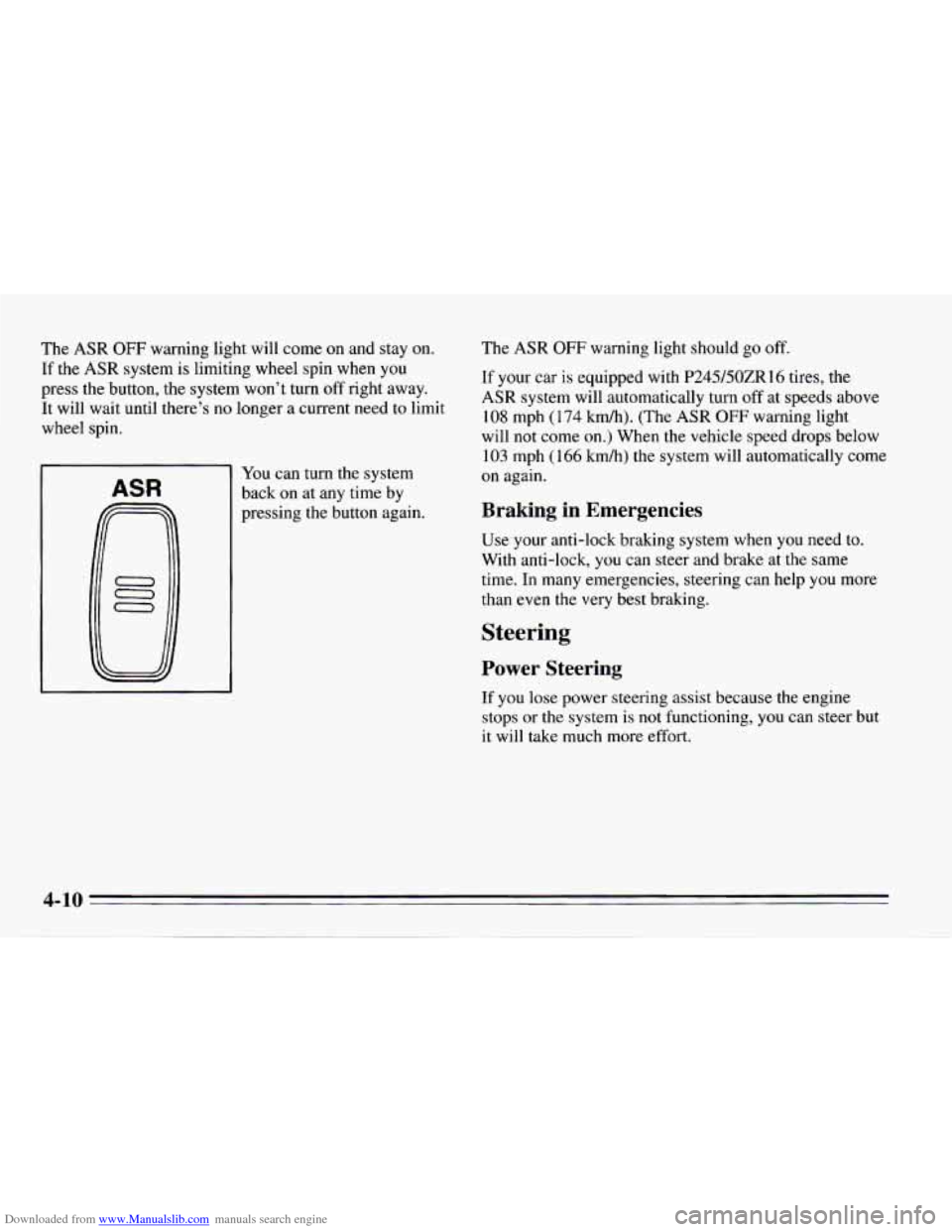
To turn the system off, press the button
on the console
near the cigarette lighter.
4-9
Page 166 of 388
Downloaded from www.Manualslib.com manuals search engine The ASR OFF warning light will come on and stay on.
If the ASR system is limiting wheel spin when you
press the button, the system won’t turn
off right away.
It will wait until there’s
no longer a current need to limit
wheel spin.
You can turn the system
back on at any time by
pressing the button again. The
ASR OFF warning
light should go off.
If your car is equipped with P245bOZR16 tires, the
ASR system will automatically turn off at speeds above
108 mph (174 Mh). (The ASR OFF warning light
will not come
on.) When the vehicle speed drops below
103 mph (166 kmh) the system will automatically come
on again.
Braking in Emergencies
Use your anti-lock braking system when you need to.
With anti-lock, you can steer and brake at the same
time. In many emergencies, steering can help you more
than even the very best braking.
Steering
Power Steering
If you lose power steering assist because the engine
stops or
the system is not functioning, you can steer but
it will take much more effort.
4-10
Page 171 of 388
Downloaded from www.Manualslib.com manuals search engine Loss of Control
Let’s review what driving experts say about what
happens when the three control systems (brakes, steering
and acceleration) don’t
have enough friction where the
tires meet the road to do what the driver has asked.
In
any emergency, don’t give up. Keep trying to steer and
constantly seek an escape route or area of less danger.
Skidding
In a skid, a driver can lose control of the vehicle.
Defensive drivers avoid most skids by taking reasonable
care suited
to existing conditions, and by not
“overdriving” those conditions. But skids are always
possible.
The three types of skids correspond to your Chevrolet’s
three control systems.
In the braking skid your wheels
aren’t rolling. In the steering or cornering skid, too
much speed
or steering in a curve causes tires to slip and
lose cornering force. And
in the acceleration skid too
much throttle causes the driving wheels to spin.
A cornering skid is best handled by easing your foot off
the accelerator pedal.
If you have the
ASR system, remember: It helps avoid
only the acceleration skid. If you
do not have ASR, or
if the system is off, then an
acceleration skid
is also best handled by easing your
foot off the accelerator pedal.
If your vehicle starts to slide,
ease your foot off the
accelerator pedal and quickly steer the way
you want the
vehicle to go.
If you start steering quickly enough, your
vehicle may straighten out. Always be ready for a
second skid if it occurs.
Of course, traction is reduced when water, snow, ice,
gravel, or other material is on the road. For safety, you’ll
want to slow down and adjust your driving to these
conditions. It is important to slow down on slippery
surfaces because stopping distance will be longer and
vehicle control more limited.
While driving on
a surface with reduced traction, try
your best to avoid sudden steering, acceleration, or
braking (including engine braking by shifting to
a lower
gear).
Any sudden changes could cause the tires to slide.
You may not realize the surface is slippery until your
vehicle is skidding. Learn to recognize warning clues
--
such as enough water, ice or packed snow on the road to
make a “mirrored surface’’ -- and slow down when you
have any doubt.
Remember: Any anti-lock brake system
(ABS) helps
avoid only the braking skid.
4-15