automatic CHEVROLET CAMARO 1995 4.G Owner's Manual
[x] Cancel search | Manufacturer: CHEVROLET, Model Year: 1995, Model line: CAMARO, Model: CHEVROLET CAMARO 1995 4.GPages: 388, PDF Size: 19.69 MB
Page 147 of 388
Downloaded from www.Manualslib.com manuals search engine Automatic Program Search
When you push APS you can go to the beginning of a
new selection.
To go forward to the beginning of the next selection,
press
,.
To go back to the beginning of the current selection
press
4. Push 4 again to go to the beginning of the
previous selection.
Program
Press the upper knob on your system to switch from one
side of the tape
to the other.
Your cassette tape player can play continuously because
the player has an auto-reverse feature.
Eject
Press STOP-EJECT fully to remove the tape or stop the
tape and switch to the radio.
Cr02 (DelcoBose System)
The Cr02 button lets you set the system for the type of
cassette being used.
If you are using chrome or metal
tapes, push Cr02 in. If you are using standard tapes,
make sure CrO2 is out.
Noise Reduction (DelcoBose System)
Your sound system has the Dolby@ automatic noise
reduction feature.
Dolby@ Noise Reduction is manufactured under license
from Dolby Laboratories Licensing Corporation. Dolby
and the double-D symbol are trademarks
of Dolby
Laboratories Licensing Corporation.
3-9
Page 165 of 388
Downloaded from www.Manualslib.com manuals search engine ASR (Acceleration Slip Regulation) System
(Option: LT1 VS Engine)
Your vehicle may have a traction control system called
ASR that limits wheel spin. This is especially useful in
slippery road conditions. The system operates only if it
senses that one or both of the rear wheels are spinning or
beginning to lose traction.
When this happens, the system works the rear brakes
and reduces engine power (by closing the throttle and
managing engine spark)
to limit wheel spin.
The
LOW TRAC light will come on when your ASR
system is limiting wheel spin, See “Low Traction Light”
in the Index. You may feel the system working, or you
may notice some noise, but this is normal.
The
ASR system may operate on dry roads under some
conditions, and you may notice a reduction
in
acceleration when this happens. This is normal and
doesn’t mean there’s a problem with your vehicle.
Examples of these conditions include
a hard acceleration
in a turn, or an abrupt upshift or downshift. Also, when
the compact spare tire
is on the rear axle, the ASR
system will cycle and limit acceleration for about the
first
15 seconds of driving after each engine start.
If your vehicle is in cruise control when the ASR system
begins to
limit wheel spin, the cruise control will automatically
disengage. When road conditions allow
you to safely use
it again, you may re-engage the cruise
control. (See “Cruise Control”
in the Index.)
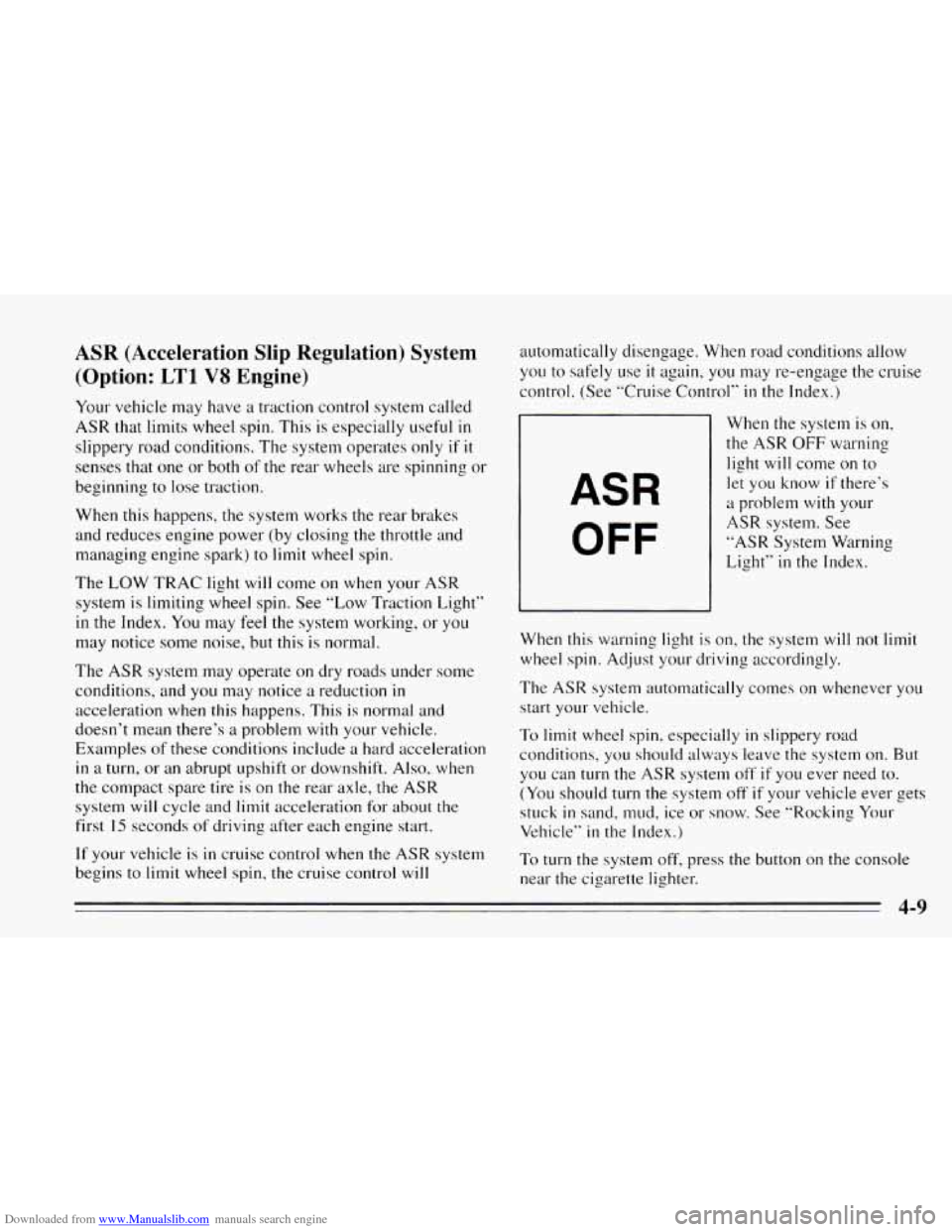
ASR
OFF
When the system is on,
the ASR OFF warning
light will come on to
let you know
if there’s
a problem with your
ASR system. See
“ASR System Warning
Light’’
in the Index.
When
this warning light is on, the system will not limit
wheel spin. Adjust your driving accordingly.
The
ASR system automatically comes on whenever you
start your vehicle.
To limit wheel spin, especially in slippery road
conditions,
you should always leave the system on. But
you can
turn the ASR system off if you ever need to.
(You should
turn the system off if your vehicle ever gets
stuck
in sand, mud, ice or snow. See “Rocking Your
Vehicle”
in the Index.)
To turn the system off, press the button
on the console
near the cigarette lighter.
4-9
Page 166 of 388
Downloaded from www.Manualslib.com manuals search engine The ASR OFF warning light will come on and stay on.
If the ASR system is limiting wheel spin when you
press the button, the system won’t turn
off right away.
It will wait until there’s
no longer a current need to limit
wheel spin.
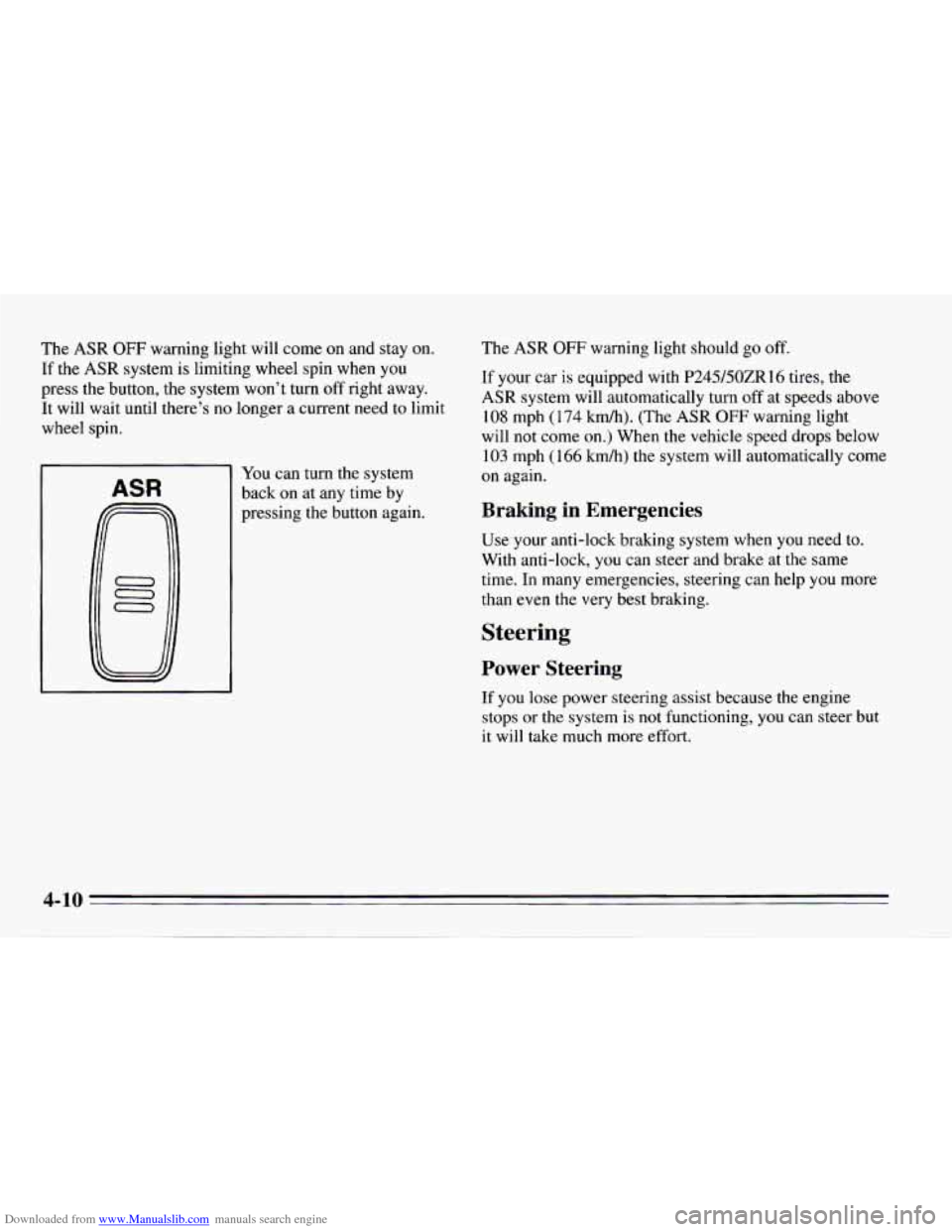
You can turn the system
back on at any time by
pressing the button again. The
ASR OFF warning
light should go off.
If your car is equipped with P245bOZR16 tires, the
ASR system will automatically turn off at speeds above
108 mph (174 Mh). (The ASR OFF warning light
will not come
on.) When the vehicle speed drops below
103 mph (166 kmh) the system will automatically come
on again.
Braking in Emergencies
Use your anti-lock braking system when you need to.
With anti-lock, you can steer and brake at the same
time. In many emergencies, steering can help you more
than even the very best braking.
Steering
Power Steering
If you lose power steering assist because the engine
stops or
the system is not functioning, you can steer but
it will take much more effort.
4-10
Page 192 of 388
Downloaded from www.Manualslib.com manuals search engine Making ’hrns When towing a trailer, the green arrows on your
instrument panel will flash for turns even if the bulbs on
the trailer are burned out. Thus, you may think drivers
NOTICE: behind you are seeing your signal when they are not. It’s
Making very sharp turns while trailering could
cause the trailer to come in contact with the
vehicle. Your vehicle could be damaged. Avoid important to check occasionally to be sure the trailer
bulbs
are still working.
Driving On Grades
making very sharp turns while trailering. Reduce speed and shift to a lower gear before you start
down
a long or steep downgrade. If you don’t shift
When you’re turning with a trailer, make wider turns
than normal.
Do this so your trailer won’t strike soft
shoulders, curbs, road signs, trees, or other objects.
Avoid jerky or sudden maneuvers. Signal well in
advance.
Turn Signals When Towing a Trailer
When you tow a trailer, your vehicle has to have a
different turn signal flasher and extra wiring. The green
arrows on your instrument panel will flash whenever
you signal a turn or lane change. Properly hooked up,
the trailer lamps will also flash, telling other drivers
you’re about to turn, change lanes or stop. down,
you might have to use your brakes
so much that
they would get hot and no longer work well.
On a long uphill grade, shift down and reduce your
speed to around
45 mph (70 km/h) to reduce the
possibility
of engine and transmission overheating.
If you are towing a trailer and you have an automatic
transmission with Overdrive, you may prefer to drive in
DRIVE (D) instead of Overdrive (or, as you need to, a
lower gear). Or, if you have a manual transmission with
FIFTH or SIXTH gear. It is better not to use FIFTH or
SIXTH gear. Just drive in FOURTH gear (FIFTH gear
if
you have a six-speed manual transmission) (or, as you
need to, a lower gear).
4-36
Page 193 of 388
Downloaded from www.Manualslib.com manuals search engine Parking on Hills
You really should not park your vehicle, with a trailer
attached,
on a hill. If something goes wrong, your rig
could start to move. People can be injured, and both
your vehicle and the trailer can be damaged.
But if you ever have to park your rig on a hill, here’s
how
to do it:
1.
2.
3.
4.
5.
Apply your regular brakes, but don’t shift into
PARK (P)
yet, or into gear for a manual
transmission.
Have someone place chocks under the trailer wheels.
When the wheel chocks
are in place, release the
regular brakes. Then apply your parking brakes until
the chocks absorb the load.
Reapply the regular brakes. Then apply your parking
brake and then shift
to PARK(P) or REVERSE (R)
for a manual transmission.
Release the regular brakes.
When You Are Ready to Leave After
Parking on a
Hill
1. Apply your regular brakes and hold the pedal down
while you:
0 Start your engine;
0 Shift into a gear; and
0 Release the parking brake.
2. Let up on the brake pedal.
3. Drive slowly until the trailer is clear of the chocks.
4. Stop and have someone pick up and store the chocks.
Maintenance When Trailer Towing
Your vehicle will need service more often when you’re
pulling a trailer. See the Maintenance Schedule for more
on this. Things that are especially important in trailer
operation are automatic transmission fluid (don’t
overfill), engine oil, axle lubricant, cooling system, and
brake adjustment. Each
of these is covered in this
manual, and the Index will help you find them quickly.
If you’re trailering, it’s a good idea
to review these
sections before you start your trip.
Check periodically
to see that all hitch nuts and bolts are
tight.
4-37
Page 196 of 388
Downloaded from www.Manualslib.com manuals search engine To turn off the flashers.
When the hazard warning flashers are on, your turn
signals won’t work.
Other Warning Devices
If you carry reflective triangles, you can set one up at
the side
of the road about 300 feet (100 m) behind your
vehicle.
Jump Starting
If your battery has run down, you may want to use
another vehicle and some jumper cables
to start your
Chevrolet. But please follow the
steps below to do it
safely.
i
NOTICE:
Ignoring these steps could result in costly damage
to your vehicle that wouldn’t be covered by your
warranty.
Trying to start your Chevrolet by pushing or
pulling it could damage your vehicle, even
if you
have a manual transmission. And
if you have an
automatic transmission, it won’t start that way.
5-2
Page 208 of 388
Downloaded from www.Manualslib.com manuals search engine If No Steam Is Coming From Your Engine
If you get the overheat warning but see or hear no
steam, the problem may not be
too serious. Sometimes
the engine can get a little too hot when you:
Climb a long hill on a hot day.
0 Stop after high speed driving.
0 Idle for long periods in traffic.
Tow a trailer.
If you get the overheat warning with no sign
of steam,
try this for a minute or
so:
1. If you have an air conditioner, turn it off.
2. Turn on your heater to full hot at the highest fan
speed and open the window as necessary.
3. If you’re in a traffic jam, shift to NEUTRAL (N);
otherwise, shift to the highest gear while
driving
-- AUTOMATIC OVERDRIVE (a)
or DRIVE (D) for automatic transmissions. If you
no longer
have the overheat warning, you can
drive. Just
to be safe, drive slower for about ten minutes.
If the warning doesn’t come back
on, you can drive
normally.
If the warning continues, pull over, stop, and park your
vehicle right away.
If there’s still no sign
of steam, you can idle the engine
for two or three minutes while you’re parked,
to see if
the warning stops. But then, if you still have the
warning,
turn ofSthe engine and get everyone out of the
vehicle
until it cools down.
You may decide not to lift the hood but to get service
help right away.
Page 231 of 388
Downloaded from www.Manualslib.com manuals search engine Compact Spare Tire
Although the compact spare was fully inflated when your
vehicle was new,
it can lose air after a time. Check the
inflation pressure regularly. It should be
60 psi
(420 kPa). After installing the compact spare on your
vehicle, you should stop as soon
as possible and make sure
your spare tire is correctly inflated.
The compact spare is
made
to perform well at posted speed limits for distances
up
to 3,000 miles (5 O00 km), so you can finish your trip
and have your full-size tire repaired or replaced where
you
want. Of course, it’s best to replace your spare with a
full-size tire as soon as you
can. Your spare will last
longer and be
in good shape in case you need it again.
When the compact spare is
on the rear axle, the optional
ASR system will cycle and limit acceleration for about
the first 15 seconds of driving after each engine start.
NOTICE:
Don’t take your compact spare through an
automatic car wash
with guide rails. The
compact spare can get caught on the rails. That
can damage the tire and wheel, and maybe other
parts
of your vehicle.
I
I NOTICE:
If the compact spare is used as a rear tire, do not
drive faster than
50 mph (80 km/h). Damage to
the rear axle may occur if the compact spare
is
driven faster than 50 mph. This speed limitation
does not apply when the compact spare is used
as
a front tire.
Don’t use your compact spare
on some other vehicle.
And don’t mix your compact spare or wheel with other
wheels or tires. They won’t fit. Keep your spare and its
wheel together.
I NOTICE:
Tire chains won’t fit your compact spare. Using
them will damage your vehicle and destroy the
chains too. Don’t use tire chains
on your compact
spare.
5-37
Page 240 of 388
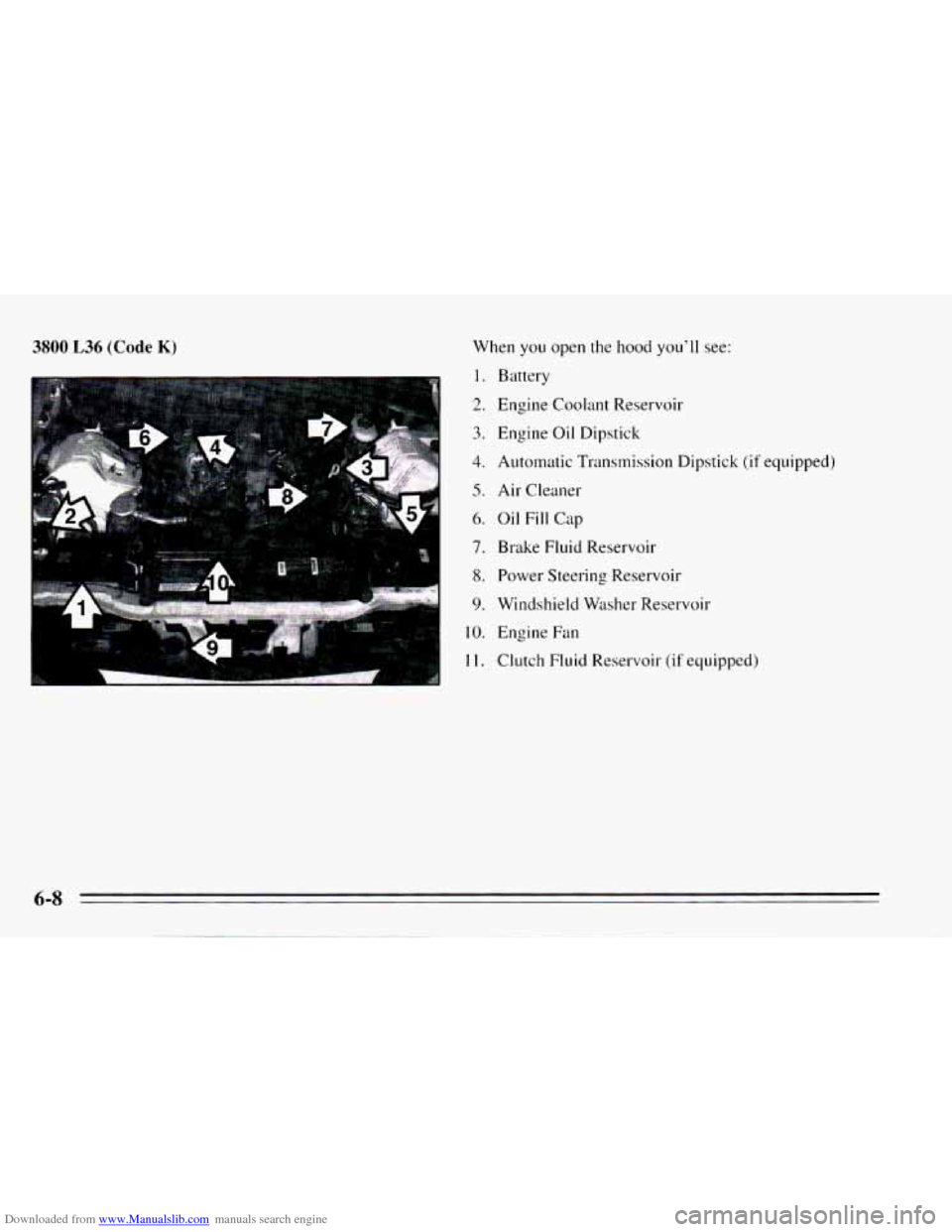
Downloaded from www.Manualslib.com manuals search engine 3800 L36 (Code K) When you open the hood you’ll see:
1.
2.
3.
4.
5.
6.
7.
8.
9.
10.
11.
Battery
Engine Coolant Reservoir
Engine
Oil Dipstick
Automatic Transmission Dipstick
(if equipped)
Air Cleaner
Oil
Fill Cup
Brake Fluid Reservoir
Power Steering Reservoir
Windshield Washer Reservoir
Engine Fan
Clutch Fluid Reservoir
(if equipped)
6-8
Page 241 of 388
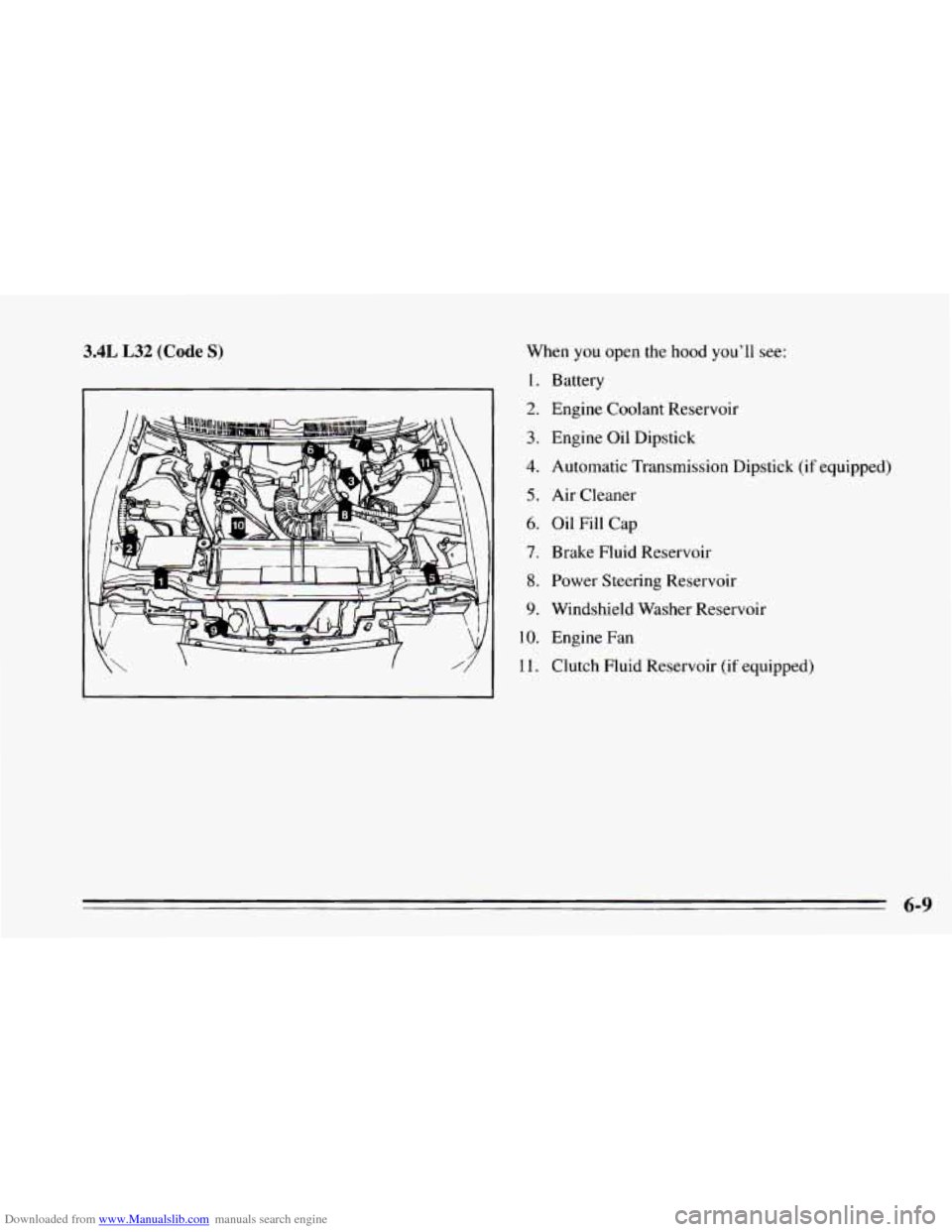
Downloaded from www.Manualslib.com manuals search engine 3.4L L32 (Code S) When you open the hood you’ll see:
1.
2.
3.
4.
5.
6.
7.
8.
9.
10.
11.
Battery
Engine Coolant Reservoir
Engine Oil Dipstick
Automatic Transmission Dipstick (if equipped)
Air Cleaner
Oil Fill Cap
Brake Fluid Reservoir
Power Steering Reservoir
Windshield Washer Reservoir
Engine Fan
Clutch Fluid Reservoir (if equipped)
6-9