manual transmission CHEVROLET CAMARO 1995 4.G Owner's Manual
[x] Cancel search | Manufacturer: CHEVROLET, Model Year: 1995, Model line: CAMARO, Model: CHEVROLET CAMARO 1995 4.GPages: 388, PDF Size: 19.69 MB
Page 94 of 388
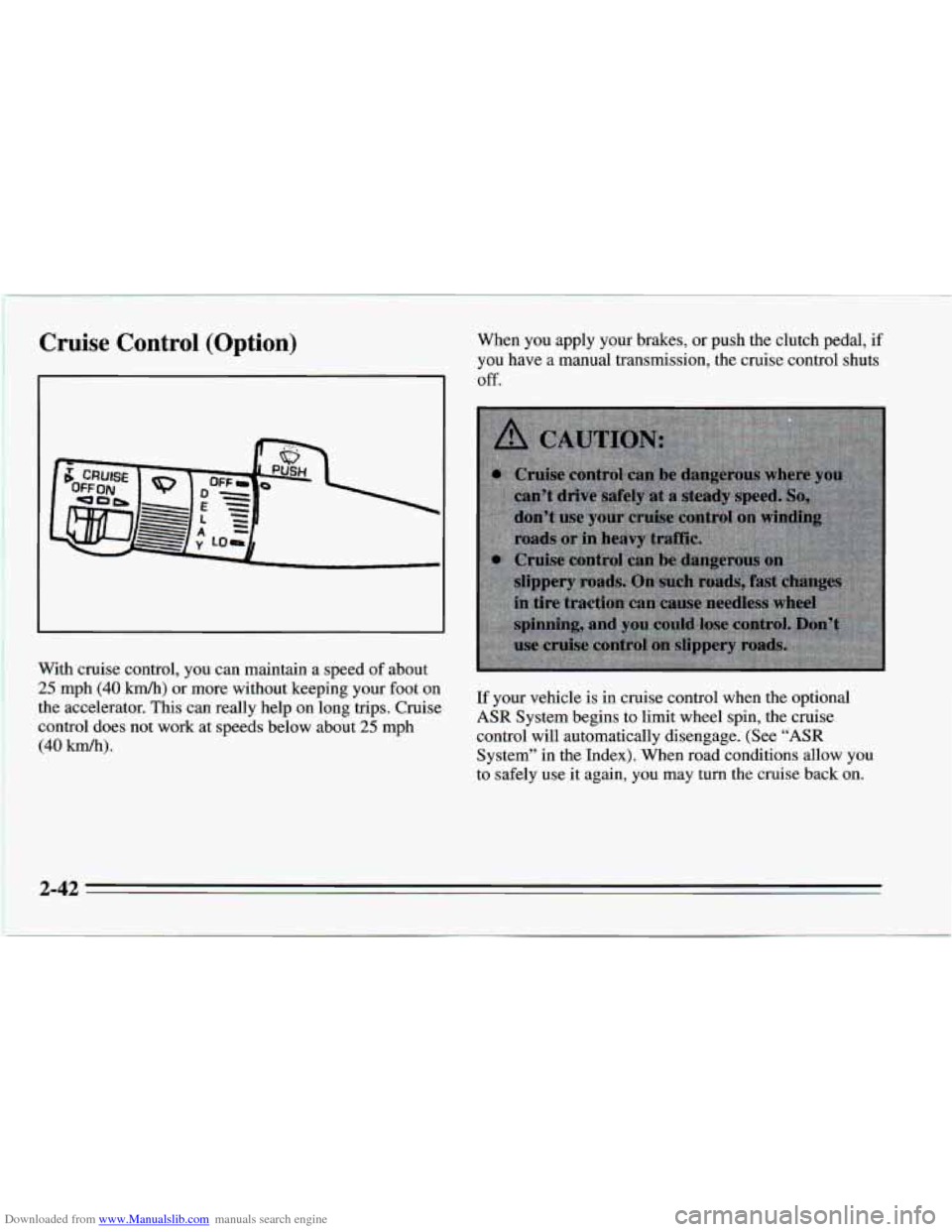
Downloaded from www.Manualslib.com manuals search engine Cruise Control (Option)
With cruise control, you can maintain a speed of about
25 mph (40 km/h) or more without keeping your foot on
the accelerator. This can really help on long trips. Cruise
control does not work at speeds below about
25 mph
(40 km/h).
When you apply your brakes, or push the clutch pedal, if
you have a manual transmission, the cruise control shuts
Off.
If your vehicle is in cruise control when the optional
ASR System begins to limit wheel spin, the cruise
control will automatically disengage. (See
“ASR
System’’ in the Index). When road conditions allow you
to safely use it again,
you may turn the cruise back on.
3 A3
Page 98 of 388
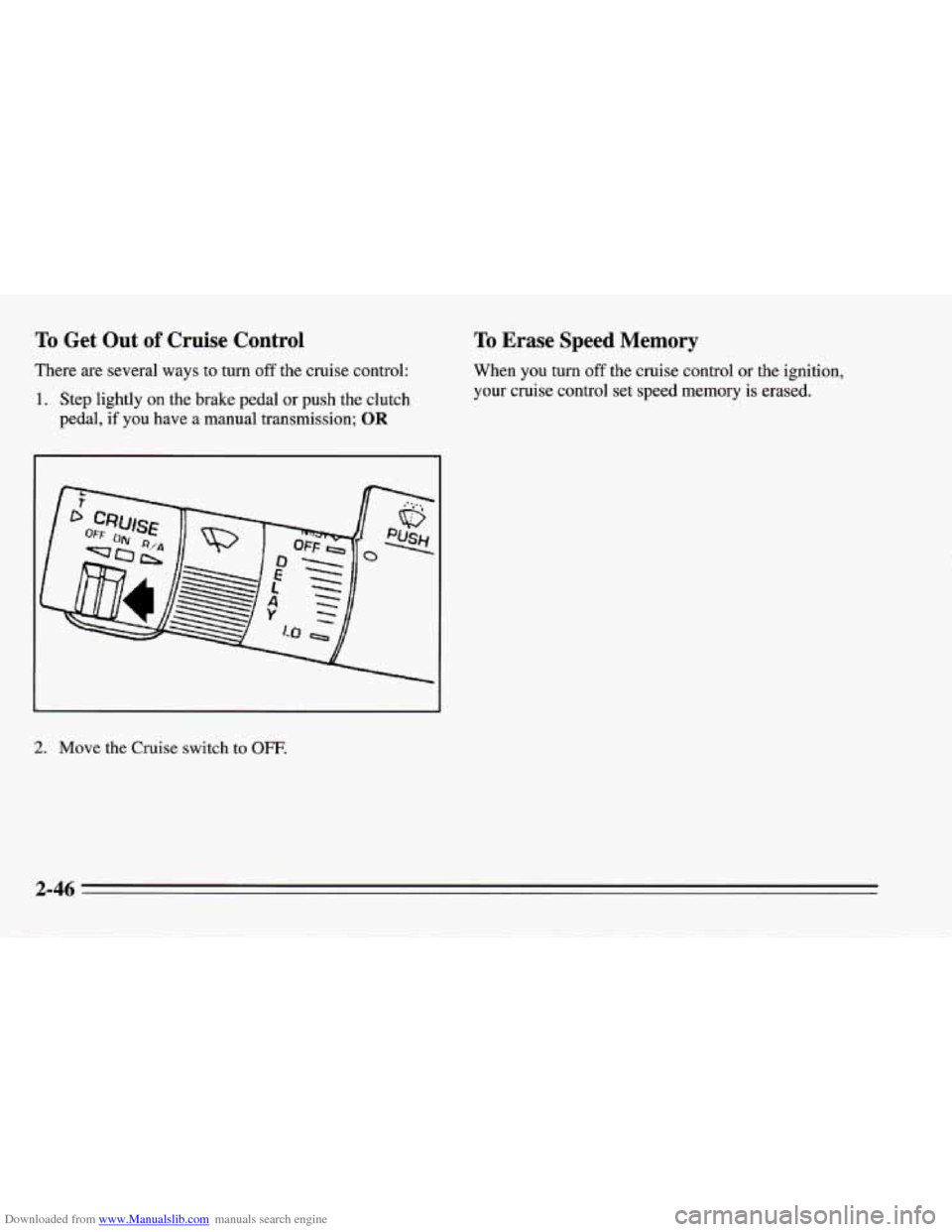
Downloaded from www.Manualslib.com manuals search engine To Get Out of Cruise Control
There are several ways to turn off the cruise control:
1. Step lightly on the brake pedal or push the clutch
pedal, if
you have a manual transmission; OR
2. Move the Cruise switch to OFF.
To Erase Speed Memory
When you turn off the cruise control or the ignition,
your cruise control
set speed memory is erased.
2-46
Page 114 of 388
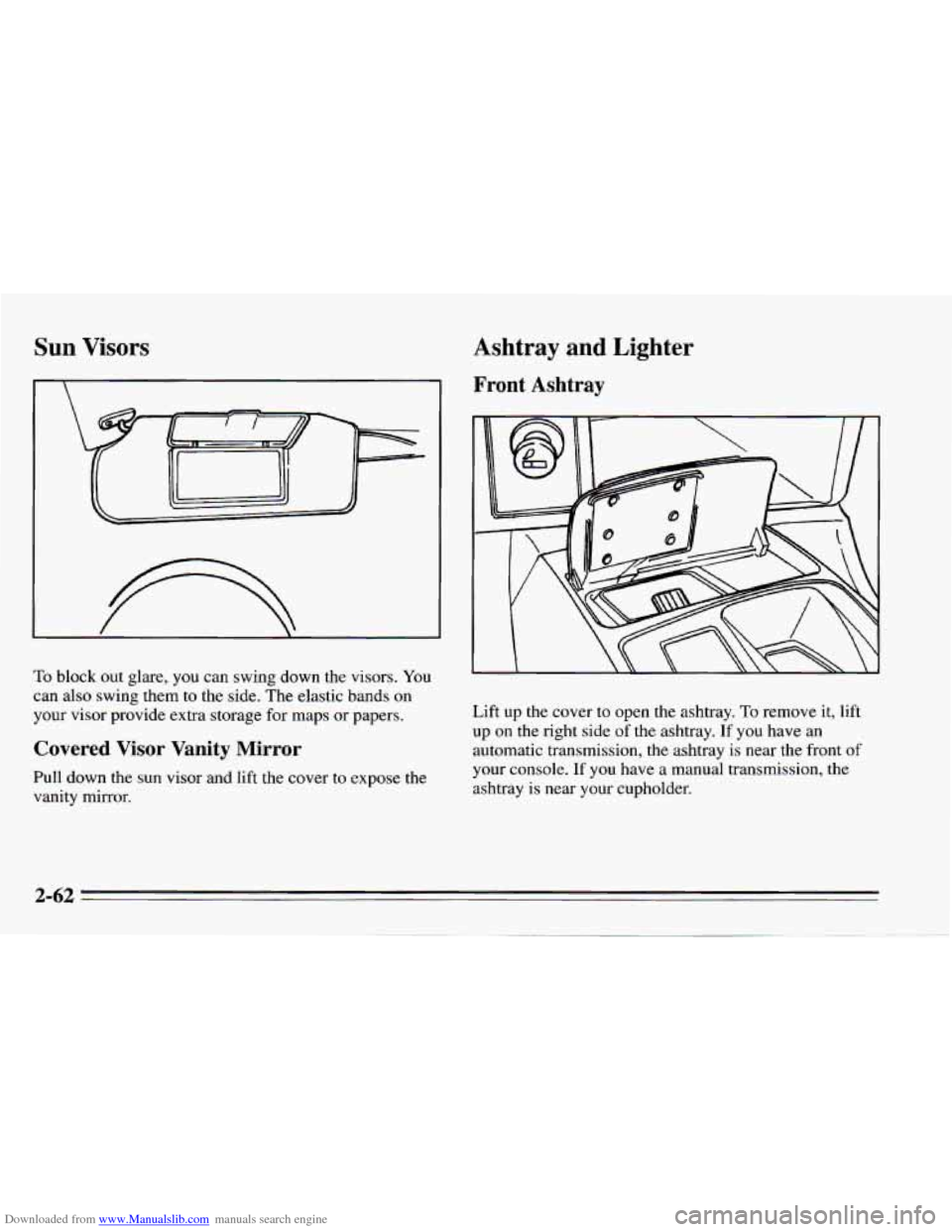
Downloaded from www.Manualslib.com manuals search engine Sun Visors
To block out glare, you can swing down the visors. You
can also swing them
to the side. The elastic bands on
your visor provide extra storage for maps or papers.
Covered Visor Vanity Mirror
Pull down the sun visor and lift the cover to expose the
vanity mirror.
Ashtray and Lighter
Front Ashtray
Lift up the cover to open the ashtray. To remove it, lift
up
on the right side of the ashtray. If you have an
automatic transmission, the ashtray is near the front
of
your console. If you have a manual transmission, the
ashtray is near your cupholder.
2-62
Page 117 of 388
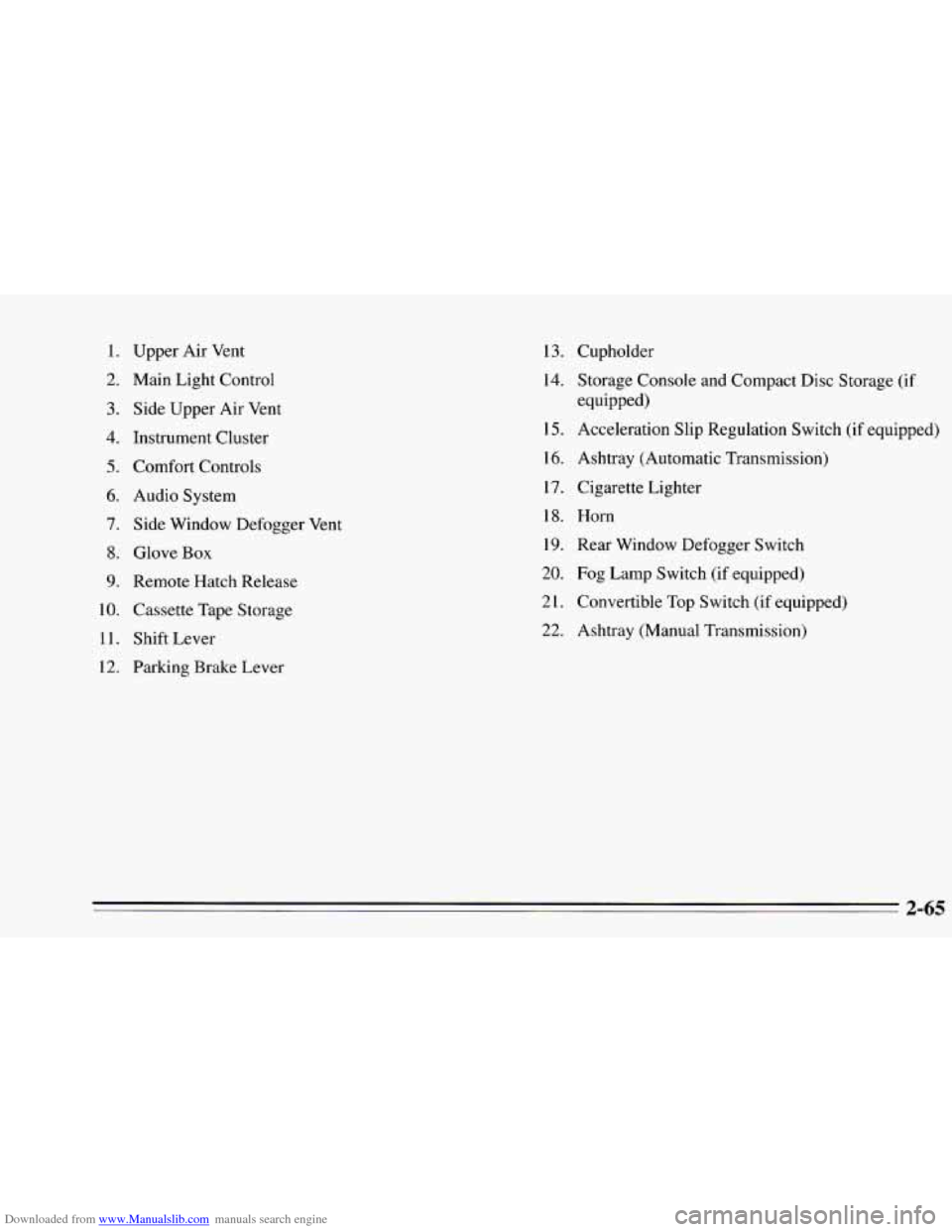
Downloaded from www.Manualslib.com manuals search engine 1. Upper Air Vent
2. Main Light Control
3. Side Upper Air Vent
4. Instrument Cluster
5. Comfort Controls
6. Audio System
7. Side Window Defogger Vent
8. Glove
Box
9. Remote Hatch Release
10. Cassette Tape Storage
11. Shift Lever
12. Parking Brake Lever 13.
Cupholder
14. Storage Console and Compact Disc Storage (if
equipped)
15. Acceleration Slip Regulation Switch (if equipped)
16. Ashtray (Automatic Transmission)
17. Cigarette Lighter
18.
Horn
19. Rear Window Defogger Switch
20. Fog Lamp Switch (if equipped)
2 1. Convertible Top Switch (if equipped)
22. Ashtray (Manual Transmission)
2-65
Page 132 of 388
Downloaded from www.Manualslib.com manuals search engine Convertible Top
The following procedures explain the proper operation
of
your convertible top.
To Lower Your Convertible Top
NOTICE:
Don't leave your convertible out with the top
down for any long periods of time. The sun and
the rain can damage your seat material and other
things inside your vehicle,
1. Park on a level surface. Set the parking brake firmly.
Shift an automatic transmission into
PARK (P) or a
manual transmission into REVERSE (R). The
ignition must be in the
ACC or RUN position. Lower
both sun visors.
NOTICE:
Don't lower the top if it is damp or wet, When
the top is down, trapped water can cause stains,
mildew and damage to the inside of your vehicle.
Be sure to dry
off the top before you lower it.
I NOTICE:
It is not recommended to lower the top if the
vehicle
is out in cold weather, 0" F (-18" C) or
lower.
2-80
I
Page 135 of 388
Downloaded from www.Manualslib.com manuals search engine To Raise Your Convertible Top
1. Park on a level surface. Set the parking brake firmly.
If
you have an automatic transmission, shift into
PARK
(P). If you have a manual transmission, shift
into REVERSE (R). The ignition must be in the
ACC or RUN position. Then lower both sun visors
and lower both windows at least three inches. If the
boot cover is in place, it must be removed first.
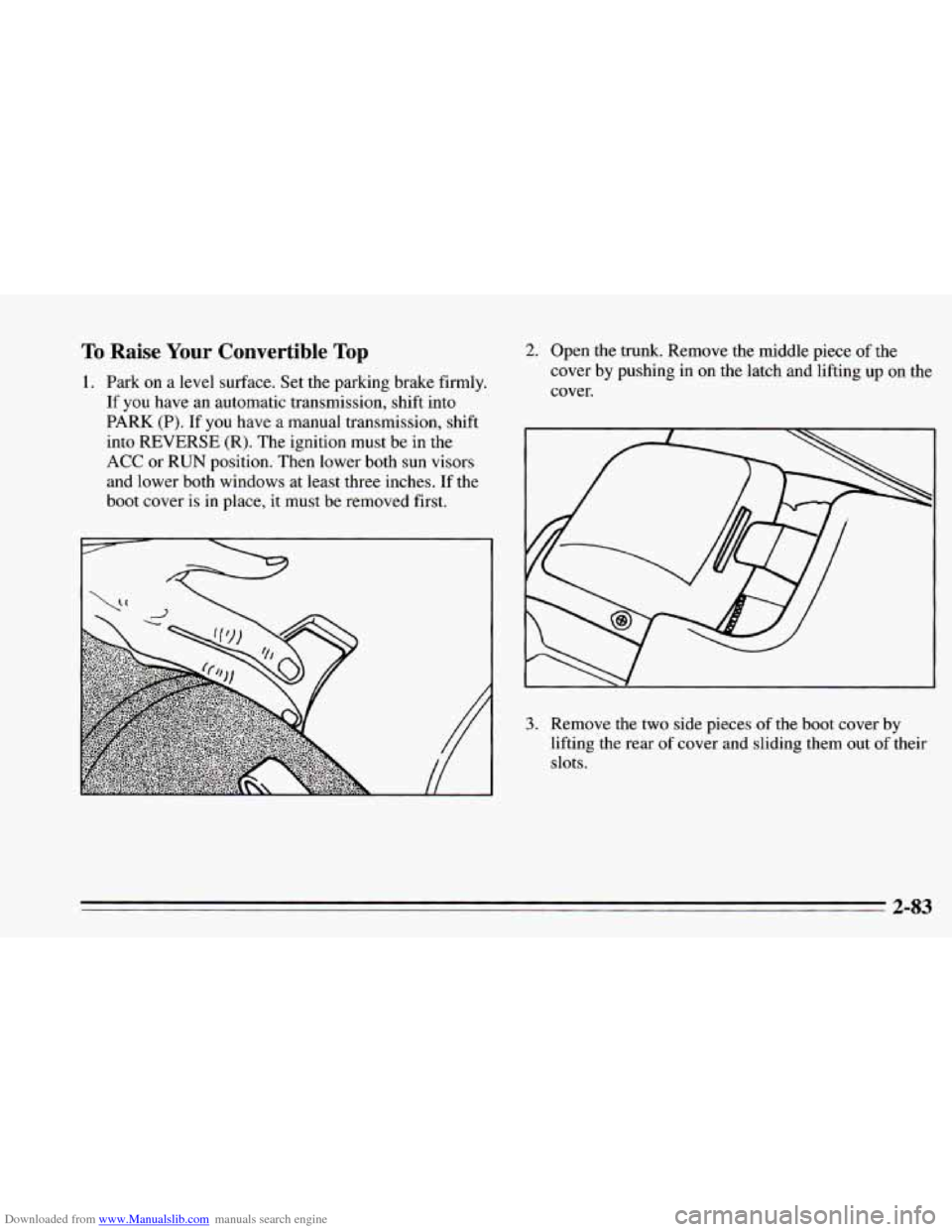
2. Open the trunk. Remove the middle piece of the
cover
by pushing in on the latch and lifting up on the
cover.
3. Remove the two side pieces of the boot cover by
lifting
the rear of cover and sliding them out of their
slots.
2-83
Page 180 of 388
Downloaded from www.Manualslib.com manuals search engine If you drive regularly in steep country, or if you’re
planning
to visit there, here are some tips that can make
your trips safer and more enjoyable.
Keep your vehicle in good shape. Check all fluid
levels and also the brakes, tires, cooling system and
transmission. These parts can work hard
on
mountain roads.
Know how to go down hills. The most important
thing to know is this: let your engine do some of
the
slowing down. Shift to a lower gear when you go
down a steep or long hill. 0
0
0
0
Know how to go uphill. You may want to shift down
to a lower gear. The lower gears help cool your engine
and transmission, and you
can climb the hill better.
Stay in your
own lane when driving on two-lane
roads in hills or mountains. Don’t swing wide or cut
across the center
of the road. Drive at speeds that let
you stay in your own lane.
As you go over the top of a hill, be alert. There could be
something in your lane, like a stalled car or an accident.
You may see highway signs on mountains that warn
of special problems. Examples are long grades,
passing or no-passing zones, a falling rocks area, or
winding roads. Be alert
to these and take appropriate
action.
4-24
Page 187 of 388
Downloaded from www.Manualslib.com manuals search engine Towing a Trailer
NOTICE:
Pulling a trailer improperly can damage your
vehicle and result in costly repairs not covered
by
your warranty. To pull a trailer correctly, follow
the advice in this part, and see your Chevrolet
dealer for important information about towing a
trailer with your vehicle.
Your car can tow a trailer if it is equipped with the
proper trailer towing equipment. To identify what the
vehicle trailering capacity is for your vehicle,
you
should read the information in “Weight of the Trailer”
that appears later
in this section. But trailering is
different than just driving your vehicle by itself.
Trailering means changes in handling, durability, and
fuel economy. Successful, safe trailering takes correct
equipment, and
it has to be used properly.
That’s the reason for this part. In
it are many
time-tested, important trailering tips and safety rules.
Many of these are important for your safety and that
of
your passengers. So please read this section carefully
before you pull a trailer.
Load-pulling components such as the engine,
transmission, rear axle, wheel assemblies, and tires are
forced to work harder against the drag
of the added
weight. The engine
is required to operate at relatively
higher speeds and under greater loads, generating extra
heat. What’s more, the trailer adds considerably
to wind
resistance, increasing the pulling requirements.
4-31
Page 192 of 388
Downloaded from www.Manualslib.com manuals search engine Making ’hrns When towing a trailer, the green arrows on your
instrument panel will flash for turns even if the bulbs on
the trailer are burned out. Thus, you may think drivers
NOTICE: behind you are seeing your signal when they are not. It’s
Making very sharp turns while trailering could
cause the trailer to come in contact with the
vehicle. Your vehicle could be damaged. Avoid important to check occasionally to be sure the trailer
bulbs
are still working.
Driving On Grades
making very sharp turns while trailering. Reduce speed and shift to a lower gear before you start
down
a long or steep downgrade. If you don’t shift
When you’re turning with a trailer, make wider turns
than normal.
Do this so your trailer won’t strike soft
shoulders, curbs, road signs, trees, or other objects.
Avoid jerky or sudden maneuvers. Signal well in
advance.
Turn Signals When Towing a Trailer
When you tow a trailer, your vehicle has to have a
different turn signal flasher and extra wiring. The green
arrows on your instrument panel will flash whenever
you signal a turn or lane change. Properly hooked up,
the trailer lamps will also flash, telling other drivers
you’re about to turn, change lanes or stop. down,
you might have to use your brakes
so much that
they would get hot and no longer work well.
On a long uphill grade, shift down and reduce your
speed to around
45 mph (70 km/h) to reduce the
possibility
of engine and transmission overheating.
If you are towing a trailer and you have an automatic
transmission with Overdrive, you may prefer to drive in
DRIVE (D) instead of Overdrive (or, as you need to, a
lower gear). Or, if you have a manual transmission with
FIFTH or SIXTH gear. It is better not to use FIFTH or
SIXTH gear. Just drive in FOURTH gear (FIFTH gear
if
you have a six-speed manual transmission) (or, as you
need to, a lower gear).
4-36
Page 193 of 388
Downloaded from www.Manualslib.com manuals search engine Parking on Hills
You really should not park your vehicle, with a trailer
attached,
on a hill. If something goes wrong, your rig
could start to move. People can be injured, and both
your vehicle and the trailer can be damaged.
But if you ever have to park your rig on a hill, here’s
how
to do it:
1.
2.
3.
4.
5.
Apply your regular brakes, but don’t shift into
PARK (P)
yet, or into gear for a manual
transmission.
Have someone place chocks under the trailer wheels.
When the wheel chocks
are in place, release the
regular brakes. Then apply your parking brakes until
the chocks absorb the load.
Reapply the regular brakes. Then apply your parking
brake and then shift
to PARK(P) or REVERSE (R)
for a manual transmission.
Release the regular brakes.
When You Are Ready to Leave After
Parking on a
Hill
1. Apply your regular brakes and hold the pedal down
while you:
0 Start your engine;
0 Shift into a gear; and
0 Release the parking brake.
2. Let up on the brake pedal.
3. Drive slowly until the trailer is clear of the chocks.
4. Stop and have someone pick up and store the chocks.
Maintenance When Trailer Towing
Your vehicle will need service more often when you’re
pulling a trailer. See the Maintenance Schedule for more
on this. Things that are especially important in trailer
operation are automatic transmission fluid (don’t
overfill), engine oil, axle lubricant, cooling system, and
brake adjustment. Each
of these is covered in this
manual, and the Index will help you find them quickly.
If you’re trailering, it’s a good idea
to review these
sections before you start your trip.
Check periodically
to see that all hitch nuts and bolts are
tight.
4-37