light CHEVROLET CAMARO 1995 4.G Workshop Manual
[x] Cancel search | Manufacturer: CHEVROLET, Model Year: 1995, Model line: CAMARO, Model: CHEVROLET CAMARO 1995 4.GPages: 388, PDF Size: 19.69 MB
Page 184 of 388
Downloaded from www.Manualslib.com manuals search engine cloth to your vehicle to alert police that you’ve been
stopped by the snow. Put
on extra clothing or wrap a
blanket around you. If you have no blankets or extra
clothing,
make body insulators from newspapers, burlap
bags, rags, floor mats
-- anything you can wrap around
yourself
or tuck under your clothing to keep warm.
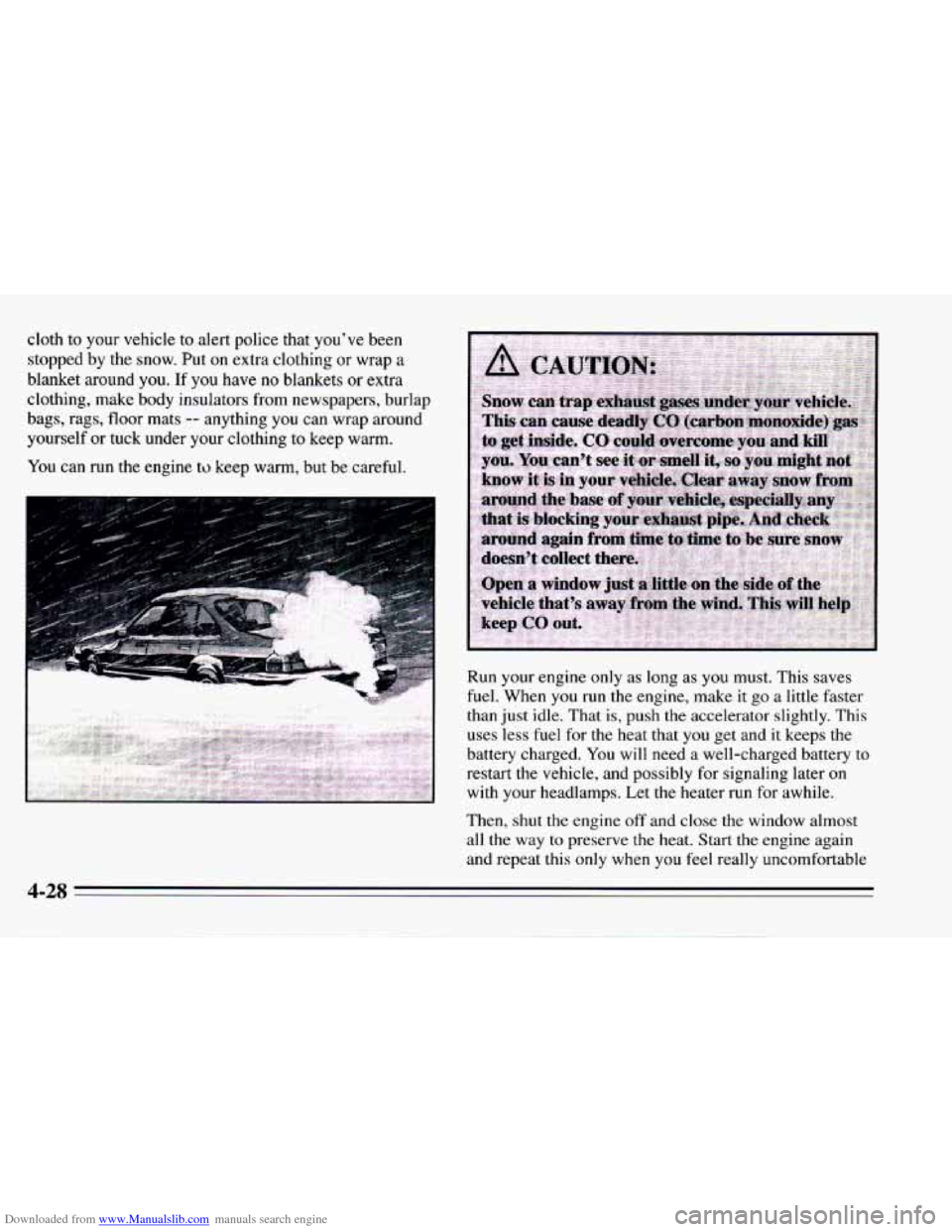
You can
run the engine to keep warm, but be careful.
Run your engine only as long as you must. This saves
fuel. When you run the engine, make it
go a little faster
than just idle. That
is, push the accelerator slightly. This
uses less fuel for the heat that you get and it keeps the
battery charged. You
will need a well-charged battery to
restart the vehicle, and possibly for signaling later
on
with your headlamps. Let the heater run for awhile.
Then,
shut the engine off and close the window almost
all the way to preserve the heat. Start the engine again
and repeat this only when you feel really uncomfortable
4-28
. ..
Page 197 of 388
Downloaded from www.Manualslib.com manuals search engine To Jump Start Your Chevrolet:
1. Check the other vehicle. It must have a 12-volt
battery with a negative ground system.
NOTICE:
If the other system isn’t a 12-volt system with a
negative ground, both vehicles can be damaged.
I
2. Get the vehicles close enough so the jumper cables
can reach, but be sure the vehicles aren’t touching
each other.
If they are, it could cause a ground
connection you don’t want. You wouldn’t be able to
start your Chevrolet, and the bad grounding could
damage the electrical systems.
3. Turn off the ignition on both vehicles. Turn off all
lights that aren’t needed, and radios. This will avoid
sparks and help save both batteries. And it could
save your radio!
I NOTICE:
If you leave your radio on, it could be badly
damaged. Thk repairs wouldn’t be covered
by
your warranty. I
4. Open the hoods and locate the batteries.
Find the positive
(+) and negative (-) terminals on
each battery.
5-3
Page 203 of 388
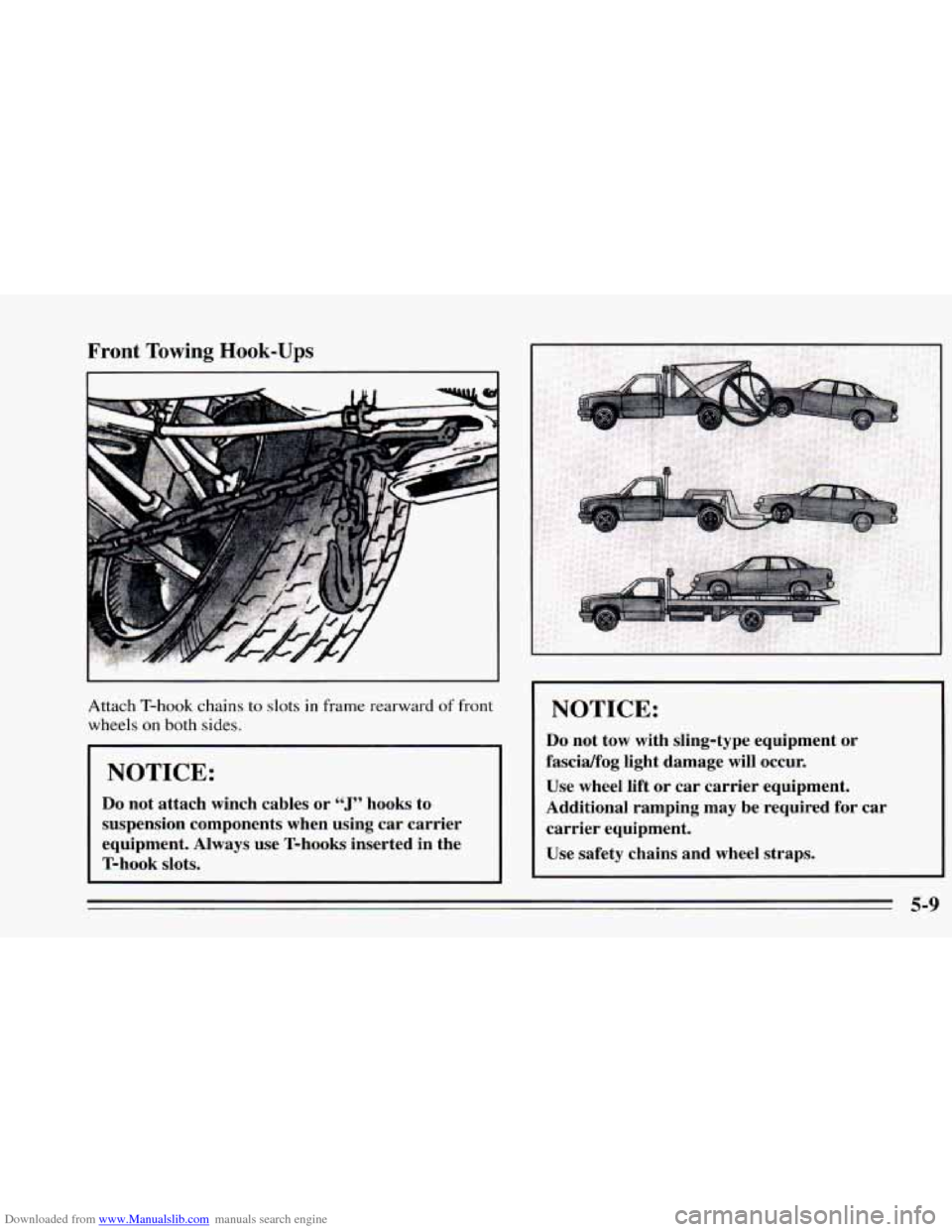
Downloaded from www.Manualslib.com manuals search engine Front Towing Hook-Ups
I
Attach T-hook chains to slots in frame rearward of front
wheels on both sides.
NOTICE:
Do not attach winch cables or “J” hooks to
suspension components when using car carrier
equipment. Always use
T-hooks inserted in the
T-hook slots.
NOTICE:
Do not tow with sling-type equipment or
fascidfog light damage will occur.
Use wheel lift or car carrier equipment.
Additional ramping may be required for car
carrier equipment.
Use safety chains and wheel straps.
Page 207 of 388
Downloaded from www.Manualslib.com manuals search engine Engine Overheating
You will find a coolant temperature gage on your
Chevrolet’s instrument panel.
You may also find a low
coolant warning light on your Chevrolet’s instrument
panel.
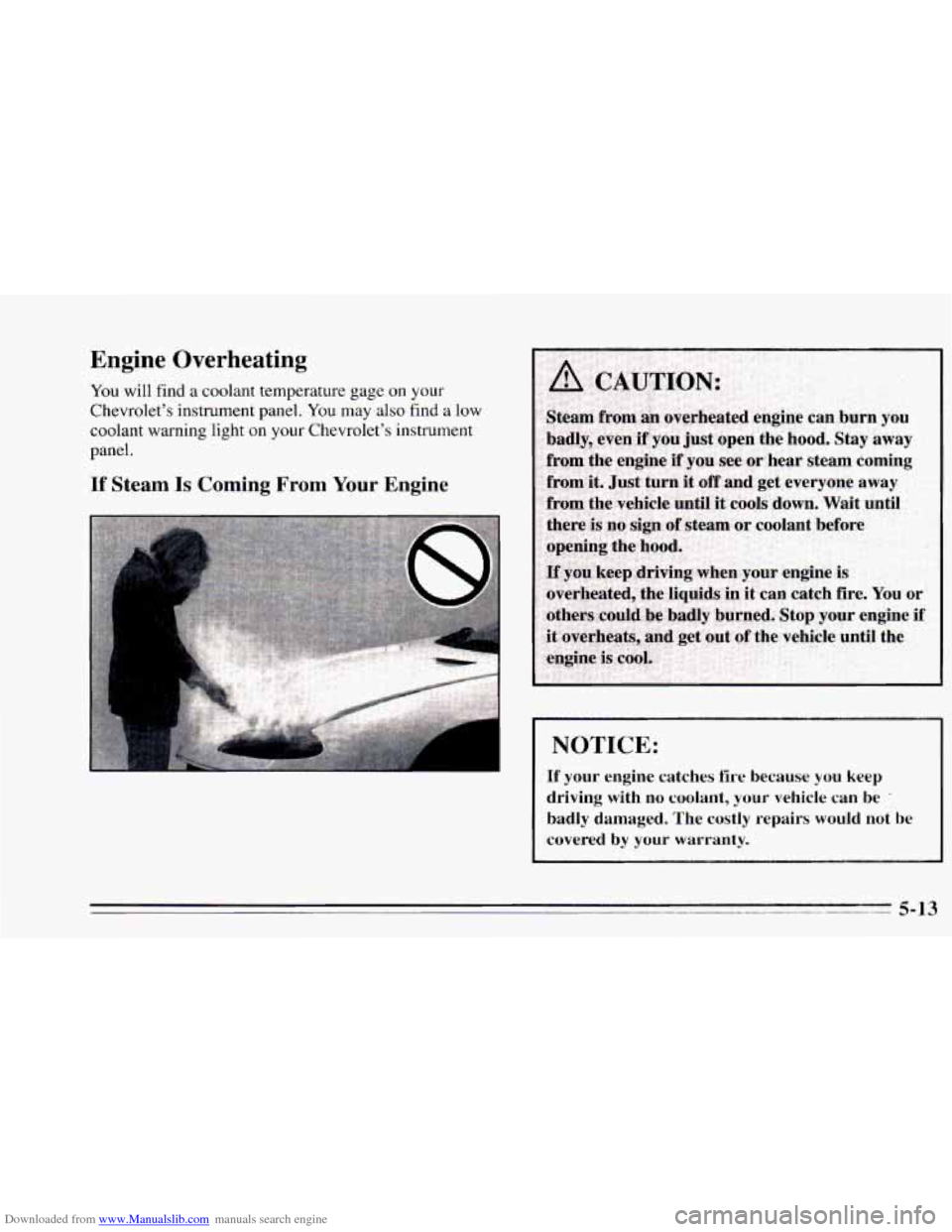
If Steam Is Coming From Your Engine
NOTICE:
If your engine catches fire because you keep
driving with
no coolant, your vehicle can be .
badly damaged. The costly repairs would not be
covered by your warranty.
Page 232 of 388
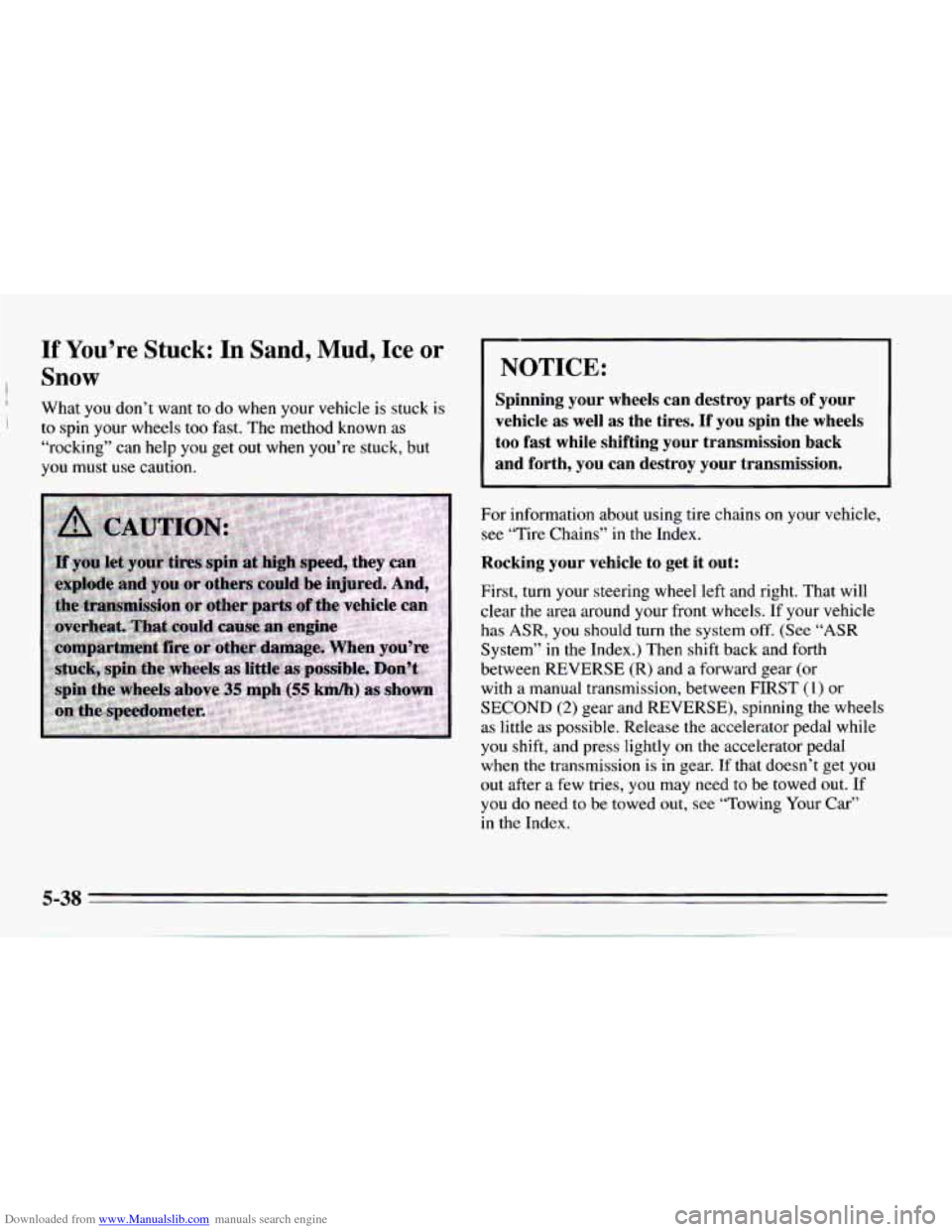
Downloaded from www.Manualslib.com manuals search engine If You’re Stuck: In Sand, Mud, Ice or
Snow
What you don’t want to do when your vehicle is stuck is
to spin your wheels too fast. The method known as
“rocking” can help you get out when you’re stuck,
but
you must use caution.
I NOTICE:
Spinning your wheels can destroy parts of your
vehicle as well as the tires. If you spin the wheels
too fast while shifting your transmission back
and forth, you can destroy your transmission.
For information about using tire chains on your vehicle,
see “Tire Chains” in the Index.
Rocking your vehicle to get it out:
First, turn your steering wheel left and right. That will
clear the area around your front wheels.
If your vehicle
has ASR, you should
turn the system off. (See “ASR
System” in the Index.) Then shift back and forth
between REVERSE
(R) and a forward gear (or
with
a manual transmission, between FIRST (1) or
SECOND
(2) gear and REVERSE), spinning the wheels
as little as possible. Release the accelerator pedal while
you shift, and press lightly on the accelerator pedal
when the transmission
is in gear. If that doesn’t get you
out after a few tries, you may need to be towed out.
If
you do need to be towed out, see “Towing Your Car”
in the Index.
Page 243 of 388
Downloaded from www.Manualslib.com manuals search engine Then just pull the hood down and close it firmly.
Before closing
the hood, be sure
all the filler caps are
on.
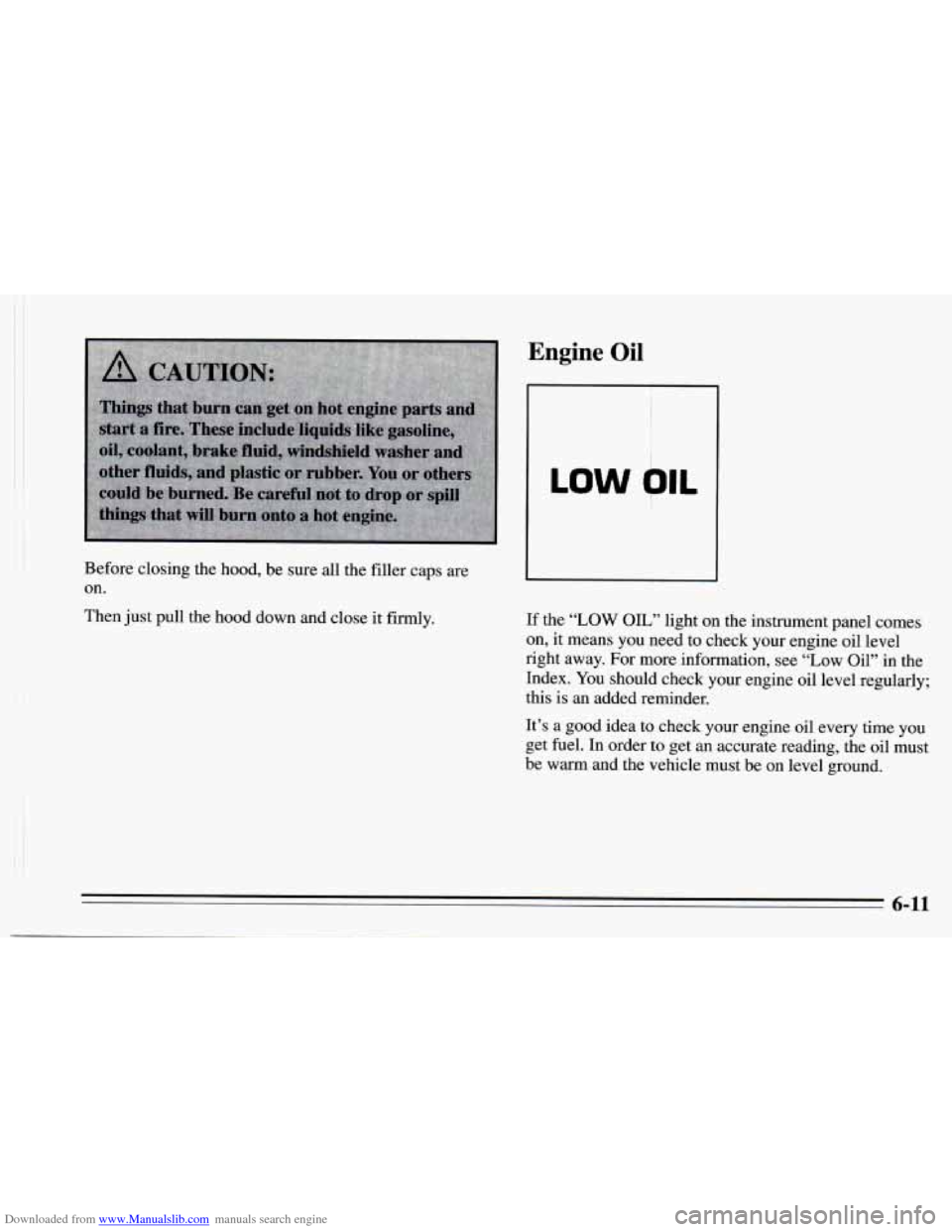
Engine Oil
LOW blL
If the “LOW OIL” light on the instrument panel comes
on, it means you need to check your engine oil level
right away. For more information, see “Low Oil”
in the
Index. You should check your engine oil level regularly;
this is an added reminder.
It’s
a good idea to check your engine oil every time you
get
fuel. In order to get an accurate reading, the oil must
be warm and the vehicle must be on level ground.
6-11
Page 260 of 388
Downloaded from www.Manualslib.com manuals search engine Engine Coolant
The following explains your cooling system and how to
add coolant when it
is low. If you have a problem with
engine overheating or if you need to add coolant to your
radiator, see “Engine Overheating”
in the Index.
The proper coolant for your Chevrolet will:
Give freezing protection down to -34°F (-37°C).
Give boiling protection up to 262” F ( 128 * C).
Protect against rust and corrosion.
0 Help keep the proper engine temperature.
0 Let the warning lights work as they should.
What to Use
Use a mixture of one-half clean water (preferably
distilled) and one-half antifreeze that meets
“GM
Specification 1825-M,” which won’t damage aluminum
parts.
You can also use a recycled coolant conforming to
GM Specification 1825-M with a complete coolant flush
and refill. If you use this mixture, you don’t need to add
anything else.
I NOTICE:
If you use an improper coolant mix, your engine
could overheat and
be badly damaged. The
repair
cost wouldn’t be covered by your
warranty.
Too much water in the mix can freeze
and crack the engine, radiator, heater core and
other parts.
6-28
Page 261 of 388
Downloaded from www.Manualslib.com manuals search engine Adding Coolant
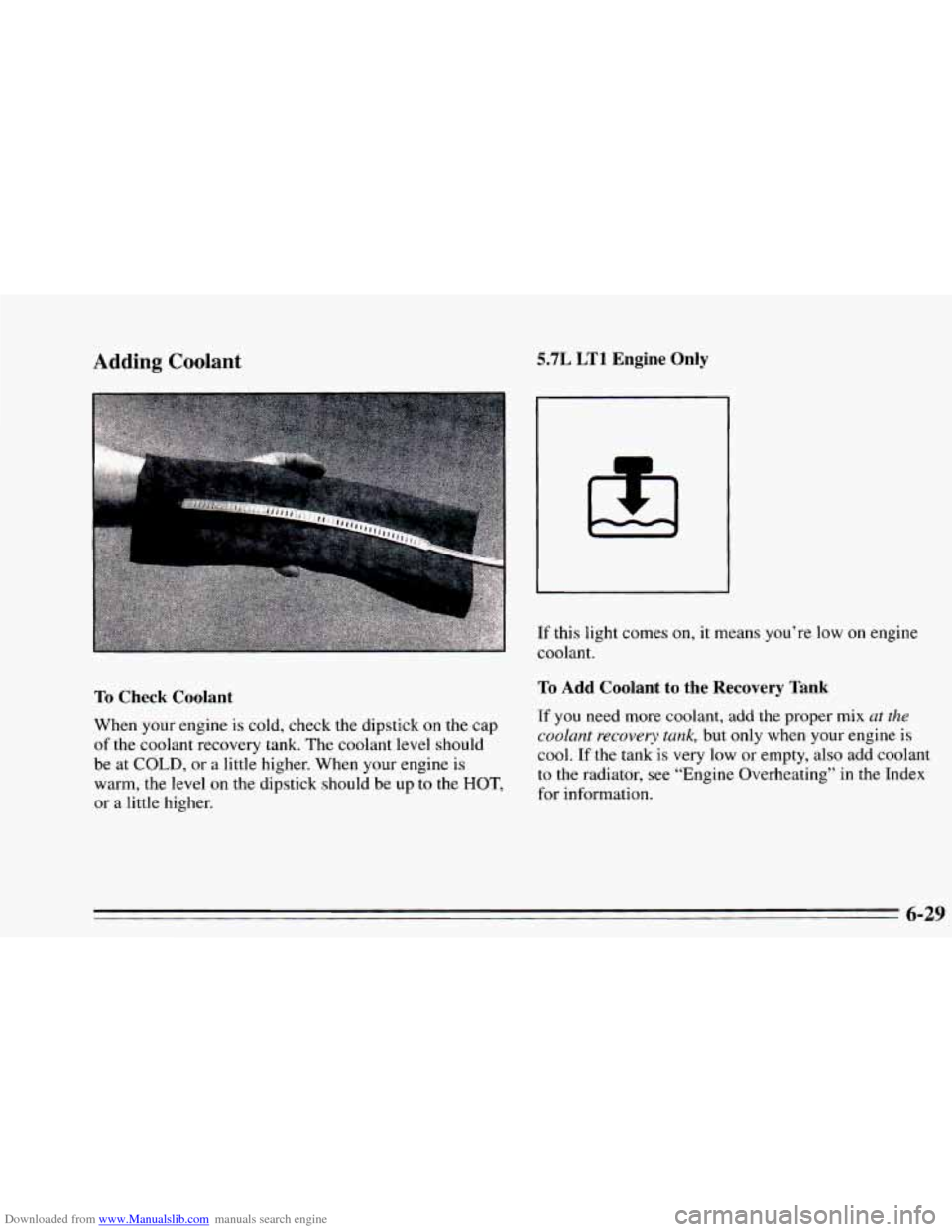
To Check Coolant
When your engine is cold, check the dipstick on the cap
of the coolant recovery tank. The coolant level should
be at
COLD, or a little higher. When your engine is
warm, the level on the dipstick should be up to the HOT,
or a little higher.
5.7L LT1 Engine Only
If this light comes on, it means you’re low on engine
coolant.
To Add Coolant to the Recovery Tank
If you need more coolant, add the proper mix ut the
coolant
recovery tank, but only when your engine is
cool. If the tank is very low or empty, also add coolant
to the radiator, see “Engine Overheating” in the Index
for information.
6-29
Page 269 of 388
Downloaded from www.Manualslib.com manuals search engine Some driving conditions or climates may cause a brake
squeal when the brakes are first applied or lightly
applied. This does not mean something is wrong with
your brakes.
If you have rear drum brakes, they don’t have wear
indicators, but
if you ever hear a rear brake rubbing
noise, have the rear brake linings inspected. Also, the
rear brake drums should be removed and inspected each
time the tires are removed for rotation or changing.
When you have the front brakes replaced, have the rear
brakes inspected, too.
Brake linings should always be replaced as complete
axle sets.
Brake Pedal Travel
See your dealer if the brake pedal does not return to
normal height, or
if there is a rapid increase in pedal
travel. This could be
a sign of brake trouble.
Brake Adjustment
Every time you make a moderate brake stop, your disc
brakes adjust for wear. If you rarely make a moderate or
heavier stop, then your brakes might not adjust correctly.
If you drive in that way, then -- very carefully -- make
a few moderate brake stops about every 1,000
miles
(1600 km), so your brakes will adjust properly. If
your brake pedal goes down farther than normal, your
rear drum brakes may need adjustment. Adjust them by
backing up and firmly applying the brakes a few times.
Replacing Brake System Parts
The braking system on a modern vehicle is complex.
Its many parts have: to be of top quality and work well
together if the vehicle is to have really good braking.
Vehicles we design and test have top-quality
GM brake
parts in them, as your Chevrolet does when it is new.
When
you replace parts of your braking system -- for
example, when your brake linings wear down and you
have to have new ones put
in -- be sure you get new
genuine
GM replacement parts. If you don’t, your
brakes may no longer work properly. For example,
if
someone puts in brake linings that are wrong for your
vehicle, the balance between your front and rear brakes
can change
-- for the worse. The braking performance
you’ve come
to expect can change in many other ways if
someone puts in t+ wrong replacement brake parts.
Page 271 of 388
Downloaded from www.Manualslib.com manuals search engine To check the aim, the vehicle should be properly
prepared as follows:
The vehicle must have all four tires on a perfectly
level surface.
0 The vehicle should not have any snow, ice, or mud
There should not be any cargo or loading of vehicle,
except it should have a full tank of gas and one
person or
160 pounds (75 kg) on the driver’s seat.
attached to
it.
0 Tires
should be properly inflated.
0 The horizontal indicator should read “0.”
I NOTICE:
To make sure your headlamps are aimed
properly, read all the instructions before
beginning. Failure to
follow these instructions
could cause damage to headlamp parts.
State inspection stations will allow a vertical reading of
plus
0.76 degrees or minus 0.76 degrees for the center of
the bubble. It
is recommended that the upper limit not exceed plus
0.4 degrees for the center of the bubble. Other drivers
may flash their bright lights at you if your adjustment is
much above plus
0.4 degrees.
If you find that the headlamp aiming needs adjustment,
follow these steps:
To adjust the aim of your headlamps:
1. Move your vehicle to a level surface. Use a spirit
level to be sure. Be sure to remove any items that are
not part of your original equipment from the trunk
and passenger areas.
No one should be seated in the
vehicle and your fuel tank should be about half full.
Check to be sure your tires are at the correct
pressure.
6-39