lock CHEVROLET CAMARO 1995 4.G Repair Manual
[x] Cancel search | Manufacturer: CHEVROLET, Model Year: 1995, Model line: CAMARO, Model: CHEVROLET CAMARO 1995 4.GPages: 388, PDF Size: 19.69 MB
Page 227 of 388
Downloaded from www.Manualslib.com manuals search engine NOTICE:
Raising your vehicle with the jack improperly
positioned will damage the vehicle or may allow
the vehicle to fall off the jack. Be sure to fit the
jack lift head into the proper location before raising your vehicle.
7I-T
a
a
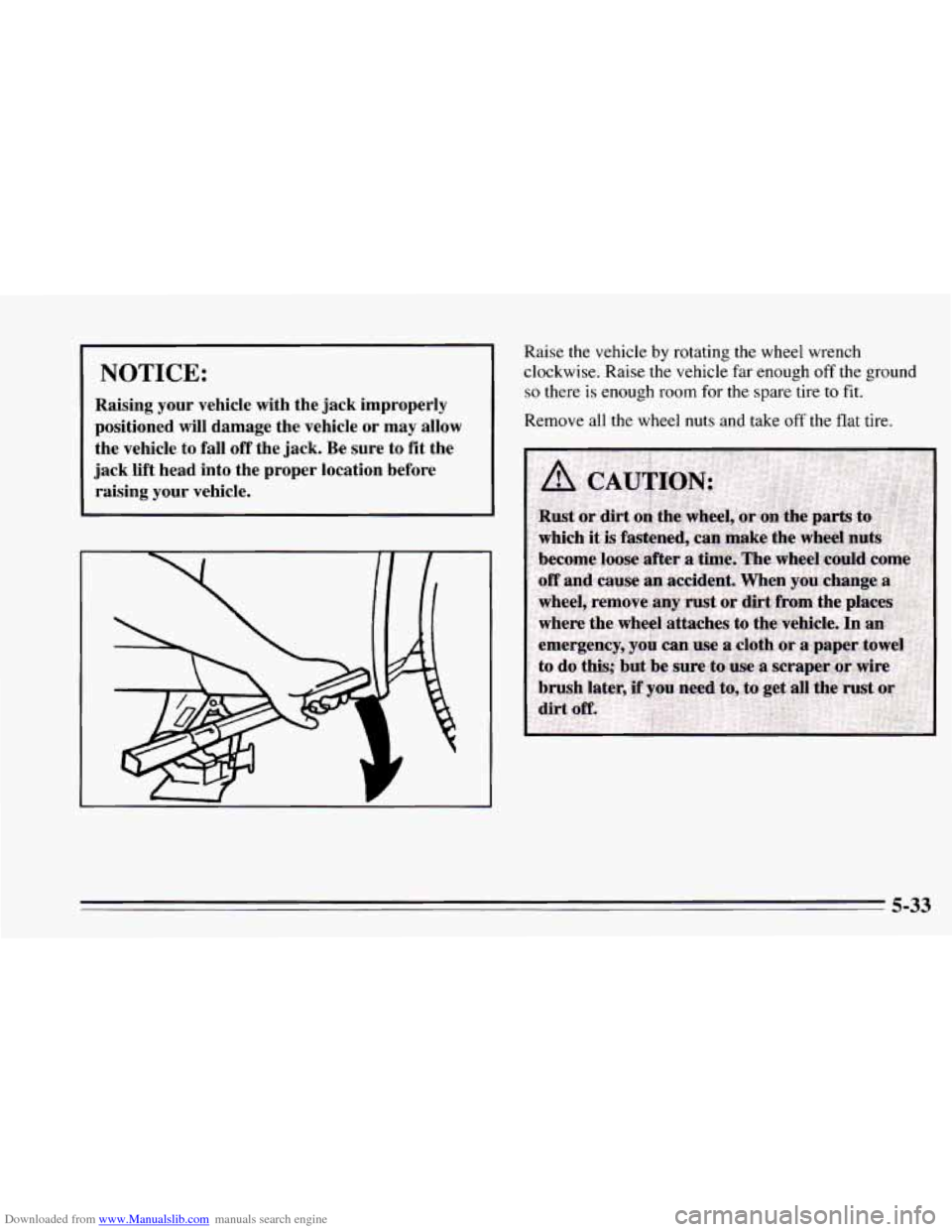
Raise the vehicle by rotating the wheel wrench
clockwise. Raise the vehicle far enough
off the ground
so there is enough room for the spare tire to fit.
Remove all the wheel nuts and take
off the flat tire.
5-33
Page 229 of 388
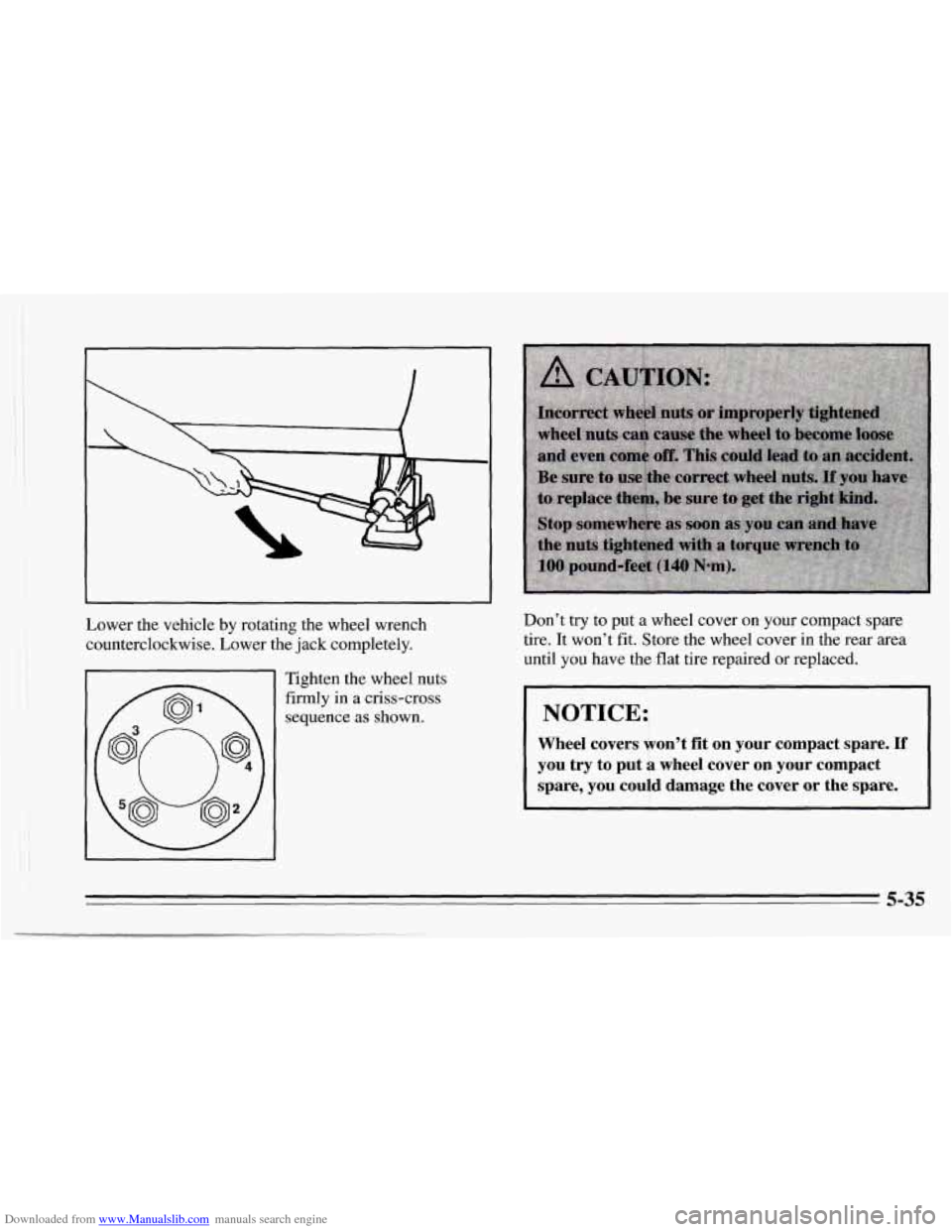
Downloaded from www.Manualslib.com manuals search engine Lower the vehicle by rotating the wheel wrench
counterclockwise. Lower the jack completely.
Tighten the wheel nuts
firmly in a criss-cross
sequence as shown. Don’t
try to put a
wheel cover on your compact spare
tire.
It won’t fit. Store the wheel cover in the rear area
until
you have the flat tire repaired or replaced.
NOTICE:
Wheel covers won’t fit on your compact spare. If
you try to put a wheel cover on your compact
spare, you could damage the cover
or the spare.
5-35
Page 238 of 388
Downloaded from www.Manualslib.com manuals search engine Filling Your Tank
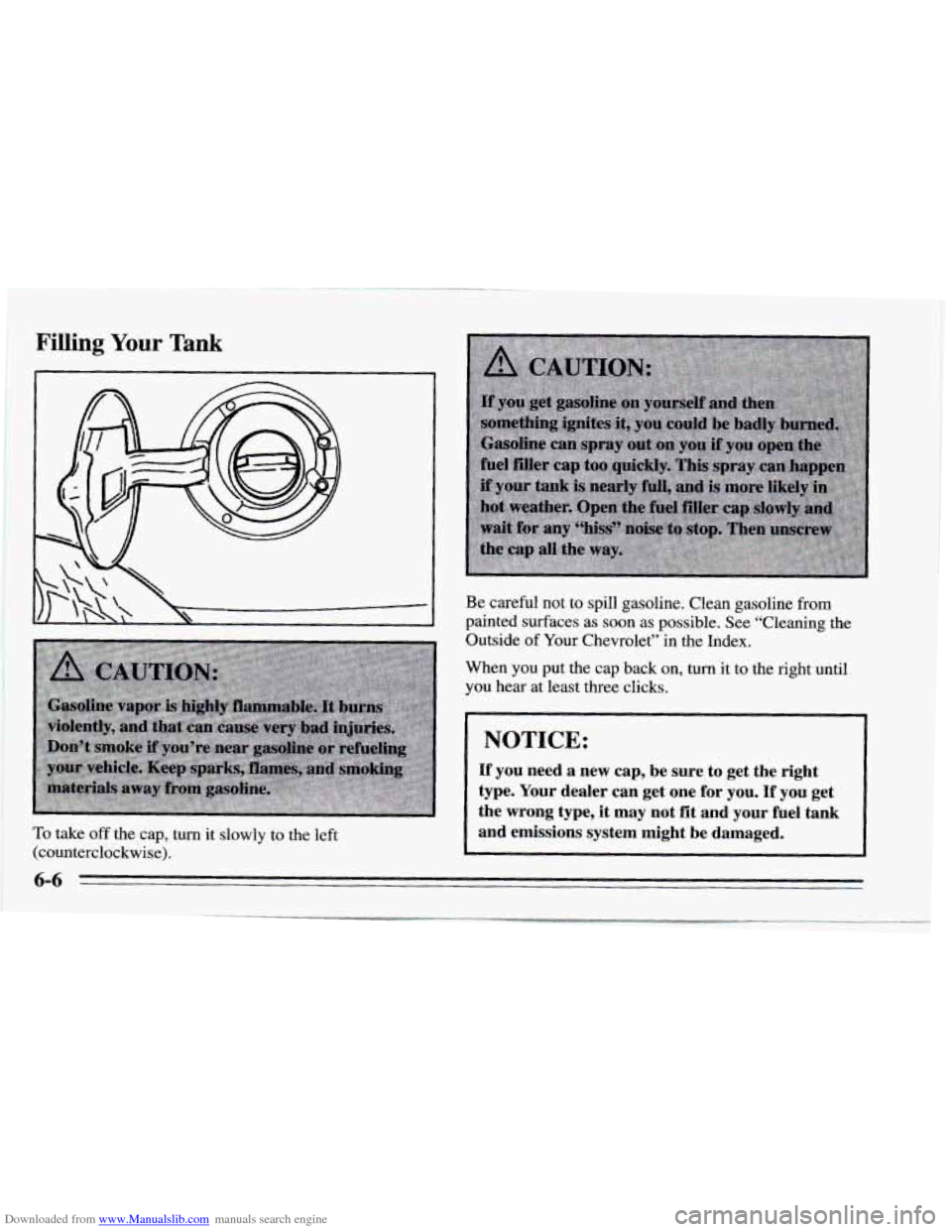
To take off the cap, turn it slowly to the left
(counterclockwise). Be careful not
to spill gasoline. Clean gasoline from
painted surfaces as soon as possible. See “Cleaning
the
Outside of Your Chevrolet” in the Index.
When
you put the cap back on, turn it to the right until
you hear at least three clicks.
NOTICE:
If you need a new cap, be sure to get the right
type. Your dealer can get one for you.
If you get
the wrong type, it may not fit and your fuel tank and emissions system might be damaged.
6-6
Page 275 of 388
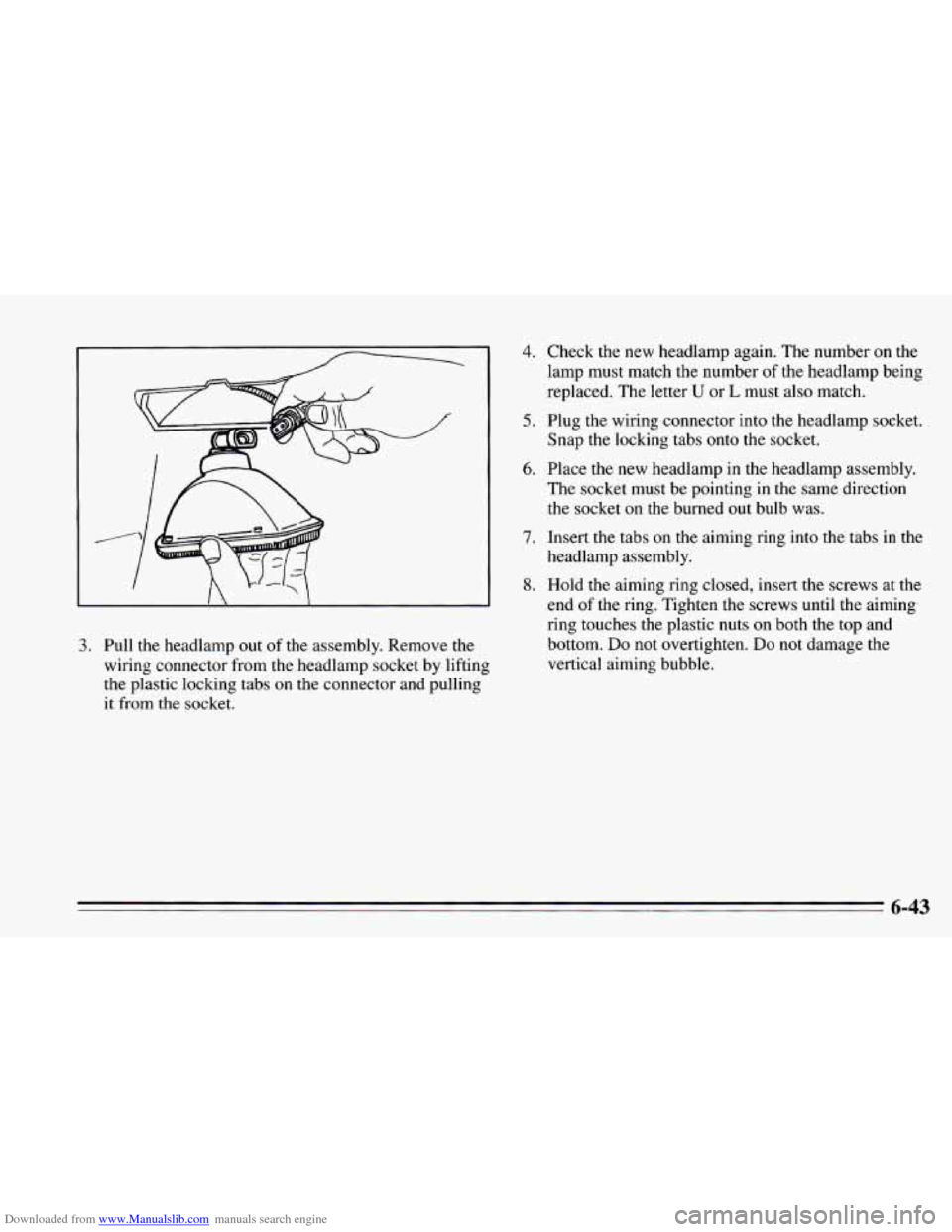
Downloaded from www.Manualslib.com manuals search engine 3. Pull the headlamp out of the assembly. Remove the
wiring connector from the headlamp socket by lifting
the plastic locking tabs
on the connector and pulling
it
from the socket.
4. Check the new headlamp again. The number on the
lamp must match the number of the headlamp being
replaced. The letter
U or L must also match.
5. Plug the wiring connector into the headlamp socket.
Snap the locking tabs onto the socket.
6. Place the new headlamp in the headlamp assembly.
The socket must be pointing in the same direction
the socket on the burned out bulb was.
7. Insert the tabs on the aiming ring into the tabs in the
headlamp assembly.
8. Hold the aiming ring closed, insert the screws at the
end
of the ring. Tighten the screws until the aiming
ring touches the plastic nuts
on both the top and
bottom.
Do not overtighten. Do not damage the
vertical aiming bubble.
6-43
Page 278 of 388
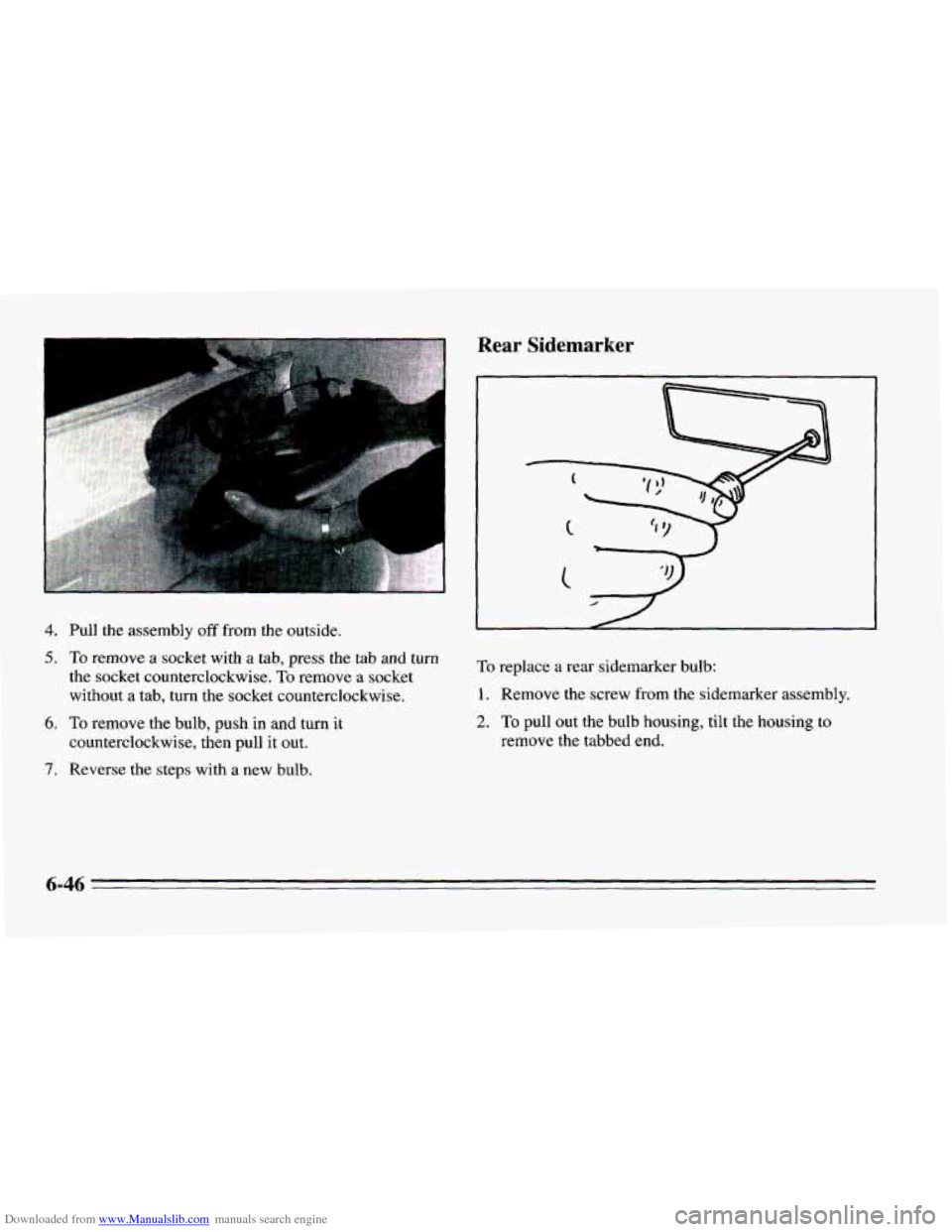
Downloaded from www.Manualslib.com manuals search engine 4. Pull the assembly off from the outside.
5. To remove a socket with a tab, press the tab and turn
the socket counterclockwise.
To remove a socket
without a tab,
turn the socket counterclockwise.
6. To remove the bulb, push in and turn it
counterclockwise, then pull
it out.
7. Reverse the steps with a new bulb.
Rear Sidemarker
To replace a rear sidemarker bulb:
1. Remove the screw from the sidemarker assembly.
2. To pull out the bulb housing, tilt the housing to
remove the tabbed end.
Page 279 of 388
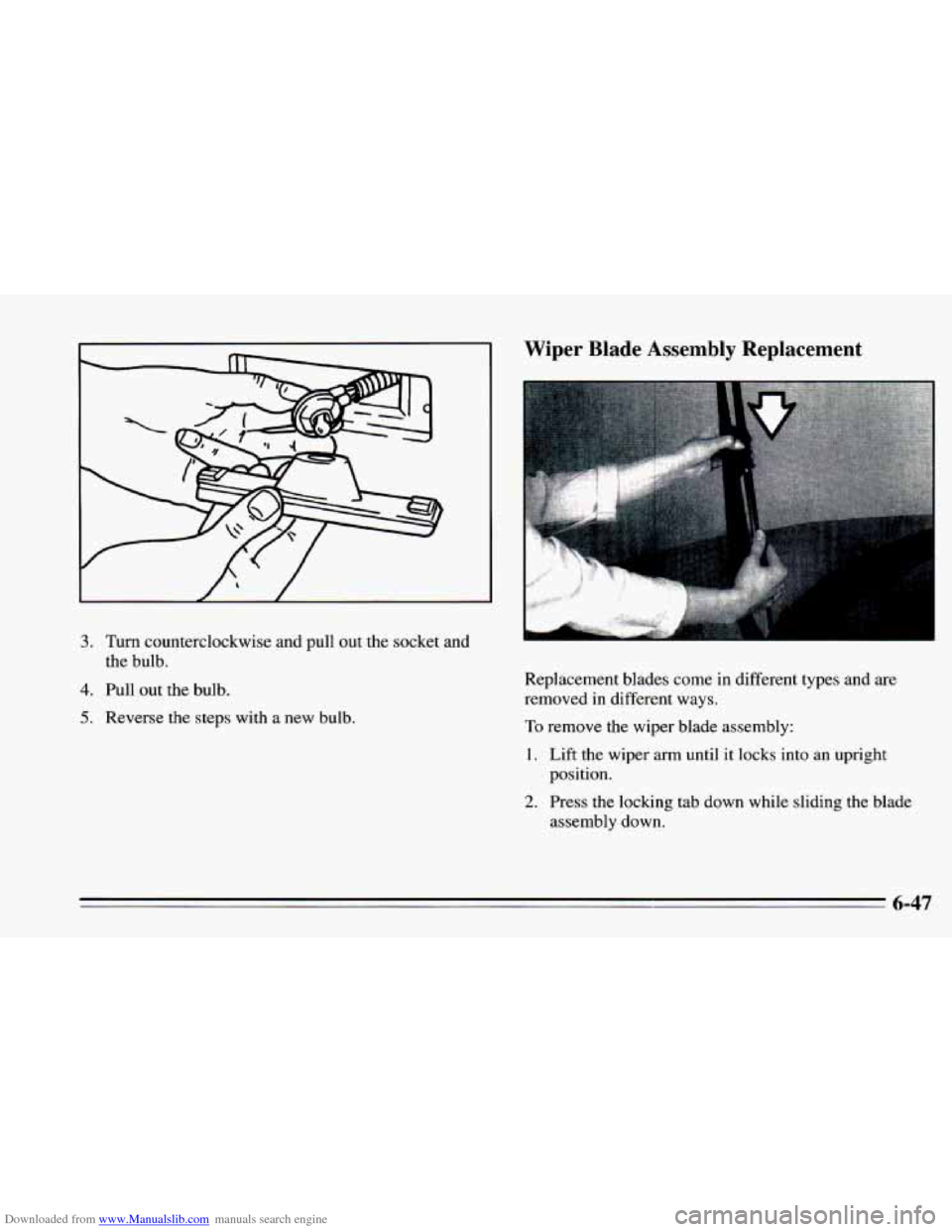
Downloaded from www.Manualslib.com manuals search engine 3. Turn counterclockwise and pull out the socket and
the bulb.
4. Pull out the bulb.
5. Reverse the steps with a new bulb.
Wiper Blade Assembly Replacement
Replacement blades come in different types and are
removed in different ways.
To remove the wiper blade assembly:
1. Lift the wiper arm until it locks into an upright
position.
2. Press the locking tab down while sliding the blade
assembly down.
Page 303 of 388
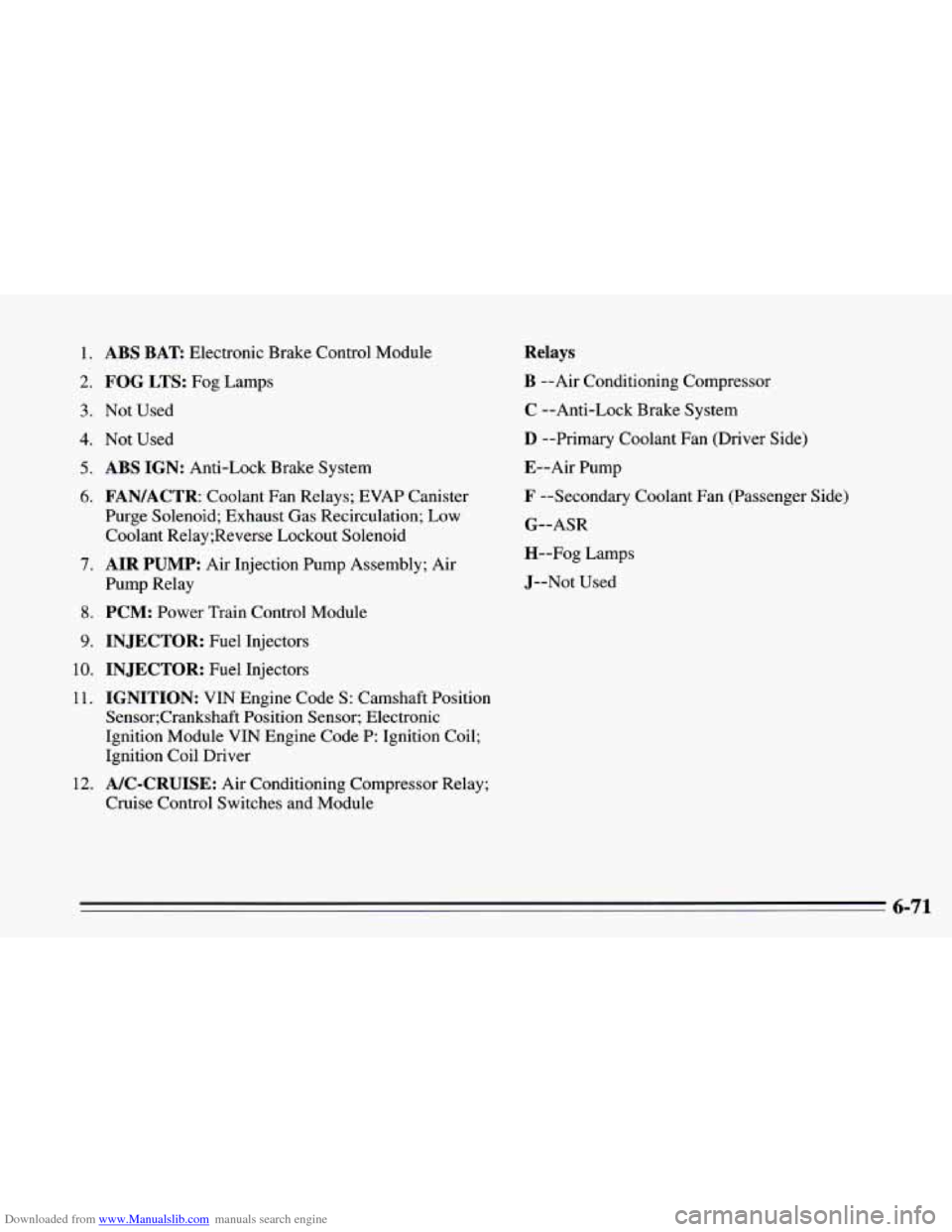
Downloaded from www.Manualslib.com manuals search engine 1. ABS BAT Electronic Brake Control Module
2. FOG LTS: Fog Lamps
3. Not Used
4. Not Used
5. ABS IGN: Anti-Lock Brake System
6. FAN/ACTR: Coolant Fan Relays; EVAP Canister
Purge Solenoid; Exhaust Gas Recirculation; Low
Coolant Re1ay;Reverse Lockout Solenoid
7. AIR PUMP: Air Injection Pump Assembly; Air
8. PCM: Power Train Control Module
Pump
Relay
9. INJECTOR: Fuel Injectors
10. INJECTOR: Fuel Injectors
11. IGNITION: VIN Engine Code S: Camshaft Position
Sensor;Crankshaft Position Sensor; Electronic
Ignition Module VIN Engine Code P: Ignition Coil; Ignition Coil Driver
Cruise Control Switches and Module
12. A/C-CRUISE: Air Conditioning Compressor Relay;
Relays
B --Air Conditioning Compressor
C --Anti-Lock Brake System
D --Primary Coolant Fan (Driver Side)
E--Air Pump
F --Secondary Coolant Fan (Passenger Side)
G--ASR
H--Fog Lamps
J--Not Used
6-71
Page 304 of 388
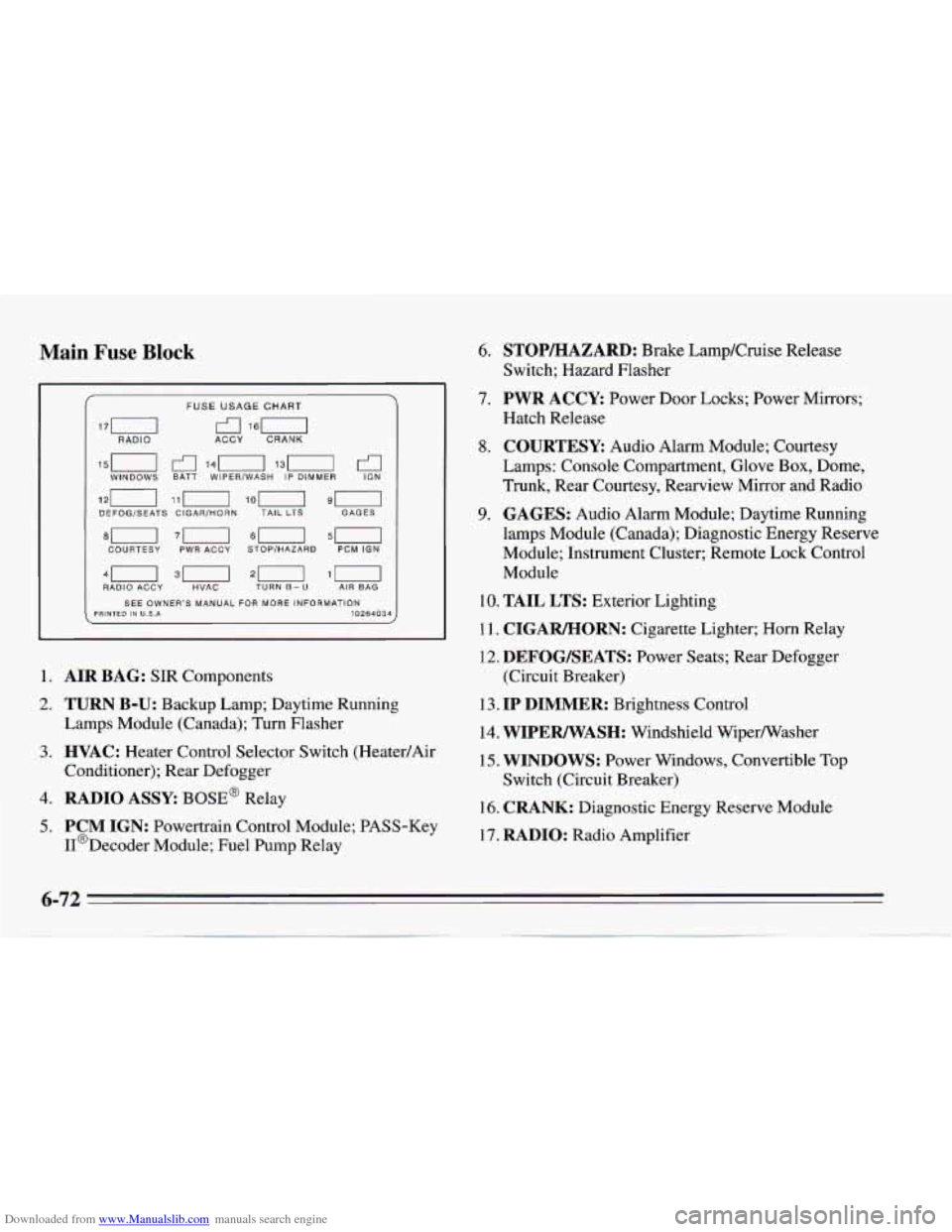
Downloaded from www.Manualslib.com manuals search engine Main Fuse Block
FUSE USAGECHART I I
I ”- RADIO
€I 160 ACCY CRANK
WINDOWS BATT WIPER/WASH IP DIMMER IGN
12[--1 11- gn
80 70 60 50
DEFOG/SEATS CIGAR/HORN TAIL LTS GAGES
COURTESY PWR
ACCY STOPIHAZARD PCM ION
RADIO ACCY TURN B- U AIR BAG
SEE OWNER’S MANUAL FOR MORE INFORMATION
PRINTED IN U.S.A 10264034
1. AIR BAG: SIR Components
2. TURN B-U: Backup Lamp; Daytime Running
Lamps Module (Canada); Turn Flasher
3. HVAC: Heater Control Selector Switch (Heater/Air
Conditioner); Rear Defogger
4. RADIO ASSY: BOSE’ Relay
5. PCM IGN: Powertrain Control Module; PASS-Key
II@Decoder Module; Fuel Pump Relay
6.
7.
8.
9.
STOPEIAZARD: Brake Lamp/Cruise Release
Switch; Hazard Flasher
PWR ACCY Power Door Locks; Power Mirrors;
Hatch Release
COURTESY: Audio Alarm Module; Courtesy
Lamps: Console Compartment, Glove
Box, Dome,
Trunk, Rear Courtesy, Rearview Mirror and Radio
GAGES: Audio Alarm Module; Daytime Running
lamps Module (Canada); Diagnostic Energy Reserve
Module; Instrument Cluster; Remote Lock Control
Module
10. TAIL LTS: Exterior Lighting
11. CIGAWORN: Cigarette Lighter; Horn Relay
12. DEFOG/SEATS: Power Seats; Rear Defogger
13. IP DIMMER: Brightness Control
14. WIPEIUWASH: Windshield WiperNasher
15. WINDOWS: Power Windows, Convertible Top
(Circuit Breaker)
Switch (Circuit Breaker)
16. CRANK: Diagnostic Energy Reserve Module
17. RADIO: Radio Amplifier
Page 354 of 388
Downloaded from www.Manualslib.com manuals search engine At Least Once a Year
Key Lock Cylinders
Lubricate the key lock cylinders with the lubricant
specified in Part
D.
Body Lubrication
Lubricate all body door hinges. Also lubricate all hinges
and latches, including those for the hood, rear
compartment, console doors and any folding seat
hardware.
Part D tells you what to use. More frequent
lubrication may be required when exposed to a corrosive
environment.
Starter Switch
1. Before you start, be sure you have enough room
around the vehicle.
2. Firmly apply both the parking brake (see ‘Tarking
Brake” in the Index if necessary) and the regular
brake.
NOTE:
Do not use the accelerator pedal, and be
ready to turn
off the engine immediately if it starts.
3. On automatic transmission vehicles, try to start the
engine in each gear. The starter should work only in
PARK
(P) or NEUTRAL (N). If the starter works in
any other position, your vehicle needs service.
On manual transmission vehicles, put the shift lever
in NEUTRAL (N), push the clutch down halfway
and
try to start the engine. The starter should work
only when
the clutch is pushed down all the way to
the floor. If the starter works when the clutch isn’t
pushed all the way down, your vehicle needs service.
Steering Column Lock
While parked, and with the parking brake set, try to turn
the key to LOCK in each shift lever position.
With an automatic transmission, the key should turn
to LOCK only when the shift lever is in PARK
(P).
With a manual transmission, the key should
turn to LOCK only when
the shift lever is in
REVERSE (R).
Page 355 of 388
Downloaded from www.Manualslib.com manuals search engine On vehicles with a key release button, try to turn the key
to LOCK without pressing the button. The key should
turn
to LOCK only with the key button depressed.
On all vehicles. the key should come out only in LOCK.
Parking Brake and Automatic Transmission PARK
(P) Mechanism Check
Park on a fairly steep hill, with the vehicle facing
downhill. Keeping your foot
on the regular brake, set the
parking brake.
To check the parking brake: With the engine running
and transmission in NEUTRAL
(N), slowly remove
foot pressure from the regular brake pedal. Do this
until the vehicle is held by the parking brake only.
0 To check the PARK (P) mechanism’s holding ability:
Shift to PARK
(P). Then release all brakes.
Underbody Flushing
At least every spring, use plain water to flush any
corrosive materials from the underbody. Take care
to
clean thoroughly any areas where mud and other debris
can collect.
7-47