second gear CHEVROLET CAMARO 1995 4.G Owners Manual
[x] Cancel search | Manufacturer: CHEVROLET, Model Year: 1995, Model line: CAMARO, Model: CHEVROLET CAMARO 1995 4.GPages: 388, PDF Size: 19.69 MB
Page 69 of 388
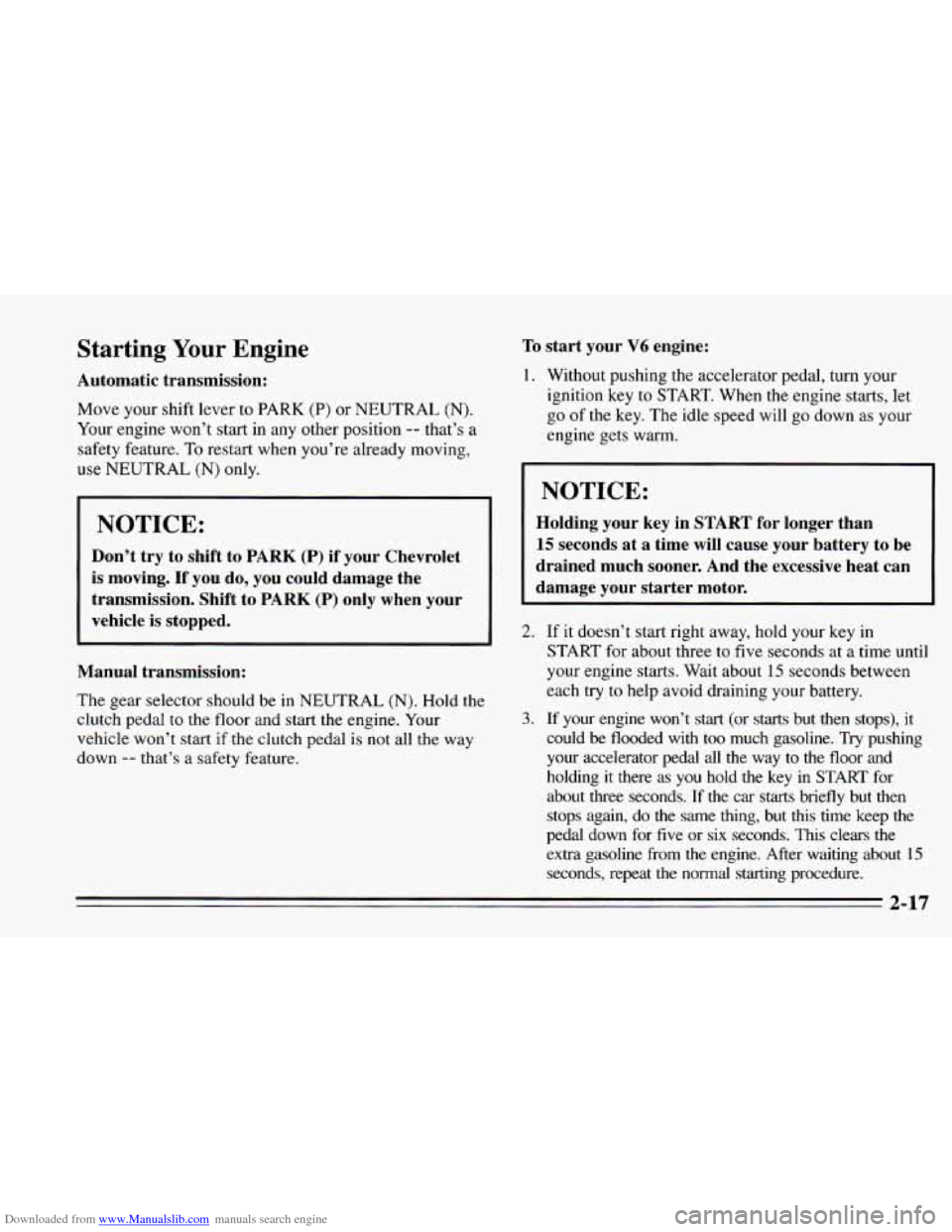
Downloaded from www.Manualslib.com manuals search engine Starting Your Engine
Automatic transmission:
Move your shift lever to PARK (P) or NEUTRAL (N).
Your engine won’t start in any other position -- that’s a
safety feature.
To restart when you’re already moving,
use NEUTRAL
(N) only.
NOTICE:
Don’t try to shift to PARK (P) if your Chevrolet
is moving. If you do, you could damage the
transmission. Shift to PARK (P) only when your
vehicle is stopped.
Manual transmission:
The gear selector should be in NEUTRAL (N). Hold the
clutch pedal to
the floor and start the engine. Your
vehicle won’t start if the clutch pedal is not all the way
down
-- that’s a safety feature.
To start your V6 engine:
1. Without pushing the accelerator pedal, turn your
ignition key to START. When the engine starts, let
go
of the key. The idle speed will go down as your
engine gets warm.
NOTICE:
Holding your key in START for longer than
15 seconds at a time will cause your battery to be
drained much sooner. And the excessive heat can
damage your starter motor.
2. If it doesn’t start right away, hold your key in
START for about three to five seconds at
a time until
your engine starts. Wait about
15 seconds between
each try to help avoid draining your battery.
3. If your engine won’t start (or starts but then stops), it
could be flooded with too much gasoline.
Try pushing
your accelerator pedal all the way
to the floor and
holding
it there as you hold the key in START for
about three seconds.
If the car starts briefly but then
stops again, do the same thing, but this time keep the
pedal
down for five or six seconds. This clears the
extra gasoline
from the engine. After waiting about 15
seconds, repeat the normal starting procedure.
Page 76 of 388
Downloaded from www.Manualslib.com manuals search engine THIRD (D): This is like @, but you never go into
Overdrive.
Here are some times you might choose
D instead of 0:
- When driving on hilly, winding roads
- When towing a trailer, so there is less shifting
between gears
- When going down a steep hill
SECOND
(2): This position gives you more power but
lower fuel economy. You can use
SECOND (2) on hills.
It can help control your speed as you go down steep
mountain roads, but then you would also want to use
your brakes
off and on.
NOTICE:
Don’t drive in SECOND (2) for more than
5 miles (8 km), or at speeds over 55 mph
~ (88 km/h), or you can damage your transmission.
Use
@ or DRIVE (D) as much as possible.
Don’t shift into SECOND
(2) unless you are going
slower than
65 mph (105 kd), or you can
damage your engine.
FIRST (1): This position gives you even more power
(but lower fuel economy) than
SECOND (2). You can
use it on very steep hills, or in deep snow or mud.
If the
selector lever is put in
FIRST (1) the transmission won’t
shift into first gear until the vehicle is going slowly
enough.
I NOTICE:
If your rear wheels can’t rotate, don’t try to
drive. This might happen if you were stuck in
very deep sand or mud
or were up against a solid
object.
You could damage your transmission.
Also, if you stop when going uphill, don’t hold
your vehicle there with only the accelerator
pedal. This could overheat and damage the
transmission. Use your brakes or shift into
PARK (P) to hold your vehicle in position on
a hill.
Maximum engine speed is limited to protect driveline
components from improper operation.
2-24
Page 77 of 388
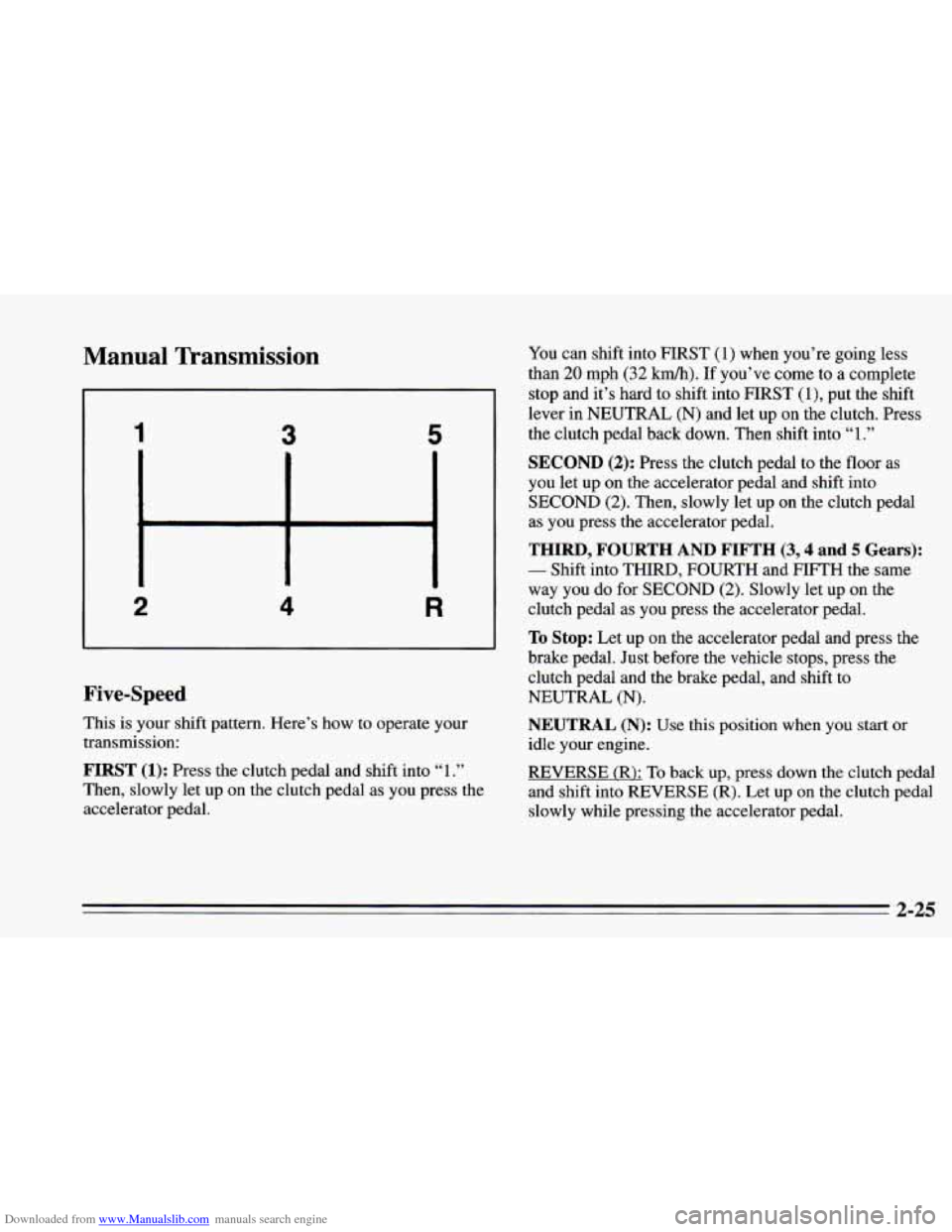
Downloaded from www.Manualslib.com manuals search engine Manual Transmission
1 ‘3 5
2 R
Five-Speed
This is your shift pattern. Here’s how to operate your
transmission:
FIRST (1): Press the clutch pedal and shift into “1 .’,
Then, slowly let up on the clutch pedal as you press the
accelerator pedal. You
can shift into FIRST (1) when you’re going less
than
20 mph (32 km/h). If you’ve come to a complete
stop and it’s hard to shift into FIRST
(l), put the shift
lever in NEUTRAL
(N) and let up on the clutch. Press
the clutch pedal back down. Then shift into
“1.”
SECOND (2): Press the clutch pedal to the floor as
you let up on the accelerator pedal and shift into
SECOND
(2). Then, slowly let up on the clutch pedal
as you press the accelerator pedal.
THIRD, FOURTH AND FIFTH (3,4 and 5 Gears):
- Shift into THIRD, FOURTH and FIFTH the same
way you do for SECOND
(2). Slowly let up on the
clutch pedal as you press the accelerator pedal.
To Stop: Let up on the accelerator pedal and press the
brake pedal. Just before the vehicle stops, press the
clutch pedal and the brake pedal, and shift to
NEUTRAL (N).
NEUTRAL (N): Use this position when you start or
idle your engine.
REVERSE
(R): To back up, press down the clutch pedal
and shift into REVERSE (R). Let up on the clutch pedal
slowly while pressing the accelerator pedal.
2-25
Page 78 of 388
Downloaded from www.Manualslib.com manuals search engine I I
1 NOTICE:
Shift to REVERSE (R) only after your vehicle is
stopped. Shifting to REVERSE (R) while your
vehicle
is moving could damage your transmission.
Also, use Reverse, along with the parking brake, for
parking your vehicle.
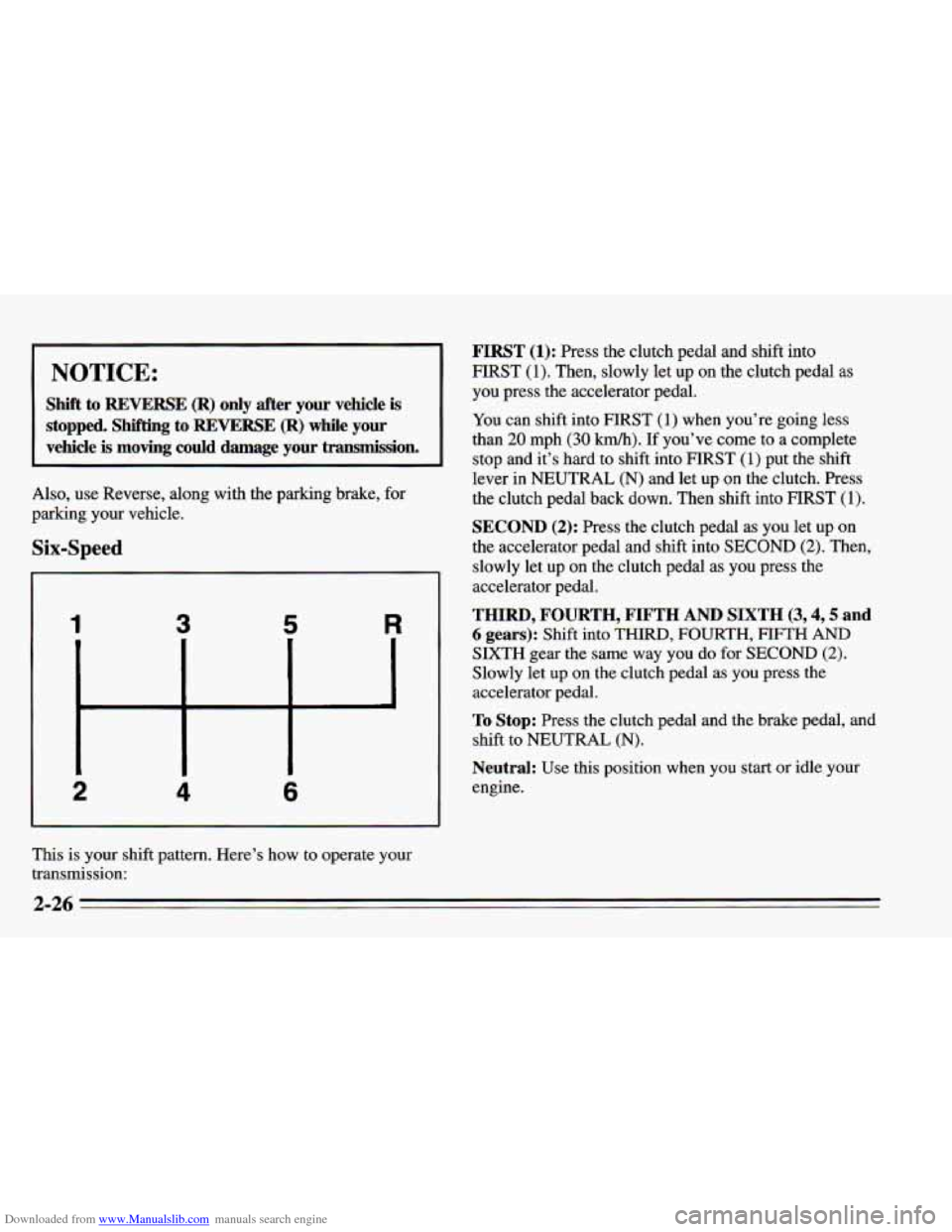
Six-Speed
1 3 5 R
2 4 6
This is your shift pattern. Here’s how to operate your
transmission:
FIRST (1): Press the clutch pedal and shift into
FIRST
(1). Then, slowly let up on the clutch pedal as
you press the accelerator pedal.
You can shift into FIRST (1) when you’re going less
than
20 mph (30 km/h). If you’ve come to a complete
stop and it’s hard to shift into
FIRST (1) put the shift
lever in NEUTRAL
(N) and let up on the clutch. Press
the clutch pedal back down. Then shift into FIRST
(1).
SECOND (2): Press the clutch pedal as you let up on
the accelerator pedal and shift into
SECOND (2). Then,
slowly let up
on the clutch pedal as you press the
accelerator pedal
THIRD, FOURTH, 1 ?TH AND SIXTH (3,4,5 and
6 gears): Shift into THIRD, FOURTH, FIFTH AND
SIXTH gear the same way you do for SECOND (2).
Slowly let up on the clutch pedal as you press the
accelerator pedal.
To Stop: Press the clutch pedal and the brake pedal, and
shift to
NEUTRAL (N).
Neutral: Use this position when you start or idle your
engine.
2-26
Page 79 of 388
Downloaded from www.Manualslib.com manuals search engine REVERSE (R): To back up, press down the clutch
pedal and shift into REVERSE
(R). Let up on the clutch
pedal slowly while pressing the accelerator pedal. If you
shift from SIXTH
(6) into REVERSE (R) the shift lever
must be first placed in the NEUTRAL
(N) position
centered between SECOND
(2) and THIRD (3) prior to
shifting into REVERSE (R).
Your 6-speed manual transmission has a feature that
allows you to safely shift into
REVERSE (R) while the
vehicle
is rolling (at less than 5 mph). You will be
“locked-out” if you try to shift into REVERSE
(R)
while your vehicle is moving faster than 5 mph.
If you have turned your ignition off and wish to park
your car in REVERSE
(R), you will have to move the
shift lever quickly to the right, “crashing” through the
high load spring and then into gear.
Skip Shift Light (5.7L LTl Engine)
When this light comes on, you can only shift from
FIRST
(1) to FOURTH (4) instead of F’IRST (1) to
SECOND (2). This helps you to get the best possible
fuel economy.
This light will
come on under these conditions:
The engine coolant temperature is greater than
0 You are going 15-20 mph (24-32 kmh), and
0 You are at 35% throttle or less.
170°F (77”C),
When this light
is on, the gear shift lever will let you
shift from FIRST
(1) gear to FOURTH (4) gears only.
2-27
Page 80 of 388
Downloaded from www.Manualslib.com manuals search engine Once you are in FOURTH (4), you can press the clutch
again
and shift into another gear.
Follow the shift speeds on
this chart when the ‘‘SKIP
SHIFT” light is on.
Computer Aided Manual Transmission Shift Speeds:
1st to 4th. . . . . . . 15 mph (24 km/h)
4th to 5th . . . . . . 25 mph (40 km/h)*
5th to 6th . . . . . . 40 mph (64 km/h)**
Each time you come to a stop, the engine’s Electronic
Control Module (ECM) determines when to activate the
“SKIP SHIFT” upshift system. Use SECOND (2) gear
only when you accelerate very quickly from a stop. You
can then follow the full gear shift pattern.
*30 mph (48 km/h) when accelerating to highway
speeds.
**45 mph (72km/h) when accelerating to highway
speeds.
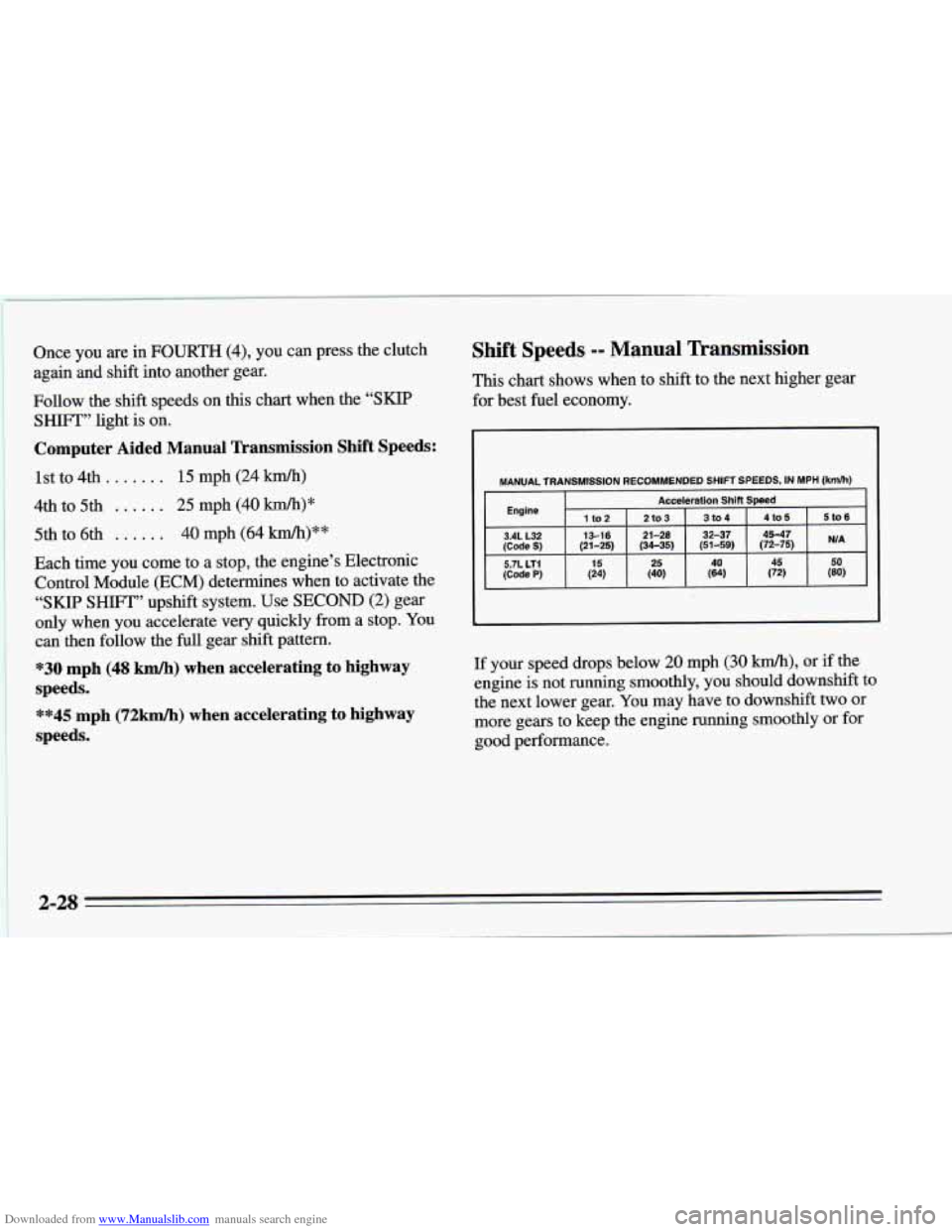
Shift Speeds -- Manual Transmission
This chart shows when to shift to the next higher gear
for best fuel economy.
MANUAL TRANSMISSION RECOMMENDED SHIFT SPEEDS, IN MPH (kmlh)
Acceleration Shift Speed Engine 1 to 2 2t03 3 to 4 4tO 5 5 to 6
3.4L L32 13-1 6 21-28 32-37 45-47 (Code S) (21-25) (34-35) (51-59) (72-75) NIA
If your speed drops below 20 mph (30 km/h), or if the
engine is not running smoothly, you should downshift to
the next lower gear. You may have to downshift two
or
more gears to keep the engine running smoothly or for
good performance.
2-28
~-
Page 97 of 388
Downloaded from www.Manualslib.com manuals search engine To Reduce Speed While Using Cruise
Control
There are two ways to reduce ?bur speed while using
cruise control:
1. Push in the button at the end of the lever until you
reach the lower speed you want, then release it.
2. To slow down in very small amounts, push the
button for less than half a second. Each time you do
this, you’ll
go 1 mph (1.6 km/h) slower.
Passing Another Vehicle While Using
Cruise Control
Use the accelerator pedal to increase your speed. When
you take your foot off the pedal, your vehicle will slow
down to the cruise control speed you set earlier.
Using Cruise Control on Hills
How well your cruise control will work on hills depends
upon your speed, load, and the steepness
of the hills.
When going up steep hills, you may have to step on the
accelerator
pedal to maintain your speed. When going
downhill, you may have to brake or shift to a lower gear to
keep your speed down.
Of course, applying the brake takes
you out
of cruise control. Many drivers find this to be too
much trouble and don’t use cruise control on steep
hills.
2-45
Page 171 of 388
Downloaded from www.Manualslib.com manuals search engine Loss of Control
Let’s review what driving experts say about what
happens when the three control systems (brakes, steering
and acceleration) don’t
have enough friction where the
tires meet the road to do what the driver has asked.
In
any emergency, don’t give up. Keep trying to steer and
constantly seek an escape route or area of less danger.
Skidding
In a skid, a driver can lose control of the vehicle.
Defensive drivers avoid most skids by taking reasonable
care suited
to existing conditions, and by not
“overdriving” those conditions. But skids are always
possible.
The three types of skids correspond to your Chevrolet’s
three control systems.
In the braking skid your wheels
aren’t rolling. In the steering or cornering skid, too
much speed
or steering in a curve causes tires to slip and
lose cornering force. And
in the acceleration skid too
much throttle causes the driving wheels to spin.
A cornering skid is best handled by easing your foot off
the accelerator pedal.
If you have the
ASR system, remember: It helps avoid
only the acceleration skid. If you
do not have ASR, or
if the system is off, then an
acceleration skid
is also best handled by easing your
foot off the accelerator pedal.
If your vehicle starts to slide,
ease your foot off the
accelerator pedal and quickly steer the way
you want the
vehicle to go.
If you start steering quickly enough, your
vehicle may straighten out. Always be ready for a
second skid if it occurs.
Of course, traction is reduced when water, snow, ice,
gravel, or other material is on the road. For safety, you’ll
want to slow down and adjust your driving to these
conditions. It is important to slow down on slippery
surfaces because stopping distance will be longer and
vehicle control more limited.
While driving on
a surface with reduced traction, try
your best to avoid sudden steering, acceleration, or
braking (including engine braking by shifting to
a lower
gear).
Any sudden changes could cause the tires to slide.
You may not realize the surface is slippery until your
vehicle is skidding. Learn to recognize warning clues
--
such as enough water, ice or packed snow on the road to
make a “mirrored surface’’ -- and slow down when you
have any doubt.
Remember: Any anti-lock brake system
(ABS) helps
avoid only the braking skid.
4-15
Page 232 of 388
Downloaded from www.Manualslib.com manuals search engine If You’re Stuck: In Sand, Mud, Ice or
Snow
What you don’t want to do when your vehicle is stuck is
to spin your wheels too fast. The method known as
“rocking” can help you get out when you’re stuck,
but
you must use caution.
I NOTICE:
Spinning your wheels can destroy parts of your
vehicle as well as the tires. If you spin the wheels
too fast while shifting your transmission back
and forth, you can destroy your transmission.
For information about using tire chains on your vehicle,
see “Tire Chains” in the Index.
Rocking your vehicle to get it out:
First, turn your steering wheel left and right. That will
clear the area around your front wheels.
If your vehicle
has ASR, you should
turn the system off. (See “ASR
System” in the Index.) Then shift back and forth
between REVERSE
(R) and a forward gear (or
with
a manual transmission, between FIRST (1) or
SECOND
(2) gear and REVERSE), spinning the wheels
as little as possible. Release the accelerator pedal while
you shift, and press lightly on the accelerator pedal
when the transmission
is in gear. If that doesn’t get you
out after a few tries, you may need to be towed out.
If
you do need to be towed out, see “Towing Your Car”
in the Index.
Page 254 of 388
Downloaded from www.Manualslib.com manuals search engine To get the right reading, the fluid should be at normal
operating temperature, which
is 180°F to 200°F
(82°C to 93°C).
To
check transmission fluid hot: Get the vehicle
warmed up by driving about
15 miles (24 km) when
outside temperatures are above
50°F (10°C).
If it's colder than
50°F (10°C) drive the vehicle in
DRIVE (D) until the engine temperature gage moves
and then remains steady for ten minutes. Then follow
the hot check procedures.
To check transmission fluid cold: A cold check is
made after the vehicle has been sitting for eight hours or
more with
the engine off and is used only as a reference.
Let the engine run at idle for five minutes
if outside
temperatures are
50°F (10°C) or more. If it's colder
than
50°F (lO"C), you may have to idle the engine
longer. Should the fluid level be low during
a cold
check,
you must perform a hot check before adding
fluid. This will give you a more accurate reading
of the
fluid level.
To check the fluid hot or cold:
Park your vehicle on a level place. Keep the engine
running.
With the parking brake applied, place the shift lever
in PARK (P).
With your foot on the brake pedal, move the shift
lever through each gear range, pausing for about
three seconds
in each range. Then, position the shift
lever
in PARK (P).
Let the engine run at idle for three minutes or more.
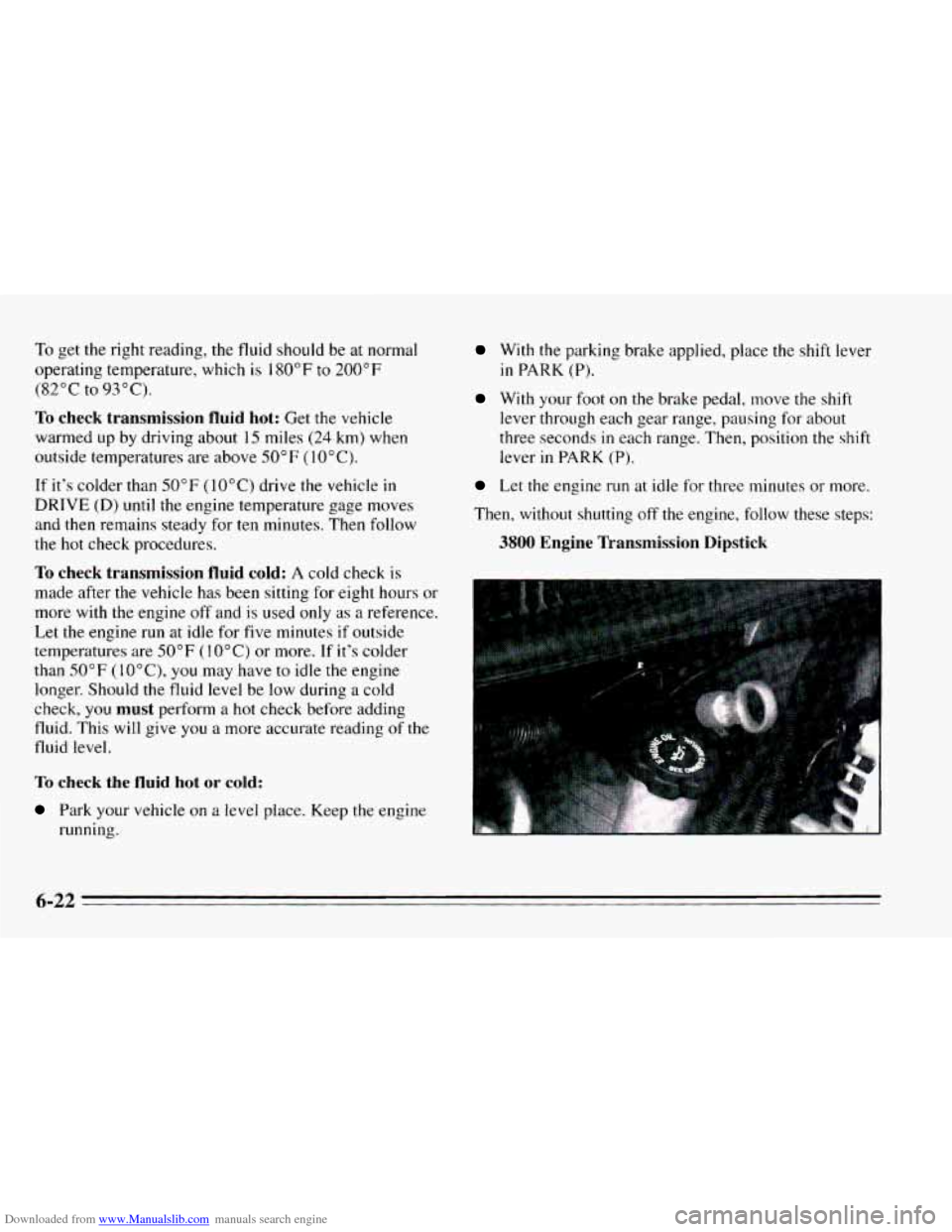
Then, without shutting off the engine, follow these steps:
3800 Engine Transmission Dipstick
6-22