automatic transmission CHEVROLET CAMARO 1996 4.G User Guide
[x] Cancel search | Manufacturer: CHEVROLET, Model Year: 1996, Model line: CAMARO, Model: CHEVROLET CAMARO 1996 4.GPages: 402, PDF Size: 21.38 MB
Page 95 of 402
Downloaded from www.Manualslib.com manuals search engine J
I
Shifting Out of PARK (P)
(Automatic Transmission)
Your Chevrolet has a brake-transmission shift interlock.
You have to fully apply your regular brake before you
can shift from PARK
(P) when the ignition is in the
I RUN position. See “Automatic Transmission Operation”
in the Index.
If you cannot shift out of PARK (P), ease pressure on
the shift lever -- push the shift lever all the way into
PARK
(P) and release the shift lever button as you
maintain brake application. Then press the
shift lever
button and move the shift lever into the gear
you wish.
If you ever hold the brake pedal down but still can’t
shift out of PARK
(P), try this:
1. Turn the key to the
OFF position.
2. Apply and hold the brake.
3. Shift to NEUTRAL (N).
4. Start the engine and then shift to the drive gear
you want.
5. Have the vehicle fixed as soon as you can.
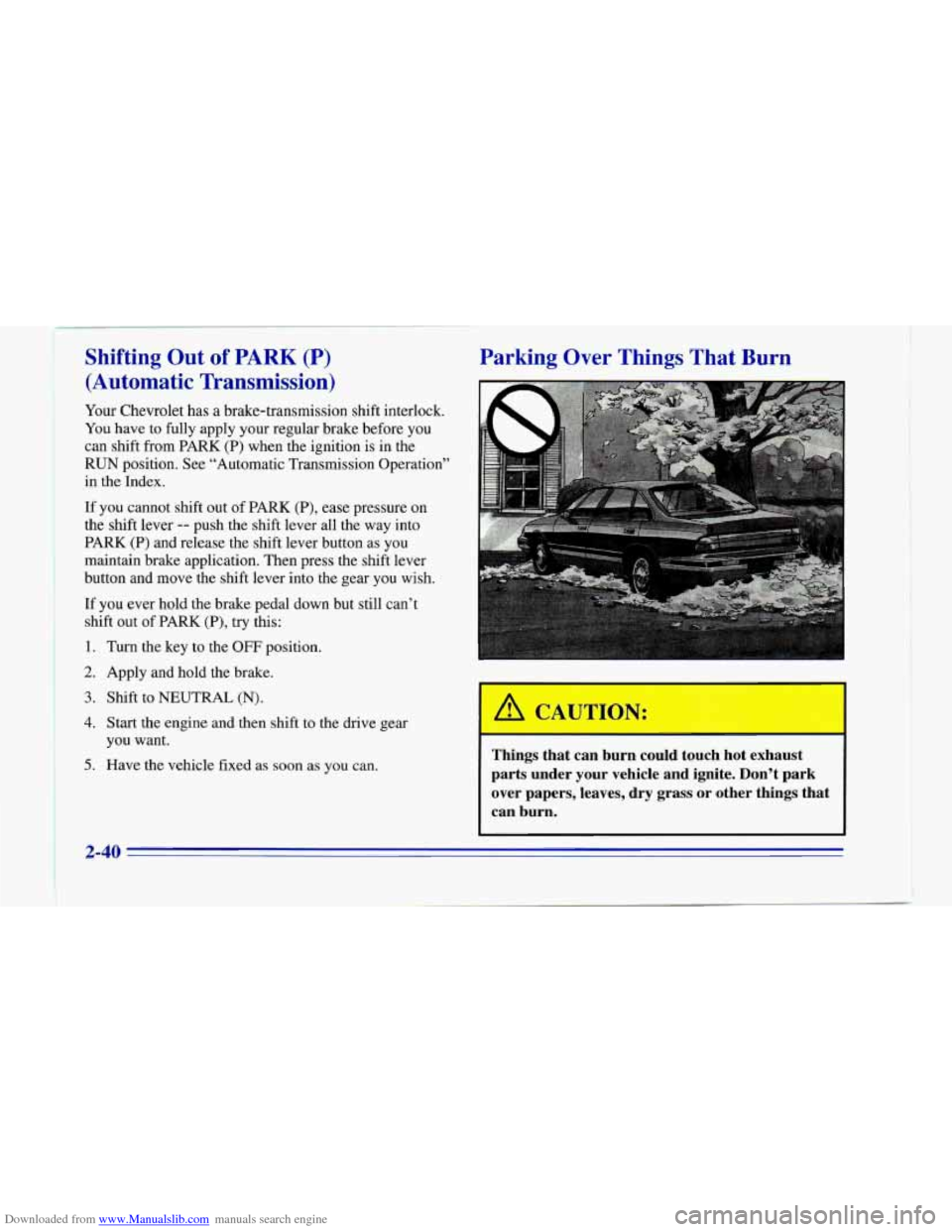
Parking Over Things That Burn
Things that can burn could touch hot exhaust
parts under your vehicle and ignite. Don’t park over papers, leaves,
dry grass or other things that
can burn.
2-40
Page 96 of 402
Downloaded from www.Manualslib.com manuals search engine Engine Exhaust
Engine exhaust can kill. It contains the gas
carbon monoxide
(CO), which you can’t see or
smell.
It can cause unconsciousness and death.
You might have exhaust coming in if:
Your exhaust system sounds strange
Your vehicle gets rusty underneath.
Your vehicle was damaged in a collision.
Your vehicle was damaged when driving over
high points on the road or over road debris.
Repairs weren’t done correctly.
Your vehicle or exhaust system had been
If you ever suspect exhaust is coming into
your vehicle:
Drive it only with all the windows down to
Have your vehicle fixed immediately.
or different.
modified improperly.
blow out any CO; and
Running Your Engine While You’re
Parked (Automatic Transmission)
It’s better not to park with the engine running, But if you
ever have to, here are some things to know.
Idling the engine with the air system control
off
could allow dangerous exhaust into your vehicle
(see the earlier Caution under “Engine Exhaust”).
Also, idling in
a closed-in place can let deadly
carbon monoxide
(CO) into your vehicle even if
the fan switch is at the highest setting. One place
this can happen is
a garage. Exhaust -- with
CO
-- can come in easily. NEVER park in a
garage with the engine running.
Another closed-in place can be a blizzard. (See
“Blizzard” in the Index.)
L-41
Page 102 of 402
Downloaded from www.Manualslib.com manuals search engine When you apply your brakes, or push the clutch pedal,
if you have a manual transmission, the cruise control
shuts
off.
Setting Cruise Control
0 Cruise control can be dangerous where you
can’t drive safely at a steady speed.
So,
don’t use your cruise control on winding
roads or in heavy traffic.
slippery roads. On such roads, fast changes
in tire traction can cause needless wheel
spinning, and you could lose control. Don’t
use cruise control on slippery roads.
0 Cruise control can be dangerous on
If your vehicle is in cruise control when the optional
ASR system begins to limit wheel spin, the cruise
control will automatically disengage. (See
“ASR
System” in the Index.) When road conditions allow you
to safely use it again, you may turn the cruise control
back
on.
L
QT’TIO’’:
If you leave your cruise contirol switch on when
you’re not using cruise, you might hit
a button
and go into cruise when you don’t want to. You
could be startled and even lose control. Keep
the cruise control switch
OFF until you want
to use it.
1. Move the cruise control switch to ON.
2-47
Page 114 of 402
Downloaded from www.Manualslib.com manuals search engine IF
An improperly stored close-out panel could be
thrown about the vehicle during
a collision or
sudden maneuver. You or others could be
injured.
If you remove the cover, always store
it outside your vehicle. When you put it back,
always be sure that
it is securely reattached.
Ashtray and Lighter
Lift up the cover to open the ashtray. To remove it,
lift up on the right side
of the ashtray. If you have an
automatic transmission, the ashtray
is near the front of
your console. If you have a manual transmission, the
ashtray is near your cupholder.
I NOTICE:
Don’t put papers and other things that burn into
your ashtrays.
If you do, cigarettes or other
smoking materials could set them on fire,
causing damage.
To use the lighter, push it in all the way and let go.
When it’s ready,
it will pop back by itself.
NOTICE:
Don’t hold a cigarette lighter in with your hand
while it is heating.
If you do, it won’t be able to
back away from the heating element when
it’s
ready. That can make it overheat, damaging the
lighter and the heating element.
- ~ __~ ~
If you plug accessories into your cigarette lighter, such
as heating devices or air compressors, these accessories
should have a rated current
of less than 15 amps.
Exceeding this limit will result in a blown fuse.
2-59
Page 121 of 402
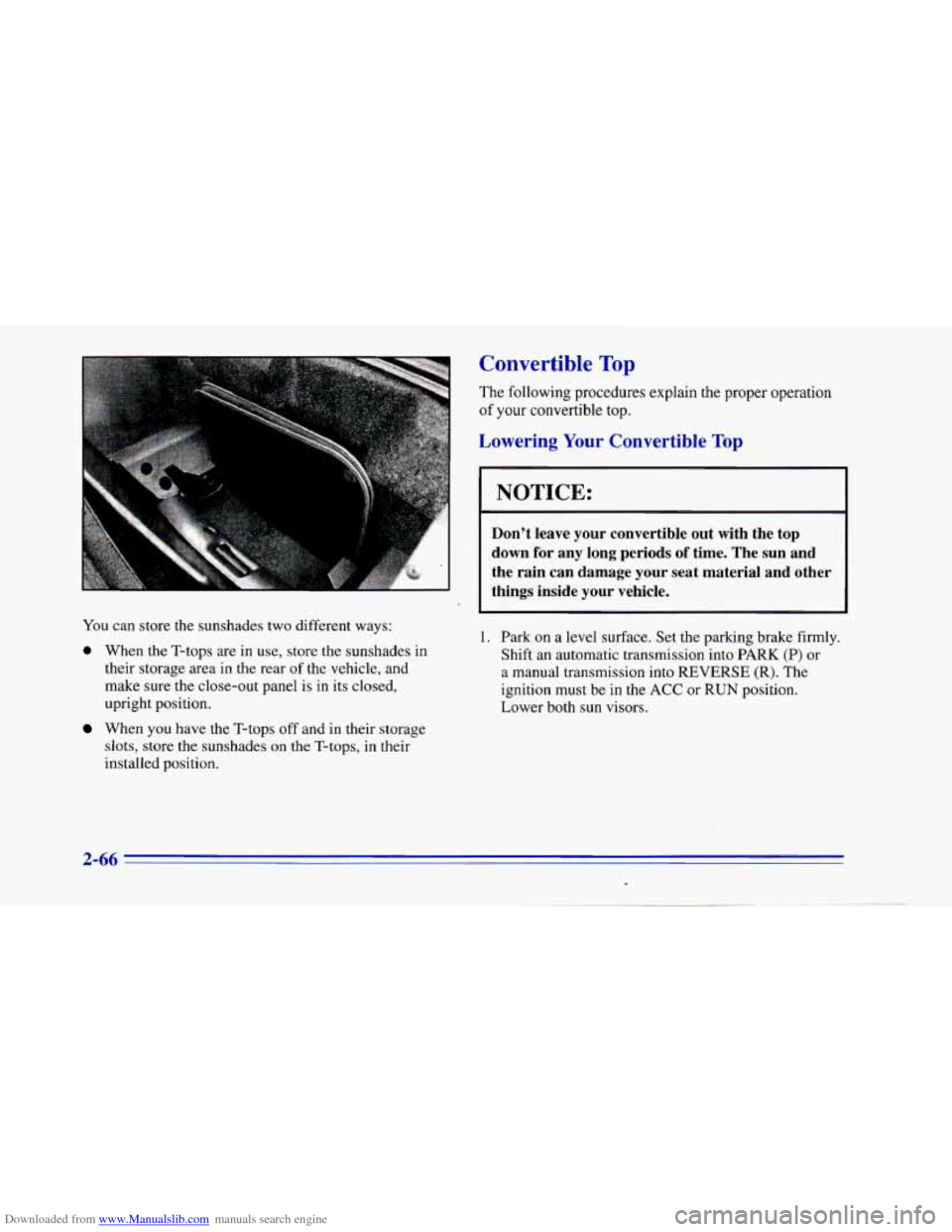
Downloaded from www.Manualslib.com manuals search engine You can store the sunshades two different ways:
0 When the T-tops are in use, store the sunshades in
their storage area in the rear
of the vehicle, and
make sure the close-out panel is in its closed,
upright position.
When you have the T-tops off and in their storage
slots, store the sunshades on the T-tops, in their
installed position.
Convertible Top
The following procedures explain the proper operation
of your convertible top.
Lowering Your Convertible Top
NOTICE:
Don’t leave your convertible out with the top
down for any long periods of time. The sun and
the rain can damage your seat material and other
things inside your vehicle.
1. Park on a level surface. Set the parking brake firmly.
Shift an automatic transmission into PARK (P) or
a manual transmission into
REVERSE (R). The
ignition must be in the
ACC or RUN position.
Lower both sun visors.
2-66
*
Page 124 of 402
Downloaded from www.Manualslib.com manuals search engine Raising ,Your Convertible Top
1. Park on a level surface. Set the parking brake firmly.
If you have an automatic transmission, shift into
PARK (P). If you have a manual transmission, shift
into REVERSE (R). The ignition must be in the
ACC or RUN position. Then lower both sun visors
and lower both windows at least
3 i-nches (8 cm). If
the boot cover is in place,
it must be removed first.
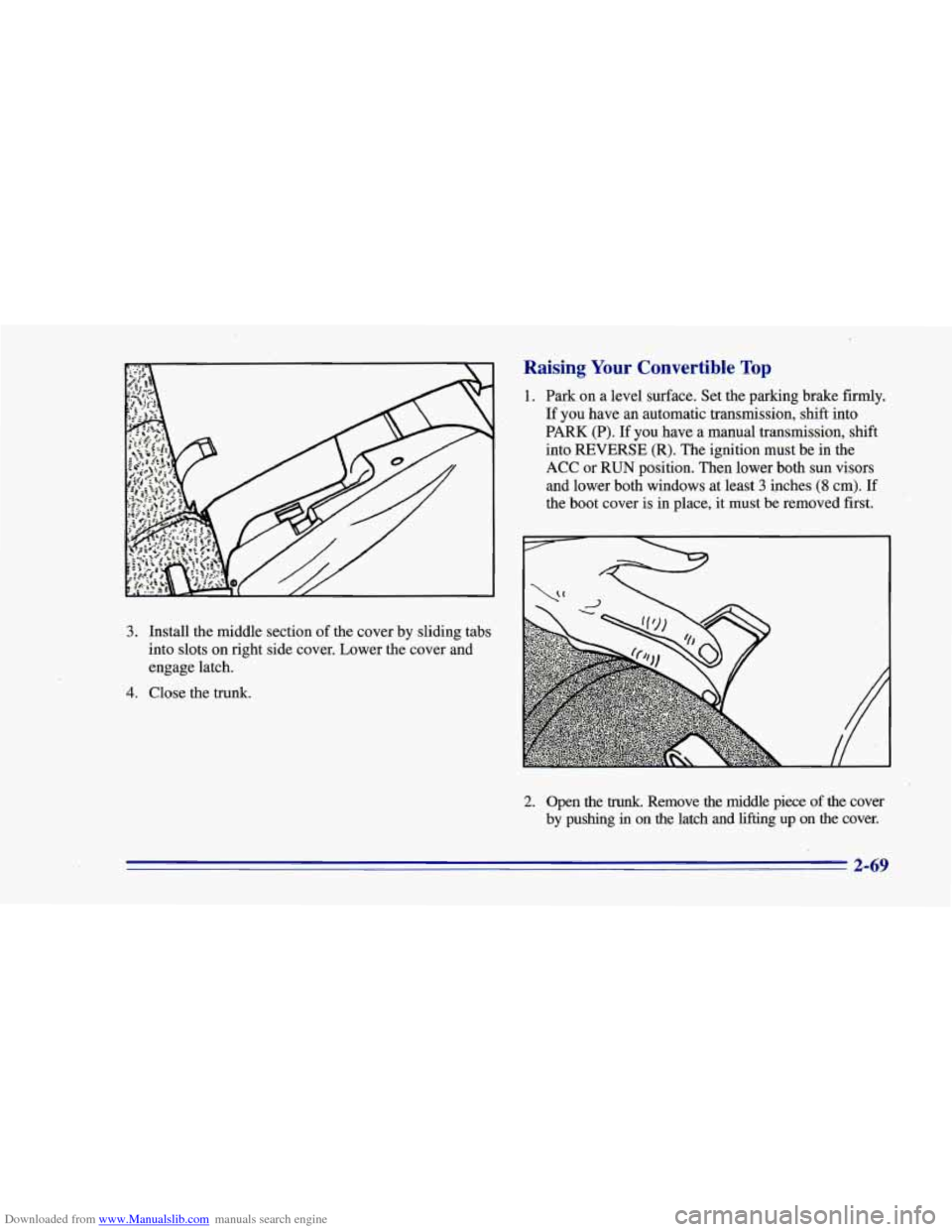
3. Install the middle section of the cover by sliding tabs
into slots on right side cover. Lower the cover and
engage latch.
4. Close the trunk.
2. Open the trunk. Remove the middle piece of the cover
by pushing in on the latch and lifting up on the cover.
2-69
Page 128 of 402
Downloaded from www.Manualslib.com manuals search engine 1. Instrument Panel Ais Deflector
2. Main Light Control
3. Instrument Panel Center Air Deflector
4. Instrument Cluster
5. Comfort Controls
6. Audio System
7. Side Window Defogger Vent
8. Glove Box
9. Remote Hatch Release
10. Cassette Tape Storage
1 1. Shift Lever
12. Parking Brake Lever 13. Cupholder
14.
Storage Console and Compact Disc
15. Acceleration Slip Regulation
(ASR)
Storage (Option) '
Switch (Option)
16. Ashtray (Automatic Transmission)
17. Cigarette Lighter
18. Horn
19. Rear Window Defogger Switch
20. Fog Lamp Switch (Option)
2 1. Convertible Top Switch (Option)
22. Ashtray (Manual Transmission)
2-73
Page 203 of 402
Downloaded from www.Manualslib.com manuals search engine Driving On Grades
Reduce speed and shift to a lower gear before you start
down a long or steep downgrade. If you don’t shift
down, you might have to use your brakes
so much that
they would get hot and no longer work well.
On a long uphill grade, shift down and reduce your
speed to around
45 mph (70 km/h) to reduce the
possibility
of engine and transmission overheating.
If you are towing a trailer and you have an automatic
transmission with overdrive,
you may prefer to drive in
DRIVE (D) instead of AUTOMATIC OVERDRIVE (@)
or, as you need to, a lower gear). Or, if you have a
manual transmission with FIFTH
(5) or SIXTH (6) gear.
It
is better not to use FIFTH (5) or SIXTH (6) gear.
Just drive in FOURTH
(4) gear (FIFTH (5) gear if you
have a six-speed manual transmission) (or, as you need
to, a lower gear).
Parking on Hills
You really should not park your vehicle, with a trailer
attached, on a hill.
If something goes wrong, your rig
could start to move. People can be injured, and both
your vehicle and the trailer can be damaged.
But if you ever have
to park your rig on a hill, here’s
how to
do it:
1.
2.
3.
4.
5.
Apply your regular brakes, but don’t shift into
PARK
(P) yet, or into gear for a manual transmission.
Have someone place chocks under the trailer wheels.
When the wheel chocks are in place, release the
regular brakes. Then apply your parking brakes until
the chocks absorb the load.
Reapply the regular brakes. Then apply your parking
brake and then shift to PARK(P) or REVERSE
(R)
for a manual transmission.
Release the regular brakes.
4-38
Page 204 of 402
Downloaded from www.Manualslib.com manuals search engine When You Are Ready to Leave After
Parking on a Hill
1. Apply your regular brakes and hold the pedal down
while you:
Start your engine;
Shift into a gear; and
Release the parking brake.
2. Let up on the brake pedal.
3. Drive slowly until the trailer is clear of the chocks.
4. Stop and have someone pick up and store the chocks.
Maintenance When Trailer Towing
Your vehicle will need service more often when you’re
pulling a trailer. See the Maintenance Schedule for more
on this. Things that are especially important in trailer
operation are automatic transmission fluid (don’t
overfill), engine oil, axle lubricant, belt, cooling system
and brake adjustment. Each
of these is covered in this
manual, and the Index will help
you find them quickly.
If you’re trailering, it’s a good idea to review these
sections before you start your trip.
Check periodically to see that all hitch nuts and bolts
are tight.
4-39
Page 210 of 402
Downloaded from www.Manualslib.com manuals search engine NOTICE:
Ignoring these steps could result in costly damage
to your vehicle that wouldn’t be covered by
your warranty.
Trying to start your Chevrolet by pushing or
pulling it could damage your vehicle, even
if you
have
a manual transmission. And if you have an
automatic transmission, it won’t start that way.
1. Check the other vehicle. It must have a 12-volt
battery with a negative ground system.
NOTICE:
If the other system isn’t a 12-volt system with a
negative ground, both vehicles can be damaged.
2.
3.
Get the vehicles close enough so the jumper cables
can reach, but be sure the vehicles aren’t touching
each other.
If they are, it could cause a ground
connection you don’t want. You wouldn’t be able to
start your Chevrolet, and the bad grounding could
damage the electrical systems.
Turn off the ignition on both vehicles. Unplug --
unnecessary accessories plugged into the cigarette
lighter. Turn
off all lamps that aren’t needed as well
as radios. This will avoid sparks and help save both
batteries. And it could save your radio!
~~
NOTICE:
If you leave your radio on, it could be badly
damaged. The repairs wouldn’t be covered by
your warranty.
5-3