engine overheat CHEVROLET CAMARO 1996 4.G Owners Manual
[x] Cancel search | Manufacturer: CHEVROLET, Model Year: 1996, Model line: CAMARO, Model: CHEVROLET CAMARO 1996 4.GPages: 402, PDF Size: 21.38 MB
Page 2 of 402
Downloaded from www.Manualslib.com manuals search engine 0 The 1996 Chevrolet Camaro Owner’s Manual
Seats and Restraint Systems ............................................................. 1-1
Features and Controls .................................................................. 2-1
Comfort Controls and Audio Systems ..................................................... 3-1
YourDrivingandtheRoad .............................................................. 4-1
This section tells you how to use your seats and safety belts properly. It also explains the “SIR’ system.
This section explains how to start and operate your Chevrolet.
This section tells you how to adjust
the ventilation and comfort controls and how to operate your
audio system.
Here you’ll find helpful information and tips about the road and how to drive under different conditions.
This section tells you what to do if you have a problem while driving, such
as a flat tire or overheated
engine, etc.
Here the manual tells you how to keep your Chevrolet running properly and looking good.
This section tells
you when to perform vehicle maintenance and what fluids and lubricants to use.
This section tells
you how to contact Chevrolet for assistance and how to get service and owner publications.
It also gives you information on “Reporting Safety Defects” on page
8-8.
Index ........................................................................\
........ 9-1
Here’s an alphabetical listing of almost every subject in this manual. You can use it to quickly find
something you want to read.
ProblemsontheRoad .................................................................. 5-1
Service and Appearance Care.. .......................................................... 6-1
MaintenanceSchedule........................... ....................................... 7-1
Customer Assistance Information ........................................................ 8-1
i
Page 82 of 402
Downloaded from www.Manualslib.com manuals search engine Engine Coolant Heater (Option)
I
Plugging the cord into an ungrounded outlet
could cause an electrical shock. Also, the wrong
kind of extension cord could overheat and cause
a fire. You could be seriously injured. Plug the
cord into a properly grounded three-prong
110-volt AC outlet.
If the cord won’t reach, use a
heavy-duty three-prong extension cord rated for
at least
15 amps.
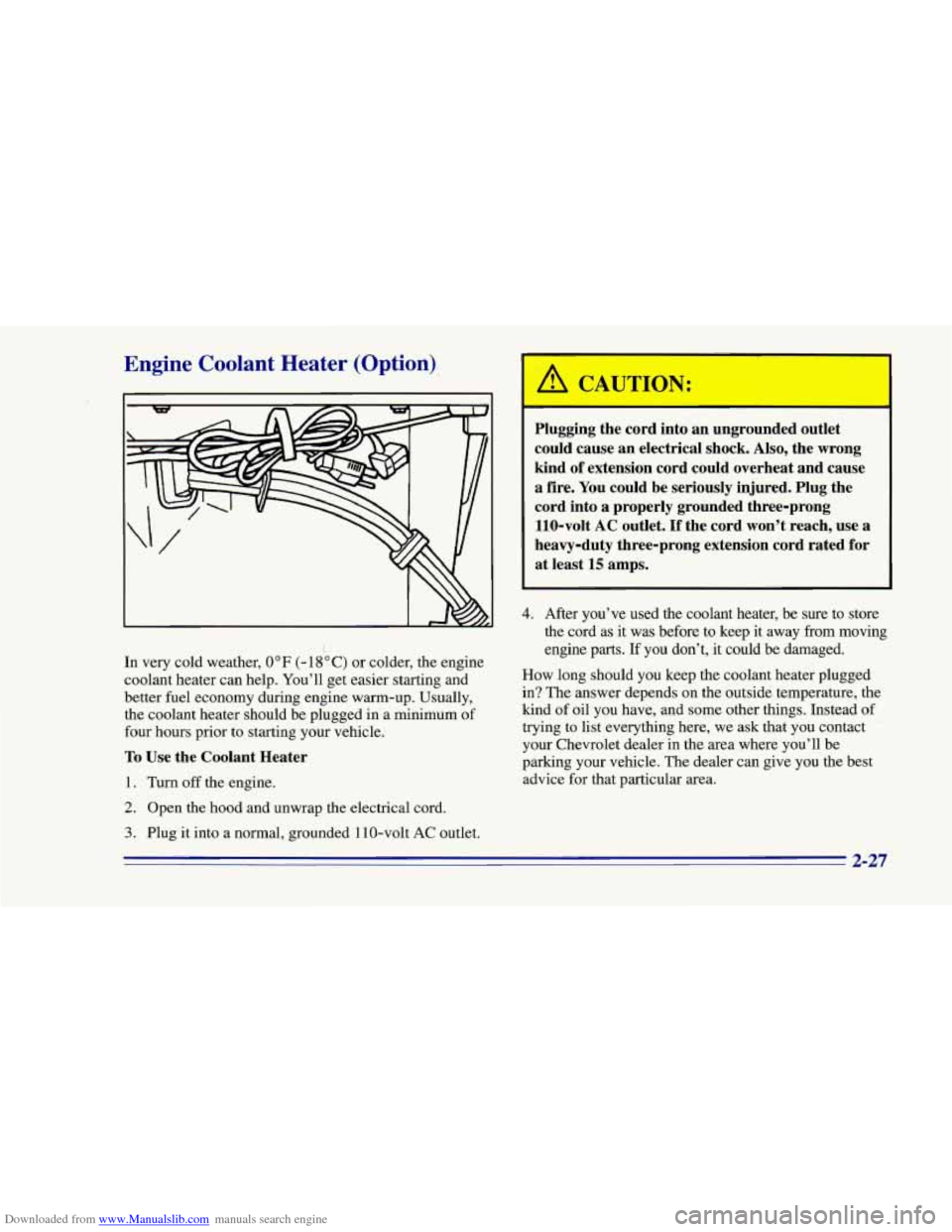
In very cold weather, 0°F (- 18 O C) or colder, the engine
coolant heater can help. You’ll get easier starting and
better fuel economy during engine warm-up. Usually,
the coolant heater should be plugged in a minimum
of
four hours prior to starting your vehicle.
To Use the Coolant Heater
1. Turn off the engine.
2. Open the hood and unwrap the electrical cord.
3. Plug it into a normal, grounded 1 10-volt AC outlet.
4. After you’ve used the coolant heater, be sure to store
the cord as it was before to keep it away from moving
engine parts.
If you don’t, it could be damaged.
How long should you keep
the coolant heater plugged
in? The answer depends on the outside temperature, the
kind
of oil you have, and some other things. Instead of
trying to list everything here, we ask that you contact
your Chevrolet dealer in the area where you’ll be
parking your vehicle. The dealer can give you the best
advice for that particular area.
2-27
Page 86 of 402
Downloaded from www.Manualslib.com manuals search engine FIRST (1): This position gives you even more power
(but lower fuel economy) than
SECOND (2). You can
use it on very steep hills, or in deep snow
or mud. If the
selector lever
is put in FIRST (l), the transmission
won’t shift into first gear until the vehicle is going
slowly enough.
NOTICE:
If your rear wheels can’t rotate, don’t try to
drive. This might happen if you were stuck
in
very deep sand or mud or were up against a solid
object.
You could damage your transmission.
Also, if you stop when going uphill, don’t hold
your vehicle there with only the accelerator
pedal. This could overheat and damage the
transmission. Use your brakes or shift into
PARK (P) to hold your vehicle in position on
a hill.
Maximum engine speed is limited to protect driveline
components from improper operation.
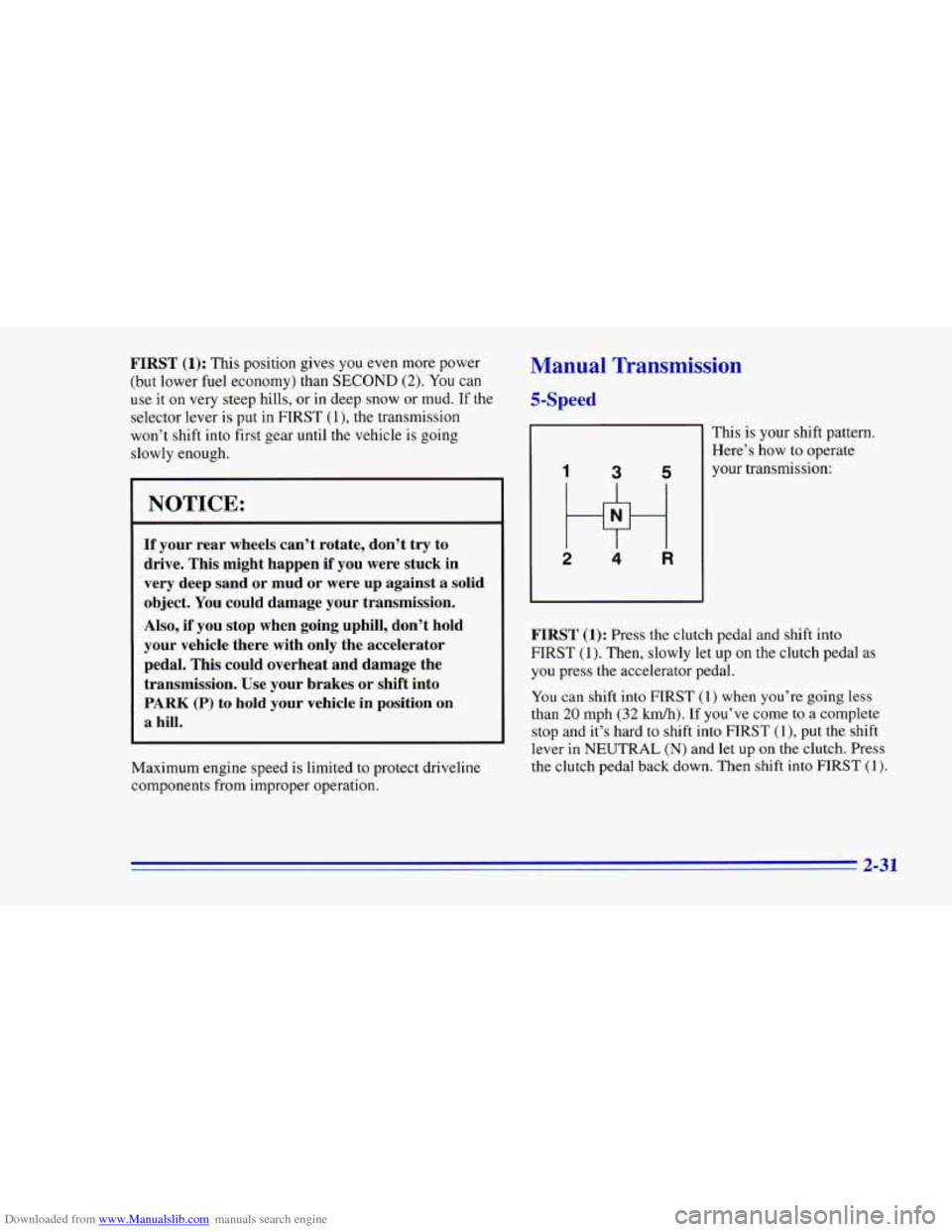
Manual Transmission
5-Speed
1 3 5
2 4 R
This is your shift pattern.
Here’s how
to operate
your transmission:
FIRST (1): Press the clutch pedal and shift into
FIRST (1). Then, slowly let up on the clutch pedal as
you press
the accelerator pedal.
You can shift into FIRST (I ) when you’re going less
than
20 mph (32 km/h). If you’ve come to a complete
stop and it’s hard to shift into FIRST
(I), put the shift
lever in
NEUTRAL (N) and let up on the clutch. Press
the clutch pedal back down. Then shift
into FIRST (1).
Page 92 of 402
Downloaded from www.Manualslib.com manuals search engine If you are towing a trailer and are parking on any hill,
see “Towing a Trailer” in the Index. That section shows
what to
do first to keep the trailer from moving.
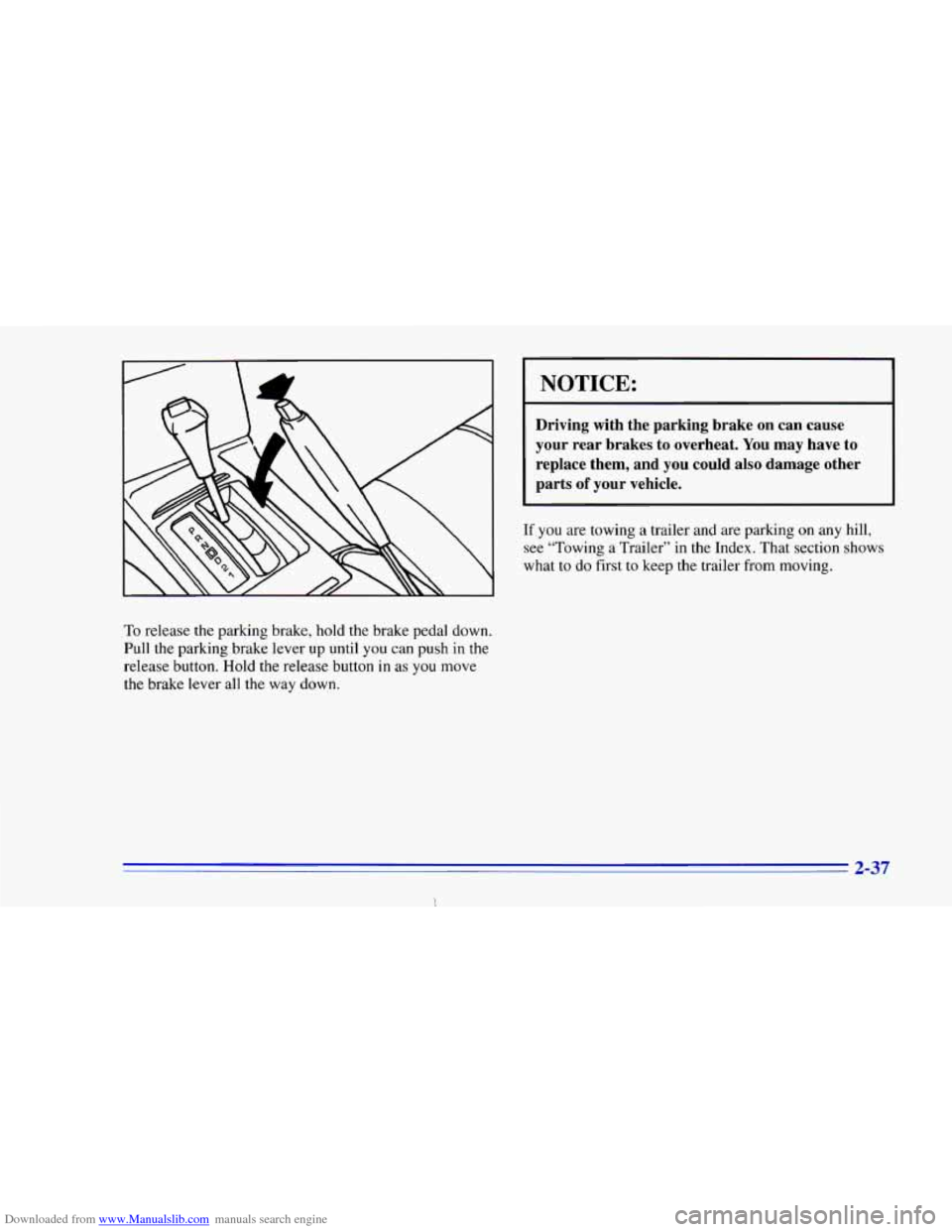
To release the parking brake, hold the brake pedal down.
Pull the parking brake lever up until you can push in the
release button.
Hold the release button in as you move
the brake lever all the
way down.
NOTICE:
Driving with the parking brake on can cause
your rear brakes to overheat. You may have to
replace them, and you could also damage other
parts
of your vehicle.
2-37
Page 94 of 402
Downloaded from www.Manualslib.com manuals search engine Leaving Your Vehicle With the Engine
Running (Automatic Transmission
M s Only)
--
/LA c A u 1lC Ln T :
It can be dang,:ous to leave your vehicle with
the engine running. Your vehicle could move
suddenly if the shift lever is not fully in
PARK (P)
with the parking brake firmly set. And, if you
leave the vehicle with the engine running, it could overheat and even catch fire. You or others could
be injured. Don’t leave your vehicle with the
engine running unless you have to.
If you have to leave your vehicle with the engine
running, be sure your vehicle is in PARK
(P) and your
parking brake is firmly
set before you leave it. After
you’ve moved the shift lever into the PARK (P)
position, hold the regular brake pedal down. Then, see
if
you can move the shift lever away from PARK (P)
without first pushing the button. If you can, it means
that the shift lever wasn’t fully locked into PARK
(P).
Torque Lock (Automatic Transmission)
If you are parking on a hill and you don’t shift your
transmission into PARK (P) properly, the weight of the
vehicle may put too much force on the parking pawl in
the transmission. You may find
it difficult to pull the
shift lever out of PARK (P). This is called “torque lock.”
To prevent torque lock, set the parking brake and then
shifteinto PARK
(P) properly before you leave the
driver’s seat.
To find out how, see “Shifting Into
PARK (P)” in the Index.
When
you are ready to drive, move the shift lever out of
PARK (P) before you release the parking brake.
If torque lock does occur, you may need to have another
vehicle push yours a little uphill to take some of the
pressure from the transmission,
so you can pull the shift
lever out of PARK
(P).
Parking Your Vehicle
(Manual Transmission)
Before you get out of your vehicle, put your manual
transmission
in REVERSE (R) and firmly apply the
parking brake.
If your vehicle is equipped
to tow a trailer, see “Towing
a Trailer”
in the Index.
2-39
Page 114 of 402
Downloaded from www.Manualslib.com manuals search engine IF
An improperly stored close-out panel could be
thrown about the vehicle during
a collision or
sudden maneuver. You or others could be
injured.
If you remove the cover, always store
it outside your vehicle. When you put it back,
always be sure that
it is securely reattached.
Ashtray and Lighter
Lift up the cover to open the ashtray. To remove it,
lift up on the right side
of the ashtray. If you have an
automatic transmission, the ashtray
is near the front of
your console. If you have a manual transmission, the
ashtray is near your cupholder.
I NOTICE:
Don’t put papers and other things that burn into
your ashtrays.
If you do, cigarettes or other
smoking materials could set them on fire,
causing damage.
To use the lighter, push it in all the way and let go.
When it’s ready,
it will pop back by itself.
NOTICE:
Don’t hold a cigarette lighter in with your hand
while it is heating.
If you do, it won’t be able to
back away from the heating element when
it’s
ready. That can make it overheat, damaging the
lighter and the heating element.
- ~ __~ ~
If you plug accessories into your cigarette lighter, such
as heating devices or air compressors, these accessories
should have a rated current
of less than 15 amps.
Exceeding this limit will result in a blown fuse.
2-59
Page 135 of 402
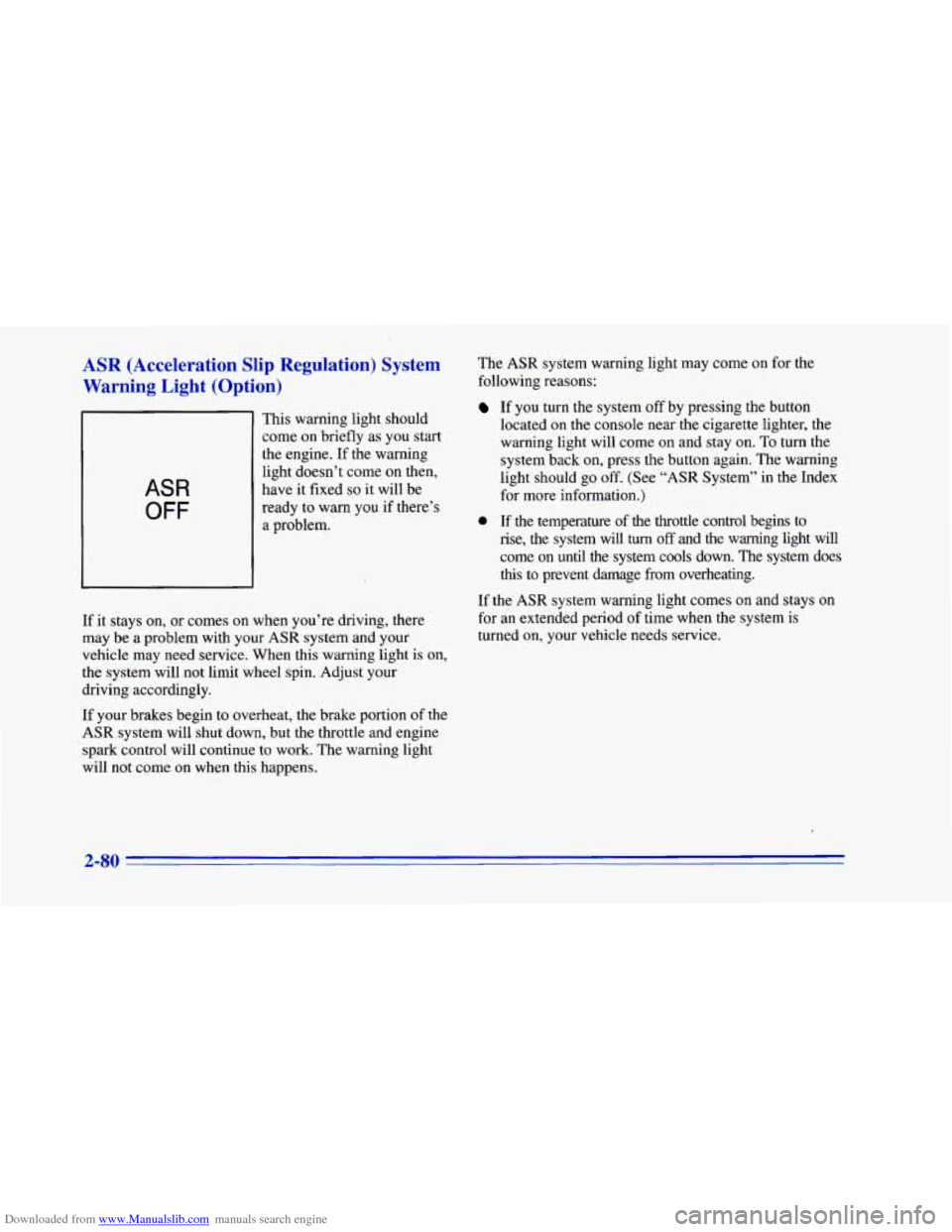
Downloaded from www.Manualslib.com manuals search engine ASR (Acceleration Slip Regulation) System
Warning Light (Option)
ASR
OFF
This warning light should
come
on briefly as you start
the engine. If the warning
light doesn’t come
on then,
have it fixed
so it will be
ready to warn
you if there’s
a problem.
If it stays on, or comes
on when you’re driving, there
may be a problem with your ASR system and your
vehicle may need service. When this warning light is on.
the system will not limit wheel spin. Adjust your
driving accordingly.
If your brakes begin
to overheat, the brake portion of the
ASR system will shut down, but the throttle and engine
spark control will continue to work.
The warning light
will not come on when this happens. The
ASR system warning light may come on for the
following reasons:
If you turn the system off by pressing the button
located
on the console near the cigarette lighter, the
warning light will come
on and stay on. To turn the
system back on, press the button again. The warning
light should go
off. (See “ASR System” in the Index
for more information.)
e If the temperature of the throttle control begins to
rise, the system will turn off and the warning light will
come on until the system
cools down. The system does
this to prevent damage from overheating.
If the ASR system warning light comes
on and stays on
for an extended period of time when the system is
turned on, your vehicle needs service.
2-80
Page 136 of 402
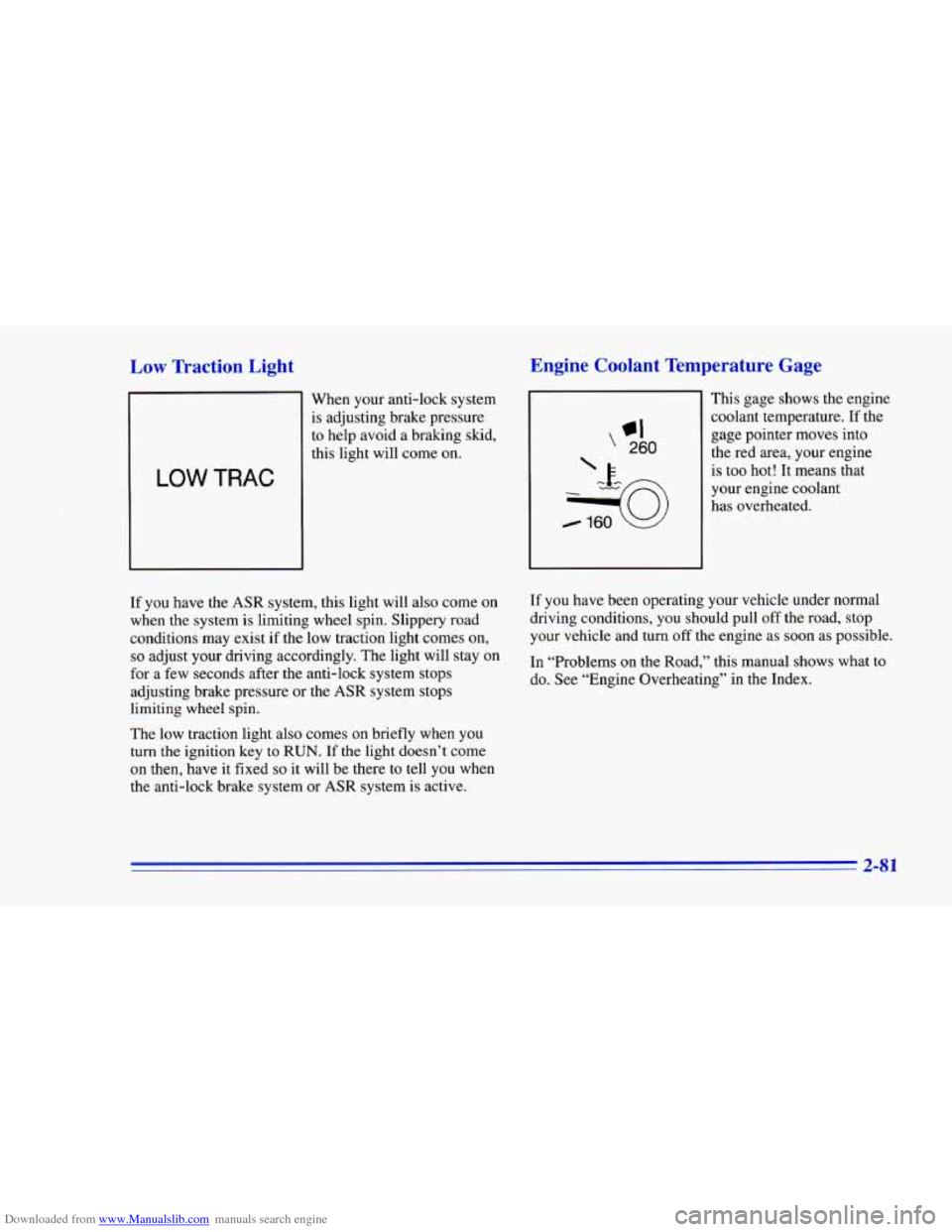
Downloaded from www.Manualslib.com manuals search engine Low Traction Light Engine Coolant Temperature Gage
When your anti-lock system
is adjusting brake pressure
to help avoid a braking skid,
this light will
come on.
LOW TRAC
This gage shows the engine
coolant temperature. If the
@I
‘ 260
/ 160
gage pointer moves into
the red area, your engine
is too hot! It means that
your engine coolant
has overheated.
If you have the ASR system, this light will also come on If
you have been operating your vehicle under normal
when the system is limiting wheel spin. Slippery road driving conditions,
you should pull off the road, stop
conditions may exist if the low traction light comes on, your
vehicle and turn off the engine as soon as possible.
so adjust your driving accordingly. The light will stay on In “Problems on the Road,” this manual shows what to
for a few seconds after the anti-lock system stops do. See “Engine Overheating” in the Index.
adjusting brake pressure or the ASR system stops
limiting wheel spin.
The low traction light also comes on briefly when you
turn the ignition key to
RUN. If the light doesn’t come
on then, have it fixed so it will be there to tell you when
the anti-lock brake system or
ASR system is active.
2-81
Page 137 of 402
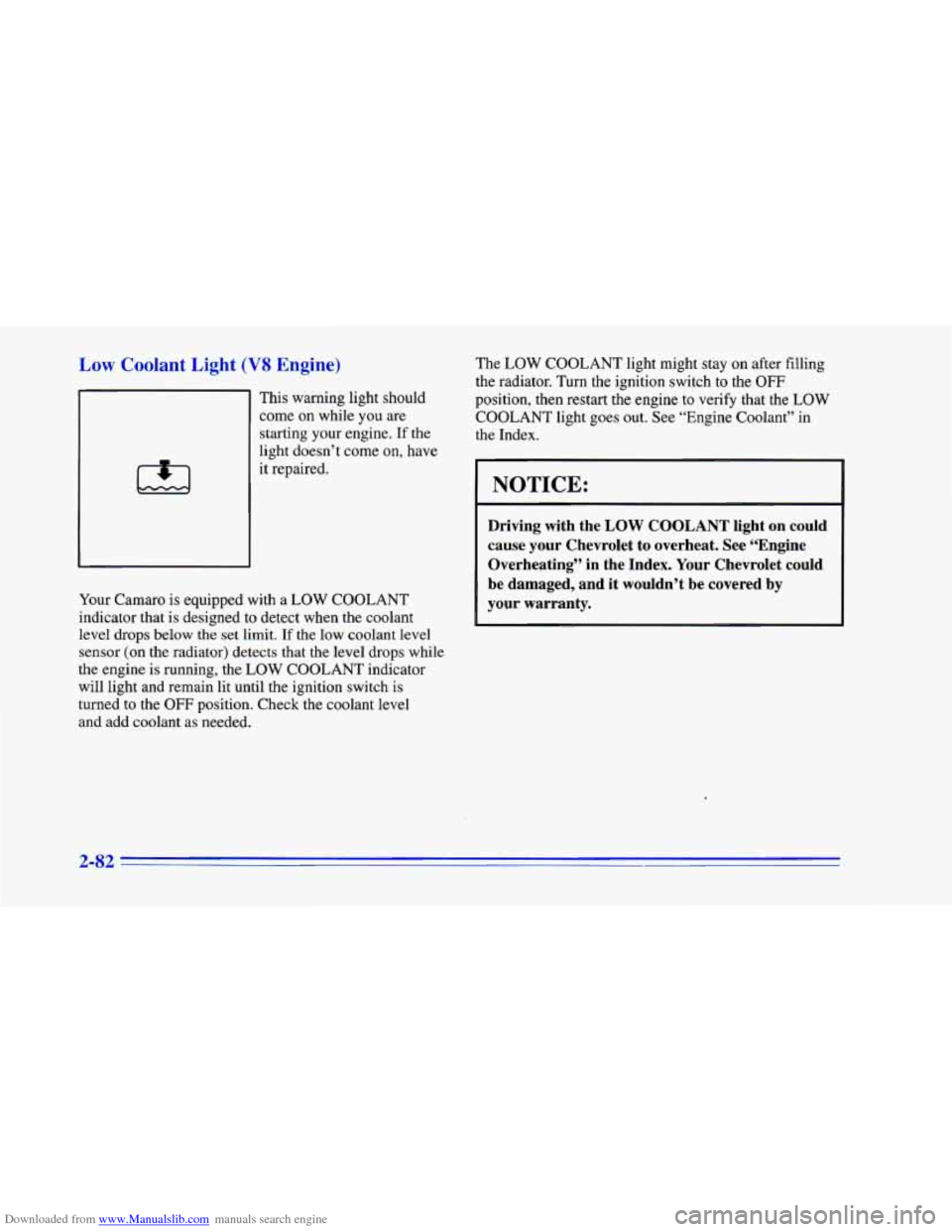
Downloaded from www.Manualslib.com manuals search engine Low Coolant Light (VI3 Engine)
This warning light should
come on while you are
starting
your engine. If the
light doesn’t come on, have
it repaired.
Your Camaro
is equipped with a LOW COOLANT
indicator that is designed to detect when the coolant
level
drops below the set limit. If the low coolant level
sensor (on
the radiator) detects that the level drops while
the engine is running, the
LOW COOLANT indicator
will light and remain lit until the ignition switch is
turned to the
OFF position. Check the coolant level
and add coolant as needed. The
LOW COOLANT
light might stay on after filling
the radiator. Turn the ignition switch to the
OFF
position, then restart the engine to verify that the LOW
COOLANT light goes out. See “Engine Coolant” in
the Index.
1 NOTICE:
Driving with the LOW COOLANT light on could
cause your Chevrolet to overheat. See “Engine
Overheating” in the Index.
Your Chevrolet could
be damaged, and it wouldn’t be covered by
your warranty.
2-82
Page 203 of 402
Downloaded from www.Manualslib.com manuals search engine Driving On Grades
Reduce speed and shift to a lower gear before you start
down a long or steep downgrade. If you don’t shift
down, you might have to use your brakes
so much that
they would get hot and no longer work well.
On a long uphill grade, shift down and reduce your
speed to around
45 mph (70 km/h) to reduce the
possibility
of engine and transmission overheating.
If you are towing a trailer and you have an automatic
transmission with overdrive,
you may prefer to drive in
DRIVE (D) instead of AUTOMATIC OVERDRIVE (@)
or, as you need to, a lower gear). Or, if you have a
manual transmission with FIFTH
(5) or SIXTH (6) gear.
It
is better not to use FIFTH (5) or SIXTH (6) gear.
Just drive in FOURTH
(4) gear (FIFTH (5) gear if you
have a six-speed manual transmission) (or, as you need
to, a lower gear).
Parking on Hills
You really should not park your vehicle, with a trailer
attached, on a hill.
If something goes wrong, your rig
could start to move. People can be injured, and both
your vehicle and the trailer can be damaged.
But if you ever have
to park your rig on a hill, here’s
how to
do it:
1.
2.
3.
4.
5.
Apply your regular brakes, but don’t shift into
PARK
(P) yet, or into gear for a manual transmission.
Have someone place chocks under the trailer wheels.
When the wheel chocks are in place, release the
regular brakes. Then apply your parking brakes until
the chocks absorb the load.
Reapply the regular brakes. Then apply your parking
brake and then shift to PARK(P) or REVERSE
(R)
for a manual transmission.
Release the regular brakes.
4-38