ABS CHEVROLET CAMARO 1996 4.G Owners Manual
[x] Cancel search | Manufacturer: CHEVROLET, Model Year: 1996, Model line: CAMARO, Model: CHEVROLET CAMARO 1996 4.GPages: 402, PDF Size: 21.38 MB
Page 69 of 402
Downloaded from www.Manualslib.com manuals search engine Arming the System
The alarm system can be armed to detect break-ins by
locking your vehicle using the Remote Lock Control
transmitter or by locking the doors with the power door
lock switch. Passive arming is also available, if
you
would like the system to arm all by itself after the doors
have been closed for a
short time. When the system is
armed, a red light will flash briefly once every two
seconds. (Note: If you return to your vehicle and the red
light is flashing two brief flashes every two seconds, the
system is armed and the shock sensor had triggered a
two minute alarm. If the red light is flashing three times
every two seconds, the system
is armed and there was an
intrusion that sounded the alarm). Horn chirps and
parking lamp flashes can
be set to your choice.
Remote Lock Control Transmitter Locking
If all the doors are closed, locking the vehicle this way
will immediately arm the system. The horn will chirp
twice and the parking lamps will flash, confirming that
the system is armed.
If any door is open when the
transmitter LOCK button is pressed, the system goes
into an armed wait mode, waiting for the doors
to close.
Once they are closed, the system will arm, chirp the
horns twice and flash the parking lamps.
If the hatch is
open or ajar at the time the system is arming, the horn
will only chirp once.
Power Door Lock Switch Locking
If any door is open when the power door lock switch
is pressed, the system goes into an armed wait mode,
waiting for the doors to close. Once they
are closed, the
system will arm and flash the parking lamps.
If all of the
doors are closed when the lock switch
is pressed, the
system assumes you are inside of the vehicle,
so it will
not arm. Note: Locking the doors by using the manual
door locks will not arm the system.
Passive Arming
If the ignition was just turned off and a door was
opened, the system will arm six seconds after all doors
are closed, whether or not you lock them. In all other
cases, the system will wait
30 seconds after all doors are
closed before arming, allowing you time to get into the
vehicle and the key in the ignition. The parking lamps
will flash when the system arms.
Disarming the System
There are two ways to disarm the system:
1. Press the UNLOCK button on the Remote Lock
Control transmitter,
OR if the horn chirps two or
three times when
you unlock the car, the alarm
sounded in your absence. Two chirps means that
the shock sensor was set
off and three chirps means
2-14
Page 124 of 402
Downloaded from www.Manualslib.com manuals search engine Raising ,Your Convertible Top
1. Park on a level surface. Set the parking brake firmly.
If you have an automatic transmission, shift into
PARK (P). If you have a manual transmission, shift
into REVERSE (R). The ignition must be in the
ACC or RUN position. Then lower both sun visors
and lower both windows at least
3 i-nches (8 cm). If
the boot cover is in place,
it must be removed first.
3. Install the middle section of the cover by sliding tabs
into slots on right side cover. Lower the cover and
engage latch.
4. Close the trunk.
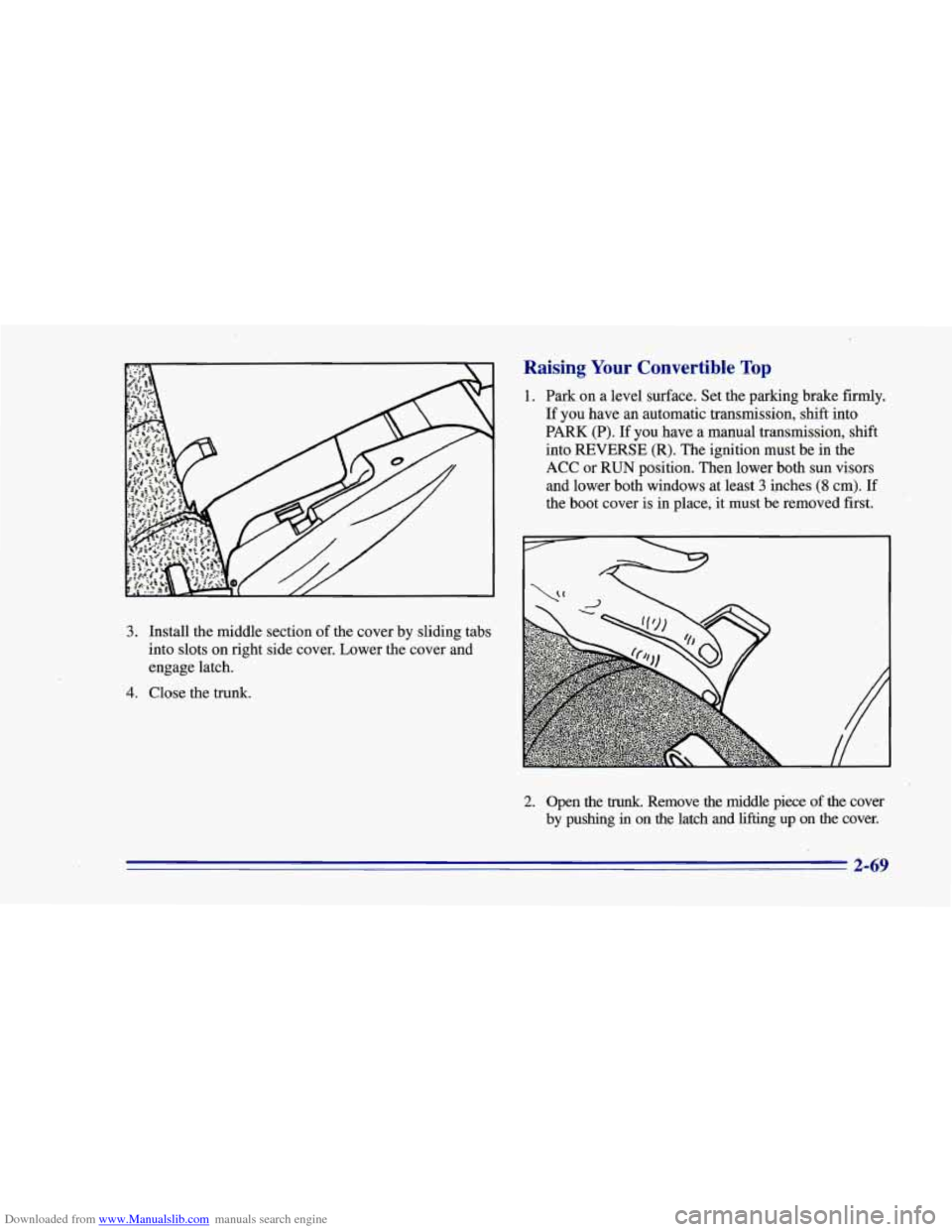
2. Open the trunk. Remove the middle piece of the cover
by pushing in on the latch and lifting up on the cover.
2-69
Page 132 of 402
Downloaded from www.Manualslib.com manuals search engine Air Bag Readiness Light
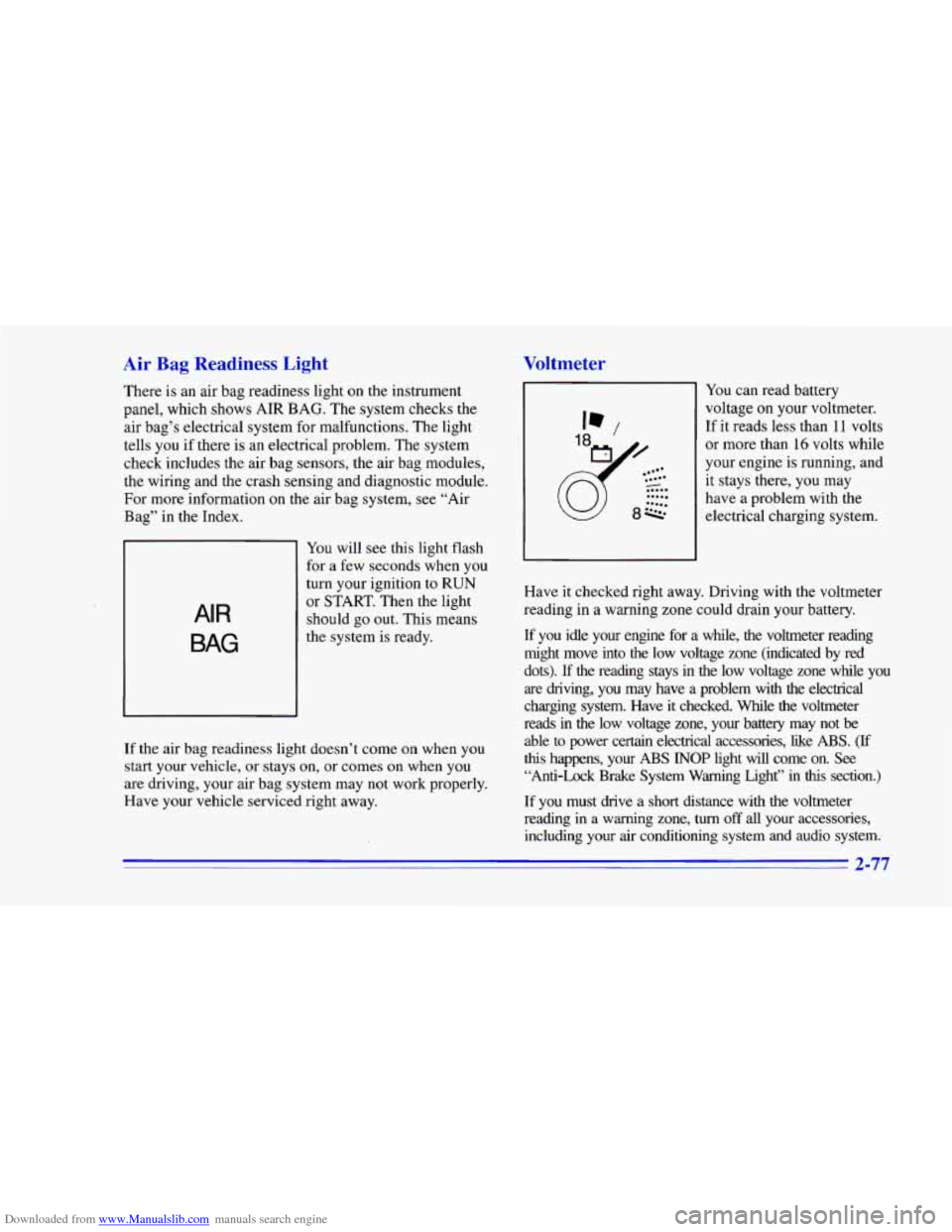
There is an air bag readiness light on the instrument
panel, which shows AIR BAG. The system checks the
air bag’s electrical system for malfunctions. The light
tells you if there is an electrical problem. The system
check includes the air bag sensors, the air bag modules,
the wiring and the crash sensing and diagnostic module.
For more information on the air bag system, see “Air
Bag” in the Index.
AIR
BAG
You will see this light flash
for a few seconds when you
turn your ignition to
RUN
or START. Then the light
should go
out. This means
the system
is ready.
If the air bag readiness light doesn’t come on when you
start your vehicle, or stays on, or comes on when you
are driving, your air bag system may not work properly.
Have your vehicle serviced right away.
Voltmeter
You can read battery
voltage
on your voltmeter.
If it reads less than 11 volts
or more than
16 volts while
your engine is running, and
it stays there, you may
have a problem with the
electrical charging system.
Have it checked right away. Driving with the voltmeter
reading in
a warning zone could drain your battery.
If you idle your engine for a while, the voltmeter reading
might move into the low voltage zone (indicated by red
dots).
If the reading stays in the low voltage zone while you
are driving, you may have a problem with the electrical
charging system. Have it checked.
While the voltmeter
reads in
the low voltage zone, your battery may not be
able
to power certain electrical accessories, like ABS. (If
this happens, your ABS INOP light will come on. See
“Anti-Lock Brake System Warning Light” in this section.)
If you must drive a short distance with the voltmeter
reading in a warning zone,
turn off all your accessories,
including your air conditioning system and audio system.
2-77
Page 134 of 402
Downloaded from www.Manualslib.com manuals search engine Anti-Lock Brake System Warning Light
ABS
INOP
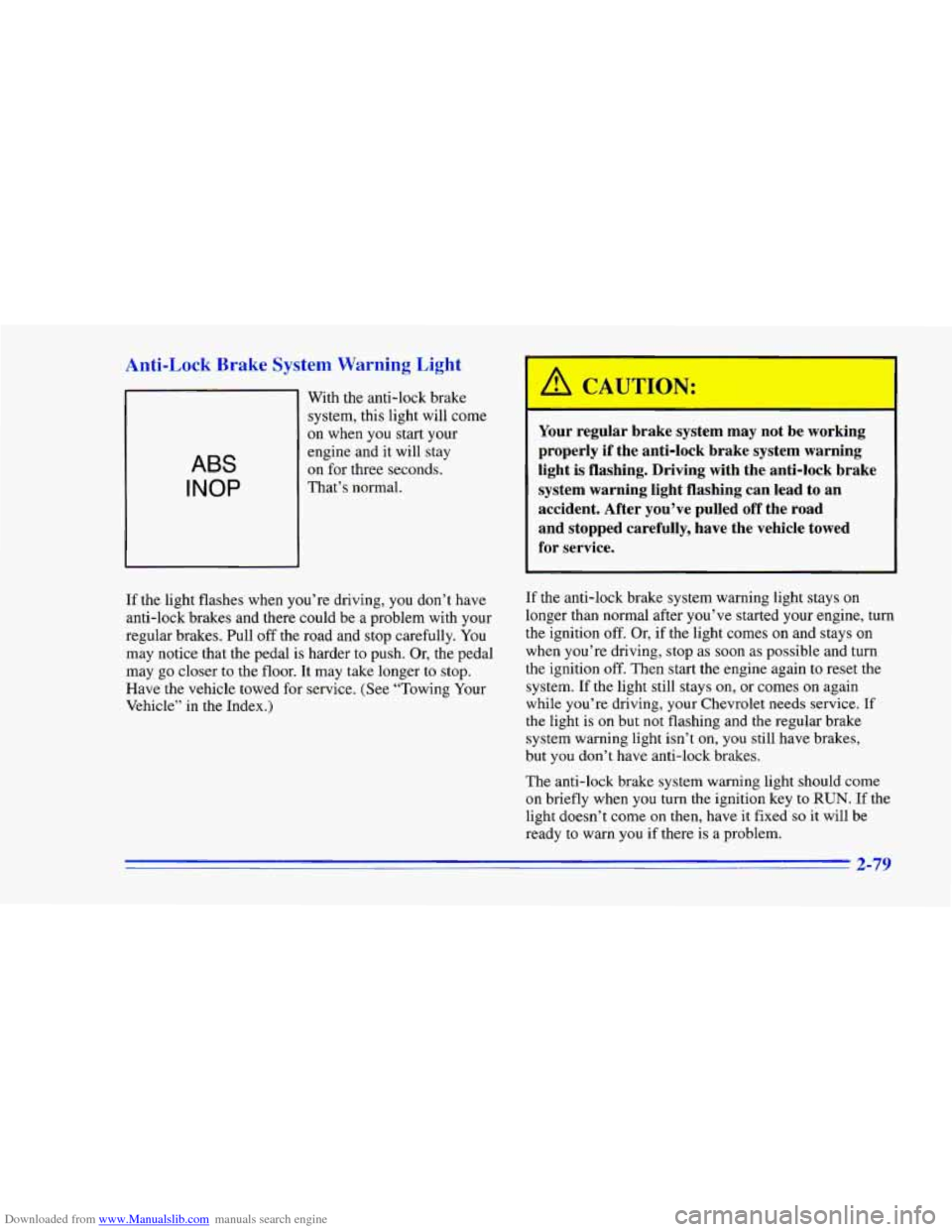
With the anti-lock brake
system, this light will come
on when you start your
engine and it will stay
on for three seconds.
That’s normal.
If the light flashes when you’re driving, you don’t have
anti-lock brakes and there could be
a problem with your
regular brakes. Pull off the road and stop carefully. You
may notice that the pedal
is harder to push. Or, the pedal
may go closer to the floor.
It may take longer to stop.
Have the vehicle towed for service. (See “Towing Your
Vehicle” in the Index.)
Your regular brake system may not be working
properly if the anti-lock brake system warning
light is flashing. Driving with the anti-lock brake
system warning light flashing can lead to an
accident. After you’ve pulled
off the road
and stopped carefully, have the vehicle towed
for service.
If the anti-lock brake system warning light stays on
longer than normal after you’ve started your engine, turn
the ignition off. Or, if the light comes on and stays on
when you’re driving, stop as soon as possible and turn
the ignition
off. Then start the engine again to reset the
system. If the light still stays on, or comes
on again
while you’re driving, your Chevrolet needs service.
If
the light is on but not flashing and the regular brake
system warning light isn’t on, you still have brakes,
but you don’t have anti-lock brakes.
The anti-lock brake system warning light should come
on briefly when you turn the ignition key to
RUN. If the
light doesn’t come on then, have it fixed
so it will be
ready to warn you if there is a problem.
2-79
Page 171 of 402
Downloaded from www.Manualslib.com manuals search engine Avoid needless heavy braking. Some people drive in
spurts -- heavy acceleration followed by heavy
braking
-- rather than keeping pace with traffic. This is a
mistake. Your brakes may not have time
to cool between
hard stops. Your brakes will wear out much faster if you
do a lot
of heavy braking. If you keep pace with the
traffic and allow realistic following distances, you will
eliminate a lot of unnecessary braking. That means
better braking and longer brake life.
If your engine ever stops while you’re driving, brake
normally but don’t pump your brakes. If
you do, the
pedal may get harder to push down. If your engine
stops, you will still have some power brake assist. But
you will use it when you brake. Once the power assist is
used up, it may take longer
to stop and the brake pedal
will be harder
to push.
Anti-Lock Brakes
Your vehicle has anti-lock brakes (ABS). ABS is an
advanced electronic braking system that will help
prevent a braking skid.
When
you start your engine, or when you begin to drive
away, your anti-lock brake system will check itself. You
may hear a momentary motor or clicking
noise while
this
test is going on, and you may even notice that your
brake pedal moves a little. This is normal.
ABS
INOP
If there’s a problem with the
anti-lock brake system, this
warning light will stay on or
flash. See “Anti-Lock
Brake System Warning
Light” in the Index.
4-6
Page 172 of 402
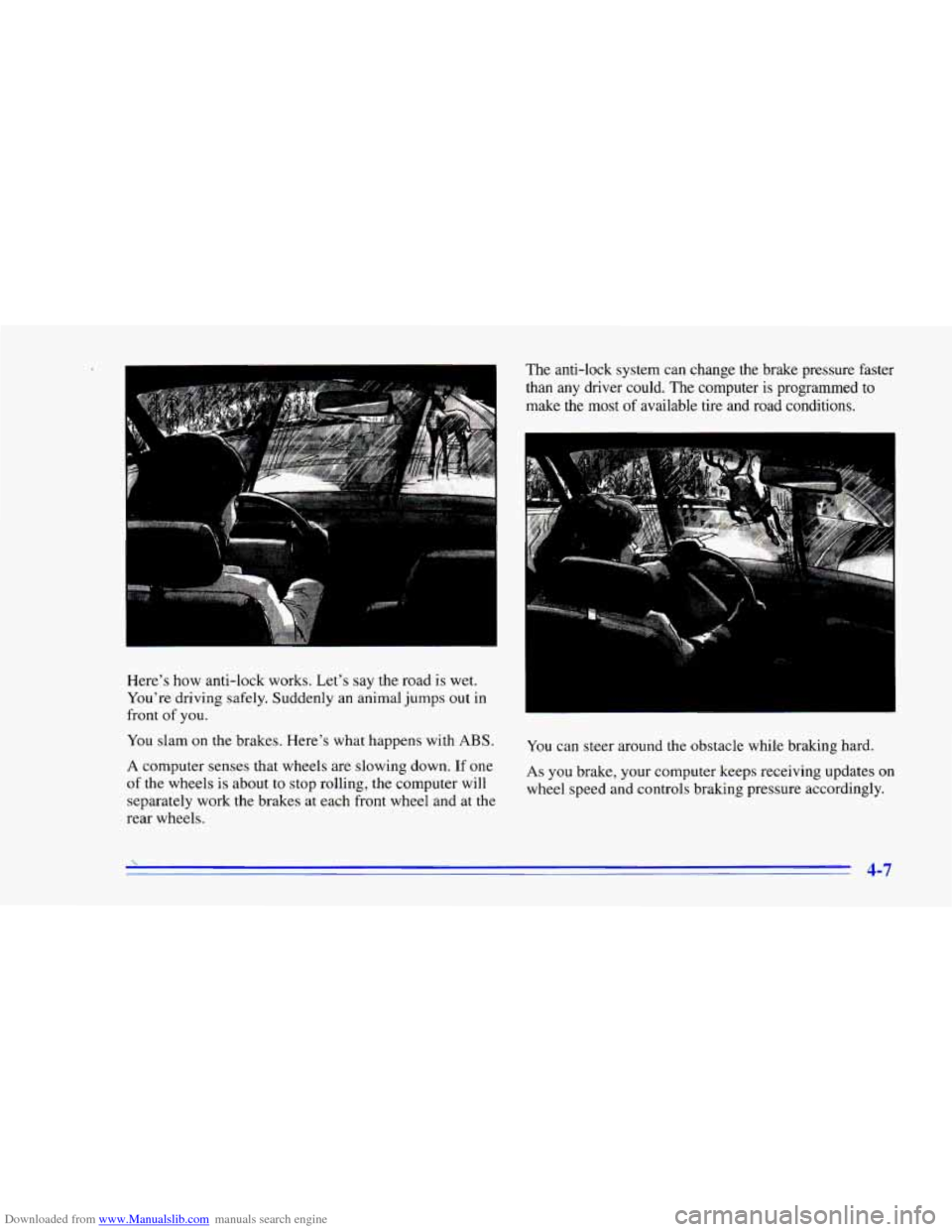
Downloaded from www.Manualslib.com manuals search engine Here's how anti-lock works, Let's say the road is wet.
You're driving safely. Suddenly an animal jumps
out in
front of you.
You slam
on the brakes. Here's what happens with ABS.
A computer senses that wheels are slowing down. If one
of the wheels is about to stop rolling, the computer will
separately work the brakes at each front wheel and at the
rear wheels. The
anti-lock system can change the brake pressure faster
than any driver could. The computer is programmed
to
make the most of available tire and road conditions.
You can steer around the obstacle while braking hard.
As you brake, your computer keeps receiving updates on
wheel speed and controls braking pressure accordingly.
Page 180 of 402
Downloaded from www.Manualslib.com manuals search engine Of course, traction is reduced when water, snow, ice,
gravel or other material is
on the road. For safety, you’ll
want
to slow down and adjust your driving to these
conditions. It is important to slow down on slippery
surfaces because stopping distance will be longer and
vehicle control more limited.
While driving
on a surface with reduced traction, try
your best
to avoid sudden steering, acceleration or
braking (including engine braking by shifting
to a lower
gear). Any sudden changes could cause the tires to
slide.
You may not realize the surface is slippery until
your vehicle is skidding. Learn to recognize warning
clues
-- such as enough water, ice or packed snow on
the road to make a “mirrored surface”
-- and slow
down when you have any doubt.
Remember: Any anti-lock brake system
(ABS) helps
avoid
only the braking skid.
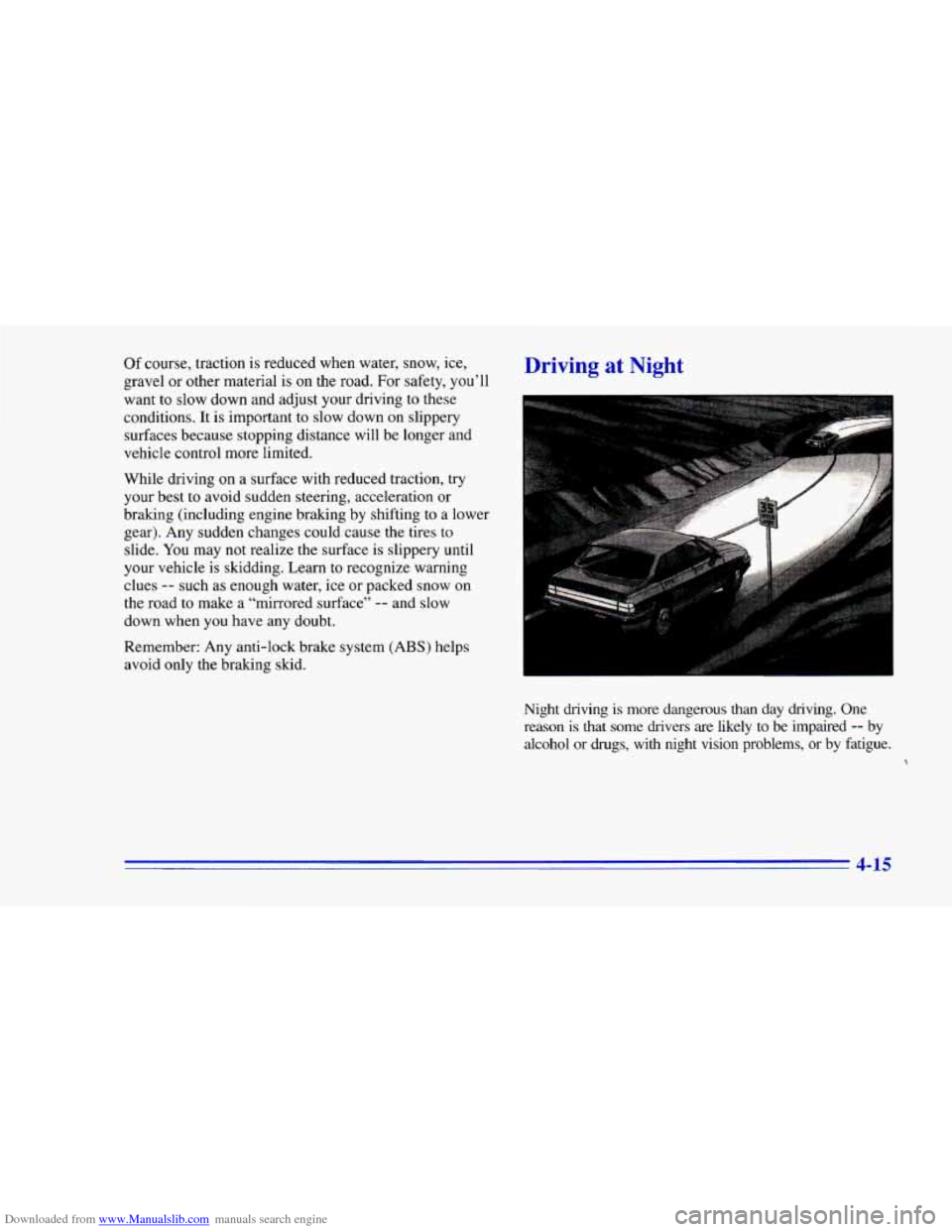
Driving at Night
Night driving is more dangerous than day driving. One
reason
is that some drivers are likely to be impaired -- by
alcohol or drugs, with night vision problems, or by fatigue.
4-15
Page 203 of 402
Downloaded from www.Manualslib.com manuals search engine Driving On Grades
Reduce speed and shift to a lower gear before you start
down a long or steep downgrade. If you don’t shift
down, you might have to use your brakes
so much that
they would get hot and no longer work well.
On a long uphill grade, shift down and reduce your
speed to around
45 mph (70 km/h) to reduce the
possibility
of engine and transmission overheating.
If you are towing a trailer and you have an automatic
transmission with overdrive,
you may prefer to drive in
DRIVE (D) instead of AUTOMATIC OVERDRIVE (@)
or, as you need to, a lower gear). Or, if you have a
manual transmission with FIFTH
(5) or SIXTH (6) gear.
It
is better not to use FIFTH (5) or SIXTH (6) gear.
Just drive in FOURTH
(4) gear (FIFTH (5) gear if you
have a six-speed manual transmission) (or, as you need
to, a lower gear).
Parking on Hills
You really should not park your vehicle, with a trailer
attached, on a hill.
If something goes wrong, your rig
could start to move. People can be injured, and both
your vehicle and the trailer can be damaged.
But if you ever have
to park your rig on a hill, here’s
how to
do it:
1.
2.
3.
4.
5.
Apply your regular brakes, but don’t shift into
PARK
(P) yet, or into gear for a manual transmission.
Have someone place chocks under the trailer wheels.
When the wheel chocks are in place, release the
regular brakes. Then apply your parking brakes until
the chocks absorb the load.
Reapply the regular brakes. Then apply your parking
brake and then shift to PARK(P) or REVERSE
(R)
for a manual transmission.
Release the regular brakes.
4-38
Page 218 of 402
Downloaded from www.Manualslib.com manuals search engine Attach a separate safety chain around outboard end of
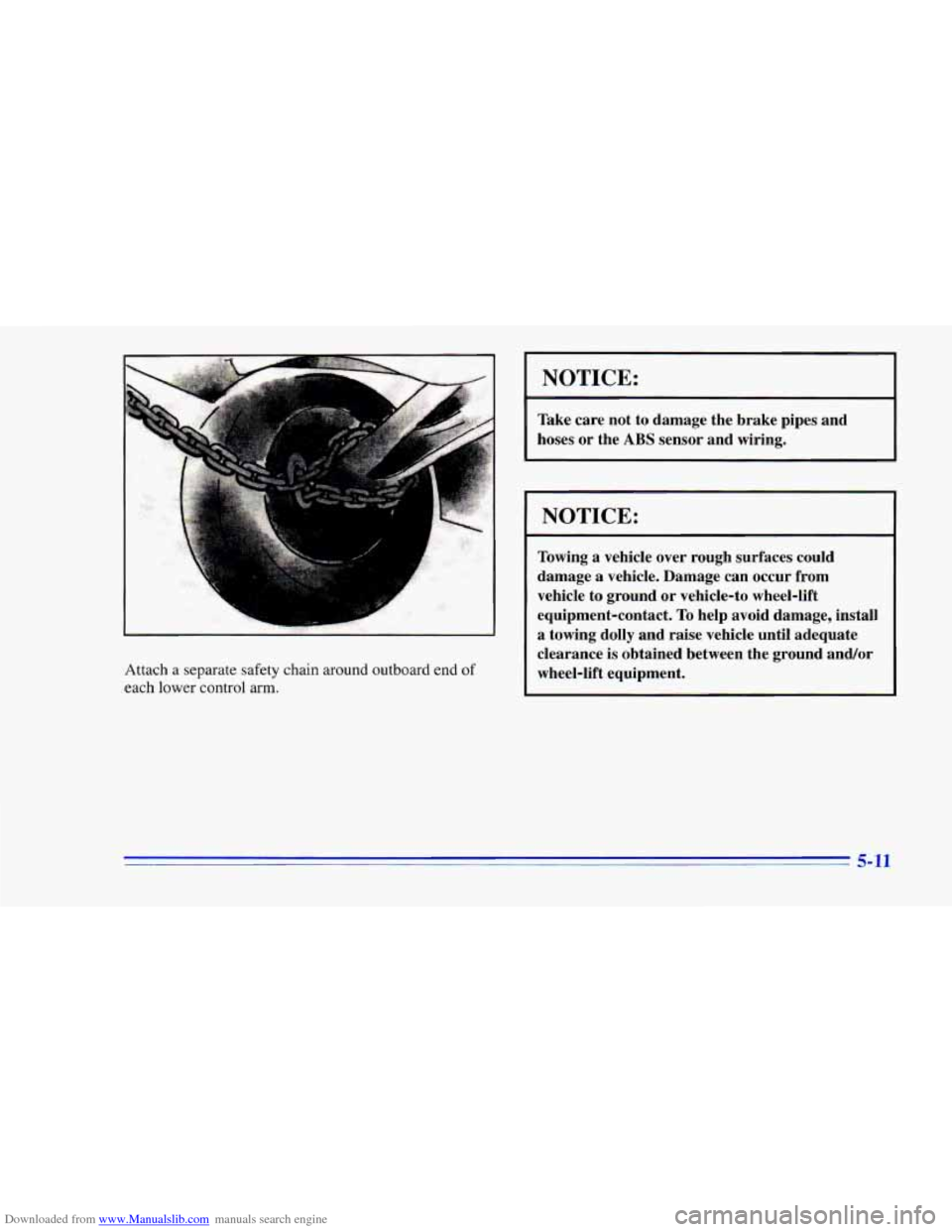
each lower control arm.
NOTICE:
I
Take care not to damage the brake pipes and
hoses or the
ABS sensor and wiring.
NOTICE:
Towing a vehicle over rough surfaces could
damage a vehicle. Damage can occur from
vehicle
to ground or vehicle-to wheel-lift
equipment-contact.
To help avoid damage, install
a towing dolly and raise vehicle until adequate
clearance is obtained between the ground and/or
wheel-lift equipment.
Page 290 of 402
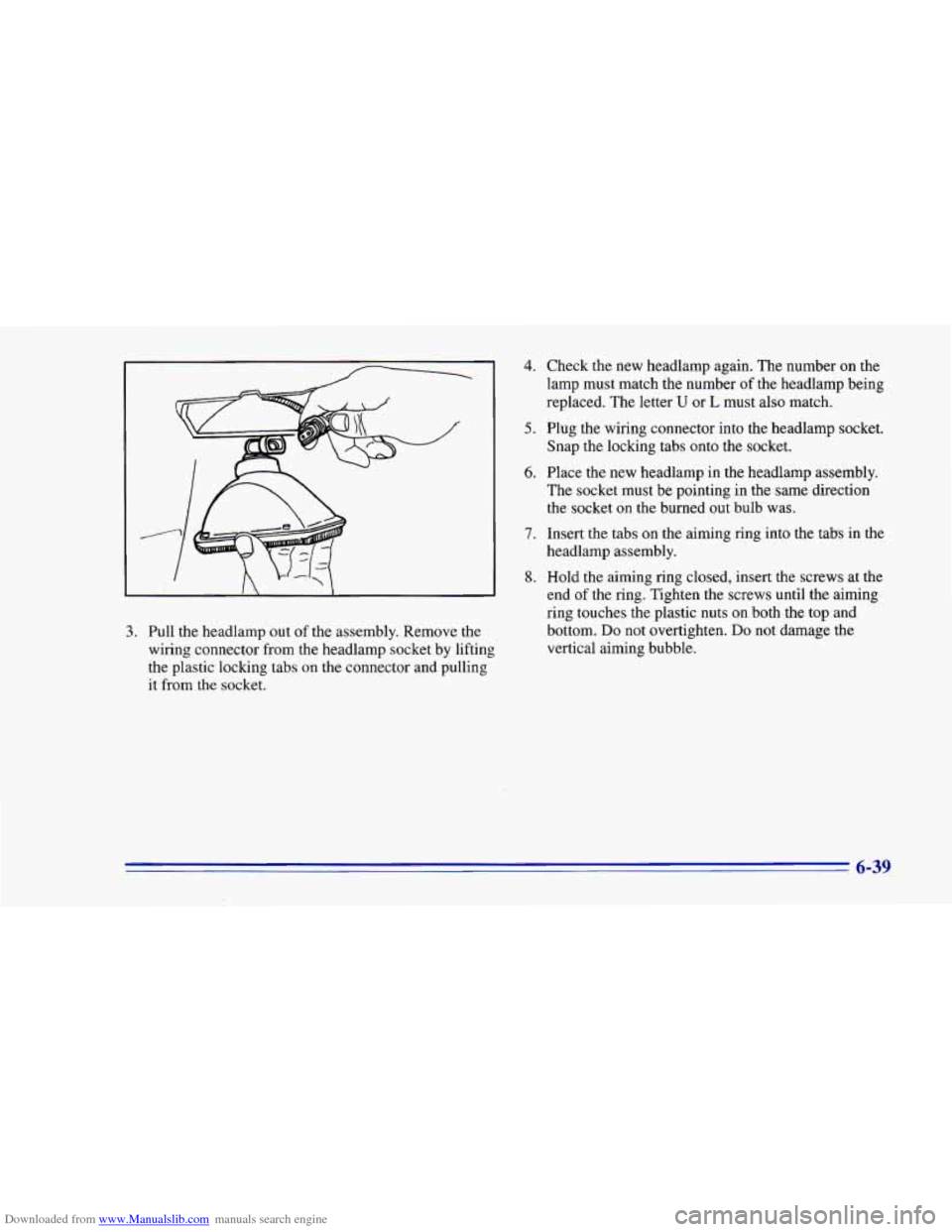
Downloaded from www.Manualslib.com manuals search engine 3. Pull the headlamp out of the assembly. Remove the
wiring connector from the headlamp socket by lifting
the plastic locking tabs on the connector and pulling
it from the socket.
4. Check the new headlamp again. The number on the
lamp must match the number
of the headlamp being
replaced. The letter
U or L must also match.
5. Plug the wiring connector into the headlamp socket.
Snap the locking tabs onto the socket.
6. Place the new headlamp in the headlamp assembly.
The socket must be pointing in the same direction
the socket
on the burned out bulb was.
7. Insert the tabs on the aiming ring into the tabs in the
headlamp assembly.
8. Hold the aiming ring closed, insert the screws at the
end
of the ring. Tighten the screws until the aiming
ring touches the plastic nuts on both the top and
bottom.
Do not overtighten. Do not damage the
vertical aiming bubble.
6-39